Archive
Ephemeris: 05/30/2024 – Virgo and what’s hidden within
This is Bob Moler with Ephemeris for Thursday, May 30th. Today the Sun will be up for 15 hours and 18 minutes, setting at 9:20, and it will rise tomorrow at 6:00. The Moon, at last quarter today, will rise at 2:52 tomorrow morning.
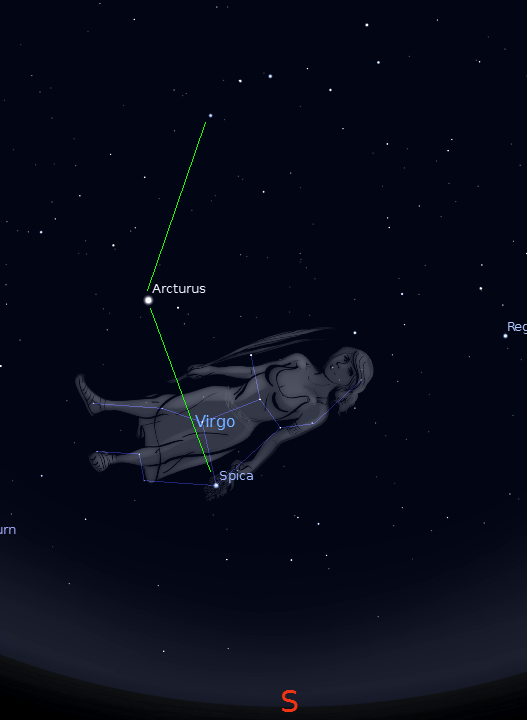
One of the large constellations we see in the south at 11 p.m. can be found using the Big Dipper overhead, follow the arc of the handle to the bright star Arcturus, then straighten the arc to a spike to reach Spica, a bright blue-white star in the south. Spica is the brightest star in the constellation Virgo, the virgin. She represents the goddess of the harvest, Virgo is holding a sheaf of wheat in depictions of her, and Spica is placed at the head of the sheaf. In the space between Spica and Leo the lion to her upper right is, a great cluster of thousands of galaxies just below naked eye visibility. The Virgo Cluster. Inside that cluster is galaxy M87, in whose center lies a black hole with the mass of 6.5 billion suns. The center of the cluster is at about 54 million light years away. The first black hole imaged by the Earth spanning Event Horizon Telescope.
The astronomical event times given are for the Traverse City/Interlochen area of Michigan (EDT, UT–4 hours). They may be different for your location.
Addendum
05/12/2023 – Ephemeris – Finding Virgo the virgin in the evening sky
This is Ephemeris for Friday, May 12th. Today the Sun will be up for 14 hours and 42 minutes, setting at 9:00, and it will rise tomorrow at 6:17. The Moon, at last quarter today, will rise at 3:44 tomorrow morning.
One of the large constellations we see in the south at 11 p.m. can be found using the Big Dipper overhead, follow the arc of the handle to the bright star Arcturus, then straighten the arc to a spike to reach Spica, a bright blue-white star in the south. Spica is the brightest star in the constellation Virgo, the virgin. She represents the goddess of the harvest, Virgo is holding a sheaf of wheat in depictions of her, and Spica is placed at the head of the sheaf. In the space between Spica and Leo the lion to her upper right is, a great cluster of thousands of galaxies just below naked eye visibility. The Virgo Cluster. Inside that cluster is galaxy M87, in whose center lies a black hole with the mass of 6.5 billion suns. The center of the cluster is at about 54 million light years away.
The astronomical event times given are for the Traverse City/Interlochen area of Michigan (EDT, UT –4 hours). They may be different for your location.
Addendum
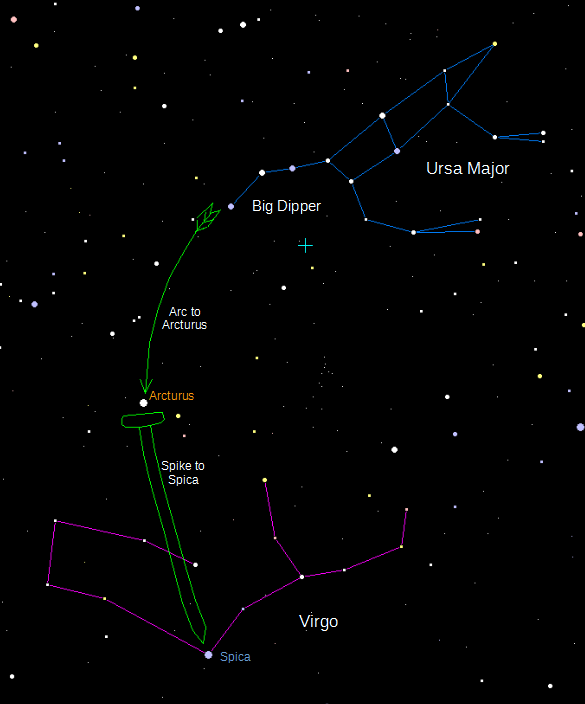
Finding Virgo from the Big Dipper at 11 pm, May 12. There are no planetary interlopers this year. The small + sign marks the zenith, and the image faces south. Created using my LookingUp app, with captions added using LibreOffice Draw.
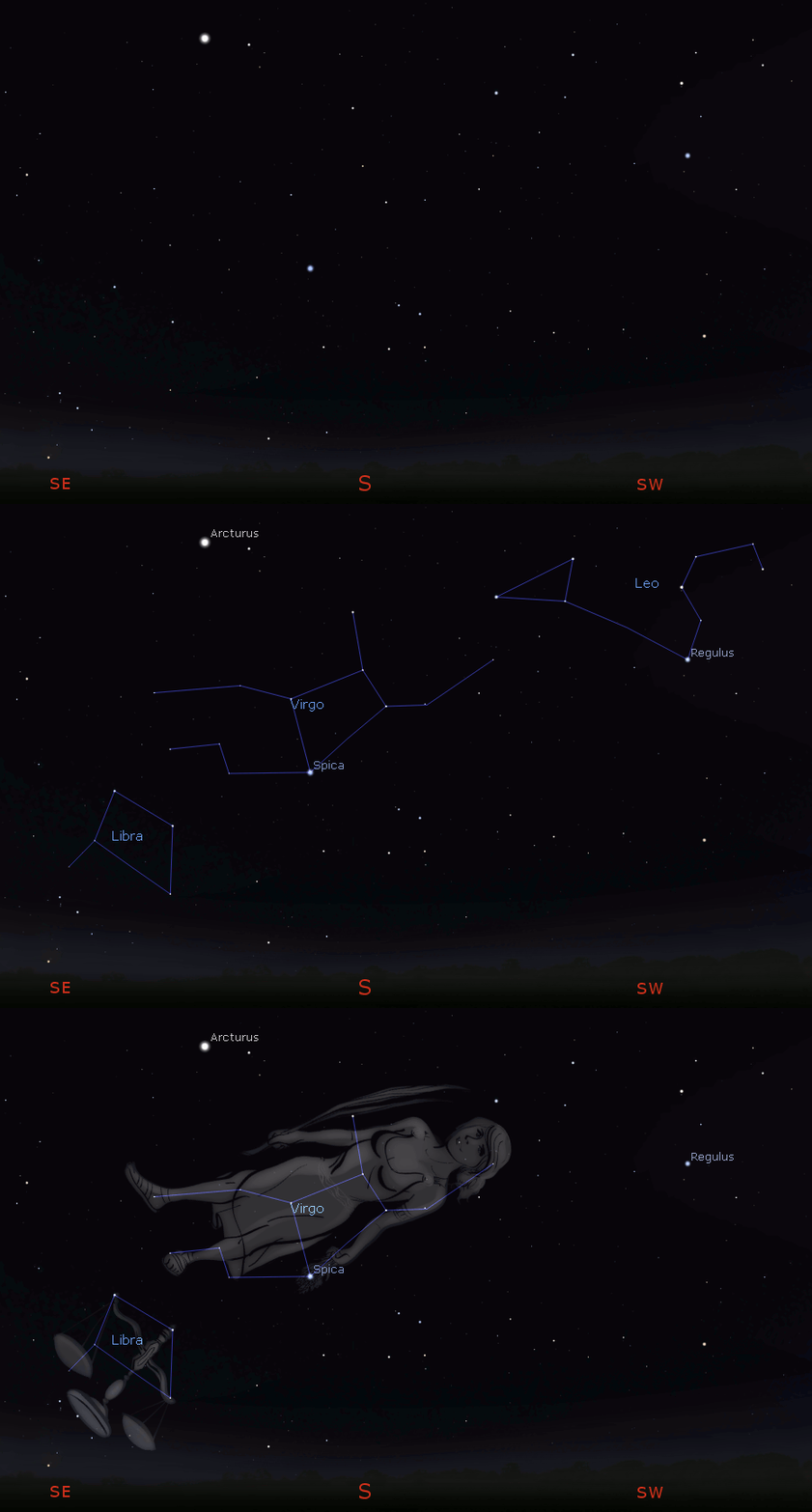
Virgo finder animation with Leo added as an aid for 11 p.m. tonight. Created using Stellarium and GIMP.
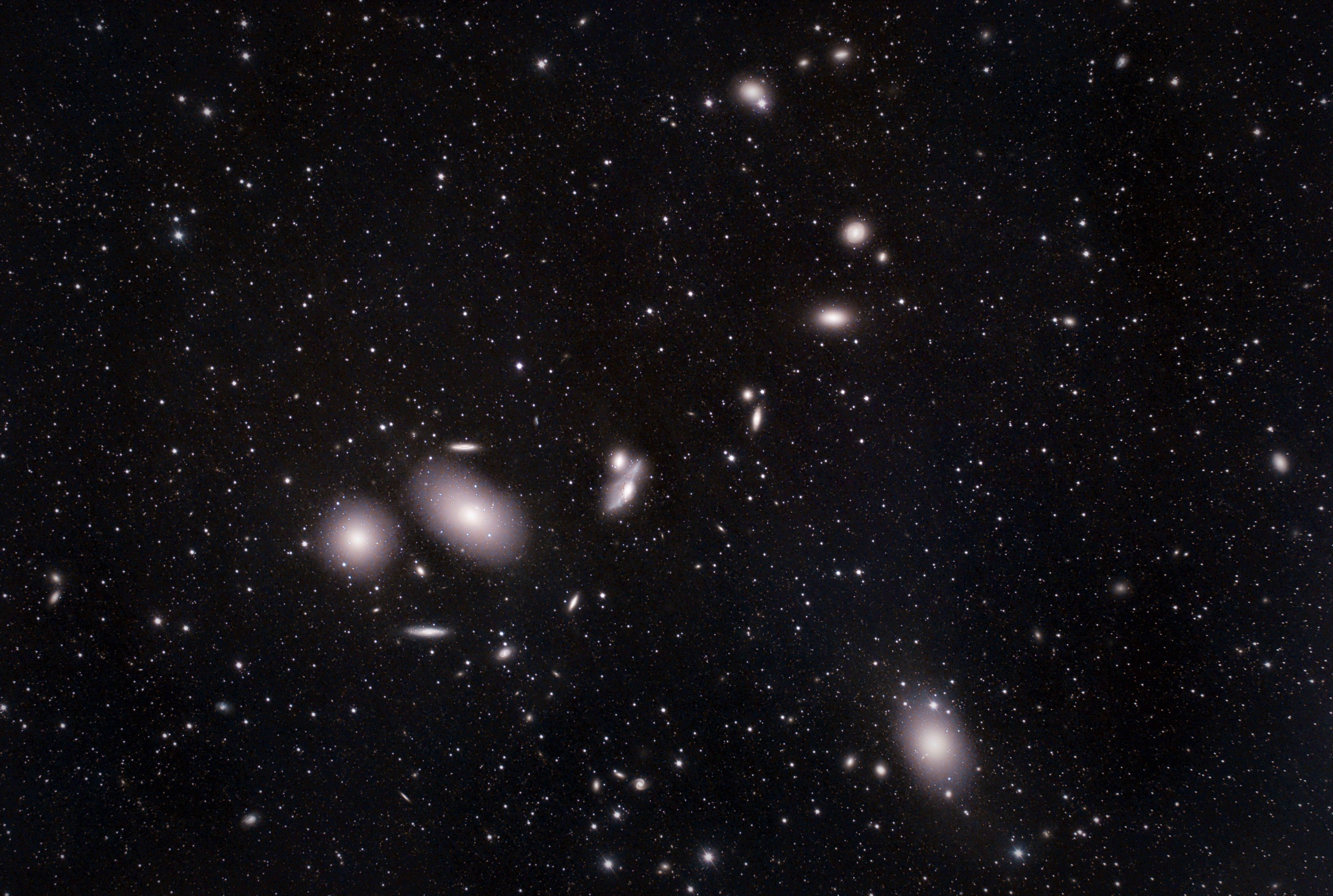
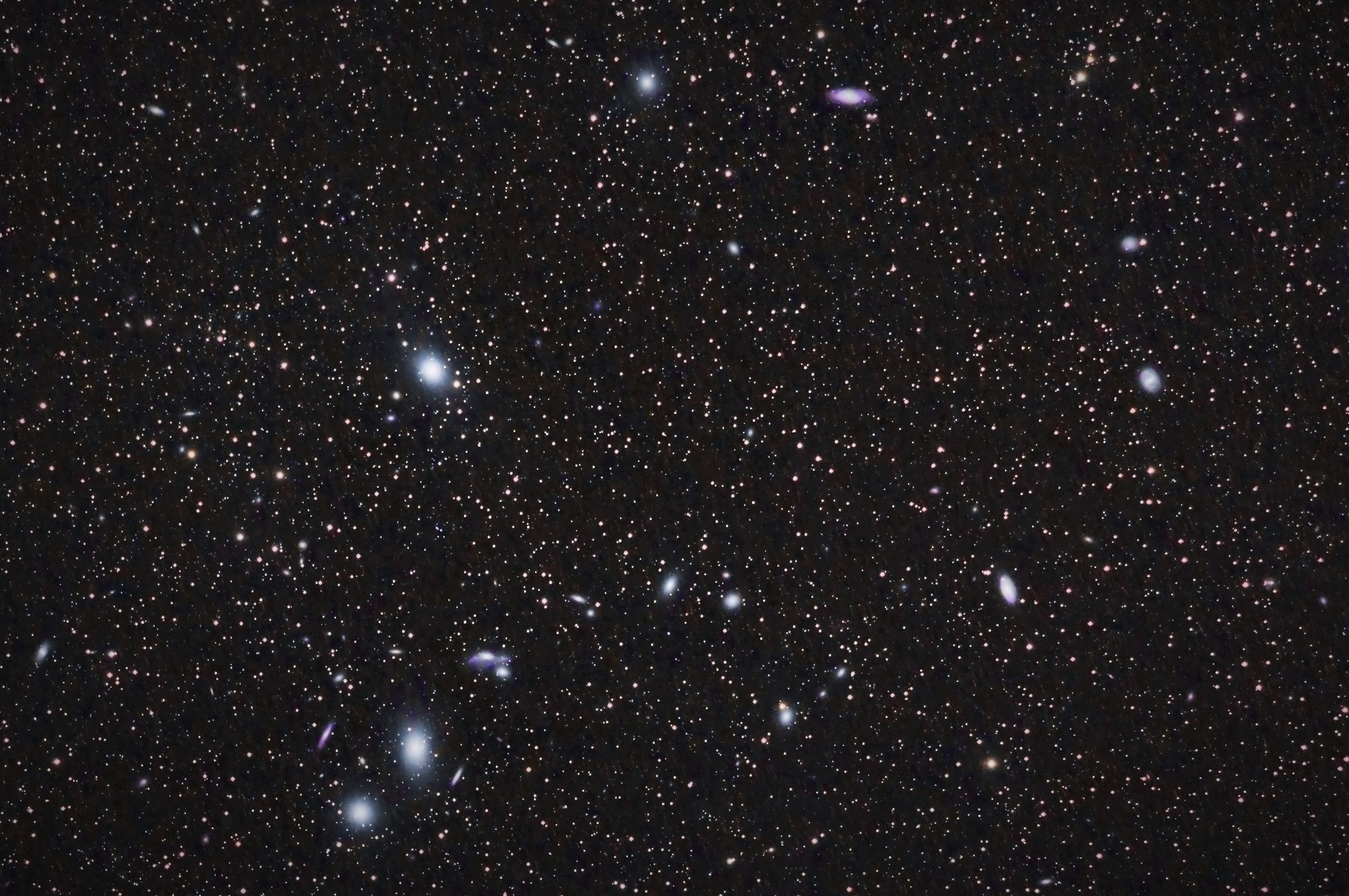
Markarian’s Chain, a small part of the Virgo Cluster of galaxies. Click or tap on the image to enlarge it. Credit: Daniel Dall’Olmo.
08/24/2020 – Ephemeris – The Milky Way’s companion galaxies
This is Bob Moler with Ephemeris for Monday, August 24th. Today the Sun will be up for 13 hours and 36 minutes, setting at 8:32, and it will rise tomorrow at 6:57. The Moon, 1 day before first quarter, will set at 11:51 this evening.
Not long after spiral nebulae were confirmed to be milky ways like ours or galaxies it was noticed that they were often found in bunches or clusters. One of the closest is the Virgo cluster seen in spring covering the constellation of Virgo and adjacent constellations. Our Milky Way Galaxy has two small satellite galaxies, the Clouds of Magellan first spotted by European eyes on his epic voyage, and belongs to a small cluster of galaxies along with the Great Andromeda galaxy. Perhaps 80 galaxies belong in all, most are small irregular dwarf galaxies, difficult to find and see. Our galaxy cluster is known simply as the Local Group. The galaxies of the Local Group interact gravitationally with each other.
The event times given are for the Traverse City/Interlochen area of Michigan. They may be different for your location.
Addendum
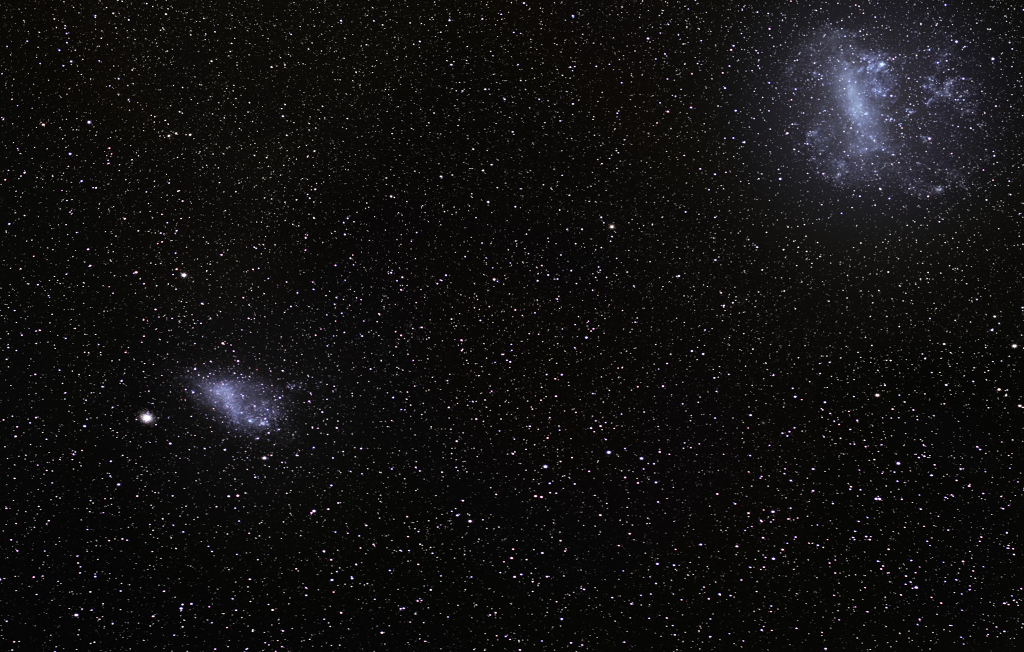
The Small and Large Magellanic Clouds, these dwarf galaxies are seen best from the southern hemisphere. Credit: ESO S. Brunier.
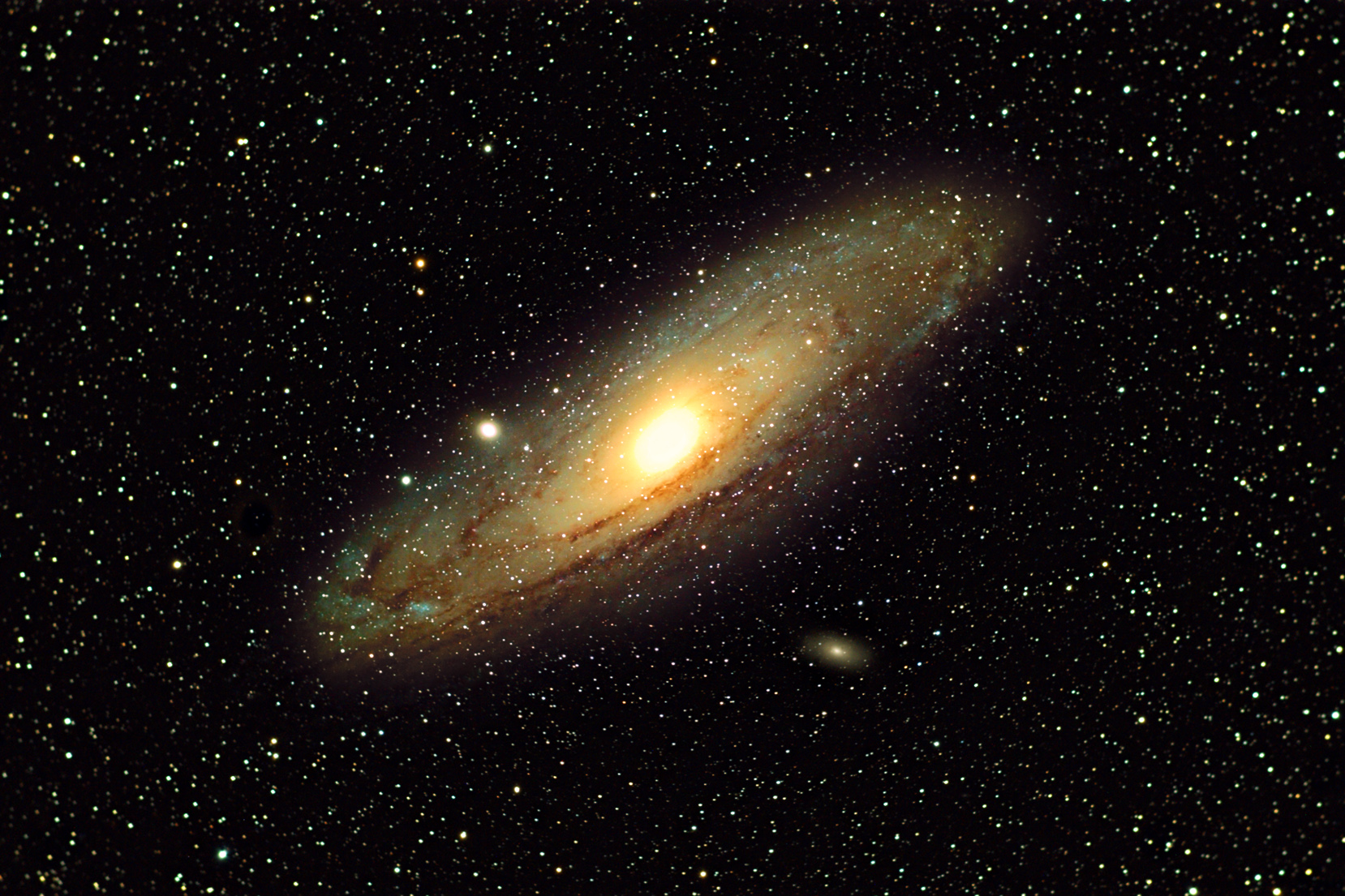
The Great Andromeda Galaxy (M31) is the largest member of the Local group with two of its satellite galaxies M32 to the left and M110 below-right. M31 can be spotted with the naked eye on fall and winter nights with the naked eye. Image taken by Scott Anttila.
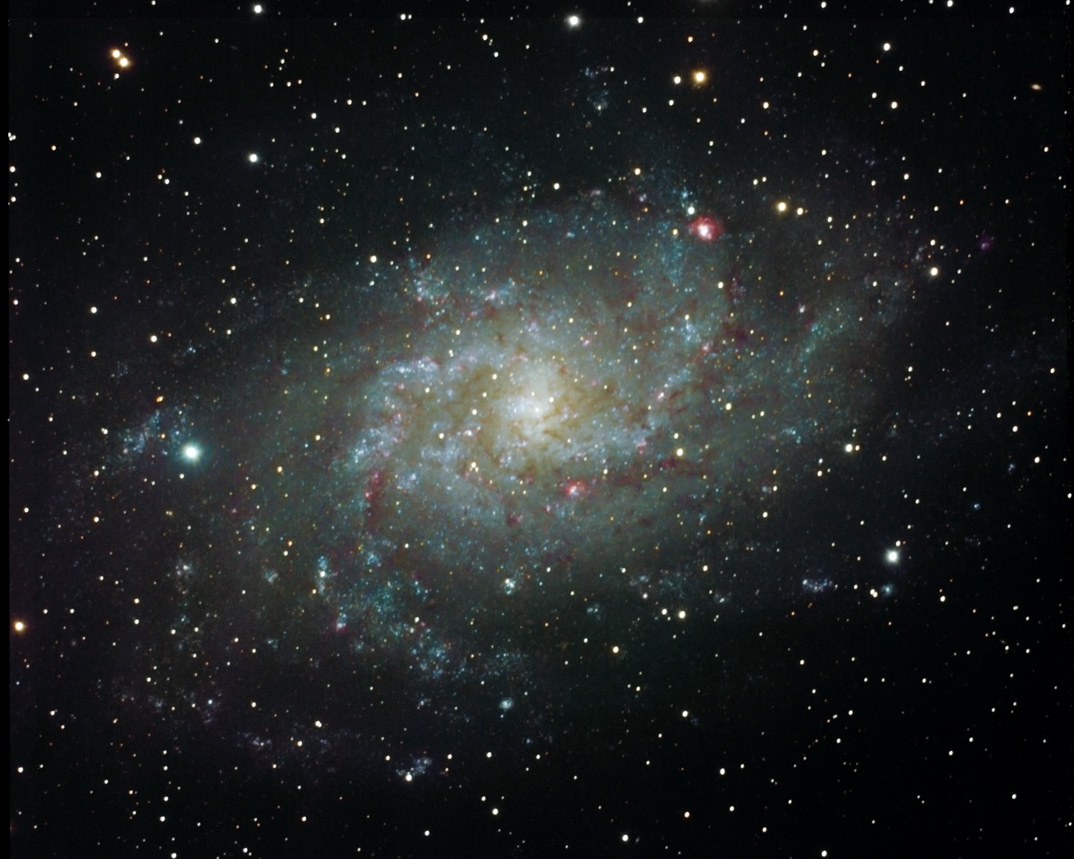
M33, the Triangulum Galaxy is the third largest galaxy in the Local Group after Andromeda and the Milky Way. It appears in the sky just east of the constellation of Andromeda in Triangulum the triangle. Though large it has a very low surface brightness making it hard to spot with binoculars or a telescope. Credit: Scott Anttila.
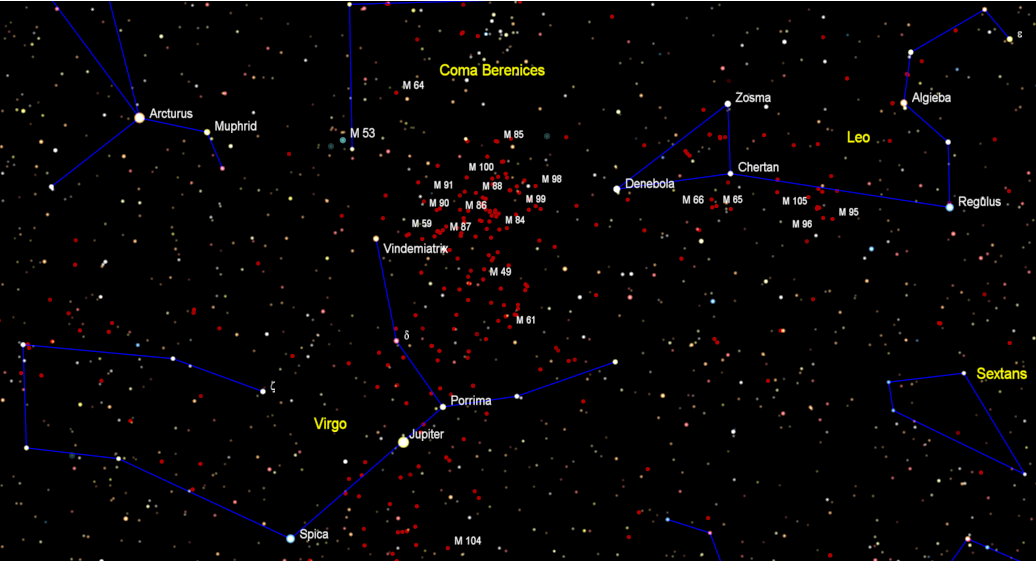
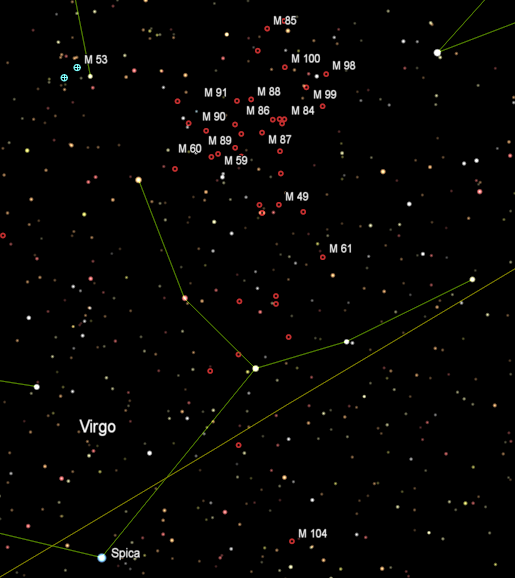
Some of the brighter members of the Virgo Cluster (of galaxies) as red ovals. The galaxies marked with an ‘M’ number are part of Charles Messier’s catalog. It took a telescope of 8 inch diameter for me to spot them. Someone with better vision, like Messier himself can spot them with a smaller telescope. Created using Cartes du Ciel (Sky Charts).
05/15/2020 – Ephemeris – Virgo and its cluster of galaxies
This is Ephemeris for Friday, May 15th. Today the Sun will be up for 14 hours and 50 minutes, setting at 9:04, and it will rise tomorrow at 6:12. The Moon, 1 day past last quarter, will rise at 4:01 tomorrow morning.
One of the large constellations we see in the south at 11 p.m. can be found using the Big Dipper overhead, follow the arc of the handle to the bright star Arcturus, the straighten the arc to a spike to reach Spica, a bright blue-white star in the south. Spica is the brightest star in the constellation Virgo the virgin. She represents the goddess of the harvest, Virgo is holding a sheaf of wheat in depictions of her, and Spica is placed at the head of the sheaf. In the space between Spica and Leo the lion to her upper right is, a great cluster of thousands of galaxies just below naked eye visibility. The Virgo Cluster. Inside that cluster is galaxy M87 in whose center lies a black hole with the mass of 6.5 billion suns that was imaged last year. The center of the cluster is at about 54 million light years away.
The event times given are for the Traverse City/Interlochen area of Michigan. They may be different for your location.
Addendum
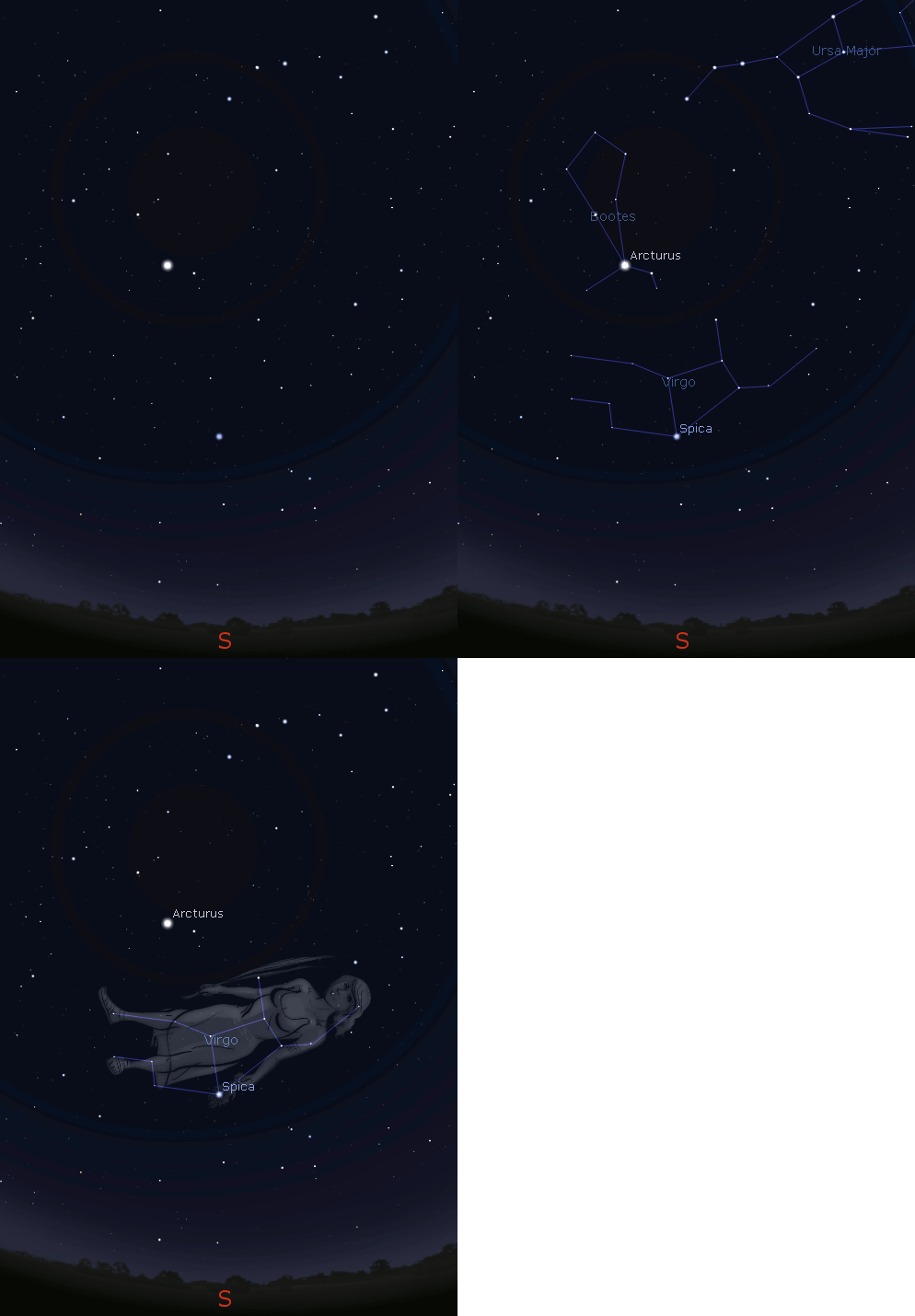
Spica finder animation . Click on the image to enlarge. Created using Stellarium and GIMP.
Some of the brighter members of the Virgo Cluster (of galaxies) as red ovals. The galaxies marked with an ‘M’ number are part of Charles Messier’s catalog. It took a telescope of 8 inch diameter for me to spot them. Someone with better vision, like Messier himself can spot them with a smaller telescope. M53 and the object next to it are globular star clusters in the outer reaches of our galaxy. Created using Cartes du Ciel (Sky Charts).
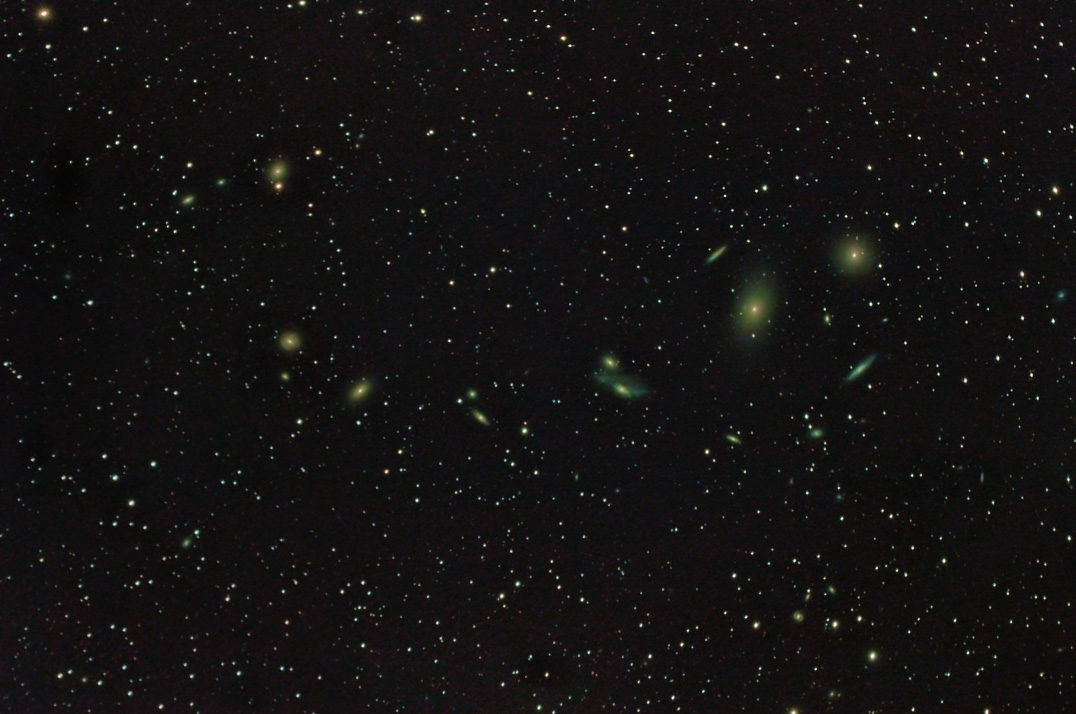
Markarian Chain of galaxies within the Virgo Cluster by Scott Anttila.

The first image of the black hole in M87. Credit Event Horizon Telescope.
05/20/2019 – Ephemeris – Dark evening skies again and a look at Virgo
Ephemeris for Monday, May 20th. Today the Sun will be up for 15 hours even, setting at 9:09, and it will rise tomorrow at 6:08. The Moon, 2 days past full, will rise at 11:10 this evening.
One of the large constellations we see in the south at 11 p.m. can be found using the Big Dipper overhead, follow the arc of the handle to the bright star Arcturus, the straighten the arc to a spike to reach Spica, a bright blue-white star in the south. Spica is the brightest star in the constellation Virgo the virgin. She represents the goddess of the harvest, Virgo is holding a sheaf of wheat in depictions of her, and Spica is placed at the head of the sheaf. In the space between Spica and Leo the lion to her upper right is, a great cluster just below naked eye visibility. The Virgo cluster of galaxies. Inside that cluster is galaxy M87 in whose center lies a black hole with the mass of 6.5 billion suns that was imaged last month.
The times given are for the Traverse City/Interlochen area of Michigan. They may be different for your location.
Addendum
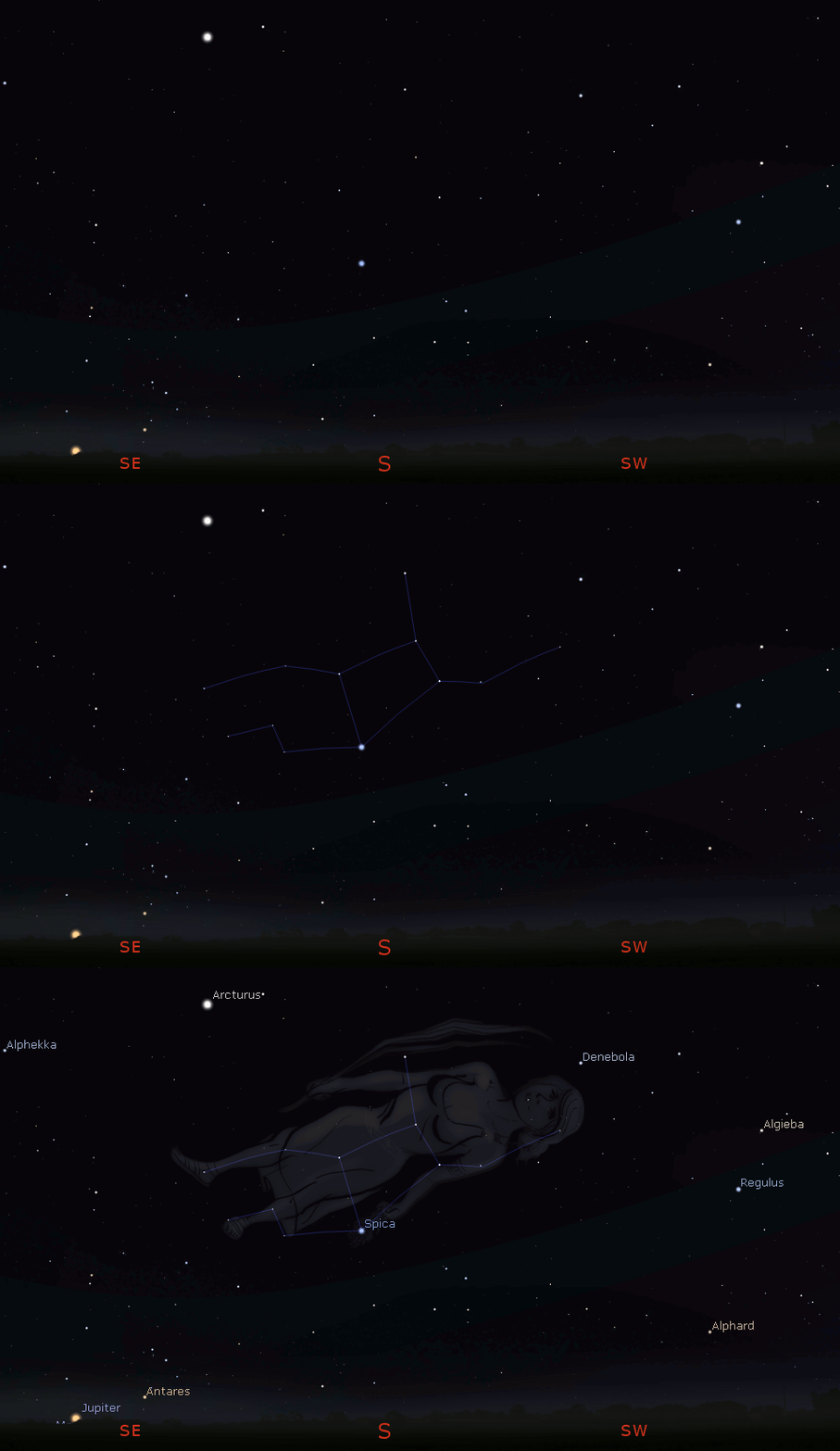
Virgo finder animation for 11 p.m. May 20, 2019. Click on the image to enlarge. Created using Stellarium.
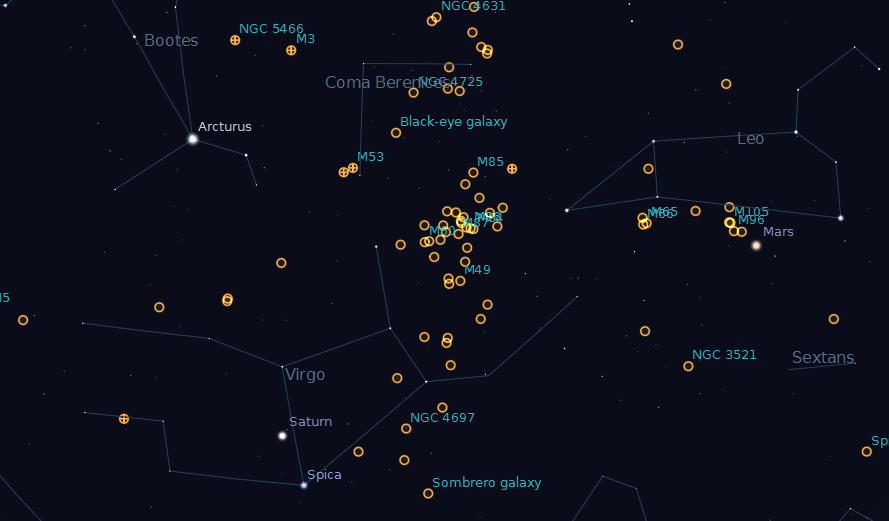
Brighter members of the Virgo Cluster. Created using Stellarium. Open circles are galaxies, circles with crosses are globular star clusters, outlying members of our Milky Way galaxy. M87 is just above center in that knot of galaxies. Created using Stellarium.
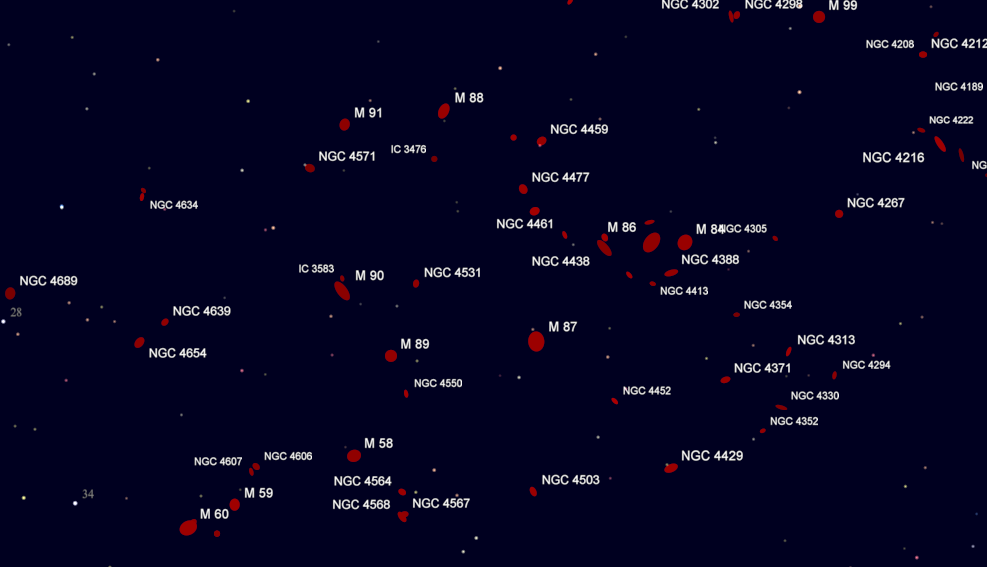
A closer look at some of the galaxies in the heart of the Virgo Cluster. M87 is near the center. Created with Cartes du Ciel (Sky Charts).
05/16/2017 – Ephemeris – The Virgo Cluster of Galaxies
Ephemeris for Tuesday, May 16th. Today the Sun will be up for 14 hours and 51 minutes, setting at 9:05, and it will rise tomorrow at 6:12. The Moon, 2 days before last quarter, will rise at 1:43 tomorrow morning.
Yesterday I talked about the constellation of Virgo the virgin. When we are looking at the constellation of Virgo, we are looking out the thin side of our galaxy, the Milky Way. The Milky Way galaxy is a flat disk. When we look into the disk we see the milky band we call the Milky Way. That band, what we can see of if is now low in the north, So the stars are much more sparse with the exception of those relatively close to us, like those of the big Dipper. Beyond the stars of Virgo is a huge cluster of over a thousand galaxies. Charles Messier, a comet hunter of the late 18th century, ran into quite a few fuzzy spots between Virgo and Leo to the upper right. Because they didn’t move in relation to the stars, they couldn’t be comets, so he added them to his list of nuisance objects, which we now enjoy looking at.
The times given are for the Traverse City/Interlochen area of Michigan. They may be different for your location.
Addendum
Some of the brighter members of the Virgo Cluster (of galaxies) as tiny red ovals. The galaxies marked with an ‘M’ number are part of Charles Messier’s catalog. It took a telescope of 8 inch diameter for me to spot them. Someone with better vision, like Messier himself can spot them with a smaller telescope. Created using Cartes du Ciel (Sky Charts). Click on image to enlarge.
05/08/2015 – Ephemeris – May’s missing Milky Way
Ephemeris for Friday, May 8th. Today the Sun will be up for 14 hours and 32 minutes, setting at 8:55. The Moon, 3 days before last quarter, will rise at 1:08 tomorrow morning. Tomorrow the Sun will rise at 6:22.
In May we look up to the sky and notice that the Milky Way is missing. Will not really it’s as if the sky has pattern baldness with the Milky Way as a fringe on the horizon around the north half of the sky. Overhead, where none should be is a galactic star cluster, a star cluster that should normally be in the Milky band. That cluster is the constellation of Coma Berenices. Its is a sparse star cluster of about 50 stars only 288 light years away. If we were a thousand light years from it, it would appear in the Milky band. One notes too that the stars of spring are also fewer, not the riot of stars we see in the winter or late summer. The Milky Way galaxy is a thin disk, and in spring we are looking out the thin side.
Times are for the Traverse City/Interlochen area of Michigan. They may be different for your location.
Addendum
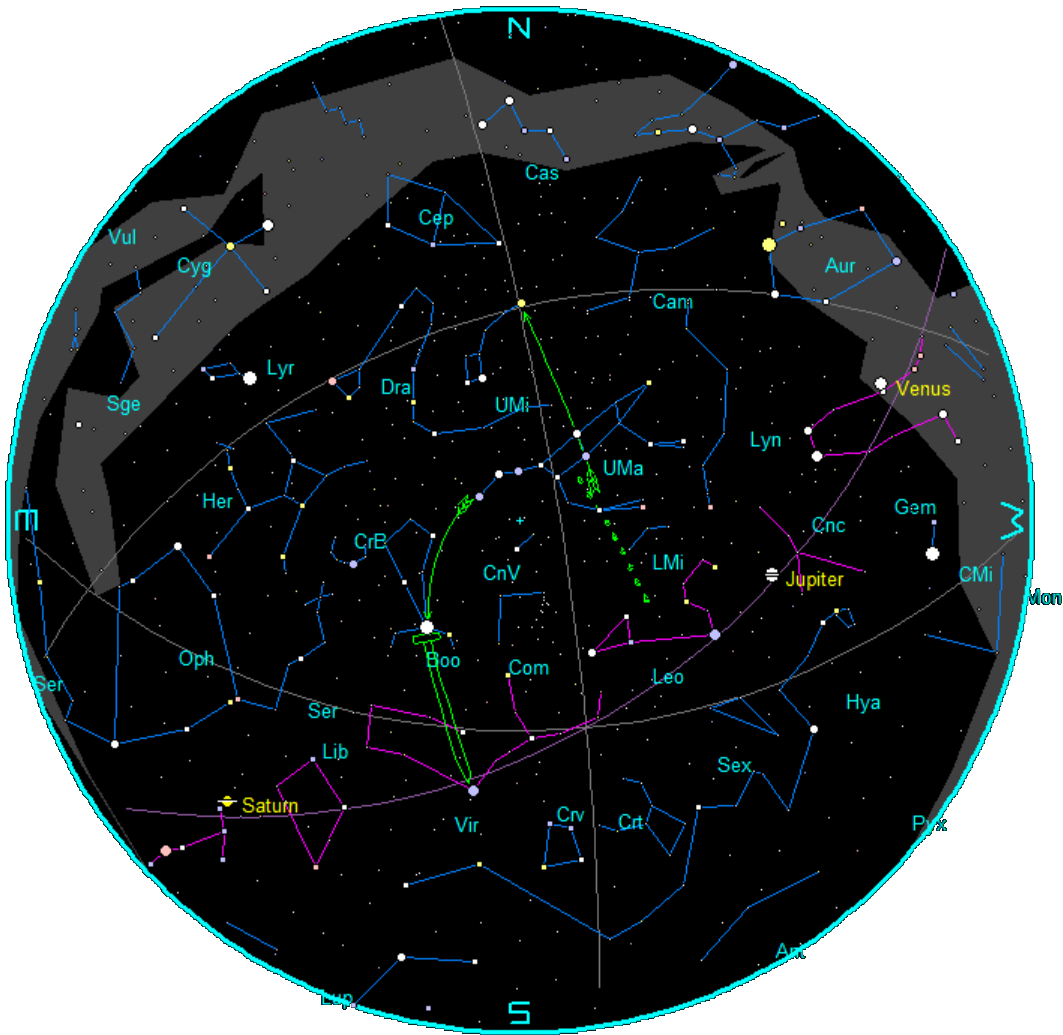
Star Chart for May 2015. Note the Milky way in the north. The Coma Berenices cluster is located between the labels CnV and Com. Created using my LookingUp program.
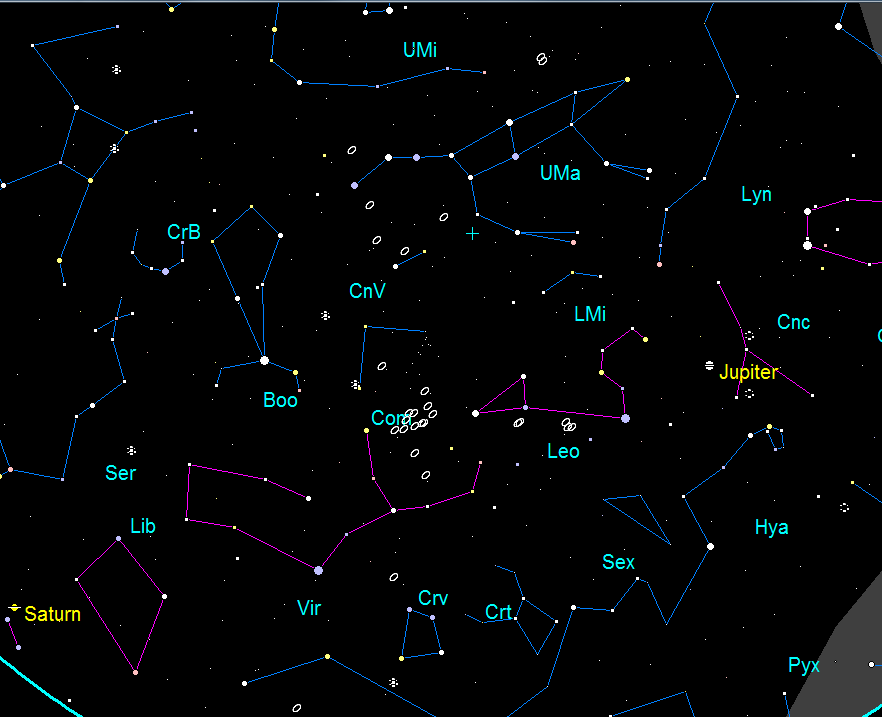
Messier objects, mostly galaxies (ovals) in the spring sky. Created using my LookingUp program.
Most of the galaxies in the above chart belong to the Virgo Cluster a cluster of several thousand galaxies about 53 million light years away. Charles Messier was a comet hunter active in the period around the time of the American Revolution at the Paris Observatory. He made a catalog of fuzzy objects he ran into that didn’t move and thus were not comets. The Messier catalog, which ran to 110 galaxies, star clusters and nebulae, some added posthumously, became a must-see list of some of the best sights for the telescope.
05/01/2015 – Ephemeris – A talk about the Virgo Cluster of galaxies tonight and a star party
Ephemeris for Friday, May 1st. Today the Sun will be up for 14 hours and 14 minutes, setting at 8:47. The Moon, 2 days before full, will set at 5:55 tomorrow morning. Tomorrow the Sun will rise at 6:31.
Tonight yours truly will be presenting the program: The Galaxy Cluster Next Door, at this evening’s meeting of the Grand Traverse Astronomical Society at 8 p.m. at Northwestern Michigan College’s Rogers Observatory. Following at 9 p.m. will be a star party featuring the Moon and planets Venus, Jupiter and later, Saturn. As to the program: There is a patch of the spring sky in the constellation of Virgo the virgin, where we are looking out the thin side of our Milky Way galaxy where there is a huge group of over a thousand galaxies astronomers have dubbed the Virgo Cluster. Galaxy clusters are held together by the gravity of mysterious dark matter, but the clusters are expanding from all the other clusters.
Times are for the Traverse City/Interlochen area of Michigan. They may be different for your location.
Addendum
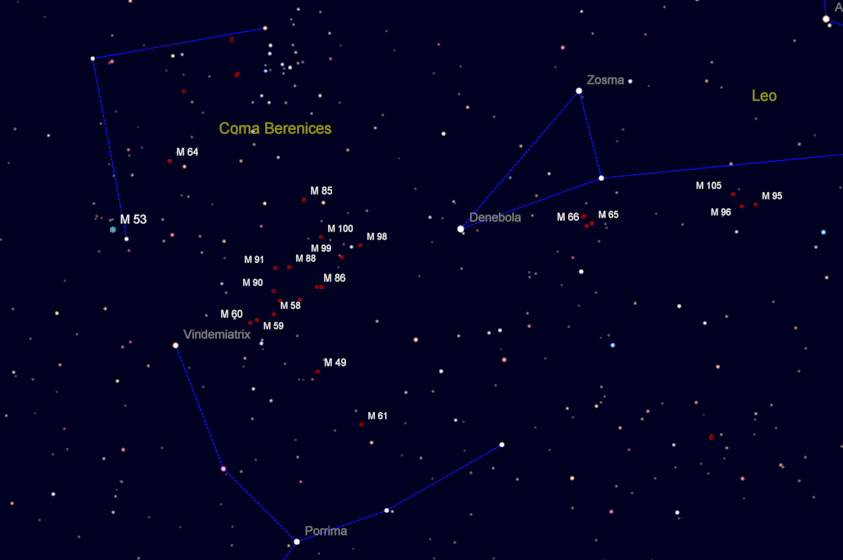
The Messier objects in the central part of the Virgo Cluster. Created with Cartes du Ciel (Sky Charts).
Some of the galaxies in the heart of the Virgo Cluster. Created with Cartes du Ciel (Sky Charts).
06/04/2013 – Ephemeris – A cluster of not stars but galaxies
Ephemeris for Tuesday, June 4th. Today the sun will be up for 15 hours and 24 minutes, setting at 9:23. The moon, half way from last quarter to new, will rise at 4:08 tomorrow morning. Tomorrow the sun will rise at 5:58.
The constellation Virgo which contains the bright star Spica and for this and the last two years the planet Saturn is in a sparse region of the sky as far as stars go. We are almost directly looking out the side of our Milky Way Galaxy. That milky band has been banished to the northern horizon. But while the stars may be few, we are also looking out past a gulf of 50 million light years to a great cluster of galaxies we call the Virgo Cluster. The galaxies here count into the thousands and overflow Virgo itself into adjacent constellations. I found that an 8 inch diameter telescope can easily pick up the brightest of them. In its heart is a giant elliptical galaxy M87 which has a black hole of 6.6 billion sun masses.
Times are for the Traverse City/Interlochen area of Michigan. They may be different for your location.
Addendum
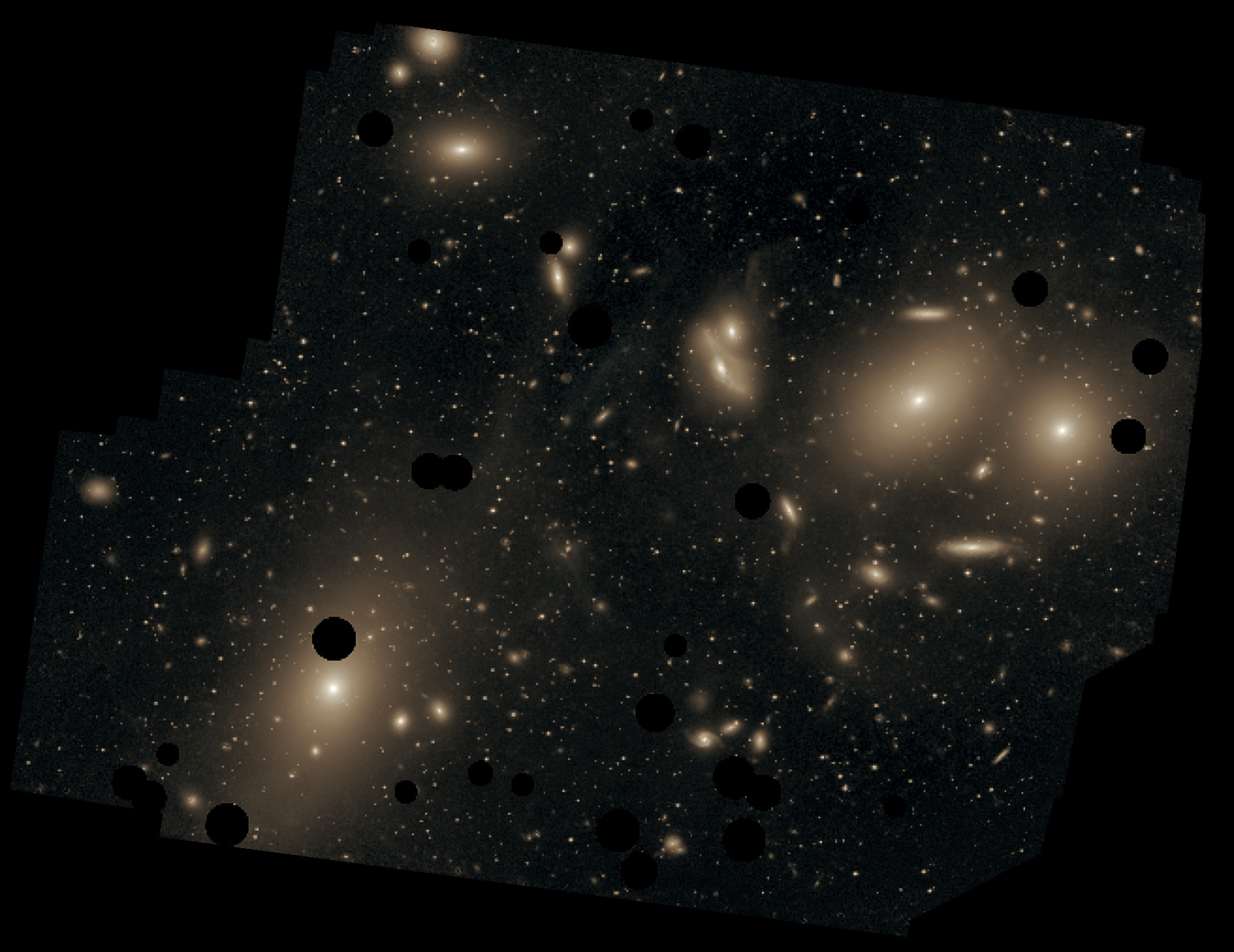
This deep image of the Virgo Cluster obtained by Chris Mihos and his colleagues using the Burrell Schmidt telescope shows the diffuse light between the galaxies belonging to the cluster. North is up, east to the left. The dark spots indicate where bright foreground stars were removed from the image. Messier 87 is the largest galaxy in the picture (lower left).
05/10/2012 – Ephemeris – The Virgo Cluster (of galaxies)
Ephemeris for Thursday, May 10th. The sun rises at 6:19. It’ll be up for 14 hours and 38 minutes, setting at 8:58. The moon, 2 days before last quarter, will rise at 1:36 tomorrow morning.
The constellation Virgo which contains the bright star Spica and for last and this year the planet Saturn is in a sparse region of the sky as far as stars go. We are almost directly looking out the side of our Milky Way Galaxy. That milky band has been banished to the northern horizon. But while the stars may be few, we are also looking out past a gulf of 50 million light years to a great cluster of galaxies we call the Virgo Cluster. The galaxies here count into the thousands and overflow Virgo itself into Leo to the west, Coma Berenices to the north and Corvus to the south. I found that an 8 inch diameter telescope can pick up the brightest, but that may be my eyesight. Charles Messier spotted them over 200 years ago with a telescope less than three inches in diameter.
Times are for the Traverse City/Interlochen area of Michigan. They may be different for your location.
Addendum
Brighter members of the Virgo Cluster. Created using Stellarium. Open circles are galaxies, circles with crosses are globular star clusters, outlying members of our Milky Way galaxy.
Click on image to enlarge.
 Bob Moler's Ephemeris Blog