Archive
What’s wrong with this picture?
I received this in an email. The picture’s pretty but is it real? If not, what’s wrong? Answer in the comments.
Sunset at the North Pole. This is one of the rarest picture that you mayever see in your life when the moon was closest to the earth. The date: Jan 13, 2011.This is the sunset at the North Pole with the moon at its closest point last week. a scene you will probably never get to see in person, so take a moment and enjoy God at work at the North Pole. And, you also see the sun below the moon, an amazing photo and not one easily duplicated. You may want to pass it on to others so they can enjoy it. The Chinese have a saying that goes something like this: 'When someone shares with you something of value, you have an obligation to share it with others!'

04/08/11 – Ephemeris – Looking out the thin side of the Milky Way
Friday, April 8th. The sun will rise at 7:11. It’ll be up for 13 hours and 7 minutes, setting at 8:18. The moon, 3 days before first quarter, will set at 1:39 tomorrow morning.
In winter and summer we see the Milky Way crossing the sky from north to south. In the autumn we see it cross nearly overhead from east to west. In the spring, especially next month the Milky way is barely visible low in the north. The Milky Way circles the sky as a great circle. It is what we see of our own galaxy. It is a spiral galaxy 100,000 light years in diameter and less than 5,000 light years thick where we are. So in the spring we look out the thin side of our galaxy. The stars are sparser than in other parts of the sky, the constellations generally are larger. The really cool part is that in telescopes we can see other galaxies, other Milky Ways beyond. In the spring we have a huge cluster of thousands of galaxies out there about 50 million light years away.
* Times are for the Traverse City/Interlochen area of Michigan. They may be different for your location.
Addendum
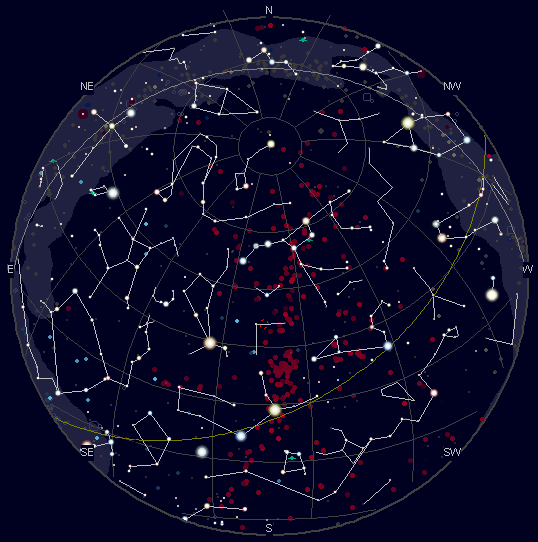
Looking out the thin side of the Milky Way. Created using Cartes duCiel
This is the entire dome of the sky on May 15th at 11 p.m. Note the Milky Way ringing the horizon. The red dots are galaxies, the blue and gray dots are star clusters in our galaxy, the green ones are nebulae, also in our galaxy.
 Bob Moler's Ephemeris Blog