Archive
05/17/11 – Ephemeris – The Dawn spacecraft sights its target the asteroid Vesta
Tuesday, May 17th. Today the sun will be up for 14 hours and 52 minutes, setting at 9:05. The moon, at full today, will rise at 9:51 this evening. Tomorrow the sun will rise at 6:11.
The Dawn spacecraft is about to make news. Never heard of it? Well, it’s been slowly building up speed for the last nearly four years, spiraling its way out into the asteroid belt with its ion engines and one gravity assist from the red planet Mars, on which it tested its cameras. Its first target is coming up, the asteroid Vesta, the brightest of asteroids, though not the largest. There won’t be a time of engine firing to drop the spacecraft into orbit, but Dawn will slowly spiral into lower and lower orbits of this asteroid starting in July. It will spend a year at Vesta before heading to the largest asteroid, now dubbed dwarf planet Ceres. Last week dawn took its first image of Vesta, which covered 5 pixels in its camera, and shows Dawn to be right on target.
* Times are for the Traverse City/Interlochen area of Michigan. They may be different for your location.
05/16/11 – Ephemeris – Space Shuttle Endeavour to launch this morning
Monday, May 16th. Today the sun will be up for 14 hours and 50 minutes, setting at 9:04. The moon, 1 day before full, will set at 6:01 tomorrow morning. Tomorrow the sun will rise at 6:12
If all goes well the Space Shuttle Endeavor will lift off for the International Space Station at 8:56 this morning (EDT). The Endeavour, named for the for British Captain James Cook’s first vessel, which was sailed to Tahiti in in 1769 to observe the transit of Venus across the sun as part of an effort to determine the earth’s distance from the sun. Endeavour’s 25th and last flight will be the second to last flight of the Shuttle program. Gregory Johnson, mission pilot has family and a cottage in the area. The State Theater in downtown Traverse City will be open for a live feed of the launch starting at 8 a.m. if the launch is still a go. It will be hosted by NASA Solar System Ambassador Carolyn McKellar. This is a free event.
* Times are for the Traverse City/Interlochen area of Michigan. They may be different for your location.
Update
There were over 200 people, young and old that came to the theater for the event. It was very successful for such short notice of a relatively few days. Great work Carolyn and the volunteers and staff of the State Theater!
05/13/11 – Ephemeris – Astronomical meaning of the morning planet lineup
Friday, May 13th. Today the sun will be up for 14 hours and 43 minutes, setting at 9:01. The moon, 3 days past first quarter, will set at 4:09 tomorrow morning. Tomorrow the sun will rise at 6:16
The planet grouping that’s now breaking up in the morning twilight might be taken as having meaning by astrologers. To astronomers it’s just a nice line up of planets, that is along our line of sight. Let’s look at their distances from the earth. Mercury is actually closest of the four now at 86 million miles, The rest are farther than the sun. Venus is next farthest at 139 million miles. Next comes Mars at 214 million miles away. Finally there’s Jupiter at 541 million miles out. So these planets are grouped by accident of their directions from the earth. They are not really close together. As far as influence goes, the moon, Jupiter and Venus gave the greatest gravitational effect of the earth, but that’s miniscule compared to the sun.
* Times are for the Traverse City/Interlochen area of Michigan. They may be different for your location.
Addendum
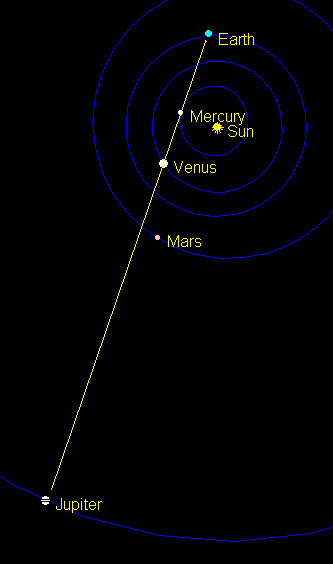
Line of sight of the planets in the Planet Jam for May 13th.
Here’s the animation of the morning planets this month.
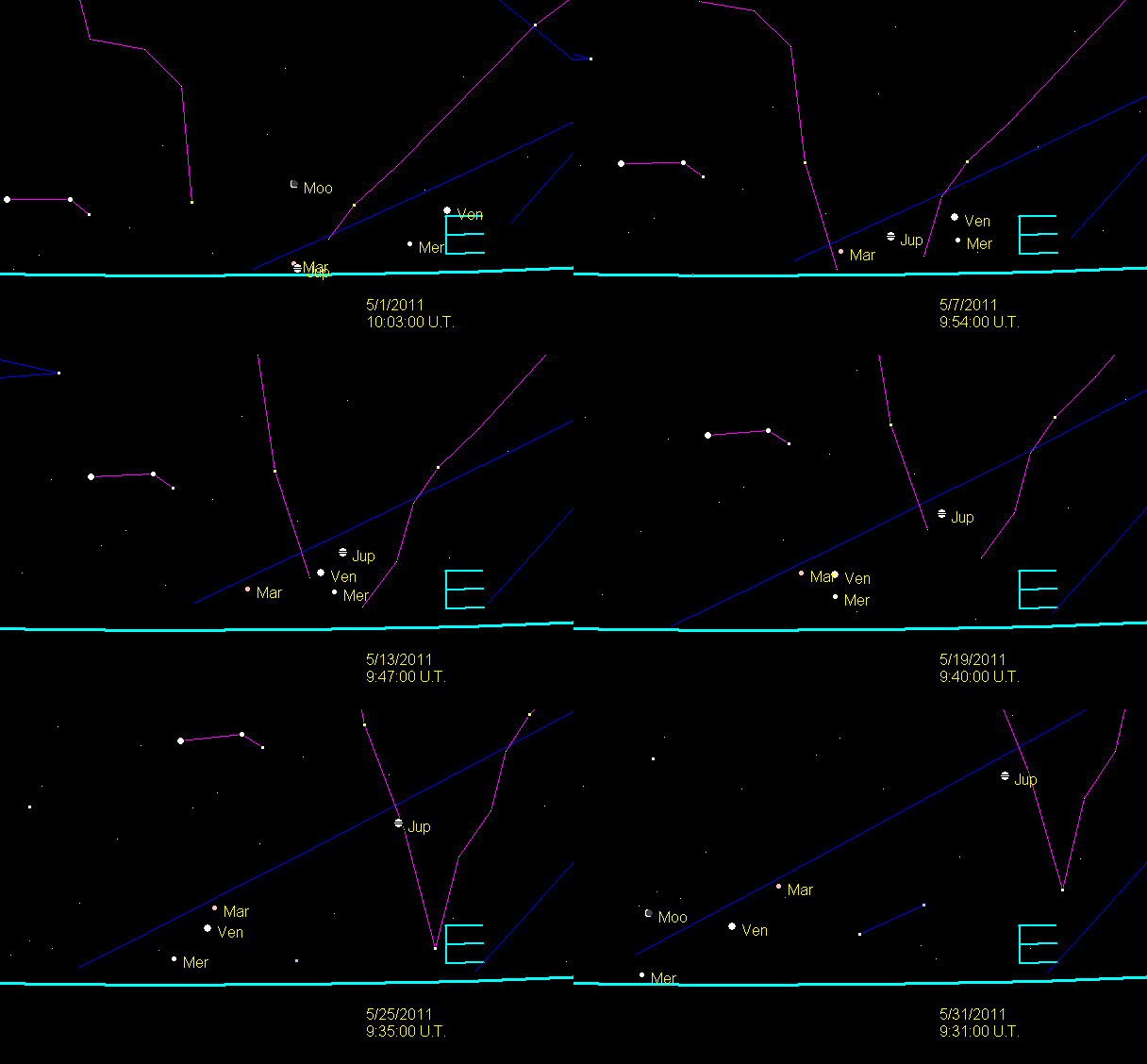
Planet Jam May 2011 animation
05/12/11 – Ephemeris – Lunar telescopic wonders: Bay of Rainbows and the crater Copernicus
Thursday, May 12th. Today the sun will be up for 14 hours and 41 minutes, setting at 8:59. The moon, 2 days past first quarter, will set at 3:40 tomorrow morning. Tomorrow the sun will rise at 6:17.
Tonight the moon will again show a hook out into the darkness at the upper left edge of the moon for observers using binoculars or a telescope. That’s the Jura mountains cupping the Bay of Rainbows, a rather gray lava expanse on the edge of the Sea of Showers. At the other edge of the that sea is the great crater Copernicus, center left on the moon. Its halo of rays will show up better when the moon is full, but now the crater itself can be appreciated. In a telescope its is quite a sight. It has a complex triple central peak, and terraced walls. The small asteroid that hit it less than a billion years ago, struck the moon, gouging out the 56 mile diameter crater we see today. Rebound created the central peaks.
* Times are for the Traverse City/Interlochen area of Michigan. They may be different for your location.
Addendum
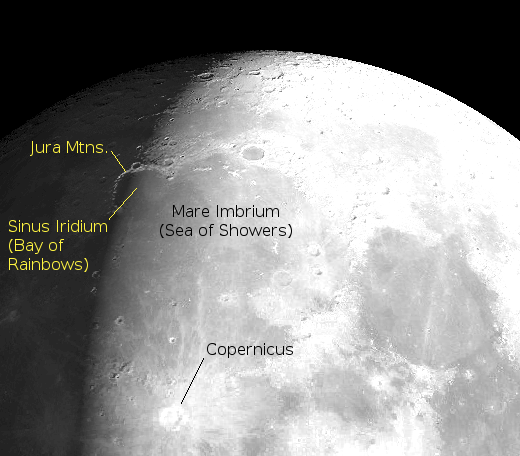
Bay of Rainbows and the crater Copernicus. Created using Virtual Moon Atlas.
I have more on Sinus Iridium and the Jura Mountains back in March.
05/11/11 – Ephemeris – The bright planets for this week
Wednesday, May 11th. The sun rises at 6:19. It’ll be up for 14 hours and 39 minutes, setting at 8:58. The moon, 1 day past first quarter, will set at 3:14 tomorrow morning.
It’s Wednesday and time again to take a look at the whereabouts of the bright planets. The ringed planet Saturn will be visible in the southeast as it gets dark. It’s near the bright star Spica to its lower left. Spica has a blue tinge, while Saturn is yellowish. It will cross the meridian due south at 11:11 p.m. and will set at 5:04 a.m. The morning planet traffic jam continues. Rising first will be Jupiter at 5:19 on the east. Venus rises at 5:25. Followed by Mars at 5:30 and Mercury at 5:31. Unless we have very clear skies and you have a very flat eastern horizon, you’d have to wait until maybe 5:45 to try to spot them. It will take binoculars to first locate Venus, Jupiter the second brightest will be nearby, followed by nearly impossible to spot Mars and Mercury.
* Times are for the Traverse City/Interlochen area of Michigan. They may be different for your location.
Addendum
The morning planets this month at 2 day intervals.
Planet Jam May 2011 animation
05/10/11 – Ephemeris – The Ancient Greeks and measuring the distance to the sun
Tuesday, May 10th. The sun rises at 6:20. It’ll be up for 14 hours and 36 minutes, setting at 8:57. The moon, at first quarter today, will set at 2:46 tomorrow morning.
The ancient Greek astronomers had great success in actually calculating the distance to the moon. They came up with 60 earth radii. Yes, they knew the earth was round and even measured its circumference to great accuracy. The distance they got for the moon lies within the range of the actual moon’s distance. They next tried to measure the distance from the sun. To do this, they tried to observe the moon and the sun at the exact time the moon was at first quarter. At this time the earth, sun and moon make a right triangle. Theoretically the actual angle between the sun and the moon would give the distance to the sun. The answer they got was that the sun was 20 times the moon’s distance. That’s way short, the sun is 400 times the moon’s distance away.
* Times are for the Traverse City/Interlochen area of Michigan. They may be different for your location.
Addendum
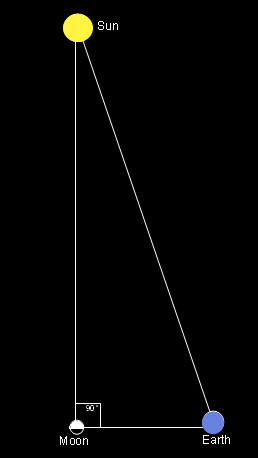
How the ancient Greeks tried to calculate the distance to the sun.
To the right is my take on the Greek sun measuring experiment. Using their guy Euclid and his geometry they knew that the sum of the angles of a triangle equal 180 degrees.
Having an exactly quarter moon, first or last, they knew the Sun-Moon-Earth angle was 90 degrees, so if they could measure the Sun-Earth-Moon angle from observation, they knew the other angle at the sun.
They had already calculated the moon’s distance, so they could calculate the other leg, the Sun-Moon distance using trigonometry. The first trig tables were invented by Greek astronomer Hipparchus.
Ah yes, Trig tables. I don’t suppose you kids use them anymore, with your electronic calculators. Back in my high school days my calculator was a slide rule. Sorry, old guy grousing.
05/09/11 – Ephemeris – The Rabbit in the Moon
Monday, May 9th. The sun rises at 6:22. It’ll be up for 14 hours and 34 minutes, setting at 8:56. The moon, 1 day before first quarter, will set at 2:18 tomorrow morning.
Lets look at the moon for this evening. There’s several ways one can see a rabbit in the moon. The head and ears can be seen in the dark seas on the moon upside down. The Sea of Serenity has just emerged into light and is the shoulders of this rabbit. In binoculars or a telescope The Sea of Serenity or Mare Serenitatis looks to me a bit like a scallop shell in shape. Below that is the Sea of Tranquility, the rabbit’s head. Finishing the rabbit off are its ears, the Sea of Fertility, the fat ear and the Sea of Nectar the skinny ear. Cultures over the earth see different things in the dark seas of the moon. Most familiar to us in the Man in the Moon. In Australia, it is the rabbit. The rest of him is on the night side of the moon now.
* Times are for the Traverse City/Interlochen area of Michigan. They may be different for your location.
Addendum
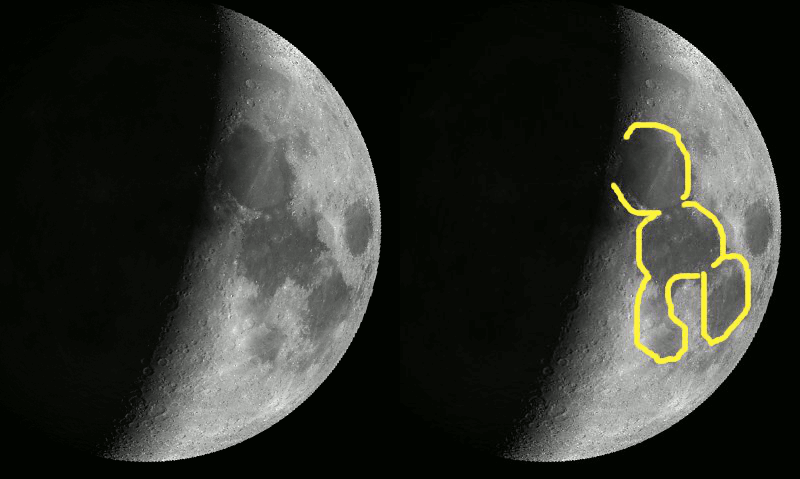
Rabbit in the Moon animation - Lunar image from Virtual Moon Atlas.
05/06/11 – Ephemeris – Saturns rings and Astronomy Day
Friday, May 6th. The sun rises at 6:26. It’ll be up for 14 hours and 26 minutes, setting at 8:52. The moon, 3 days past new, will set at 12:25 tomorrow morning.
This evening Northwestern Michigan College’s professor emeritus “Doc” H.G. Smith will present a program on Saturn’s rings at this evening’s meeting of the Grand Traverse Astronomical Society starting at 8 p.m. at the college’s Rogers Observatory. The Cassini spacecraft has given us some amazing images of those rings. Tomorrow evening starting at 9 p.m. the Society along with the NMC Astronomy Association will host a public viewing night at the observatory. On tap, if it’s clear, will be the planet Saturn and the crescent moon. Tomorrow is also Astronomy Day, and we’ll have some special exhibits and programs related to that. The observatory is located south of Traverse City on Birmley road between Garfield and Keystone roads.
* Times are for the Traverse City/Interlochen area of Michigan. They may be different for your location.
05/05/11 – Ephmeris – The Eta Aquarid meteor shower
Thursday, May 5th. The sun rises at 6:27. It’ll be up for 14 hours and 24 minutes, setting at 8:51. The moon, 2 days past new, will set at 11:35 this evening.
The Eta Aquarid meteor shower is ramping up. The Eta Aquarids are caused by bits of Halley’s Comet, passing the earth’s orbit heading out from the sun. The Orionids of late October are debris of Halley’s comet passing the earth’s orbit heading in toward the sun. It’s the only comet I recollect caused two meteor showers. The Eta Aquarids are named for the star nearest the radiant of the meteor shower. The constellation of Aquarius has many shower radiants, which is why the shower is named for a star in Aquarius. The radiant rises shortly before 3:30 and astronomical twilight begins an hour later. There’s perhaps another half hour of visibility after that. The peak will occur tomorrow morning where up to 20 meteors per hour might be seen.
* Times are for the Traverse City/Interlochen area of Michigan. They may be different for your location.
Addendum
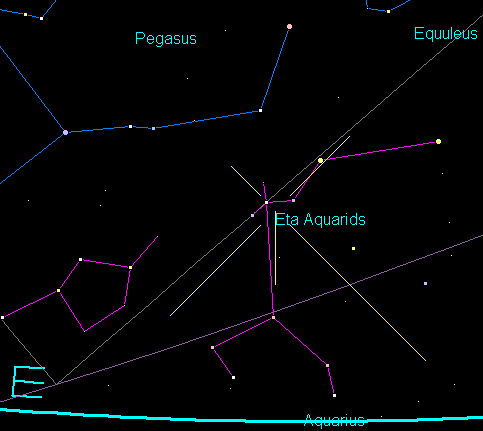
Eta Aquarid radiant
05/04/11 – Ephemeris – The bright planets this week
Wednesday, May 4th. The sun rises at 6:28. It’ll be up for 14 hours and 21 minutes, setting at 8:50. The moon, 1 day past new, will set at 10:39 this evening.
It’s Wednesday and time again to take a look at the whereabouts of the bright planets. The ringed planet Saturn will be visible in the southeast as it gets dark. It’s near the bright star Spica to its lower left. Spica has a blue tinge, while Saturn is yellowish. It will cross the meridian due south at 11:40 p.m. and will set at 5:33 a.m. Our only other planet really visible is Venus which will rise at 5:34 a.m. in the east. Rising at 5:42 will be Mercury, followed a minute later by Jupiter. Dimmest is Mars, rising at 5:46. This is what I call a Planet Jam. If you can find Venus in the twilight and follow it until 7 a.m., you just might be able to spot Jupiter and Mercury. Mars will be problematic because it’s so dim.
* Times are for the Traverse City/Interlochen area of Michigan. They may be different for your location.
 Bob Moler's Ephemeris Blog