Archive
06/30/11 – Ephemeris – July Preview
Thursday, June 30th. Today the sun will be up for 15 hours and 30 minutes, setting at 9:31. The moon, 1 day before new, will rise at 6:17 tomorrow morning. Tomorrow the sun will rise at 6:01.
Lets preview July’s skies. The sun, having reached its northern solstice, is beginning to slide southward again, at first imperceptibly, then with greater speed. The daylight hours will decrease from 15 hours and 30 minutes Tomorrow to 14 hours 41 minutes at month’s end. The daylight hours will be slightly shorter south of Interlochen, and slightly longer to the north. The altitude of the sun at local noon, when the sun is due south will decrease from 68 degrees Tomorrow to 63 degrees at month’s end. The sun will be a degree lower in the Straits area. Despite the warmth, the earth will reach its greatest distance from the sun on Monday the 4th. The range of the earth’s distance from the sun is 3 million out of 93 million miles.
* Times are for the Traverse City/Interlochen area of Michigan. They may be different for your location.
06/29/11 – Ephemeris – The bright planets this week
Wednesday, June 29th. Today the sun will be up for 15 hours and 31 minutes, setting at 9:31. The moon, 2 days before new, will rise at 5:14 tomorrow morning. Tomorrow the sun will rise at 6:00.
It’s Wednesday and time again to take a look at the whereabouts of the bright planets. The ringed planet Saturn will be visible in the southwest as it gets dark. It’s near the bright star Spica to its left. Spica has a blue tinge, while Saturn is yellowish. It will set at 1:57 a.m. Saturn is a wonderful sight is a telescope with its rings. The shadows of the rings on the planet and planet on the rings are now near their maximum extent. Its bright moon Titan is also visible. Folks with good telescopes and good eyesight can also see up to four of Saturn’s fainter moons. Jupiter will rise at 2:30 a.m. in the east. Mars will rise at 3:54. Venus now rises too close to sunrise to be seen in the twilight as is Mercury.
* Times are for the Traverse City/Interlochen area of Michigan. They may be different for your location.
06/28/11 – Ephemeris – The constellation Lyra the harp
Tuesday, June 28th. Today the sun will be up for 15 hours and 32 minutes, setting at 9:31. The moon, 3 days before new, will rise at 4:19 tomorrow morning. Tomorrow the sun will rise at 6:00.
High in the east at 11 p.m. can be found a bright star just above a small, narrow, but very distinctive parallelogram of stars. They are the stars of the constellation Lyra the harp. The bright star is Vega, one of the twenty one brightest stars, called first magnitude stars. Vega is actually the 5th brightest night time star. The harp, according to Greek mythology, was invented by the god Hermes. The form of the harp in the sky, is as he had invented it: by stretching strings across a tortoise shell. Hermes gave it to his half-brother Apollo, who in turn gave it to the great musician Orpheus. In binoculars, near Vega, two stars appear together. They barely appear to the unaided eye as one star, called Epsilon Lyrae.
* Times are for the Traverse City/Interlochen area of Michigan. They may be different for your location.
Addendum
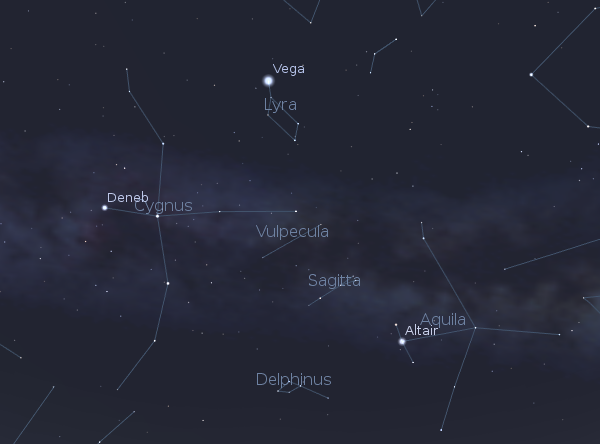
The constellations Lyra, Cygnus and Aquila. Created using Stellarium.
Lyra has some interesting treats for the telescope.
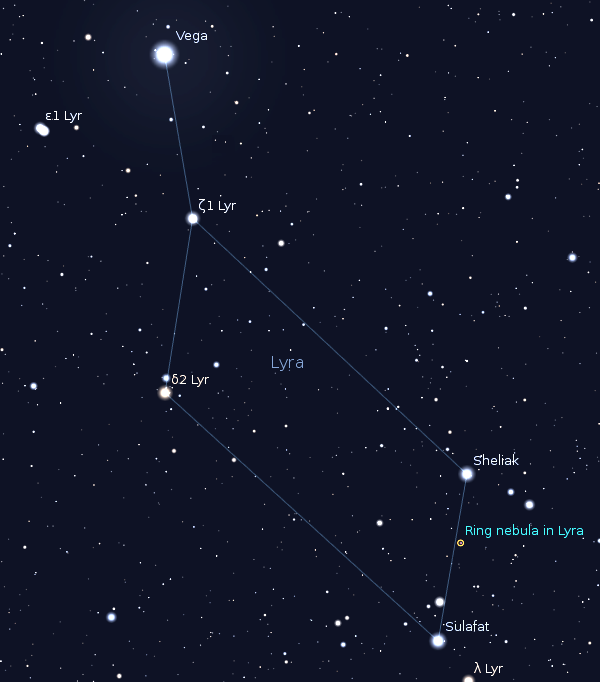
Lyra in Binoculars. Created using Stellarium.
Epsilon (ε) Lyrae, near Vega is easier to split than this image. In good telescopes each of its stars is again split into two stars. Amateur astronomers call it the Double-Double Star. Not mentioned in the program is the Ring Nebula. It isn’t visible in small finder telescopes, but if you have a telescope point the finder directly between the stars Sheliak and Sulafat, and the ghostly ring of the Ring Nebula will be near in the telescope.
06/27/11 – Ephemeris – Asteroid 2011 MD makes a close approach today
Monday, June 27th. Today the sun will be up for 15 hours and 32 minutes, setting at 9:31. The moon, half way from last quarter to new, will rise at 3:32 tomorrow morning. Tomorrow the sun will rise at 5:59.
At about 1:14 this afternoon a small asteroid provisionally named 2011 MD will pass within 8,000 miles of the earth. The asteroid, discovered last Wednesday, is thought to be about 30 feet in diameter. It will fly well within the communication geosynchronous satellites and 3,000 miles lower than the GPS satellites. It is, however, over 7,000 miles above the orbit of the International Space Station. At its closest approach it will be over South Africa. Back in February an asteroid came within 3,400 miles of the earth. And a few years ago a tiny object was picked up before it entered the atmosphere and broke up over the Nubian Desert. There are several observing programs to spot these near earth objects.
* Times are for the Traverse City/Interlochen area of Michigan. They may be different for your location.
06/24/11 – Ephemeris – Local astronomical events this weekend
Friday, June 24th. Today the sun will be up for 15 hours and 33 minutes, setting at 9:31. The moon, 1 day past last quarter, will rise at 1:54 tomorrow morning. Tomorrow the sun will rise at 5:58.
This weekend we’ll have a night and a day of viewing courtesy of the Grand Traverse Astronomical Society. Tonight the Northwestern Michigan College’s Rogers Observatory will be open for viewing starting at 9 p.m. It won’t get dark until after 10 p.m. The planet Saturn, colorful binary stars and some of the brighter deep sky objects later on may be seen if its clear. Saturday, society members will bring their telescopes for viewing the sun and meteorites to the Boardman River Nature Center’s Nature Fest. They’re at, 1450 Cass Road from 10a.m. to 4 p.m. Last week’s viewing at Platte River Point was great. Despite gray skies, we spotted the star Arcturus and our main objective, Saturn and had a turnout of 40 people.
* Times are for the Traverse City/Interlochen area of Michigan. They may be different for your location.
06/23/11 – Ephemeris – The constellation Hercules
Thursday, June 23rd. Today the sun will be up for 15 hours and 33 minutes, setting at 9:31. The moon, at last quarter today, will rise at 1:30 tomorrow morning. Tomorrow the sun will rise at 5:58.
The greatest Greek hero of all, Hercules, gets a dim group of stars on the border between the spring and summer stars. At 11 p.m. Hercules is high in the southeastern sky. It is located above and right of the bright star, Vega, also in the east. Hercules’ central feature is a keystone shaped box of stars, called the Keystone, which represents the old boy’s shorts. From each top corner extend lines of stars that are his legs, from the bottom stars, the rest of his torso and arms extend. So in one final indignity he’s upside down in our sky. Just below and right of the topmost star of the keystone is what looks like a fuzzy star in binoculars or small telescope. It is the Great Hercules Globular Star Cluster, home to a million stars.
* Times are for the Traverse City/Interlochen area of Michigan. They may be different for your location.
Addendum
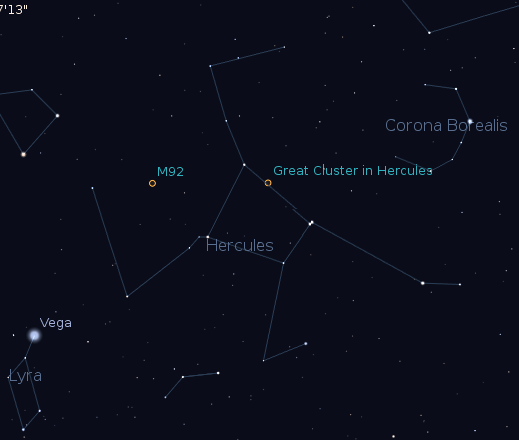
The constellation Hercules and his neighbors. Created with Stellarium.
06/22/11 – Ephemeris – The bright planets visible this week
Wednesday, June 22nd. Today the sun will be up for 15 hours and 33 minutes, setting at 9:31. The moon, 1 day before last quarter, will rise at 1:07 tomorrow morning. Tomorrow the sun will rise at 5:57.
It’s Wednesday and time again to take a look at the whereabouts of the bright planets. The ringed planet Saturn will be visible in the south southwest as it gets dark. It’s near the bright star Spica to its lower left. Spica has a blue tinge, while Saturn is yellowish. It will set at 2:21 a.m. Saturn is a wonderful sight is a telescope with its rings. The shadows of the rings on the planet and planet on the rings are now near their maximum extent. Its bright moon Titan is also visible. Folks with good telescopes and good eyesight can also see up to four of Saturn’s fainter moons. Jupiter will rise at 2:55 a.m. in the east. Mars will rise at 4:06. Venus now rises too close to sunrise to be seen in the twilight as is Mercury.
* Times are for the Traverse City/Interlochen area of Michigan. They may be different for your location.
06/21/11 – Ephemeris – Summer solstice is today
Tuesday, June 21st. Today the sun will be up for 15 hours and 33 minutes, setting at 9:31. The moon, 2 days before last quarter, will rise at 12:46 tomorrow morning. Tomorrow the sun will rise at 5:57.
At 1:16 this afternoon the sun will reach its greatest angle north of the celestial equator or 23 ½ degrees. The date and the point in the sky where the sun is at that instant is called the summer solstice, or summer sun standstill. It means the point at which the sun seems poised farthest north before heading southward. This would be most noticeable if you were monitoring the height of the sun at noon or the sun’s rising or setting point day by day as the ancients did. Besides being the day with the longest sunlight we, in the northern hemisphere, are also receiving more intense heat from the sun than any other day of the year. Still hotter weather is in store as the northern hemisphere continues to warm up.
* Times are for the Traverse City/Interlochen area of Michigan. They may be different for your location.
06/20/11 – Ephemeris – The constellation Libra the scales
Monday, June 20th. Today the sun will be up for 15 hours and 33 minutes, setting at 9:30. The moon, 3 days before last quarter, will rise at 12:24 tomorrow morning. Tomorrow the sun will rise at 5:57.
One of the constellations of the Zodiac or circle of animals isn’t either animal or human. It is Libra the Scales or balance. It lies low in the southern sky at 11 p.m., just to the right of the rising Scorpius the scorpion. Libra, it seems, is an afterthought, a simple diamond shape of four stars.. Its two brightest stars Zubeneschamali and Zubenelgenubi translate to the north and south claw respectively, of Scorpius to the left of it. The Arabs, at least, seemed to view this as part of Scorpius. The balance was perhaps to signify the equality of day and night, at the time the sun was in this part of the sky at the start of autumn, over 2000 years ago. Nowadays the sun is one constellation west, in Virgo at the start of autumn.
* Times are for the Traverse City/Interlochen area of Michigan. They may be different for your location.
Addendum
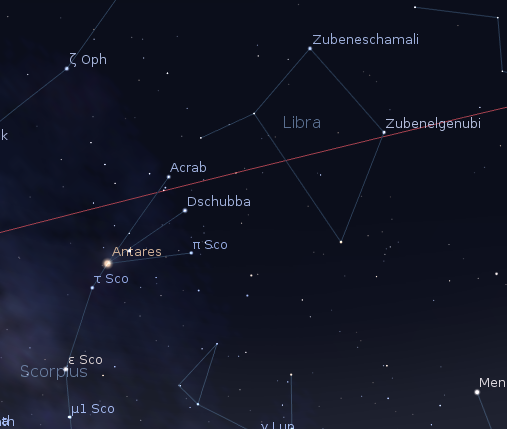
Libra the scales. Created using Stellarium
06/17/11 – Ephemeris – Viewing at the Sleeping Bear Dunes National Lakeshore
Friday, June 17th. Today the sun will be up for 15 hours and 33 minutes, setting at 9:30. The moon, 2 days past full, will rise at 11:02 this evening. Tomorrow the sun will rise at 5:56.
Tomorrow, that’s Saturday night the 18th, Grand Traverse Astronomical Society will host the first of five viewing nights at the Sleeping Bear Dunes National Lakeshore. This one will be held at Platte River Point, at the mouth of the Platte River. We’ll be setting up telescopes around 8:30. Sunset will be about 9:30 and we expect to see Saturn and the first stars about 10 to 10:15 p.m. We’ll be there up to midnight depending on the crowds, and clear skies. Our next viewing opportunity at the Dunes will be July 30th at the Dunes overlook, stop 3 on Pierce Stocking Drive. We’ll also have evenings in August at the Port Oneida Fair, September, and October for the Lakeshore’s 41st Anniversary.
* Times are for the Traverse City/Interlochen area of Michigan. They may be different for your location.
Note: Platte River Point can be googled for the location.
 Bob Moler's Ephemeris Blog