Archive
08/05/11 – Ephemeris – Viewing night tommorrow at the Rogers Observatory
Friday, August 5th. The sun rises at 6:33. It’ll be up for 14 hours and 29 minutes, setting at 9:03. The moon, 1 day before first quarter, will set at 11:53 this evening.
Tomorrow night the Grand Traverse Astronomical Society and the NMC Astronomical Association will host a public viewing night at Northwestern Michigan College’s Rogers Observatory starting at 9 p.m. featuring, if it’s clear the planet Saturn early and the moon. Some of the brighter wonders of the summer sky can be seen as it gets darker, though the moon will interfere somewhat. There are sparkling binary stars and star clusters including the Wild Duck Cluster and at least one bright nebula, the Ring Nebula, the expanding envelope of a dying star. The observatory is located south of Traverse City, on Birmley Road between Garfield and Keystone roads.
* Times are for the Traverse City/Interlochen area of Michigan. They may be different for your location.
08/04/11 – Ephemeris – The moon’s Sea of Tranquility
Thursday, August 4th. The sun rises at 6:32. It’ll be up for 14 hours and 32 minutes, setting at 9:04. The moon, 2 days before first quarter, will set at 11:18 this evening.
In binoculars the center of the of the moon and clipped by the terminator, the moon’s sunrise line is the landing area of the first humans on the moon The Sea of Tranquility. It is a circular basin 424 miles in diameter with a flat floor. It was formed in the first 600 million years of the moon’s existence after the worst of the cratering was over. The moon appears to have been formed by a glancing collision of a Mars sized body with the earth during the formation of the solar system. The debris circled the earth and condensed to form the moon. It is from studying the rocks brought back by the Apollo astronauts that this origin scenario was first put forth. The origin of a huge satellite for the earth had baffled astronomers before this discovery..
* Times are for the Traverse City/Interlochen area of Michigan. They may be different for your location.
Addendum
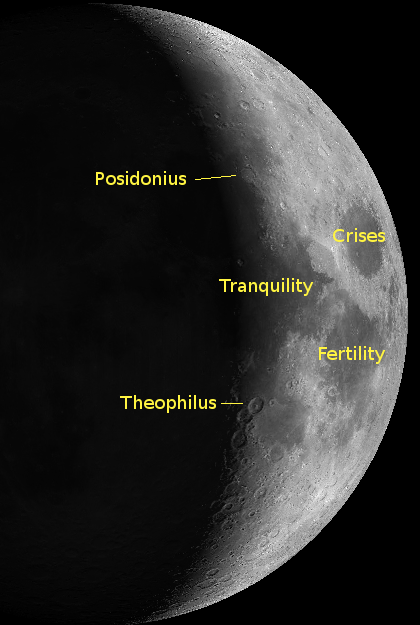
The Sea of Tranquility emerging into sunlight - Virtual Moon Atlas
08/03/11 – Ephemeris – The bright planets for this week
Wednesday, August 3rd. The sun rises at 6:30. It’ll be up for 14 hours and 34 minutes, setting at 9:05. The moon, 3 days before first quarter, will set at 10:47 this evening.
It’s Wednesday and time again to take a look at the whereabouts of the bright planets. The ringed planet Saturn will be visible in the west southwest as it gets dark. It’s near the bright star Spica to its left. Spica has a blue tinge, while Saturn is yellowish. It will set at 11:35 p.m. Saturn is a wonderful sight is a telescope with its rings. We are now slowly seeing Saturn slip into evening twilight. We have a couple of more weeks of good viewing of Saturn before its image deteriorates by being too low in the sky. Jupiter will rise at 12:24 a.m. in the east northeast and is seen against the stars of the constellation Aries now. Mars will rise at 3:08 also in the east northeast and is now entering the constellation Gemini the twins at Castor’s foot.
* Times are for the Traverse City/Interlochen area of Michigan. They may be different for your location.
08/02/11 – Ephemeris – The constellation of Aquila the eagle
Note: this is a repeat due to Internet problems for the July 25th program with one alteration.
Tuesday, August 2nd. The sun rises at 6:29. It’ll be up for 14 hours and 37 minutes, setting at 9:06. The moon, 3 days past new, will set at 10:19 this evening.
The southernmost star in the Summer Triangle of three bright stars is Altair, high in the south southeast in the evening. It’s in the head of the constellation Aquila the Eagle. Altair is flanked by two stars, the eagle’s shoulders, and farther out are the wing tips. Other stars to the lower right are in its body and a last three in its tail. Near the tail binoculars will show a fuzzy spot that telescopes show as a compact star cluster, sometimes called the Wild Duck Cluster for its nearly triangular shape. Aquila is flying northeastward through the Milky Way, where it is split in two by a cloud of gas and dust, the edges of which can be seen in binoculars. According to mythology the Trojan boy Ganymede was taken to heaven at the behest of the god Zeus by this eagle.
* Times are for the Traverse City/Interlochen area of Michigan. They may be different for your location.
Addendum
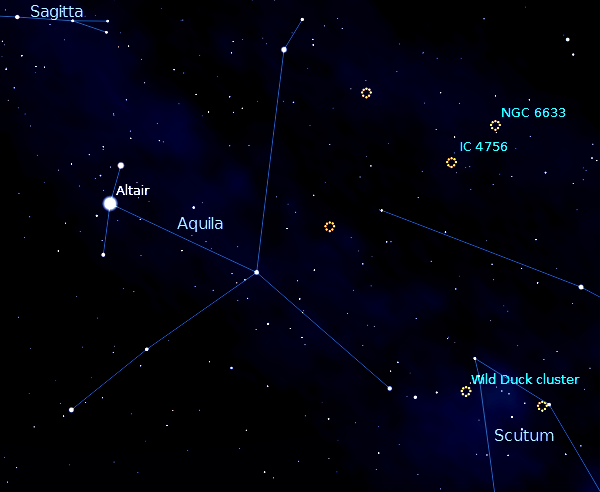
Finder chart for M11, the Wild Duck Cluster, Created using Stellarium.
08/01/11 – Ephemeris – Previewing August skies
Monday, August 1st. The sun rises at 6:28. It’ll be up for 14 hours and 39 minutes, setting at 9:08. The moon, 2 days past new, will set at 9:52 this evening.
Let’s look ahead at the month of August in the skies. Daylight hours will decrease from 14 hours and 39 minutes today to 13 hours 17 minutes on the 31st. The altitude of the sun at local noon, that is degrees of angle above the horizon will decrease from 63 degrees today to just over 53 degrees on the 31st. Straits area listeners can subtract one more degree from those angles. Local noon, when the sun is due south, is about 1:43 p.m. The Perseid meteor shower will reach its peak on the morning of the 12th, but will be mostly unseen due to the bright moon. However on the nights between now and then when the moon has set these meteors will still be plentiful. We saw two bright ones Saturday night at the Sleeping Bear Dunes viewing night.
* Times are for the Traverse City/Interlochen area of Michigan. They may be different for your location.
 Bob Moler's Ephemeris Blog