Archive
Comet Lovejoy is growing a new tail
Wow! It looks like C/2011W3 Lovejoy is growing two new tails, a faint ion tail and a brighter dust tail.
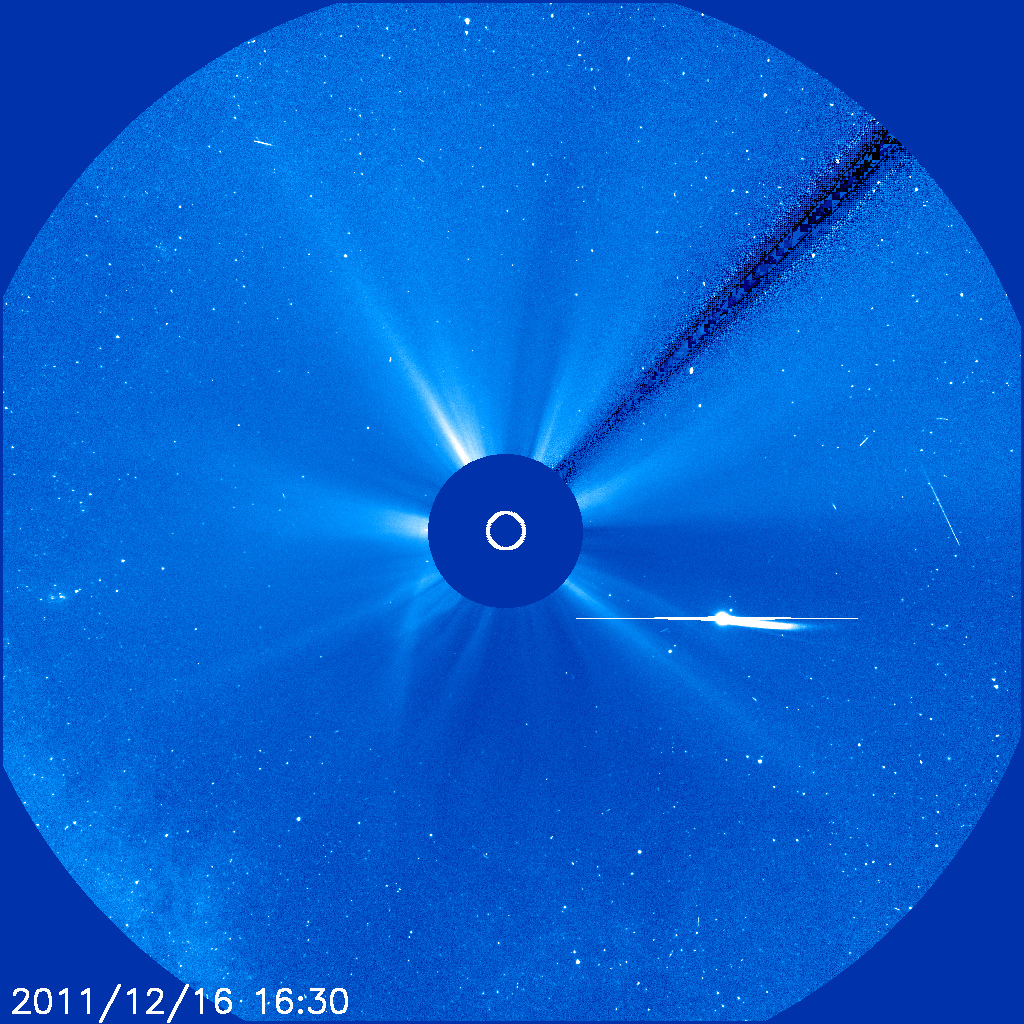
Comet Lovejoy growing new tails. Courtesy ESA, NASA, LASCO C3 group.
The old tail is still visible.
Lovejoy Lives!
Barely.
The Solar Dynamics Observer (SDO) detected Comet Lovejoy (C/2011W3) leaving the sun, but thousands of times fainter than it went in. the LASCO C3 and C2 images that I’ve seen for 9:30 UT show the ghost of Lovejoy’s tail. See Below:
Ghost of Comet Not So Past
Sorry, couldn’t help it. It’s the season I guess. However reports of Lovejoy’s death may have been exaggerated. Sorry Mr. Twain.
Update 8:38 a.m.
I dashed off the above as soon as I got up this morning. It wasn’t until later looking at spaceweather.com’s animation of the LASCO C3 images that I found that the over bright star to the lower left of the sun was what’s left of Comet Lovejoy. I took a quick look at Stellarium and saw no planets in that position, so I thought it may have been an artifact. So it appears Lovejoy lost all its volatile components and is probably a bare nucleus like the progenitor of the Geminid meteor shower 3200 Phaethon. I wonder if the brightness of it will change its size estimates?
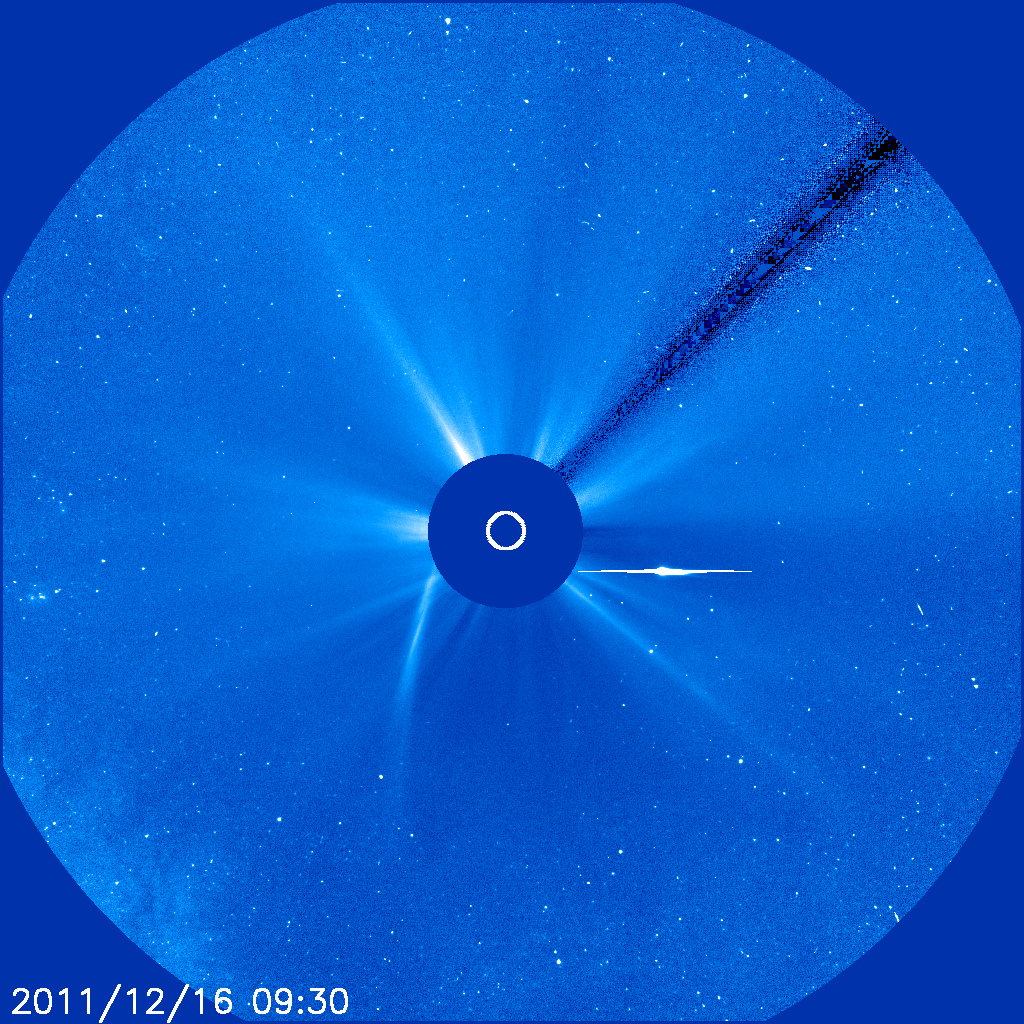
Ghost tail of Comet Lovejoy. Courtesy of ESO, NASA and the LASCO team.
12/16/11 – Ephemeris – The constellation Orion rising
Friday, December 16th. The sun will rise at 8:12. It’ll be up for 8 hours and 50 minutes, setting at 5:03. The moon, 1 day before last quarter, will rise at 11:49 this evening.
At 9 p.m. the constellation of Orion the giant hunter will be rising in the east southeast, with its belt stars nearly vertically aligned. The belt stars are contained within a tilted rectangle of four bright stars that’s leaning to the left. The brightest of the top stars is Betelgeuse a bright red star. It’s a huge red giant star. Both top stars are Orion’s shoulders. The other shoulder star is Bellatrix. The bottom stars are Orion’s knees. The brightest, diagonally opposite from Betelgeuse is Rigel, a bright blue-white giant star. The other knee star is named Saiph. Orion is home to a beautiful nebula or cloud of gas, which we’ll explore later this winter, visible in binoculars it is located right and below Orion’s belt stars.
* Times, as always are for the Traverse City/Interlochen area of Michigan.
Addendum
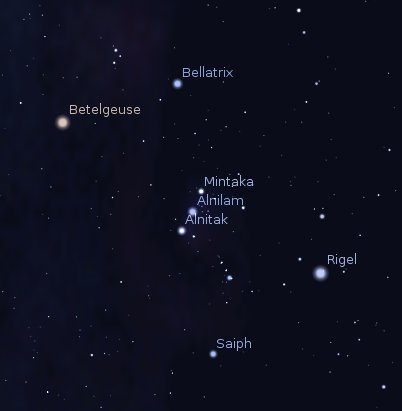
Orion with star names
12/15/11 – Ephemeris – Comet Lovejoy will skim past the sun today
Thursday, December 15th. The sun will rise at 8:12. It’ll be up for 8 hours and 50 minutes, setting at 5:02. The moon, 2 days before last quarter, will rise at 10:39 this evening.
Today Comet Lovejoy will pass 100,000 miles above the surface of the sun. The sun is 865,000 miles in diameter, so that’s very close. Will the comet survive? Will it break into multiple pieces? Or will it evaporate in the sun’s intense heat? To get the latest news on the internet go to Spaceweather,com or space.com. For first hand information google SOHO NASA. Look for real time images. LASCO C3 and C2 are the views you want. These are near white light views with the sun’s face blocked out so the solar corona is visible. The C2 view is closer in than the C3 view. The comet will move from the lower left to upper right. And will go behind the occulting disk that hides the sun. The comet’s tail should be quite long.
* Times, as always are for the Traverse City/Interlochen area of Michigan.
Update 6:09 a.m.
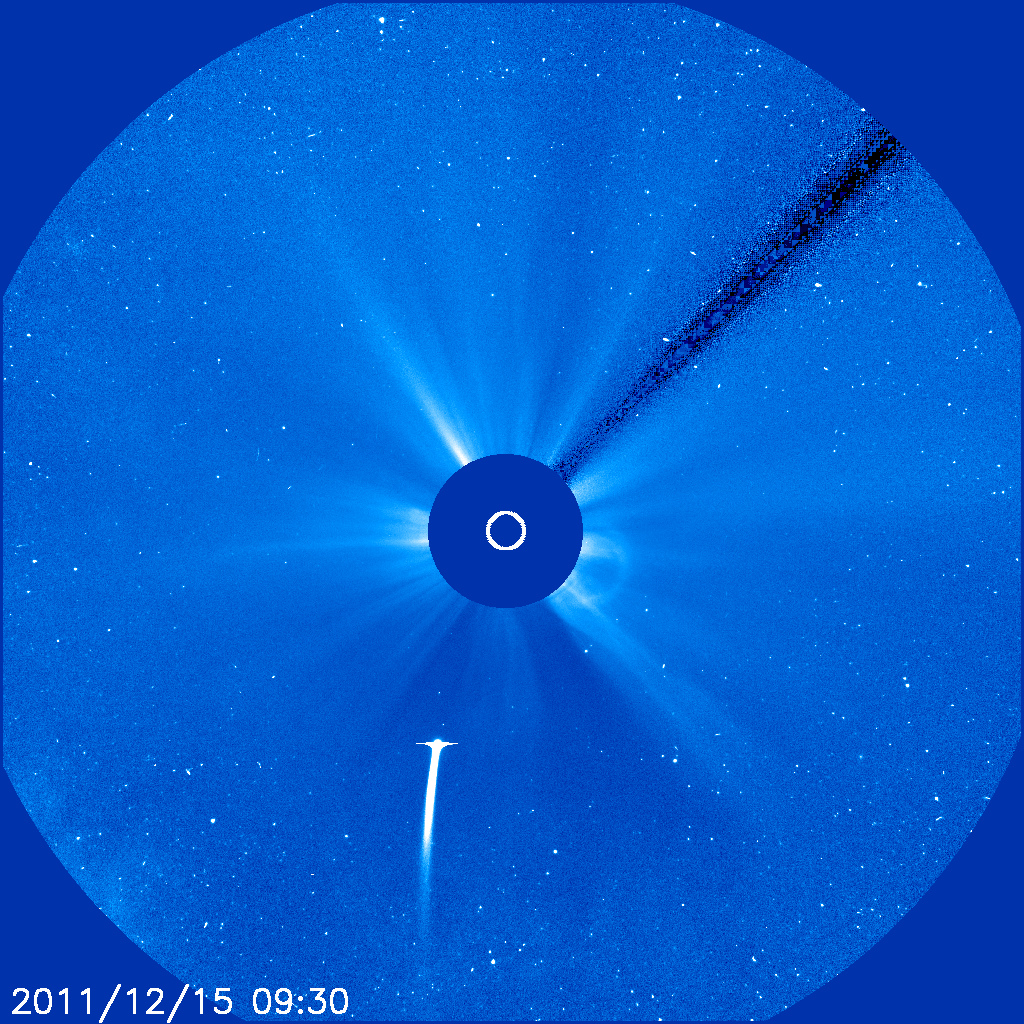
Comet Lovejoy at 9:30 UT or 2:23 a.m. EST. Courtesy of ESA, NASA, LASCO Team.
Click image to enlarge.
Planetary Society Blog has animation of Comet Lovejoy (C/2011W3) entering SOHO’s LASCO C3 field.
Emily Lakdawalla has the scoop. http://www.planetary.org/blog/article/00003301/
The comet should be closest to the sun (100,000 miles from the surface) tomorrow about 7 p.m. EST (0h U.T. December 16th). Supposedly about 600 feet in diameter. Do you think it’s got a snowball’s chance in hell of surviving? The sun’s surface (photosphere) is about 10,000 degrees F.
—
Bob Moler
12/14/11 – Ephemeris – Where are the bright planets this week?
Wednesday, December 14th. The sun will rise at 8:11. It’ll be up for 8 hours and 51 minutes, setting at 5:02. The moon, 3 days before last quarter, will rise at 9:29 this evening.
It’s Wednesday and time again to take a look at the whereabouts of the bright planets. The planet Venus is prominent in the southwestern twilit sky after sunset setting at 7:12[, and should be visible by 5:45]. Jupiter is now the most prominent planet of the evening sky located in the high in the southeast to south and is seen against the stars of the constellation Aries. It will pass due south at 9:04 p.m. It will set at 3:48 a.m.. Mars will rise at 11:41 p.m in the east northeast and will be in the constellation Leo. [Mars will be due south at 6:17 a.m.] It is 111 million miles away and closing. Saturn will rise at 3:22 a.m. just to the left of the bright star Spica in the east southeast. Remember Comet Lovejoy will enter SOHO’s LASCO C3 frame today.
* Times, as always are for the Traverse City/Interlochen area of Michigan. Text in brackets deleted from the program due to time constraints.
Update 6:16 a.m.
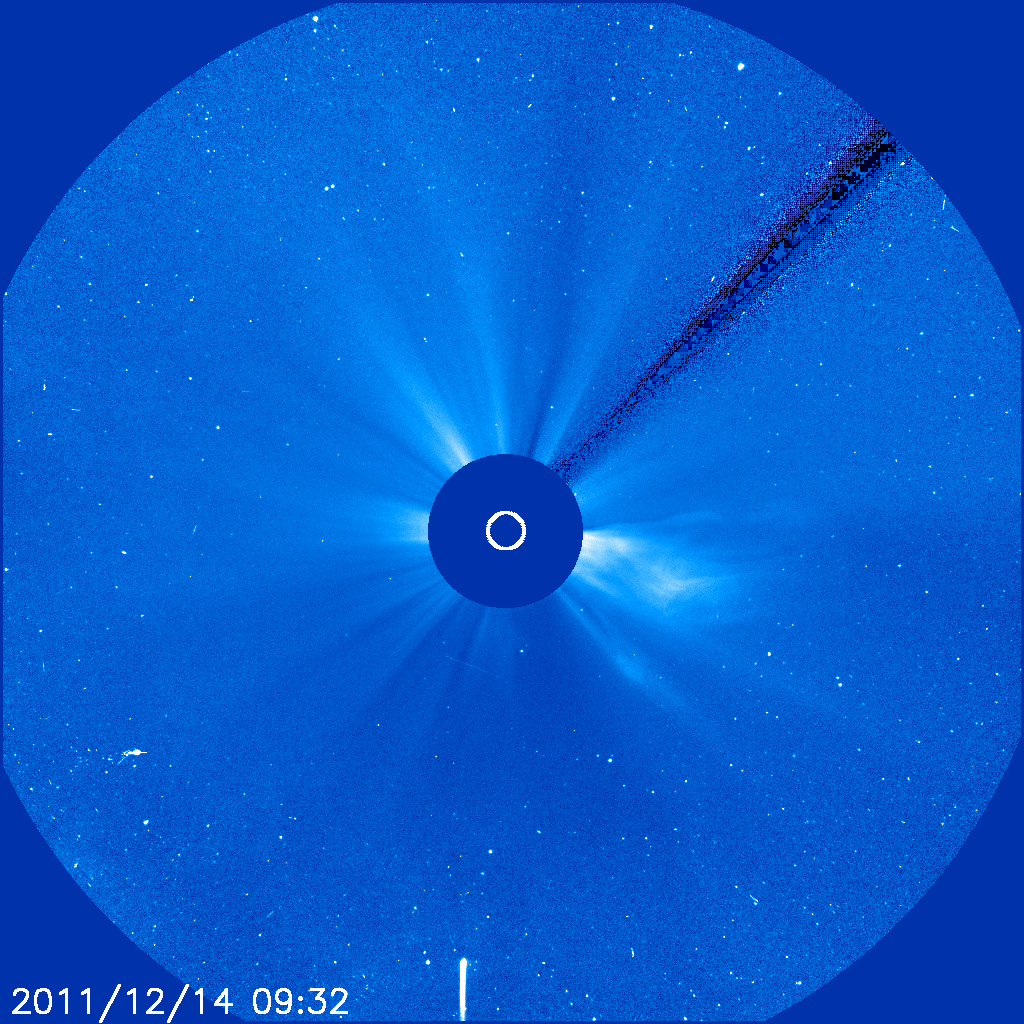
Comet Lovejoy entering at the bottom of the LASCO C3 frame. Courtesy SOHO, ESA, NASA. Timestamp on image.
Click to enlarge.
12/13/11 – Ephemeris – Comet Lovejoy and Kreutz sungrazing comets
Tuesday, December 13th. The sun will rise at 8:10. It’ll be up for 8 hours and 51 minutes, setting at 5:02. The moon, 3 days past full, will rise at 8:21 this evening.
Comet Lovejoy which will pass close to the sun Thursday is not alone. It belongs to the Kreutz sungrazing group of comets. They are named after Heinrich Kreutz the 19th century astronomer who discovered some of the great comets of history were sungrazers and had similar orbits. Astronomers , trying to backtrack the comets, think the original comet broke up maybe in the 4th century AD into two unequal fragments, that have continued to fragment during close approached to the sun. The SOHO spacecraft can detect these comets toward the sun. Over 1,500 Kreutz sungrazer comets have been found on SOHO photographs. Comet Lovejoy should enter SOHO’s LASCO C3 image frame starting tomorrow morning. Google SOHO and NASA to locate the site on the internet.
http://sohowww.nascom.nasa.gov/data/realtime-images.html
* Times, as always are for the Traverse City/Interlochen area of Michigan.
Addendum
Here’s something like what we’ll see in the next two days.

A Kreutz Sungrazer in 1996 seen by SOHO. Credit: LASCO, SOHO Consortium, NRL, ESA, NASA
12/12/11 – Ephemeris – The Solar and Heliospheric Observatory (SOHO)
Monday, December 12th. The sun will rise at 8:09. It’ll be up for 8 hours and 52 minutes, setting at 5:02. The moon, 2 days past full, will rise at 7:15 this evening.
Most of this week will be on the topic of Comet Lovejoy which will pass a hundred thousand moles of the sun’s surface Thursday evening our time. It should be visible to the SOHO spacecraft orbiting the sun a million miles sunward of the earth starting Wednesday. Normally a spacecraft inside the earth’s orbit will orbit the sun in less time than the earth and move away from the earth. However SOHO is placed at a unique spot called L1, kind of a equilibrium point between the earth and sun SOHO means Solar and Heliospheric Observatory was launched in 1995 and has served as an early warning sentinel for solar storms approaching the earth pretty much ever since. It is with SOHO that we’ll see if Comet Lovejoy survives its plunge near the sun.
* Times, as always are for the Traverse City/Interlochen area of Michigan.
12/09/11 – Ephemeris – Glimpse a piece of a lunar eclipse tomorrow morning
Friday, December 9th. The sun will rise at 8:07. It’ll be up for 8 hours and 55 minutes, setting at 5:02, the earliest sunset of the year. The moon, 1 day before full, will set at 8:08 tomorrow morning.
There will be an eclipse of the moon tomorrow, however we will get a chance to spot the very beginning of the partial phase. The eclipse will be best seen in the western United States, Australia and most of Asia. The partial phase starts at 7:46 a.m. with the moon low in the west northwest. The sun will rise about the time the moon will set. That will occur at 8:09 a.m., give or take a few minutes depending where you are in northern Michigan. It will have to be really crystal clear to see this at all. Next year we’ll see the tail end of an eclipse of the sun as it sets on May 20th. And we’ll see partial eclipse of the moon on June 4th. The next evening we’ll have the rare transit of Venus which won’t reoccur for over 100 years.
* Times, as always are for the Traverse City/Interlochen area of Michigan.
Addendum
More Information here: http://eclipse.gsfc.nasa.gov/OH/OHfigures/OH2011-Fig06.pdf
Update
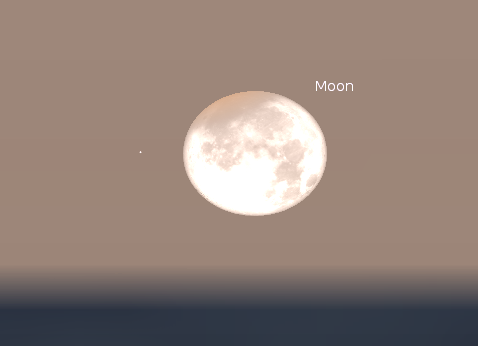
Lunar Eclipse at 8 a.m. December 10, 2011. Created using Stellarium.
12/08/11 – Ephemeris – RIP Phobos-Grunt
Thursday, December 8th. The sun will rise at 8:06. It’ll be up for 8 hours and 56 minutes, setting at 5:02. The moon, 2 days before full, will set at 7:14 tomorrow morning.
November was the month to send spacecraft to Mars for its close approach in 2012. On November 8th the Russian’s launched Phobos-Grunt a mission to Mars’ moon Phobos to land and return a soil sample. On the way it was to release a Chinese satellite to orbit Mars. Making the round trip was a tiny capsule from the Planetary Society containing freeze-dried microbes to see if they could survive the long trip in interplanetary space. The rocket performed flawlessly, but the Phobos-Grunt package did not ignite its engine to escape earth and head out to Mars. Subsequent attempts by the Russians and Europeans have failed to correct the situation. On the 26th NASA’s Curiosity was launched and is now heading to Mars to land August 5th next year.
* Times, as always are for the Traverse City/Interlochen area of Michigan.
 Bob Moler's Ephemeris Blog