Archive
03/30/2012 – Ephemeris – April Preview
Ephemeris for Friday, March 30th. The sun will rise at 7:26. It’ll be up for 12 hours and 41 minutes, setting at 8:08. The moon, at first quarter today, will set at 3:36 tomorrow morning.
The 4th month of the year begins Sunday with Palm Sunday. Daylight hours in the Interlochen/Traverse City area and will increase from 12 hours and 48 minutes Sunday to 14 hours 13 minutes on April 30th. The altitude, or angle, of the sun above the southern horizon at local noon will be 50 degrees Sunday and will ascend to 60 degrees on April 30th. The altitude of the sun in the Straits area will be a degree lower. The actual time of local apparent noon this month for the Interlochen/Traverse City area, when the sun passes due south, will be about 1:43 p.m. The full moon next Friday is the Pascal full moon meaning the western churches will celebrate Easter the following Sunday. Passover starts that Friday night, while Orthodox Easter is the 15th.
* Times are for the Traverse City/Interlochen area of Michigan. They may be different for your location.
03/29/2012 – Ephemeris – The moon tonight
Ephemeris for Thursday, March 29th. The sun will rise at 7:28. It’ll be up for 12 hours and 38 minutes, setting at 8:06. The moon, 1 day before first quarter, will set at 2:55 tomorrow morning.
Tonight’s moon will be nearly half full. The gray patches on the moon are from the upper right the sea of Crises, Below it is the sea of fertility, centered on the moon’s equator is the sea of Tranquility. Above that is the scallop shaped sea of Serenity. One of the interesting craters in viwe for a telescope now is the ruined crater Julius Caesar. It’s on the edge of Tranquility near Serenity. This is an ancient crater whose crater walls were breached by the impact that created the sea of Tranquility, so it kind of looks like the letter C. So how did this crater become named for a Roman Emperor? My only guess is that it was for his calendar reform giving us the 365 day year with a leap year every 4th. This is also a good time to check out the rest of the moon.
* Times are for the Traverse City/Interlochen area of Michigan. They may be different for your location.
Addendum
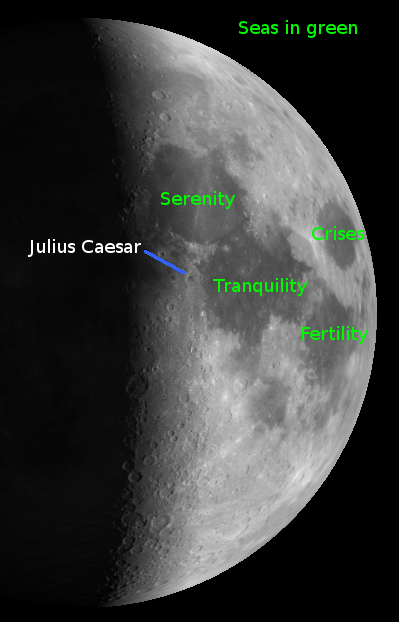
The moon at 10 p.m. 3/29/2012. Created using Virtual Moon Atlas.
03/28/2012 – Ephemeris – Where are the bright planets this week?
Ephemeris for Wednesday, March 28th. The sun will rise at 7:29. It’ll be up for 12 hours and 35 minutes, setting at 8:05. The moon, 2 days before first quarter, will set at 2:10 tomorrow morning.
Let’s see what’s happening with the bright planets for this week. Venus and Jupiter are separating in the western sky after sunset. Jupiter is below Venus, the brighter planet. Jupiter will set at 11:01 p.m. followed by Venus at 12:20 a.m. Mars is up in the southeast in the evening with its unmistakable bright reddish color. It’s in the constellation Leo the lion now. It is 68.3 million miles and moving away. Mars will pass due south at 11:43 p.m. and will be setting in the west at 6:37 a.m. Saturn will rise at 9:31 p.m. just to the left of the bright star Spica in the east southeast. It will pass due south at 3:01 We have 4 bright planets visible in the evening.
* Times are for the Traverse City/Interlochen area of Michigan. They may be different for your location.
Addendum
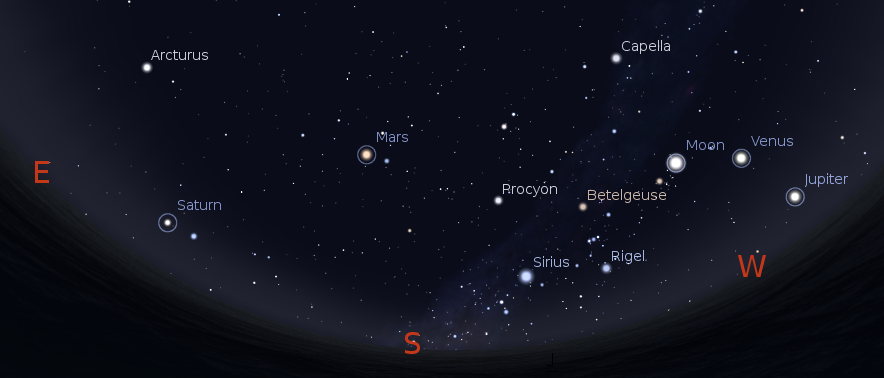
The stars and planets at 10:30 p.m. on 3/28/2012. Created using Stellarium,
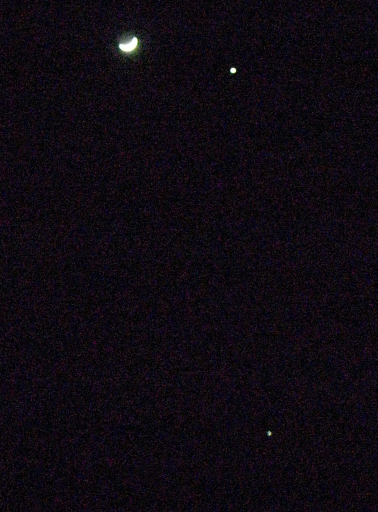
My photo of the moon, Venus and Jupiter last night
This was taken shortly after 9 p.m. with my Canon point &shoot type camera in manual mode. The moon is over exposed to get Jupiter at the bottom, but does show some earthshine.
03/27/2012 – Ephemeris – Supernova near the direction of Mars
Ephemeris for Tuesday, March 27th. The sun will rise at 7:31. It’ll be up for 12 hours and 32 minutes, setting at 8:04. The moon, 3 days before first quarter, will set at 1:19 tomorrow morning.
Last week a supernova was spotted in nearby galaxy M95, which happens to be close to the direction where Mars is right now. It takes a telescope of about 6 inch diameter to spot it. If you’d like to spot it, Google “M95 supernova” for more information on its exact location. Since discovery, astronomers have found the progenitor star on an old image of the galaxy taken by the Hubble Space Telescope. The star that blew itself up appears to have been 8 times the mass of the sun as determined by its color and brightness. We don’t have to worry about the sun doing the same thing, it’s simply not massive enough. It’s nice to live orbiting around a boring star of low mass. Our sun’s wildness is seen in the sunspot cycle.
* Times are for the Traverse City/Interlochen area of Michigan. They may be different for your location.
Addendum
Finder Charts
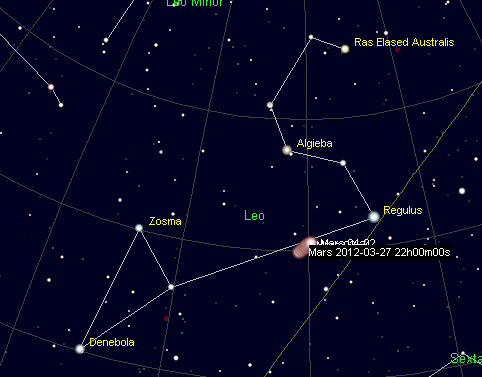
Mars' motion from March 26th to April 2nd 2012. Created using Cartes du Ciel.
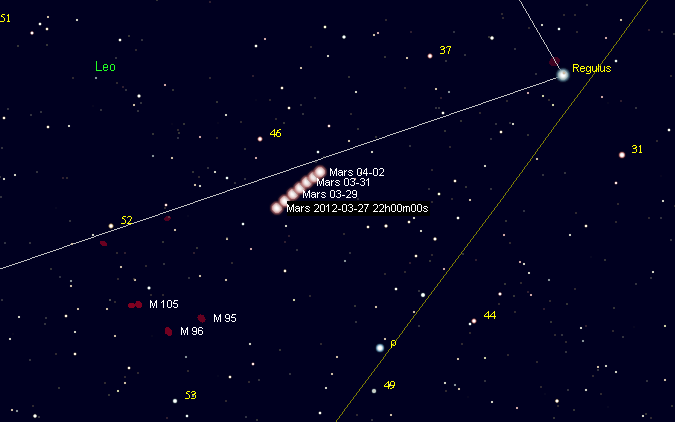
Closeup Mars and M95 for the dates March 27th to April 2nd 2012. Created using Cartes du Ciel.
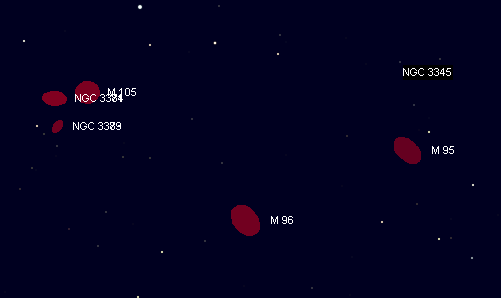
M95 and neighboring galaxies. The supernova will appear below M95. The faintest stars here are 10th magnitude. The supernova is about 12th. Created using Cartes du Ciel.
Google “M95 supernova” in Google images for what the supernova and galaxy look like.
03/26/2012 – Ephemeris – The moon will pass Venus today
Ephemeris for Monday, March 26th. The sun will rise at 7:33. It’ll be up for 12 hours and 29 minutes, setting at 8:03. The moon, half way from new to first quarter, will set at 12:25 tomorrow morning.
Yesterday the moon moved past Jupiter in the sky. Today the moon will pass Venus, the brightest planet. Check them out in the west southwest in the evening after sunset. Venus is going to be at greatest elongation from the sun tomorrow. Venus is at an angle of 46 degrees from the sun, and it will soon diminish. As it does, this is the best time to view Venus in a telescope. 400 years ago Galileo observed Venus with his small telescope and observed that Venus had phases like the moon, and its size changed proving that Venus orbited the sun and not the earth. You can repeat his observations this spring. Venus now appears about half illuminated by the sun, like the quarter moon. Its phase will thin and it will grow in size.
* Times are for the Traverse City/Interlochen area of Michigan. They may be different for your location.
Addendum
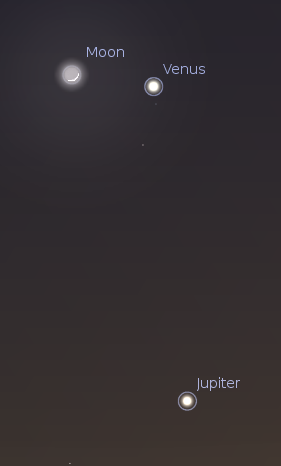
The Moon passing Venus with Jupiter below. Created using Stellarium.
03/23/2012 – Ephemeris – The moon will pass Jupiter Sunday Night
Ephemeris for Friday, March 23rd. The sun will rise at 7:39. It’ll be up for 12 hours and 20 minutes, setting at 7:59. The moon, 1 day past new, will set at 9:27 this evening.
The thin crescent moon is moving away from the setting sun in the west. By Sunday evening it will be to the upper right of Jupiter. In the moon’s monthly journey around the sun it passes each of the planets in turn, because the moon, earth and most of the planets lie very close to the same plane. The sun and the solar system condensed out of a cloud which spun in a flat disk. The sun had the most mass and began to glow as a star. The other material accreted into protoplanets, then into larger planets. Spiral galaxies also have this flattened appearance. It is the reason the Kepler satellite can pick up so many exoplanets around other stars. Of the tiny fraction of stellar planetary planes tilted our way, there can be multiple planets found in each.
* Times are for the Traverse City/Interlochen area of Michigan. They may be different for your location.
Addendum
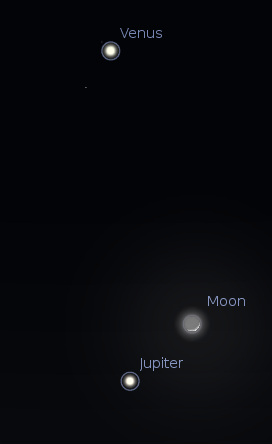
Jupiter and Moon march 25, 2012 at 10:15 p.m.. Created using Stellarium.
03/22/2012 – Ephemeris – Leo the lion and Mars
Ephemeris for Thursday, March 22nd. The sun will rise at 7:41. It’ll be up for 12 hours and 17 minutes, setting at 7:58. The moon is new today, and won’t be visible.
One of the great constellations of spring is up in the southeastern sky. This month Leo can be found by the bright planet Mars which adds a bright red star to the constellation. The head and mane of this beast is a backward question mark. It’s also known as the sickle. The bright star Regulus is at the bottom of this figure. It is now dimmer than Mars. To the east or left of Regulus and Mars is the triangle of stars that is his rump. The lion is special for several ancient cultures. Another way to find him when Mars isn’t around is to use the Bug Dipper, now soaring high in the northeast. Drill a hole in the bottom of the bowl of the dipper and imagine the water flowing out to the south and it will fall on the back of Leo the lion.
* Times are for the Traverse City/Interlochen area of Michigan. They may be different for your location.
Addendum
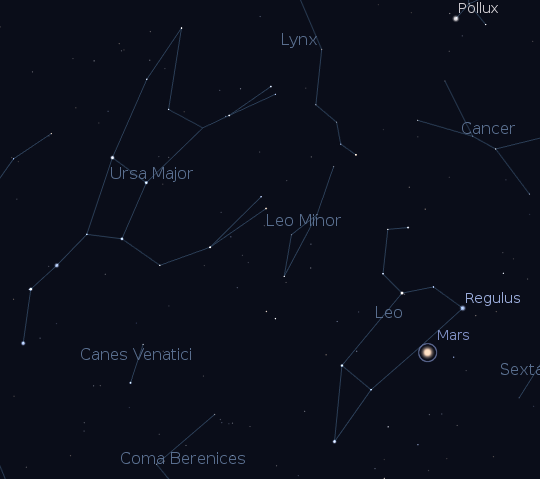
Mars and the constellation of Leo the lion March 22, 2012. Created using Stellarium.
03/21/2012 – Ephemeris – Where are the bright planets this week?
Ephemeris for Wednesday, March 21st. The sun will rise at 7:42. It’ll be up for 12 hours and 13 minutes, setting at 7:56. The moon, 1 day before new, will rise at 7:18 tomorrow morning.
Let’s see what’s happening with the bright planets for this week. Mercury will pass between the earth and the sun, and will enter the morning sky this afternoon, so is invisible. Venus and Jupiter are separating in the western sky after sunset. Jupiter is below of Venus, the brighter planet. Jupiter will set at 11:20 p.m. followed by Venus at 12:05 a.m. Mars is up in the southeast in the evening with its unmistakable bright reddish color. It’s in the constellation Leo the lion now. It is 65.2 million miles and moving away. Mars will pass due south at 12:23 a.m. and will be setting in the west at 7:15 a.m. Saturn will rise at 10:01 p.m. just to the left of the bright star Spica in the east southeast. We have 4 bright planets visible in the evening.
* Times are for the Traverse City/Interlochen area of Michigan. They may be different for your location.
Addendum
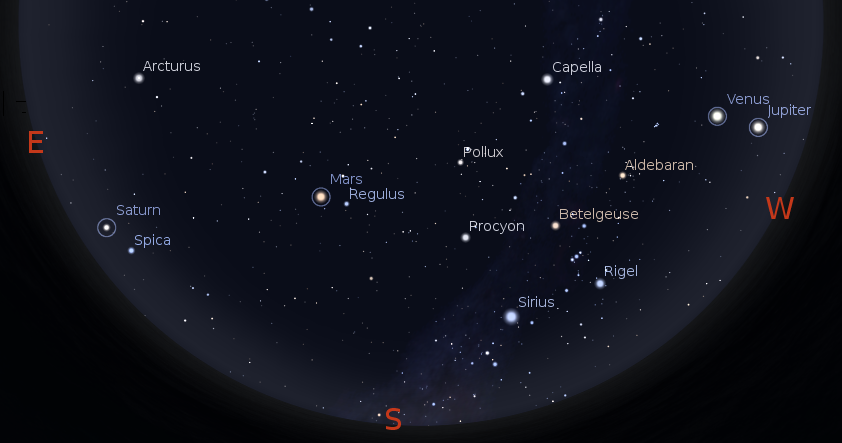
The planets visible at 10:30 p.m. March 21, 2012. Created using Stellarium.
Scott Anttila was photographing the red planet instead of drinking green beer on Srt. Patrick’s day night. Here is the result.
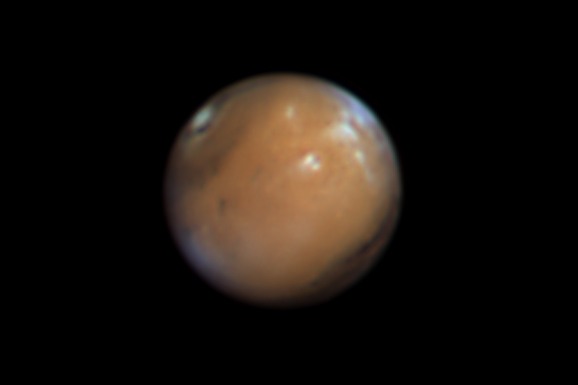
Mars on March 17, 2012 at 10:15 p.m. edt. Photo by Scott Anttila.
This I generally consider the bland side of Mars. However the white blotch near the center appears to be clouds over the largest mountain in the solar system Olympus Mons. I’m willing to bet the three white blotches to the right of it are clouds over the three Tharsis volcanoes, from top to bottom: Ascraeus Mons, Pavonis Mons and Arsia Mons.
03/20/2012 – Ephemeris – First day of spring
Ephemeris for Tuesday, March 20th. The sun will rise at 7:44. It’ll be up for 12 hours and 10 minutes, setting at 7:55. The moon, 2 days before new, will rise at 6:54 tomorrow morning.
At 1:14 this morning the season of spring started. The sun crossed the celestial equator heading northward. On the day of the equinox, either today’s vernal equinox or September’s autumnal equinox the sun rises due east and sets due west. From today until that September date the sun will rise and set north of those points. The sun will also rise higher in the sky until the summer solstice. The combination of longer daylight hours and it rising higher in the sky will mean more solar heat falling on the northern hemisphere of the earth and less falling on the southern. This will give us spring and summer, and the southern hemisphere autumn and winter. After a really screwy winter I wonder what spring and summer will bring.
* Times are for the Traverse City/Interlochen area of Michigan. They may be different for your location.
 Bob Moler's Ephemeris Blog