Archive
10/17/2012 – Ephemeris – Autumn wonders for binoculars or small telescope: The Alpha Persei Association
Ephemeris for Wednesday, October 17th. The sun will rise at 8:00. It’ll be up for 10 hours and 52 minutes, setting at 6:53. The moon, 2 days past new, will set at 8:21 this evening.
Let’s see how many bright planets we can find this week. At 8 p.m. Mars can be seen low in the southwest approaching another red star Antares, whose name means rival of Mars. They will be closest in a few days. The moon will be nearby too. Mars will set at 8:45. The planetary action moves to later in the evening and the morning. Jupiter, will rise at 9:17 p.m. in the east northeast. It is located in the constellation of Taurus. It will transit or pass due south at 4:52 a.m. The last bright planet of the night is the morning star Venus which will rise at 4:44 a.m. also in the east. Venus is now below the hind end of Leo. The planets Venus and Jupiter and the winter constellations are a great sight for early risers. You can enjoy for a few more weeks without danger of frost bite.
Times are for the Traverse City/Interlochen area of Michigan. They may be different for your location.
Addendum
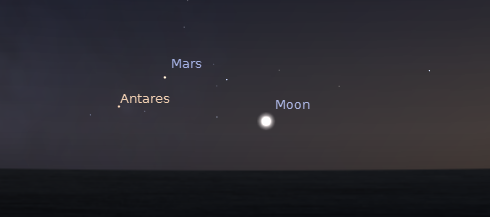
Mars, Antares, and the moon at 7:50 p.m. on October 17, 2012. Created using Stellarium.
The moon at this scale is over exposed.
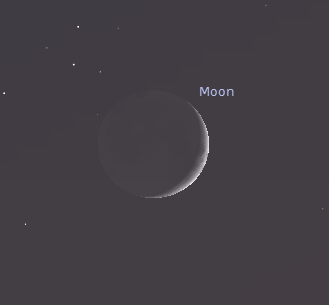
The actual phase of the moon in the chart above. Created using Stellarium.
The morning sky.
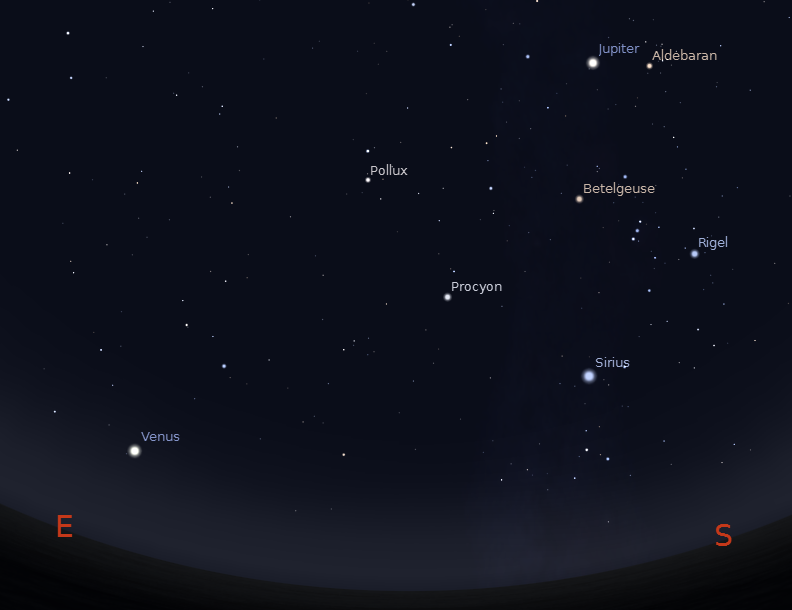
The morning skies including Jupiter and Venus at 6 a.m. on October 18, 2012. Created using Stellarium.
10/16/2012 – Ephemeris – Autumn wonders for binoculars or small telescope: The Pleiades
Ephemeris for Tuesday, October 16th. The sun will rise at 7:59. It’ll be up for 10 hours and 55 minutes, setting at 6:55. The moon, 1 day past new, will set at 7:33 this evening.
The most magnificent star cluster of the autumn sky is the Pleiades or Seven Sisters. At 10 p.m. It will appear as a close group of stars of a nebulous fuzz, depending your eyesight or sky conditions low in the east. It is the perfect binocular object, showing under good conditions a hundred more than the 7 brightest stars. Some mistake it for the Little Dipper because the stars do make a nearly handle less dipper. I tend to call it the Tiny Dipper. The stars in the Pleiades are less than half the age of the stars in the Double Cluster I talked about yesterday. The stars in the is cluster are about 100 million years old. Compared to the sun, these guys aren’t out of diapers yet. I’ll have lots more to to talk about the Pleiades as autumn wears on.
Times are for the Traverse City/Interlochen area of Michigan. They may be different for your location.
Addendum
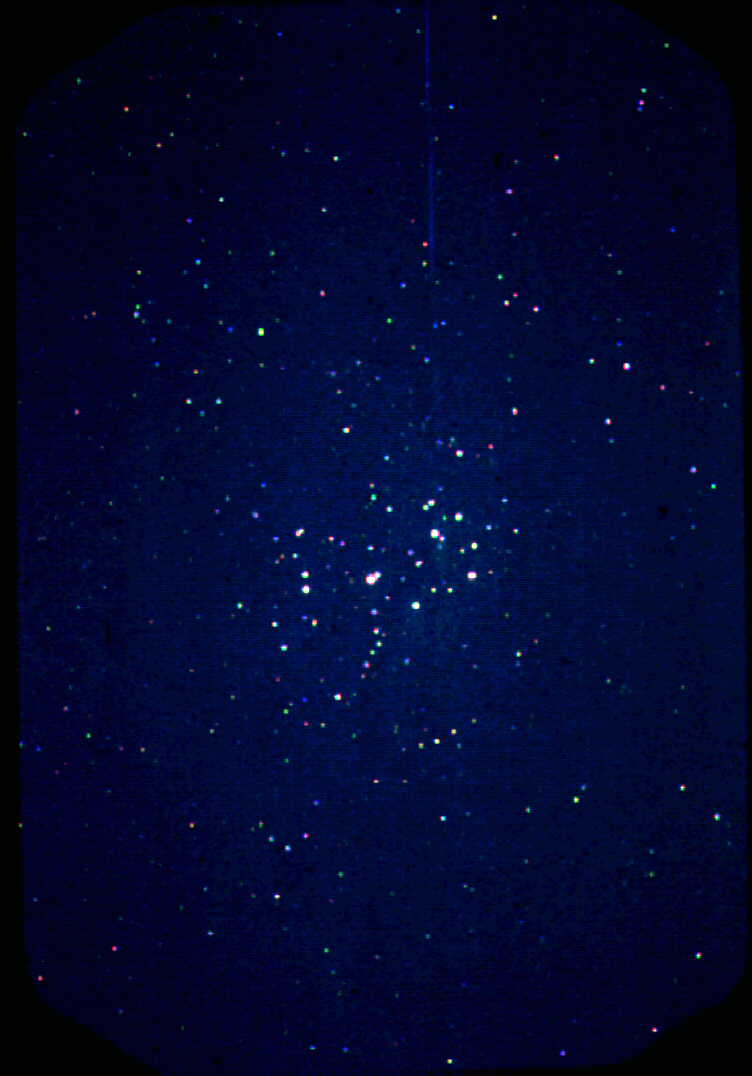
The Pleiades, about what you’d see in binoculars.
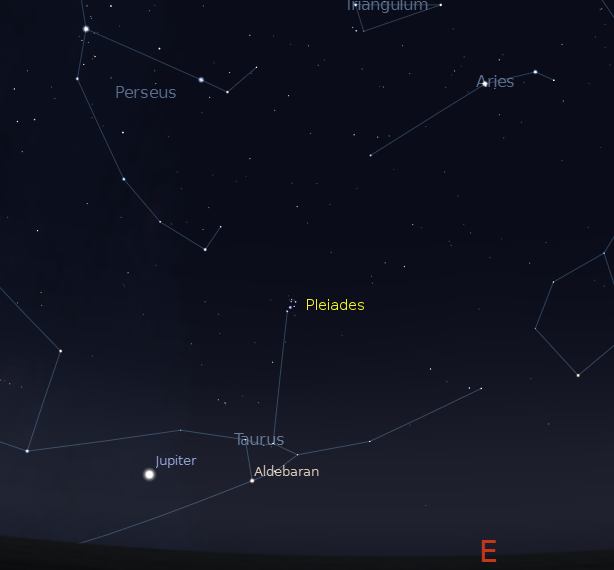
Pleiades and Jupiter at 10 p.m. October 16, 2012. Created using Stellarium.
10/15/2012 – Ephemeris – Autumn wonders for binoculars or small telescope: The Double Cluster
Ephemeris for Monday, October 15th. The sun will rise at 7:58. It’ll be up for 10 hours and 58 minutes, setting at 6:57. The moon is new today, and won’t be visible.
This week we’ll be looking at some of the wonders of the autumn sky that might better be seen in binoculars or a small telescope. Tonight we turn our attention to the Double Cluster, a fine pair of star clusters just below the W of the constellation of Cassiopeia the queen located in the northeast. Draw a vertical line down from the middle star of the W through the next star into the glow of the Milky Way. The Double Cluster appears to the unaided eye as a brighter glow of the Milky Way. This is confirmed with binoculars. But in a small telescope it becomes two piles of sparkling diamonds. The clusters are much younger than the sun so their brightest stars are blue-white to our eyes. The average distance of the two from earth is 7,200 light years and the are 1200 light years from each other.
Times are for the Traverse City/Interlochen area of Michigan. They may be different for your location.
Addendum
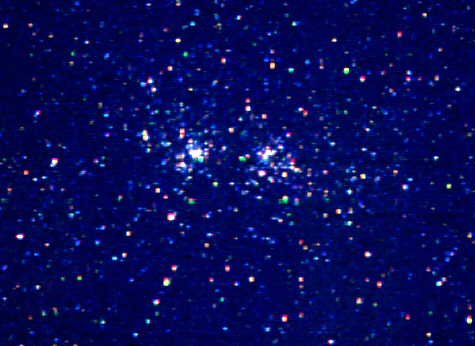
Double Cluster as it would be seen in a small telescope.
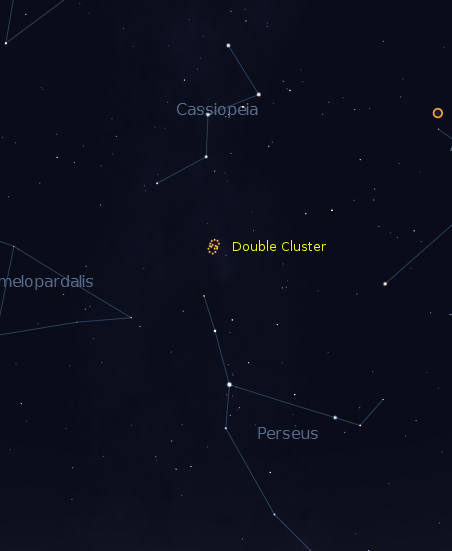
Chart for finding the Double cluster in October. Created using Stellarium.
10/12/2012 – Ephemeris – The constellation of Andromeda and its great galaxy
Ephemeris for Friday, October 12th. The sun will rise at 7:54. It’ll be up for 11 hours and 7 minutes, setting at 7:02. The moon, 3 days before new, will rise at 5:42 tomorrow morning.
In the east at 9 this evening can be found a large square of stars, the Great Square of Pegasus the flying horse. The square is standing on one corner. What look like its hind legs stretching to the left from the left corner star is another constellation, Andromeda the chained maiden. She is seen in the sky as two diverging curved strings of stars that curve upward. She was rescued by the hero Perseus, a nearby constellation, riding his steed Pegasus. Andromeda’s claim to astronomical fame is the large galaxy seen with the unaided eye just above the upper line of stars, the Great Andromeda Galaxy, nearly 2 and a half million light years away. To the unaided eye the galaxy appears as a small smudge of light. In binoculars the galaxy is a delicate spindle of light.
Times are for the Traverse City/Interlochen area of Michigan. They may be different for your location.
Addendum
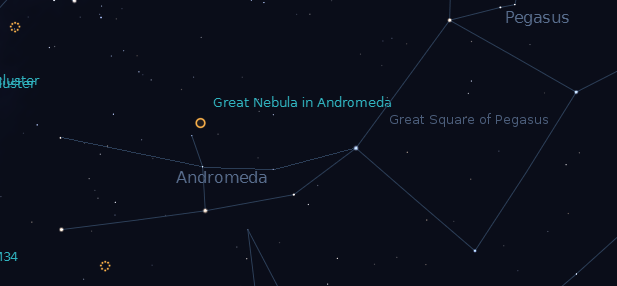
Andromeda at 9 p.m. with the Great Andromeda Galaxy. Created using Stellarium.
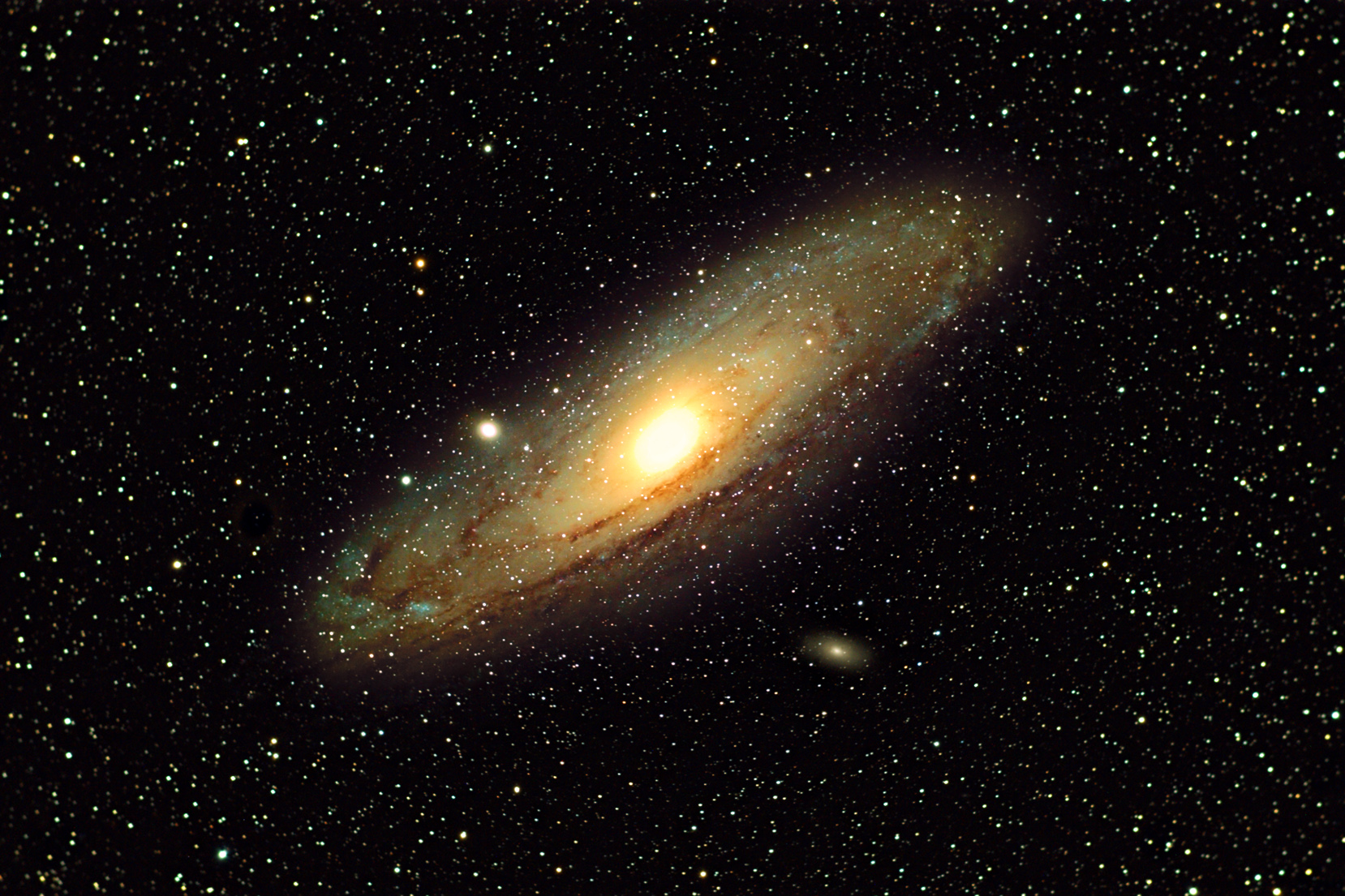
The Great Andromeda Galaxy (M31). Image taken by Scott Anttila.
The story of the Fisher Star
The Anishinaabe peoples have lived in the Great Lakes area since way before the coming of the Europeans. They are comprised of the Ojibwe, Ottawa, Chippewa and even Algonquin tribes. While some did see a bear in the stars and around the Big Dipper sans tail. Most of the stories concern the Fisher or Fisher Star.
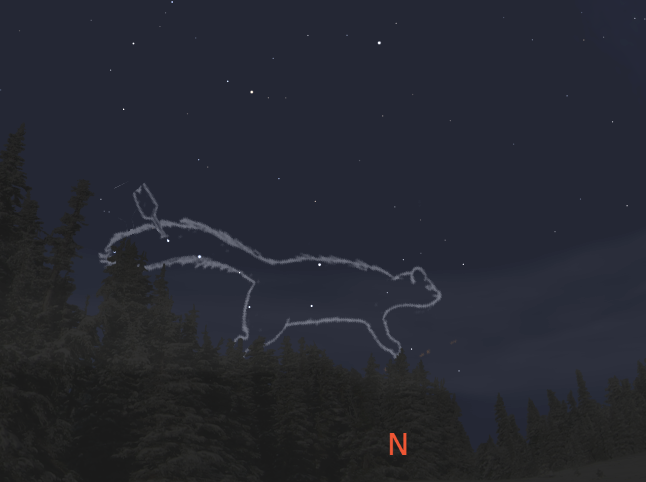
The Fisher Star in Autumn painting the leaves with his tail. Created using Stellarium and other sources.
By the way, the thee stars of the handle of the Big Dipper were hunters that were following the bear. The hunter denoted by the star Mizar at the bend in the handle of the dipper had a dog with him, the star we call Alcor, that make it an intriguing double for folks with good eyesight.
Fisher is supposed to be a weasel-like animal, intelligent, and a great hunter. He lived in a world that was snow covered and cold year round, where food was scarce. Perhaps this story is a cultural remembrance of the last glaciation period. Contrary to his name Fisher didn’t fish.
One day his son came to him with a request to bring summer, for he was cold and hungry. Fisher decided to somehow get to Skyland and tap into its warmth. He brought together his three bravest friends for the journey: Otter, Lynx, and Wolverine. They set out to seek the tallest mountains so they could reach Skyland.
When they had climbed the tallest mountain they found that Skyland was just out of reach. If they could only crack through. Otter tried first. He jumped first and bounced off. He fell back and slid completely down the mountain on his belly. It was so much fun that this is what otters do to this day. The lynx tried. He jumped up and hit his head and was knocked unconscious.
The wolverine was persistent. He jumped time after time and was finally able to chew a hole in the base of Skyland. When it was large enough he scampered through. Fisher was sure the hole wasn’t large enough, and that the inhabitants of Skyland would soon cover it up. So he chewed and chewed, enlarging the hole so the Skyland people couldn’t cover it for more than half the year.
As he was finishing up the hole the Skyland people discovered him. He boasted to them; “I am Fisher, the great hunter, you cannot catch me.” he jumped to the nearest tree and climbed to the top. The sky people shot arrows at him, but he had a special power making him impervious to arrows except for a particular spot on his tail. Kind of an Achilles tail, to mix my legends. Well, after some time the sky people got wise to Fisher’s protections and an arrow found the vulnerable spot in his tail and he fell out of the tree. Before Fisher’s body could fall to the ground the Great Spirit, Gitchee Manitou, caught him and placed him in the night sky to herald the seasons Fisher had created for the earth. In the sky Fisher’s tail is the handle of the Big Dipper. Tiny Alcor signifies the spot where the arrow hit. Every fall as Fisher’s tail passes over the northern horizon the blood in his wound paints the autumn leaves red. In late winter as he rises again in the northeast it is time to begin tapping the maple trees.
Sources: Keepers of the Earth, by Michael Caduto and Joseph Bruchac, and Anishinaabe Star Knowledge by Michael Wassegijig Price. Thanks also to Nodwese Red Bear.
10/11/2012 – Ephemeris – North American Nebula
Ephemeris for Thursday, October 11th. The sun will rise at 7:53. It’ll be up for 11 hours and 10 minutes, setting at 7:04. The moon, 3 days past last quarter, will rise at 4:30 tomorrow morning.
Most of what we see in the Milky Way are just masses of stars, but there are bright clouds of gas , or to name them properly: emission nebulae. These bright clouds are areas of star formation. It is the ultraviolet light from young massive stars that light up the clouds they were formed from. A bright one, easily visible in binoculars is just about overhead at 9 p.m. Called the North American Nebula, a glow shaped much like our continent just east of the star Deneb, the northernmost star of the Summer Triangle, and brightest star in Cygnus the swan or Northern Cross. There are many other nebulae in the Milky Way, visible in binoculars and small telescopes. Many enjoyable hours can be spent sweeping the Milky Way for nebulae and star clusters.
Times are for the Traverse City/Interlochen area of Michigan. They may be different for your location.
Addendum
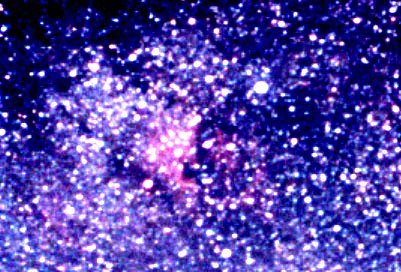
North American Nebula in Red. My old image.
The red object is the North American Nebula. Our eyes cannot perceive the color, due to hydrogen. This was a time exposure on film without telephoto. The bright star to the upper right is Deneb. The orientation is approximately correct if facing south. The photo also shows the stars that make up the glow of the Milky Way to the unaided eye.
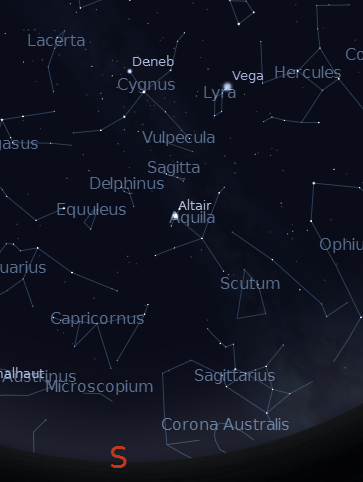
Deneb Overhead at 9 p.m. on October 11. Created using Stellarium.
The North American Nebula is about the size and position of the C in Cygnus.
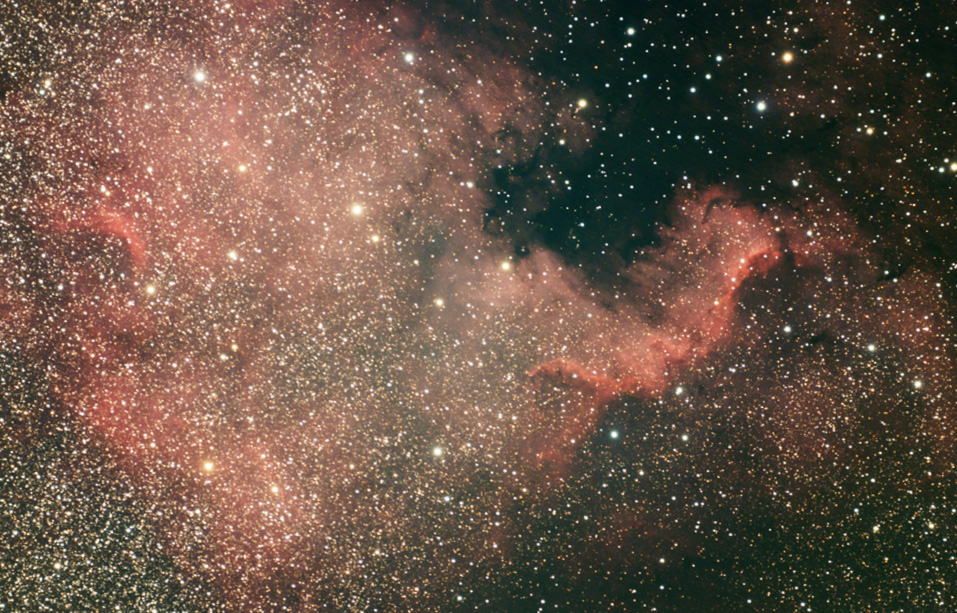
Better view of the North American Nebula taken by Scott Anttila.
This nebula is cataloged as NGC 7000.
10/10/2012 – Ephemeris – Where are the bright planets this week?
Oct 10. This is Bob Moler with Ephemeris for Wednesday, October 10th. The sun will rise at 7:52. It’ll be up for 11 hours and 13 minutes, setting at 7:05. The moon, 2 days past last quarter, will rise at 3:22 tomorrow morning.
Let’s see how many bright planets we can find this week. Mars and Saturn now set too close to the sun to be easily seen in the evening sky. Both are in the west southwestern sky and very low in twilight. Saturn will set at 7:45 p.m., while Mars will set at 8:56. The planetary action moves to later in the evening and the morning. Jupiter, will rise at 9:45 p.m. in the east northeast. It is located in the constellation of Taurus. The last bright planet of the night is the morning star Venus which will rise at 4:28 a.m. also in the east northeast. Venus is now in Leo outshining the star Regulus next to it. The planets Venus and Jupiter and the winter constellations are a great sight for early risers. You can enjoy for a few more weeks without danger of frost bite.
Times are for the Traverse City/Interlochen area of Michigan. They may be different for your location.
Addendum
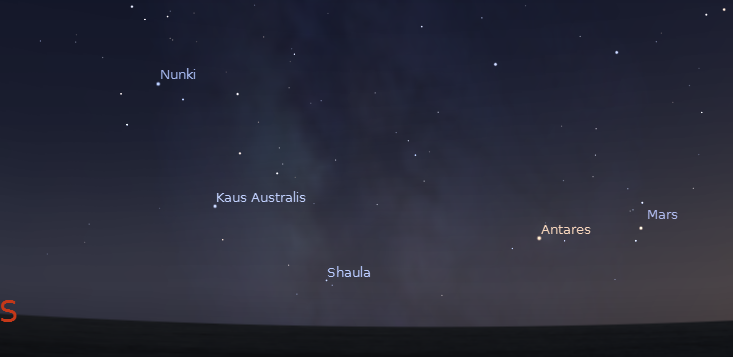
Mars is approaching Antares at 8 p.m. on October 10, 2012. Created using Stellarium.
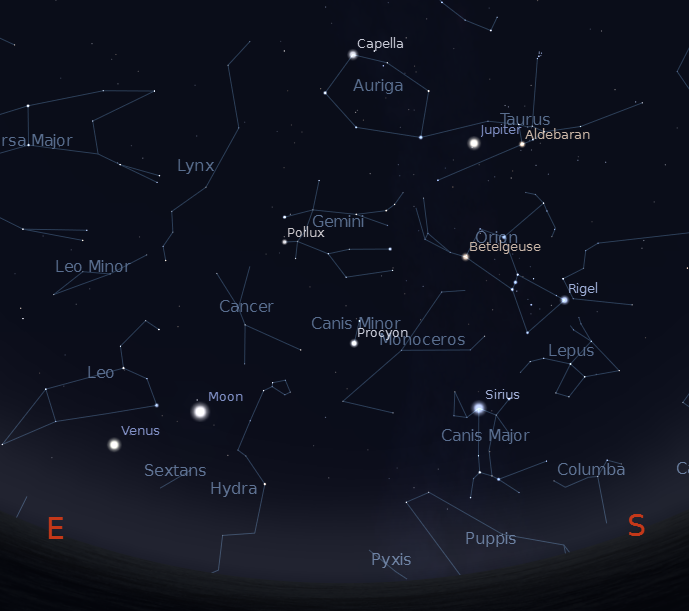
Morning Sky at 6 a.m. with Jupiter and Venus on October 11, 2012. Created using Stellarium.
Note that the moon is really a thin crescent and is over blown at this scale.
10/09/2012 – Ephemeris – Capricornus the sea-goat
Ephemeris for Tuesday, October 9th. The sun will rise at 7:50. It’ll be up for 11 hours and 16 minutes, setting at 7:07. The moon, 1 day past last quarter, will rise at 2:16 tomorrow morning.
The sky around 9 p.m. when it gets dark is that of summer stars overhead and to the west while the stars of autumn approach from the east. The southern terminus of the Milky Way will reach the horizon in the southwest. The teapot shaped constellation of Sagittarius is tipped as if pouring its contents on the southwestern horizon. To the south is found the next constellation of the Zodiac Capricornus the sea goat. Capricornus doesn’t have as bright a stars as Sagittarius. It looks like the stars trace a sagging triangle. Capricornus used to be the southernmost constellation of the Zodiac in ancient times, but precession, the slow wobbling of the earth’s axis, has shifted Sagittarius to that position now.
Times are for the Traverse City/Interlochen area of Michigan. They may be different for your location.
Addendum
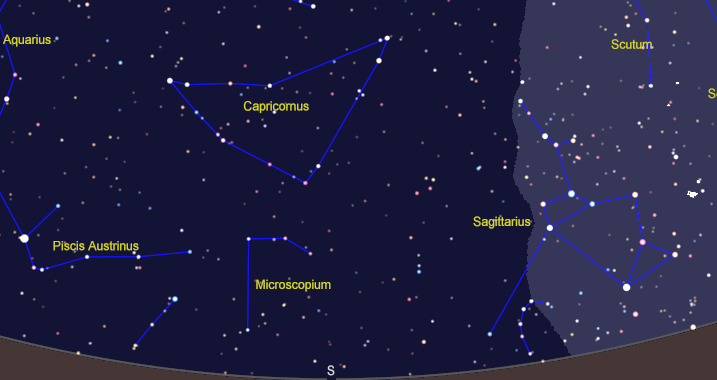
Capricornus the way I see it. Created using Cartes duCiel.
10/08/2012 – Ephemeris – The Draconid Meteor Shower
Ephemeris for Columbus Day, Monday, October 8th. The sun will rise at 7:49. It’ll be up for 11 hours and 19 minutes, setting at 7:09. The moon, at last quarter today, will rise at 1:13 tomorrow morning.
The peak of the Draconid meteor shower is about now, (6-7 a.m. when the program airs) as the radiant point for these meteors is low in the north. They will be visible for the next few days seeming to radiate from the head of the constellation Draco, near the star Vega high in the west. These meteors are best about every 7 years, the last was last year. So maybe we may see 15 to 20 of these meteors per hour this time. These meteors are debris shed by Comet Giacobini-Zinner a short period comet of only 6.6 years. These meteors are very slow moving, about a third the velocity of the Perseid meteors of August. Meteors are the light given off by tiny bits of material sand grain to pea size as a rule as they burn up by friction due to their great speed.
Times are for the Traverse City/Interlochen area of Michigan. They may be different for your location.
Addendum
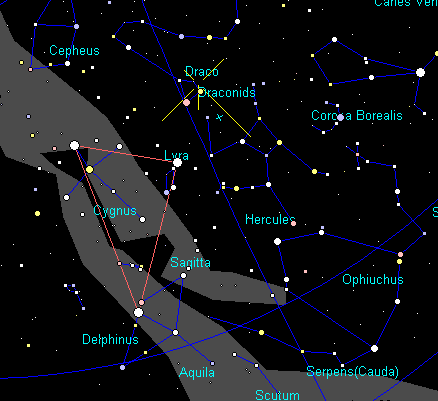
Draconid Meteor Shower Radiant
10/05/2012 – Ephemeris – Tonight’s astronomical events in Traverse City
Ephemeris for Wednesday, October 3rd. The sun will rise at 7:43. It’ll be up for 11 hours and 35 minutes, setting at 7:18. The moon, 4 days past full, will rise at 8:59 this evening.
Let’s see how many bright planets we can find this week. Mars and Saturn now set too close to the sun to be easily seen in the evening sky. Both are in the west southwestern sky and very low in twilight. Saturn sets at 8:10 p.m., while Mars sets at 9:08. The planetary action moves to later in the evening and the morning. Jupiter, will rise at 10:09 p.m. in the east northeast. It is located in the constellation of Taurus. The last bright planet of the night is the morning star Venus which will rise at 4:13 a.m. also in the east northeast. Venus is now in Leo outshining the star Regulus next to it. The planets Venus and Jupiter and the winter constellations are a great sight for early risers. You can enjoy them without danger of frost bite.
Times are for the Traverse City/Interlochen area of Michigan. They may be different for your location.
Addendum
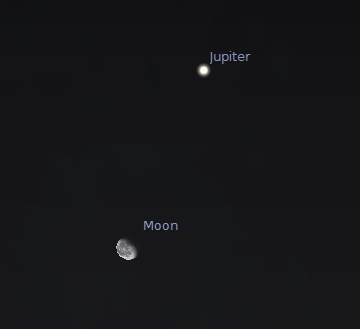
Jupiter and the waning gibbous moon at 11 p.m. October 5, 2012. Created using Stellarium.
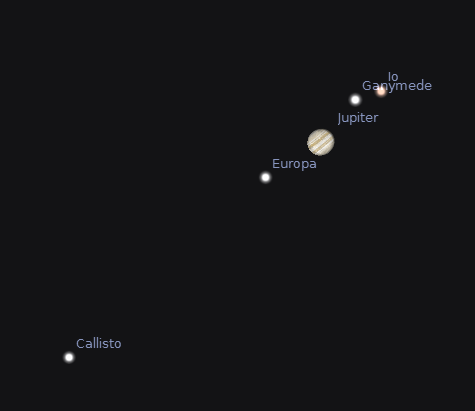
Jupiter with its moons at 11 p.m. October 5, 2012. Created using Stellarium. Stellarium shows the moons much brighter than they actually appear. compared to Jupiter.
 Bob Moler's Ephemeris Blog