Archive
01/31/2013 – Ephemeris – Preview of February Skies
Ephemeris for Thursday, January 31st. The sun will rise at 8:02. It’ll be up for 9 hours and 48 minutes, setting at 5:50. The moon, 3 days before last quarter, will rise at 11:06 this evening.
February is the shortest month, even so the daylight hours through out the month will be getting longer. Daylight hours will increase from 9 hours and 50 minutes tomorrow to 11 hours and 7 minutes on the 28th. The sunrise time will decrease from 8:00 tomorrow to 7:21 at months end. The sunset times will increase from 5:51 tomorrow to 6:28 on the 28th. Along with that the altitude of the sun at noon will increase from 28 degrees today to nearly 38 degrees at month’s end. It will be a degree lower for folks in the Straits area because they are a degree of latitude farther north. Local noon, by the way for Interlochen and Traverse City is about 12:55 p.m. We are expecting clearer skies later this month as the lakes cool.
Times are for the Traverse City/Interlochen area of Michigan. They may be different for your location.
Addendum
Ephemeris of Sky Events for NMC Observatory, Traverse City MI |
||||||||||
| February, 2013 – Local time zone: EST | ||||||||||
|---|---|---|---|---|---|---|---|---|---|---|
| Date | Sun | Twilight* | Moon | Illum | ||||||
| Rise | Set | Hours | End | Start | Phase | R/S** | Time | Fractn | ||
| Fri | 1 | 08:00a | 05:51p | 09:50 | 07:31p | 06:20a | Rise | 12:15a | 67% | |
| Sat | 2 | 07:59a | 05:53p | 09:53 | 07:33p | 06:19a | Rise | 01:25a | 57% | |
| Sun | 3 | 07:58a | 05:54p | 09:55 | 07:34p | 06:18a | L Qtr | Rise | 02:34a | 45% |
| Mon | 4 | 07:57a | 05:56p | 09:58 | 07:35p | 06:17a | Rise | 03:41a | 34% | |
| Tue | 5 | 07:56a | 05:57p | 10:01 | 07:36p | 06:16a | Rise | 04:42a | 24% | |
| Wed | 6 | 07:54a | 05:58p | 10:03 | 07:38p | 06:15a | Rise | 05:36a | 15% | |
| Thu | 7 | 07:53a | 06:00p | 10:06 | 07:39p | 06:14a | Rise | 06:22a | 7% | |
| Fri | 8 | 07:52a | 06:01p | 10:09 | 07:40p | 06:13a | Rise | 07:01a | 2% | |
| Sat | 9 | 07:50a | 06:03p | 10:12 | 07:41p | 06:12a | Rise | 07:36a | 0% | |
| Sun | 10 | 07:49a | 06:04p | 10:15 | 07:43p | 06:11a | New | Set | 06:58p | 1% |
| Mon | 11 | 07:48a | 06:05p | 10:17 | 07:44p | 06:09a | Set | 08:09p | 4% | |
| Tue | 12 | 07:46a | 06:07p | 10:20 | 07:45p | 06:08a | Set | 09:17p | 9% | |
| Wed | 13 | 07:45a | 06:08p | 10:23 | 07:46p | 06:07a | Set | 10:23p | 16% | |
| Thu | 14 | 07:43a | 06:10p | 10:26 | 07:48p | 06:05a | Set | 11:27p | 24% | |
| Fri | 15 | 07:42a | 06:11p | 10:29 | 07:49p | 06:04a | Set | 12:29a | 33% | |
| Sat | 16 | 07:40a | 06:12p | 10:32 | 07:50p | 06:03a | Set | 01:28a | 42% | |
| Sun | 17 | 07:39a | 06:14p | 10:35 | 07:51p | 06:01a | F Qtr | Set | 02:23a | 51% |
| Mon | 18 | 07:37a | 06:15p | 10:38 | 07:53p | 06:00a | Set | 03:15a | 61% | |
| Tue | 19 | 07:36a | 06:17p | 10:41 | 07:54p | 05:58a | Set | 04:01a | 70% | |
| Wed | 20 | 07:34a | 06:18p | 10:43 | 07:55p | 05:57a | Set | 04:43a | 78% | |
| Thu | 21 | 07:32a | 06:19p | 10:46 | 07:57p | 05:55a | Set | 05:21a | 85% | |
| Fri | 22 | 07:31a | 06:21p | 10:49 | 07:58p | 05:54a | Set | 05:55a | 91% | |
| Sat | 23 | 07:29a | 06:22p | 10:52 | 07:59p | 05:52a | Set | 06:26a | 96% | |
| Sun | 24 | 07:27a | 06:23p | 10:55 | 08:01p | 05:51a | Set | 06:54a | 99% | |
| Mon | 25 | 07:26a | 06:25p | 10:58 | 08:02p | 05:49a | Full | Rise | 06:40p | 100% |
| Tue | 26 | 07:24a | 06:26p | 11:02 | 08:03p | 05:47a | Rise | 07:47p | 98% | |
| Wed | 27 | 07:22a | 06:27p | 11:05 | 08:04p | 05:46a | Rise | 08:56p | 95% | |
| Thu | 28 | 07:21a | 06:29p | 11:08 | 08:06p | 05:44a | Rise | 10:06p | 89% | |
| * Astronomical Twilight | ||||||||||
| ** Moonrise or moonset, whichever occurs between sunset and sunrise | ||||||||||
01/30/2013 – Ephemeris – Where are the bright planets this week?
Ephemeris for Wednesday, January 30th. The sun will rise at 8:03. It’ll be up for 9 hours and 45 minutes, setting at 5:48. The moon, half way from full to last quarter, will rise at 9:58 this evening.
Let’s check out the planets for this week. Mars can be seen low in the west southwest. It will set at 7:15 p.m, two minutes later than last week because Mars is moving northward. The sun is gaining on it since it sets 10 minutes later each week. Jupiter will be visible in the southeast as it gets dark. Jupiter is located in the constellation of Taurus and moves from the southeast to the high south southwest during the evening. It will transit or pass due south at 8:15 p.m, and will set at 3:45 a.m. Jupiter is a wonderful sight in telescopes with its cloud bands and its moons which change positions each night. Saturn will be the next planet to rise at 1:24 a.m. in the east southeast. It’s located in eastern Virgo. Saturn will pass due south at 6:38 a.m.
Times are for the Traverse City/Interlochen area of Michigan. They may be different for your location.
Addendum
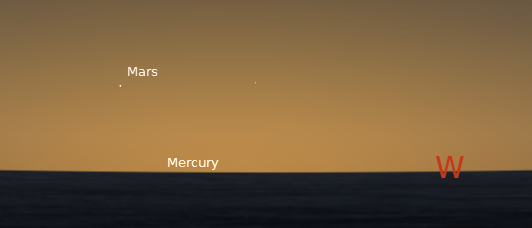
Mars low in the west southwest with Mercury just below the horizon at 6:30 p.m. on January 30, 2013. Created using Stellarium.
On February 8th Mercury will appear closest to Mars. Mercury’s greatest elongation from the sun will be on February 16th.
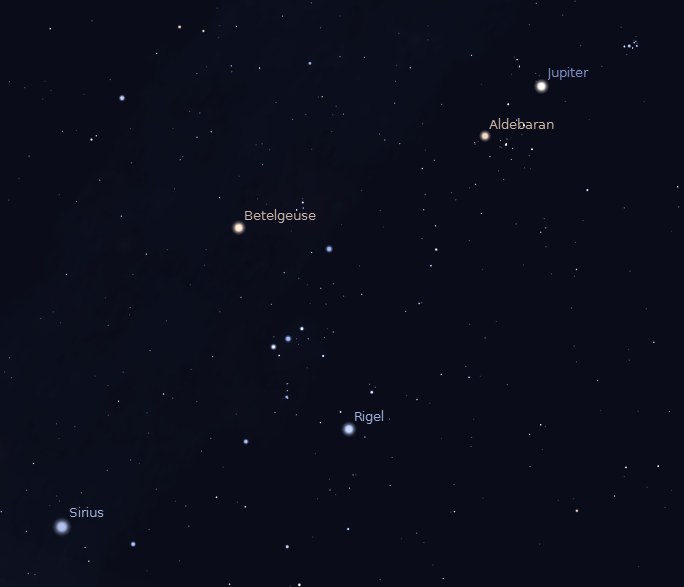
Jupiter and the stars of Taurus and Orion at 9 p.m. on January 30, 2013. Created using Stellarium.
Also see the Pleiades right and just above Jupiter.
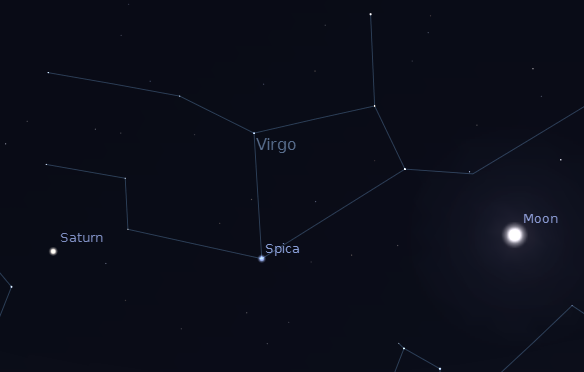
Saturn and the moon in Virgo at 6 a.m. on January 31, 2013. Created using Stellarium.
The moon will pass Saturn Sunday morning February 3rd.
01/29/2013 – Ephemeris – Procyon, the Little Dog Star
Ephemeris for Tuesday, January 29th. The sun will rise at 8:04. It’ll be up for 9 hours and 43 minutes, setting at 5:47. The moon, 3 days past full, will rise at 8:52 this evening.
The constellation Orion has two hunting dogs. We’ve seen Canis Major the greater dog at Orion’s feet with Sirius in its heart. The lesser dog, Canis Minor iS level with Betelgeuse in Orion’s shoulder and off to the left. Just two stars mark it. Is it a dachshund or maybe a hot dog? It’s brighter star’s name is Procyon which means “Before the dog”, an odd title. It means that though east of Sirius, it rises before Sirius, due to its more northerly position in the sky. In many ways Procyon is nearly a twin of Sirius. It shines with the same white color, although a bit cooler, and has a white dwarf companion like Sirius. It’s a bit farther away than Sirius 8 light years. Procyon is at a distance of 11.46 light years. Procyon, Betelgeuse and Sirius make the winter triangle.
Times are for the Traverse City/Interlochen area of Michigan. They may be different for your location.
Addendum
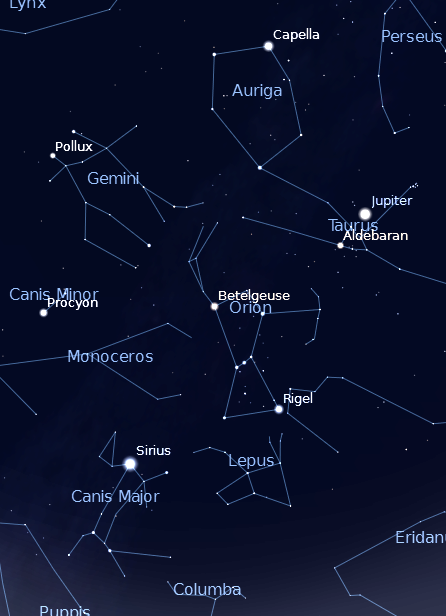
Winter Circle and Jupiter with Procyon to the far left. Created using Stellarium.
01/28/2013 – Ephemeris – Jupiter the largest planet
Ephemeris for Monday, January 28th. The sun will rise at 8:05. It’ll be up for 9 hours and 40 minutes, setting at 5:46. The moon, 2 days past full, will rise at 7:47 this evening.
The planet Jupiter is the largest, most massive planet in the solar system. It contains more mass that all the other planets, asteroids, and moons twice over. As Isaac Asimov once said: “The solar system contains the sun, Jupiter and debris.” Jupiter, named after the king of the Roman gods, processes majestically through the Zodiac, spending about one year in each of the constellations. This year it’s Taurus, next year it will be Gemini. Saturn, on the other hand limps along, taking nearly 30 years to make the same circuit. It’s the god of old age. Jupiter throws its weight around. It’s responsible for the asteroid belt, keeping a planet from forming there. It deflects some comets from the inner solar system, but also sends others on in.
Times are for the Traverse City/Interlochen area of Michigan. They may be different for your location.
Addendum
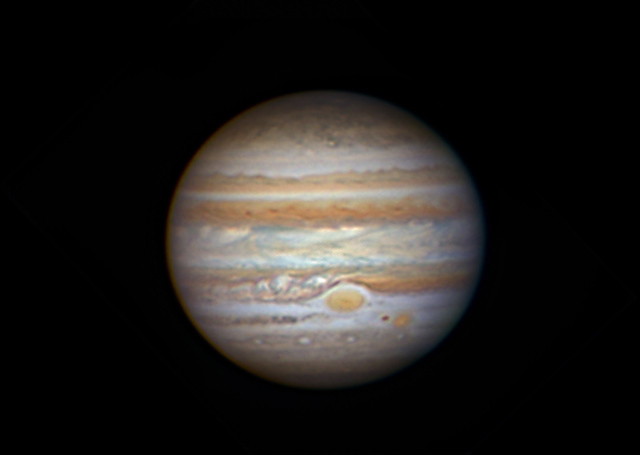
Jupiter with its Great Red Spot November 18, 2012 by Scott Anttila.
01/25/2013 – Ephemeris – The star names of Orion
Ephemeris for Friday, January 25th. The sun will rise at 8:08. It’ll be up for 9 hours and 33 minutes, setting at 5:42. The moon, 1 day before full, will set at 7:23 tomorrow morning.
The constellation of Orion the hunter is visible in the south at 9 p.m. The stars of Orion are interesting in themselves. Starting at the top left of the seven bright stars of Orion’s torso is Betelgeuse the bright red star, whose name means something like “Armpit of the Giant”. The star in Orion’s other shoulder is Bellatrix the “Amazon Star”. Below are the three stars of Orion’s belt, from left to right; Alnitak, Alnilam and Mintaka. Their names mean “Girdle”, “Belt of Pearls”, and “Belt” respectively. Down to Orion’s knees we look on the left to the star Saiph which means “Sword”, though it is some ways from the stars of Orion’s sword. Finally there’s the bright blue-white star Rigel whose name means “left Leg of the Giant”.
Times are for the Traverse City/Interlochen area of Michigan. They may be different for your location.
Addendum
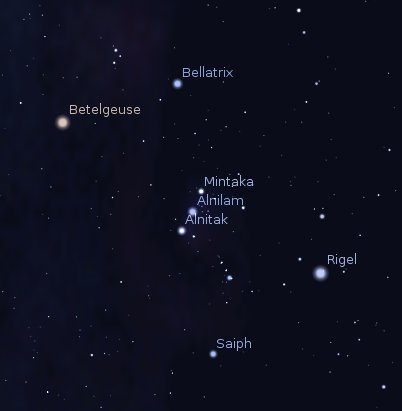
Orion with star names
01/24/2013 – Ephemeris – Sirius B, the Pup
Ephemeris for Thursday, January 24th. The sun will rise at 8:09. It’ll be up for 9 hours and 31 minutes, setting at 5:40. The moon, 2 days before full, will set at 6:48 tomorrow morning.
Sirius is the brightest night-time star and is located in the south at 9 p.m. below and a bit left of Orion the Hunter. We’ve visited Sirius Tuesday. But there is another star in the Sirius system that is practically invisible due to Sirius’ dazzling glare. Its name is Sirius B, nicknamed the Pup, alluding to Sirius’ Dog Star title. The tiny star was suspected as far back as 1834 due to Sirius’ wavy path against the more distant stars. Sirius and the Pup have 50 year orbits of each other. The Pup was first seen by famed 19th century telescope maker Alvan Clark in 1862 while testing a new telescope. The Pup was the first of a new class of stars to be discovered, white dwarfs. The Pup, with the mass of the sun, is only the size of the earth.
Times are for the Traverse City/Interlochen area of Michigan. They may be different for your location.
Addendum

Sirius A and B (near the diffraction spike to the lower left), A Hubble Space Telescope photograph. Credit NASA, ESA.
The Hubble Space Telescope has two mirrors to produce its main image. The concave primary mirror, and a secondary mirror in front supported by 4 vanes called a spider. Light passing these vanes are bent or diffracted causing bright stars to have these 4 spikes. Most reflecting telescopes produce these diffraction spikes.
01/23/2013 – Ephemeris – Where are the bright planets this week?
Ephemeris for Wednesday, January 23rd. The sun will rise at 8:10. It’ll be up for 9 hours and 29 minutes, setting at 5:39. The moon, 3 days before full, will set at 6:08 tomorrow morning.
Let’s check out the planets for this week. Mars can be seen low in the southwest. It will set at 7:13 p.m, two minutes later than last week because Mars is moving northward. The sun will eventually catch up with it in mid April. Even before you can spot Mars, bright Jupiter will be visible in the southeast. Jupiter is located in the constellation of Taurus and moves from the southeast to the high south southwest during the evening. It will transit or pass due south at 8:46 p.m, and will set at 4:17 a.m. Jupiter is a wonderful sight in telescopes with its cloud bands and its moons which change positions each night. Saturn will be the next planet to rise at 1:54 a.m. in the east southeast. It’s located in eastern Virgo. Venus is now too close to the sun to be seen.
Times are for the Traverse City/Interlochen area of Michigan. They may be different for your location.
Addendum
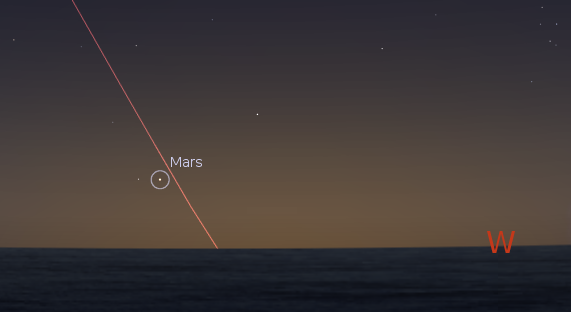
Mars at 6:30 p.m. on January 23, 2013. Note the steep angle of the ecliptic (in red) the line near which the planets are found. It’s heading northward as Mars moves to the upper left against the stars. Created using Stellarium.
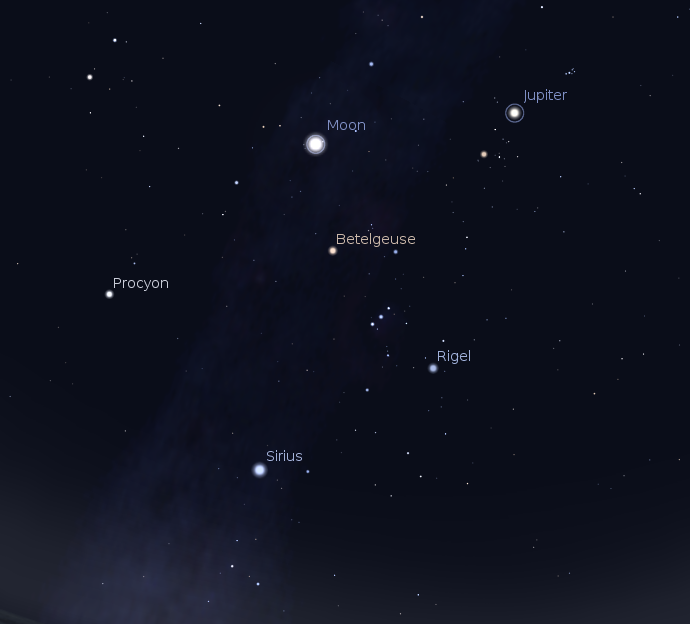
Jupiter, the moon and the winter stars at 9 p.m. on January 23, 2013. Created using Stellarium.
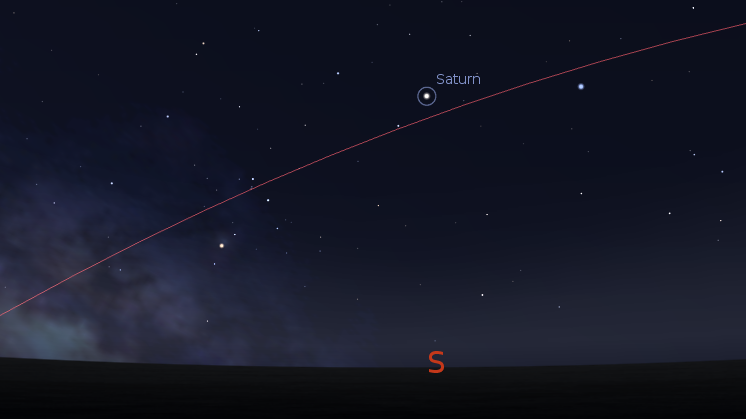
Saturn at 7 a.m. on January 24, 2013. Note the shallowness of the ecliptic compared to the evening sky in the first image. Created using Stellarium.
01/22/2013 – Ephemeris – Sirius the Dog Star
Ephemeris for Tuesday, January 22nd. The sun will rise at 8:10. It’ll be up for 9 hours and 27 minutes, setting at 5:37. The moon, half way from first quarter to full, will set at 5:23 tomorrow morning.
The brightest star-like object in the evening sky is Jupiter high in the sky now. The second brightest star-like object is Sirius, also known as the Dog Star. It also is the brightest night-time star in our skies period. Tonight at 9 p.m. it’s located low in the southeastern sky. The Dog Star name comes from its position at the heart of the constellation Canis Major, the great dog of Orion the hunter. The three stars of Orion’s belt tilt to the southeast and point to Sirius. The name Sirius means ‘Dazzling One’ or ‘Scorcher’, a reference to its great brilliance and twinkling. Its Egyptian name was Sothis, and its appearance in the dawn skies in late June signaled the flooding of the Nile, and the beginning of the Egyptian agricultural year.
Times are for the Traverse City/Interlochen area of Michigan. They may be different for your location.
Addendum
Winter Circle and Jupiter with Sirius at the bottom. Created using Stellarium.
01/21/2013 – Ephemeris – MLK Day, Jupiter above the Moon tonight
Ephemeris for Martin Luther King Day and Inauguration Day, Monday, January 21st. The sun will rise at 8:11. It’ll be up for 9 hours and 24 minutes, setting at 5:36. The moon, 3 days past first quarter, will set at 4:33 tomorrow morning.
Today is the holiday commemorating the life of Dr. Martin Luther King Jr., and his struggle for civil rights. Today we will have the second inauguration of the first African American President. Another chapter in the struggle for the equality of all people. Back before the Civil War, runaway slaves used the stars to steer their flight northward. The prominent pattern of northern stars that aided their journey was the Drinking Gourd. We know it as the Big Dipper. which is starting to rise higher in the northeast. Also in the sky tonight the planet Jupiter will appear above the moon, their closest approach will be at 10:30 p.m. For us closest approach will be at 2 moon diameters. A couple of thousand miles south of here the moon will cover the planet.
Times are for the Traverse City/Interlochen area of Michigan. They may be different for your location.
Addendum
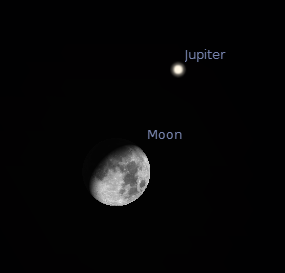
Jupiter and the moon at 10:30 p.m. January 21, 2013. Created using Stellarium.
01/18/2013 – Ephemeris – Aldebaran, Taurus’ angry read eye
Ephemeris for Friday, January 18th. The sun will rise at 8:13. It’ll be up for 9 hours and 18 minutes, setting at 5:32. The moon, at first quarter today, will set at 1:42 tomorrow morning.
The bright orange star Aldebaran is the most westerly bright star of winter Aldebaran appears at the upper left tip of a letter V group of stars that is the face of the bull, his angry red eye. Aldebaran isn’t actually part of the group, called the Hyades star cluster. Aldebaran is 65 light years away, less than half the distance of the Hyades. The name Aldebaran means “The Follower” because it follows the Pleiades across the skies. The Pleiades is the brightest star cluster in Taurus, also known as the Seven Sisters. Aldebaran has an orange hue because its surface is cooler than the sun’s. However Aldebaran is 44 times larger in diameter, and shines 500 times brighter than the sun. It’s the type of star that’s in the red giant phase of life.
Times are for the Traverse City/Interlochen area of Michigan. They may be different for your location.
Addendum
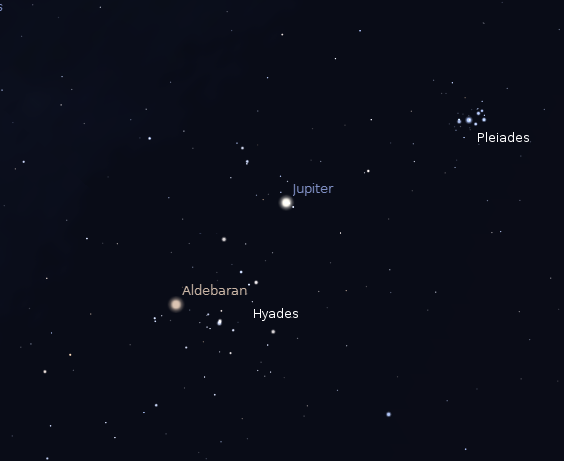
Aldebaran,Jupiter, the Hyades, and the Pleiades on January 18 2913. Created using Stellarium.
 Bob Moler's Ephemeris Blog