Archive
06/28/2013 – Ephemeris – Vega and Lyra the harp
Ephemeris for Friday, June 28th. Today the sun will be up for 15 hours and 31 minutes, setting at 9:31. The moon, 2 days before last quarter, will rise at 12:43 tomorrow morning. Tomorrow the sun will rise at 6:00.
One of the first stars visible when twilight fades is Vega. It will be east of the zenith and is perfectly white. Another bright star with a yellow-orange hue is to the west of the zenith. That’s Arcturus. We’re concentrating on Vega now. It is in a small constellation called Lyra the harp or lyre. Just off to the southeast of Vega as it gets dark is a narrow parallelogram of stars that make up the body of this celestial instrument. A dim star next to Vega completes the constellation. Take good look at it in binoculars and the star near Vega appears as two. It’s Epsilon Lyrae. Each can be split again in a telescope. Lyra has another wonder, but that will have to wait for another time.
Times are for the Traverse City/Interlochen area of Michigan. They may be different for your location.
Addendum
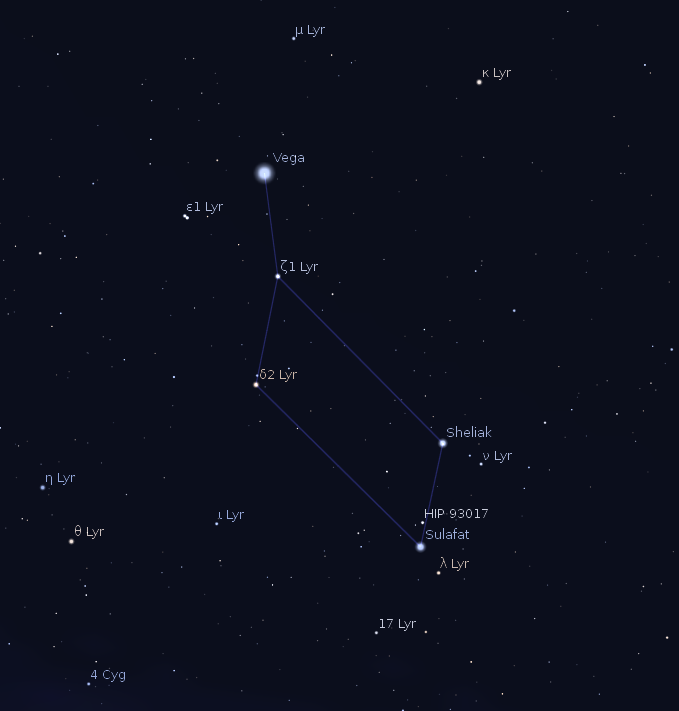
Magnified view of Lyra. Created using Stellarium.
Epsilon Lyra is the closest star to Vega. Look closely, because it’s double. The funny characters next to “Lyr” are lower case Greek letters Epsilon is the Greek letter “e”. The one next to it is the slightly brightest star of the pair. The Greek letter designations are from Johannes Bayer’s 1603 atlas. The number designations are Flamsteed numbers. There’s other stars with proper names. The HIP number is from the Hipparcos catalog, a relatively new catalog.
06/26/2013 – Ephemeris – Latest sunset and the Summer Triangle
Ephemeris for Thursday, June 27th. Today the sun will be up for 15 hours and 32 minutes, setting at 9:31. The moon, 3 days before last quarter, will rise at 12:14 tomorrow morning. Tomorrow the sun will rise at 5:59.
Last night we had the latest sunset of the year. The sun is really beginning to head south. Other than the sunrise and sunset numbers, we’ll begin to notice it for real in a few weeks. At first that realization strikes me a sad note that summer is beginning to end. However the astronomer in me realizes that means more night-time hours, and that the summer Milky Way is coming. Of the three bright stars of the Summer Triangle overhead and in the east, two of its stars are in the milky band. They are Deneb to the north and Altair to the south. Vega, closest to the zenith is not in the band. Actually all the stars we see with the naked eye or small telescopes belong to the Milky Way galaxy.
Times are for the Traverse City/Interlochen area of Michigan. They may be different for your location.
Addendum
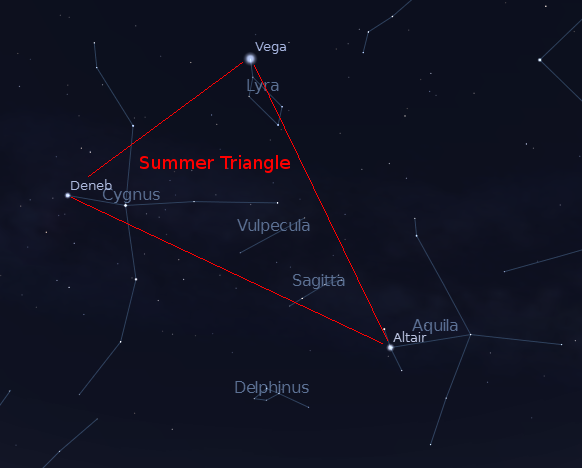
The Summer Triangle at 11 p.m. Created using Stellaruim and The Gimp.
06/26/2013 – Ephemeris – Then there was one
Wednesday, June 26th. Today the sun will be up for 15 hours and 32 minutes, setting at 9:31. The moon, 3 days past full, will rise at 11:42 this evening. Tomorrow the sun will rise at 5:59.
Venus is now all alone in the evening twilight low in the west northwest, Mercury having sunk closer to the sun. Venus will set at 11:05 p.m. Holding forth in the south southwest will be Saturn this evening, the brightest star-like object in the constellation Virgo appearing yellowish to the left of the extremely blue-white star Spica. Saturn is a wonderful sight in a telescope of 20 power or more. Saturn will pass due south at 9:36 p.m., and will set at 2:54 tomorrow morning. Jupiter and Mars are along with Mercury too close to the direction of the sun to be seen. I will cover Jupiter and Mars emerging into the morning sky late next month when they’ll appear together.
Times are for the Traverse City/Interlochen area of Michigan. They may be different for your location.
Addendum
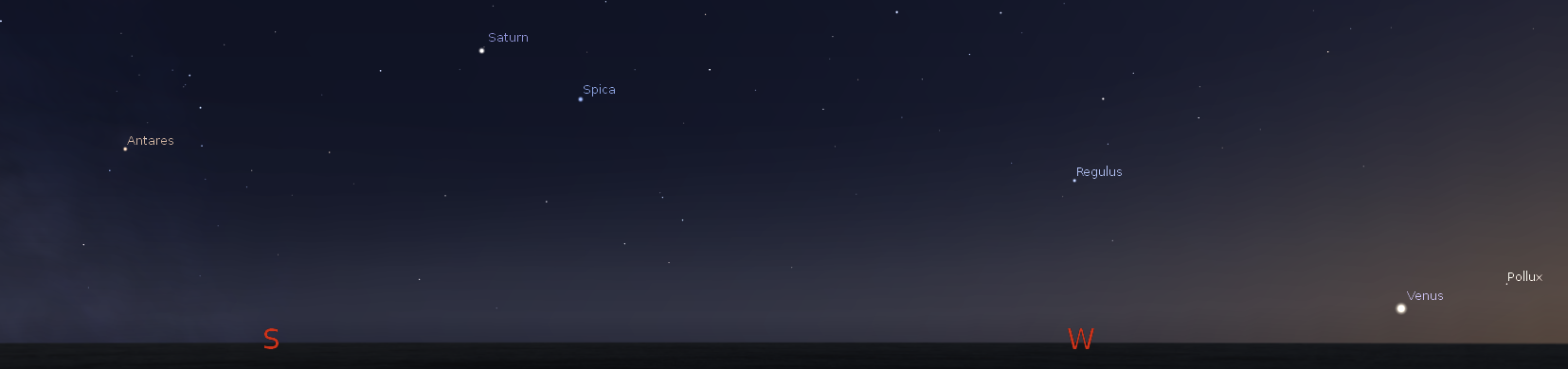
Panorama from Antares to Saturn to Venus at 10:45 p.m. on June 26, 2013. Created using Stellarium. Click on image to expand.
06/25/2013 – Ephemeris – Noctilucent Clouds
Ephemeris for Tuesday, June 25th. Today the sun will be up for 15 hours and 33 minutes, setting at 9:31. The moon, 2 days past full, will rise at 11:07 this evening. Tomorrow the sun will rise at 5:58.
This time of year one can see, on rare occasions, some ghostly clouds called noctilucent clouds. Noctilucent means night shining. These are silvery clouds that can be seen near the end of twilight. We’re a bit south of the prime latitudes to see them from 50 to 70 degrees both north and south of the equator. I’ve seen them but a few times. They move rather rapidly, even though they’re at an altitude of around 50 miles. The clouds appear to be made of ice crystals that possibly form around meteoritic dust or volcanic ash. Their appearance cannot be predicted, but be aware that they may appear near the end of twilight and they are white, move rapidly, and are not the twilit clouds lower down.
Times are for the Traverse City/Interlochen area of Michigan. They may be different for your location.
Addendum
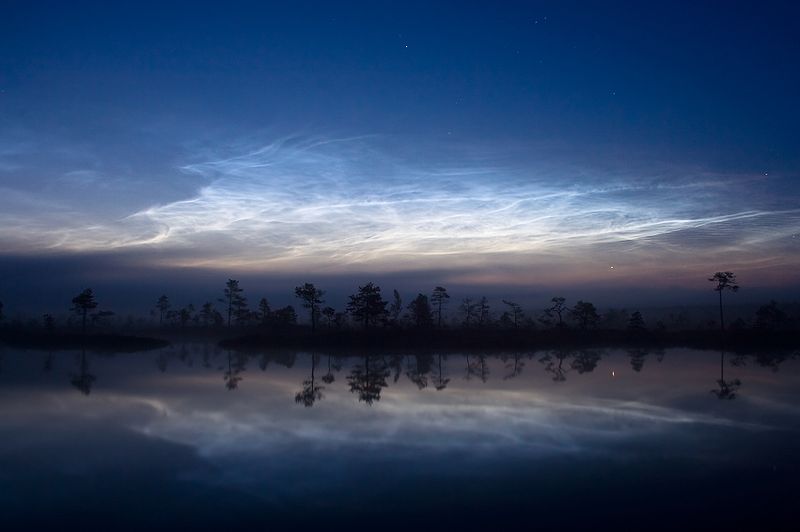
Noctilucent clouds, Kuresoo bog, Soomaa National Park, Estonia. July 26, 2009 by Martin Koitmäe. From Wikimedia Commons.
06/24/2013 – Ephemeris – Infrared astronomy
Ephemeris for Monday, June 24th. Today the sun will be up for 15 hours and 33 minutes, setting at 9:31. The moon, 1 day past full, will rise at 10:27 this evening. Tomorrow the sun will rise at 5:58.
During most of history astronomers viewed the heavens in visible light. That’s all we had, our eyes, later augmented by telescopes, and photography. Today astronomers view the heavens with a myriad of detectors on the earth, above the earth and inside the earth. Radiation detected, beside visible are radio, infrared, ultraviolet, x-rays, and gamma rays, all part of the electromagnetic spectrum as is visible light. Besides that the observe neutrinos and cosmic rays, and are searching for gravitational waves. An intense field of study now is infrared, which must be observed from high mountaintops or from space. Last year I visited one of those facilities at nearly 14,000 feet altitude the observatories atop Mauna Kea in Hawaii. [Which included the two largest telescopes in the world the twin 10 meter Keck telescopes, Gemini North, Subaru and other telescopes. ]
Times are for the Traverse City/Interlochen area of Michigan. They may be different for your location.
Addendum
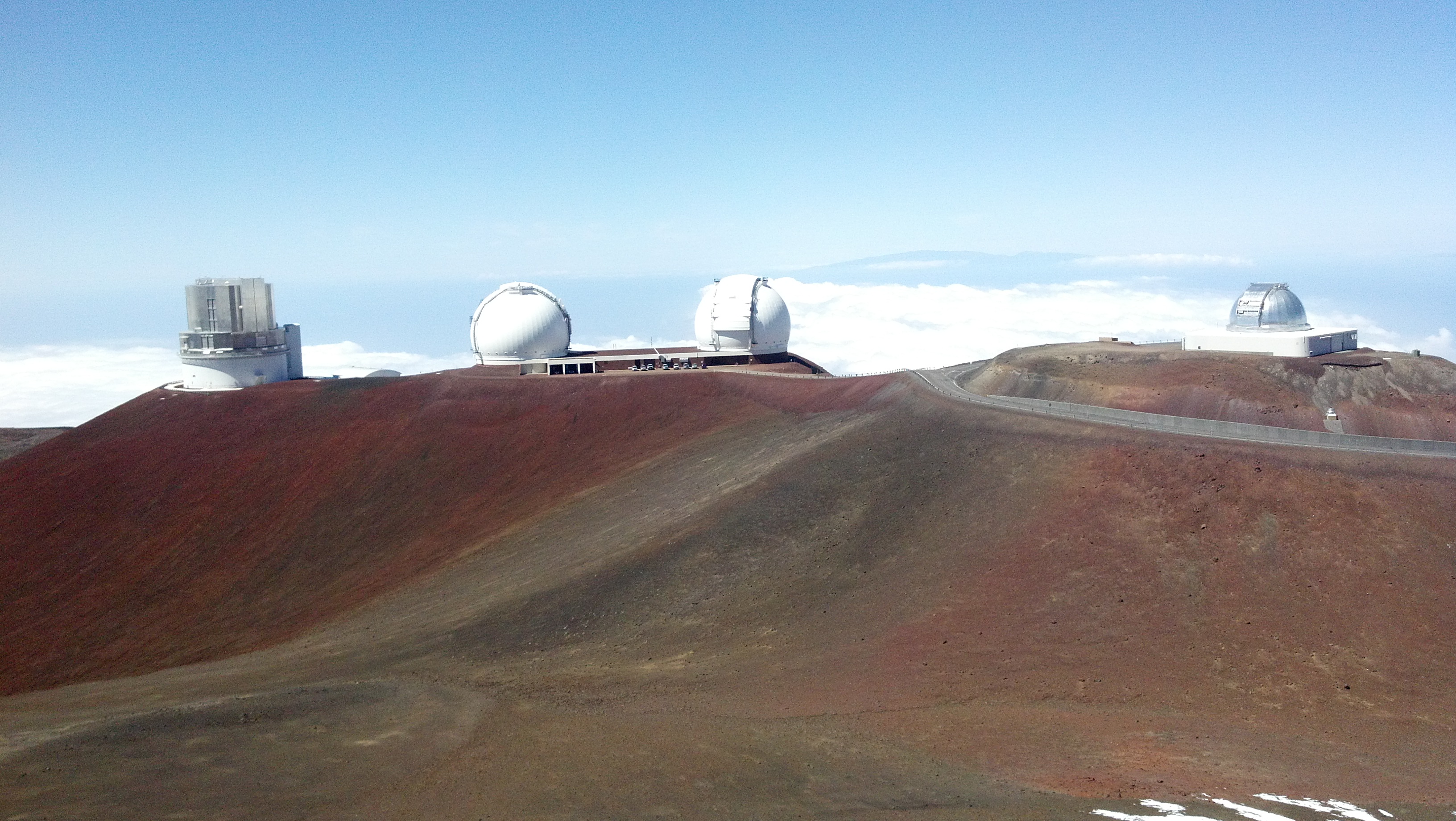
The twin domes of the Keck 10 meter telescopes. Left is the Japanese Subaru telescope. Right is the NASA Infrared Telescope facility. Credit: Bob Moler. Click to enlarge.
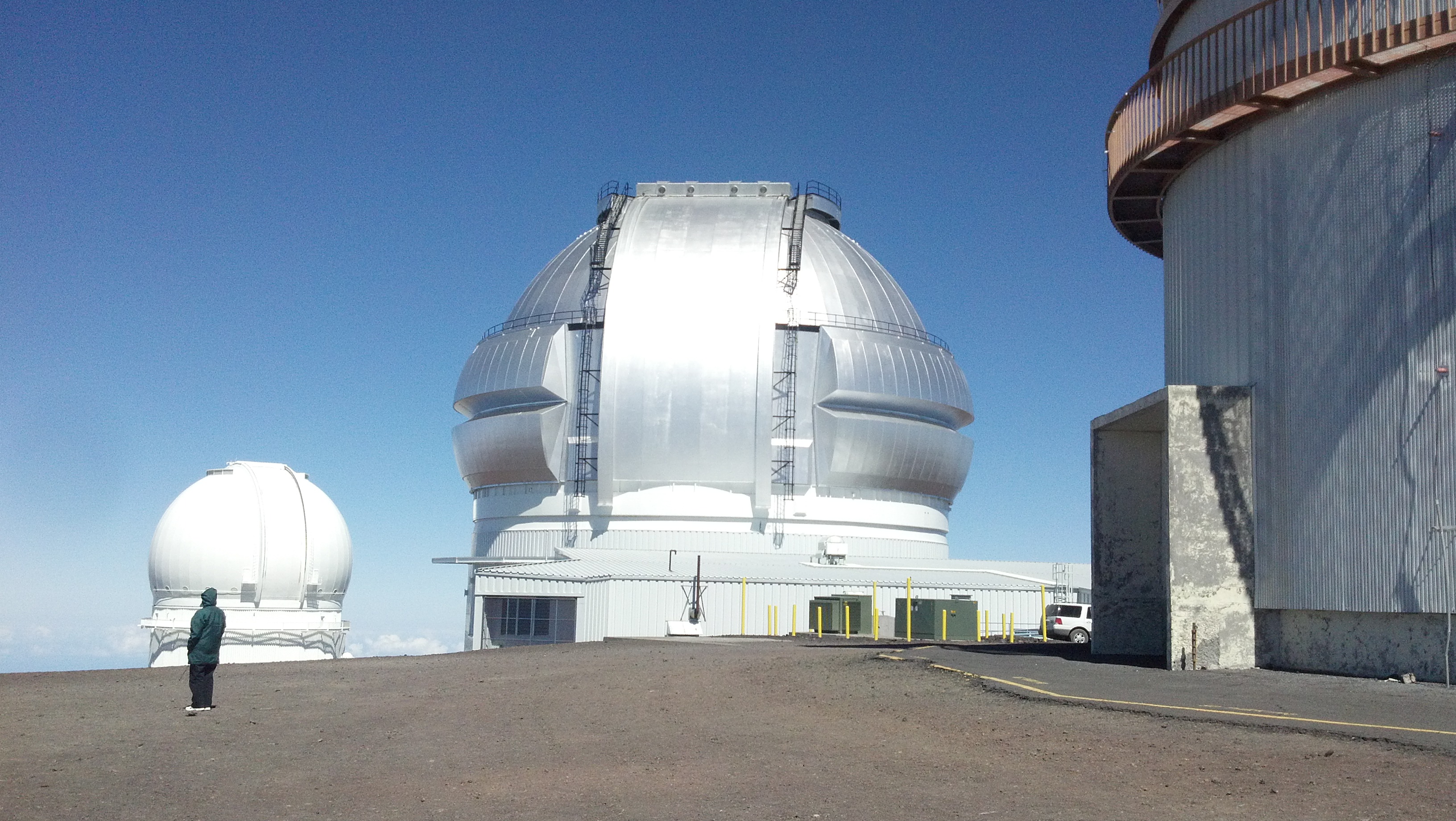
The 8.1 meter Gemini North telescope dome in the center. To the left is the Canada-France-Hawaii Telescope dome. Credit: Bob Moler.
06/21/2013 – Ephemeris – Seasons and the height of the sun
Ephemeris for Friday, June 21st. Today the sun will be up for 15 hours and 33 minutes, setting at 9:31. The moon, 2 days before full, will set at 5:11 tomorrow morning. Tomorrow the sun will rise at 5:57.
Happy summer. It began at 1:04 this morning. The sun is at its highest at noon, well local solar noon that is, which is 1:44 p.m. in the Interlochen Traverse City area. At that time the sun will reach an altitude or angle above the southern horizon of nearly 69 degrees. If you want to get an idea of the difference between that and the sun at the winter solstice, check out the moon tonight. It is almost to the point in the sky where the sun was at the winter solstice. Notice how low it is in the sky, and how few hours it is up. The cause is the tilt of the earth’s axis of 23 and a half degrees. It gives us a 47 degree span of altitudes of the sun over the year. It is not the sun’s distance that causes seasons, as we’ll see next month.
Times are for the Traverse City/Interlochen area of Michigan. They may be different for your location.
Addendum
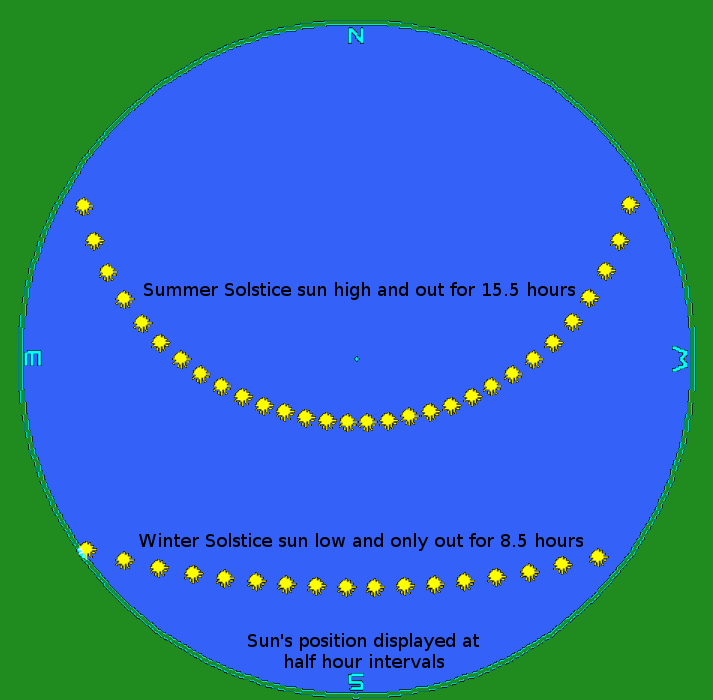
Comparing the sun’s path at the summer and winter solstices. This is a stereographic representation of the whole sky which distorts the sky and magnifies the size of the sun’s path near the horizon.
06/20/2013 – Ephemeris – Summer starts tomorrow
Ephemeris for Thursday, June 20th. Today the sun will be up for 15 hours and 33 minutes, setting at 9:31. The moon, 3 days before full, will set at 4:15 tomorrow morning. Tomorrow the sun will rise at 5:57.
Summer will arrive overnight at 1:04 a.m. tomorrow morning when the sun will reach its highest point in the northern sky. If you were watching the sun’s shadow of a flag pole at local noon, when the sun is due south, it would be getting shorter every day since the winter solstice back on December 21st. From tomorrow until the next winter solstice that shadow will be getting longer. We are getting the most heat from the sun now due to the length of daylight and the high altitude of the sun most of the day. Because the earth and water takes time to heat up, we are not experiencing our greatest temperatures yet. That will take a month or a month and a half. That’s why solstice just starts summer and is not at the peak of it.
Times are for the Traverse City/Interlochen area of Michigan. They may be different for your location.
Addendum
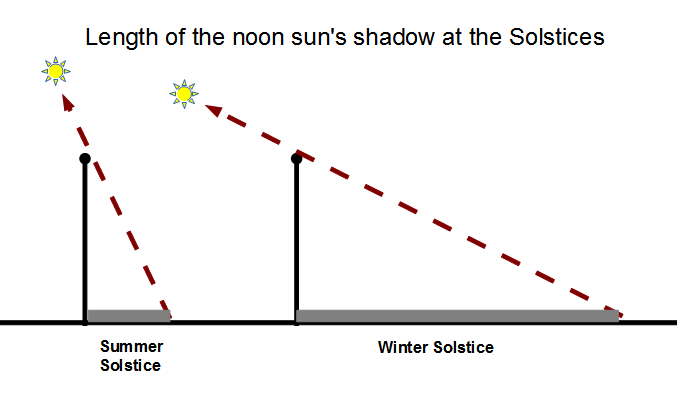
Comparison of shadows between winter and summer solstices. Note the angles are approximate.
06/19/2013 – Ephemeris – Mercury and Venus one last time
Ephemeris for Wednesday, June 19th. Today the sun will be up for 15 hours and 33 minutes, setting at 9:30. The moon, 3 days past first quarter, will set at 3:28 tomorrow morning. Tomorrow the sun will rise at 5:57.
The early evening will still be taken up with Venus and faint Mercury low in the west northwest at about 10:15 p.m. Mercury is below and left of Venus by 2 degrees, about 4 times the width of the moon. Mercury has dropped greatly in brightness as its phase is now a crescent, moving between the sun and the earth. Mercury will set at 10:56, and Venus will set at 11:03 p.m. Holding forth in the south will be Saturn this evening, the brightest star-like object in the constellation Virgo appearing yellowish to the left of the extremely blue-white star Spica. Saturn is a wonderful sight in a telescope of 20 power or more. Saturn will pass due south at 10:04 p.m., and will set at 3:23 tomorrow morning.
Times are for the Traverse City/Interlochen area of Michigan. They may be different for your location.
Addendum
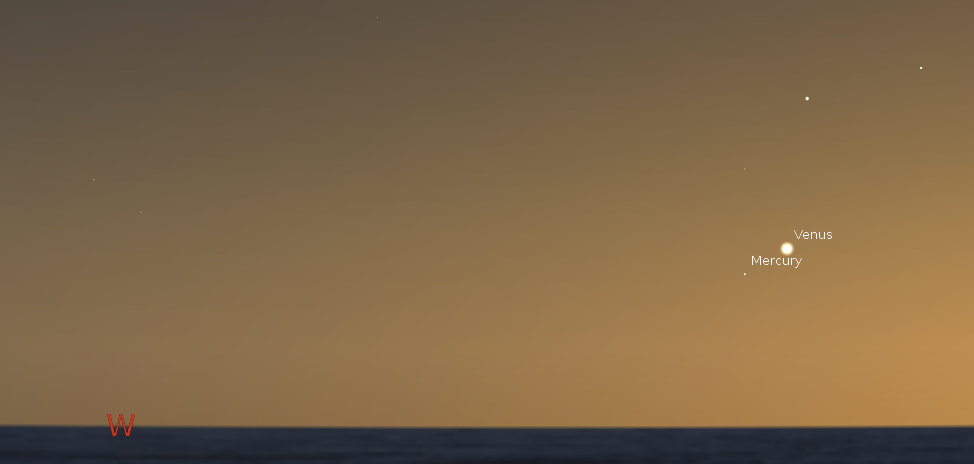
Venus and Mercury conjunction seen at 10:15 p.m. June 19 2013. Created using Stellarium.
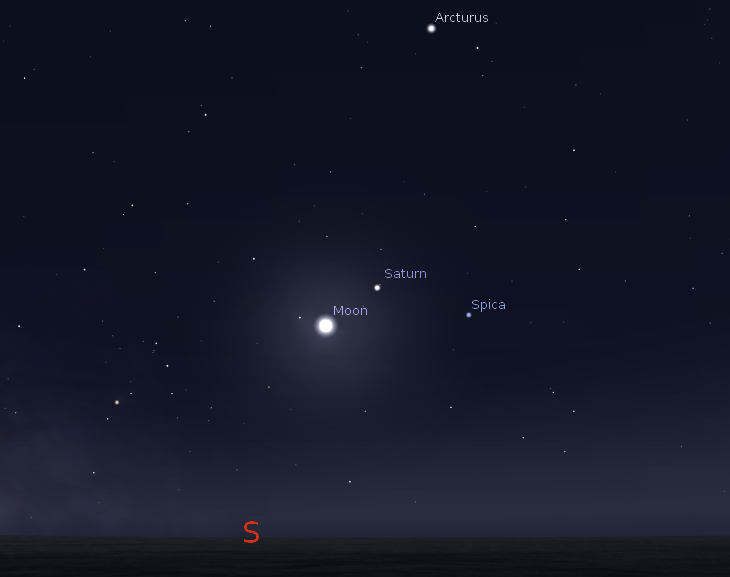
Saturn, the moon and bright stars at 11 p.m. June 19, 2013. Created using Stellarium.
06/18/2013 – Ephemeris – The moon’s most striking feature, the Jura Mountains and the Bay of Rainbows
Ephemeris for Tuesday, June 18th. Today the sun will be up for 15 hours and 33 minutes, setting at 9:30. The moon, 2 days past first quarter, will set at 2:48 tomorrow morning. Tomorrow the sun will rise at 5:56.
On the moon tonight the gibbous phase and the terminator on the left side of the moon is revealing a large semi circular mountain range called the Jura Mountains that encloses a flat lava plain that looks like a bay in the margin of the Sea of Showers or Mare Imbrium. The bay is Sinus Iridium, or Bay of Rainbows. It is easily visible in binoculars this evening when the sunrise line is crossing the bay. The Jura Mountains will appear as a hook at the upper left edge of the moon. That’s about the coolest sight that’s visible on the moon that can be seen with binoculars. It’s especially striking if seen in a small telescope. Though the bay is the same gray as the rest of the moon, at least its name is colorful.
Times are for the Traverse City/Interlochen area of Michigan. They may be different for your location.
Addendum
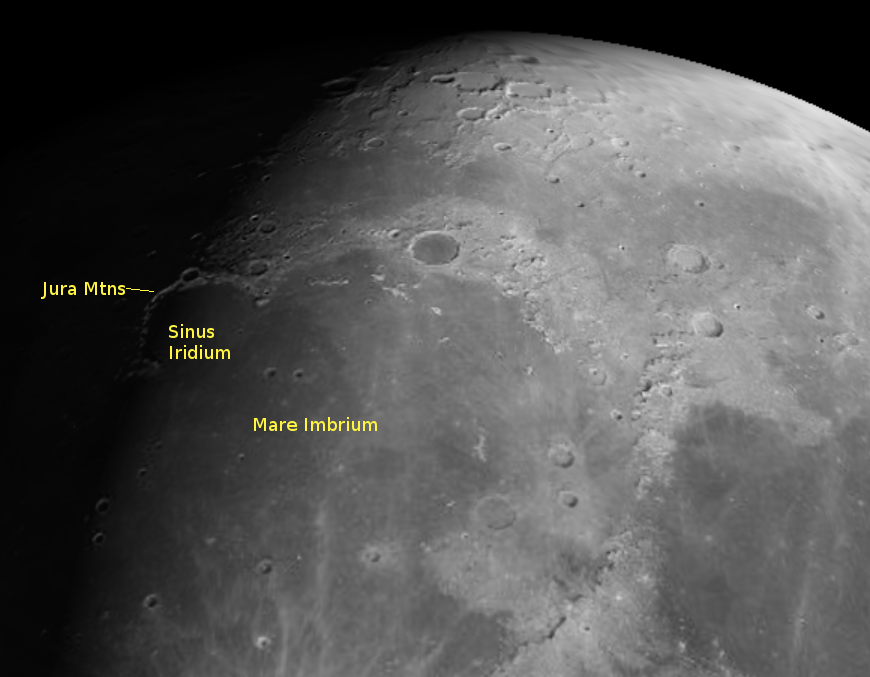
Bay of Rainbows (Sinus Iridium) within the Jura Mountains on the moon. Created using Virtual Moon Atlas.
06/17/2013 – Ephemeris – The crater named Copernicus
Ephemeris for Monday, June 17th. Today the sun will be up for 15 hours and 33 minutes, setting at 9:30. The moon, 1 day past first quarter, will set at 2:15 tomorrow morning. Tomorrow the sun will rise at 5:56.
Let’s take a look at the moon tonight. The sun will have risen on one of the great craters Copernicus. It’s near the terminator, the sunrise line on the moon on the left, close to half way from north to south. Copernicus was named for the Polish astronomer who put forth the heliocentric solar system in the 16th century. The crater is 56 miles in diameter with a vaguely hexagonal form and two miles deep. It has terraced walls and three central peaks. It may look deeper than that due to the low sun angle exaggerating its depth. The asteroid that hit the moon to create the crater hit the moon’s smooth lava plains called seas, probably less that 1.1 billion years ago. Many great photographs of it have been taken.
Times are for the Traverse City/Interlochen area of Michigan. They may be different for your location.
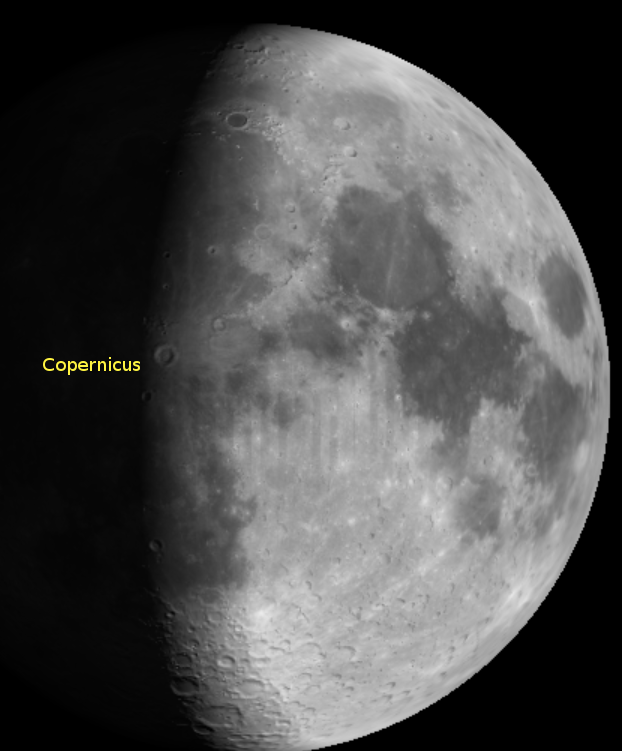
The Crater Copernicus near the moon’s terminator. Created using the Virtual Moon Atlas.
 Bob Moler's Ephemeris Blog