Archive
09/05/2013 – Ephemeris – The constellation of Andromeda, the chained maiden
Ephemeris for Thursday, September 5th. The sun will rise at 7:09. It’ll be up for 13 hours and 1 minute, setting at 8:11. The moon is new today, and won’t be visible.
In the east at 10 this evening can be found a large square of stars, the Great Square of Pegasus the flying horse. The square is standing on one corner. What look like its hind legs stretching to the left from the left corner star is another constellation, Andromeda the chained maiden. She is seen in the sky as two diverging curved strings of stars that curve upward. She was rescued by the hero Perseus, a nearby constellation, riding his steed Pegasus. Andromeda’s claim to astronomical fame is the large galaxy seen with the unaided eye just above the upper line of stars, the Great Andromeda Galaxy, two and a half million light years away. To the unaided eye the galaxy appears as a small smudge of light. In binoculars the galaxy is a delicate spindle of light.
Times are for the Traverse City/Interlochen area of Michigan. They may be different for your location.
Addendum
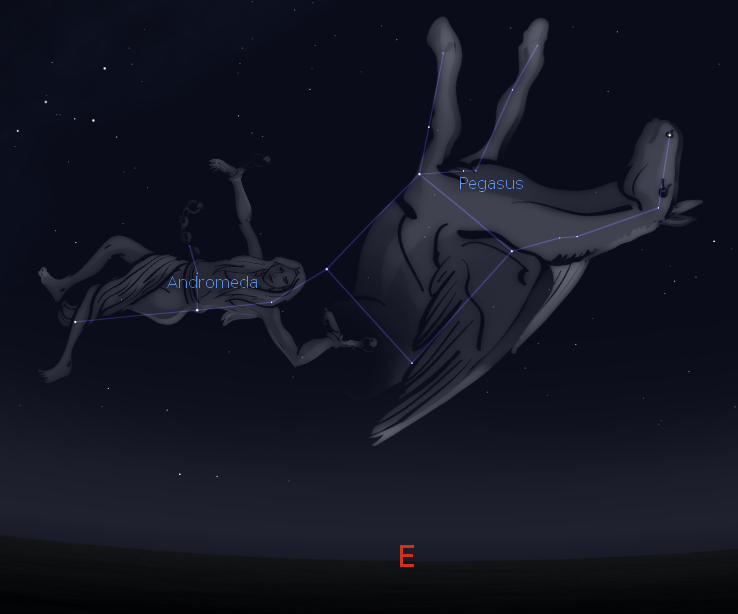
Andromeda and Pegasus images in the stars at 10 p.m. September 5, 2013. Created using Stellarium. Drawing by Johan Meuris.
The constellation lines in Stellarium omit the top strong of stars I see in Andromeda. I’m working on changing that.
09/04/2013 – Ephemeris – Where are the bright planets this week?
Ephemeris for Wednesday, September 4th. The sun will rise at 7:08. It’ll be up for 13 hours and 4 minutes, setting at 8:13. The moon, 1 day before new, will rise at 7:23 tomorrow morning.
Lets check out the planets visible now. Venus is now brilliant low in the western sky in evening twilight. Tonight the bright blue star Spica will appear below and left of Venus, It may take binoculars to spot the much dimmer star in twilight. Venus will set at 9:35 p.m. Holding forth in the west southwest will be Saturn this evening. It has a date with Venus on the 18th. Saturn will set at 10:24 p.m. In the morning sky Jupiter will rise at 2:07 in the east northeast. Starting mid October it will rise before midnight. The red planet Mars will rise at 3:48 a.m. At about 6 a.m. Jupiter will be the brightest star-like object in the east, with Mars visible below and left by two widths of your fist held at arm’s length.
Times are for the Traverse City/Interlochen area of Michigan. They may be different for your location.
Addendum
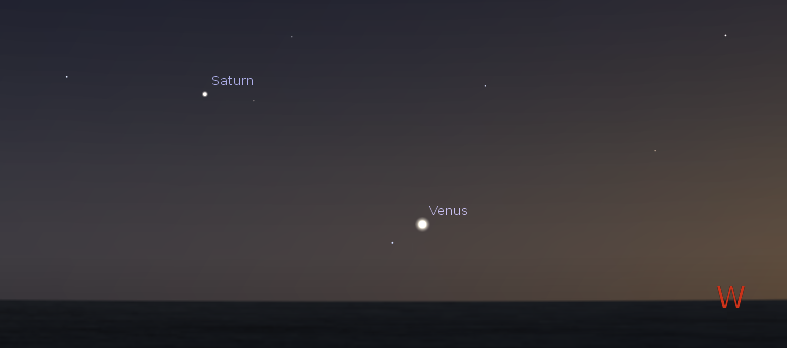
Venus and Saturn low in the west southwest at 9 p.m. on September 4, 2013. Created using Stellarium.
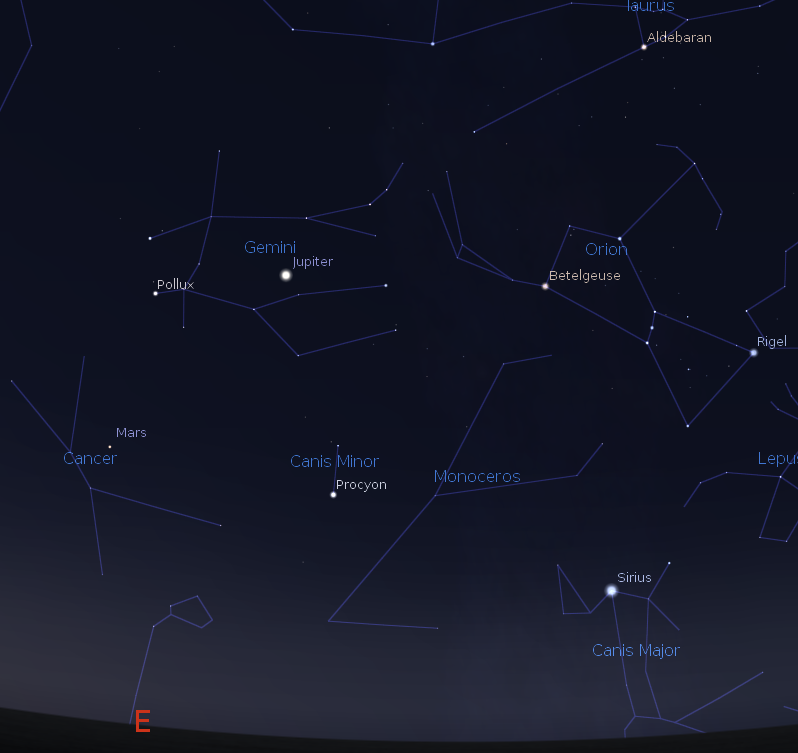
Jupiter, Mars and a preview of the winter constellations at 6n a.m. on September 5, 2013.
09/03/2013 – Ephemeris – The constellation of Pegasus the flying horse
Ephemeris for Tuesday, September 3rd. The sun will rise at 7:07. It’ll be up for 13 hours and 7 minutes, setting at 8:14. The moon, 2 days before new, will rise at 6:20 tomorrow morning.
A reminder that the end of summer is approaching is located in the east around 10 p.m. It’s one of the great autumn constellations: Pegasus the flying horse of Greek myth. Its most visible feature is a large square of four stars, now standing on one corner. This feature, called the Great Square of Pegasus, represents the front part of the horse’s body. The horse is quite aerobatic, because it is seen flying upside down. Remembering that fact, the neck and head is a bent line of stars emanating from the right corner star of the square. Its front legs can be seen in a gallop extending to the upper right from the top star of the square. In Mythology Pegasus was born of the blood of Medusa, decapitated by the hero Perseus, seen as a constellation rising in the northeast.
Times are for the Traverse City/Interlochen area of Michigan. They may be different for your location.
Addendum
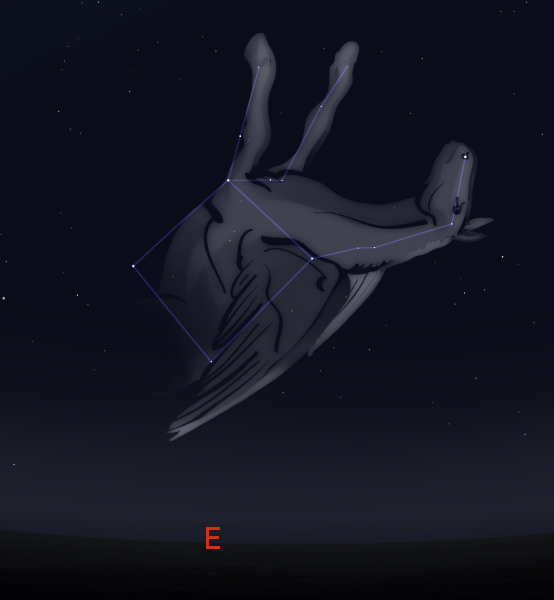
Pegasus image in the stars at 10 p.m. September 3, 2013. Created using Stellarium. Drawing by Johan Meuris.
09/02/2013 – Ephemeris – The Milky Way’s Great Rift
Ephemeris for Labor Day, Monday, September 2nd. The sun will rise at 7:06. It’ll be up for 13 hours and 10 minutes, setting at 8:16. The moon, 3 days before new, will rise at 5:19 tomorrow morning.
High overhead the Milky Way is seen passing through the Summer Triangle of three bright stars. Here we find the Milky Way split into two sections. The split starts in the constellation of Cygnus the Swan or Northern Cross very high in the east. The western branch of the Milky Way ends in the south. The dark dividing feature is called the Great Rift. Despite the lack of stars seen there, it doesn’t mean that there are fewer stars there than in the brighter patches of the Milky Way. The rift is a number of overlapping clouds of dust and gas about 300 light years away that obscure the light of the stars behind them. Sometimes binoculars can be used to find the edges of the clouds of the rift, as stars numbers drop off suddenly. This is especially easily seen in the constellation of Aquila.
Times are for the Traverse City/Interlochen area of Michigan. They may be different for your location.
Addendum
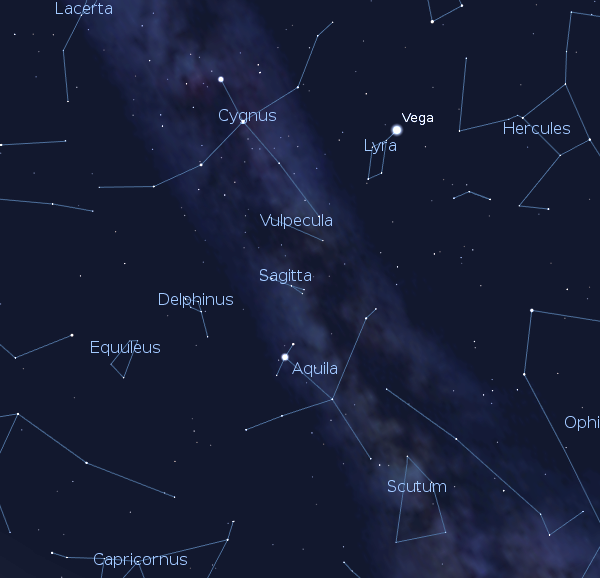
The Great Rift in the Milky Way. Created using Stellarium.
 Bob Moler's Ephemeris Blog