Archive
12/18/2013 – Ephemeris – Where are the bright planets and Comet Lovejoy?
Ephemeris for Wednesday, December 18th. The sun will rise at 8:14. It’ll be up for 8 hours and 49 minutes, setting at 5:03. The moon, 1 day past full, will rise at 6:38 this evening.
This is our weekly look at the planets. Venus is brilliant in the southwest after sunset. It will set at 7:30 p.m. Venus us beginning to noticeably close with the sun. It will be gone from our evening sky in a month. Venus is a crescent, and we’re coming to the point where the crescent can be visible in binoculars. The giant planet Jupiter will rise at 6:28 p.m. in the east northeast. It’s cruising against the stars of Gemini now. It will pass due south at 2:07 a.m. Mars will rise at 1:13 a.m. in the east. Reddish Mars is closer to Spica in Virgo than to Regulus in Leo. Saturn will rise at 5 a.m. in the east southeast. There is a comet visible in binoculars in the morning sky. It’s Comet Lovejoy. A finder chart for the next week will be at bobmoler.wordpress.com with today’s transcript.
Times are for the Traverse City/Interlochen area of Michigan. They may be different for your location.
Addendum
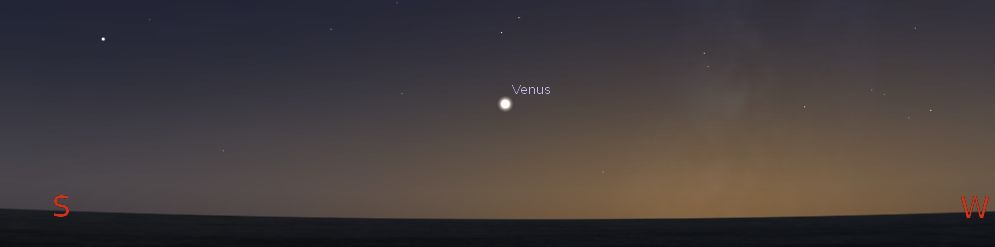
Venus in the southwest at 6 p.m. on December 18, 2013. Created using Stellarium.
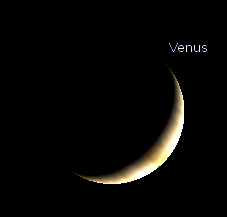
Venus as seen in a telescope at 6 p.m. December 18, 2013. The disk will be blindingly bright with no detail. Created using Stellarium.
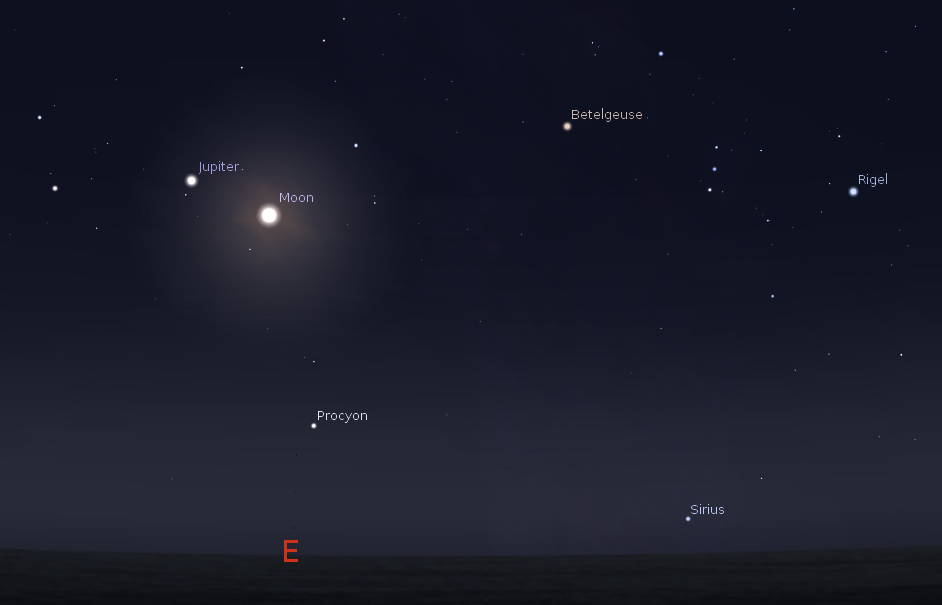
Jupiter and the Moon at 9 p.m. on December 18, 2013. Created using Stellarium.
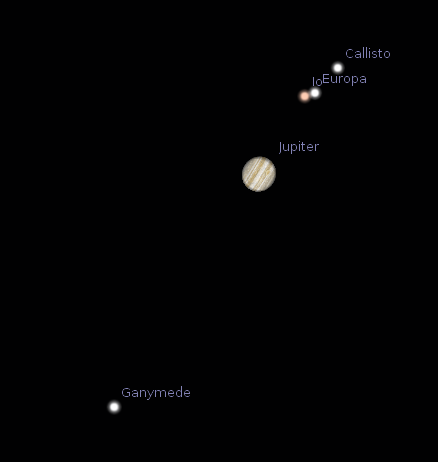
Jupiter and its moons as seen in a telescope at 9 p.m. December 18, 2013. The orientation may be rotated or even mirror image. Created using Stellarium.
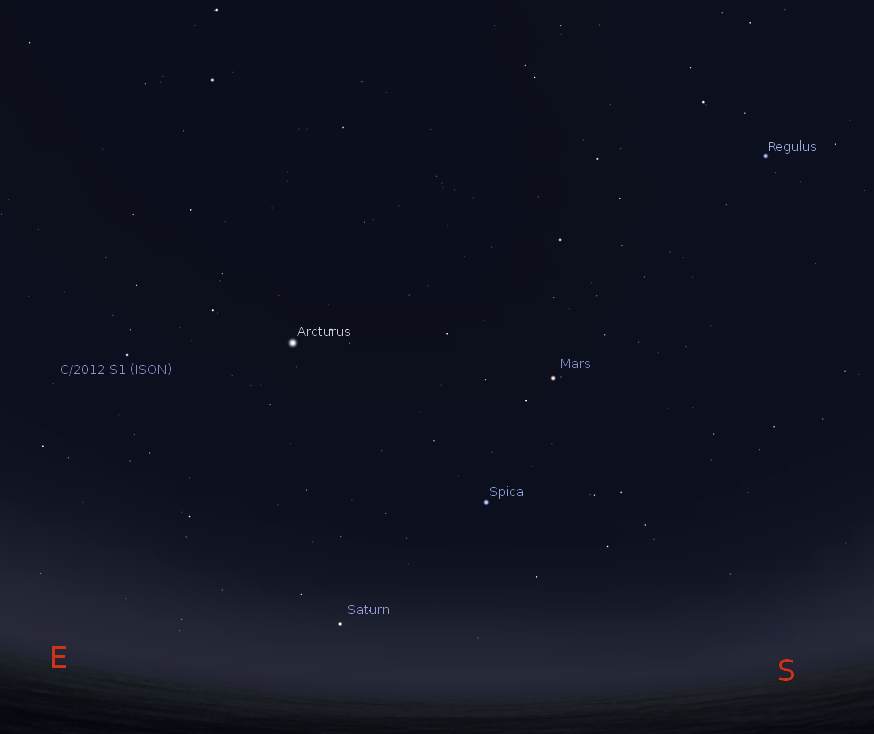
Mars, Saturn and the ghost of Comet ISON at 6 a.m. on December 19, 2013. Created using Stellarium.
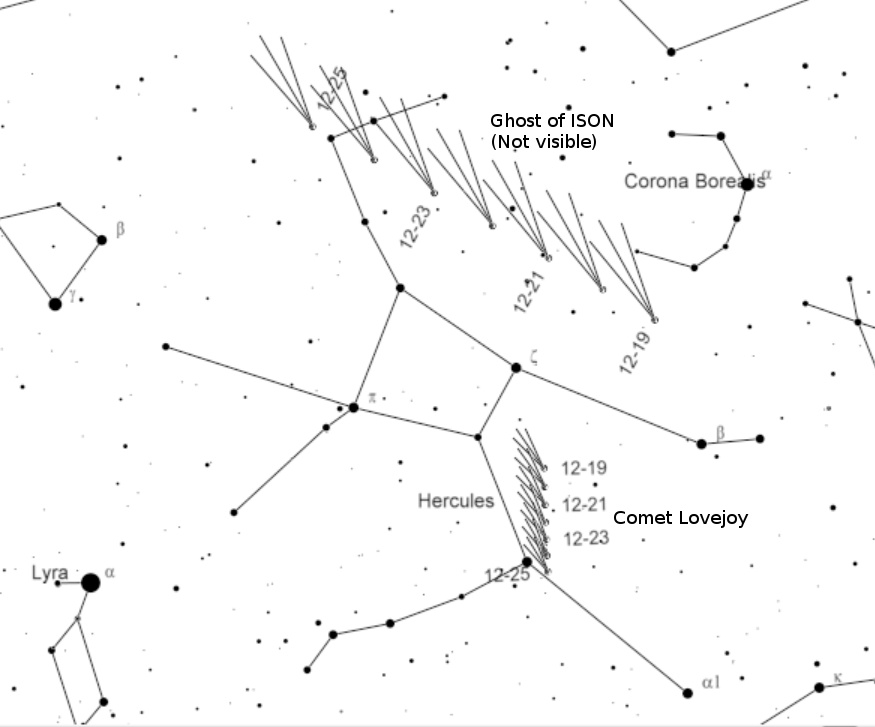
Comet Lovejoy finder chart for the next week at 6 a.m. We’re stuck also with the ghost of Comet ISON. Look in the northeast at the constellation Hercules. Created using Cartes du Ciel.
12/17/2013 – Ephemeris – The Chinese have landed a rover on the Moon
Ephemeris for Tuesday, December 17th. The sun will rise at 8:14. It’ll be up for 8 hours and 49 minutes, setting at 5:03. The moon, at full today, will rise at 5:45 this evening.
Over the weekend the Chinese landed a spacecraft on the moon with a rover. The spacecraft was Chang’E 3 and the third of their successful lunar spacecraft. Name after an ancient moon goddess it deposited a rover named Yutu, or Jade Rabbit named for the goddess’ pet rabbit. The aim point was to be the beautiful Bay of Rainbows or Sinus Iridium, but it landed just outside it in Mare Imbrium, the Sea of Showers. Some astronomers think that the actual landing spot is more interesting mineralogically speaking than the original aim point. Both Chang’E and Yutu are solar powered and it’s difficult to see them surviving the two-week lunar night, Night will fall on the site on December 25th or 26th. Give the Chinese credit though for a flawless landing.
Times are for the Traverse City/Interlochen area of Michigan. They may be different for your location.
Addendum

Chang’E 3 as seen from the Yutu rover. There’s a lot more pictures and information from Emily Lakdawalla’s Planetary Society Blog, where I got this picture link from.
12/16/2013 – Ephemeris – Orion’s bright blue-white star Rigel
Ephemeris for Monday, December 16th. The sun will rise at 8:13. It’ll be up for 8 hours and 49 minutes, setting at 5:03. The moon, 1 day before full, will set at 8:07 tomorrow morning.
Last week I talked about the star Betelgeuse the bright red star in the top left of Orion’s rectangle in the hunter’s shoulder. Orion is seen in the southeast at 9 in the evening. The blue-white star in Orion’s opposite corner is usually brighter. It is Rigel whose longer Arabic name of which Rigel is the first part means Left Leg of the Giant. Rigel is a giant itself, actually a super giant star, which is more a measure of its mass than its size, that of 17 solar masses. Its surface temperature is more than twice as hot as the sun. It is 130 thousand times as bright as the sun and 74 times its diameter. Its distance is around 860 light years. A telescope might reveal a close companion star to Rigel, off the edge of the bright arc light image of Rigel itself.
Times are for the Traverse City/Interlochen area of Michigan. They may be different for your location.
Addendum
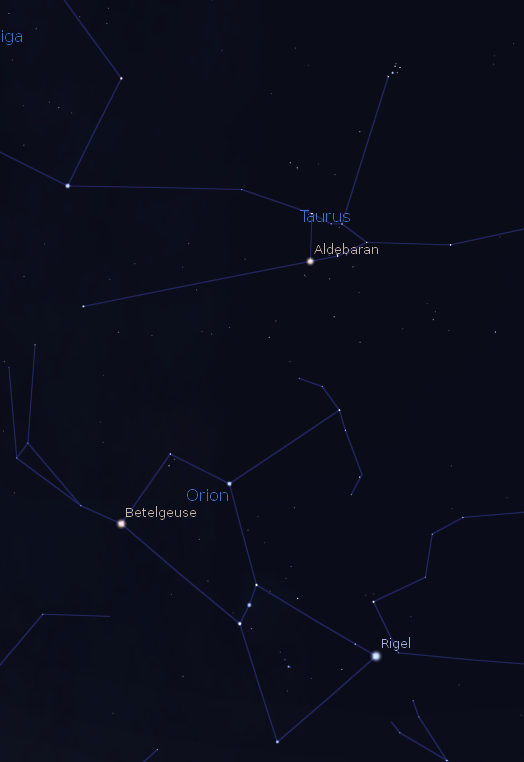
Taurus and Orion with Orion’s brightest stars named. Created using Stellarium.
12/13/2013 – Ephemeris – The Geminid meteor shower will peak overnight
Ephemeris for Friday, December 13th. The sun will rise at 8:11. It’ll be up for 8 hours and 51 minutes, setting at 5:02. The moon, half way from first quarter to full, will set at 5:27 tomorrow morning.
The Geminid meteor shower will reach maximum around 12:45 a.m. tomorrow morning. The big problem will be the bright moon, so only the brightest meteors will be visible before the moon sets tomorrow morning. The 5:27 moon-set time will give the Geminids about an hour of dark skies, plus maybe another half hour of unobjectionable morning twilight to see them at their best. The Geminids will appear to originate from near the star Castor at the head of the constellation Gemini, where Jupiter is currently located. It is said that the Geminids are year in and year our the most reliable shower. That may be true, because in 1983 the source of the meteor shower was found, a long dead comet hulk, that resembles an asteroid but with a comet’s orbit.
Times are for the Traverse City/Interlochen area of Michigan. They may be different for your location.
Addendum
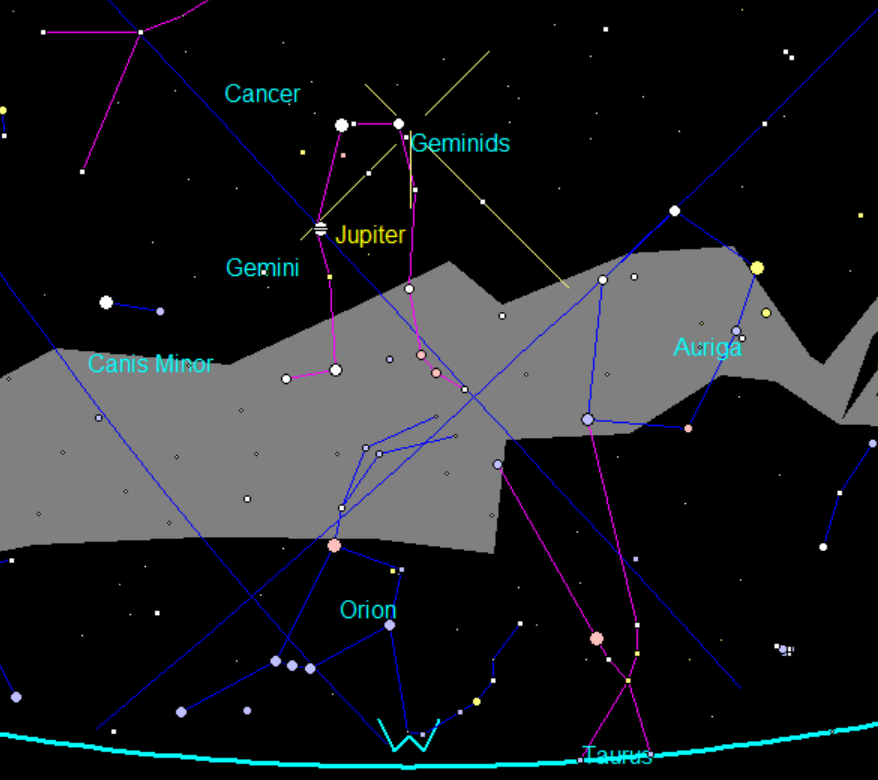
The Geminid radiant at 6 a.m. December 14, 2014 after moon set. Created using my LookingUp program for Windows
The brighter Geminids can be seen all night, but the darkest time will be just before dawn.
12/12/2013 – Ephemeris – The bright star Betelgeuse (Don’t say it three times)
Ephemeris for Thursday, December 12th. The sun will rise at 8:10. It’ll be up for 8 hours and 52 minutes, setting at 5:02. The moon, 3 days past first quarter, will set at 4:26 tomorrow morning.
The bright red star in the constellation Orion’s shoulder is Betelgeuse, and it’s about 643 light years away. Despite its great distance, it is the star whose surface is easiest seen, after the sun of course. That’s because it’s so big, maybe as large around as the orbit of Jupiter. Its true diameter is hidden by the cloud of gas it’s expelling. Betelgeuse varies in size and brightness, so its size varies by nearly 30 percent. The Hubble telescope has sent back pictures of the star, and has found a bright spot, seen in ultraviolet light on what may be its surface. It has a really hot core generating energy that pushes out its gaseous envelope to a great size. Some astronomers think the Betelgeuse will become a supernova within a million years.
Times are for the Traverse City/Interlochen area of Michigan. They may be different for your location.
Addendum
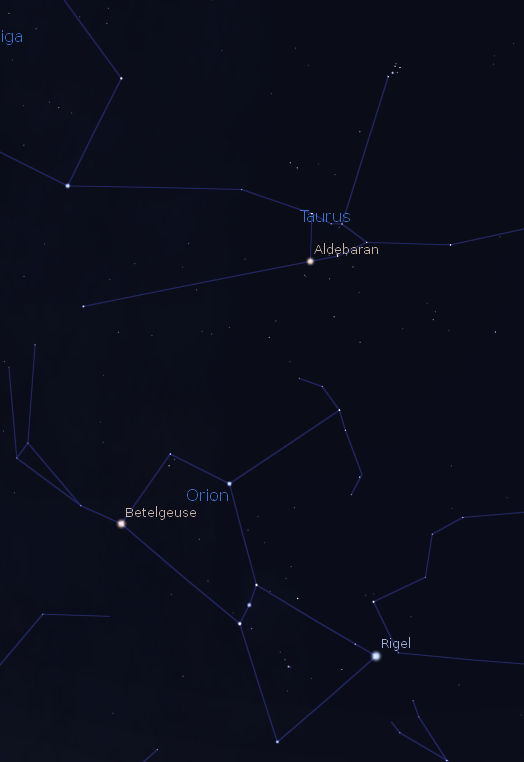
Aldebaran, the Hyades, of Taurus, Orion and the Pleiades at 10 p.m. December 12, 2013. Created using Stellarium.
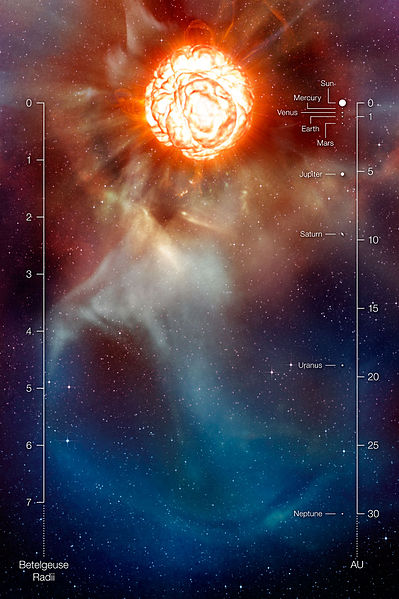
“This artist’s impression shows the supergiant star Betelgeuse as it was revealed thanks to different state-of-the-art techniques on ESO’s Very Large Telescope, which allowed two independent teams of astronomers to obtain the sharpest ever views of the supergiant star Betelgeuse. They show that the star has a vast plume of gas almost as large as our Solar System and a gigantic bubble boiling on its surface. These discoveries provide important clues to help explain how these mammoths shed material at such a tremendous rate. The scale in units of the radius of Betelgeuse as well as a comparison with the Solar System is also provided.” Credit: ESO/L. Calçada (ESO is the European Southern Observatory)
12/11/2013 – Ephemeris – Where are the bright planets this week, plus a consolation comet
Ephemeris for Wednesday, December 11th. The sun will rise at 8:09. It’ll be up for 8 hours and 52 minutes, setting at 5:02. The moon, 2 days past first quarter, will set at 3:23 tomorrow morning.
Let’s see where the bright planets are this week. Venus is brilliant in the southwest after sunset. It will set at 7:44 p.m. Venus has a crescent appearance because it is between the Earth and Sun which is easily seen in telescopes and can be detected in binoculars now. Venus is 57 million kilometers away from us now or 35.4 million miles. The giant planet Jupiter will rise at 7 p.m.. in the east northeast. It’s cruising against the stars of Gemini now. It will pass due south at 2:37 a.m. Mars will rise at 1:22 a.m. in the east. Mars is a bit closer to Spica in Virgo than Regulus in Leo, and can be distinguished by its yellow-orange color. Saturn will rise at 5:24 a.m. and should be visible low in the east south east by 6 a.m.
Times are for the Traverse City/Interlochen area of Michigan. They may be different for your location.
Addendum
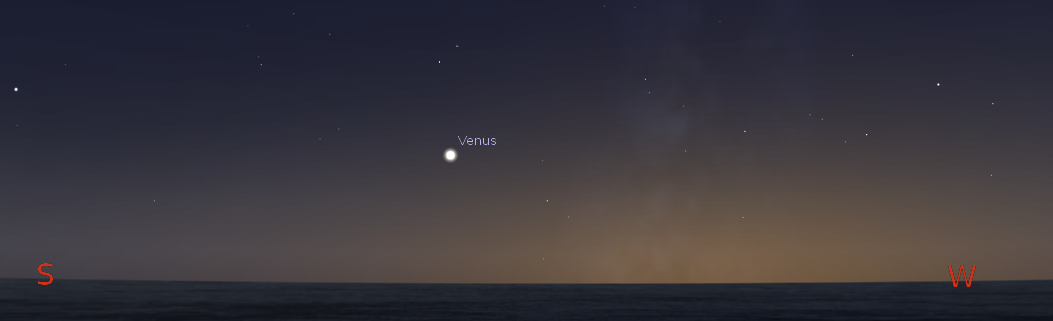
Venus in the southwest at 6 p.m. on December 11, 2013. Created using Stellarium.
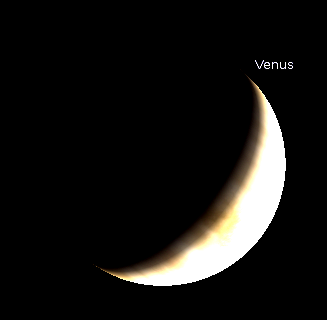
Venus as seen in a telescope at 6 p.m. December 11, 2013. The disk will be blindingly bright with no detail. Created using Stellarium.
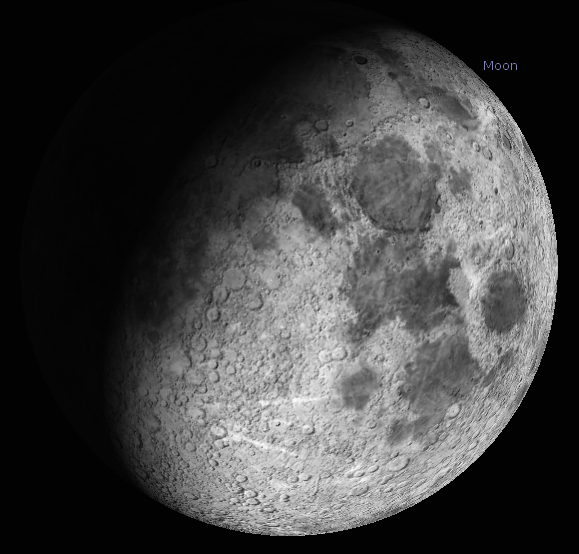
The gibbous Moon magnified at 9 p.m. on December 11, 2013. Created using Stellarium.
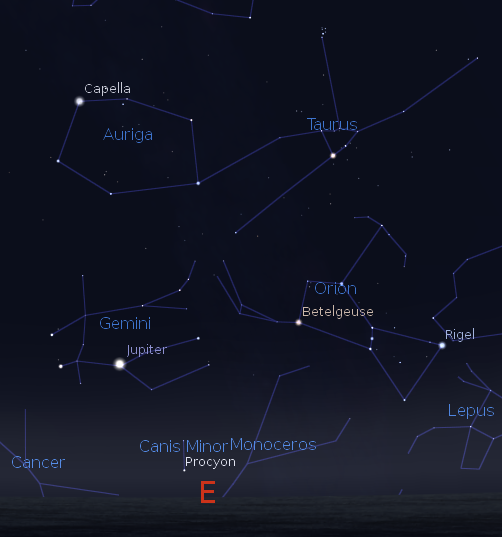
Jupiter and some winter constellations at 9 p.m. on December 11, 2013. Created using Stellarium.
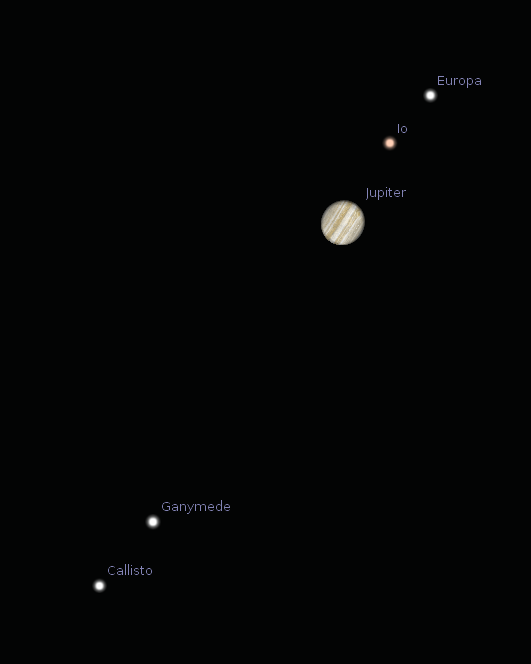
Jupiter and its moons as seen in a telescope at 9 p.m. December 11, 2013. The orientation may be rotated or even mirror image. Created using Stellarium.
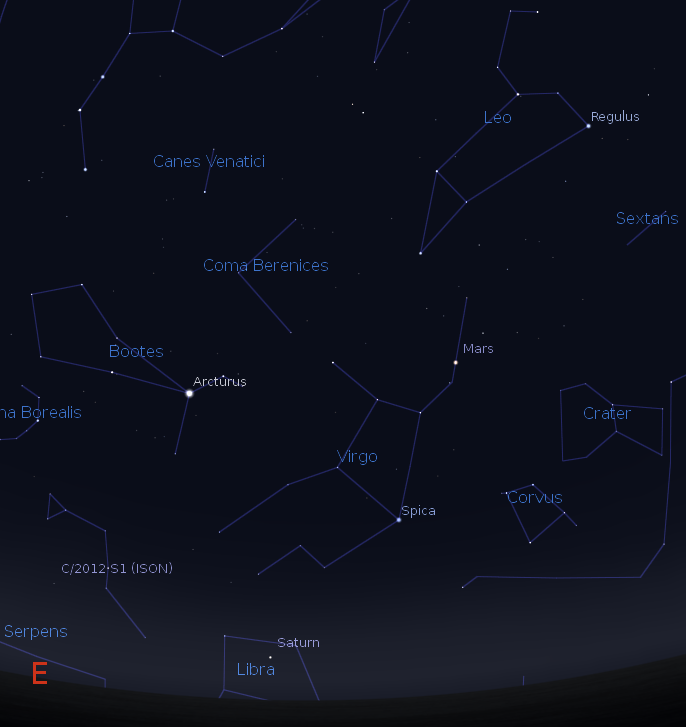
Mars, Saturn and the ghost of Comet ISON at 6 a.m. on December 12, 2013. Created using Stellarium.
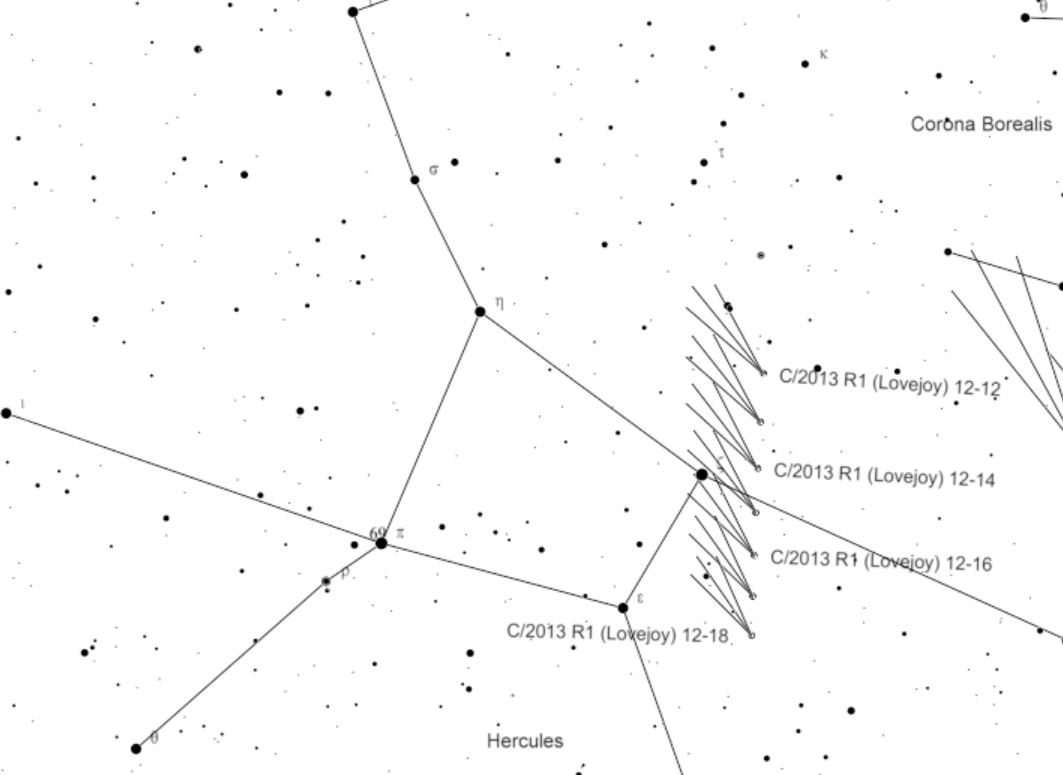
Comet Lovejoy finder chart for the next week at 6 a.m. There a bit of a tail at the right edge from the ghost of ISON (It’s not visible). Look in the northeast at the constellation Hercules with binoculars. Created using Cartes du Ciel.
Comet Lovejoy is an easy binocular object. It’s brighter than Comet ISON was in dark skies.
12/10/2013 – Ephemeris – The bright star Aldebaran, the Follower
Ephemeris for Tuesday, December 10th. The sun will rise at 8:08. It’ll be up for 8 hours and 53 minutes, setting at 5:02. The moon, 1 day past first quarter, will set at 2:18 tomorrow morning.
The central constellation of winter, Orion, is in the east southeast at 9 p.m. Above it is Taurus the bull. The bright orange star in Taurus is Aldebaran. Aldebaran appears at the lower left tip of a letter V group of stars lying on its side that is the face of the bull. Aldebaran isn’t actually part of the group, called the Hyades star cluster. The cluster is about 153 light years away, while Aldebaran is 65. The star has an orange hue because its surface is cooler than the sun’s. However Aldebaran is 44 times larger in diameter, and shines 465 times brighter than the sun. The name Aldebaran means “Follower” because it follows the Pleiades star cluster through the skies. The Pleiades is above right of Aldebaran.
Times are for the Traverse City/Interlochen area of Michigan. They may be different for your location.
Addendum
Aldebaran, the Hyades, of Taurus, Orion and the Pleiades at 10 p.m. December 10, 2013. Created using Stellarium.
12/09/2013 – Ephemeris – The bright star Capella, the she-goat
Ephemeris for Monday, December 9th. The sun will rise at 8:07. It’ll be up for 8 hours and 54 minutes, setting at 5:02, the earliest sunset of the year. The moon, at first quarter today, will set at 1:12 tomorrow morning.
A bright star called Capella is now high in the east. Capella is the farthest north of winter’s seven brilliant first magnitude stars. Capella never quite sets for anyone north of Ludington. Due to its brightness, and being the closest first magnitude star to the pole, Capella appears to move slowly as the earth rotates, and spends summer and autumn evenings close to the horizon and is a reminder that winter’s not far away. It has in years past elicited a few phone calls and other queries about that ‘bright object in the northeast’. Capella belongs to the pentagonal constellation of Auriga the Charioteer. Capella represents a mother goat he is holding. Three stars in a thin triangle nearby to the star’s right are her kids.
Times are for the Traverse City/Interlochen area of Michigan. They may be different for your location.
Addendum
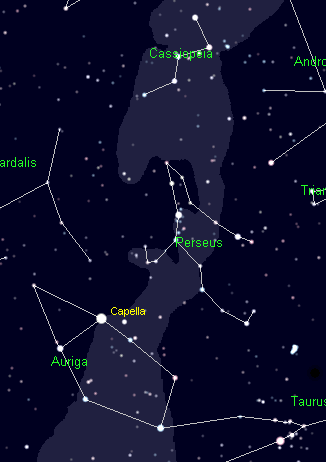
The Constellations Cassiopeia, Perseus and Auriga. Created using Cartes du Ciel
Note the small slender triangle of stars under the “p” in Capella. That’s the Kids, an asterism or informal constellation.
12/06/2013 – Ephemeris – I’ll talk about ancient cosmologies tonight
Ephemeris for Friday, December 6th. The sun will rise at 8:04. It’ll be up for 8 hours and 57 minutes, setting at 5:02. The moon, 3 days before first quarter, will set at 9:40 this evening.
This evening’s meeting of the Grand Traverse Astronomical Society starting at 8 p.m. at Northwestern Michigan College’s Rogers Observatory will be a new December program. In the past yours truly alternated between a program on the Star of Bethlehem and the cosmology of the Bible. This year I’m presenting Ancient Cosmologies, a look at the cosmologies of many mostly pre-scientific cultures, including how the Biblical world view was influenced by one of them. Then we’ll see the beginnings of Greek scientific thought that codified by Ptolemy in the second century AD, held sway for 1,500 years. At 9 p.m. there will be a star party at the observatory, and another program if it’s cloudy. All are welcome.
Times are for the Traverse City/Interlochen area of Michigan. They may be different for your location.
12/05/2013 – Ephemeris – The constellation Taurus the bull
Ephemeris for Thursday, December 5th. The sun will rise at 8:03. It’ll be up for 8 hours and 58 minutes, setting at 5:02. The moon, 3 days past new, will set at 8:27 this evening.
Early in the evening the moon will appear above the bright planet Venus in the southwest. Low in the east at 9 p.m. is the constellation of Orion the giant hunter. Above him is Taurus the bull. His face is a letter V shape of stars lying on its side with the bright orange-red star Aldebaran at the bottom tip of the V as its angry blood-shot eye. Orion is depicted in the sky facing with club in one hand and a shield in the other the approaching and in some depictions charging Taurus. The V of stars is a star cluster called the Hyades. The Pleiades are in his shoulder above. Taurus in Greek mythology was the guise the god Zeus when he carried off the maiden Europa. Europa’s still with him, sort of, as the intriguing satellite orbiting Zeus’ Roman equivalent Jupiter.
Times are for the Traverse City/Interlochen area of Michigan. They may be different for your location.
Addendum
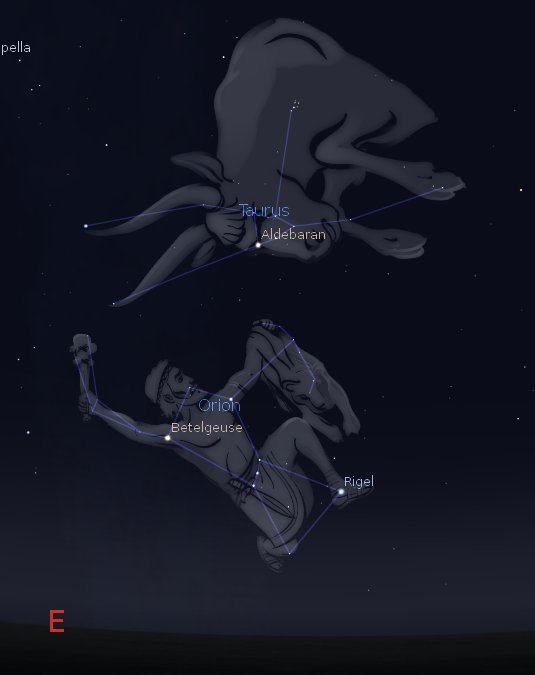
Taurus and Orion in the east at 9 p.m, December 5, 2013. Created using Stellarium.
 Bob Moler's Ephemeris Blog