Archive
01/31/2014 – Ephemeris – Previewing February skies
Ephemeris for Friday, January 31st. The sun will rise at 8:02. It’ll be up for 9 hours and 47 minutes, setting at 5:50. The moon, 1 day past new, will set at 7:18 this evening.
Lets look ahead at the short month of February. It’s so short that this year it has no new moons. To make up for it both January and March have two. We’re in the depths of winter but the sun is continuing its return to northern climes. This is reflected in the increase in daylight hours, from 9 hours 50 minutes tomorrow to 11 hours 7 minutes on the 28th. These times are for the Interlochen/Traverse City area. Durations are slightly shorter in the northern part of our listening area and slightly longer to the south.. As the month goes on the weather should generally warm up, though this year who knows what will happen. Mercury is seen early for the next week or so and Jupiter are seen in the evening along with all the wonderful constellations of winter.
Times are for the Traverse City/Interlochen area of Michigan. They may be different for your location.
Addendum
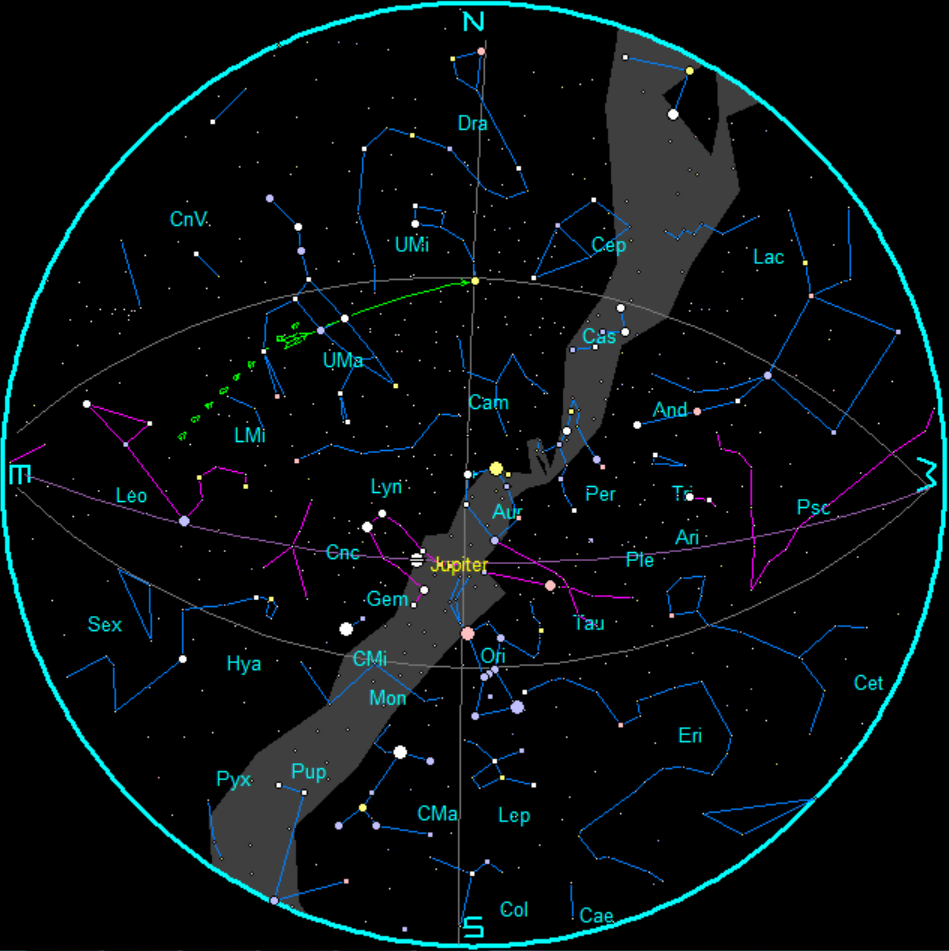
A star chart for February 15th at 9 p.m. Add a half hour to every week before the 15th and subtract and hour for every week after the 15th. Created using my LookingUp program.
For a list of constellation names to go with the abbreviations click here
01/30/2014 – Ephemeris – More on the supernova in M82
Ephemeris for Thursday, January 30th. The sun will rise at 8:03. It’ll be up for 9 hours and 45 minutes, setting at 5:48. The moon is new today, and won’t be visible.
Let’s talk more about our new supernova in galaxy M82 off the bowl of the Big Dipper. Of course new and nova used in the same sentence is a bit redundant because Nova is Latin for Stella Nova or new star. It is thought that tiny massive white dwarf stars near the end of their life are involved in some way. Type 1a supernovae all seem to explode with about the same brightness so it’s thought that they accrete matter from a nearby giant star until their mass gets to about 1.44 times the sun’s mass. That that point they explode. The explosion of 1.44 solar masses is what gives them the common brightness. The 1.44 of the sun’s mass is called the Chandrasekhar limit discovered mathematically in 1930 by the Indian-American astronomer of the same name.
Times are for the Traverse City/Interlochen area of Michigan. They may be different for your location.
Addendum
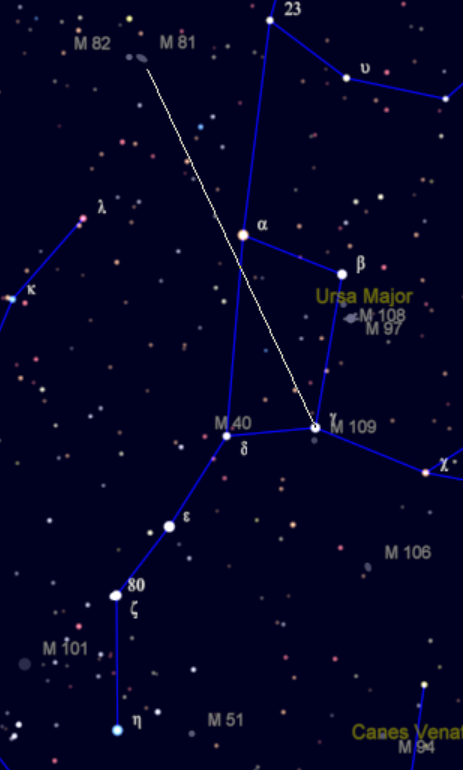
Finder Chart for M82 and M81. Actual time is 9 p.m. on January 28, 2014. Created using Cartes du Ciel (Sky Charts).
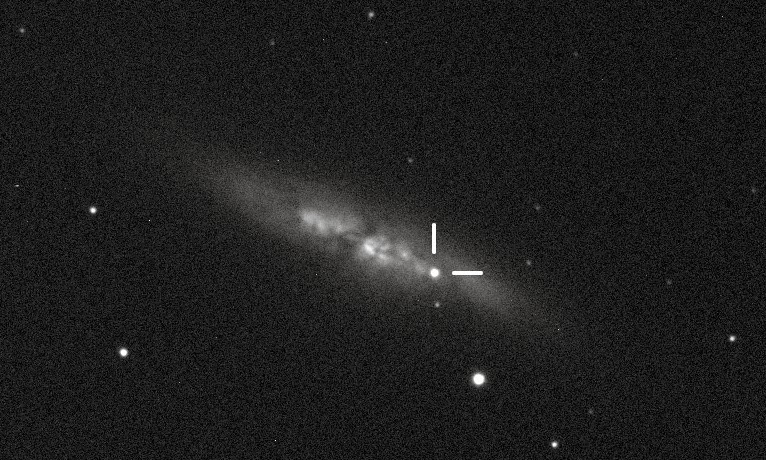
Discovery image of SN 2014J. Credit: UCL/University of London Observatory/Steve Fossey/Ben Cooke/Guy Pollack/Matthew Wilde/Thomas Wright.
Check here for the Wikipedia article on astrophysicist Subrahmanyan Chandrasekhar and the Chandrasekhar limit.
Chandra, as he was know was honored four years after his death with the naming of the Chandra X-ray Observatory, one of NASA’s Great Observatories launched in 1999 and still operating.
01/29/2014 – Ephemeris – We could spot all the 5 naked eye planets this week
Ephemeris for Wednesday, January 29th. The sun will rise at 8:04. It’ll be up for 9 hours and 42 minutes, setting at 5:47. The moon, 1 day before new, will rise at 7:27 tomorrow morning.
Let’s take our weekly look at the planets. Tiny Mercury is 3 days from its greatest eastern elongation low in the west-southwest between sunset and 7:22, when it sets. After that Jupiter takes over the evening sky. It will be in the eastern sky as darkness falls tonight. It’s cruising against the stars of Gemini now. It will move southeast and pass due south at 10:59 p.m., and will set at 6:41 a.m. in the west-northwest. Mars will rise at 11:55 p.m. in the east-southeast. Reddish Mars is in Virgo now and above the bright star Spica. Saturn will rise at 2:32 a.m. in the east-southeast. It’s seen against Libra the scales this year. Venus will rise at 6:02 tomorrow morning, so it may become visible around 6:30 or so very low in the east-southeast.
Times are for the Traverse City/Interlochen area of Michigan. They may be different for your location.
Addendum
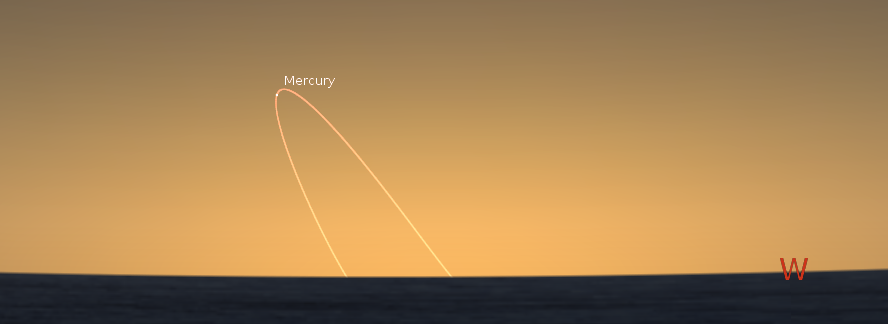
Mercury in the west southwest at 6:15 p.m. on January 29, 2014. Also displayed is Mercury’s orbit. It will reach the peak, its greatest eastern elongation from the Sun on Friday. Created using Stellarium.
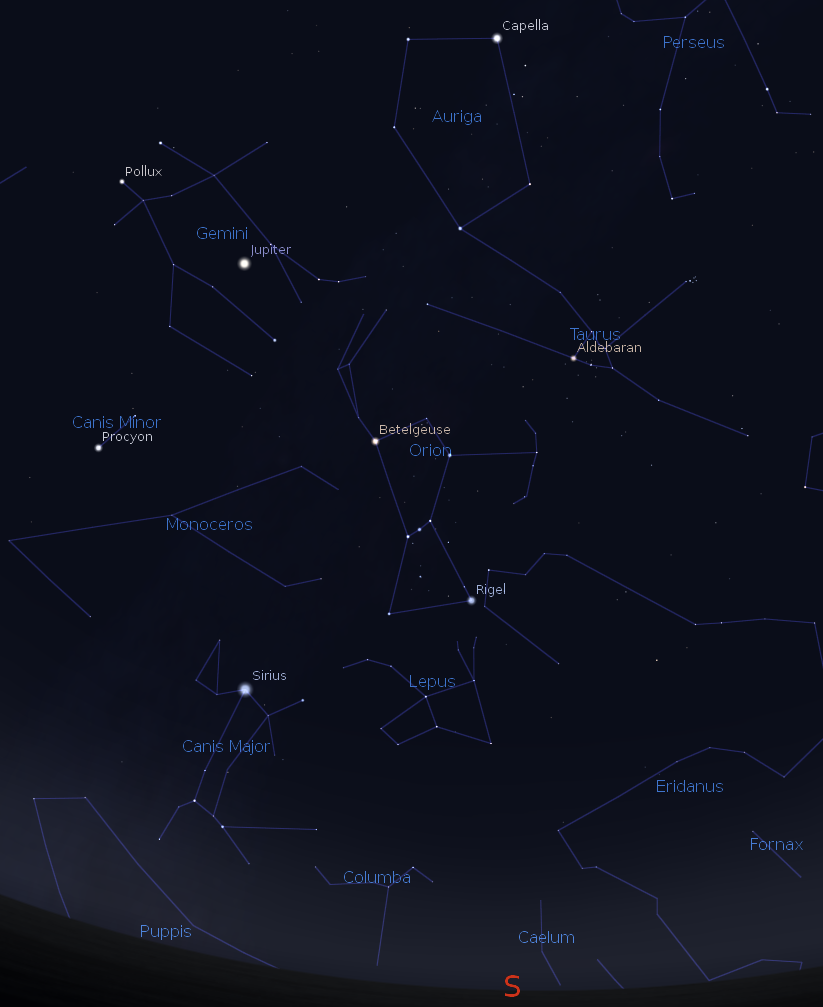
Jupiter with the winter constellations at 9 p.m. on January 29, 2014. Created using Stellarium.
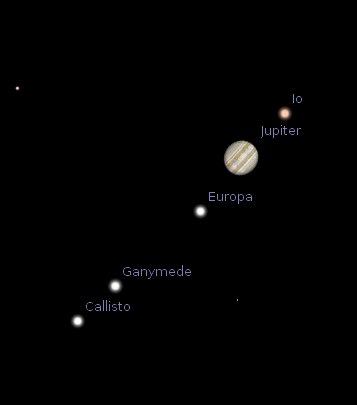
The telescopic Jupiter at 9 p.m. and January 29, 2014. Created using Stellarium.
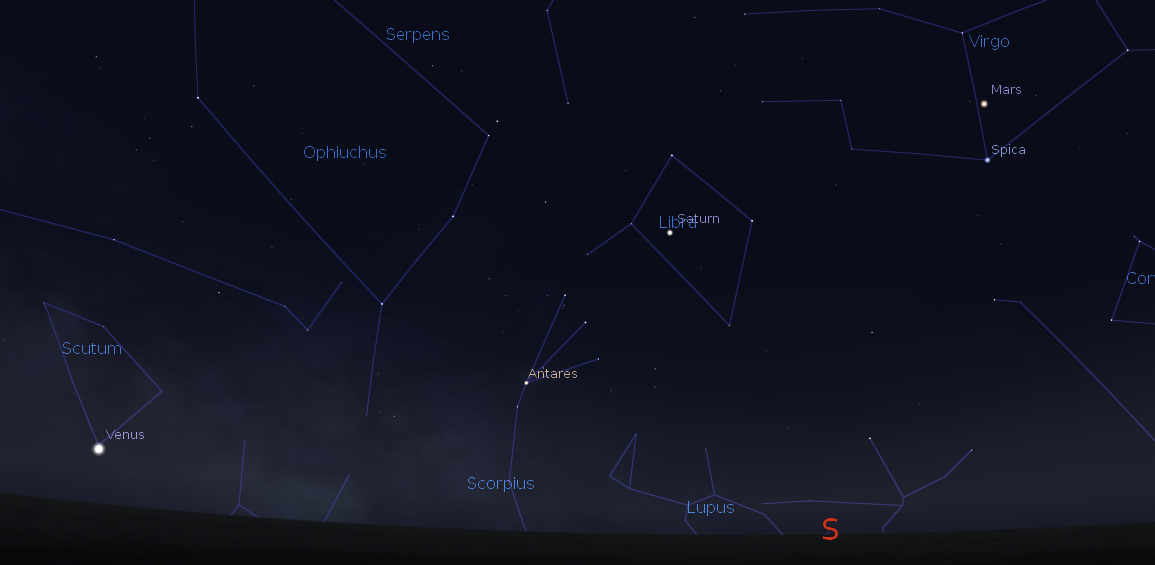
Mars, Saturn and Venus with the spring constellations at 6:30 a.m. on January 29, 2014. Created using Stellarium.
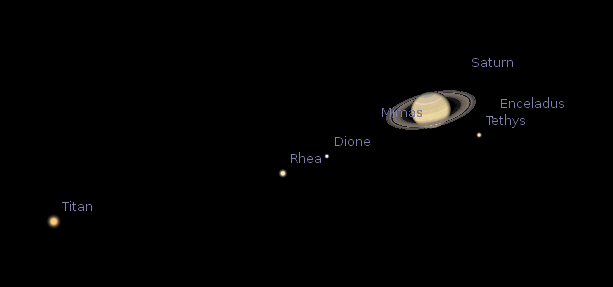
Saturn and its moons at 6:30, January 30, 2014. Of the moons, Titan will be the only one visible in small telescopes. Created using Stellarium.
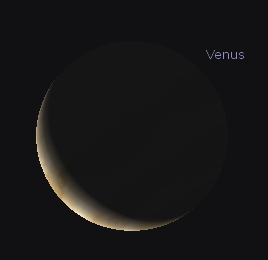
Venus as seen in a telescope at 7 a.m. on January 30, 2014. Created using Stellarium.
01/28/2014 – Ephemeris – A supernova found in a nearby galaxy
Ephemeris for Tuesday, January 28th. The sun will rise at 8:05. It’ll be up for 9 hours and 40 minutes, setting at 5:45. The moon, 2 days before new, will rise at 6:40 tomorrow morning.
There is a new supernova in our skies. It’s designation is SN 2014J and it’s pretty close as the things go, but not in our galaxy. It’s in another galaxy M82 off the front of the bowl of the Big Dipper, and 12 million light years away. It’s the closest supernova since supernova 1987A, which appeared on the last days of February 1987 in a companion galaxy to us the Large Magellanic Cloud. While the latter was visible to the naked eye, this will stay a binocular object at best. I’ll have a finder chart and more information in bobmoler.wordpress.org for those that may need it. This is a special type of supernova that’s used for distance measurement in the universe called a type 1a and this will be a good time to fine tune the calibration.
Times are for the Traverse City/Interlochen area of Michigan. They may be different for your location.
Addendum
Links to more discussion of the new supernova and type 1a supernovae in general.
Finder Charts
Finder Chart for M82 and M81. Actual time is 9 p.m. on January 28, 2014. Created using Cartes du Ciel (Sky Charts)
Pointer to M81 and M82 is a line diagonally through the bowl of the Big Dipper from the star Phad γ (gamma) Ursa Majoris through Dubhe α (alpha) Ursa Majoris. Note that the Big Dipper is not an official constellation but part of Ursa Major, the Great Bear.
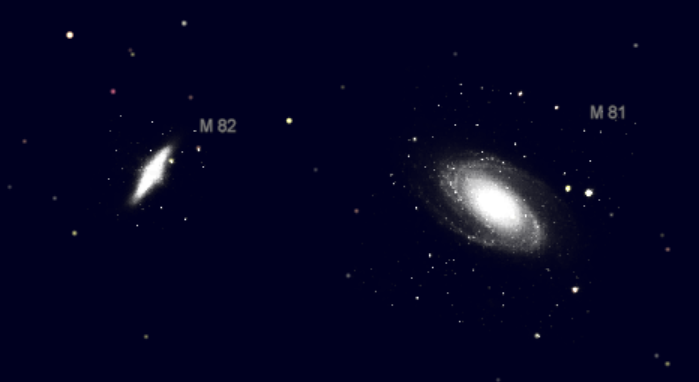
M82 and M81 as seen close up. Note the spiral arms of M81 are invisible visually. Created using Cartes du Ciel (Sky Charts).
Discovery image of SN 2014J. Credit: UCL/University of London Observatory/Steve Fossey/Ben Cooke/Guy Pollack/Matthew Wilde/Thomas Wright.
01/27/2014 – Ephemeris – Mercury’s back in the evening sky now
Ephemeris for Monday, January 27th. The sun will rise at 8:06. It’ll be up for 9 hours and 37 minutes, setting at 5:44. The moon, half way from last quarter to new, will rise at 5:47 tomorrow morning.
Mercury is now making an appearance in the evening sky. It will have its greatest elongation or angular separation from the sun on Friday of 18.4 degrees. Mercury has a markedly elliptical orbit. Unfortunately both the best times to view Mercury from the northern hemisphere of earth, late summer and autumn mornings and late winter and spring evenings, Mercury is near perihelion or closest point in its orbit to the sun. The southern hemisphere, which has seasons opposite from ours, has the same viewing opportunities in late summer and autumn mornings and late winter and spring evenings. Only for them Mercury is near aphelion or its farthest from the sun, so this planet can be seen just outside of twilight, where we don’t have that luxury.
Times are for the Traverse City/Interlochen area of Michigan. They may be different for your location.
Addendum
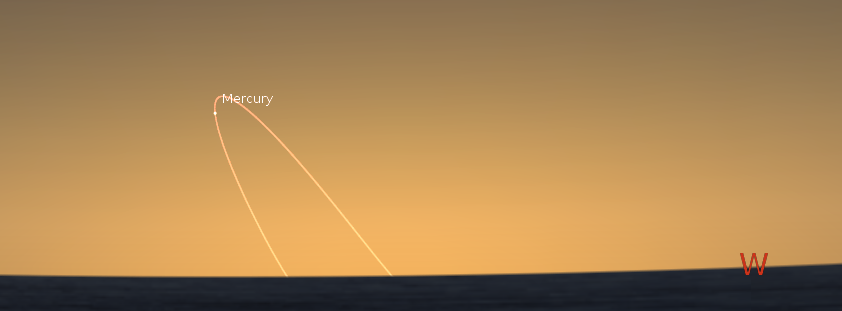
Mercury and its orbit as seen from Earth at 6:15 p.m. on January 27, 2014. Created using Stellarium.
Mercury will move to the top of the orbital loop Friday about 5 a.m. and descend to the right. The Mercury image will be posted Wednesday again.
01/24/2014 – Ephemeris – The constellation of Auriga the charioteer
Ephemeris for Friday, January 24th. The sun will rise at 8:09. It’ll be up for 9 hours and 30 minutes, setting at 5:40. The moon, at last quarter today, will rise at 2:37 tomorrow morning.
The constellation Auriga the charioteer is nearly overhead at 9 p.m. It is a pentagon of stars, with the brilliant star Capella at one of its corners. Capella represents a she goat he’s carrying. A narrow triangle of stars nearby Capella is her kids. The Kids is an informal constellation or asterism. Within and near that pentagon, binoculars and telescopes will find several star clusters, groups of hundreds of stars born in the clump we still see them in. These star clusters will appear as fuzzy spots in binoculars. One called M38 is near the center of the pentagon. Another, M36 is to the east of it. Still another star cluster, M37, is farther east, just outside the pentagon. The M designations come from Charles Messier who 2 centuries ago ran into them while looking for comets.
Times are for the Traverse City/Interlochen area of Michigan. They may be different for your location.
Addendum
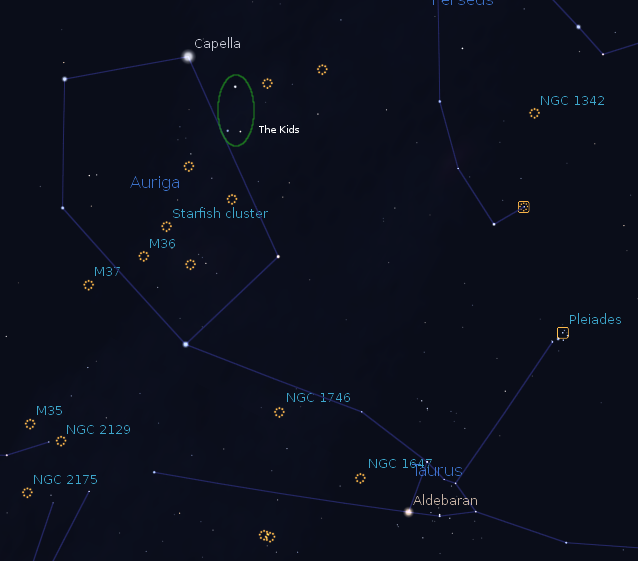
Auriga the charioteer with Taurus below. M38 here is called the Starfish Cluster, a name I am unfamiliar. Created using Stellarium.
01/23/2014 – Ephemeris – The river Eridanus
Ephemeris for Thursday, January 23rd. The sun will rise at 8:10. It’ll be up for 9 hours and 28 minutes, setting at 5:38. The moon, 1 day before last quarter, will rise at 1:31 tomorrow morning.
There is a long and sinuous constellation that’s part of the winter sky. It is Eridanus, which depicts a river. The river starts near the lower right corner of Orion, near the bright star Rigel and flows to the right then down near the southern horizon, then it meanders below the horizon. One has to travel to the far southern United States or even farther south to see the southern terminus of the river, the bright star Achernar. Writers over the ages have seen here the Nile and the earth circling river Ocean of the flat earth days. One of its stars is close to us and famous. It’s Omicron 2 Eridani a triple star system and the fictional home to Mr. Spock and other Vulcans of the Star Trek franchise. No real planet has been found there. Yet.
Times are for the Traverse City/Interlochen area of Michigan. They may be different for your location.
Addendum
Note: In previous posts about Eridanus I had identified Epsilon Eridani and the fictional Mr. Spock’s home star. It’s actually Omicron 2 according to Gene Roddenberry himself.
Speaking of Vulcan, Star Trek fans nominated Vulcan for one of the names for Pluto’s latest two satellites, apparently forgetting that Vulcan was borrowed from Roman mythology as the god of fire, and the history of astronomy. Pluto and its satellites are some of the coldest bodies in the solar system, and the International Astronomical Union (IAU) had designated that the satellites carry on the Pluto and Hades or underworld theme. Anyway, in the mid 19th century some astronomers thought they discovered a planet that resided inside the orbit of Mercury and named it appropriately, Vulcan. If anything is ever found orbiting inside Mercury, it may get the name Vulcan. As for the names of the latest two moons of Pluto, they are Styx named after the the River Styx; and Kerberos, Greek for Cerberus the three headed dog that guards the entrance to Hades. Harry Potter fans may know this creature better as “Fluffy”.
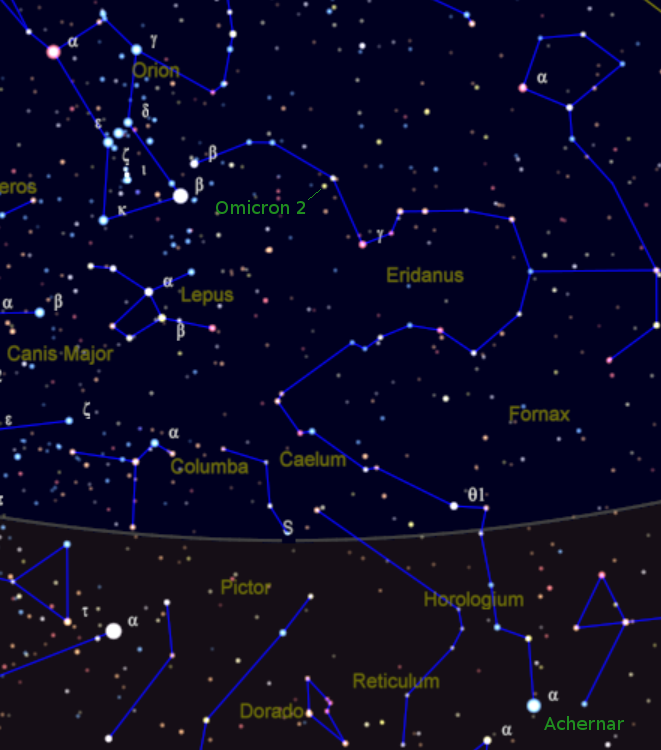
The constellation of the river Eridanus above and below the horizon for 9 p.m. on January 23, 2014. Created using Cartes du Ciel (Sky Charts).
01/22/2014 – Ephemeris – Where are the bright planets this week?
Ephemeris for Wednesday, January 22nd. The sun will rise at 8:11. It’ll be up for 9 hours and 26 minutes, setting at 5:37. The moon, 2 days before last quarter, will rise at 12:27 tomorrow morning.
Let’s take our weekly look at the planets. Tiny Mercury is starting its week and a half appearance low in the west-southwest between sunset and 6:53, when it sets. After that Jupiter takes over the evening sky. It will be in the eastern sky as darkness falls tonight. It’s cruising against the stars of Gemini now. It will rise and pass due south at 11:30 p.m., and will set at 7:11 a.m. in the west-northwest. Mars will rise at 12:11 a.m. in the east-southeast. Reddish Mars is in Virgo now and above the bright star Spica and the Moon tomorrow morning. Saturn will rise at 2:57 a.m. in the east-southeast. It’s seen against Libra the scales this year. Venus will rise at 6:35 tomorrow morning, so it may become visible around 7 or so very low in the east-southeast.
Times are for the Traverse City/Interlochen area of Michigan. They may be different for your location.
Addendum
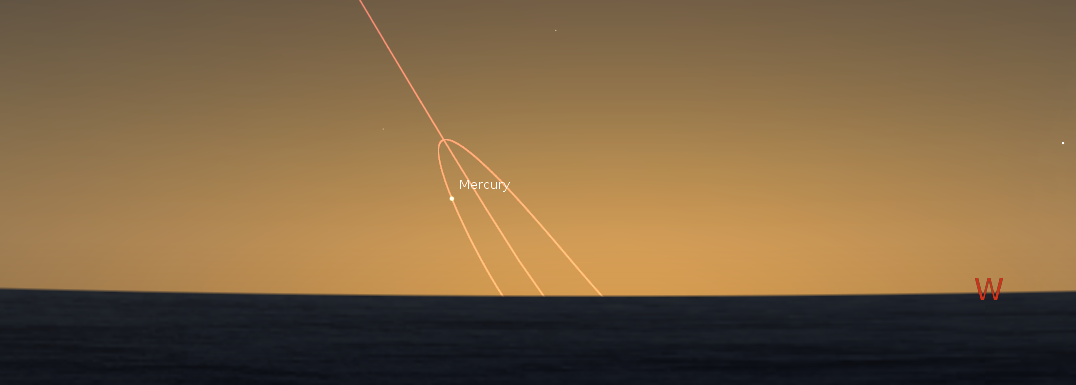
Mercury in the west-southwest at 6:15 p.m. on January 22, 2014. Also displayed is Mercury’s orbit, the loop, and the ecliptic, the plane of the Earth’s orbit. Created using Stellarium.
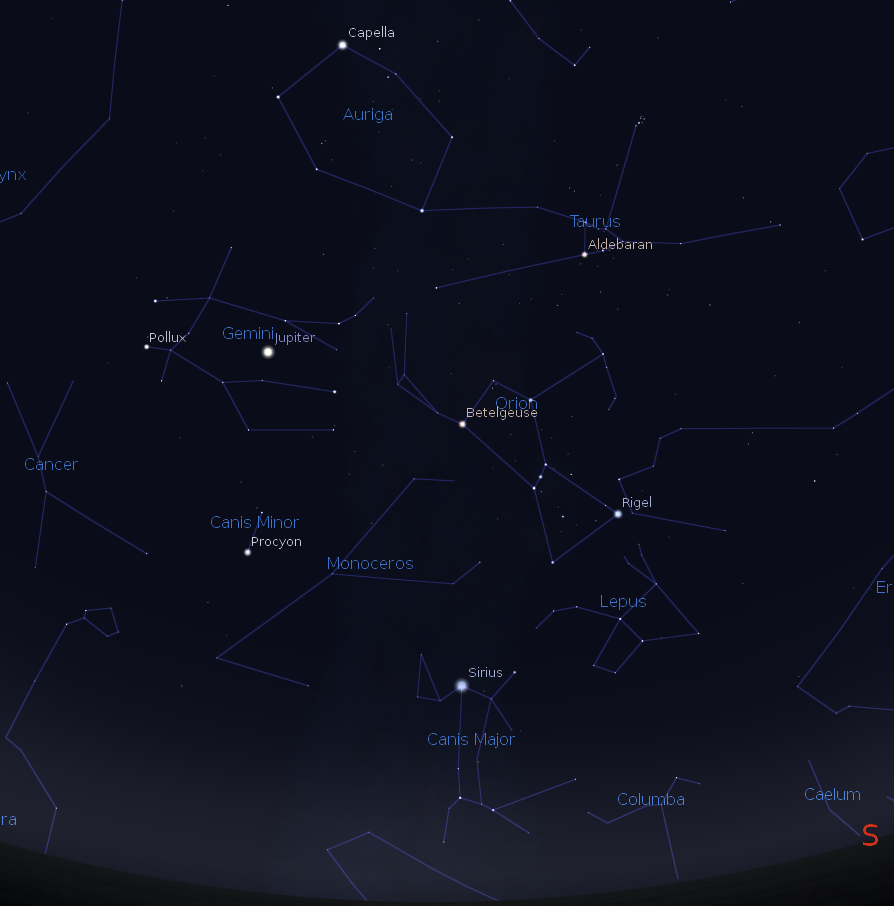
Jupiter with the winter constellations at 9 p.m. on January 22, 2014. Created using Stellarium.
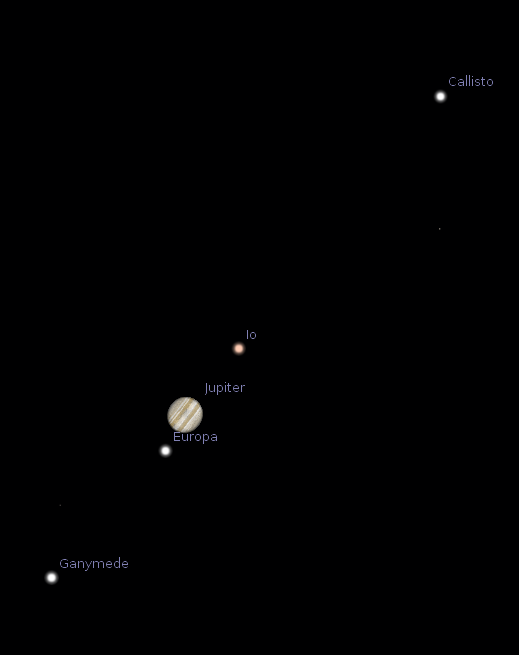
The telescopic Jupiter at 9 p.m. and January 22, 2014. Created using Stellarium.
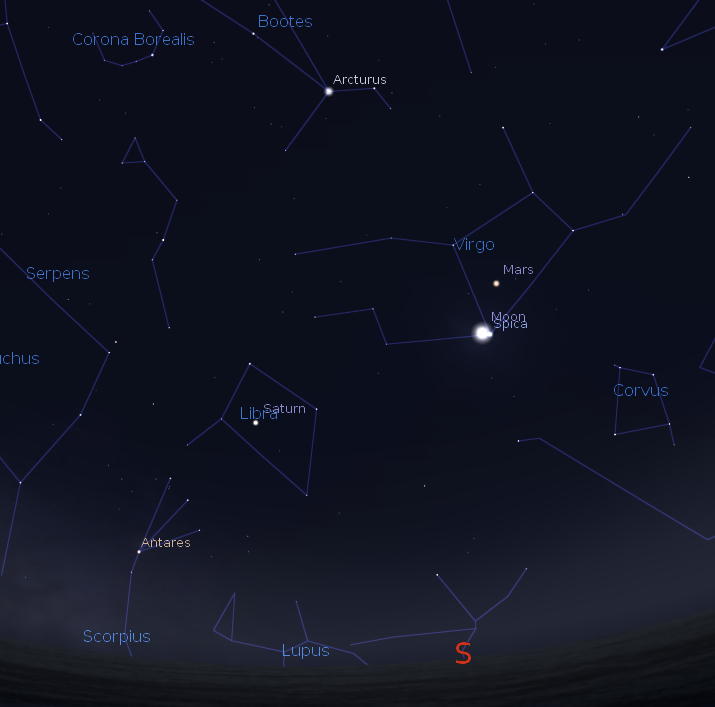
Mars, Saturn and the Moon with the spring constellations at 6:30 a.m. on January 23, 2014. Created using Stellarium.
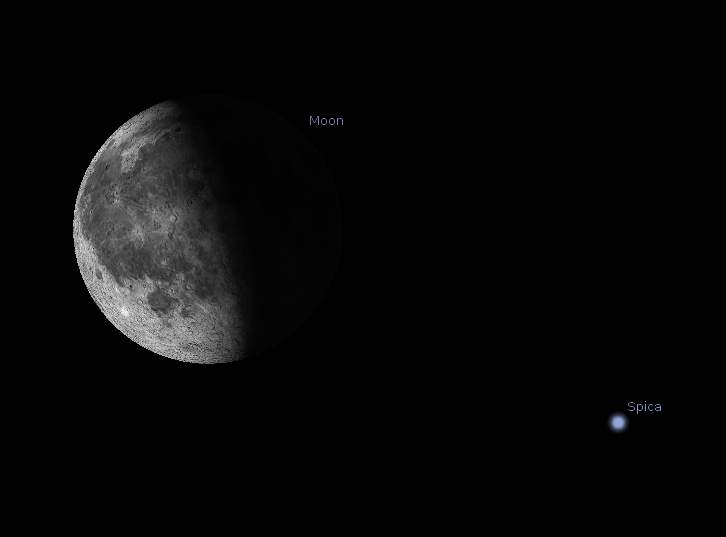
The Moon and the star Spica at 6:30 a.m. on January 23, 2014. Created using Stellarium.
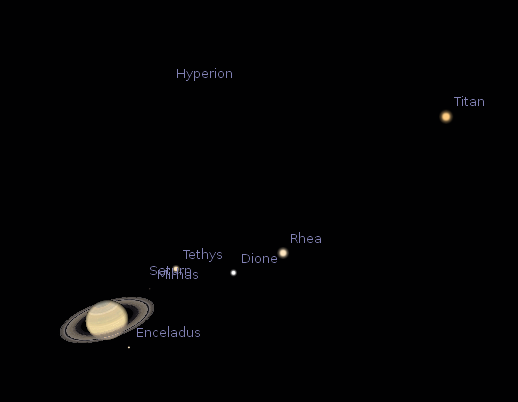
Saturn and its moons at 6:30, January 23, 2014. Of the moons, Titan will be the only one visible in small telescopes. Created using Stellarium.
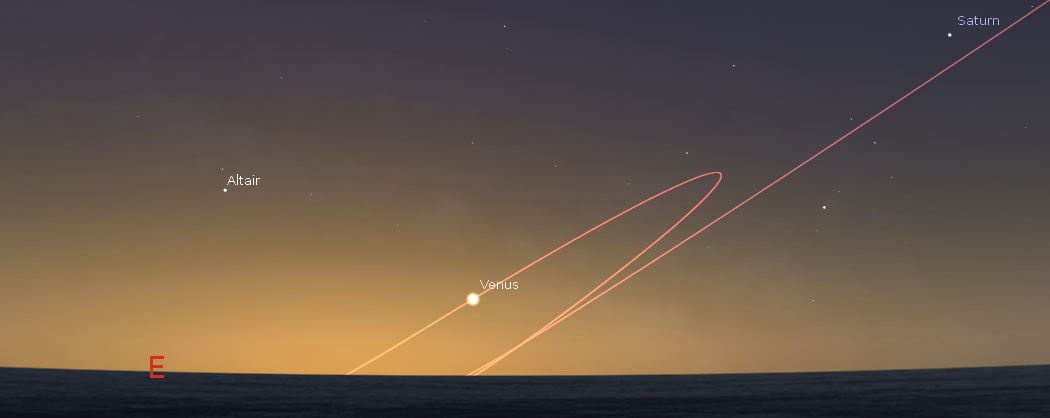
Venus in the east-southeast at 7:45 a.m. on January 23, 2014. Also displayed is Venus’ orbit, the loop, and the ecliptic, the plane of Earth. Created using Stellarium.
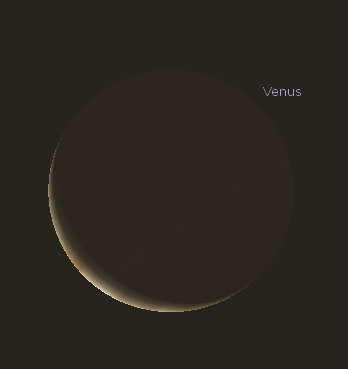
Venus as seen in a telescope at 7:45 a.m. on January 23, 2014. Created using Stellarium.
01/21/2014 – Ephemeris – Orion’s hunting dogs
Ephemeris for Tuesday, January 21st. The sun will rise at 8:11. It’ll be up for 9 hours and 24 minutes, setting at 5:36. The moon, 3 days before last quarter, will rise at 11:23 this evening.
The great winter constellation or star group Orion the Hunter, is located in the south-southeastern sky at 9 p.m. His elongated rectangle of a torso is almost vertical. In the center of the rectangle are three stars in a line that make his belt. As a hunter, especially one of old, he has two hunting dogs. The larger, Canis Major can be found by following the three belt stars of Orion down and to the left. There lies the brilliant star called Sirius, also known as the Dog Star. It’s in the heart of a stick figure dog facing Orion that appears to be begging. The smaller dog can be found by extending a line through Orion’s shoulder stars to the left. We find a bright star called Procyon. It and one other star make up the hot-dog shaped constellation of Canis Minor, the little dog.
Times are for the Traverse City/Interlochen area of Michigan. They may be different for your location.
Addendum
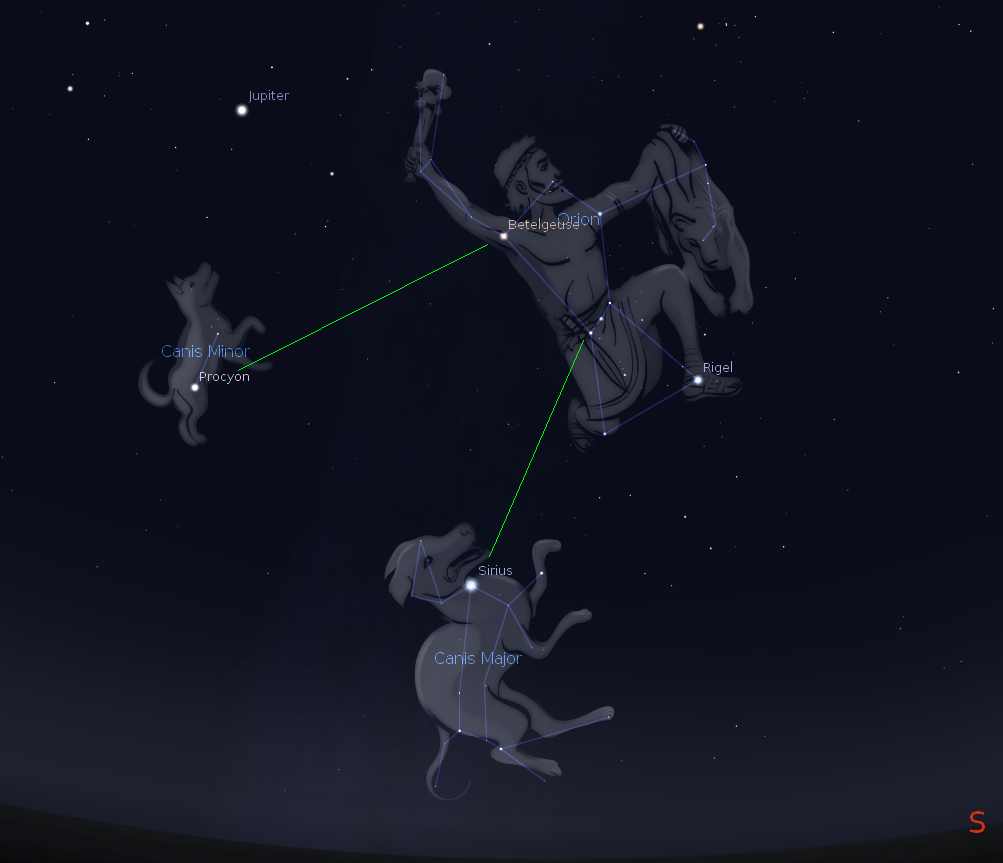
Orion and his hunting dogs with pointers as seen at 9 p.m. on January 21, 2014. Created using Stellarium.
Rosetta’s awake and phoning home
Check out this from Emily Lakdawalla from the Planetary Society. Looks like ESA’s big gamble paid off. Now on to the comet!
 Bob Moler's Ephemeris Blog