Archive
02/28/2014 – Ephemeris – Looking forward to March and spring
Ephemeris for Friday, February 28th. The sun will rise at 7:21. It’ll be up for 11 hours and 7 minutes, setting at 6:29. The moon, 1 day before new, will rise at 7:11 tomorrow morning.
Let’s look at the skies for the month of March. The sun will pass the celestial equator in March as the promising season of spring will begin. Daylight hours in the Interlochen/Traverse City area and will increase from 11 hours and 10 minutes tomorrow to 12 hours 43 minutes on the 31st. The altitude, or angle, of the sun above the southern horizon at local noon will be just under 38 degrees tomorrow and will ascend to nearly 50 degrees on the 31st. The altitude of the sun in the Straits area will be a degree lower. Local apparent noon this month, when the sun passes due south, will be about 12:49 p.m. Spring will begin on the 20th at 11:57 a.m. Eastern Daylight Time (15:57 UT), which now rules most of the year and will start a week from Sunday.
Times are for the Traverse City/Interlochen area of Michigan. They may be different for your location.
Addendum
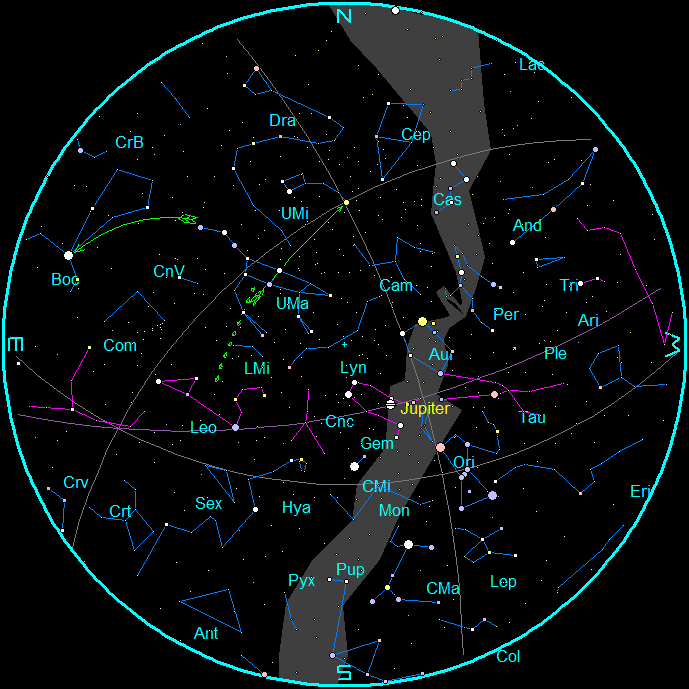
Star Chart for mid-month for March 2014 at 10 p.m. Credit: Bob Moler.
Add a half hour to every week before the 15th and subtract and hour for every week after the 15th.
For a list of constellation names to go with the abbreviations click here.
02/27/2014 – Ephemeris – Lepus the hare, the rabbit that got away
Ephemeris for Thursday, February 27th. The sun will rise at 7:23. It’ll be up for 11 hours and 4 minutes, setting at 6:27. The moon, 2 days before new, will rise at 6:36 tomorrow morning.
Orion, the central winter constellation is seen in the south at 9 p.m. He is a hunter, but he’s preoccupied with the charge of Taurus the bull from the upper right. At Orion’s feet, and unnoticed by him is the small constellation of Lepus the hare. It’s very hard to see a rabbit in its eight dim stars: however, I do see a rabbit’s head ears and shoulders. A misshapen box is the head and face of this critter facing to the left. His ears extend upwards from the upper right star of the box, and the bend forward a bit. Two stars to the right of the box and a bit farther apart hint at the front part of the body. In Lepus telescopes can find M79, a distant globular star cluster, one of the few of these compact star clusters visible in the winter sky.
Times are for the Traverse City/Interlochen area of Michigan. They may be different for your location.
Addendum
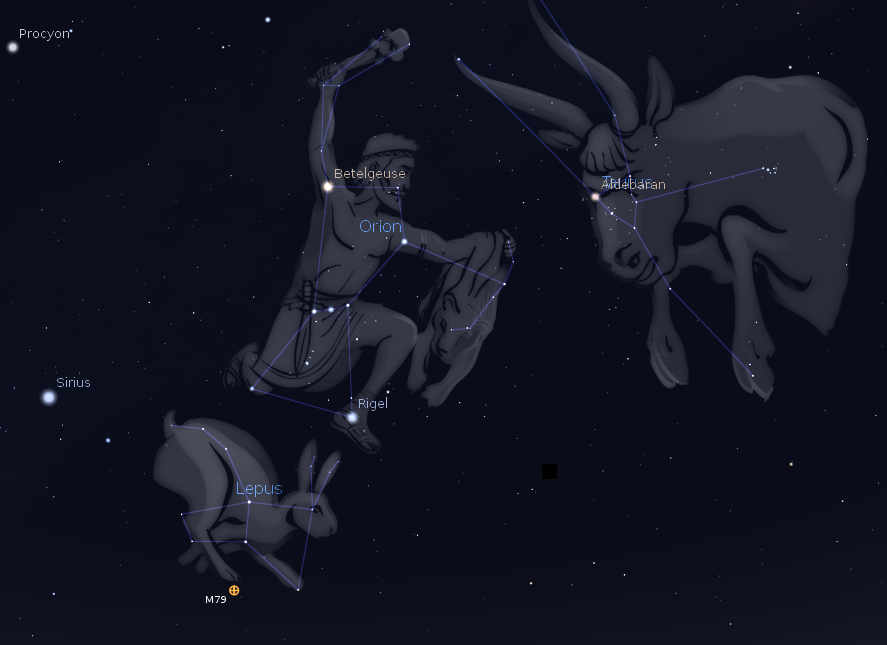
Lepus the hare as imagined in Stellarium. I haven’t added the four stars in the ears as I saw it based on the older Sky and Telescope magazine star charts.
Globular star cluster M79 is very distant: 41,000 light years from us and 60,000 light years from the center of the Milky Way. It possibly was a member of the Canis Major Dwarf Galaxy that seems to have become entangled with our own Milky Way galaxy. That’s what massive galaxies do to smaller, less massive dwarf galaxies: “Resistance is futile, you will be assimilated”.
02/26/2014 – Ephemeris – Where are the bright planets this week?
Ephemeris for Wednesday, February 26th. The sun will rise at 7:25. It’ll be up for 11 hours and 1 minute, setting at 6:26. The moon, 3 days before new, will rise at 5:58 tomorrow morning.
Let’s take our weekly look at the planets. Jupiter will be in the southeastern sky as darkness falls tonight. It’s cruising against the stars of Gemini now. It will pass due south at 9:01 p.m., and will set at 4:44 a.m. in the west-northwest. Reddish Mars is in Virgo now and above and left of the bright star Spica, which it now outshines. Mars will rise at 10:29 p.m. and will appear above the moon when it rises a half an hour later. It will pass due south at 4 a.m. Saturn will rise at 12:45 a.m. in the east-southeast. It’s seen against the stars of Libra the scales this year. Venus will rise at 5:03 tomorrow morning but this morning it will appear above and right of the Moon. and shines brightly in the southeast before sunrise.
Times are for the Traverse City/Interlochen area of Michigan. They may be different for your location.
Addendum
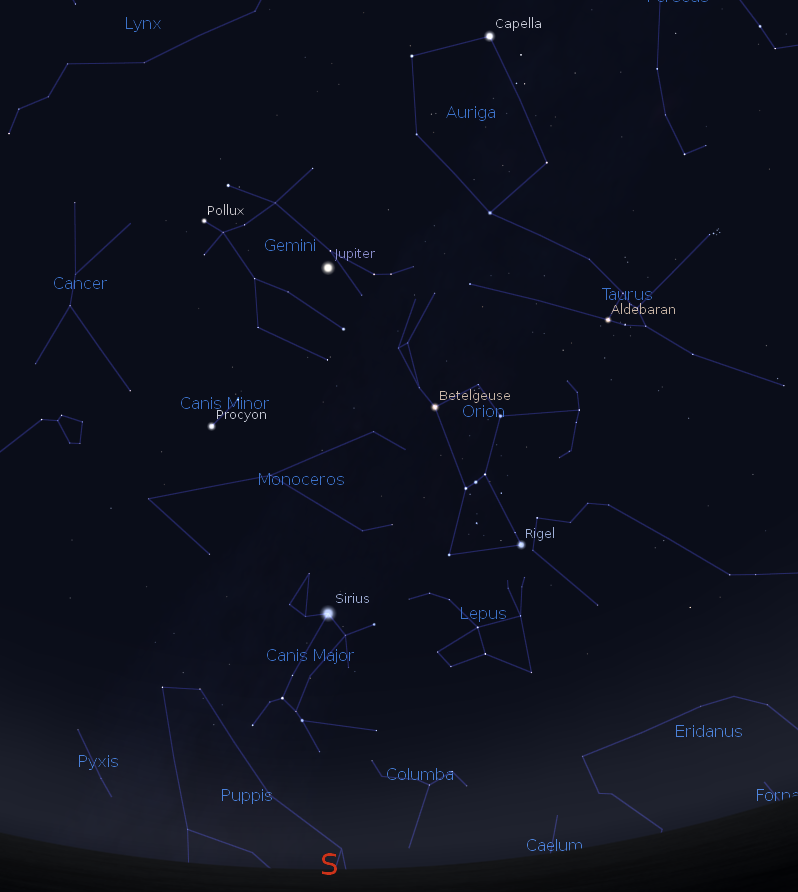
Jupiter and the winter constellations at 9 p.m. on February 26, 2014. Created using Stellarium.
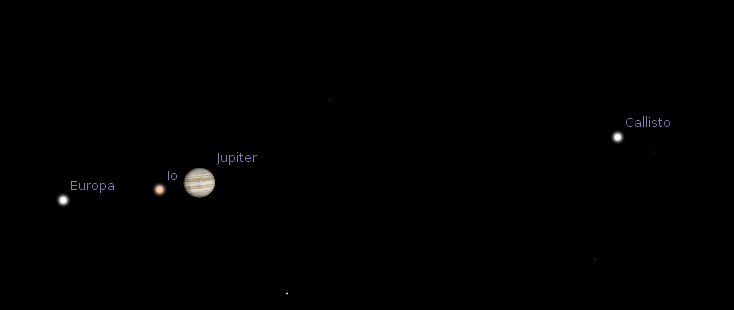
Telescopic Jupiter. The missing moon Ganymede is near Io from our vantage point, however it’s in Jupiter’s shadow. It will emerge into sunlight at 10:25 p.m. (3:25 UT on the 27th) between Io and Europa. Created using Stellarium.
Stellarium models the eclipses of the satellites fine, but for this one it is more than a half hour early. It may not take into account the light travel time between Jupiter and the earth. Another free program Cartes du Ciel does not model Jovian satellite eclipses at all.
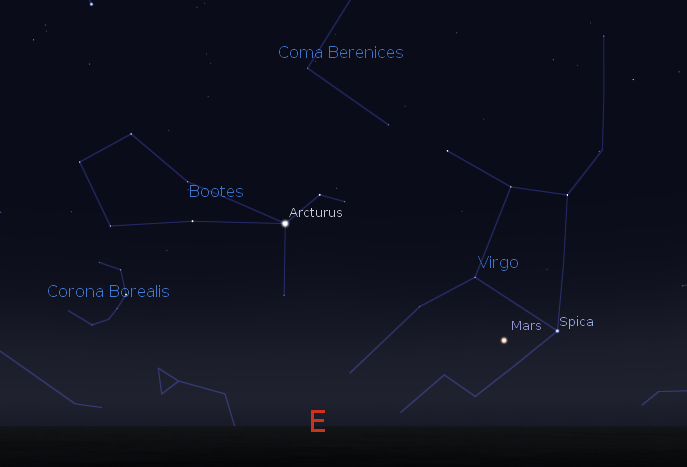
Mars rising near the star Spica at 11:30 p.m. February 26, 2014. Created using Stellarium.
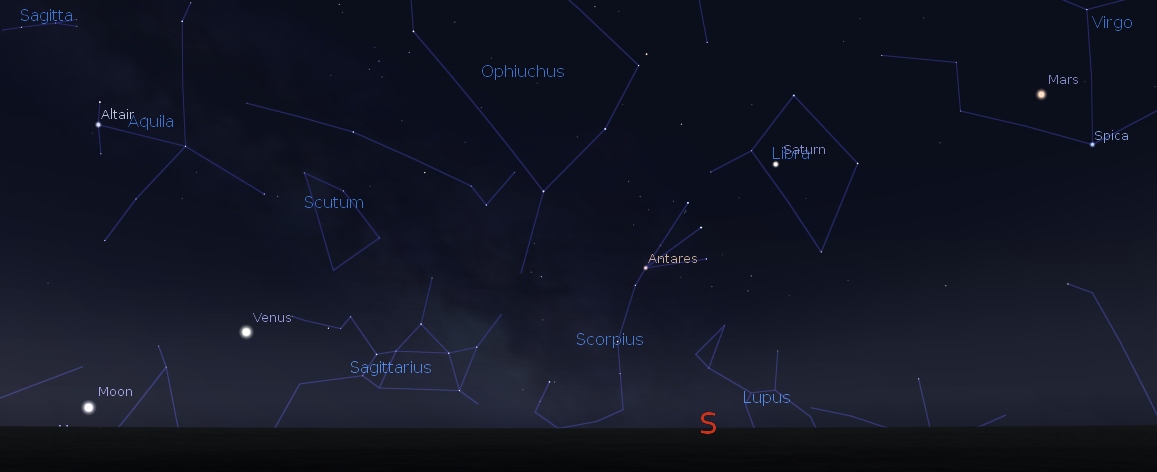
The morning planets Mars, Saturn and Venus with the moon at 6:15 a.m. February 27, 2014. Created using Stellarium.
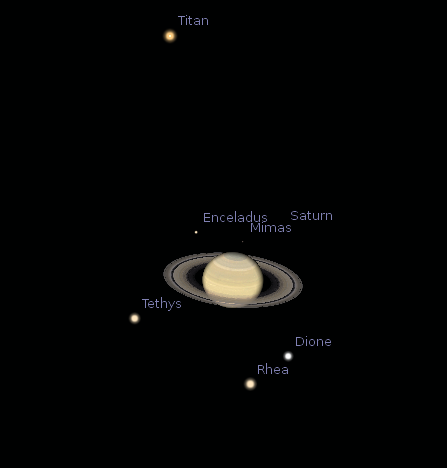
Saturn through a telescope on the morning of February 27, 2014. It would be difficult to see any satellites other than Titan with a small telescope. Created using Stellarium
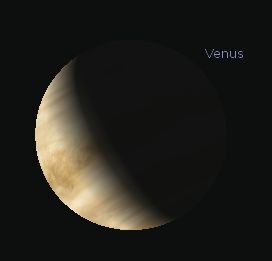
Venus through a telescope, except there will be no cloud detail, in the morning of February 27, 2014. Created using Stellarium.
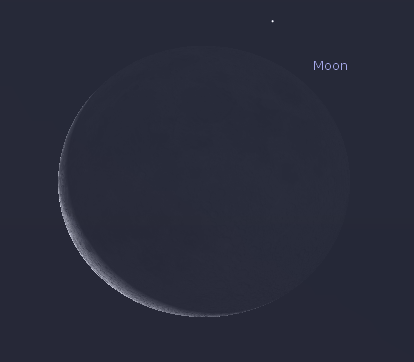
The thin crescent moon at 6:15 a.m. on February 27, 2014. Created using Stellarium.
02/25/2014 – Ephemeris – Mars starts its retrograde motion this weekend
Ephemeris for Tuesday, February 25th. The sun will rise at 7:26. It’ll be up for 10 hours and 58 minutes, setting at 6:24. The moon, 3 days past last quarter, will rise at 5:15 tomorrow morning.
The planet Mars, which rises about 10:30 p.m. and is near the star Spica, is slowing its eastward motion as the Earth approaches it. Mars will stop and appear to reverse course on Saturday March 1st. It will begin what astronomers call retrograde motion. This westward motion will continue past Mars’ opposition with the sun on April 8th, and its closest approach to the Earth on April 14th. Mars retrograde motion will end on May 21st when Mars will resume its prograde or eastward motion. The ancient Greeks especially had a problem with this because they believed that celestial bodies traveled in uniform circular motion. They added a circle on the planet’s main circle called an epicycle to kind of solve the problem. The problem was solved centuries later by Copernicus who made the earth another planet and Kepler who made the planet orbits elliptical.
Times are for the Traverse City/Interlochen area of Michigan. They may be different for your location.
Addendum
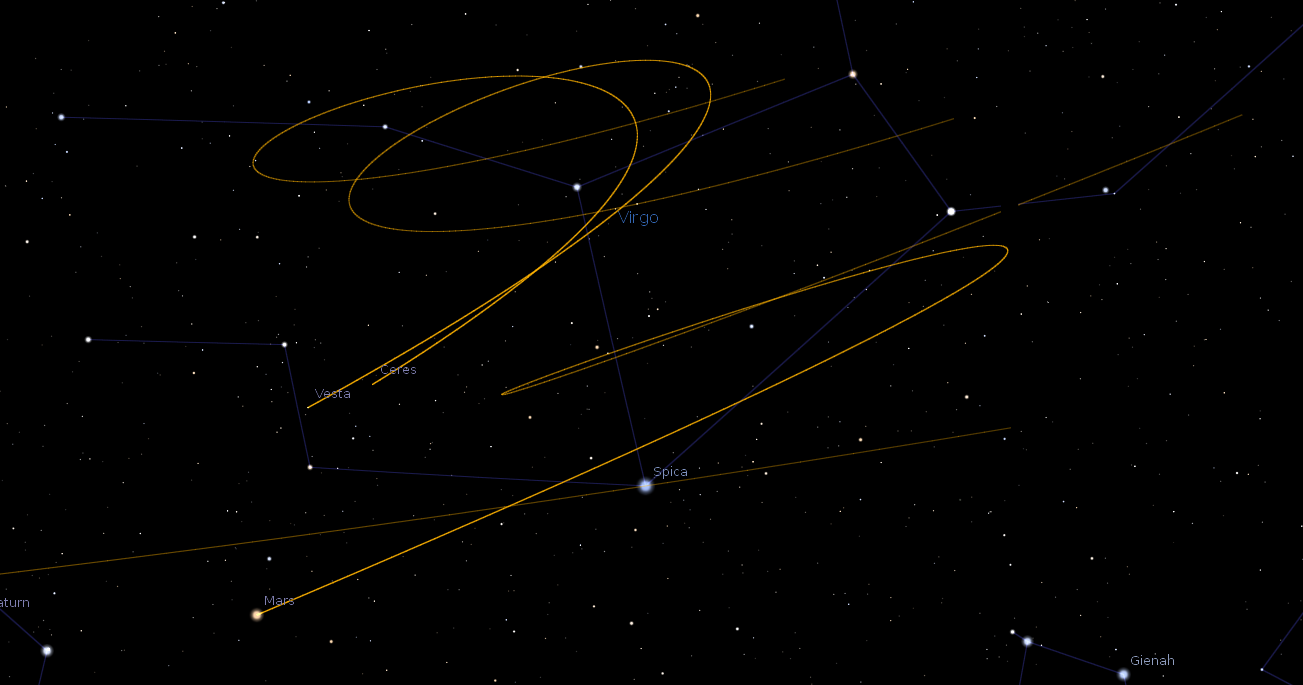
The trails of Mars and three asteroids from December 2013 to August 2014. Created using Stellarium.
Vesta and Ceres are going retrograde at the same time as Mars. The Dawn spacecraft traveling between Vesta to Ceres is about half way in between them. The other trail, not exhibiting retrograde is that of the small asteroid 2012 DA14 whose claim to fame is that it passed inside the ring of geosynchronous satellites on February 15, 2013. It was completely upstaged a few hours earlier by the meteor that exploded over Chelyabinsk, Russia. It looks like the orbital trail shown for 2012 DA14 has not been updated. As the result of the encounter with Earth that day the asteroid’s orbit was altered. 2012 DA14 is a provisional designation based on the year, half month and order of discovery. It’s permanent designation with a name is 367943 Duende. The name of the asteroid is usually up to the discoverer with the approval of the International Astronomical Union (IAU). It is the 367,943rd asteroid whose orbital elements are known. BTW Ceres is 1 Ceres, and Vesta is 4 Vesta. Though the 4th asteroid found, Vesta is the brightest, at the very limit of naked eye visibility.
02/24/2014 – Ephemeris – Two more bright star clusters of winter
Ephemeris for Monday, February 24th. The sun will rise at 7:28. It’ll be up for 10 hours and 55 minutes, setting at 6:23. The moon, 2 days past last quarter, will rise at 4:27 tomorrow morning.
The Milky Way isn’t as bright in the winter as it is in the summer. That’s because we are looking away from the galactic center, the central part of the Milky Way. But there’s still a lot to see as can be attested to by the bright stars of winter that outshine those of summer. There are a lot of Galactic or open star clusters visible, such as the Pleiades. With binoculars one can spot at least two more. Just below Sirius the Dog Star the brightest night-time star which can be found by extending the line of the belt stars of Orion to the lower left. It’s Messier 41. Then off Castor’s toe in Gemini, where the sun would be on the first day of summer, as I mentioned last Tuesday, is another bright binocular star cluster cataloged as Messier 35.
Times are for the Traverse City/Interlochen area of Michigan. They may be different for your location.
Addendum
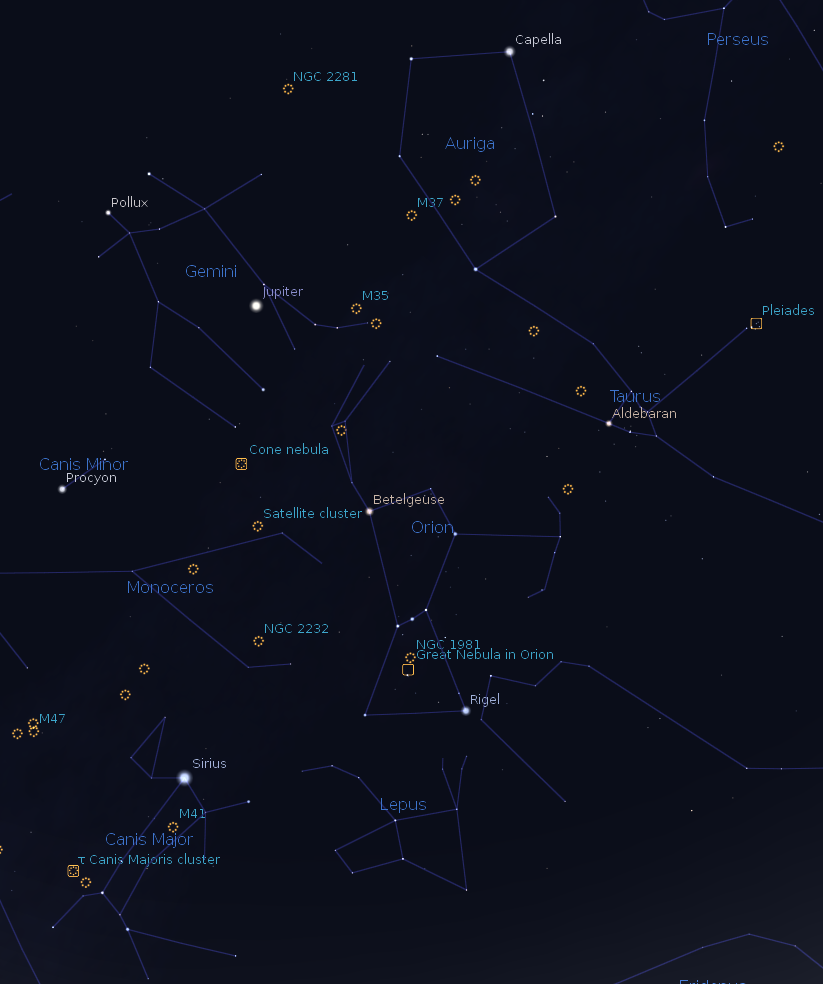
Winter Deep Sky Objects including the Pleiades, M35 and M41. Created using Stellarium.
02/21/2014 – Ephemeris – Some nebulae in Orion
Ephemeris for Friday, February 21st. The sun will rise at 7:33. It’ll be up for 10 hours and 46 minutes, setting at 6:19. The moon, 1 day before last quarter, will rise at 1:31 tomorrow morning.
With the moon out of the sky, it’s a good time to get those binoculars or small telescope out to view at least one nebula in the constellation Orion the hunter and maybe even more. Orion is in the south with those belt stars lie in a straight line. Below the belt are three fainter stars, vertically arranged: Orion’s sword. In binoculars each of those stars are multiples. Around what looks like a center star there is a haze, which is the Great Orion Nebula, the nearest star forming region to us at around 1,400 light years away. Some of its gasses envelop the stars that make up the top star of the sword. Orion hosts the famous Horse head Nebula, which unfortunately can only be seen in photographs, It is right below the left star of the belt.
Times are for the Traverse City/Interlochen area of Michigan. They may be different for your location.
Addendum
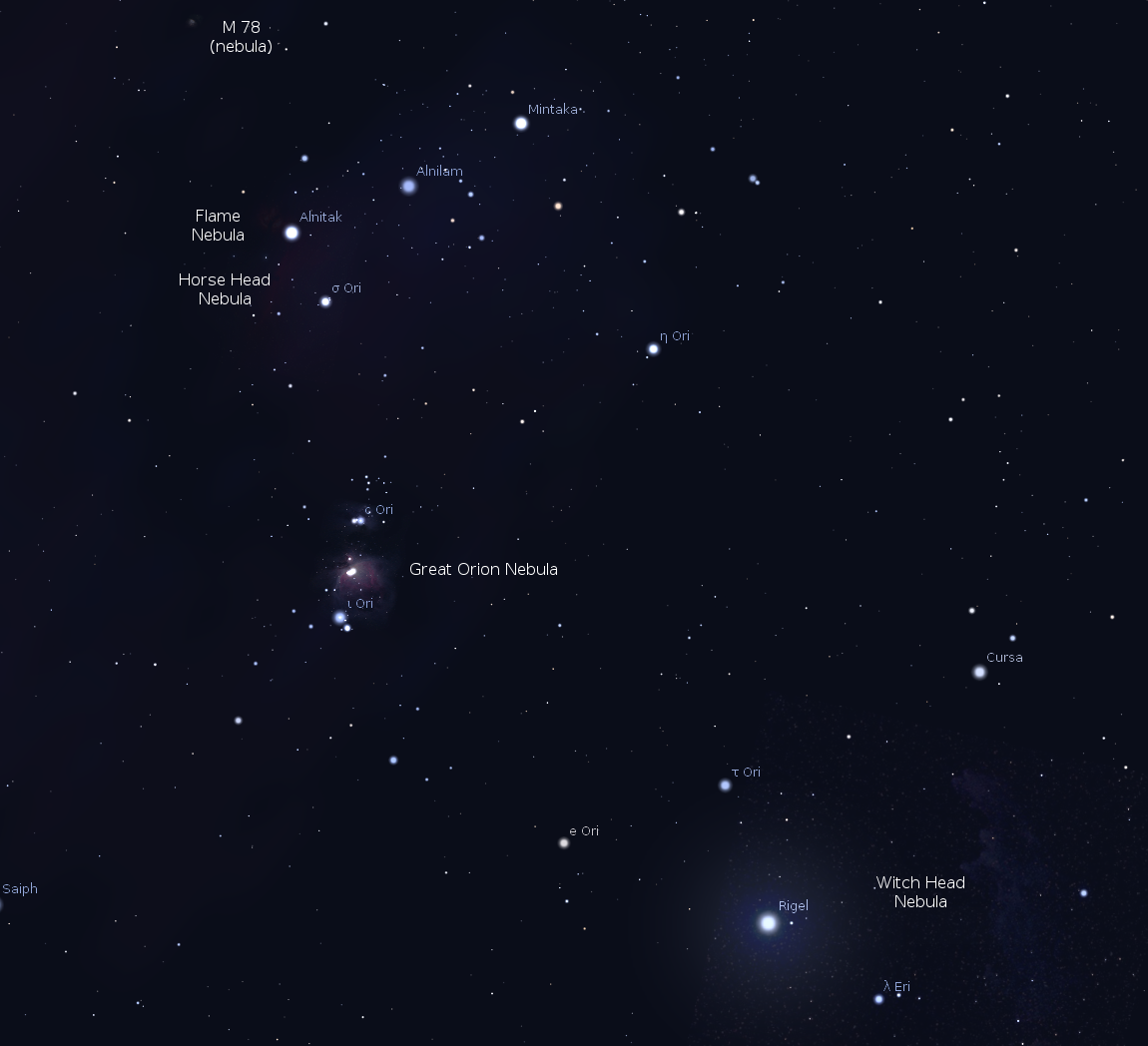
Orion’s Nebulae in the southern part of the constellation as displayed by Stellarium.
A couple of nebulae are seen here that are not in the text above. M78 is a small nebula north of the belt star Alnitak. It is visible in a telescope. The Witch Head Nebula, another large nebula, shining by the reflected light of Rigel. It’s officially in the neighboring constellation of Eridanus, and I believe strictly a photographic nebula. The witch head is best seen if the image is turned upside down.
02/20/2014 – Ephemeris – Winter Circle plus 1
Ephemeris for Thursday, February 20th. The sun will rise at 7:34. It’ll be up for 10 hours and 43 minutes, setting at 6:18. The moon, 2 days before last quarter, will rise at 12:27 tomorrow morning.
The winter skies are blessed with more first magnitude stars than any other season. Six of these stars lie in a large circle centered on the seventh. This circle is up at 9 p.m. Starting high overhead is Capella in Auriga the charioteer. Moving down clockwise is Aldebaran in the face of Taurus the Bull. Then down to Orion’s knee we find Rigel. Down and left is the brightest star of all Sirius the Dog Star in Canis Major, lowest of these stars in the south-southeast. Moving up and left is Procyon in Canis Minor, Above Procyon is Pollux in Gemini the twins. All these are centered on Betelgeuse the bright red star in Orion’s shoulder. The interloper this year is Jupiter which is situated in Gemini and outshines them all.
Times are for the Traverse City/Interlochen area of Michigan. They may be different for your location.
Addendum
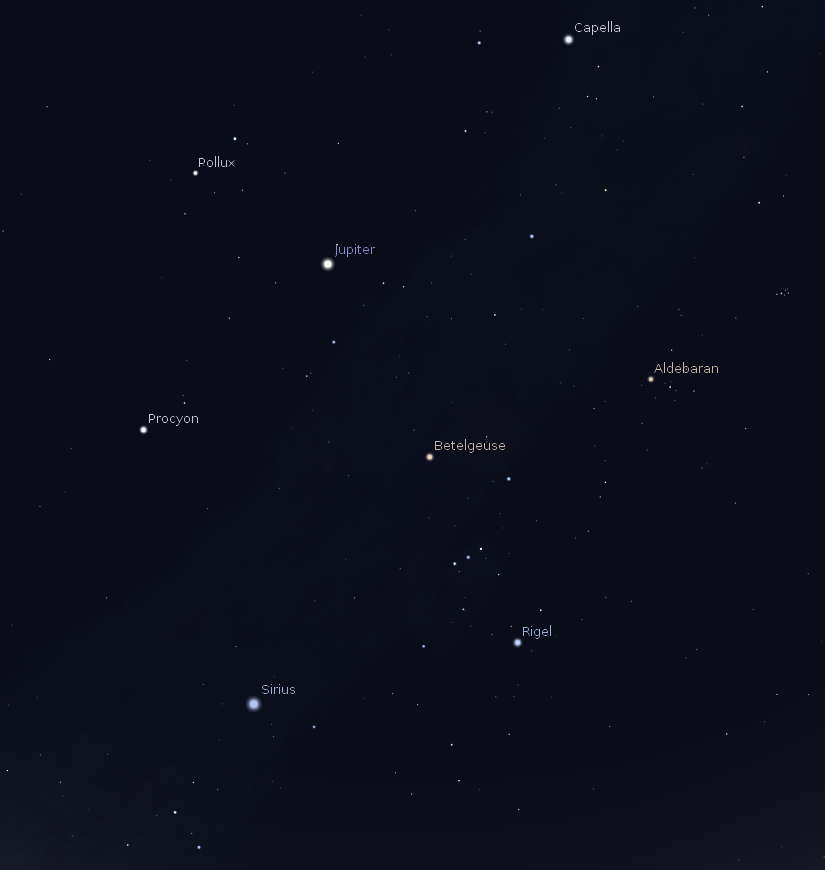
The Winter Circle plus Jupiter at 9 p.m. on February 20, 2014. Created using Stellarium.
02/19/2014 – Ephemeris – Where are the bright planets this week?
Ephemeris for Wednesday, February 19th. The sun will rise at 7:36. It’ll be up for 10 hours and 40 minutes, setting at 6:16. The moon, 3 days before last quarter, will rise at 11:23 this evening.
Let’s take our weekly look at the planets. Jupiter will be in the southeastern sky as darkness falls tonight. It’s cruising against the stars of Gemini now. It will pass due south at 9:29 p.m., and will set at 5:12 a.m. in the west-northwest. Reddish Mars is in Virgo now and above and left of the bright star Spica, which it now outshines. Mars will rise at 10:54 p.m. and will appear above the moon when it rises a half an hour later. It will pass due south at 4:26 a.m. Saturn will rise at 1:13 a.m. in the east-southeast. It’s seen against the stars of Libra the scales this year. Venus will rise at 5:10 tomorrow morning, and shines brightly in the southeast before sunrise. It’s in Sagittarius, left of its Teapot shape of stars.
Times are for the Traverse City/Interlochen area of Michigan. They may be different for your location.
Addendum
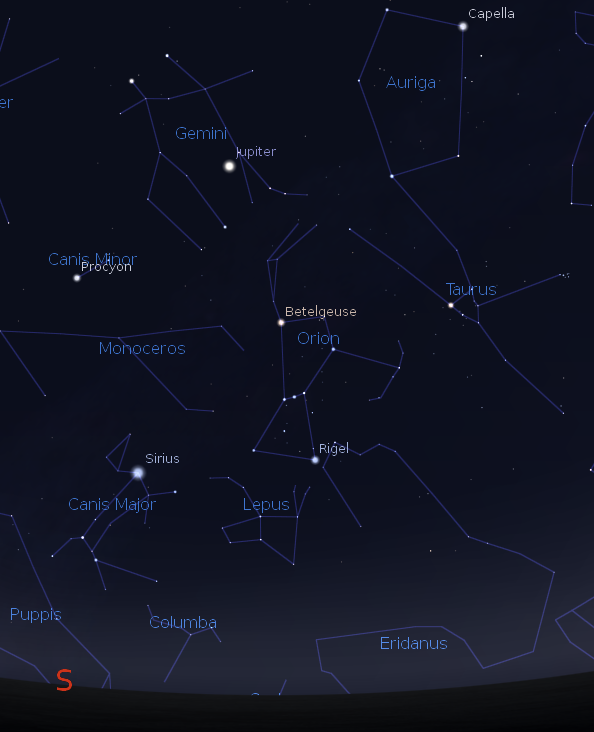
Jupiter and the constellations of winter at 9 p.m. February 18, 2014. Created using Stellarium.
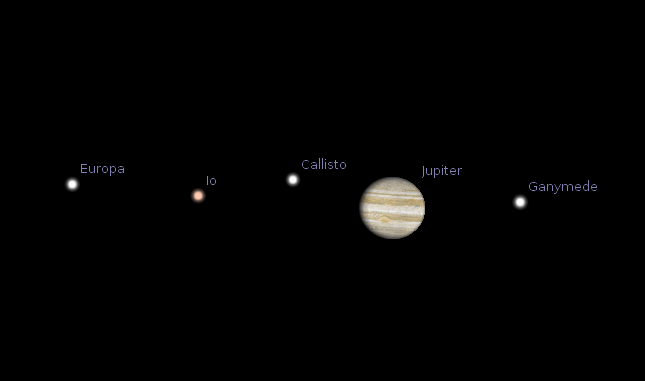
Jupiter at 9 p.m. on February 18, 2014. Created using Cartes du Ciel.
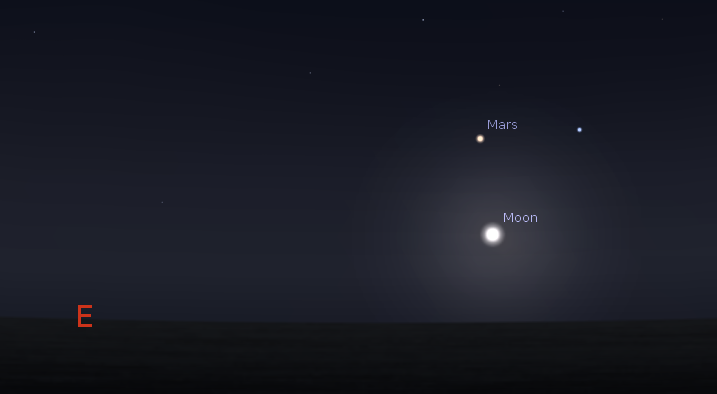
Mars and the Moon at midnight on February 20, 2014. Created using Cartes du Ciel.
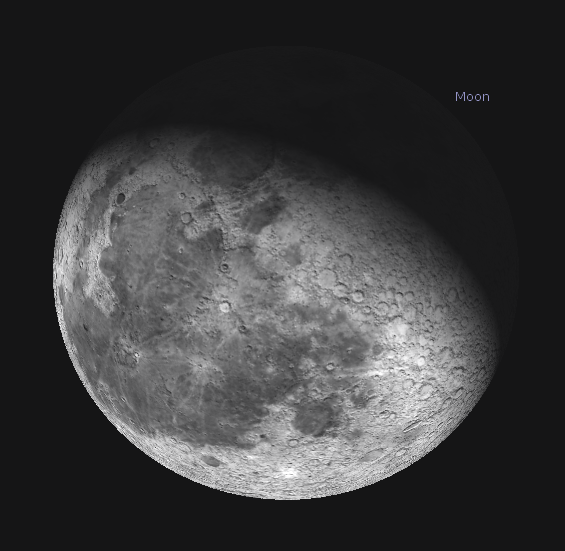
The Moon at midnight on February 20, 2014. Created using Stellarium.
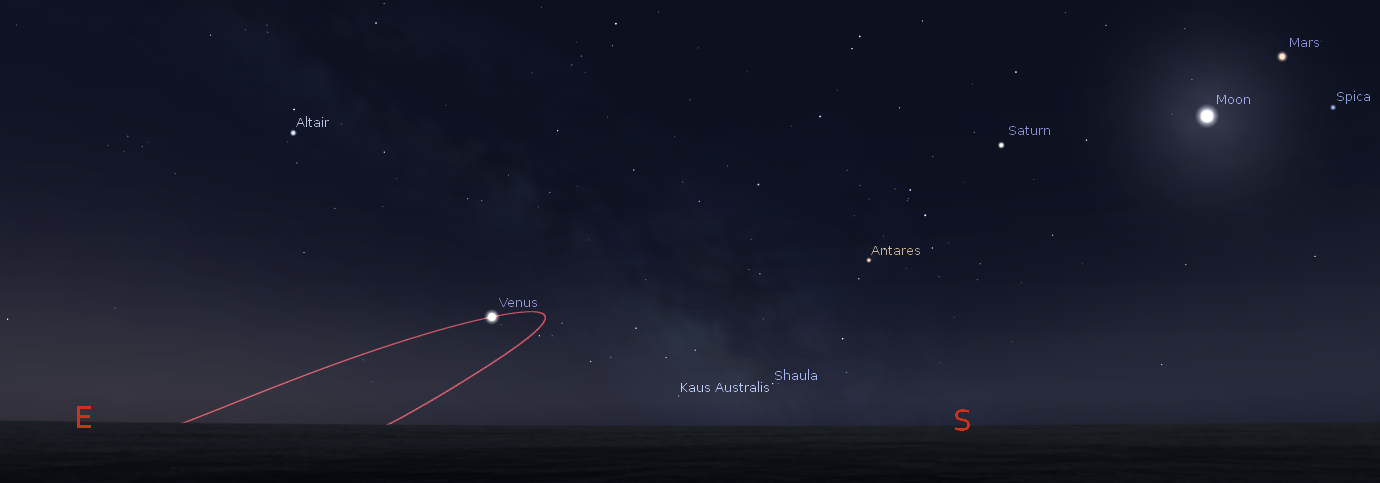
The morning planets at 6:30 a.m. February 20, 2014, including the orbit of Venus. Created using Stellarium.
Venus will reach the end of the red loop, its orbit as seen from Earth, on March 22nd. Of course we and Venus are moving, and so the apparent position of Venus will change also by the Earth’s motion.
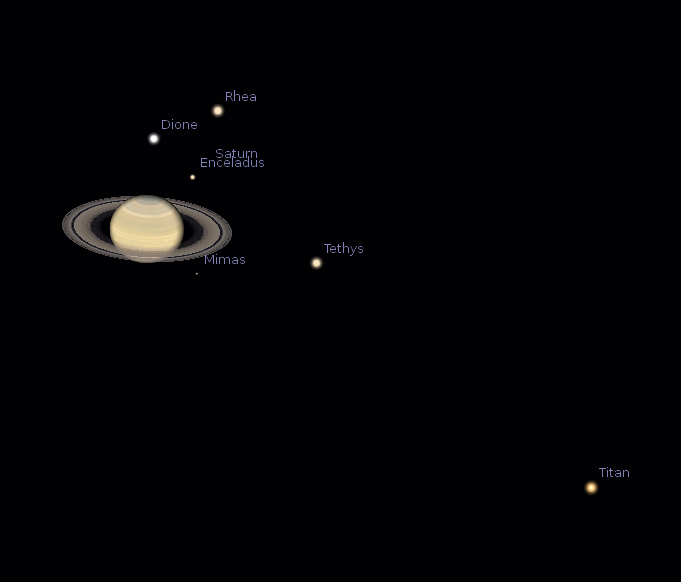
Saturn and its moons at 6:30, February 20, 2014. Of the moons, Titan will be the only one visible in small telescopes. Created using Stellarium.
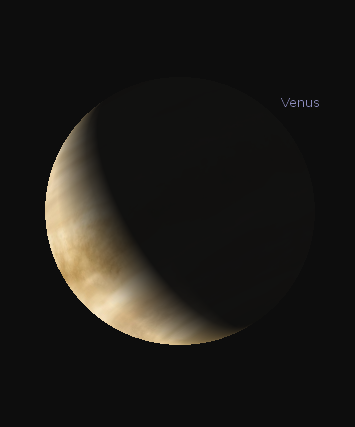
Venus through a telescope. The planet is getting smaller and its crescent is getting fatter as it moves away from the Earth. This image is for 6:30 a.m. February 20, 2014.Created using Stellarium.
02/18/2014 – Ephemeris – Gemini and the summer solstice
Ephemeris for Tuesday, February 18th. The sun will rise at 7:38. It’ll be up for 10 hours and 37 minutes, setting at 6:15. The moon, half way from full to last quarter, will rise at 10:19 this evening.
The constellation Gemini lies above and left of Orion in the southern evening sky. Jupiter is now seen against its stars. Gemini is called the twins and its head stars at the upper left of the constellation are Castor and Pollux. Pollux is to the lower left of Castor. Stick figures of the lads can be seen extending to the lower right of these stars. Currently the place in the sky where the sun is on the winter solstice is just to the right of Castor’s big toe. So it would seem that the sun is entering Gemini on the first day of summer, not Cancer as the astrologers would tell you. That solstice point is moving westward at one degree every 71.6 years, a motion called precession. I checked two astronomy programs and that point has now moved into Taurus the bull.
Times are for the Traverse City/Interlochen area of Michigan. They may be different for your location.
Addendum
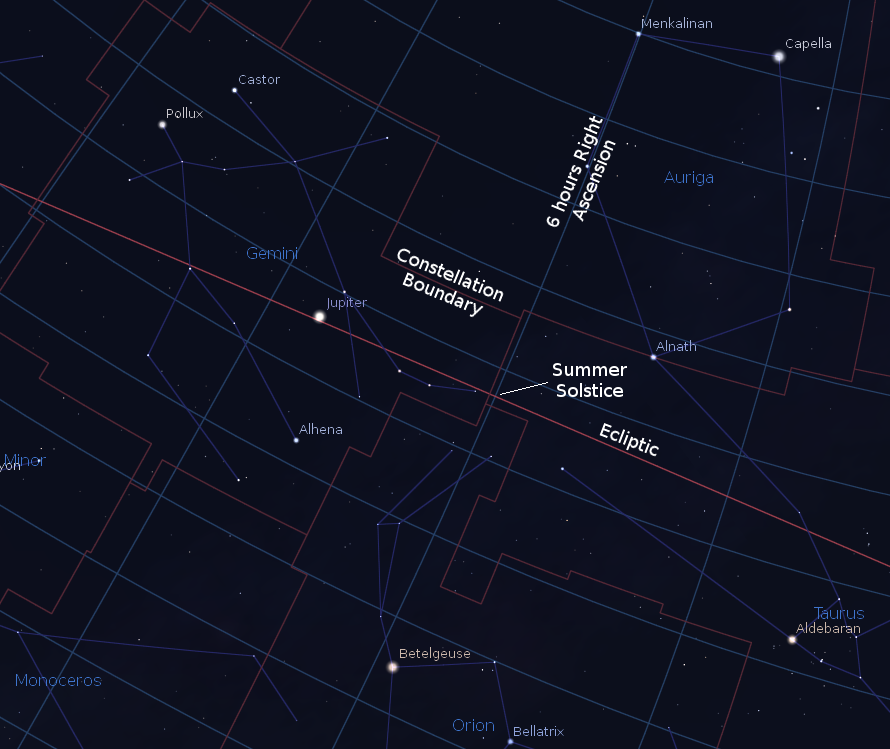
The constellation Gemini and the summer solstice point in the sky. Created using Stellarium.
The summer solstice point in the sky is the intersection of the ecliptic, the suns path in the sky and the 6 hour line of right ascension which is like longitude on the earth. The other blue lines are lines are lines of declination which is like latitude in the sky. Note also that the summer solstice point is the point on the ecliptic closest to the blue declination line which is the 25º north declination line. It’s at approximately 23½º north declination, right over the earth’s 23½º north latitude line also known as the Tropic of Cancer.
Back a couple of thousand of years ago the sun was entering the constellation of Cancer, off our image to the left, on the first day of summer. Since then the summer solstice point has moved westward against the stars at one degree every 71.6 years. This is due to what is called general precession, of the slow wobble of the earth’s axis caused by the pull of the Moon and Sun on the Earth’s equatorial bulge. This torques the earth and causes the 26,000 year wobble, like a spinning top. Since back then the solstice point passed all the way across Gemini and in 1989 entered the territory of Taurus.
02/17/2014 – Ephemeris – Viewing tonight’s waning gibbous moon
Ephemeris for President’s Day, Monday, February 17th. The sun will rise at 7:39. It’ll be up for 10 hours and 34 minutes, setting at 6:13. The Moon, 3 days past full, will rise at 9:17 this evening.
The bright Moon is now a waning gibbous phase, The right edge of the Moon is now in night as the sunset terminator slowly advances across the moon. Tonight the Sea of Fertility is half in daylight on the right side of the Moon. A telescope looking at it can spot the double crater of Messier and Messier A, a funny impact where the small asteroid skipped producing two craters and a double ray of ejecta. On the other side of the moon the largest sea Oceanus Procellarum, or Ocean of Storms can be seen in its entirety to the left limb of the moon. It happens that the moon is rotated toward us on that side, an effect called libration. The effect is due to the moon’s uneven velocity around the earth.
Times are for the Traverse City/Interlochen area of Michigan. They may be different for your location.
Addendum
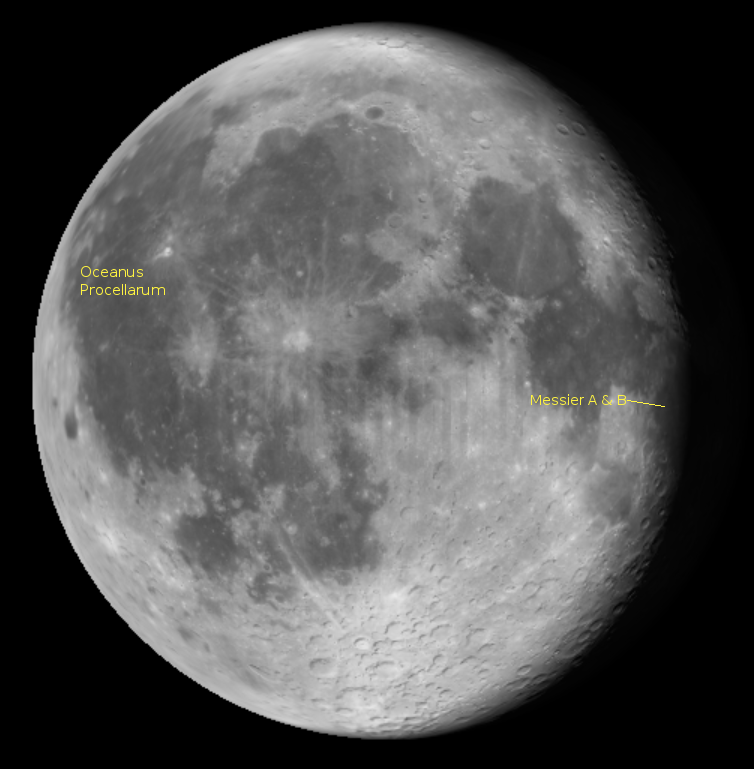
The moon at 9 p.m. on February 17, 2014 showing Oceanus Procellarum and the craters Messier A and B. Created using Virtual Moon Atlas.
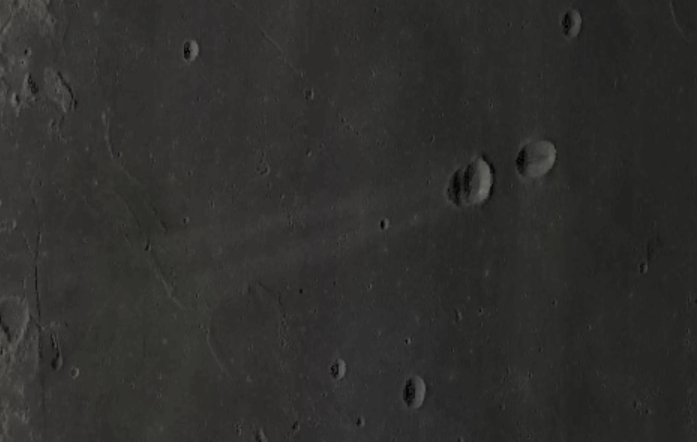
Closeup of the craters Messier A and B showing their twin rays. Created using Virtual Moon Atlas and the Lunar Reconnaissance Orbiter images. Credit: NASA.
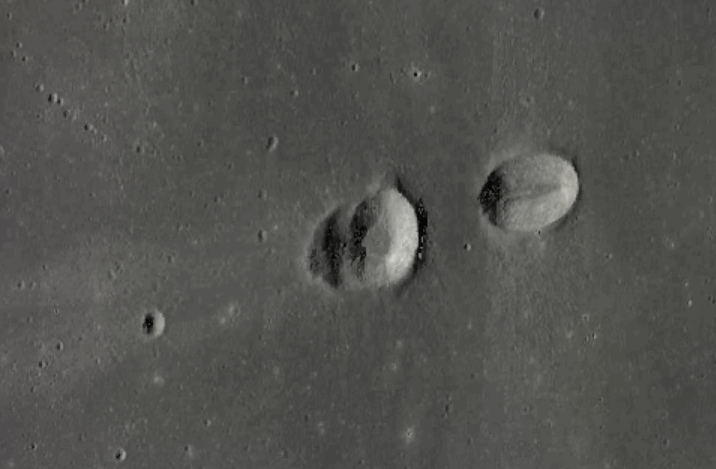
Extreme closeup of the craters Messier A and B showing their twin rays. Created using Virtual Moon Atlas and the Lunar Reconnaissance Orbiter images. Credit: NASA.
 Bob Moler's Ephemeris Blog