Archive
02/14/2014 – Ephemeris – This full moon is a bit too cold for lovers.
Ephemeris for St Valentine’s Day, Friday, February 14th. The sun will rise at 7:44. It’ll be up for 10 hours and 25 minutes, setting at 6:09. The Moon, at full today, will rise at 6:15 this evening.
Tonight’s full moon won’t be the type that young lovers would want to look up to because, well it’s February, and it’s cold. Let’s wait until June. But one can bundle up and get the telescope or binoculars out to view the face of our only natural satellite. Even though the actual reflectance is a bit less than 13% of the light that the sun sends its way. If it were snow covered it would really be bright. Looking at it with or without binoculars one can see the man in the moon face. At the bottom of the moon or bottom right as the moon rises is the splashiest crater of all, the crater Tycho. The crater itself seems to have a dark halo around it. Also one can see rays extending great distances across the moon from it.
Times are for the Traverse City/Interlochen area of Michigan. They may be different for your location.
Addendum
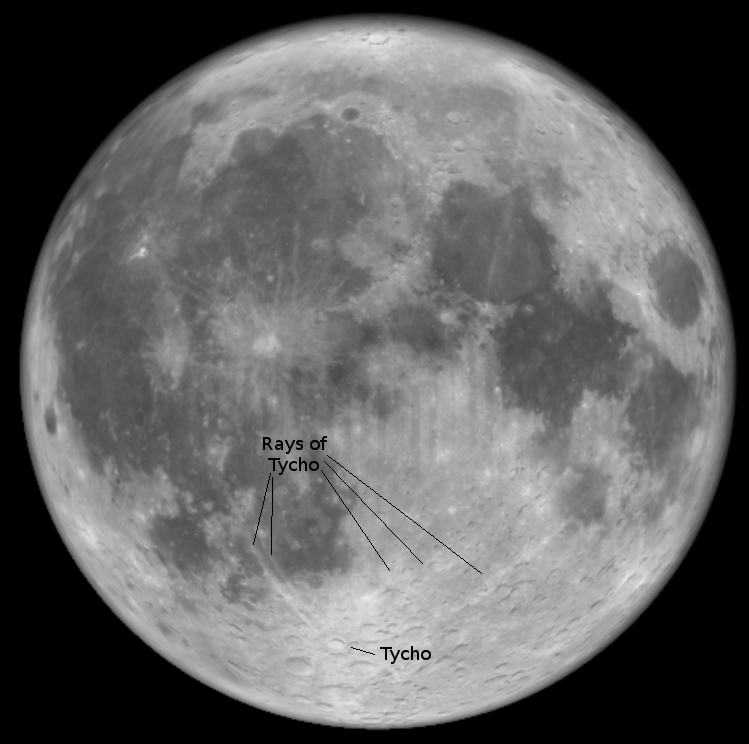
Tycho’s rays at full moon are actually secondary craters thrown by debris from the initial impact. At full moon they are no longer shadow filled so show as being bright. Image created using Virtual Moon Atlas.
02/13/2014 – Ephemeris – Dwarf planet Ceres is the next stop for the Dawn spacecraft.
Ephemeris for Thursday, February 13th. The sun will rise at 7:45. It’ll be up for 10 hours and 22 minutes, setting at 6:08. The Moon, 1 day before full, will set at 7:10 tomorrow morning.
The Dawn spacecraft is in the asteroid belt. After spending a year orbiting the asteroid Vesta two years ago, it has set its sights on Ceres, the largest asteroid, which was promoted by the same reasoning that Pluto was demoted, as a dwarf planet. Recently it was announced that Ceres is out-gassing water molecules. Dawn, with its ion engine is slowly approaching Ceres and will enter orbit of the body in April next year, a few months before the new Horizons spacecraft will fly by the dwarf planet Pluto on Bastille Day 2015. Dawn will stay in orbit of Ceres for a year at least. It will take at least several months to download all the images and data from the Pluto encounter from New Horizons, so we will have a very eventful 2015.
Times are for the Traverse City/Interlochen area of Michigan. They may be different for your location.
Addendum
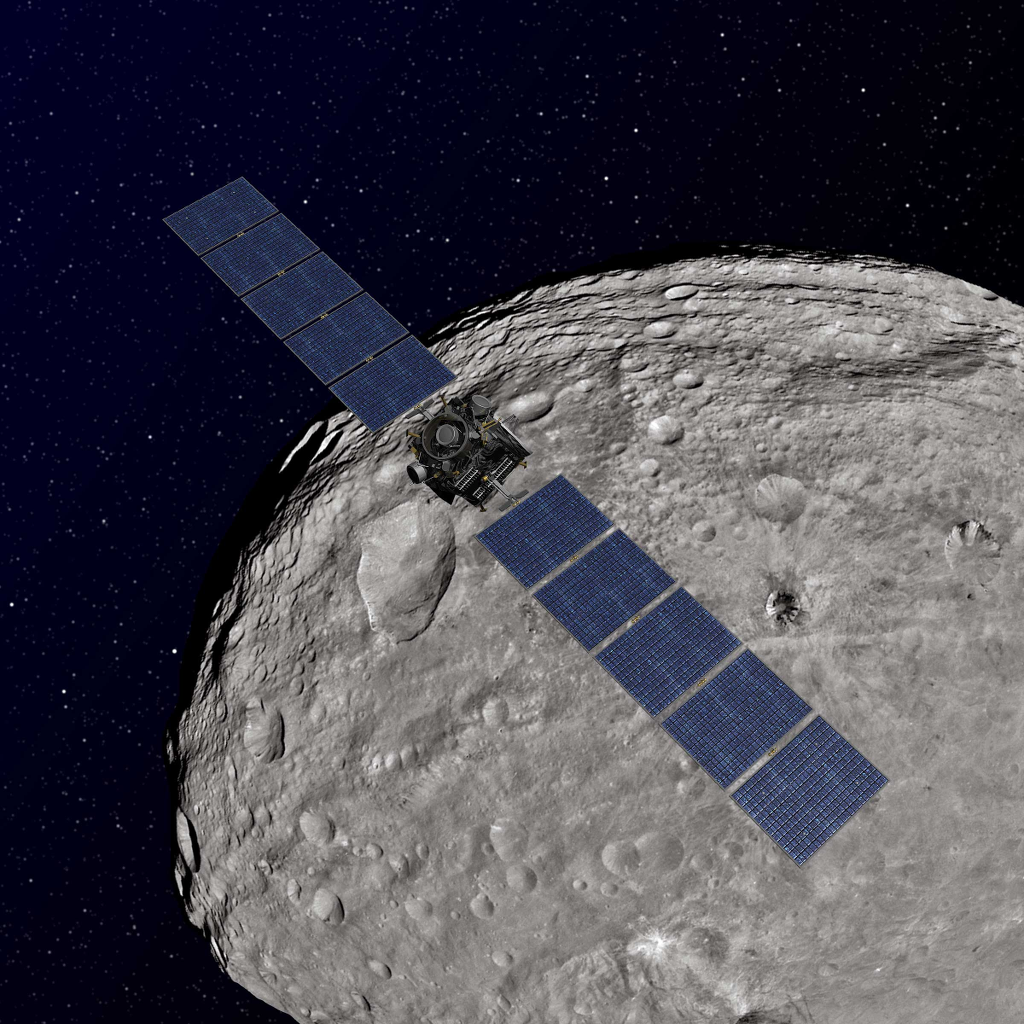
Artist’s rendition of the Dawn spacecraft at Vesta. Credit: NASA/JPL.
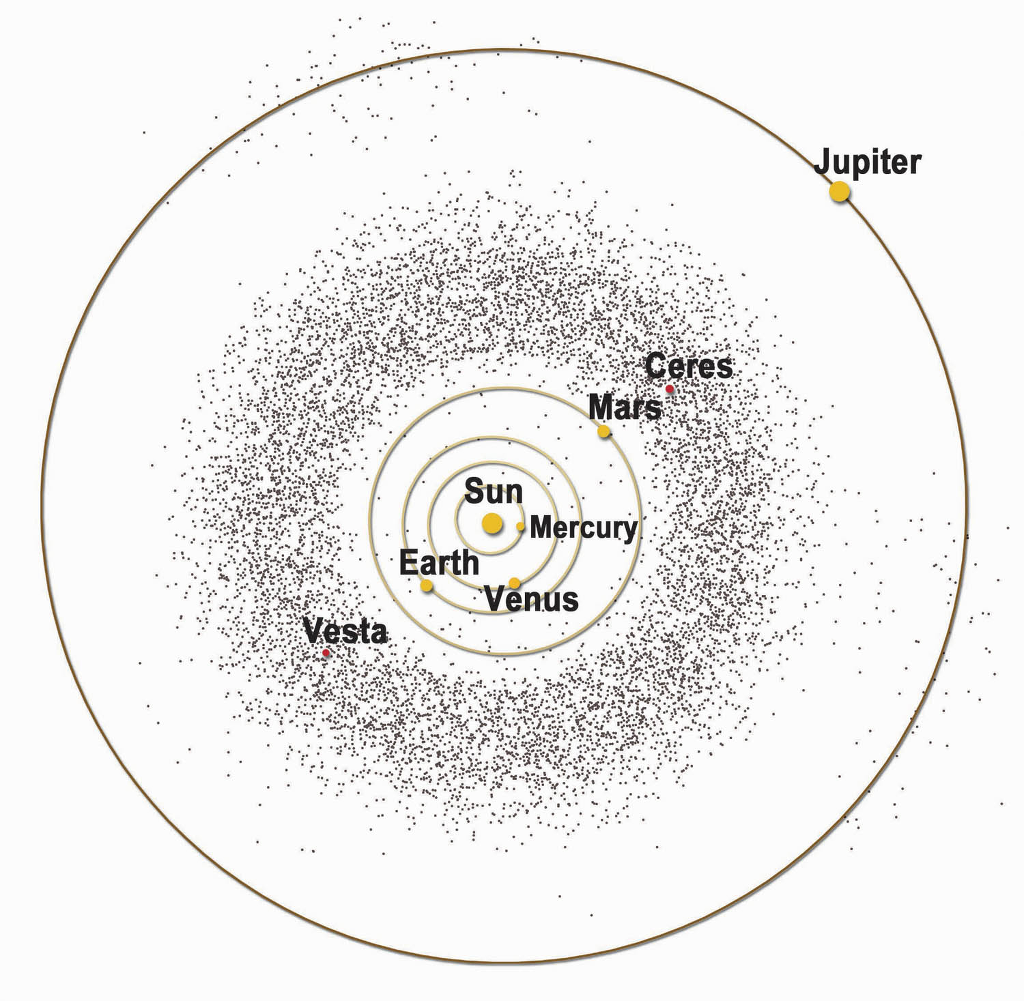
The asteroid belt n the inner solar system. Credit: NASA/JPL.
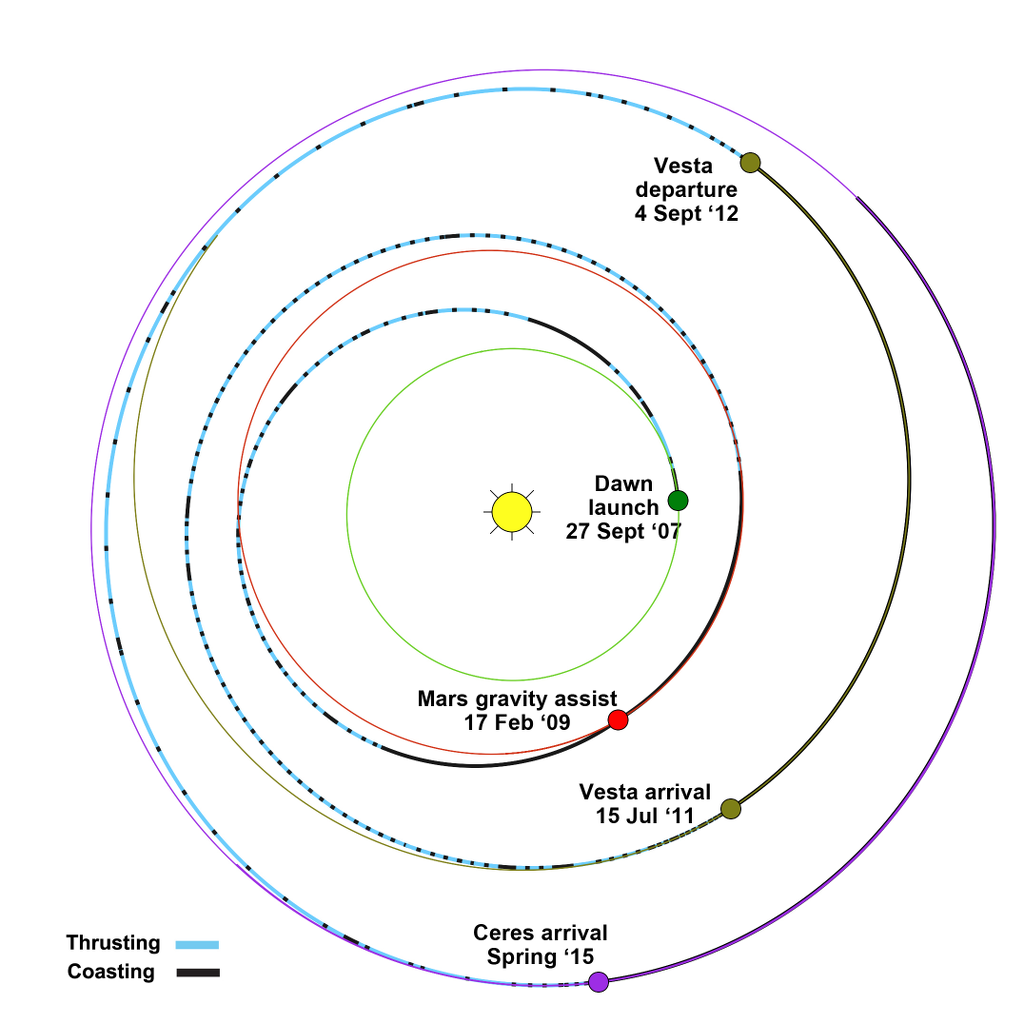
Dawn orbital track past Mars, stopping at Vesta and continuing to Ceres. Credit: NASA/JPL.
The Dawn spacecraft uses ion propulsion, which though 10 times more efficient than chemical fuels, has the thrust comparable to that of the weight of a piece of a piece of paper. Consequently the spacecraft spends most of its time thrusting. Since it’s antenna is bolted on the spacecraft, it cannot thrust and communicate with the earth at the same time, so it has to stop thrusting and turn toward the earth to report back at scheduled intervals before resuming thrusting again.
02/12/2014 – Ephemeris – Where are the bright planets this week?
Ephemeris for Wednesday, February 12th. The sun will rise at 7:47. It’ll be up for 10 hours and 19 minutes, setting at 6:06. The Moon, 2 days before full, will set at 6:39 tomorrow morning.
Let’s take our weekly look at the planets. Jupiter will be in the southeastern sky as darkness falls tonight. It’s cruising against the stars of Gemini now. It will pass due south at 9:58 p.m., and will set at 5:41 a.m. in the west-northwest. The moon is seen where Cancer is tonight. Mars will rise at 11:17 p.m. in the east-southeast. Reddish Mars is in Virgo now and above and left of the bright star Spica, which it now outshines. Mars will pass due south at 4:49 a.m. Saturn will rise at 1:39 a.m. in the east-southeast. It’s seen against the stars of Libra the scales this year. Venus will rise at 5:21 tomorrow morning, and shines brightly in the southeast before sunrise. It’s in Sagittarius, above the Teapot asterism.
Times are for the Traverse City/Interlochen area of Michigan. They may be different for your location.
Addendum
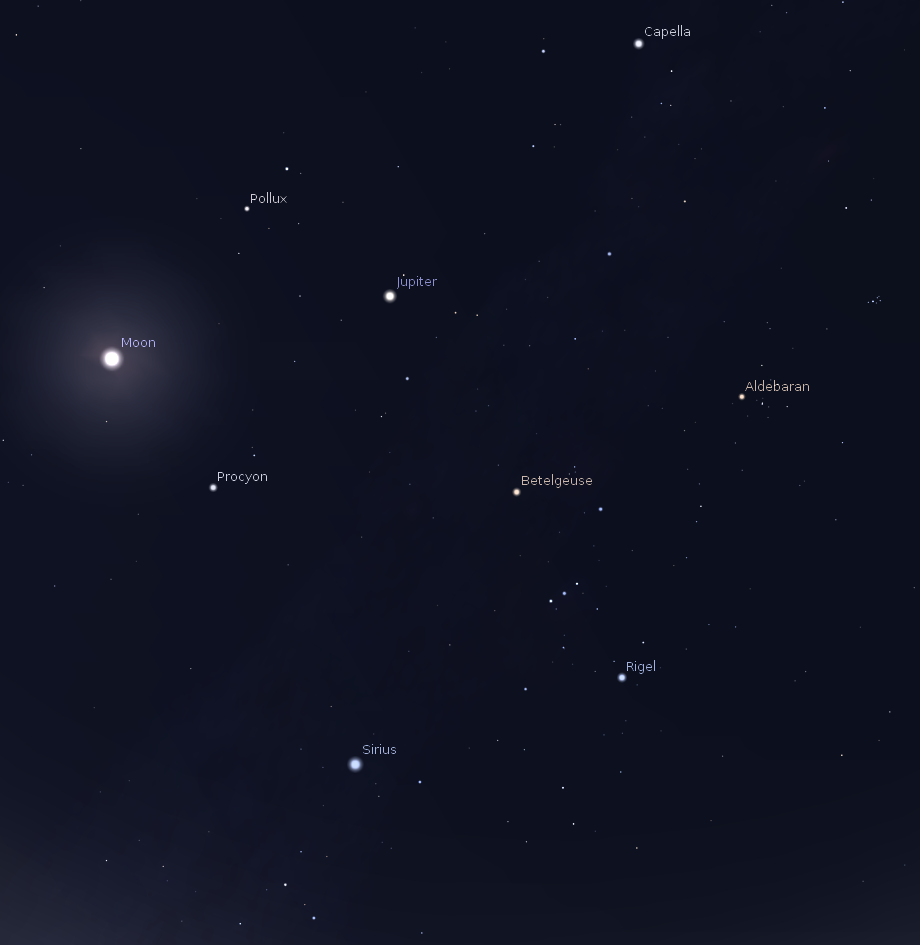
Jupiter, the Moon and the bright stars of winter at 9 p.m. February 12, 2014. Created using Stellarium.
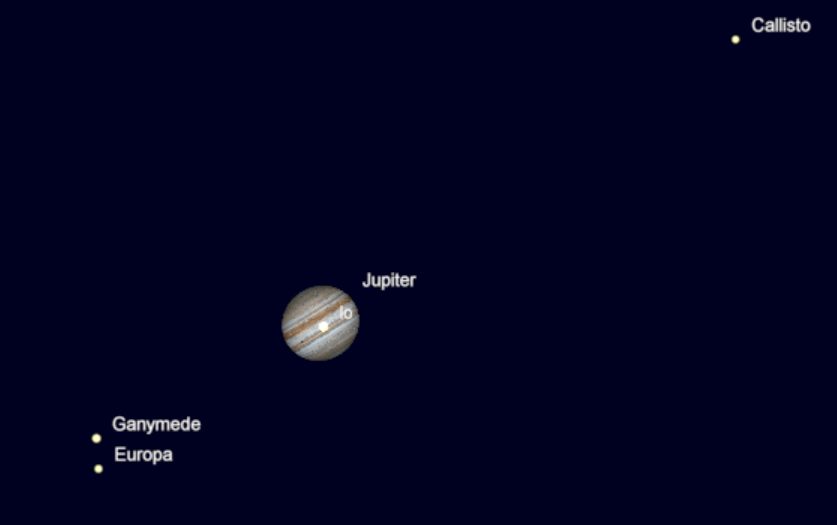
Jupiter at 9 p.m. on February 12, 2014. IO is pretty much invisible in front of the planet. Created using Cartes du Ciel.
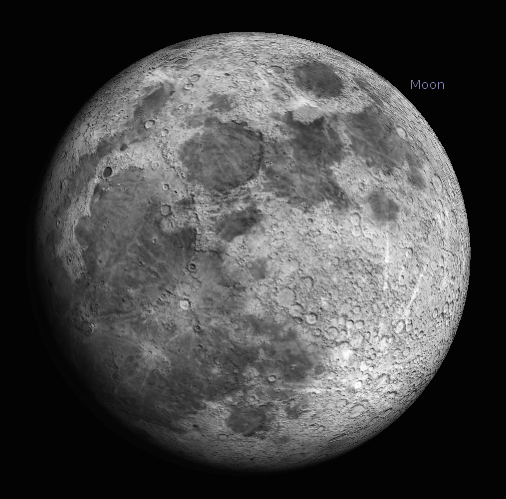
The Moon at 9 p.m. on February 12, 2014. Created using Stellarium.
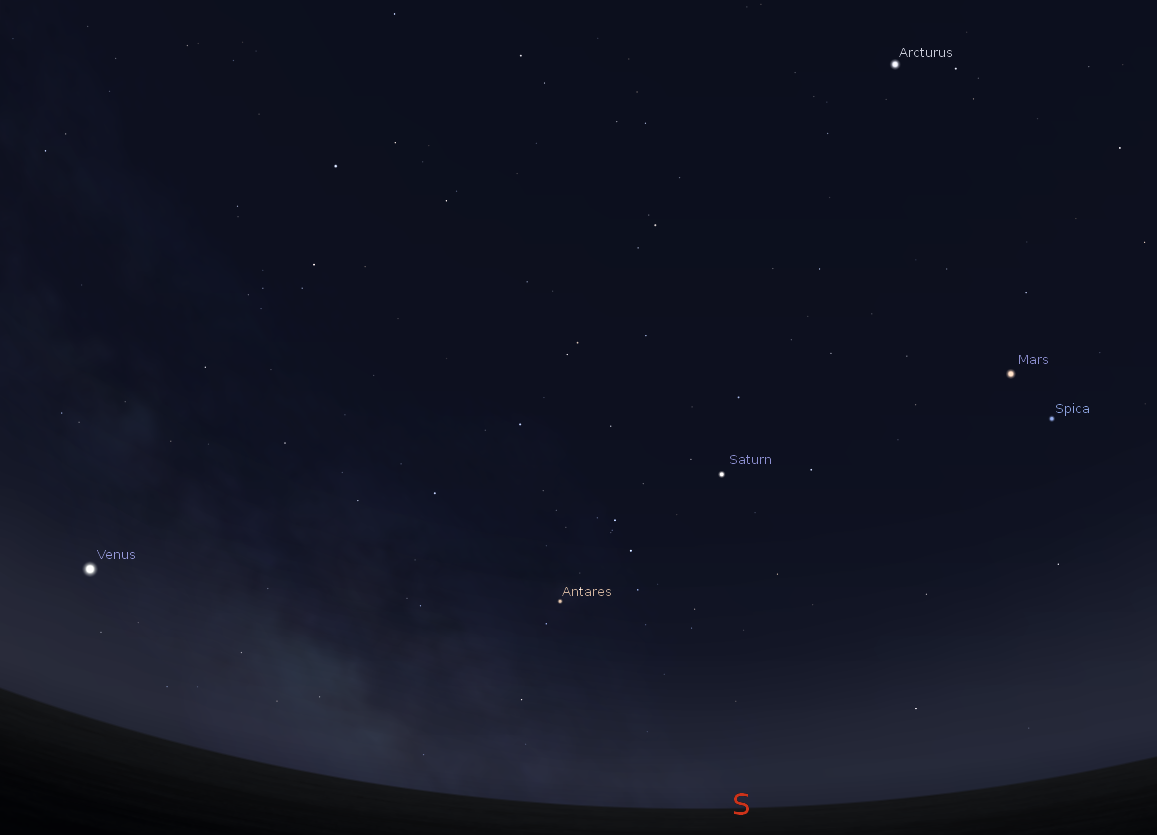
Mars, Saturn, and Venus at 6:30 a.m. February 13, 2014. Created using Stellarium.
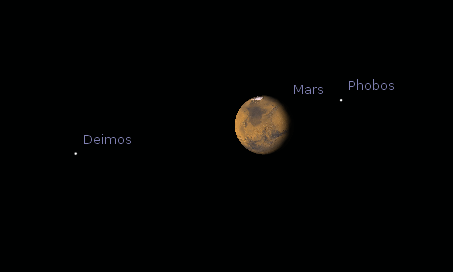
Tiny Mars in a telescope at 6:30 a.m. on February 13, 2014. Don’t expect to see it’s satellites Phobos and Deimos. Created using Stellarium.
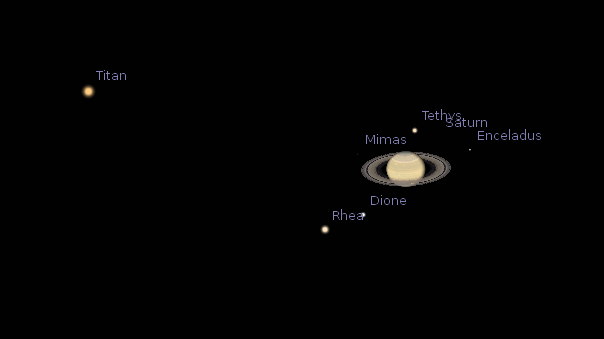
Saturn and its moons at 6:30, February 13, 2014. Of the moons, Titan will be the only one visible in small telescopes. Created using Stellarium.
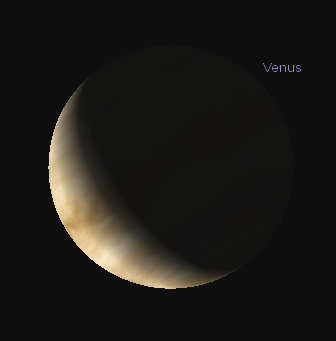
Venus through a telescope. The planet is getting smaller and its crescent is getting fatter as it moves away from the Earth. This image is for 6:30 a.m. February 13, 2014.Created using Stellarium.
02/11/2014 – Ephemeris – The brightest spot on the moon is visible tonight
Ephemeris for Tuesday, February 11th. The sun will rise at 7:48. It’ll be up for 10 hours and 17 minutes, setting at 6:05. The Moon, 3 days before full, will set at 6:06 tomorrow morning.
The moon tonight is very bright. It will be full on Friday. Using binoculars the brightest object on the moon is a spot at the left edge of the moon that rotates to the upper left as the moon rises. It is the young crater Aristarchus. The age is less than 1.1 billion years. How much younger is unknown. It’s in the same age range as Copernicus to the lower right of it with the big round splash marks. In a telescope Aristarchus is a crater 24 miles (40 kilometers) in diameter. Generally, the fresher the crater the brighter it is. The Lunar Reconnaissance Orbiter has been in orbit of the moon for nearly four years. In that time it has discovered small craters that were formed after it arrived in orbit. The initial impacts drill into the moon’s lighter subsurface.
Times are for the Traverse City/Interlochen area of Michigan. They may be different for your location.
Addendum
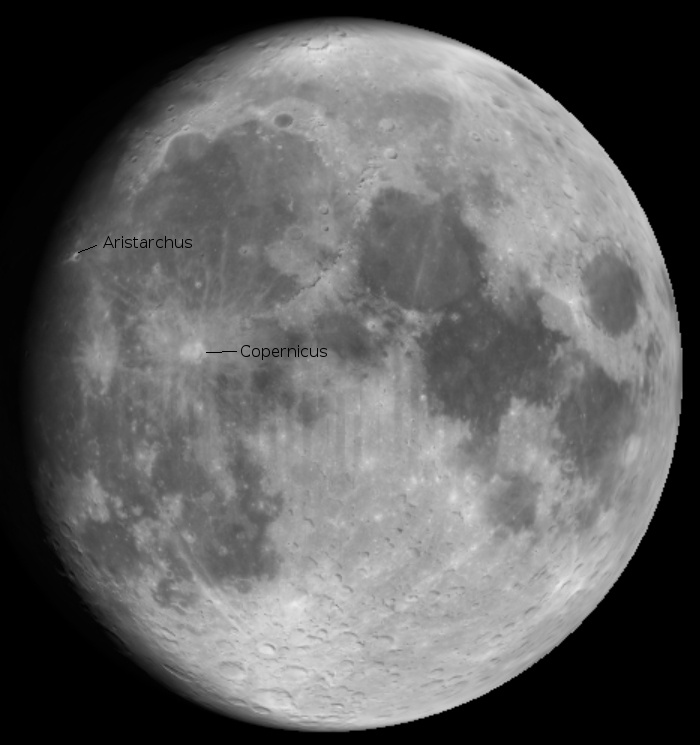
The Moon at 9 p.m. February 11, 2014 showing the craters Aristarchus and Copernicus. Created using Virtual Moon Atlas.
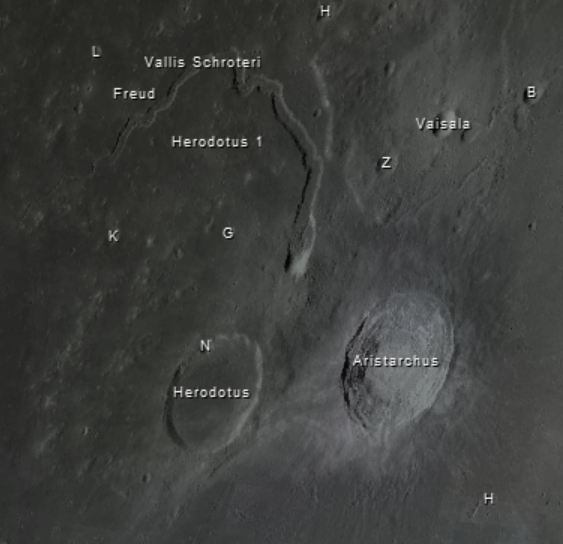
The crater Aristarchus and its environs via the Lunar Reconnaissance Orbiter as a texture in the Virtual Moon Atlas. Credit NASA.
Note the valley that borders Aristarchus, Vallis Schroteri, or Schroter’s Valley. It’s head is called the Cobra’s Head. It is up to a kilometer or 3,000 feet deep.
02/10/2014 – Ephemeris – Jupiter will appear near the Moon tonight
Ephemeris for Monday, February 10th. The sun will rise at 7:49. It’ll be up for 10 hours and 14 minutes, setting at 6:04. The Moon, half way from first quarter to full, will set at 5:28 tomorrow morning.
The planet Jupiter will appear above the moon tonight. At 9 p.m. Jupiter will be 5 and a half degrees, or 11 moon widths above the Moon. It will only get a little closer as the night progresses. The Moon will pass below Jupiter from our vantage point. In binoculars or a telescope the planets satellites can be seen spread out around the planet. Some of us amateur astronomers with pretty good-sized telescopes still can see only the same 4 moons that Galileo saw in 1610. The count of the Jovian satellites is up to something like 67, but these are small bodies Jupiter picked up from the outer part of the asteroid belt. Many of these are in retrograde of backward orbits, a sure sign of capture.
Times are for the Traverse City/Interlochen area of Michigan. They may be different for your location.
Addendum
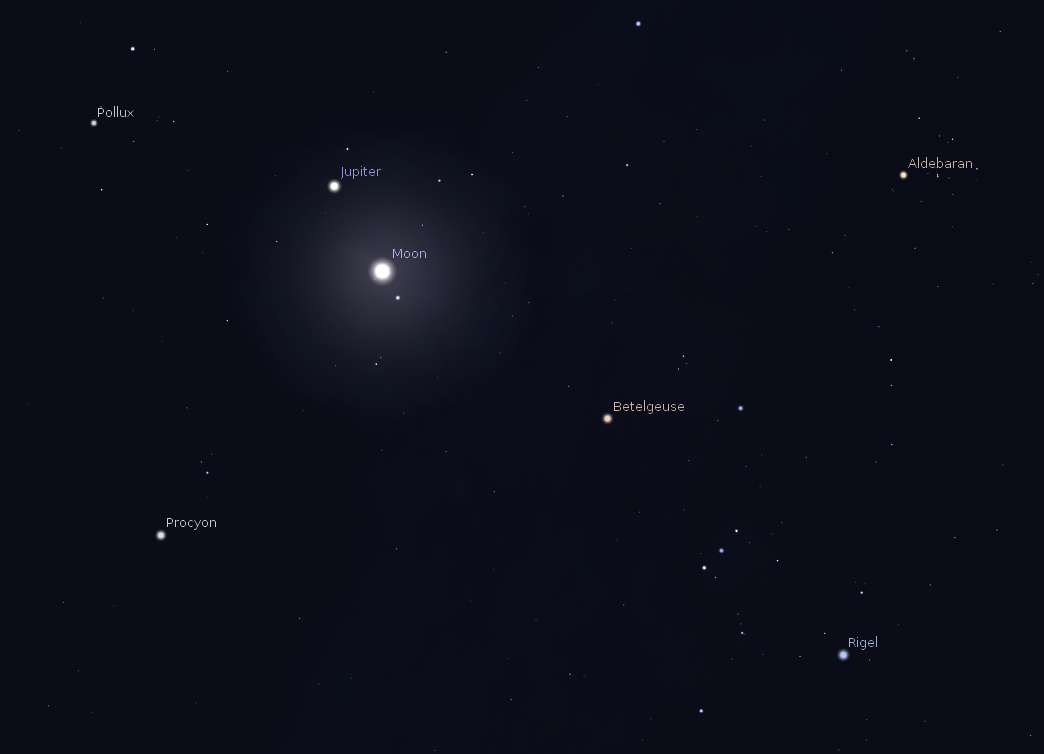
The Moon and Jupiter at 9 p.m. on February 10, 2014. Created using Stellarium.
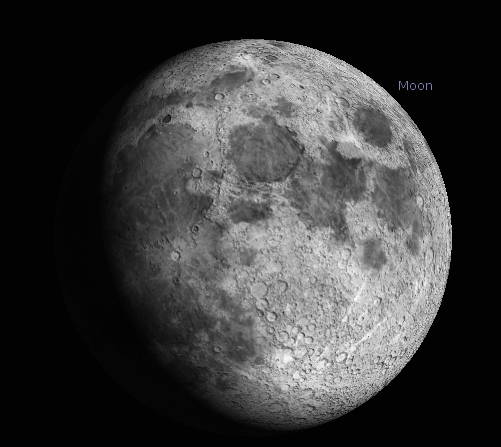
The Moon at 9 p.m. on February 10, 2014. Created using Stellarium.
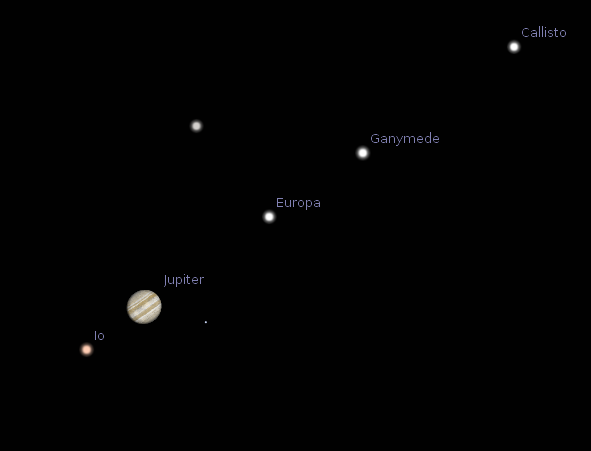
Jupiter at 9 p.m. on February 10, 2014. There’s quite a few interloper stars nearby. Created using Stellarium.
02/07/2014 – Ephemeris – Telescope Clinic tonight in Traverse City
Ephemeris for Friday, February 7th. The sun will rise at 7:53. It’ll be up for 10 hours and 6 minutes, setting at 5:59. The Moon, 1 day past first quarter, will set at 3:07 tomorrow morning.
The Grand Traverse Astronomical Society will hold a telescope clinic at 8 p.m. this evening at the Northwestern Michigan College’s Rogers Observatory located south of Traverse City on Birmley Road. If you have a new telescope or an old telescope and don’t know how to use it, bring it in. The expert amateur astronomers will show you how to set up and align the telescopes and then give you observing tips. At 9 p.m. the telescopes can be tried out on the stars and the planet Jupiter or the lights of Traverse City if it’s cloudy during the star party that follows every meeting. While members are always available to help new telescope users on other star parties or meetings, this is a time really designated for the new telescope user.
Times are for the Traverse City/Interlochen area of Michigan. They may be different for your location.
Addendum
A basic telescope guide that I wrote for the event Telescope Basics2.pdf
02/06/2014 – Ephemeris – The moon tonight and libration
Ephemeris for Thursday, February 6th. The sun will rise at 7:55. It’ll be up for 10 hours and 3 minutes, setting at 5:58. The Moon, at first quarter today, will set at 2:11 tomorrow morning.
The Moon, being at first quarter today, has the terminator or sunrise line cut the Moon in half tonight. In binoculars and telescopes the best detail is seen near the terminator where the shadows are longest. The farther one wanders with a telescope the flatter the terrain appears. There’s another effect that can be seen. It’s called libration where the Moon appears to slowly wobble during the month. This is mostly caused by the Moon’s very steady rotation countered by the fact that the Moon’s orbit is elliptical and gets ahead or behind the rotation. At the upper right of the Moon is the small Sea of Crises. That has rotated forward a bit revealing yet another sea at the edge of the Moon, Mare Marginis, the Margin or Border Sea.
Times are for the Traverse City/Interlochen area of Michigan. They may be different for your location.
Addendum
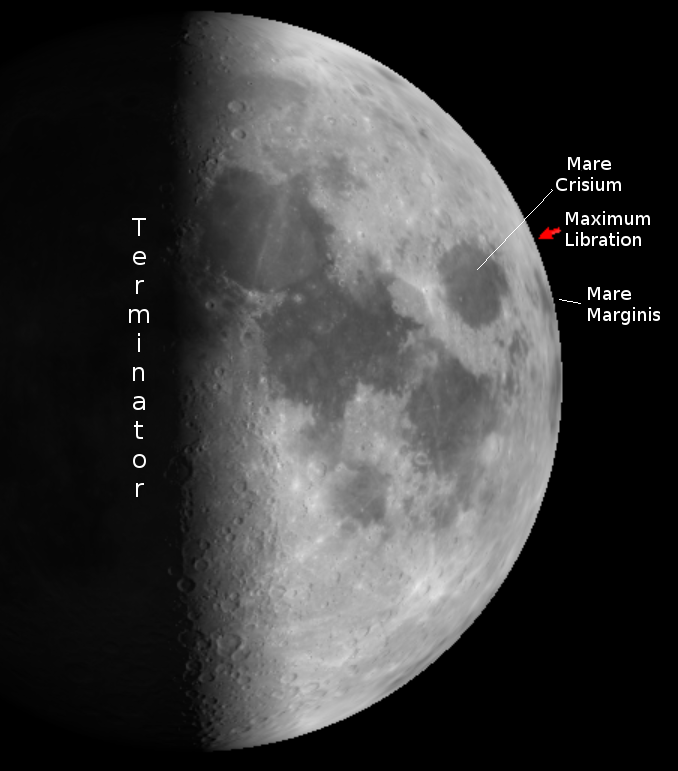
The Moon highlighting the Ephemeris topics at 9 p.m. on February 6, 2014. Created using Virtual Moon Atlas.
The Moon highlighting the Ephemeris topics at 9 p.m. on February 6, 2014. Created using Virtual Moon Atlas.
02/05/2014 – Ephemeris – Where are the bright planets this week?
Ephemeris for Wednesday, February 5th. The sun will rise at 7:56. It’ll be up for 10 hours and 1 minute, setting at 5:57. The moon, 1 day before first quarter, will set at 1:10 tomorrow morning.
Let’s take our weekly look at the planets. Tiny Mercury is 4 days after its greatest eastern elongation and is seen low in the west-southwest between sunset and 7:25, when it sets. After that Jupiter takes over the evening sky. It will be in the southeastern sky as darkness falls tonight. It’s cruising against the stars of Gemini now. It will pass due south at 10:28 p.m., and will set at 6:11 a.m. in the west-northwest. Mars will rise at 11:37 p.m. in the east-southeast. Reddish Mars is in Virgo now and above the bright star Spica, which it now outshines. Saturn will rise at 2:06 a.m. in the east-southeast. It’s seen against Libra the scales this year. Venus will rise at 5:38 tomorrow morning, and shines brightly in the southeast before sunrise.
Times are for the Traverse City/Interlochen area of Michigan. They may be different for your location.
Addendum

Mercury, its orbit and the ecliptic (you’ll only see Mercury) at 6:30 p.m. on February 5, 2014. Created using Stellarium.
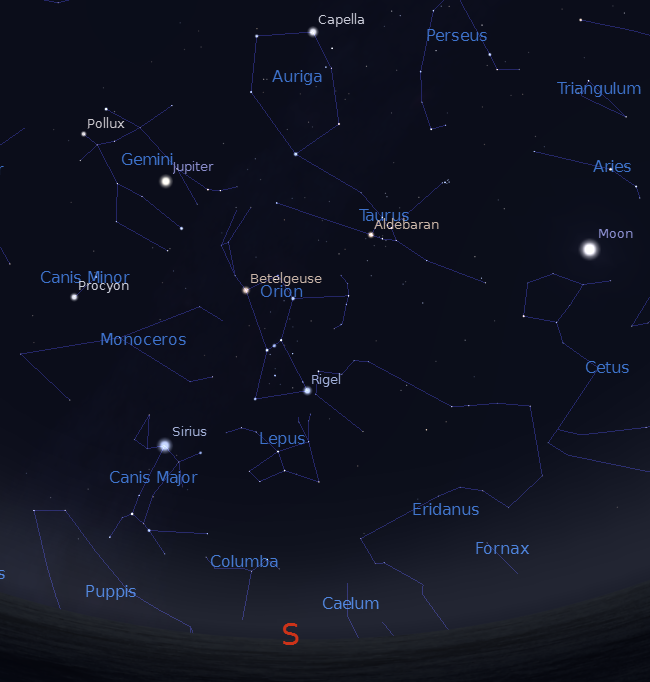
Jupiter, the Moon and the constellations of winter at 9 p.m. February 5, 2014. Created using Stellarium.
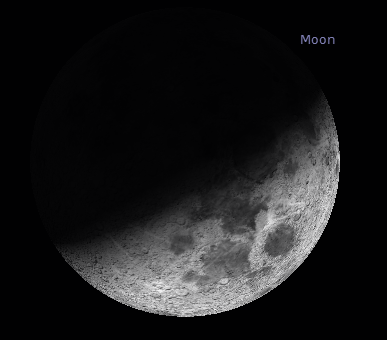
The Moon at 9 p.m. February 5, 2014. Created using Stellarium.
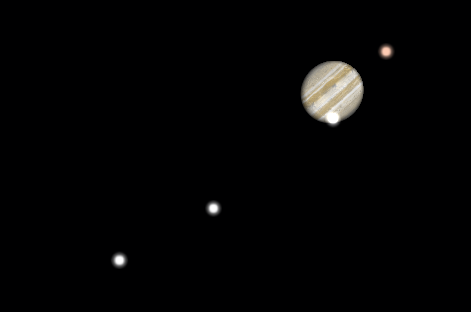
Jupiter and it’s satellites at 9 p.m. February 5, 2014. The satellites from left to right are Ganymede, Europa, Callisto and Io) Callisto may not be visible against the face of Jupiter. Created using Stellarium.
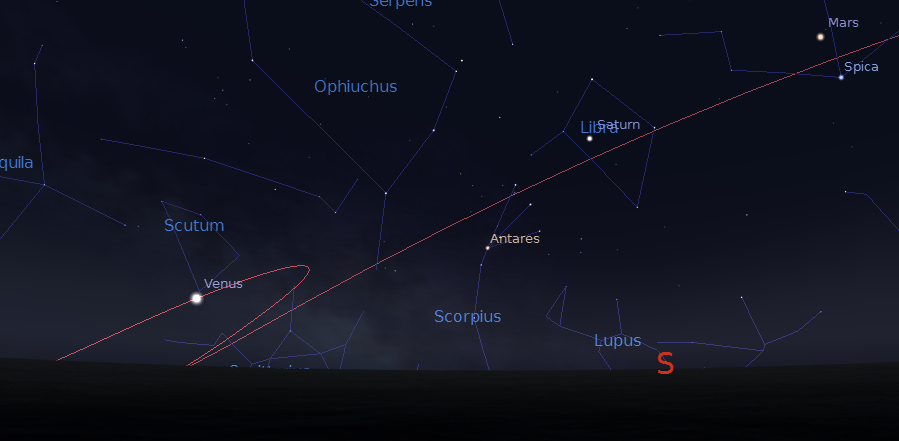
Mars, Saturn, and Venus at 6:30 a.m. February 6, 2014 along with imaginary lines of Venus’ orbit and the ecliptic. Created using Stellarium.
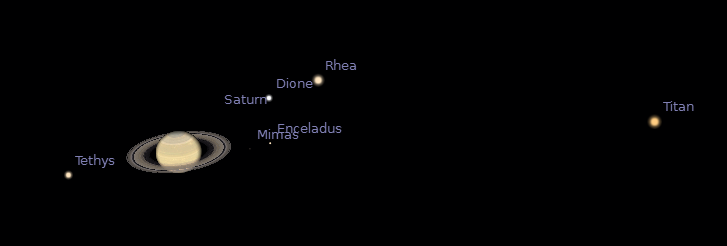
Saturn and its satellites at 6:30 a.m. February 6, 2014. You’ll need a big telescope to see any satellites other than Titan. Created using Stellarium.
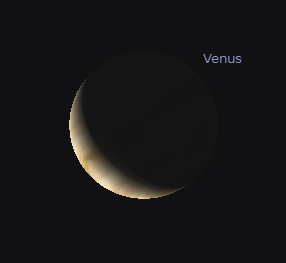
Venus through a telescope. The planet is getting smaller and its crescent is getting fatter as it moves away from the Earth. Created using Stellarium.
Sorry for the late post, but I was watching the Bill Nye – Ken Ham creationist debate last night. Bill took him apart like Inherit the Wind 2.
02/04/2014 – Ephemeris – Viewing the crescent moon tonight
Ephemeris for Tuesday, February 4th. The sun will rise at 7:57. It’ll be up for 9 hours and 57 minutes, setting at 5:55. The moon, 2 days before first quarter, will set at 12:05 tomorrow morning.
The Moon is now beginning to dominate the sky. In small telescopes one of my favorite craters is peeking into sunlight at the sunrise line, astronomers call it the terminator. This one is called Theophilus. Tonight it should be a ring of the circular ramparts lit by the sun as the evening progresses, in the center of which is the central peak just catching sunlight. Theophilus is at the edge of the small Sea of Nectar or Mare Nectaris. For those with small telescopes who want to learn more about how to use them the Grand Traverse Astronomical Society will host a Telescope Clinic at Northwestern Michigan College’s Rogers Observatory on Friday starting at 8 p.m. You can bring your telescope. It’s free, but for the star party the College requests a small donation.
Times are for the Traverse City/Interlochen area of Michigan. They may be different for your location.
Addendum
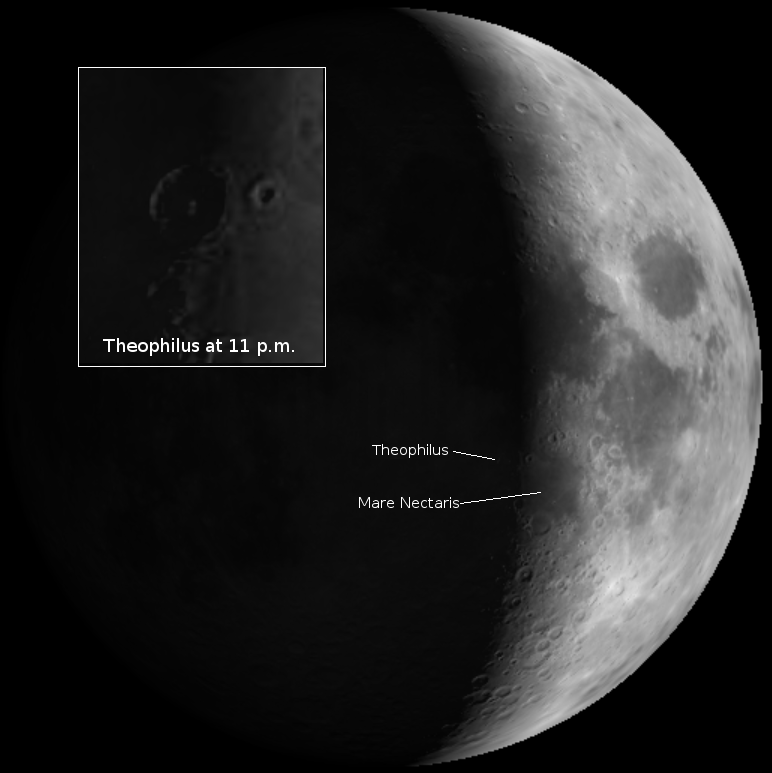
The Moon highlighting the crater Theophilus at 9 and 11 p.m. on February 4, 2014. Created using Virtual Moon Atlas.
02/03/2014 – Ephemeris – Why we don’t see unicorns anymore
Ephemeris for Monday, February 3rd. The sun will rise at 7:58. It’ll be up for 9 hours and 55 minutes, setting at 5:54. The moon, 3 days before first quarter, will set at 10:58 this evening.
Among all the constellations in the sky of animals real and mythical, there is also a unicorn. It’s called Monoceros, and inhabits the southern sky at 9 p.m. bounded by Orion on the right, Canis Major, the great dog below and Canis Minor, the little dog to the left. Unfortunately for observers without optical aid Monoceros, though large, is devoid of any but the faintest stars. Maybe that’s why no one sees unicorns anymore. It has many faint stars because the Milky Way runs through it. To the telescope it is a feast of faint nebulae or clouds of gas and dust, the birth place of stars, including the red rose of the Rosette Nebula, and the strange and tiny Hubble’s Variable Nebula. It contains no bright stars, but a wealth of wonders below the surface so to speak.
Times are for the Traverse City/Interlochen area of Michigan. They may be different for your location.
Addendum
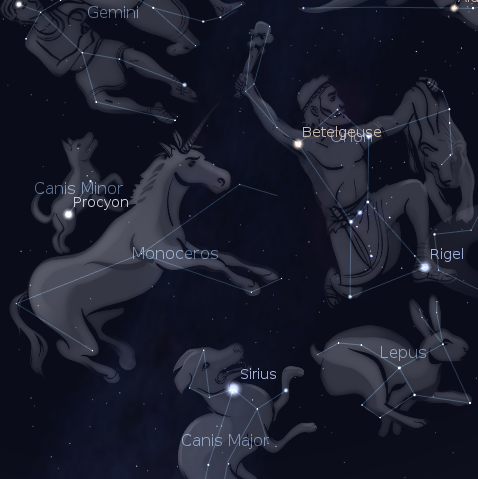
Moniceros the unicorn. See really, really dim stars. Created using Stellarium.
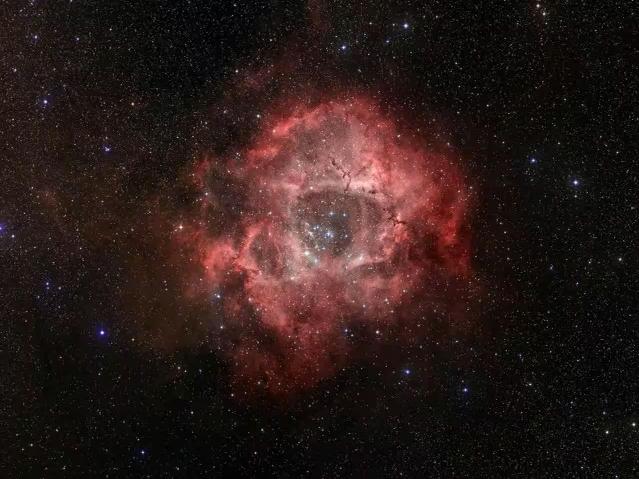
Rosette Nebula in the infrared from the Spitzer Space Telescope. Credit: NASA/JPL/Caltech
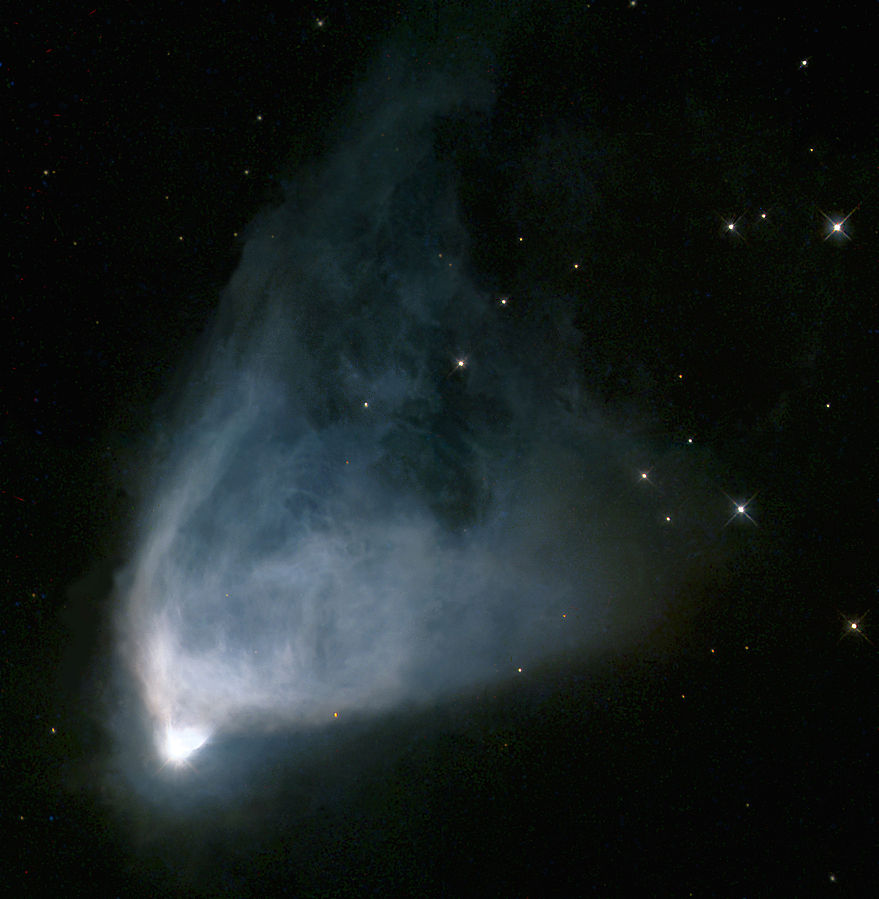
Hubble’s Variable Nebula photographed appropriately enough by the Hubble Space Telescope. Credit: NASA/ESA and The Hubble Heritage Team (AURA/STScI).

Another nebula: The Cone Nebula as seen with the Hubble Space Telescope. Credit ESA/Hubble
 Bob Moler's Ephemeris Blog