Archive
10/17/2014 – Ephmeris – There’s a star party Saturday at the NMC Rogers Observatory
Ephemeris for Friday, October 17th. The sun will rise at 8:00. It’ll be up for 10 hours and 54 minutes, setting at 6:54. The moon, 2 days past last quarter, will rise at 2:47 tomorrow morning.
Tomorrow night the Grand Traverse Astronomical Society will host a Star Party at Northwestern Michigan College’s Rogers Observatory from 9 p.m. to 11 p.m. On tap, if it’s clear will be the wonders of both the summer and the autumn skies, The summer Milky Way is still visible moving off to the southwest with its star clusters and nebulae. The autumn sky has star clusters too, including the famous Pleiades, best seen in binoculars or telescope finders, and the wonderful Double Cluster. The autumn sky is also host to the closest spiral galaxy to us the Great Andromeda Galaxy, which will get a whole lot closer in 4 billion years. Come on out to the observatory on Birmley Road, about 2 miles south of South Airport Road.
Times are for the Traverse City/Interlochen area of Michigan. They may be different for your location.
Addendum
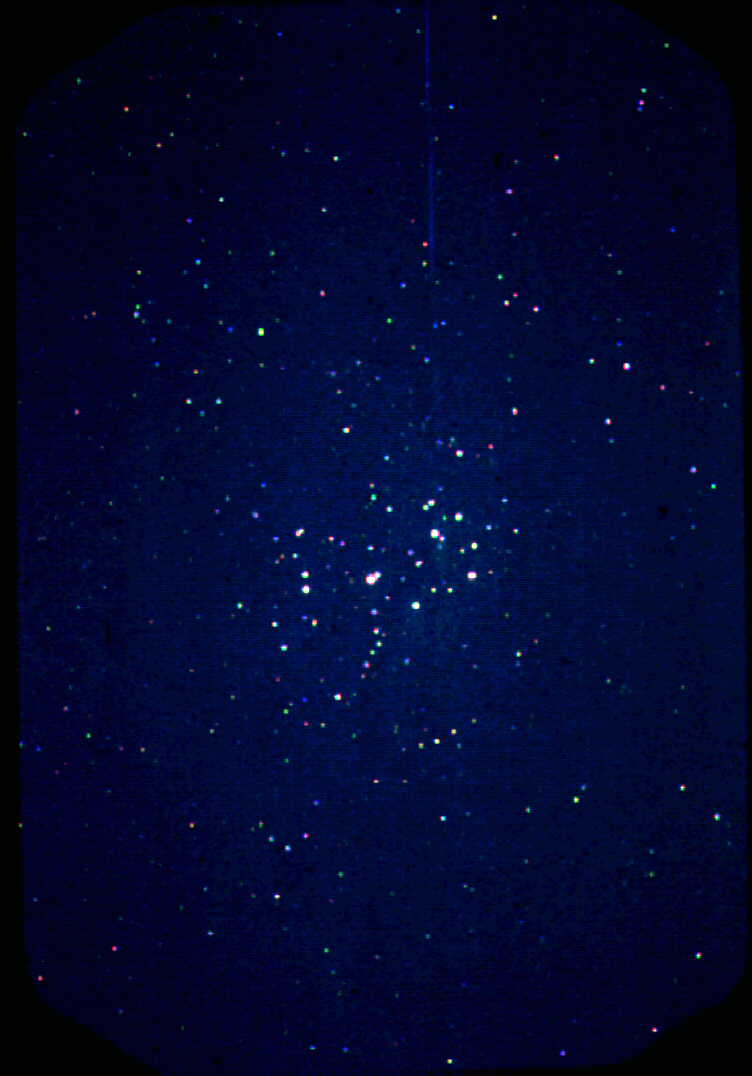
The Pleiades, about what you’d see in binoculars.
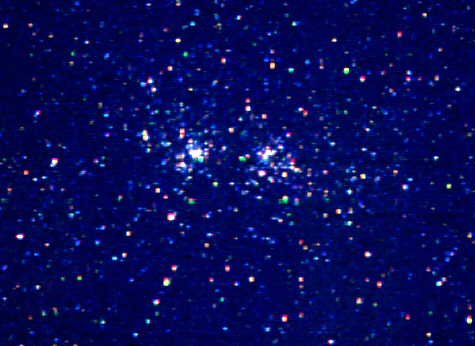
Double Cluster as it would be seen in a small telescope.
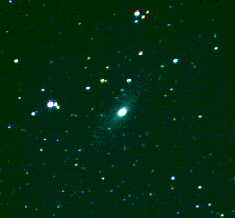
The Great Andromeda Galaxy (M31) as seen in binoculars. Visually even in a telescope the hub of this galaxy is all that is seen. However it also can be seen with the naked eye. However a telescope can also show its two satellite galaxies.
10/16/2014 – Ephemeris – Comet Siding Spring will buzz Mars this Sunday
Ephemeris for Thursday, October 16th. The sun will rise at 7:59. It’ll be up for 10 hours and 57 minutes, setting at 6:56. The moon, 1 day past last quarter, will rise at 1:50 tomorrow morning.
Sunday afternoon our time the comet C/2013 A1 also known a Siding Spring will pass 86 thousand miles (140 thousand km) from Mars. The three NASA Mars satellites, Mars Odyssey, Mars Reconnaissance Orbiter and Maven plus the two rovers Opportunity and Curiosity; the European Mars Express and the latest to arrive, India’s Mars Orbital Mission or MOM will all be studying the comet. Protection of the satellites is key. The satellite’s orbits have all been phased so as to be behind the planet from the expected possible debris of the comet when Mars passes its closest to the comet’s orbit 101 minutes after the comet itself passes. Early next week we may have some spectacular photos of Comet Siding Spring.
Times are for the Traverse City/Interlochen area of Michigan. They may be different for your location.
Addendum
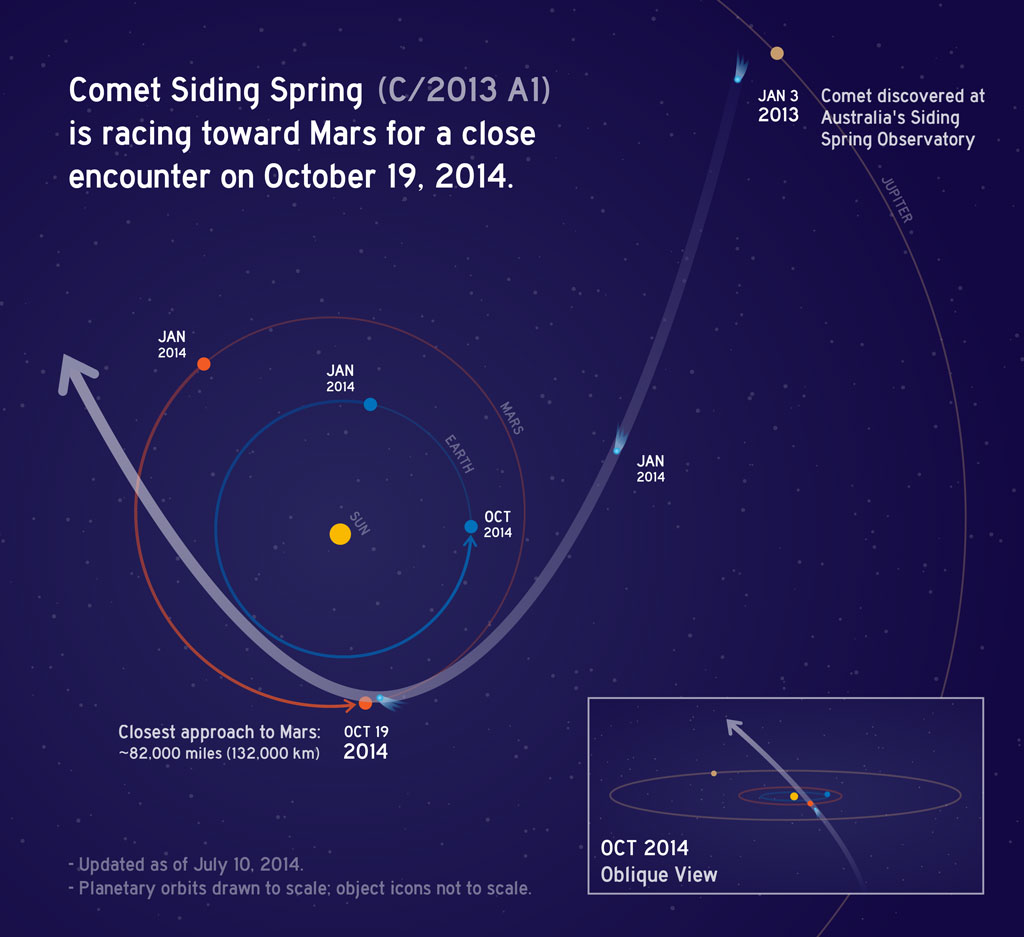
Two views of Comet Siding Springs orbit past Mars. Credit: NASA.
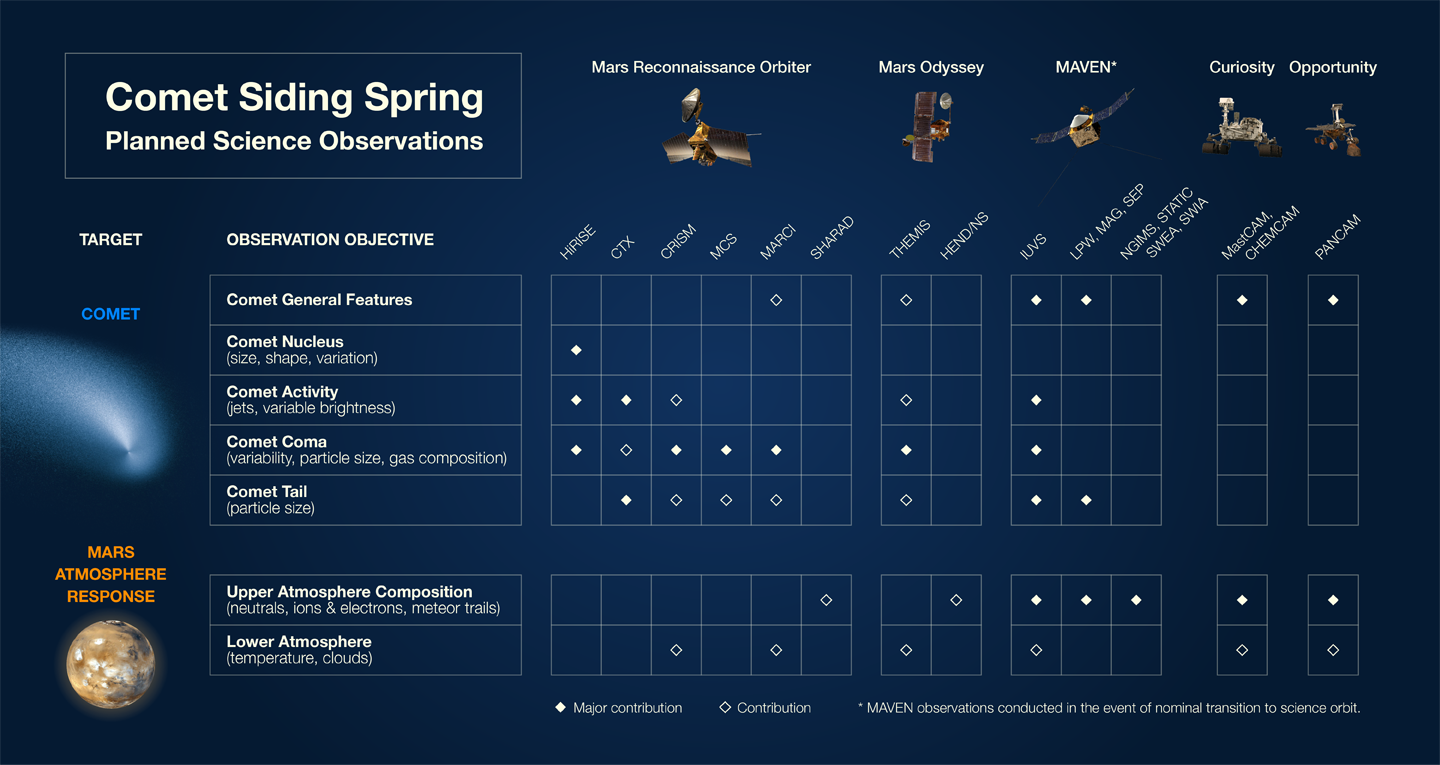
Planned science observations of Comet Siding Spring by NASA spacecraft and rovers at Mars. Credit: NASA.
Siding Spring Links:
10/15/2014 – Ephemeris – Looking for the bright planets this week
Ephemeris for Wednesday, October 15th. The sun will rise at 7:57. It’ll be up for exactly 11 hours, setting at 6:57. The moon, at last quarter today, will rise at 12:53 tomorrow morning.
Let’s check out the bright planets for this week. Saturn is very low in the west-southwestern sky at 8 p.m. and difficult to spot. It will set at 8:22 p.m. Mars is right of the spout of the Teapot of Sagittarius low in the southwest. Mars is in the constellation of Ophiuchus as astronomers draw constellation boundaries, it will set at 9:46. Comet Siding Spring will pass close to Mars this coming Sunday the 19th. More on that tomorrow. In the morning sky brilliant Jupiter will rise in the east-northeast at 2:18 a.m. It’s moving from Cancer to Leo now. Venus is too close to the sun to be seen. On the 25th of this month Venus will be in superior conjunction with the sun, that is it will move behind the sun, and will enter the evening sky.
Times are for the Traverse City/Interlochen area of Michigan. They may be different for your location.
Addendum
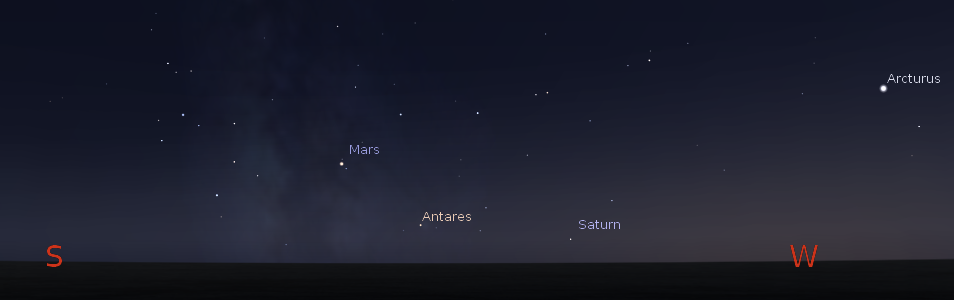
Saturn and Mars low near the setting southern summer stars at 8 p.m. October 15, 2014. Created using Stellarium.
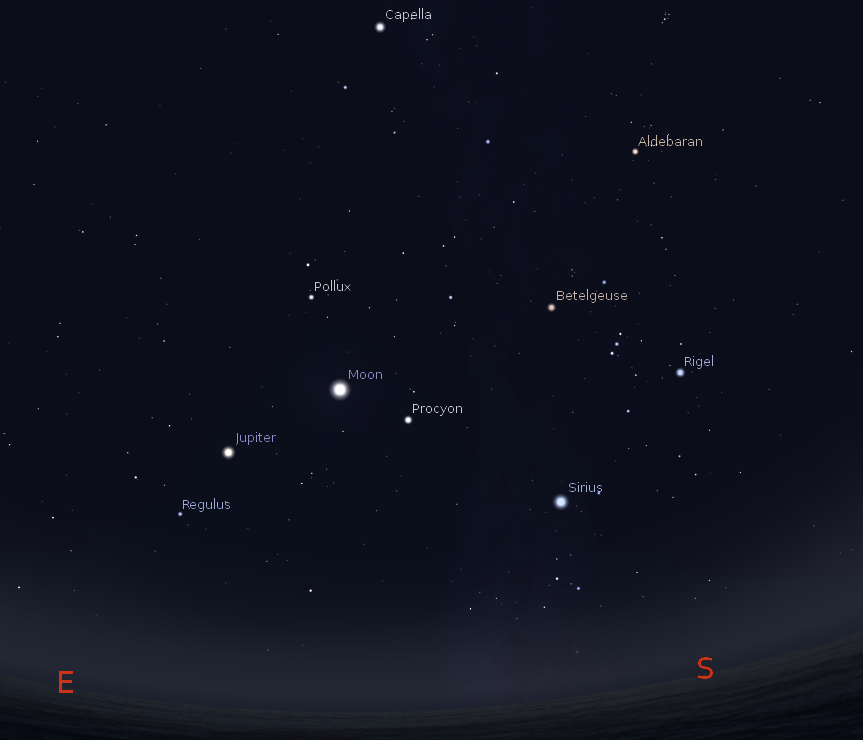
Jupiter and the Moon among the stars of winter at 6 a.m. October 16, 2014. Created using Stellarium.
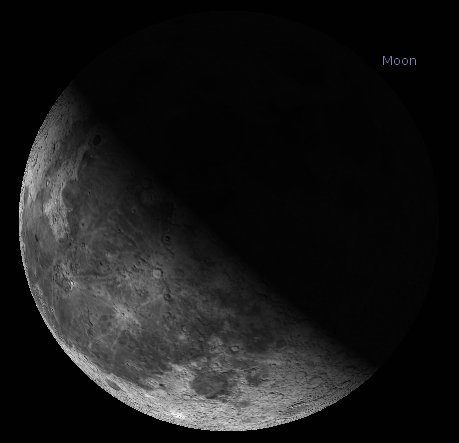
The Moon slightly after last quarter as seen in binoculars at 6 a.m. October 16, 2014. Created using Stellarium.
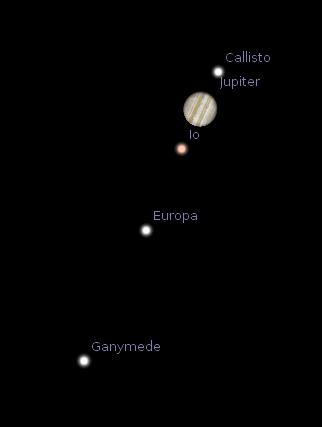
A telescopic view of Jupiter and its moons as they would be seen at 6 a.m. October 16, 2014. Created using Stellarium.
10/14/2014 – Ephemeris – The loneliest star
Ephemeris for Tuesday, October 14th. The sun will rise at 7:56. It’ll be up for 11 hours and 3 minutes, setting at 6:59. The moon, 1 day before last quarter, will rise at 11:57 this evening.
There’s a bright star that appears for only seven and a half hours a night on autumn evenings. It’s appearance, low in the south, is a clear indication of the autumn season. At 9 p.m. tonight it’s low in the southeast. The star’s name is Fomalhaut, which means fish’s mouth. That fits because it’s in the constellation of Piscis Austrinus, the southern fish. At our latitude it’s the fish that got away, because Fomalhaut appears to be the loneliest star in the sky. The dimness of the constellation’s other stars and location close to the horizon make the fainter stars hard to spot. They would be overhead in Australia. The earth’s thick atmosphere near the horizon reduces the stars brightness by a factor of two or more.
Times are for the Traverse City/Interlochen area of Michigan. They may be different for your location.
Addendum
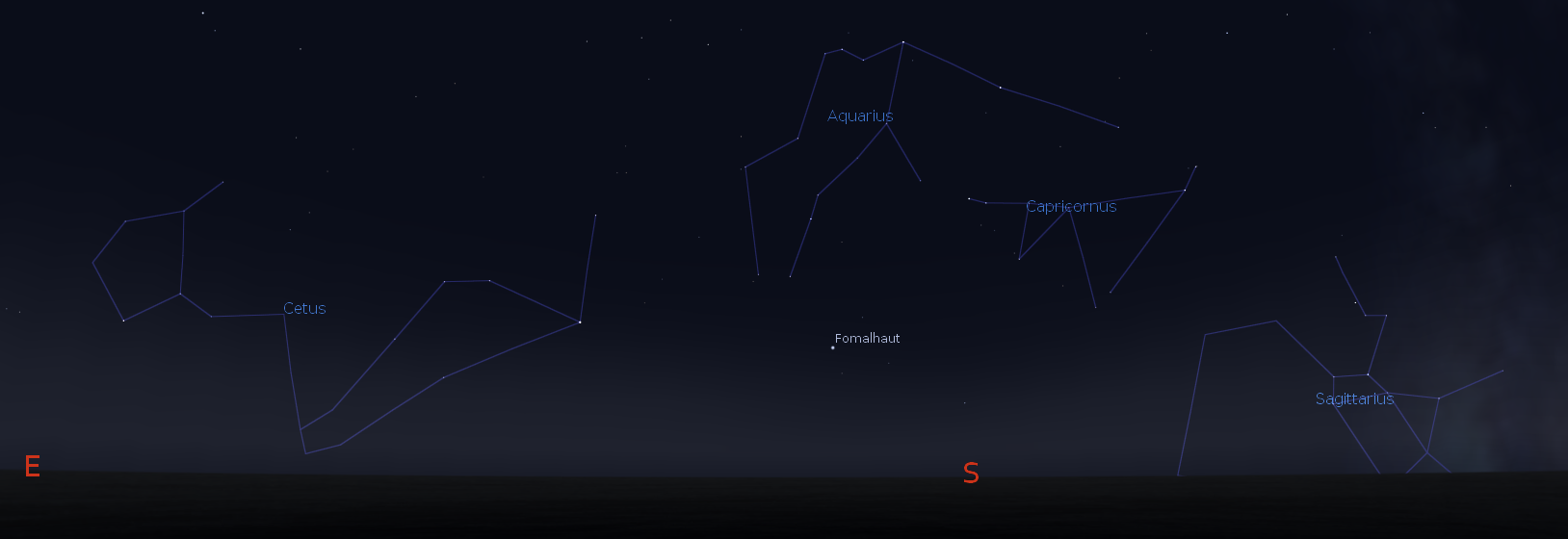
Fomalhaut appears quite alone in the south-southeast at 10 p.m. October 14, 2014. Created using Stellarium. Click on the image to enlarge.
10/13/2014 – Ephemeris – Columbus uses knowledge of eclipses to get supplies from the natives
Ephemeris for Columbus Day, Monday, October 13th. The sun will rise at 7:55. It’ll be up for 11 hours and 6 minutes, setting at 7:01. The moon, 2 days before last quarter, will rise at 11:04 this evening.
On Columbus’ 4th voyage to the Caribbean he was stranded on Jamaica. For a while the natives of the island fed Columbus and his men. However due to the thievery of some of his crew, these people no longer trusted Columbus any refused them any more supplies. Columbus consulted a table of eclipses and found that a lunar eclipse was to occur on February 29th that year (1504), and that at his location the moon would rise in eclipse. He went to the leader of the people and said that they had displeased their god by refusing his crew food, and that the god would turn the Moon red in anger. The native peoples saw the red moon rising and promptly gave Columbus the supplies he wanted.
Times are for the Traverse City/Interlochen area of Michigan. They may be different for your location.
Addendum
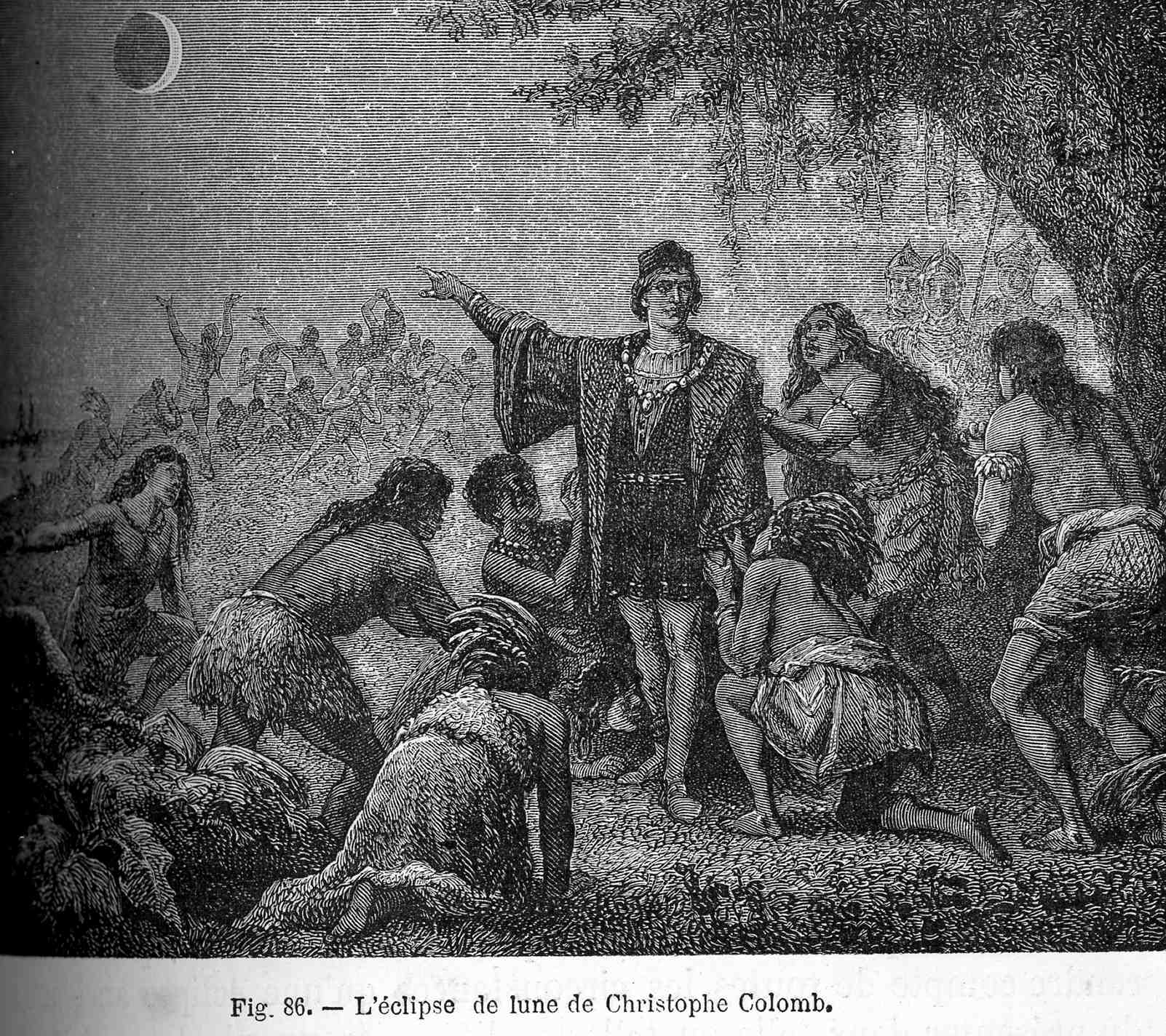
Christopher Columbus showing the lunar eclipse. From Camille Flammarion – Astronomie Populaire 1879, p231.
For more information in the Internet – search for Columbus lunar eclipse
10/10/14 – Ephemeris – Hunters Moon effect… Same as the Harvest Moon effect
Ephemeris for Friday, October 10th. The sun will rise at 7:51. It’ll be up for 11 hours and 15 minutes, setting at 7:06. The moon, 2 days past full, will rise at 8:41 this evening.
Let’s talk about the Moon one more time this week. Wednesday’s lunar eclipse came on the hunter’s moon. Like the harvest moon, the previous full moon, the bright Moon lingers in the twilit sky. We are two days past full moon and the Moon rises just before the end of twilight. 50 minutes is the average night to night advance in moon rise times. Depending on what part of the sky the moon is in, the nightly delay in rise times can be as little as 35 minutes or as long as an hour and 5 minutes. The smallest moon rise advance is when the moon is near the constellation Pisces and the longest advance time is when the moon is near Virgo. It doesn’t matter the season, it’s where the moon is in the sky. We only notice it when the moon is near full.
Times are for the Traverse City/Interlochen area of Michigan. They may be different for your location.
Addendum (4 p.m.)
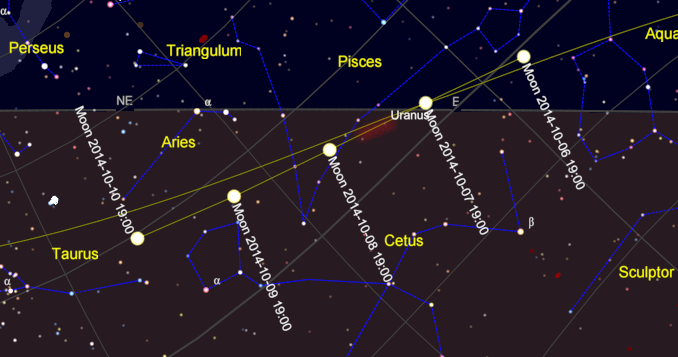
The Hunters/Harvest Moon effect for 2014. Note the shallowness of the Moon’s path. Created using Cartes du Ciel (Sky Charts).
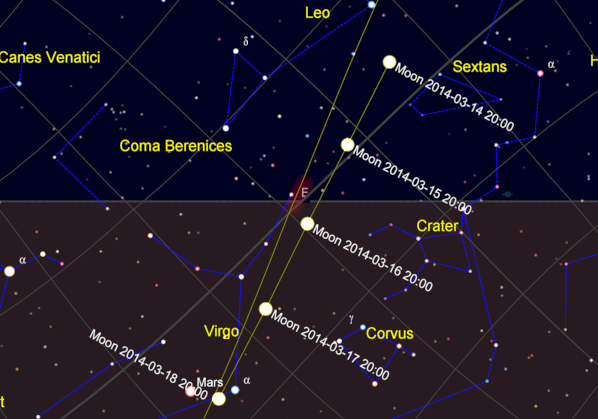
The Worm (March Full Moon) Moon effect for 2014. Note the the steepness of the Moon’s path. Created using Cartes du Ciel (Sky Charts).
Note that the brown shading on the bottom of the images is below the horizon. The yellow line is the ecliptic or plane of the Earth’s orbit. The motion of all the objects in the sky due to the Earth’s rotation is to the upper right parallel to the celestial equator line that crosses the horizon below the E or east compass point. The red smudge on the ecliptic is the display of the Earth’s shadow for the 5 days of the display. Note in the top image that early on October 8th the Moon passes through the Earth’s shadow, which gave us the lunar eclipse that morning. On the Worm Moon image the Moon misses the Earth’s shadow. However you can see that the Moon is tracking toward the ecliptic. The next month on April 15th, the Moon did indeed pass through the earth’s shadow, giving us a lunar eclipse that morning.
10/09/2014 – Ephemeris – The next lunar eclipses and recollections of what happened with yesterday’s eclipse
Ephemeris for Thursday, October 9th. The sun will rise at 7:50. It’ll be up for 11 hours and 18 minutes, setting at 7:08. The moon, 1 day past full, will rise at 8:01 this evening.
With the two total lunar eclipses done for this year, we can look forward to two more next year. The April 4th, 2015 eclipse won’t appear total here because the moon will set before totality. However the September 28th, 2015 lunar eclipse will be an evening eclipse. These 4 eclipses make a rare tetrad of total lunar eclipses that won’t be repeated until 2032 and 2033. After September 28th the next total lunar eclipse visible from northern Michigan will be in 2021. On the solar eclipse side there’s one on the 23rd of this month, a partial eclipse at sunset. I’ll have more on that later. After that is the big event, the total solar eclipse on August 21, 2017. The path of totality will run from coast to coast, running just south of St. Louis Missouri, and just north of Nashville Tennessee.
Times are for the Traverse City/Interlochen area of Michigan. They may be different for your location.
Addendum
What follows is my recollection of the October 8th lunar eclipse. Originally relayed in an email to Pat Stinson, freelance writer and author of the wonderful article in the Grand Traverse Insider about the activities of Space Week and the astronomical events in October:
The skies were trending clearer at midnight and again at 2:30 a.m. when I took a shower to prepare for the eclipse. After that it got slowly worse. That afternoon Ranger Marie Scott of the Sleeping Bear Dunes National Lakeshore said she’d go to our site, Platte River Point, clouds or not, and I was willing. In setting up the eclipse observing sites,earlier in the year, this site was the one place that if it were clear, we could see either the moon or the sun set onto the Lake Michigan horizon for the three eclipses this year. I loaded my van with my two telescopes, the C8 and an 11″ Dobsonian and lots of coffee.
I got to the site at 4:30 and began to set up. Marie arrived a few minutes later and another Grand Traverse Astronomical Society member Don Flegel arrived shortly after that. They had some rain in Kingsley, where he lived that morning. We had a strong, cold northwest wind. When we’re at the Point we commandeer the small parking lot to the north of the road that’s up against a hill. That hill and my van offered some protection from the wind. I got the C8 set up just in time to spot the moon emerging from the clouds a few minutes after first contact. We were able to follow the eclipse intermittently until about 5:45 when a large cloud covered the moon big time. We could see the glint of the moon off the water until after totality.
This was our situation until about 7:30 when the clouds began to break up, By then the moon was so low that the foreshortened breaks weren’t all that open. Then about 10 minutes before moon set it did peek out at intervals. Unlike the Cheshire Cat’s smile, the moon (cat) had a frown because the upper edge of the moon was coming back into sunlight. 5 minutes later the moon finally disappeared for good in a cloud bank as the puffy clouds overhead caught the sun’s golden sunrise rays.
Marie Scott counted 18 folks that at one time or another came out to witness the event. Marie also posted some pictures she took of the eclipse on the park’s Facebook page.
10/08/2014 – Ephemeris – The ongoing lunar eclipse and a peek at the planets
Note: This program is scheduled to be aired at two points during the total lunar eclipse. The first airing occurs at6:19 a.m., six minutes before totality starts. The second airing will occur at 7:59 a.m. during totality.
Ephemeris for Wednesday, October 8th. The sun will rise at 7:48. It’ll be up for 11 hours and 21 minutes, setting at 7:10. The moon, at full today, will rise at 7:23 this evening.
There is a lunar eclipse occurring right now. Totality is either about to start or the moon is in totality with an orange or reddish hue, depending on when you hear this. You can see it right now in the west, if it’s reasonably clear. Totality will end at 7:24. The ending partial phase will be interrupted by moon setting near 8 a.m. Tonight Saturn will be low in the west-southwest before it sets at 8:47 p.m. Mars will be low in the southwest at 9 p.m. and will set at 9:54 p.m. The sky will stay devoid of bright planets until Jupiter rises, which it will do at 2:40 a.m. tomorrow morning. Jupiter is visible this morning in twilight in the south-southeast along with the brighter stars of winter visible, a preview of colder evenings to come.
Times are for the Traverse City/Interlochen area of Michigan. They may be different for your location.
Addendum
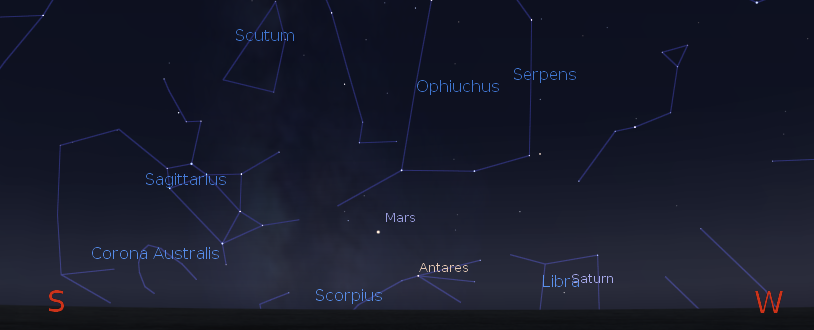
Saturn, Mars and the setting stars of summer at 8:30 p.m. on October 8, 2014.
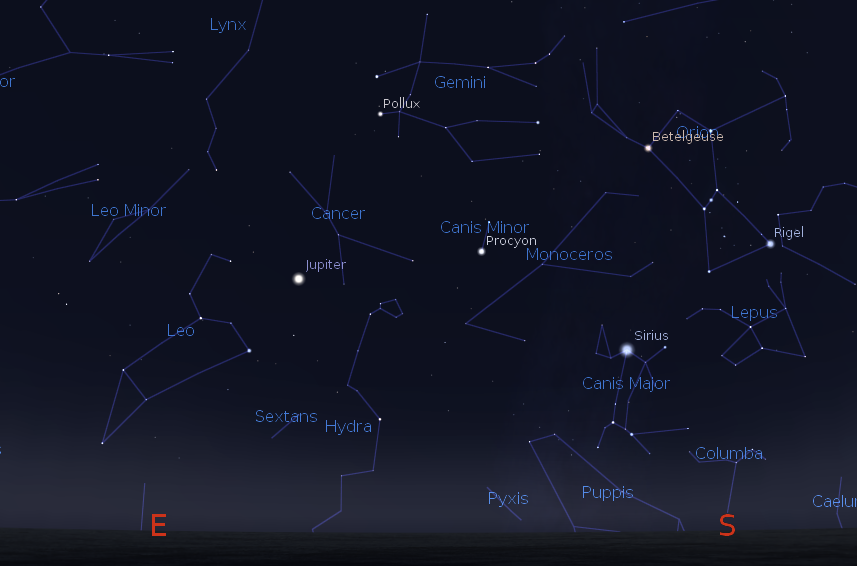
Jupiter and a preview of the stars of winter at 6:30 a.m. on October 9, 2014.
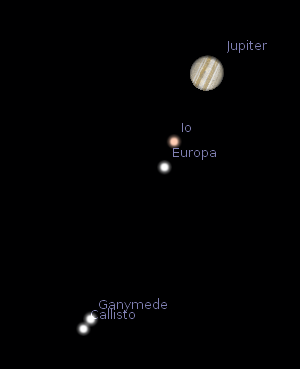
Jupiter and its moons as seen through a telescope at 6:30 a.m. October 9, 2014.
10/07/2014 – Ephemereis – One more day: Tomorrow’s total lunar eclipse
Note: Being a radio program, I do have to repeat the eclipse timings a couple of times.
Ephemeris for Tuesday, October 7th. The sun will rise at 7:47. It’ll be up for 11 hours and 24 minutes, setting at 7:12. The moon, 1 day before full, will set at 7:56 tomorrow morning.
Tomorrow’s Total Lunar Eclipse will be visible without losing too much sleep. Just set the alarm clock so you’ll be ready to view the start of the eclipse at 5:15 a.m. That’s when the partial phase starts when the upper left edge of the moon enters the Earth’s inner shadow called the umbra. The total phase or totality starts at 6:25 with morning twilight just beginning. The middle of the eclipse will occur at 6:54. Totality will end at 7:24 when twilight will be bright. The ending partial phase will not be completely visible from northern Michigan. From the Dakotas and westward the entire ending partial phase will be visible. Amazingly, next year we will have two more total lunar eclipses in the United States, April 4th and September 28th.
Times are for the Traverse City/Interlochen area of Michigan. They may be different for your location.
Addendum
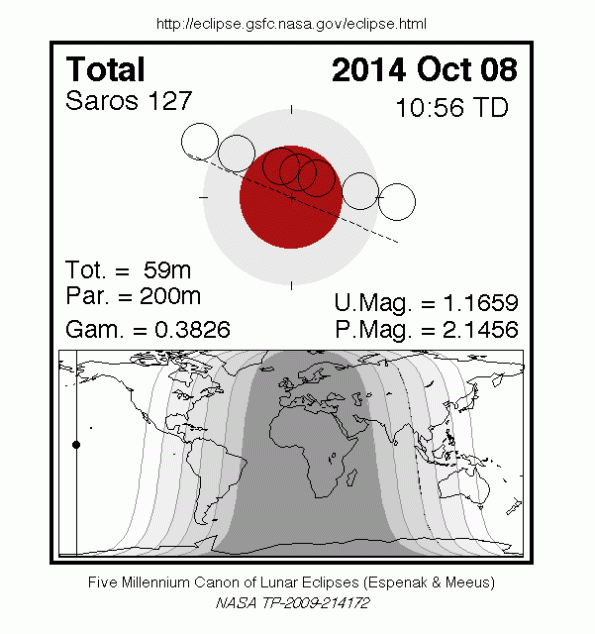 Click on the image above to display or download a more detailed Adobe Acrobat (PDF) image showing more information about the eclipse. The time shown will be Universal Time (UT). Subtract 4 hours for EDT, 5 hours for CDT, etc.
In the Grand Traverse area there are two locations the Grand Traverse Astronomical Society (GTAS) will be set up to view the eclipse if it is clear enough. Opens at 5 a.m.
- Northwestern Michigan College’s Joseph H. Rogers Observatory. located south of Traverse City on Birmley Road, between Garfield and Keystone roads. (One road south of Hammond)
- Sleeping Bear Dunes National Lakeshore at Platte River Point. It’s in several miles from the Platte River Campground off M22 on Lake Michigan Rd. Park in the big parking lot to the left. The GTAS will have their scopes in the small parking lot to the right.
If it’s cloudy, there is a place to view the lunar eclipse on the Internet from Griffith Observatory in Los Angeles. There will probably be more locations. I’ll put them up if and when I find them. Last eclipse, it was cloudy here, so I watched the eclipse Livestream from Griffith Observatory. They also have a running commentary and answer your questions. Though it still wasn’t as good as seeing it with your own eyeballs. Videos cannot duplicate the range of brightness and color that can be seen with your own eyes.
10/06/2014 – Ephemeris – Previewing Wednesday’s lunar eclipse
Ephemeris for Monday, October 6th. The sun will rise at 7:46. It’ll be up for 11 hours and 27 minutes, setting at 7:13. The moon, 2 days before full, will set at 6:42 tomorrow morning.
Wednesday’s Total Lunar Eclipse will be visible without losing too much sleep. Just set the alarm clock for about 5 a.m. The partial phase starts at 5:15 a.m. when the upper left edge of the moon enters the Earth’s inner shadow called the umbra. The total phase or totality starts at 6:25 with morning twilight just beginning. The middle of the eclipse will occur at 6:54. Totality will end at 7:24 when twilight will be bright. The ending partial phase will not be completely visible from northern Michigan. From the Dakotas and westward the entire ending partial phase will be visible. Amazingly, in the next eclipse season another lunar eclipse will be visible, though not as favorable as this one. That one is April 4th 2015 with a totality duration of only 5 minutes.
Times are for the Traverse City/Interlochen area of Michigan. They may be different for your location.
AddendumClick on the image above to display or download a more detailed Adobe Acrobat (PDF) image showing more information about the eclipse. The time shown will be Universal Time (UT). Subtract 4 hours for EDT, 5 hours for CDT, etc.
In the Grand Traverse area there are two locations the Grand Traverse Astronomical Society (GTAS) will be set up to view the eclipse if it is clear enough. Opens at 5 a.m.
- Northwestern Michigan College’s Joseph H. Rogers Observatory. located south of Traverse City on Birmley Road, between Garfield and Keystone roads. (One road south of Hammond)
- Sleeping Bear Dunes National Lakeshore at Platte River Point. It’s in several miles from the Platte River Campground off M22 on Lake Michigan Rd. Park in the big parking lot to the left. The GTAS will have their scopes in the small parking lot to the right.
 Bob Moler's Ephemeris Blog