Archive
11/14/2014 – Ephemeris – When Galaxies collide… With ours (Gulp)
Ephemeris for Friday, November 14th. The sun will rise at 7:37. It’ll be up for 9 hours and 37 minutes, setting at 5:15. The moon, at last quarter today, will rise at 12:33 tomorrow morning.
Yesterday we looked at the closest spiral galaxy to our own Milky Way, the Great Andromeda Galaxy. I said that it would collide with the Milky Way in about 4 billion years. Usually no stars are harmed by such a collision. What does collide are the dust and gasses in each galaxy, that will trigger a burst of star formation. Over the next several billion years the two galaxies will probably merge into one giant elliptical galaxy. The sun at that time will see some changes of life the too. The Earth would by then be uninhabitable because the sun would be too hot, and by then would begin to bloat out into a red giant star. It would be a great spectacle, but no one would be around to watch it. However there are many distant colliding galaxies to watch.
Closer to home, Saturday night there will be a star party at NMC’s Rogers Observatory starting at 9 p.m.
Times are for the Traverse City/Interlochen area of Michigan. They may be different for your location.
Addendum
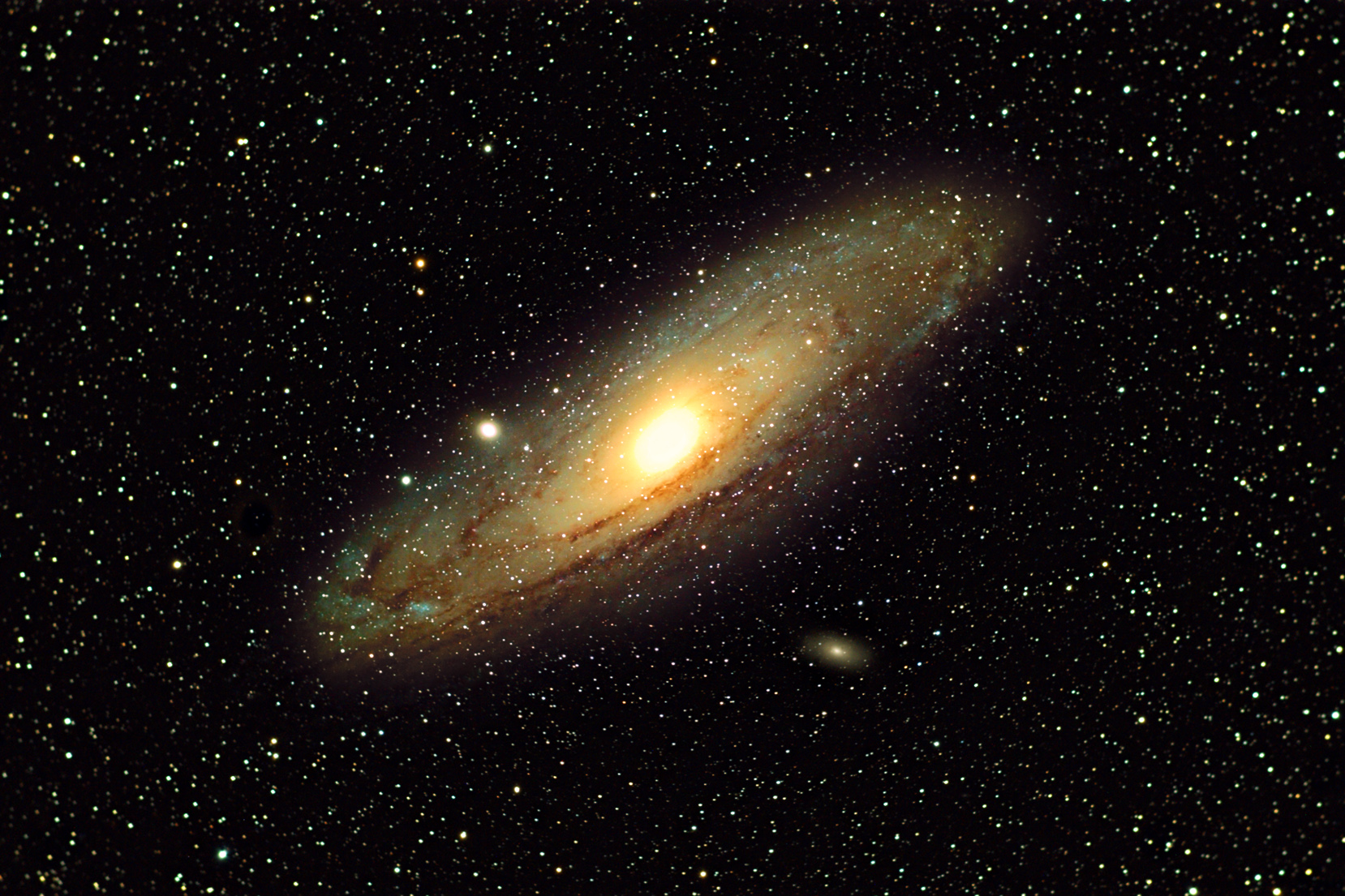
The Great Andromeda Galaxy (M31). Image taken by Scott Anttila.
Here’s a link to a YouTube video of a computer simulation of the collision of the Andromeda galaxy with our Milky Way galaxy.
11/13/2014 – Ephemeris – The Great Andromeda Galaxy
Ephemeris for Thursday, November 13th. The sun will rise at 7:36. It’ll be up for 9 hours and 40 minutes, setting at 5:16. The moon, 1 day before last quarter, will rise at 11:36 this evening.
The Great Andromeda Galaxy that we amateur astronomers usually call M31 is the closest spiral galaxy to our own Milky Way Galaxy. It is actually visible to keen-eyed observers to the naked eye. To locate it, first find the Great Square of Pegasus, 4 stars high in the south that make a pretty good square. From the top left star, Alpheratz, direct your gaze to the first two stars in a slightly curved line to the left to Mirach. Then go two stars up. The last one is a bit dim. But just to the upper right of that last star is a little fuzzy spot. That is the core of the Great Andromeda Galaxy. In binoculars it looks elongated. Photographs show the galaxy to span 6 Moon widths. It is somewhat larger than our galaxy and will collide with the Milky Way in about 4 billion years.
Times are for the Traverse City/Interlochen area of Michigan. They may be different for your location.
Addendum
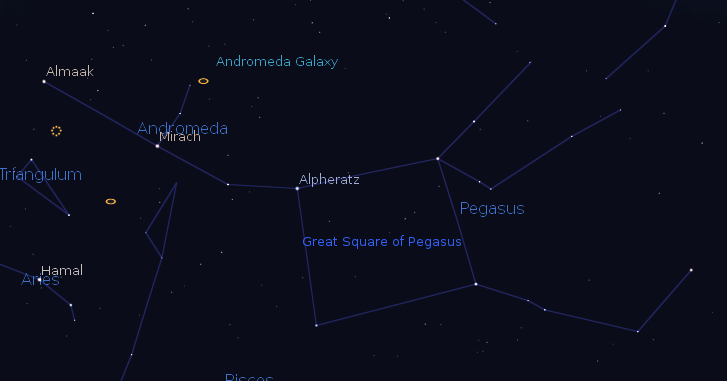
Great Andromeda Galaxy finder chart. Created using Stellarium and GIMP.
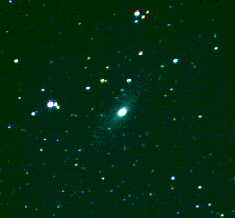
The Great Andromeda Galaxy (M31) as seen in binoculars. Visually even in a telescope the hub of this galaxy is all that is seen. However it also can be seen with the naked eye. My photograph.
The Great Andromeda Galaxy (M31). Satellite galaxy M32 is located at the edge of the disk at 9 o’clock, and another, M110 is located at 5 o’clock. Both can be seen in telescopes, but some distance from the core of M31 and seen visually. Image taken by Scott Anttila.
11/12/2014 – Ephemeris – A look at the bright planets for this week.
Ephemeris for Wednesday, November 12th. The sun will rise at 7:35. It’ll be up for 9 hours and 42 minutes, setting at 5:17. The moon, 2 days before last quarter, will rise at 10:38 this evening.
Tonight Mars will be low in the southwest at 7 p.m. It will set at 8:30 p.m. Jupiter now rises before midnight at 11:45 p.m. The best telescopic views will have to wait a couple of hours. Better to view Jupiter in the morning. The planet Mercury is making its autumn morning appearance now, rising in the east-southeast at 6:19 a.m. By 6:45 or so it should be visible low in the eastern sky, below and left of the star Spica, of about the same brightness, but has a bluish tinge in binoculars. Mercury is brightening as moves away from us and its phase appears fuller. Being close in to the sun its distance doesn’t vary by much so its brightness is governed more by its phase. Its separation from the sun is now down to 14.5 degrees.
Times are for the Traverse City/Interlochen area of Michigan. They may be different for your location.
Addendum
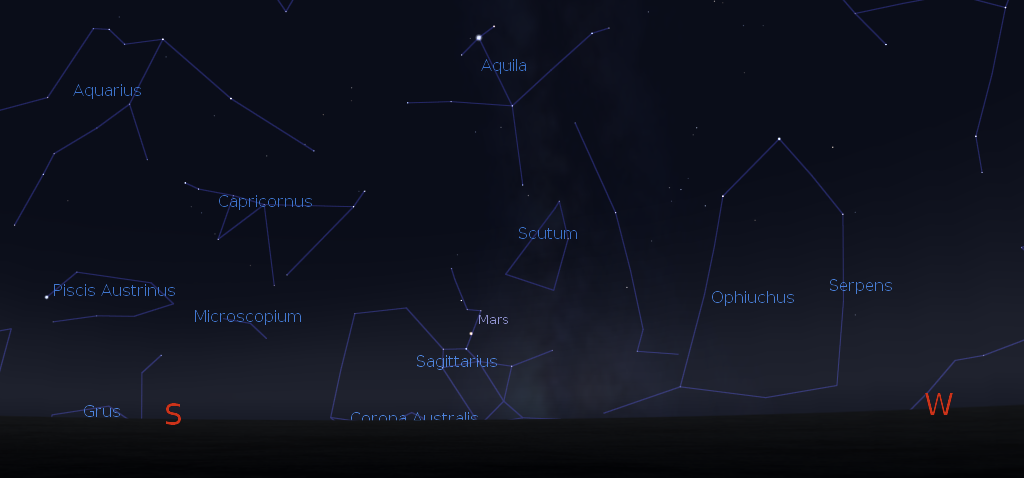
Mars and setting summer constellations at 7 p.m. on November 12, 2014. Created using Stellarium.
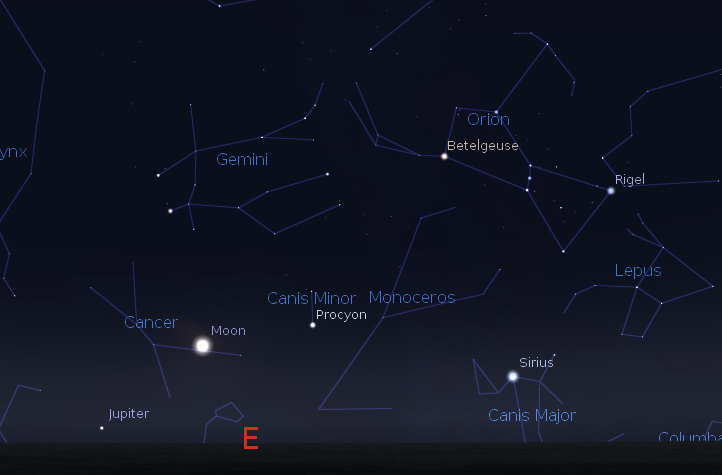
Jupiter and the Moon rising at midnight on November 13, 2014. Created using Stellarium.
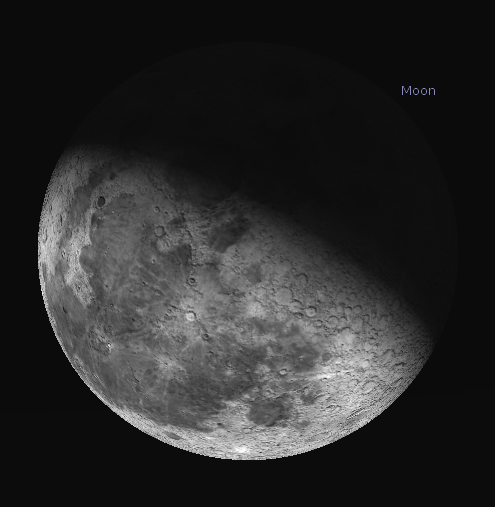
The Moon as seen in binoculars at midnight November 13, 2014. Created using Stellarium.
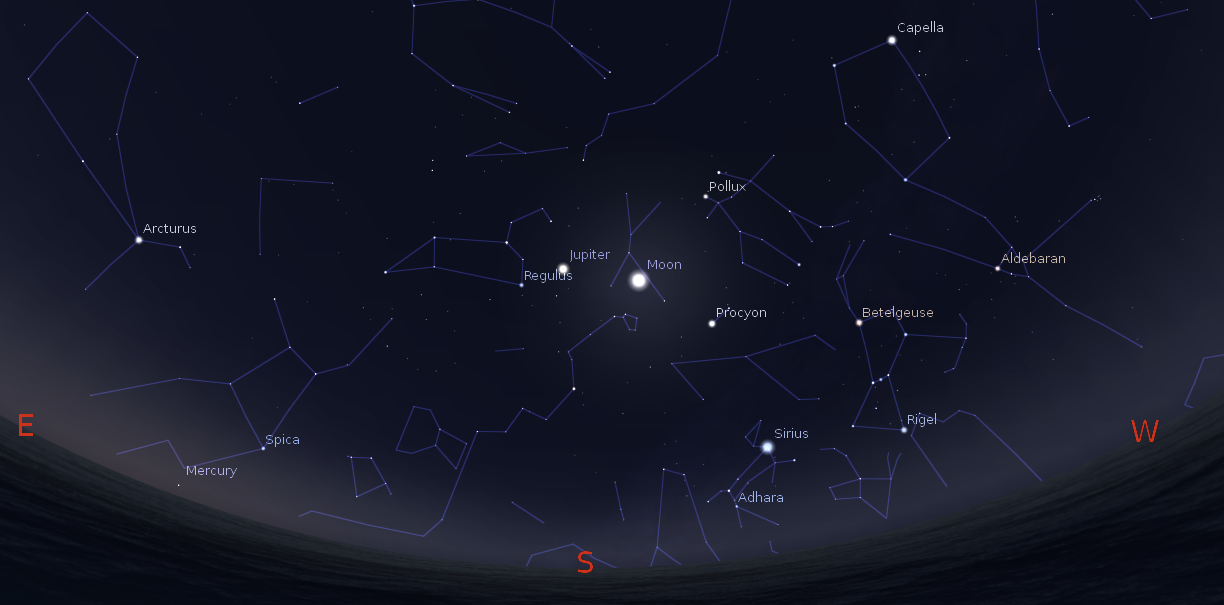
The morning sky including the Moon, Jupiter and Mercury at 6:30 a.m. on November 13, 2014.
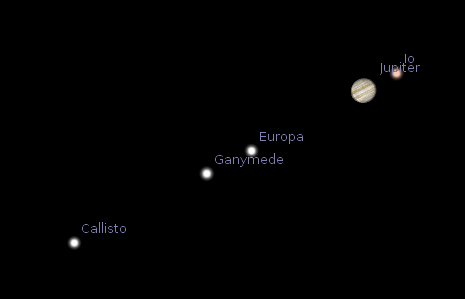
Jupiter and moons through a telescope at 6:30 a.m. November 13, 2014. Created using Stellarium.
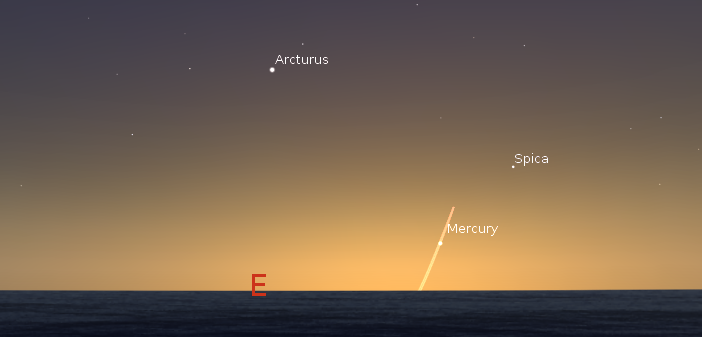
Mercury in twilight showing also its orbit. No, you won’t see that in the real sky. Mercury is sliding back from its peak a couple of weeks ago. 7 a.m. on November 13, 2014. Created using Stellarium.
Philae will attempt to land on comet 67P C-G today (updated)
Today’s the big event when the European Space Agency’s Rosetta spacecraft will release Philae the lander to land on the head of the rubber ducky shaped comet.
Go to the Rosetta landing mission site for links to the live stream feed and other blog and Twitter links.
The times given are CET (Central European Time) and GMT (Greenwich Mean Time or Universal time) Subtract 5 hours for Eastern Standard Time. I’ll convert them below.
Final Go/NoGo decision will be between 1:35 and 2:35 a.m. EST. As of the time of this posting that’s an hour and a half from now.
The release of Philae will be at 4:03 a.m. EST
Landing of Philae will occur around 11:02 a.m. EST. The Philae lander will fall over 7 hours to the comet.
Updated 8:46 EST: Philae has been released. Live update expected at 9 a.m.
Below is a link to the live feed from the Rosetta operations center
Also follow on Twitter #CometLanding
Update 11:05 a.m. EST: The Philae has landed! From the happy faces and celebration in he control center. No announcement yet.
Update 11:08 a.m. EST: The official announcement came from the flight director. The harpoons were fired and cables reeled back to attach the lander to the surface.
Update 11:48 a.m. EST: It is reported that Philae may not be anchored to the surface Stay tuned.
11/11/14 – Ephemeris – Something fishy in the stars
Ephemeris for Veteran’s Day, Tuesday, November 11th. The sun will rise at 7:33. It’ll be up for 9 hours and 45 minutes, setting at 5:18. The moon, 3 days before last quarter, will rise at 9:41 this evening.
High in the south at 9 p.m. are the four bright stars of the Great Square of Pegasus, the upside down flying horse. Lying along the left and bottom sides of the great square is the constellation of Pisces the fish, one of the 12 constellations of the Zodiac that lie along the path of the sun, moon and planets. Even though Pisces is called the fish, the fish themselves are not seen in the stars. What can be traced in the stars is the rope, that’s tied to their tails, anchored at the extreme southeastern part of the constellation far below and left of the lower left corner of the Great Square. The right end of Pisces is the asterism, or informal constellation, of the Circlet. It’s the loop of 5 stars, the rope around the tail of one of the two fish.
Times are for the Traverse City/Interlochen area of Michigan. They may be different for your location.
Addendum
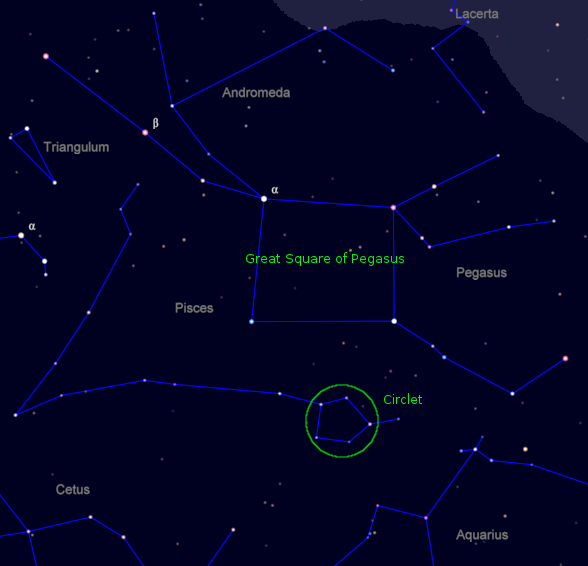
Pisces below the Great Square of Pegasus in the south at 9 p.m.
11/10/2014 – Ephemeris – Where is the constellation of Aquarius the water bearer
Ephemeris for Monday, November 10th. The sun will rise at 7:32. It’ll be up for 9 hours and 47 minutes, setting at 5:19. The moon, half way from full to last quarter, will rise at 8:45 this evening.
One of the constellations of the zodiac is in the southern sky at 8 in the evening. It’s the constellation of Aquarius the water bearer. The image that is supposed to be depicted in the stars is that of a hapless fellow spilling a stone jar of water across the sky. Aquarius is fairly hard to spot because it is made of faint stars. One part of Aquarius is easy to spot, the Water Jar, an asterism or informal constellation. It’s a distinctive small nearly equilateral triangle of stars with another star in the center. Stars extending to the right from the water jar are that stream of water in some depictions. The body of Aquarius is below, a misshapen balloon of stars that is seen above the bright star Fomalhaut, low in the south.
Times are for the Traverse City/Interlochen area of Michigan. They may be different for your location.
Addendum
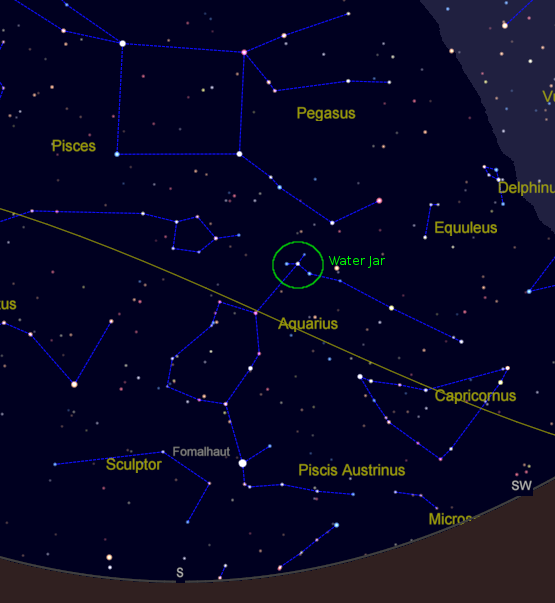
Aquarius highlighting the Water Jar. Created using Stellarium.
11/07/2014 – Ephemeris – GTAS meeting tonight and Star Party
Ephemeris for Friday, November 7th. The sun will rise at 7:28. It’ll be up for 9 hours and 55 minutes, setting at 5:23. The moon, 1 day past full, will rise at 6:15 this evening.
Tonight the Grand Traverse Astronomical Society will hold their monthly meeting at he Northwestern Michigan College’s Rogers Observatory at 8 p.m. featuring yours truly presenting the Hitchhikers Guide to the Solar System. I have found, what NASA and other space agencies have found, that once orbiting the Sun in the solar system. One can go anywhere in the solar system with a minimum of energy, if one has the time. We’ll start by looking at orbits about the Earth and how they can be changed. We’ll look at escape velocity and those seemingly strange Lagrangian points, plus stealing energy from the planets. At 9 p.m. there will be a star party featuring the Moon and some of the brighter deep sky objects. The observatory is located on Birmley road.
Times are for the Traverse City/Interlochen area of Michigan. They may be different for your location.
Addendum
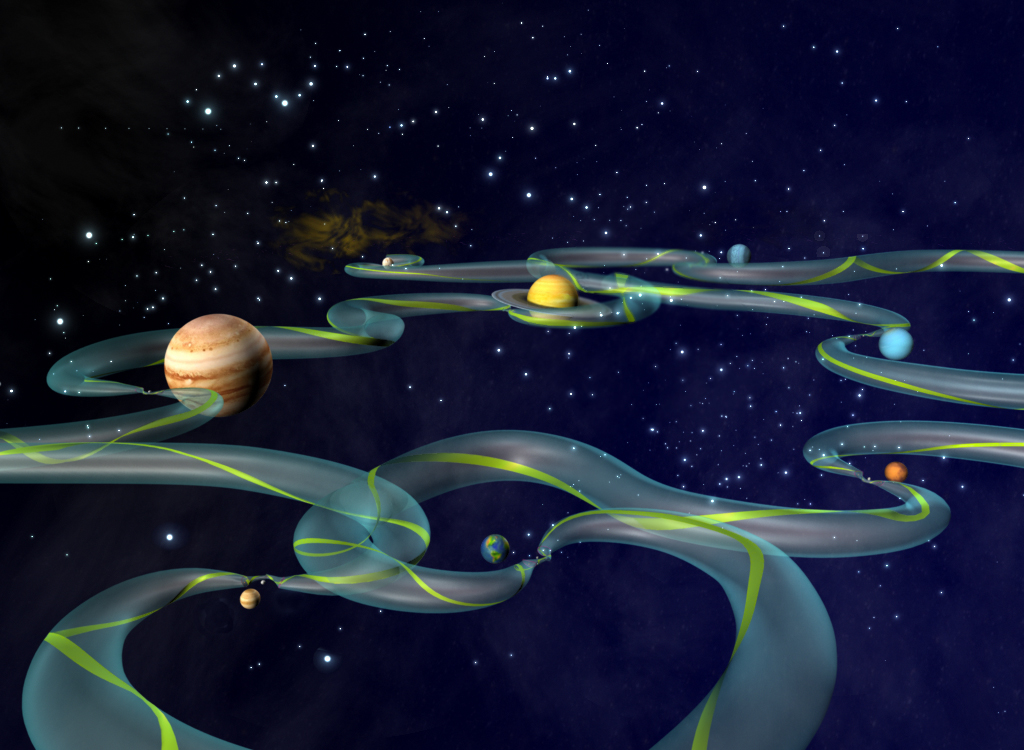
Artist’s concept of interplanetary superhighway or Interplanetary Transport Network. Credit: NASA/JPL.
11/06/2014 – Ephemeris – New Horizons headed toward the 9th planet will pass a dwarf planet instead
Ephemeris for Thursday, November 6th. The sun will rise at 7:26. It’ll be up for 9 hours and 57 minutes, setting at 5:24. The moon, at full today, will rise at 5:32 this evening.
The New Horizons spacecraft is 9 months from reaching the dwarf planet Pluto. After a 9 and a half years journey it will zip past Pluto and its moons in a day. At launch Pluto was designated as planet number 9. In less than a year later Pluto was demoted to a dwarf planet. The authority was the International Astronomical Union. It was a vote taken at the end of the last day of the meeting that year after most members have left. The definitions only pertain to the solar system, and not exoplanets orbiting other stars. Besides we cannot detect anything as small as Pluto orbiting another star…yet. The asteroid Ceres was once a planet too, it was demoted to asteroid 75 years after discovery. It was promoted to a dwarf planet with Pluto.
Times are for the Traverse City/Interlochen area of Michigan. They may be different for your location.
Addendum

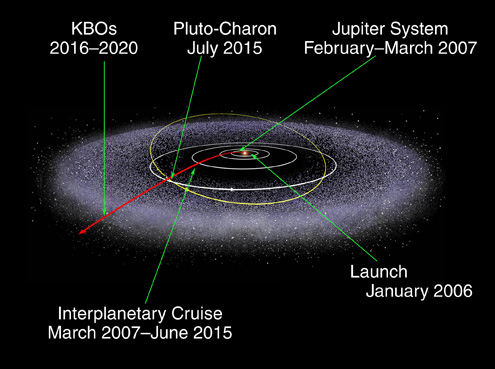
New Horizon’s trajectory through the solar system. Credit: NASA/JHAPL.
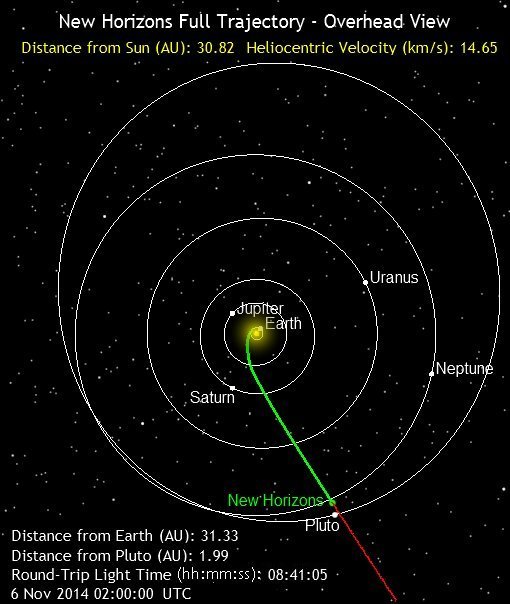
Where is New Horizons on November 6, 2014? Credit NASA/JHAPL.
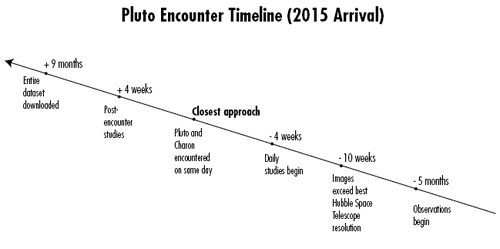
New Horizons Encounter Timeline. Credit: NASA/JHAPL.
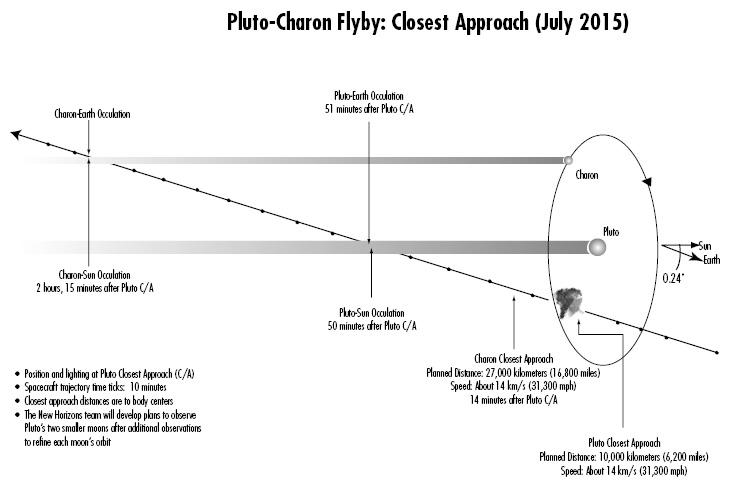
New Horizons at closest approach to Pluto. Credit: NASA/JHAPL.
11/05/2014 – Ephemeris – This week there’s one bright planet in the early evening and two in the morningf
Ephemeris for Wednesday, November 5th. The sun will rise at 7:25. It’ll be up for 10 hours and 1 minute, setting at 5:26. The moon, 1 day before full, will set at 6:56 tomorrow morning.
Tonight Mars will be low in the southwest at 7 p.m. It will set at 8:32 p.m. The sky will stay devoid of bright planets until Jupiter rises at 12:13 a.m. Jupiter is visible this morning in twilight an hour earlier than last week, in the south-southeast along with the brighter stars of winter, a preview of colder evenings to come. The planet Mercury is making its autumn morning appearance now, rising in the east-southeast at 5:48 a.m. By 6:20 or so it should be visible low in the sky. Mercury is brightening as moves away from us and its phase becomes fuller. Being close in to the sun its distance doesn’t vary by much so its brightness is governed more by its phase. Its separation from the sun is now an 18 degree angle and slowly decreasing.
Times are for the Traverse City/Interlochen area of Michigan. They may be different for your location.
Addendum
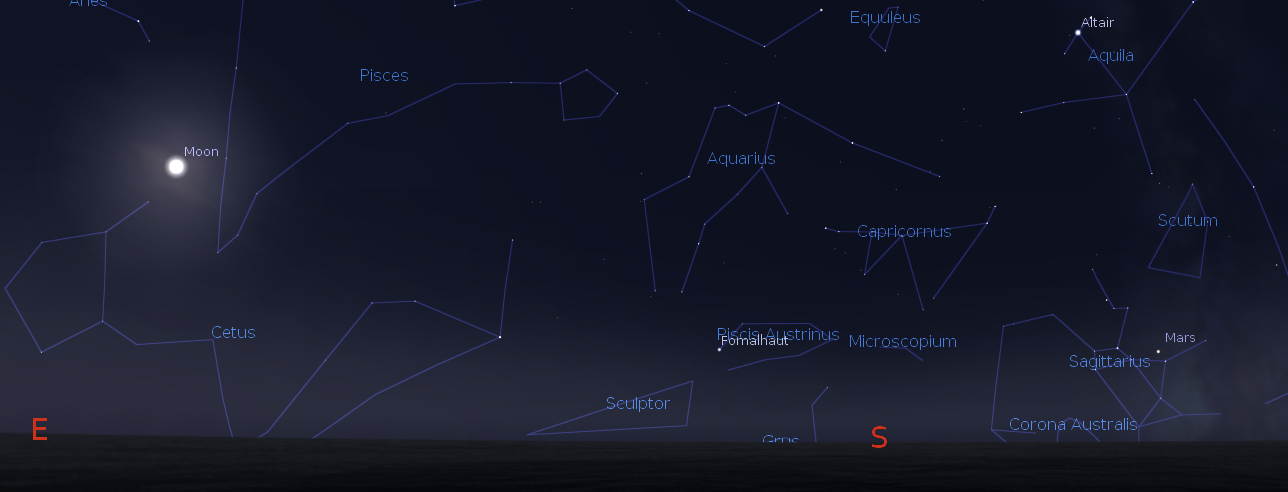
Mars and the bright Moon at 7 p.m. on November 5, 2014. Created using Stellarium.
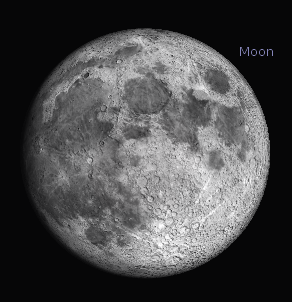
The nearly full Moon as it would be seen in binoculars at 7 p.m. on November 5, 2014. Created using Stellarium.
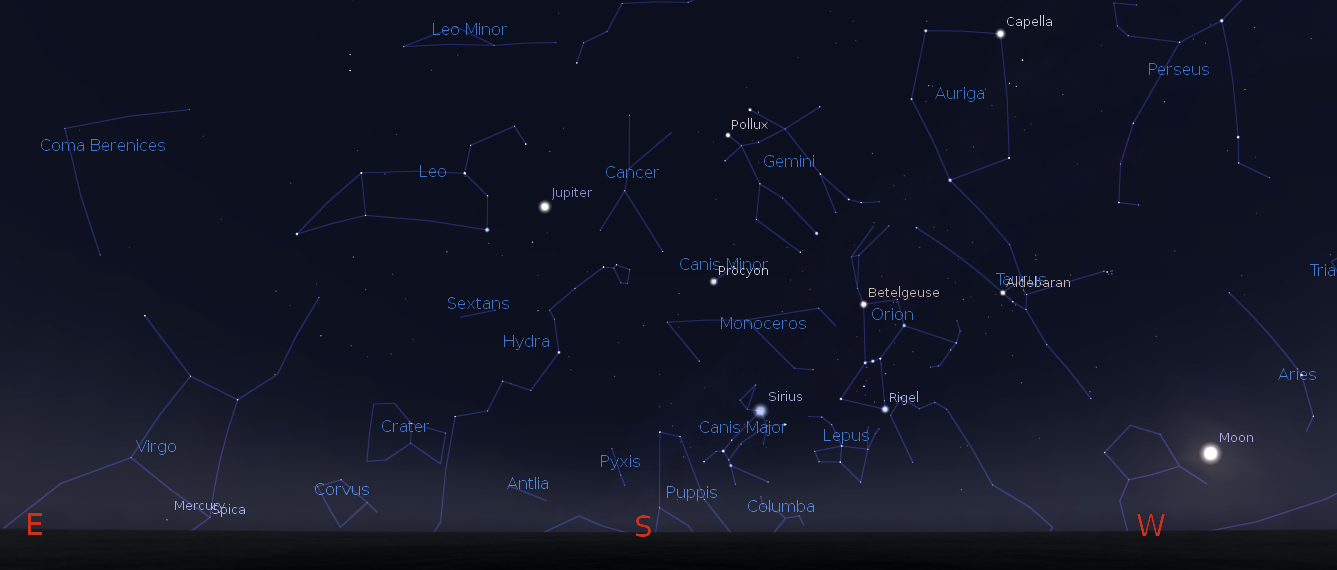
Panorama of the morning sky at 6 a.m. with Jupiter and the just risen Mercury, with the Moon hanging on in the west. Created using Stellarium.
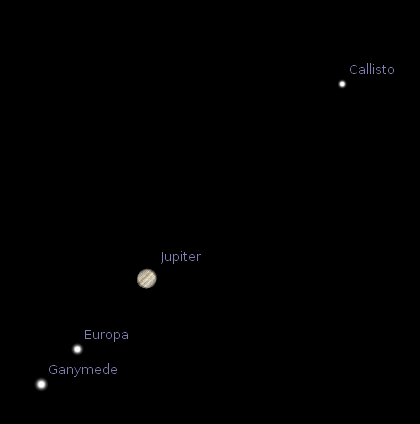
Jupiter and moons as seen in a telescope at 6 a.m., November 6, 2014. The moon Io, visible earlier in the morning, is hiding behind the planet. Created using Stellarium.
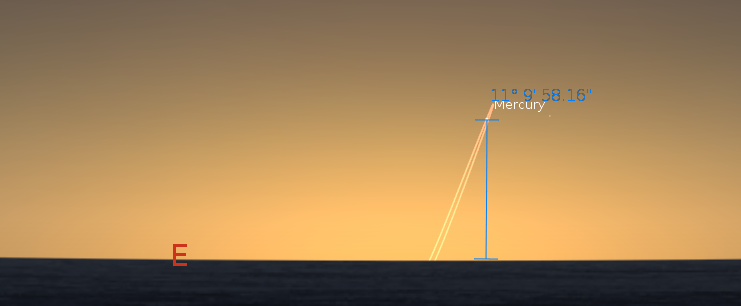
Mercury low in the east at 7 a.m., November 6, 2014. Note its altitude is 11 degrees above the flat horizon. Also shown is Mercury’s orbit. Created using Stellarium.
11/04/2014 – Ephemeris – Last week was a bad one for commercial space
Ephemeris for Election Day, Tuesday, November 4th. The sun will rise at 7:24. It’ll be up for 10 hours and 3 minutes, setting at 5:27. The moon, 2 days before full, will set at 5:46 tomorrow morning.
Last week was not a happy one for commercial space companies. First, last Tuesday the Orbital Science’s Antares blew up (or in space-talk: “Suffered an anomaly”) attempting to deliver it’s third contracted commercial cargo to the International Space Station. No one was killed because it was an unmanned rocket and the spectators were kept at a safe distance. Then on Friday an anomaly occurred during a test flight of Virgin Galactic’s SpaceShipTwo. In that mishap the co-pilot, Michael Alsbury, was killed. “Space is hard.” was the phrase heard quite often last week. And it’s true. I’ve found that the natural state of any mechanism is not to work. The more complicated the device is, like a rocket, the harder it is to get it to work.
Times are for the Traverse City/Interlochen area of Michigan. They may be different for your location.
Addendum

The initial signs that the Antares rocket was in trouble. Credit: Parabolic Arc.

A sequence of photos of the flight and breakup of SpaceShipTwo. Credit: Kenneth Brown/Reuters.
 Bob Moler's Ephemeris Blog