Archive
06/17/2015 – Ephemeris – Jupiter and Venus approach each other while Saturn looks on
Ephemeris for Wednesday, June 17th. Today the Sun will be up for 15 hours and 34 minutes, setting at 9:30. The Moon, 1 day past new, will set at 10:14 this evening. Tomorrow the Sun will rise at 5:56.
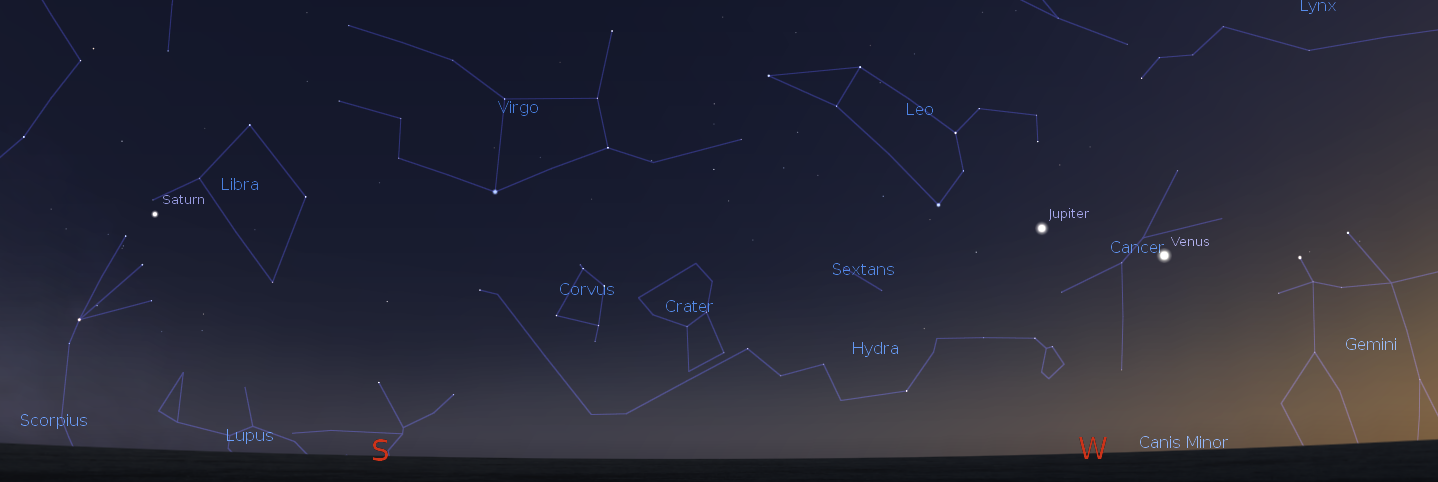
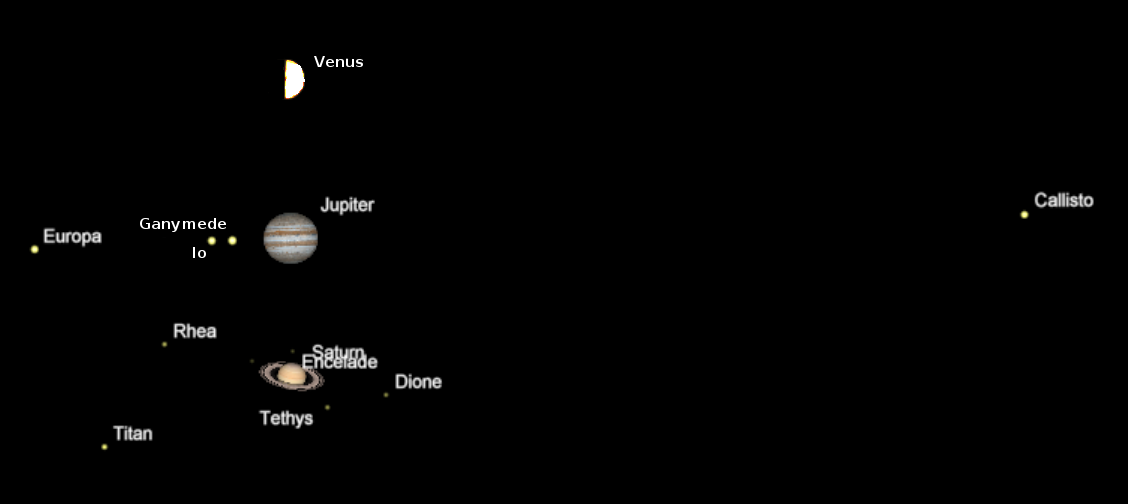
Lets take a look at the bright planets for this week. Our brilliant evening star Venus is in the west by 9:45 p.m. It will set at 12:19 a.m. Venus’ will slide down to the Sun faster and faster in the coming weeks. It will take a bit less than 2 months. Jupiter will appear western sky to the left of and slightly above Venus at about 10 p.m. It will set at 12:34 a.m. It seems to approach Venus, and now appears about 8 degrees away. That’s somewhat less than the width of your fist held at arm’s length. They will cross paths in 13 days, on the 30th. Saturn is in the southeast in evening twilight. It will pass due south at 11:51 p.m. and will set at 4:39 a.m. Check out Saturn’s rings in any small telescope.
Times are for the Traverse City/Interlochen area of Michigan. They may be different for your location.
Addendum
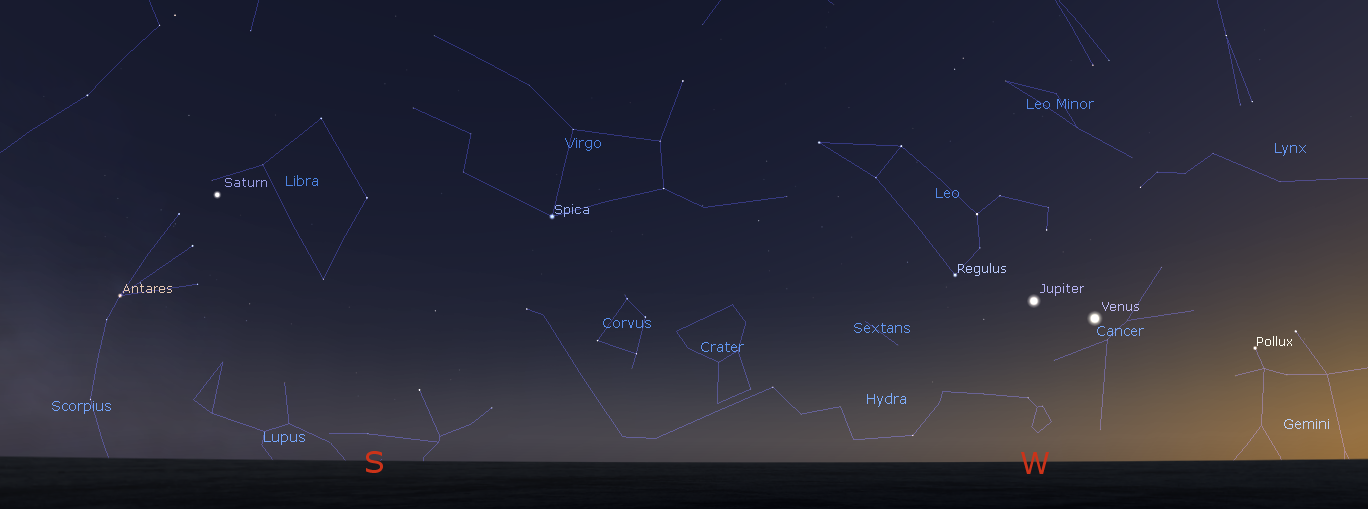
Venus, Jupiter and Saturn with the late spring southern constellations at 10:30 p.m., June 17, 2015. Created using Stellarium. Click on image to enlarge.
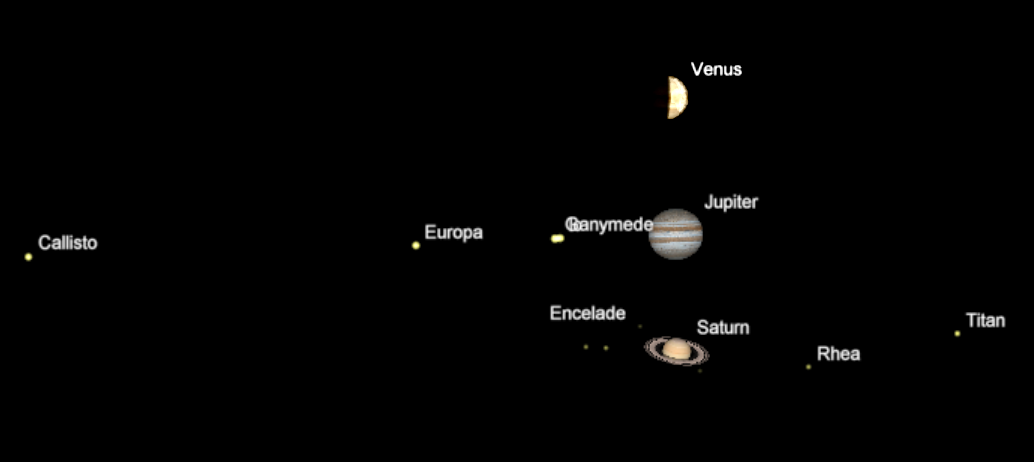
The evening planets using the same magnification at 10:30 p.m., June 17, 2015. Created using Cartes du Ciel (Sky Charts). Click on image to enlarge. Note that Jupiter’s moons Ganymede and Io are so close their labels overlap.
06/16/2015 – Ephemeris – Philae phones home
Ephemeris for Tuesday, June 16th. Today the Sun will be up for 15 hours and 33 minutes, setting at 9:30. The Moon is new today, and won’t be visible.
Tomorrow the Sun will rise at 5:56. | As Comet 67P/Churyumov-Gerasimenko (Comet 67P for short, or the Rubber Duckie Comet) nears the orbit of Mars a couple of months from perihelion, its closest to the Sun, the Rosetta spacecraft, which has been orbiting it received welcome news from its lander Philae which fell silent 5 months ago. The lander woke up and has enough power to take measurements and transmit data to the Rosetta spacecraft. This is something the folks at the European Space Agency had hoped for. The comet has moved in its orbit around the Sun, so the Sun’s light now can fall on Philae’s solar panels long enough during the comet’s daily rotation to recharge its batteries. They are hoping that Philae can resume its surface mission. This is just amazing!
Times are for the Traverse City/Interlochen area of Michigan. They may be different for your location.
Addendum

Comet 67P and jets of dust, carried by sublimating ices. Credit: ESA/Rosetta
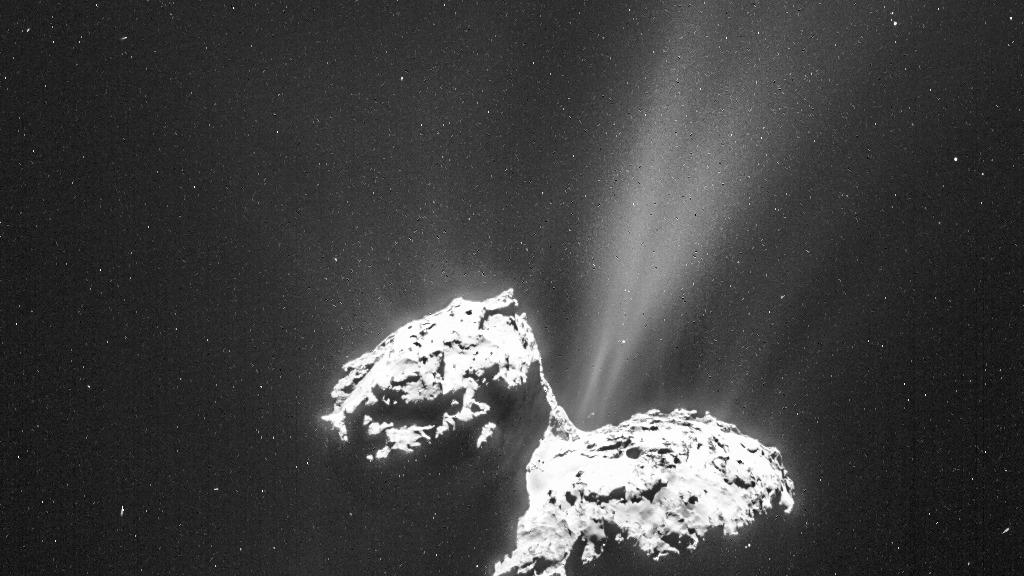
Comet 67P and jets of dust, carried by sublimating ices from another angle. Credit: ESA/Rosetta
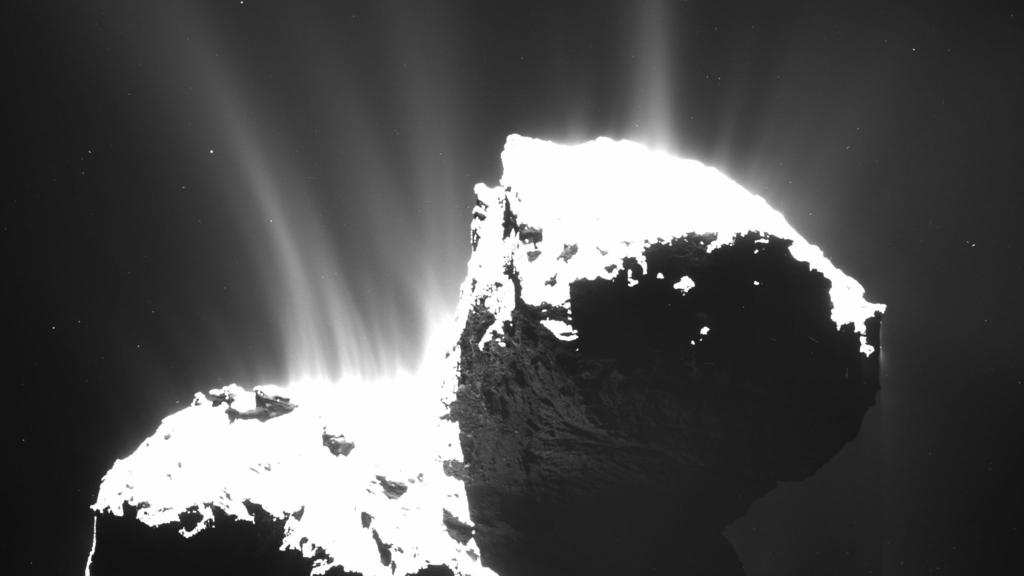
Comet 67P and jets of dust, carried by sublimating ices from yet another angle. Credit: ESA/Rosetta
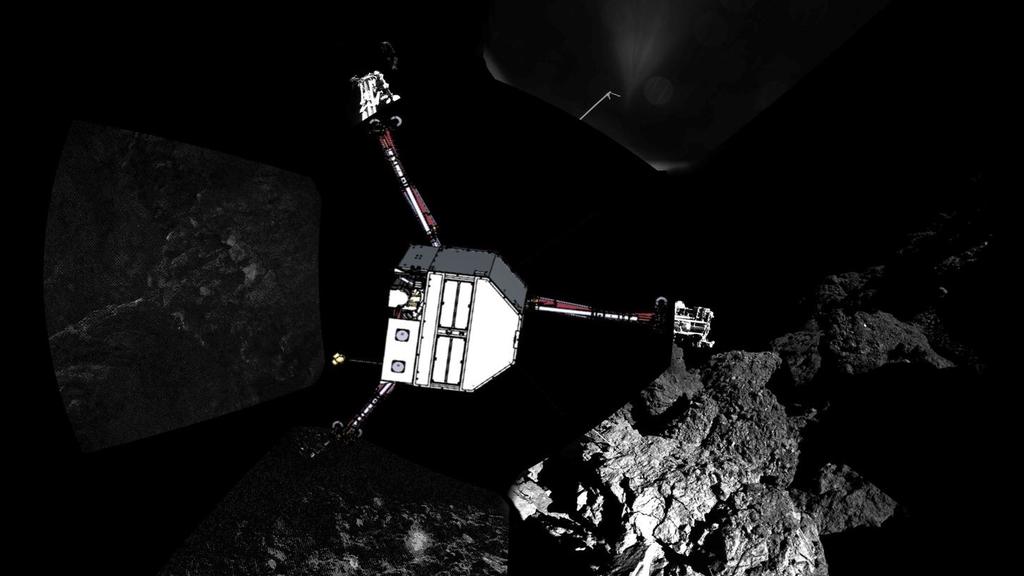
An image of the Philae lander superimposed on its panorama photographs where it was wedged between ice and a hard place in the shadows last November. Credit: ESA/Rosetta.
06/15/2015 – Ephemeris – The earliest sunrise
Ephemeris for Monday, June 15th. Today the Sun will be up for 15 hours and 33 minutes, setting at 9:30. The Moon, 1 day before new, will rise at 6:19 tomorrow morning. Tomorrow the Sun will rise at 5:56.
This is the day of the earliest sunrise. We are still six days from the summer solstice, that day the Sun stays up the longest. And 11 days from the latest sunset. I could be off a day since I don’t calculate sunrise and sunset times to the second. I use the standard formula for these computations, which, among other things assumes that the horizon is the sea horizon. If you’re standing on the bluffs overlooking Lake Michigan, sunset would be slightly later than one seen down on the shore, and for the Sleeping Bear Dunes or Empire Bluff, your sunset would be 2 minutes later that Traverse City or Interlochen anyway because that’s west of them. At the latitude of 45 degrees the rise and set times are 1 minute later for each 12 and a half miles west you are.
Times are for the Traverse City/Interlochen area of Michigan. They may be different for your location.
Addendum
The discussion turned from sunrises to sunsets. Well, sunsets are a bigger deal this side of the state. I suppose that if I lived in Alpena or Rogers City, I’d be more interested in sunrises. The timing difference for the rising and setting of celestial objects depends on the longitude one is versus the longitude of the position for which it is calculated, as long as one stays at roughly the same latitude. The times for this program are for a position roughly half way between Interlochen and Traverse City. Full disclosure: It’s the Moler homestead. Back, when I started this program in 1975, it was an era I call BC. Before Computers, well before personal computers. I used the rising and setting tables from the Royal Canadian Astronomical Society’s Observer’s Handbook for the year in question, adjusting for longitude. I climbed op on my rooftop to verify the times several times a year. That was back when my house wasn’t surrounded by trees.
In the sky east or west, what we call longitude on the Earth is marked not in degrees, but in hours, minutes and seconds. Since 360 degrees or Earth’s rotation equals 24 hours, one hour equals 15 degrees, and each degree equals 4 minutes. In Traverse City, near 45 degrees north latitude, The longitude lines are closer than at the equator. They are 71% that of the equatorial separation. Working it out, each minute of rotation equates to 12.31 miles. The 12 1/2 miles is close enough for radio, and besides I had calculated it a looooong time ago and was pulling it off the top of my head. I recalculated it just now.
Any change time in the rising and setting of objects for persons north or south of the standard position depends on the object’s declination (latitude in the sky) north of south of the celestial equator, so the calculation isn’t as simple.
06/12/2015 – Ephemeris – The first stars to appear at night
Ephemeris for Friday, June 12th. Today the Sun will be up for 15 hours and 31 minutes, setting at 9:28. The Moon, 3 days past last quarter, will rise at 4:03 tomorrow morning. Tomorrow the Sun will rise at 5:56.
Evening twilight lasts a very long time this time of year, so the stars will come out slowly. By about a half hour after sunset the planets Venus and Jupiter should be visible in the west. Probably the first actual star to appear is very high in the east, the orange star Arcturus in the constellation of Boötes, which is the 4th brightest night-time star. Next, lower in the northeast, is the 5th brightest star the white Vega in Lyra the harp. By this time Saturn should appear low in the southeast as a yellowish star. Soon many more stars will become visible with the Big Dipper overhead pointing to Polaris in the north, blue-white Spica in the south, Regulus, left of Jupiter and Capella low in the northwest.
Times are for the Traverse City/Interlochen area of Michigan. They may be different for your location.
Addendum
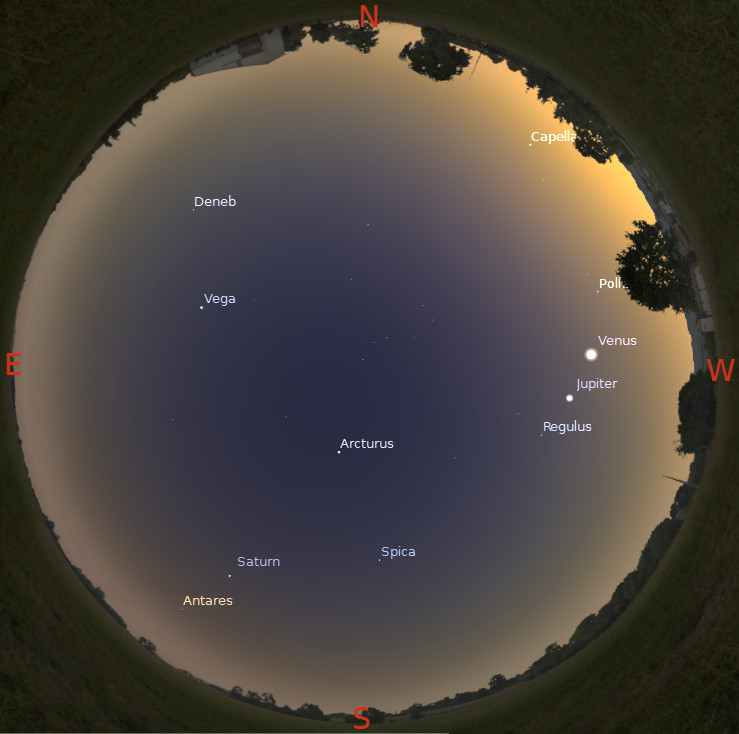
The first stars to appear after sunset. This is created from Stellarium for a half hour after sunset. It’s a bit optimistic, in my view, though my eyes aren’t the best. Try your eyes. Click on image to enlarge.
06/11/2015 – Ephemeris – Jupiter and Venus continue to appear to approach each other during this month
Thursday, June 11th. Today the Sun will be up for 15 hours and 31 minutes, setting at 9:28. The Moon, 2 days past last quarter, will rise at 3:27 tomorrow morning. Tomorrow the Sun will rise at 5:56.
In the western sky at sunset can be seen the brilliant evening star Venus and the bright but dimmer Jupiter. Jupiter is slowly moving eastward against the stars of the constellation Leo, but is losing the battle with the Earth’s own motion around the Sun. and is setting about 4 minutes earlier each night. Venus is moving faster eastward against the stars, setting only 2 minutes earlier each night. On June 30th it will only be two thirds of the Moon’s diameter south of Jupiter. However Venus will finally surrender to the Sun and will pass Jupiter again on August 3rd, being 7 degrees or 14 moon widths south of Jupiter. Venus will pass the Sun first on August 15th, followed by Jupiter on the 26th, both entering the morning sky.
Times are for the Traverse City/Interlochen area of Michigan. They may be different for your location.
Addendum
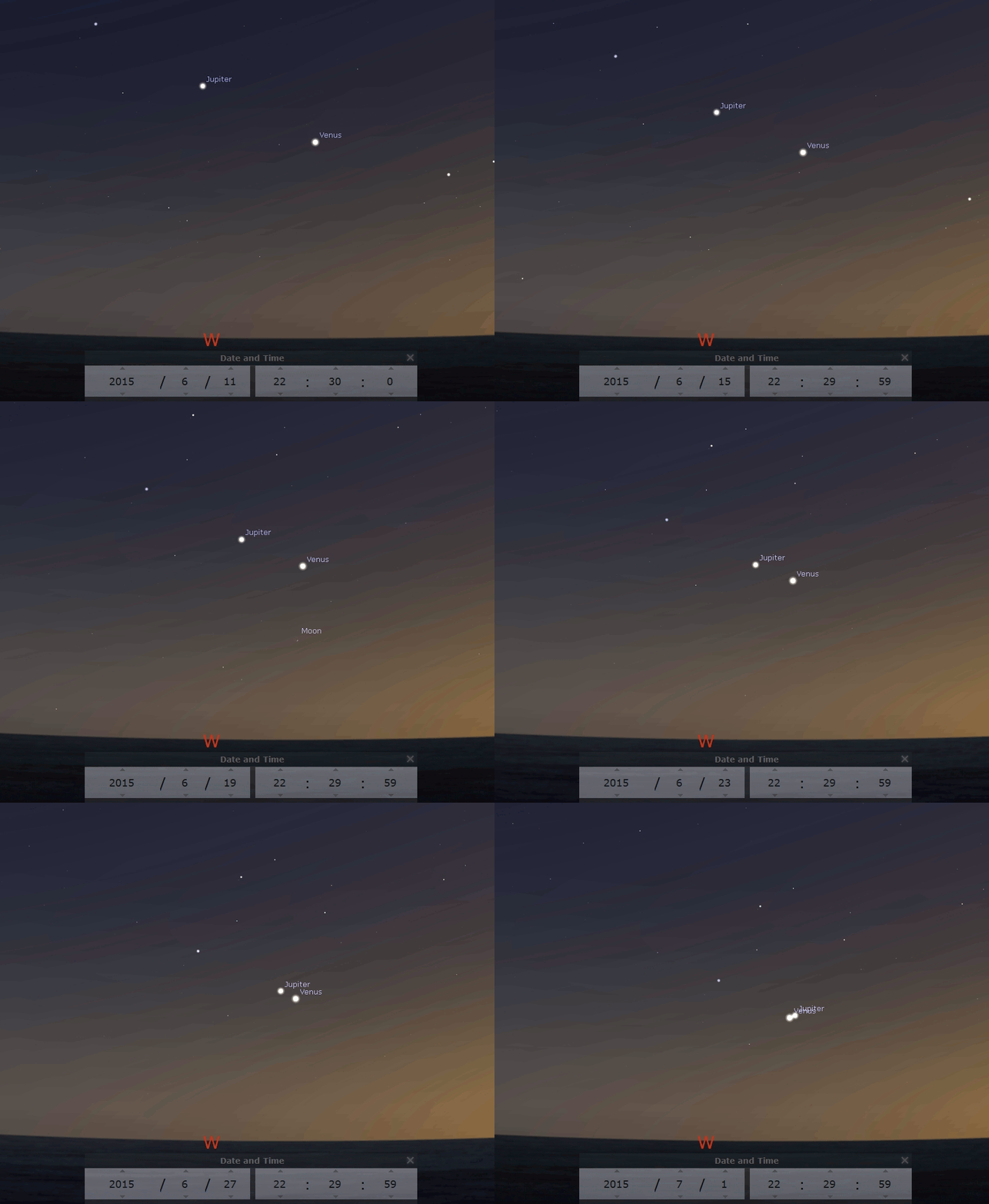
Jupiter-Venus approach animation June 11 to July 1, 2015 at 10:30 p.m. Created using Stellarium and GIMP. Click on image to enlarge.
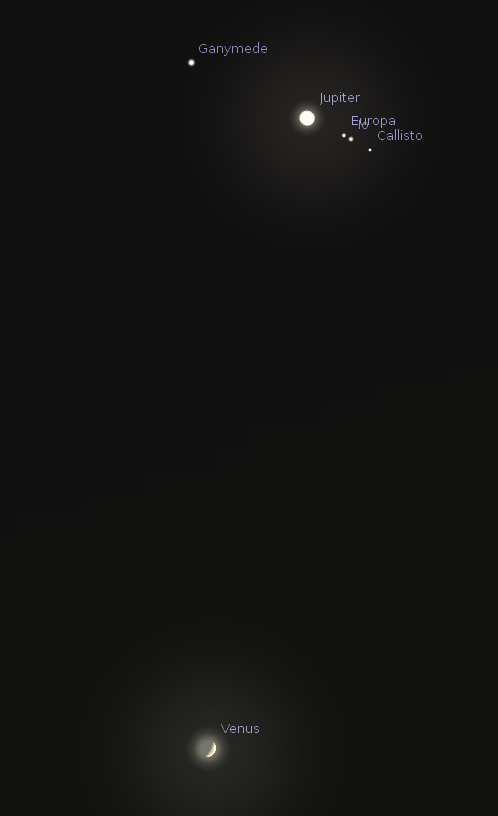
Conjunction of Jupiter and Venus at low power. They will be 20′ apart at 10:30 p.m. EDT June 30, 2015 (2:30 UT July 1, 2015). Created using Stellarium.
Later this month I will have a post showing that this conjunction and a similar conjunction of August last year are a near repeat of two Jupiter-Venus Conjunctions of 3 and 2 BC. which are candidates for the Star of Bethlehem.
06/10/2015 – Ephemeris – Three bright planets in the evening
Ephemeris for Wednesday, June 10th. Today the Sun will be up for 15 hours and 30 minutes, setting at 9:27. The Moon, 1 day past last quarter, will rise at 2:52 tomorrow morning. Tomorrow the Sun will rise at 5:56.
Lets take a look at the bright planets for this week. Our brilliant evening star Venus is in the west by 9:45 p.m. It will set at 12:31 a.m. Venus reached its greatest eastern elongation or separation from the Sun last Saturday it is now setting earlier. Venus’ slide down to the Sun will be much faster than its climb to greatest elongation. It will take a bit more than 2 months. Jupiter will appear western sky to the left of and slightly above Venus at about 10 p.m. It will set at 12:59 a.m. It seems to approach Venus. Now it appears about 13 degrees away. That’s somewhat more than the width of your fist held at arm’s length. They will cross paths on the 30th. Saturn is in the southeast as evening twilight fades.
Times are for the Traverse City/Interlochen area of Michigan. They may be different for your location.
Addendum
Venus, Jupiter and Saturn with the late spring southern constellations at 10:30 p.m., June 10, 2015. Created using Stellarium. Click on image to enlarge.
The evening planets using the same magnification at 10:30 p.m., June 10, 2015. Created using Cartes du Ciel (Sky Charts). Click on image to enlarge.
06/09/2015 – Ephemeris – What’s Pluto Time?
Ephemeris for Tuesday, June 9th. Today the Sun will be up for 15 hours and 29 minutes, setting at 9:27. The Moon, at last quarter today, will rise at 2:19 tomorrow morning. Tomorrow the Sun will rise at 5:57.
This weekend I received several messages from the New Horizons team and others about Pluto Time. New Horizons is the spacecraft that will pass through the Pluto system in a bit more than 5 weeks from now. Pluto Time is the time of day when the landscape around you is lit up as much as the Sun lights up Pluto’s surface from nearly 33 times the Earth’s distance from the sun. The Sun’s intensity is a bit less than a thousandths that which it appears from the Earth, but still reasonably bright. For around the northern lower peninsula it’s about 6 minutes after sunset or before sunrise. To check out the time for yourself go to solarsystem.nasa.gov/plutotime, or use the link from my blog.
Times are for the Traverse City/Interlochen area of Michigan. They may be different for your location.
Addendum
Header for Pluto Time Page. Credit NASA.
Phil Plait yesterday had a post about Pluto Time and a free iPhone and Android app called Pluto Safari.
Also check out the New Horizons Twitter feed @NewHorizons2015.
06/08/2015 – Ephemeris – Libra in the balance
Ephemeris for Monday, June 8th. Today the Sun will be up for 15 hours and 28 minutes, setting at 9:26. The Moon, 1 day before last quarter, will rise at 1:46 tomorrow morning and tomorrow the Sun will rise at 5:57.
One of the constellations of the Zodiac or circle of animals isn’t either animal or human. It is Libra the Scales or balance. It lies low in the southeastern sky at 11 p.m., just to the right of the rising Saturn and Scorpius the scorpion. Libra, it seems, is an afterthought, a simple diamond shape of four stars. Its two brightest stars Zubeneschamali and Zubenelgenubi translate to the north and south claw respectively, of Scorpius to the left of it. The Arabs, at least, seemed to view this as part of Scorpius. The balance was perhaps to signify the equality of day and night, at the time the sun was in this part of the sky at the start of autumn, over 2000 years ago. Now its in Virgo.
Times are for the Traverse City/Interlochen area of Michigan. They may be different for your location.
Addendum
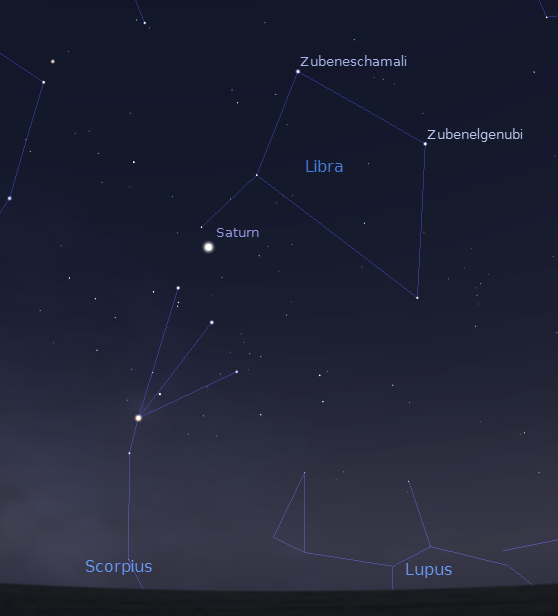
Libra with Saturn and Scorpius rising behind in the southeast at 10:30 p.m. on June 8, 2015. Created using Stellarium.
06/05/2015 – Ephemeris – Astronomy in Traverse City tonight: Parallax and Planets
Ephemeris for Friday, June 5th. Today the Sun will be up for 15 hours and 25 minutes, setting at 9:24. The Moon, 3 days past full, will rise at 11:53 this evening and tomorrow the Sun will rise at 5:58.
Stellar parallax is a way to measure distances to the nearest stars by observing them six months apart, from opposite ends of the Earth’s orbit. Parallax is why we have two eyes to judge distance. Parallax is also proof that the earth revolves around the Sun. Dr. David Penney will investigate this at this evening’s meeting of the Grand Traverse Astronomical Society at 8 p.m. at Northwestern Michigan College’s Rogers Observatory. Everyone is welcome. Also at 9 p.m. there will be a star party at the observatory. The astronomical objects of the evening will be the planets Venus, Jupiter and Saturn. The observatory is located south of Traverse City on Birmley Road between Garfield and Keystone roads.
Times are for the Traverse City/Interlochen area of Michigan. They may be different for your location.
06/04/2015 – Ephemeris – Venus’ greatest eastern elongation from the Sun is Saturday
Ephemeris for Thursday, June 4th. Today the Sun will be up for 15 hours and 24 minutes, setting at 9:23. The Moon, 2 days past full, will rise at 11:06 this evening and tomorrow the Sun will rise at 5:58.
On Saturday Venus will reach its greatest eastern elongation or separation from the Sun of 45.4 degrees angle. It’s phase should be that of exactly half illuminated by the sun. The problem is that the date it is exactly half illuminated can vary from 1 to 4 days from the greatest elongation. Of course this is something that has to be seen in a telescope. Try to catch Venus in bright twilight so its bright glare is minimized. I find that a moon filter fitted to the eyepiece gets rid of the glare nicely. After that time Venus will to begin to move toward the Earth, then curve around in its orbit to pass between the Earth and the Sun. As it does so it will increase its apparent size and its phase will become a crescent.
Times are for the Traverse City/Interlochen area of Michigan. They may be different for your location.
Addendum
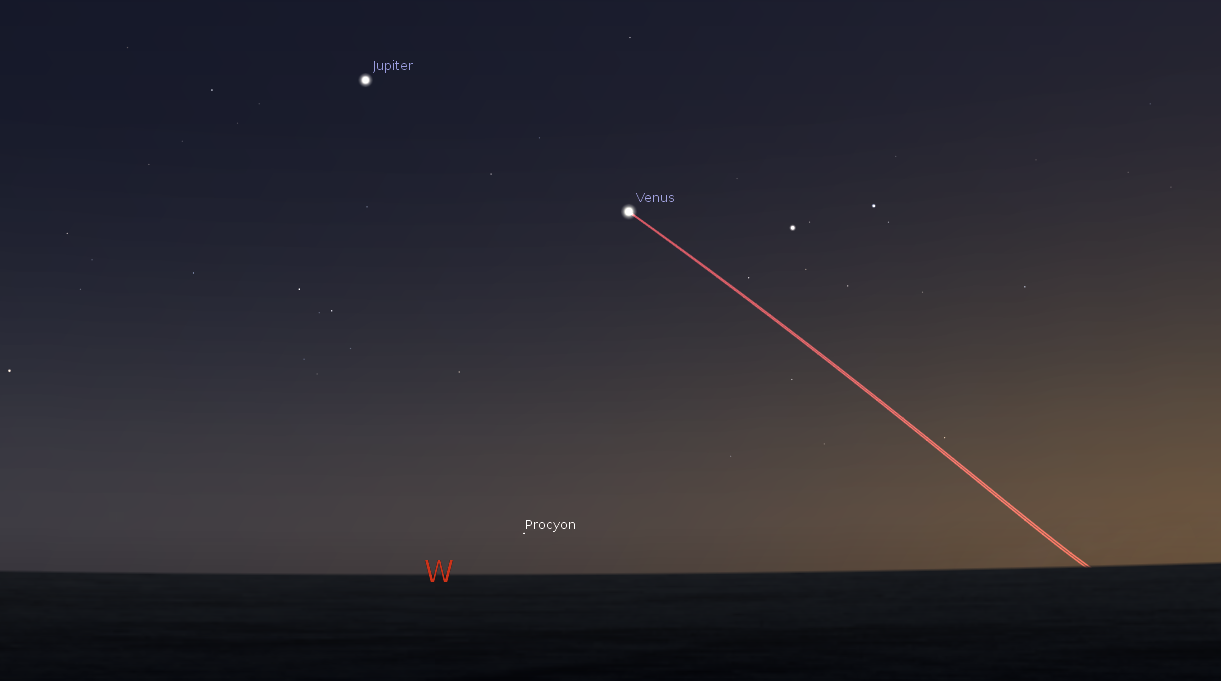
Venus at elongation with a plot of its orbit as seen from Earth at 10:30 p.m. June 6, 2015. Note that the orbit appears at a line. It is this time of year that the Earth passes through the plane of Venus’ orbit. Back in 2012 this occurred when Venus was at inferior conjunction on June 5th. It passed in front of the Sun in the rare transit of Venus. Created using Stellarium.
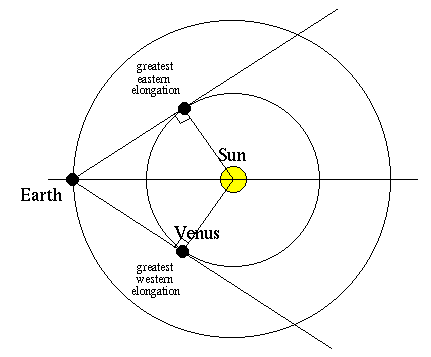
Diagram showing the geometry of a greatest elongation. Note that the sight line is perpendicular to the Venus-Sun line. So the phase should be exactly at dichotomy (half illuminated). Additional lines added to an uncredited diagram.
 Bob Moler's Ephemeris Blog