Archive
10/16/2015 – Ephemeris – The topic this Saturday will be comets (Updated)
Ephemeris for Friday, October 16th. The Sun will rise at 7:59. It’ll be up for 10 hours and 57 minutes, setting at 6:56. The Moon, half way from new to first quarter, will set at 9:20 this evening.
Tomorrow I have a treat for youngsters of all ages. From 10 a.m. to noon ( Update: noon to 2 p.m.) I’ll be talking about and helping to make comets at the Betsie Valley District Library in Thompsonville. First we’ll explore comets as seen in our skies then travel along with the Rosetta space mission to get up close to Comet 67P/Churyumov–Gerasimenko to see what it’s made of and what happens when it comes close to the Sun. Then we’ll make our own comet nucleus using many of the ingredients that are found in actual comets, though we’ll leave out all the poisonous ones, and we’ll see if it survives this close to the Sun. If you want to help make a comet, bring your winter gloves. I do have extras, but yours will probably work better.
Times for astronomical events are for the Traverse City/Interlochen area of Michigan. They may be different for your location.
10/15/2015 – Ephemeris – More planet and Moon action
Ephemeris for Thursday, October 15th. The Sun will rise at 7:57. It’ll be up for 11 hours and one minute, setting at 6:58. The Moon, 3 days past new, will set at 8:41 this evening.
Tonight the planet Saturn will be seen about 15 moon-diameters left of the thin crescent Moon. We are getting close to the end of Saturn’s evening visibility. It will be pretty much lost in the evening twilight by the end of the month. In the morning sky, Mercury will be at greatest elongation by tomorrow morning. It will be at an angle of only 18 degrees from the Sun, however that angle won’t diminish much over the next week, and Mercury will actually get a bit brighter because its phase becomes fuller. Remember it is illuminated by the sun and it is beginning to move around the back of the Sun. Both Mercury and Venus show phases in a telescope like the Moon as they move around the sun.
Times are for the Traverse City/Interlochen area of Michigan. They may be different for your location.
Addendum
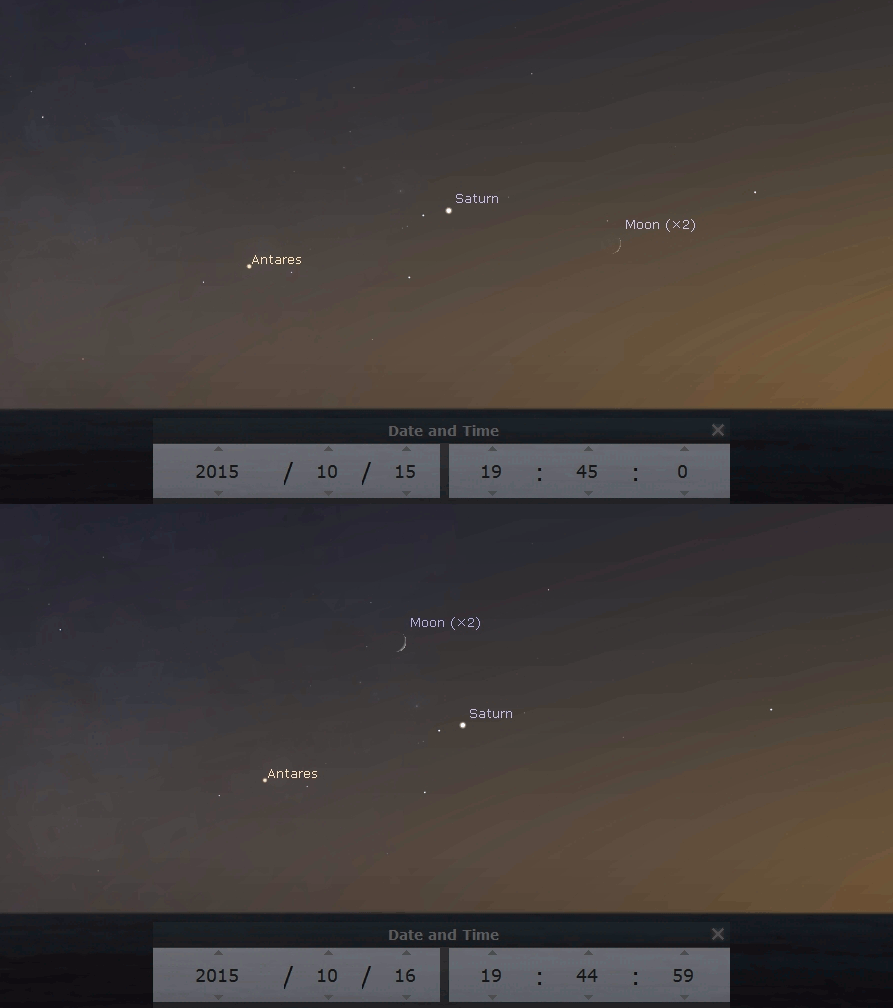
Animation rocking back and forth between 7:45 p.m. on October 15th and 16th (2015_. Created using Stellarium.
10/14/2015 – Ephemeris – The planet get together in the morning
Ephemeris for Wednesday, October 14th. The Sun will rise at 7:56. It’ll be up for 11 hours and 3 minutes, setting at 7:00. The Moon, 2 days past new, will set at 8:06 this evening.
Lets see what’s happening with the bright planets. Saturn is alone in the evening sky spotted by 8 p.m. low in the west-southwestern sky near the bright star Antares to its left. Antares has a reddish hue, while Saturn is brighter and yellowish. Both these colors are enhanced by being low to the horizon. Saturn will set at 8:56 p.m. The rest of the planets are in the morning sky and seeing more action. Brilliant Venus, the morning star, will rise at 4 a.m. a bit north of east. Below and left of Venus is bright Jupiter, though not as bright as Venus. Above it tomorrow is dim Mars. They will pass each other on Saturday. Jupiter will rise at 4:37 preceded by 7 minutes by Mars. Mercury is way below these, but brightening. It will rise at 6:20.
Times are for the Traverse City/Interlochen area of Michigan. They may be different for your location.
Addendum
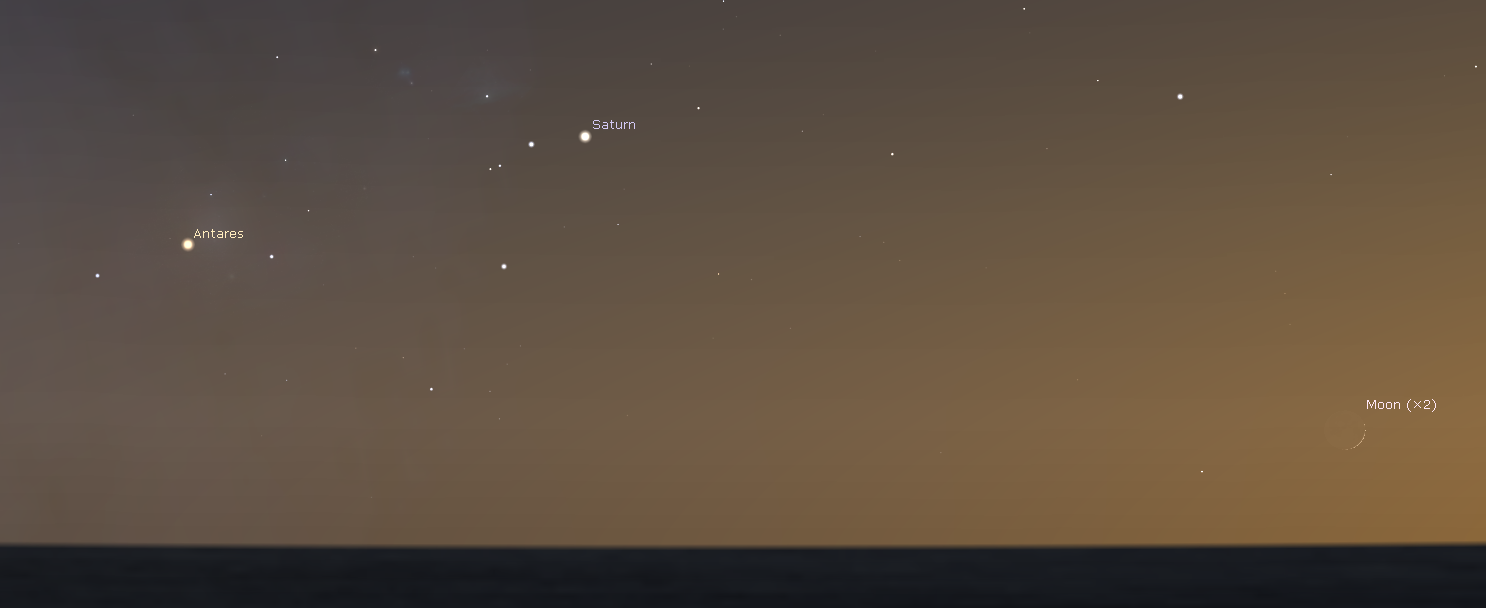
Saturn and Antares appear in west-southwestern twilight with the thin crescent Moon, shown twice its actual size to show up at all, at 7:45 p.m., October 14, 2015. Created using Stellarium.
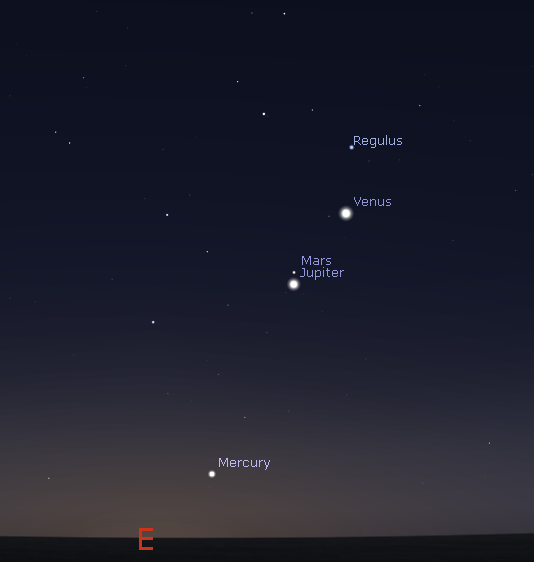
The morning planets getting together at 7 a.m. Mercury will be falling back toward the Sun after tomorrow. Created using Stellarium.
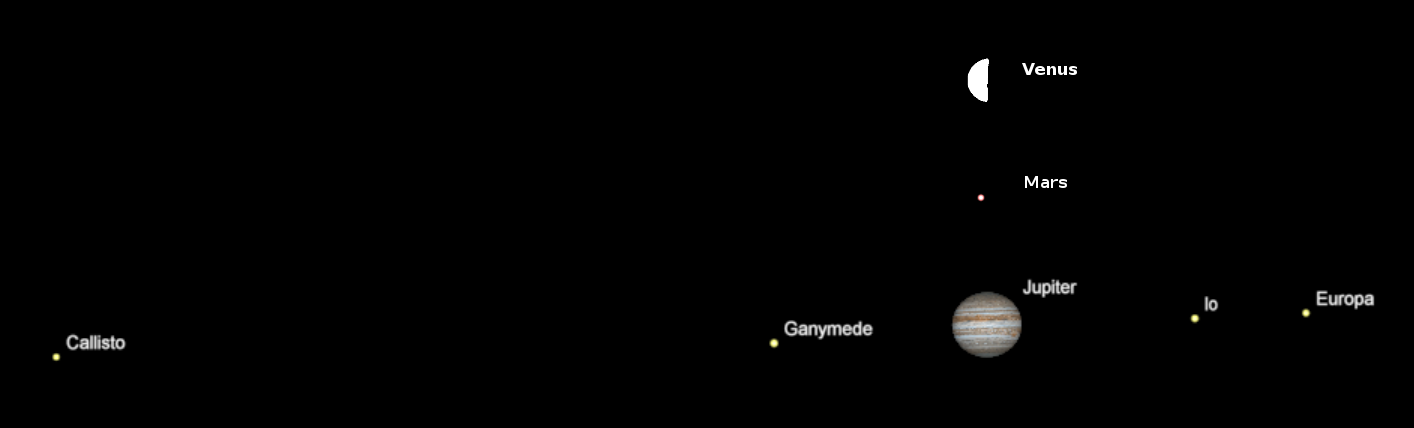
Apparent sizes of the morning planets Venus, Mars and Jupiter as seen through a telescope. Created using Cartes du Ciel (Sky Charts).
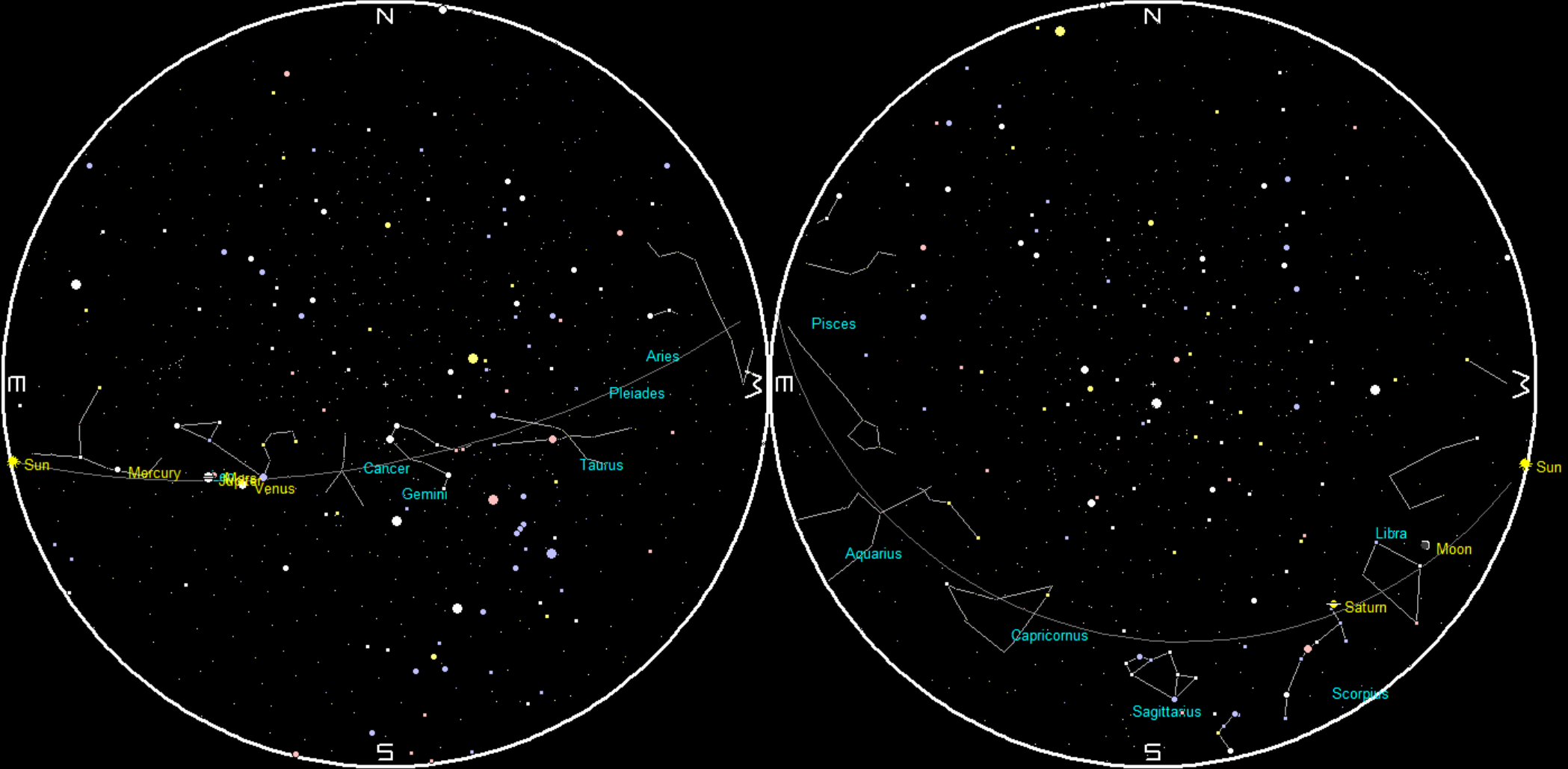
This is a chart showing the sunrise and sunset skies for October 14, 2015 showing the location of the planets and the Moon at that time. Created using my LookingUp program. Click on the image to enlarge.
10/13/2015 – Ephemeris – Columbus was wrong!
Ephemeris for Tuesday, October 13th. The Sun will rise at 7:55. It’ll be up for 11 hours and 6 minutes, setting at 7:02. The Moon, 1 day past new, will set at 7:35 this evening.
Yesterday I recounted that Christopher Columbus was able to extort supplies from the native Jamaicans by using an eclipse table to predict a lunar eclipse. But let’s face it Columbus was lost. He wasn’t in India as he thought. He based his voyage on the erroneous belief that the Earth was less than 19,000 miles in circumference, when it’s actually 25,000 miles, which was the prevailing view of the day. That the Earth was round was known from the 3rd century BC, and measured quite accurately by Eratosthenes. Of course with the varieties of distance units of the day it was no wonder an error of that magnitude could be made. Of course did anyone think to remeasure the circumference of the Earth? Apparently not. Nowadays no scientist thinks of taking only one measurement. Columbus was lucky a continent was here, or no one would have heard from him again.
Times are for the Traverse City/Interlochen area of Michigan. They may be different for your location.
Addendum
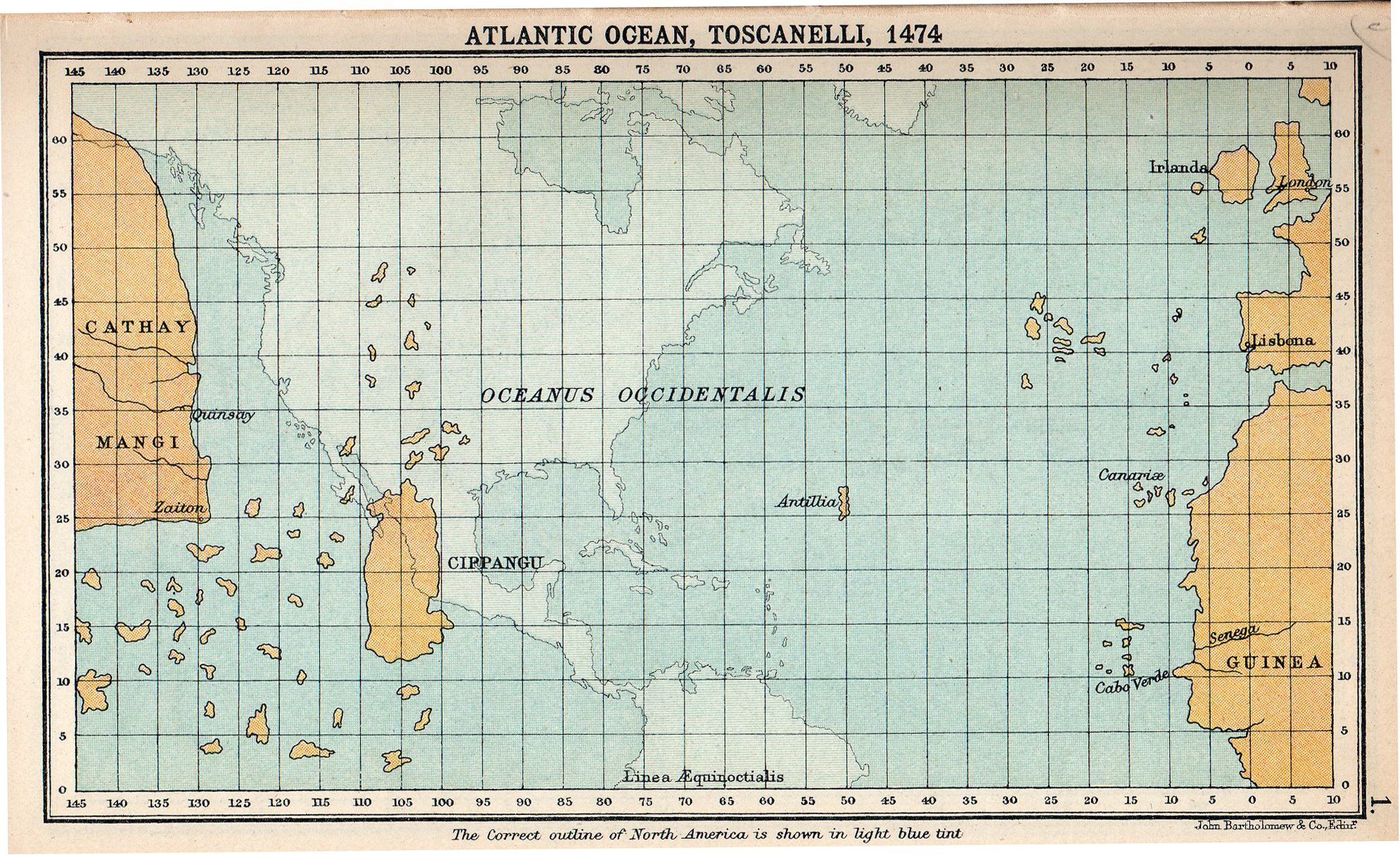
A map of the western ocean (Atlantic Ocean) by Paolo dal Pozzo Toscanelli about 1474 which may have influenced Columbus. North America is superimposed at the proper longitudes. Credit: A literary and historical atlas of America, by Bartholomew, J. G. via Wikipedia. Click to enlarge.
Note that Cathay is China and Cippangu represents Japan. It was thought back then that the Eurasian continent spanned 180 degrees of longitude at the latitude of Spain, rather than 130 degrees it actually does Japan was thought to be bigger and farther off the Chinese coast. The phantom island of Antillia seems to date back to stories from Spain of the 8th century.
Ephemeris for the real Columbus Day for once, Monday, October 12th. The Sun will rise at 7:54. It’ll be up for 11 hours and 9 minutes, setting at 7:03. The Moon is new today, and won’t be visible.
On Columbus’ 4th voyage to the Caribbean he was stranded on Jamaica. For a while the natives of the island fed Columbus and his men. However due to the thievery of some of his crew, these people no longer trusted Columbus any refused them any more supplies. Columbus consulted a table of eclipses and found that a lunar eclipse was to occur on February 29th that year (1504), and that at his location the moon would rise in eclipse. He went to the leader of the people and said that they had displeased their god by refusing his crew food, and that the god would turn the Moon red in anger. It worked. As Arthur C. Clarke once wrote: “Any sufficiently advanced technology is indistinguishable from magic.”
Times are for the Traverse City/Interlochen area of Michigan. They may be different for your location.
Addendum
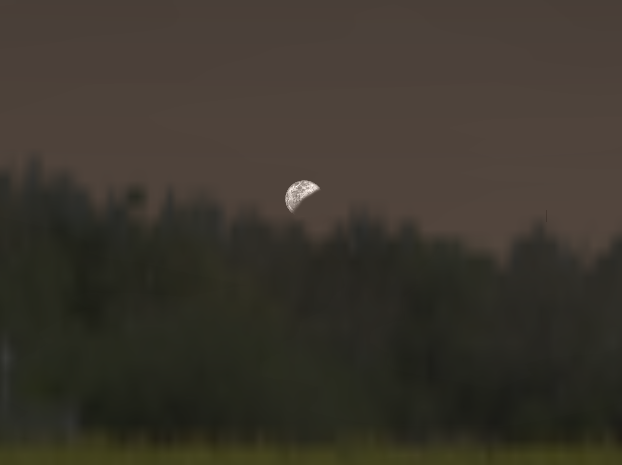
The moon rising from Jamaica February 29, 1504 as shown by Stellarium with some additional shadow darkening by myself.
Tomorrow I’ll look at what Columbus got wrong… Beside being lost.
I note for the record that Stellarium calendar dating includes what I call the Gregorian discontinuity. It drops the 10 days between October 4, 1582 and October 15th, which was the adjustment the Gregorian calendar makes to move ahead the actual vernal equinox from March 11 to the 21st. Christian churches always use the tabular value of March 21 as the vernal equinox for the calculation of the date of Easter. The old Julian calendar let that slip back about 3/4 of a day every century.
10/09/2015 – Ephemeris – The Moon is seen with the morning planets this weekend
Ephemeris for Friday, October 9th. The Sun will rise at 7:50. It’ll be up for 11 hours and 18 minutes, setting at 7:09. The Moon, 3 days before new, will rise at 5:31 tomorrow morning.
This morning up to about 7:15 look to the east at the crescent Moon and the planets. The Moon is between Venus above and Jupiter just below and to the left. Mars will be a bit above and just left of the Moon. Mercury will be farther below the moon to the left and about 22 degrees below the Moon (that’s about twice the width of a fist held at arm’s length.) By Sunday morning the thin sliver of the Moor will be near Mercury with the tiny planet just above left of the Moon. Next Thursday the 15th, Mercury will climb to its greatest angular distance or elongation west of the Sun. It will be getting a bit brighter for a while because even though it’s moving away from us, its phase will be getting fuller. Remember it’s illuminated by the sun.
Times are for the Traverse City/Interlochen area of Michigan. They may be different for your location.
Addendum
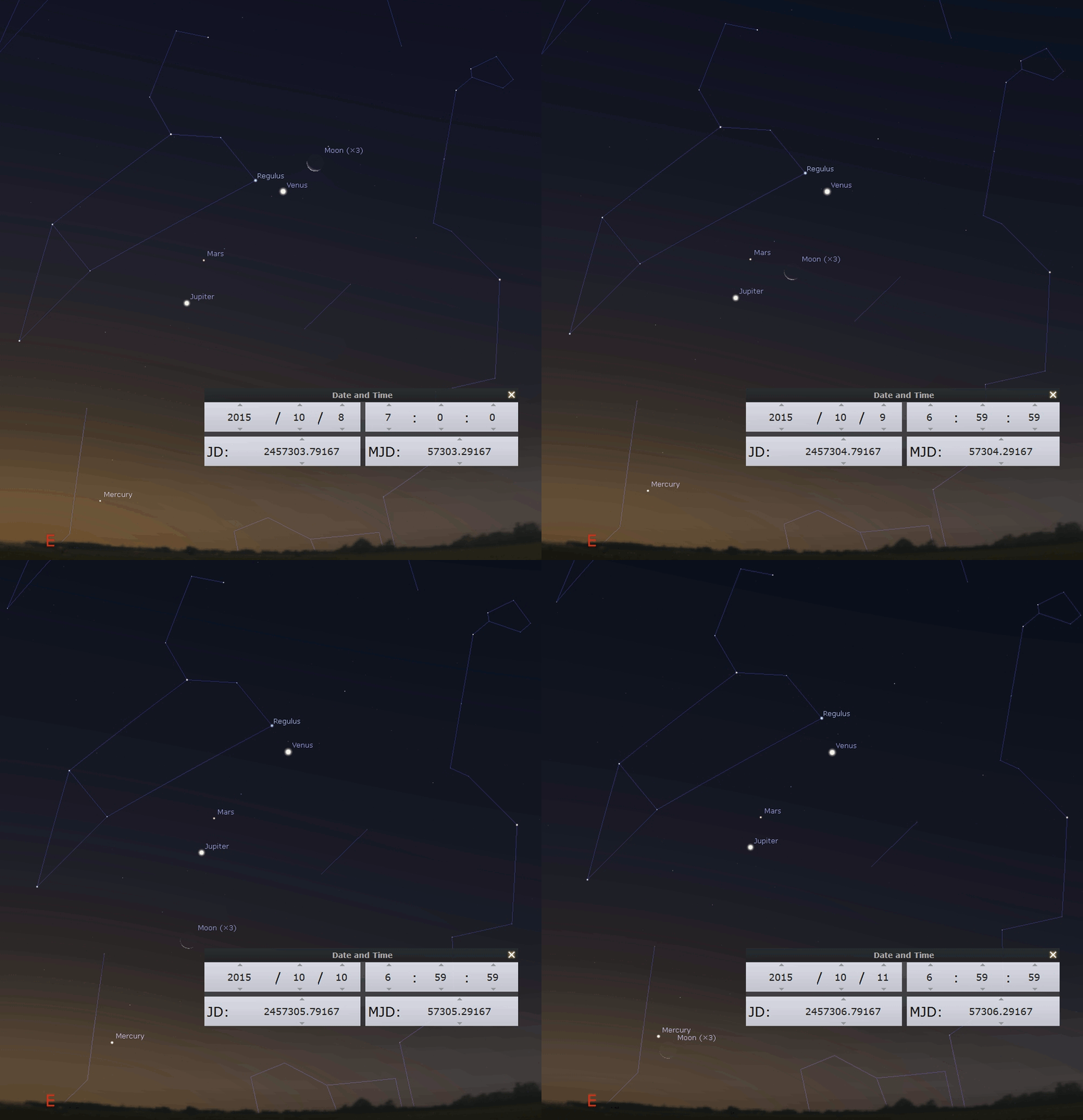
Morning planet animation for 7 a.m. October 8 to 11, 2015. Created using Stellarium and GIMP.
10/08/2015 – Ephemeris – The Draconid meteors will reach peak overnight tonight
Ephemeris for Thursday, October 8th. The Sun will rise at 7:49. It’ll be up for 11 hours and 21 minutes, setting at 7:10. The Moon, half way from last quarter to new, will rise at 4:33 tomorrow morning.
For this and the next few morning the Moon will pass the morning planets. This morning it’s Venus, tomorrow it will be near Mars and Jupiter, and Sunday morning it will be near Mercury.
This evening is the expected peak of the Draconid meteor shower. We can expect anything between zero and hundreds of meteors an hour. The calculated time of the peak number will be around 1:40 a.m. (5:40 UT, October 9). The point in space they will appear to come from is the head of the constellation Draco the dragon, a bit north of the bright star Vega, high in the west in the evening. Meteor experts don’t expect much from the shower this year, but the Draconids are capricious, you never know what to expect. However we do expect them to be slow-moving.
Times are for the Traverse City/Interlochen area of Michigan. They may be different for your location.
Addendum
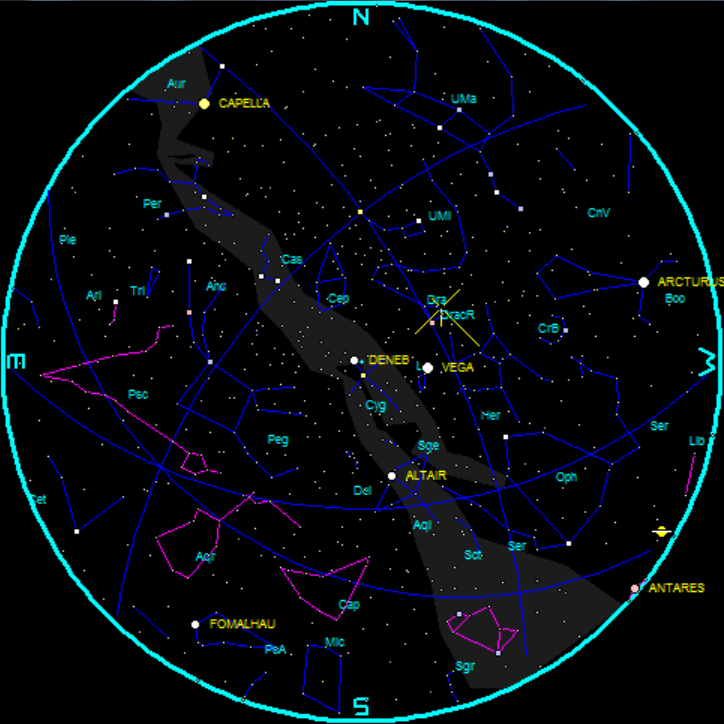
The entire sky dome including the Draconid Radiant (DraR) for 9 p.m. October 8, 2015 (1:00 UT 10/9). Created with my LookingUp program.
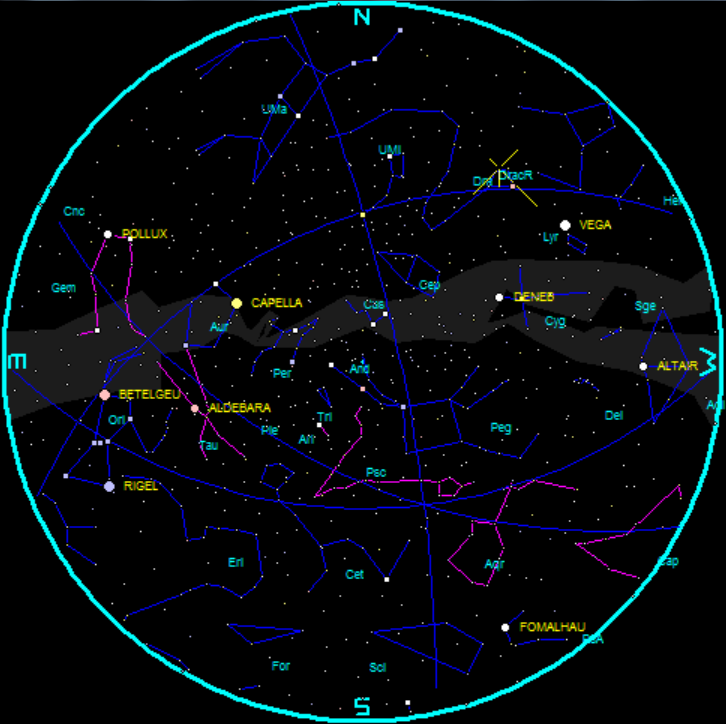
The entire sky dome including the Draconid Radiant (DraR) for 1:40 a.m. October 9, 2015 (05:40 UT). Created with my LookingUp program.
Morning planet animation for 7 a.m. October 8 to 11, 2015. Click on image to enlarge. Note the Moon’s size is tripled for visibility. Created using Stellarium 0.13 and GIMP.
10/07/2015 – Ephemeris – Saturn lingers in the evening, but the planet action is in the morning
Ephemeris for Wednesday, October 7th. The Sun will rise at 7:47. It’ll be up for 11 hours and 24 minutes, setting at 7:12. The Moon, 3 days past last quarter, will rise at 3:34 tomorrow morning.
Lets see what’s happening with the bright planets. Saturn is alone in the evening sky spotted by 8:30 p.m. low in the southwestern sky near the bright star Antares to its left. Antares has a reddish hue, while Saturn is brighter and yellowish. Both these colors are enhanced by being low to the horizon. Saturn will set at 9:22 p.m. The rest of the planet action in the morning sky is getting interesting. Brilliant Venus, the morning star, will rise at 3:58 a.m. a bit north of east. Tomorrow it will be at its greatest separation from the sun and start to fall back. The Moon will be near Venus tomorrow morning. The star Regulus is near Venus. Much dimmer Mars, brighter Jupiter and finally Mercury will rise at 4:35, 4:57 and 6:37 respectively.
Times are for the Traverse City/Interlochen area of Michigan. They may be different for your location.
Addendum
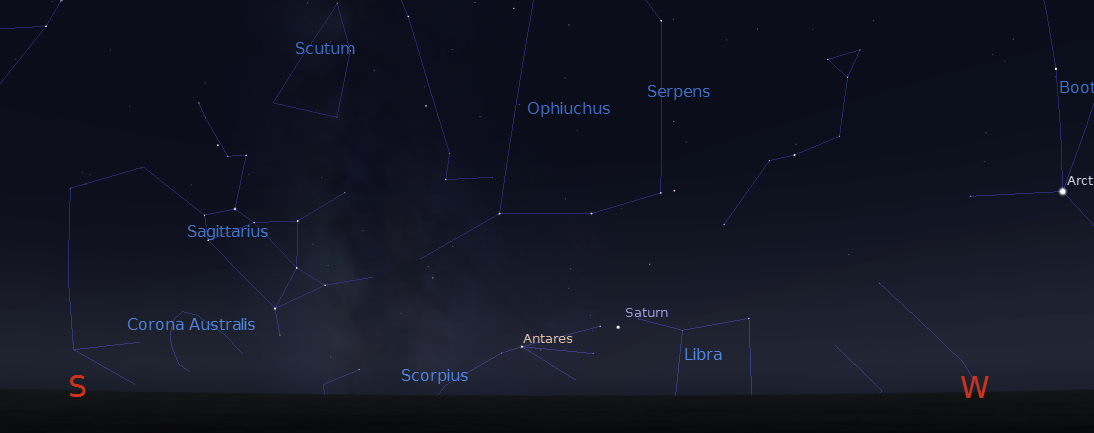
Saturn and setting zodiacal constellations at 8:30 .m. on October 7, 2015. Create using Stellarium.
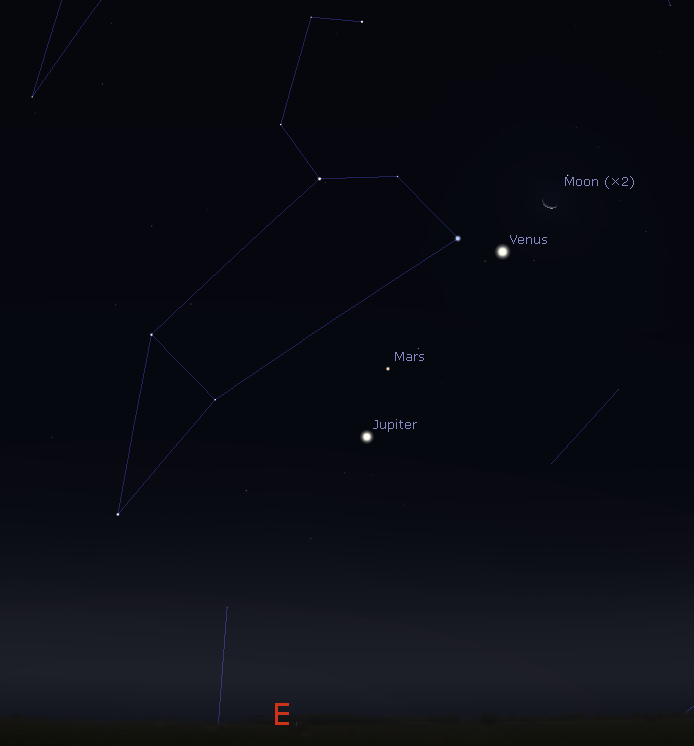
Morning Planets and the Moon at 6:30 a.m. on October 8, 2015. The Moon is shown twice actual size. Created using Stellarium.
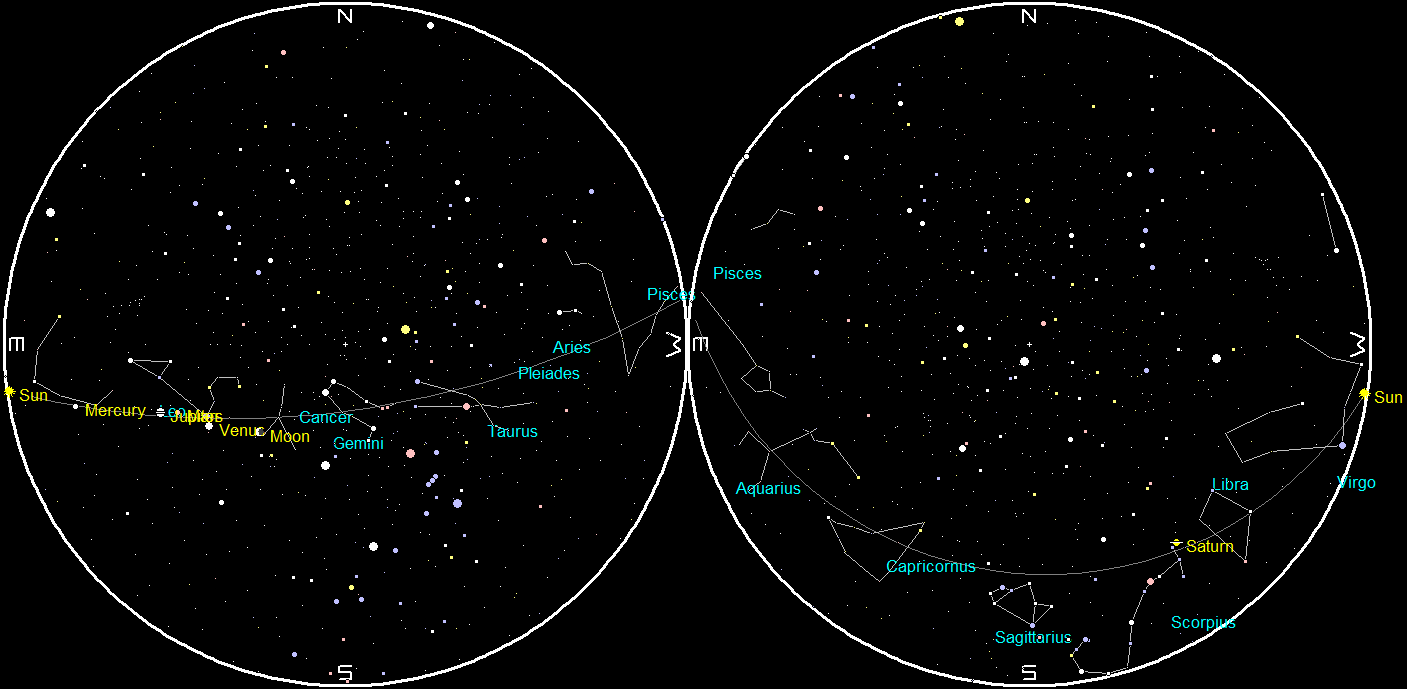
This is a chart showing the sunrise and sunset skies for October 7, 2015 showing the location of the planets and the Moon at that time. Created using my LookingUp program. Click on the image to enlarge.
10/06/2015 – Ephemeris – Deneb our home-town star
Ephemeris for Tuesday, October 6th. The Sun will rise at 7:46. It’ll be up for 11 hours and 27 minutes, setting at 7:14. The Moon, 2 days past last quarter, will rise at 2:36 tomorrow morning.
We, here in Traverse City, Michigan have a pretty unique relation to the bright star Deneb, as is any location near 45 degrees north latitude. Tonight at 9:23 Deneb will be three-quarters of a degree due north of the zenith. Due north means that it’s on our meridian, a line you may remember from your school days. For astronomers it passes from the north point on the horizon, through the overhead point or zenith to the south point on the horizon. Also due to our latitude Deneb is circumpolar, meaning that it doesn’t quite set on a clean northern horizon. Deneb and 56 other stars are used for celestial navigation, which is still taught in case the GPS system goes down due to solar or enemy action.
Times are for the Traverse City/Interlochen area of Michigan. They may be different for your location.
Addendum
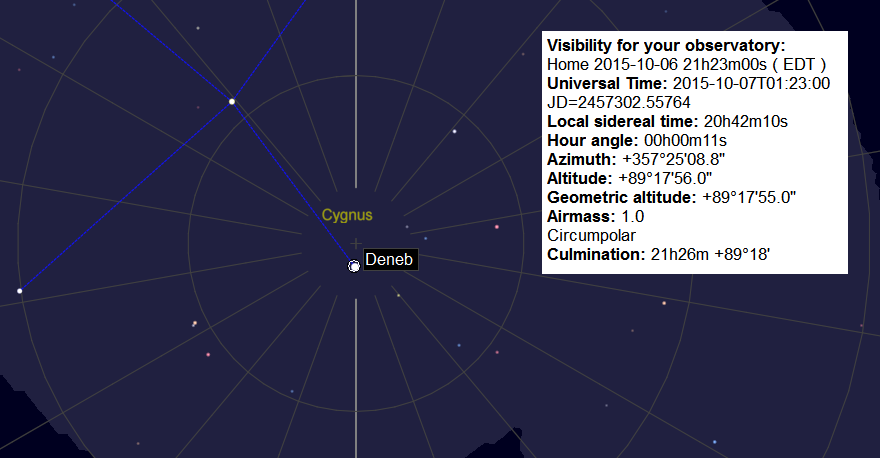
Deneb nearly at the zenith from Traverse City. Created using Cartes du Ciel.
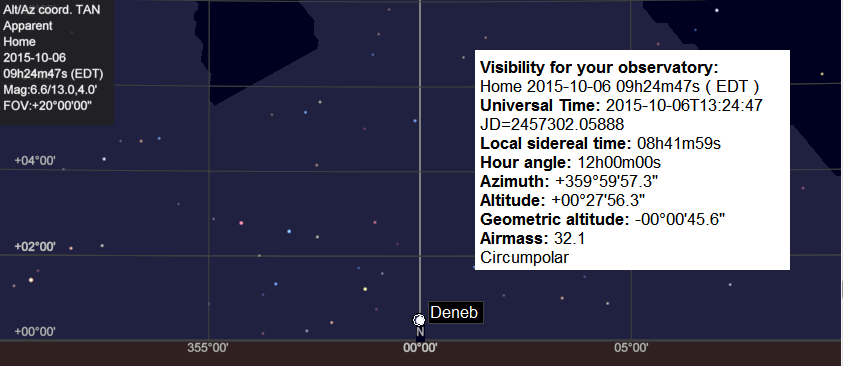
Deneb is close to the horizon due north. Created using Cartes du Ciel.
10/05/2015 – Ephemeris – The loneliest star
Ephemeris for Monday, October 5th. The Sun will rise at 7:45. It’ll be up for 11 hours and 31 minutes, setting at 7:16. The Moon, 1 day past last quarter, will rise at 1:38 tomorrow morning.
There’s a bright and lonely star that appears low in the south for only seven and a half hours a night on autumn evenings. It’s appearance is a sign as sure as the falling leaves that autumn is here At 10 p.m. tonight it’s low in the south-southeast. The star’s name is Fomalhaut, which means fish’s mouth. This is appropriate because it’s in the constellation of Piscis Austrinus, the southern fish. At our latitude it’s the fish that got away, because Fomalhaut appears to be quite alone. The dimness of the constellation’s other stars and location close to the horizon make the fainter stars hard to spot. The earth’s thick atmosphere near the horizon reduces the stars brightness by a factor of two or more, so Fomalhaut appears to keep a lonely vigil in the south.
Times are for the Traverse City/Interlochen area of Michigan. They may be different for your location.
Addendum
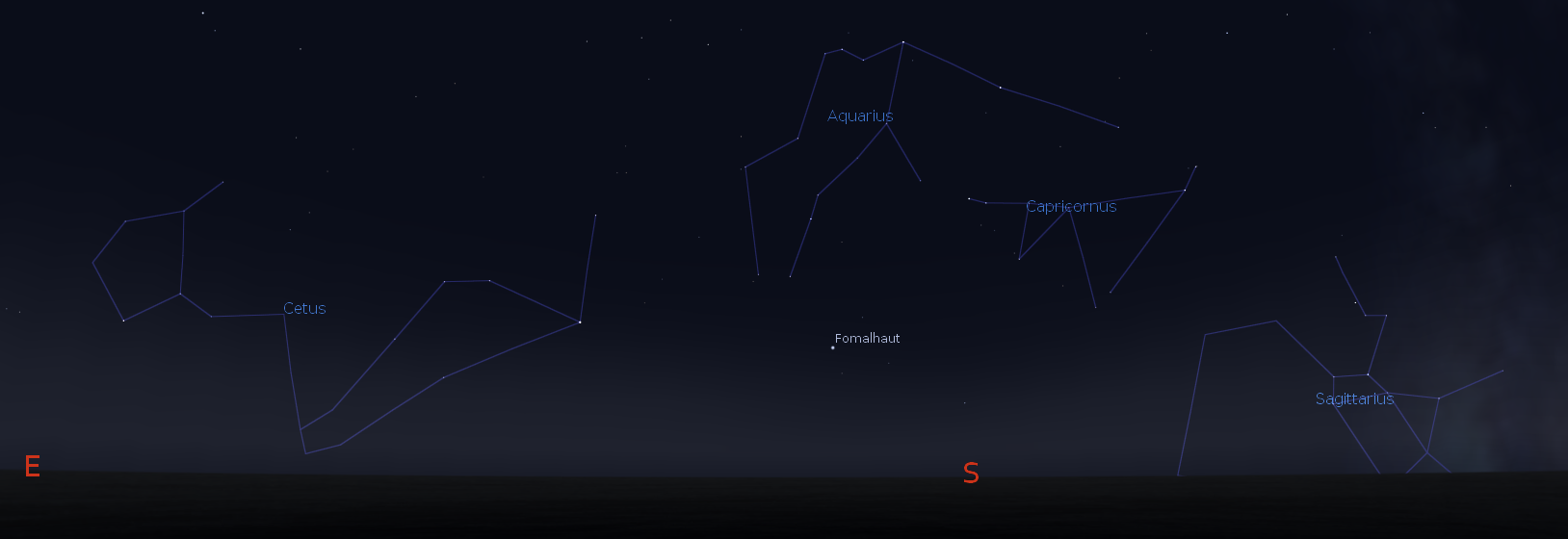
Fomalhaut appears quite alone in the south-southeast at about 10 p.m. Created using Stellarium.
Actually Fomalhaut isn’t all that alone, It apparently has a companion planet.
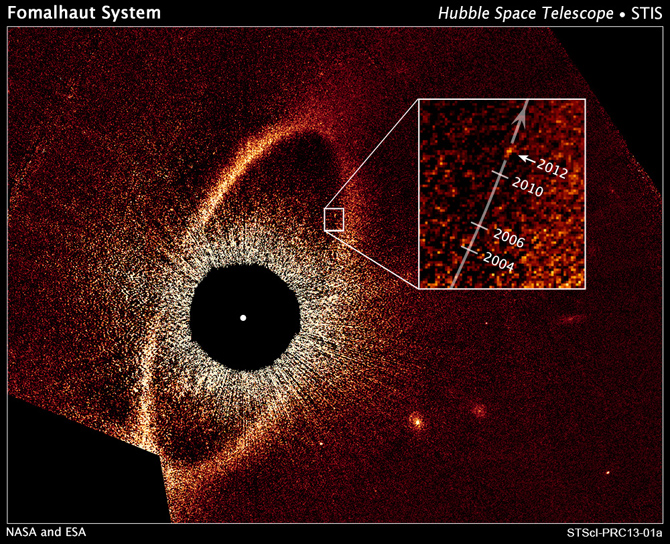
Fomalhaut b and it’s path around its star. Credit: NASA, ESA, and P. Kalas (University of California, Berkeley and SETI Institute)
 Bob Moler's Ephemeris Blog