Archive
02/16/2015 – Ephemeris – The little Dog Star
Ephemeris for Tuesday, February 16th. The Sun will rise at 7:42. It’ll be up for 10 hours and 29 minutes, setting at 6:12. The Moon, 1 day past first quarter, will set at 3:45 tomorrow morning.
Procyon is the bright star to the east or left of Betelgeuse in the sky tonight, which puts it in the east-southeast at 9 tonight. Procyon is the brightest of the two stars in Canis Minor, Orion’s little hunting dog. Procyon is sometimes called the Little Dog Star for that reason. The Dog Star Sirius is a ways below and right of it. The name Procyon means “Before the Dog”, because Procyon, though east of Sirius, rises before it due to its more northerly position. This only works if one is north of 30 degrees north latitude. South of that, Sirius rises first. Procyon is a white star 11 and a half light years away, 3 light years farther than Sirius, and like Sirius it has a faint white dwarf companion. It’s a bit less than half the Sun’s age.
Times are for the Traverse City/Interlochen area of Michigan. They may be different for your location.
Addendum
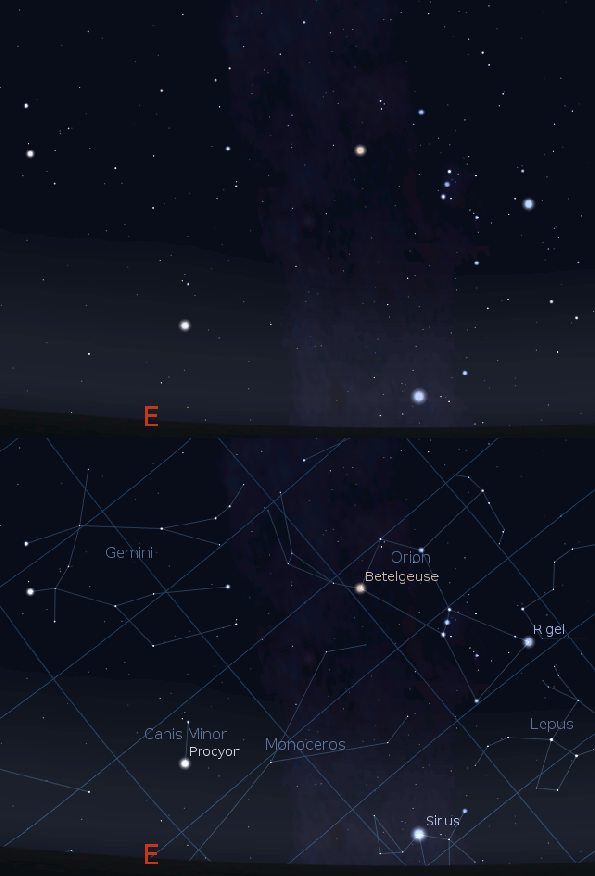
Procyon, Sirius and the stars of winter. Created using Stellarium
Note that at their rising Procyon is higher in the sky than Sirius.
There are some grid lines on the chart. The ones running from lower left to upper right are lines of declination, which are like latitude lines on the Earth. On this chart they are 10º apart. The line that intersects the horizon at the east compass point is the celestial equator. It will meet the western compass point at the horizon. As the Earth rotates the stars and planets will move westward in the direction of these declination lines. The lines that run from upper left to lower right are hour lines of right ascension. Here they are 15 degrees or one hour apart, The Earth rotates 360º in a sidereal* day. 360 divided by 24 hours gives 15º an hour. So the celestial sphere of stars and planets will slide 15º westward in a sidereal hour.
* A sidereal day, rotation with respect to the stars, is about 4 minutes shorter that the solar day, the day and time we keep based on the Sun. The Sun moves about one degree eastward each day, so the rotation has to catch up that one degree each day. The rotation of one degree takes 4 minutes. I’ll let you work that one out for yourself.
02/15/2016 – Ephemeris – President Lincoln’s visit to the Naval Observatory
Ephemeris for President’s Day, Monday, February 15th. The Sun will rise at 7:43. It’ll be up for 10 hours and 26 minutes, setting at 6:10. The Moon, at first quarter today, will set at 2:44 tomorrow morning.
In August of 1863, during the height of the Civil War, President Abraham Lincoln and his secretary John Hay rode out to the Naval Observatory where it was back then in Foggy Bottom. The astronomer there Asaph Hall showed them the moon and the star Arcturus through the observatory’s telescope. A couple of nights later Lincoln came out alone to ask the astronomer some questions about what he saw, in including why the Moon was upside down in the observatory telescope while the telescope he used gave a right side up image. Fourteen years later Asaph Hall, still at the Naval Observatory, discovered the two satellites of Mars through the observatory’s then larger telescope.
Times are for the Traverse City/Interlochen area of Michigan. They may be different for your location.
Addendum

The old Naval Observatory. From the Astronomy.com web site.
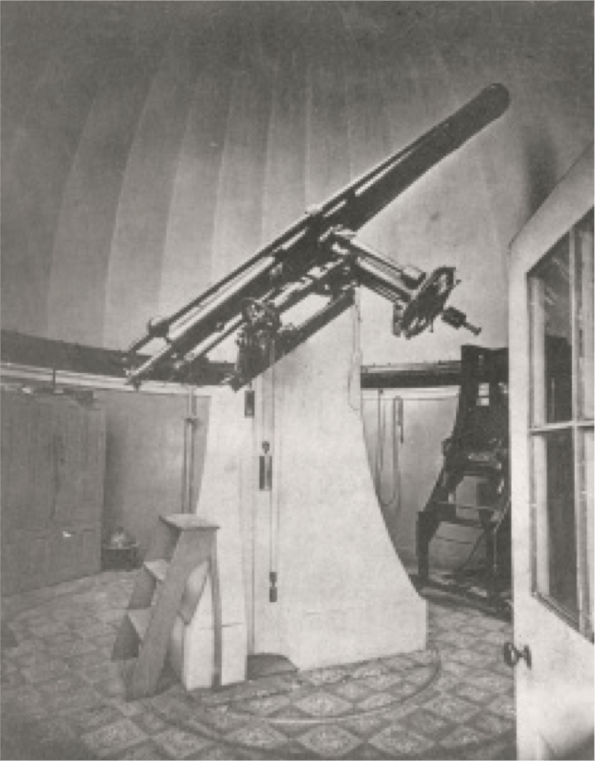
The 9.6 inch telescope through which Lincoln viewed the Moon and Arcturus on the night of August 22, 1863. From the Astronomy.com website.
The above images are from the excellent post Lincoln and the cosmos by Kirk R. Benson, USN Ret. on the Astronomy Magazine website.
02/12/2016 – Ephemeris – A circle of bright stars in winter
Ephemeris for Friday, February 12th. The Sun will rise at 7:48. It’ll be up for 10 hours and 18 minutes, setting at 6:06. The Moon, 3 days before first quarter, will set at 11:19 this evening.
The winter skies are blessed with more first magnitude stars than any other season. With the moon out these stars will stand out even more, as dimmer stars are suppressed. Six of these stars lie in a large circle centered on the seventh, the Winter Circle.
This circle is up at 9 p.m. Starting high nearly overhead is Capella in Auriga the charioteer. Moving clockwise down to the south, we come to Aldebaran in the face of Taurus the Bull. Then down to Orion’s knee we find Rigel. Down and left is the brightest star of all Sirius in Canis Major Orion’s large hunting dog, lowest of these stars in the southeast. Moving up and left there is Procyon in Canis Minor, Above is Pollux in Gemini the twins. All are centered on Betelgeuse the bright red star in Orion’s shoulder.
Times are for the Traverse City/Interlochen area of Michigan. They may be different for your location.
Addendum
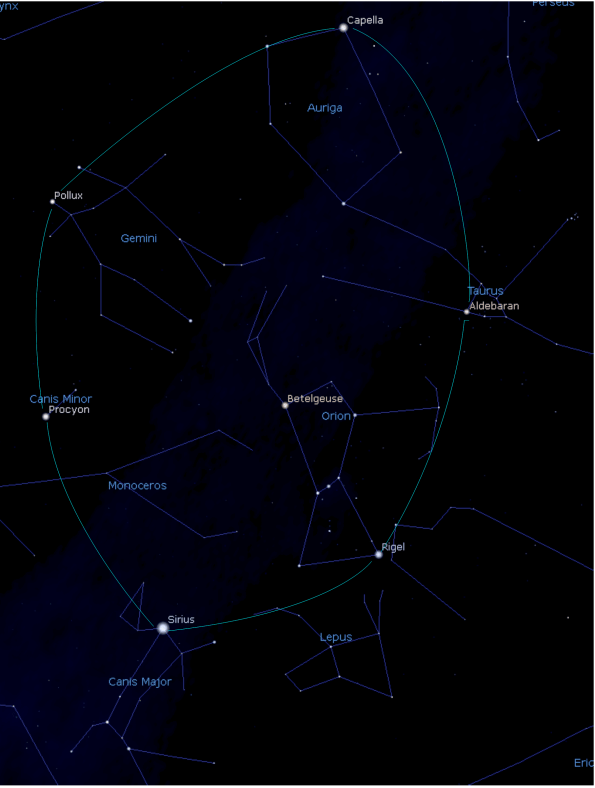
The bright stars of winter arrayed in a circle. Created using Stellarium.
Some also see a Winter Triangle consisting of the stars Betelgeuse, Sirius and Procyon.
02/11/2016 – Ephemeris – What do star colors reveal?
Ephemeris for Thursday, February 11th. The Sun will rise at 7:49. It’ll be up for 10 hours and 15 minutes, setting at 6:05. The Moon, 3 days past new, will set at 10:06 this evening.
The bright stars of winter have subtle differences in color. But what do those colors mean? In stars color is indicative of surface temperature. From coolest to hottest are red, orange, yellow, and white to blue, the hottest. Interior decorators may disagree, but that’s how it is. Coolest of the bright stars is red Betelgeuse in Orion’s shoulder, then orange Aldebaran in the face of Taurus the bull, and Pollux in Gemini. Hotter yet is yellow Capella in Auriga the Charioteer, about the temperature of the Sun. Then we come to the white-hot Procyon and Sirius in the little and big dogs of Orion. Hottest is blue-white Rigel in Orion’s knee. There are hotter stars in Orion, the center and rightmost stars of Orion’s belt are bluer and hotter yet.
Times are for the Traverse City/Interlochen area of Michigan. They may be different for your location.
Addendum
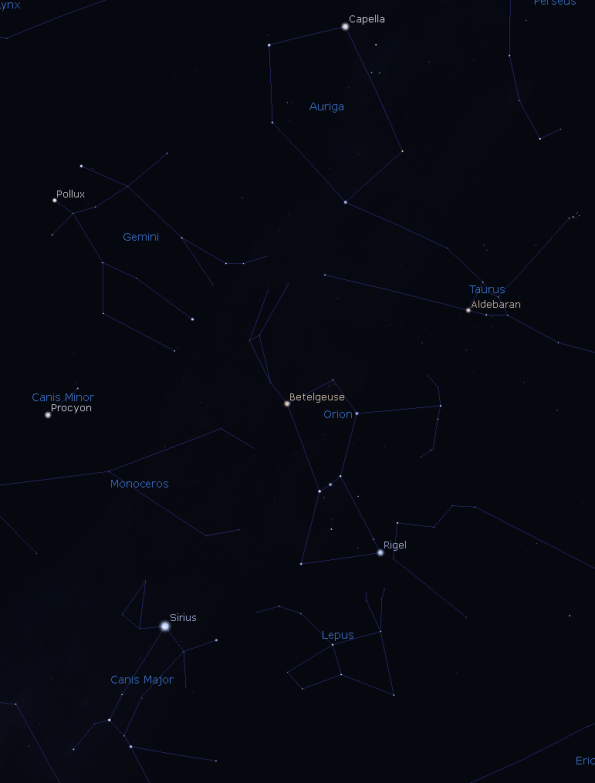
Bright stars of winter with hints as to their colors. The star label is the color of the star. Created using Stellarium.
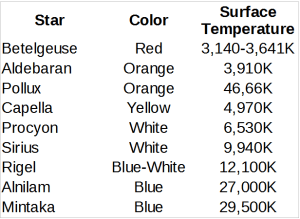
A table of star color and surface temperatures. Created from data in Wikipedia.
The star Alnilam is the center star of Orion’s belt, while Mintaka is the rightmost star of the belt. The temperature scale K is the Kelvin scale which is the Celsius scale plus 273.15. Zero on the Kelvin scale is absolute zero. 1 degree Celsius equals 1 Kelvin. One never says degrees Kelvin.
Betelgeuse is a variable star, so its surface temperature varies.
02/10/2016 – Ephemeris – The morning planet gang will be around for 9 more days
Ephemeris for Ash Wednesday, Wednesday, February 10th. The Sun will rise at 7:51. It’ll be up for 10 hours and 12 minutes, setting at 6:03. The Moon, 2 days past new, will set at 8:53 this evening.
Let’s check out the whereabouts of the bright naked eye planets. All the classical planets visible from antiquity are officially now in the morning sky. However Jupiter actually will rise at 8:29 p.m., in the east. Jupiter is still a morning planet since it’s not up at sunset. Mars will rise next at 1:35 a.m. in the east-southeast. It’s brighter than the bright star Spica growing even farther to the right of it.. Saturn will rise at 3:40 a.m. in the east-southeast. Venus will rise at 6:25 a.m. again in the east-southeast. Mercury will rise behind Venus at 6:39. Comet Catalina is up all night and is a binocular object in the dark expanse of the constellation Camelopardalis between the bowl of the Big Dipper and the constellation of Perseus.
Times are for the Traverse City/Interlochen area of Michigan. They may be different for your location.
Addendum
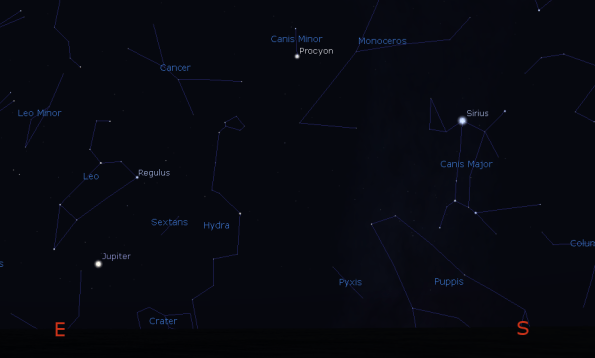
Jupiter low in the east-southeast at 10 p.m. on February 10th, 2016. Created using Stellarium.
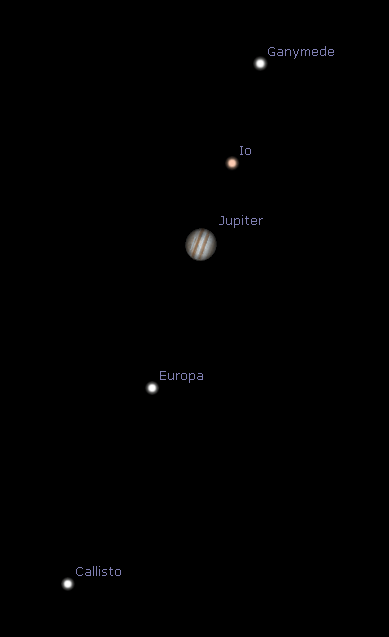
Jupiter and its moons as they would be seen in a telescope, at 10 p.m. February 10, 2016. Created using Stellarium.
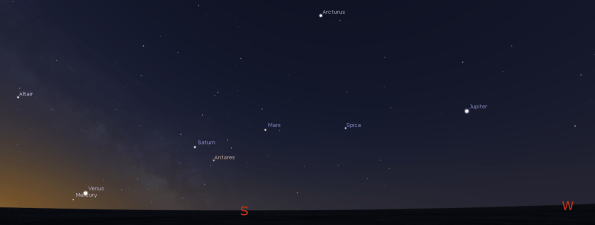
The planets in the morning sky at 7 a.m. on February 11, 2016. Jupiter is far to the west. Created using Stellarium.
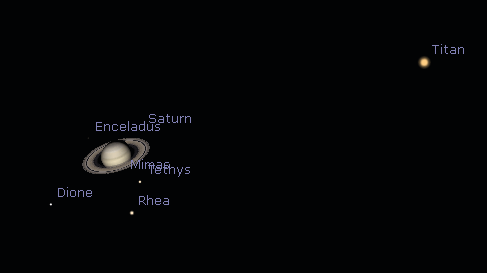
Saturn and its large satellite Titan and other moons as they should appear in a telescope at 7 a.m. February 11, 2016.
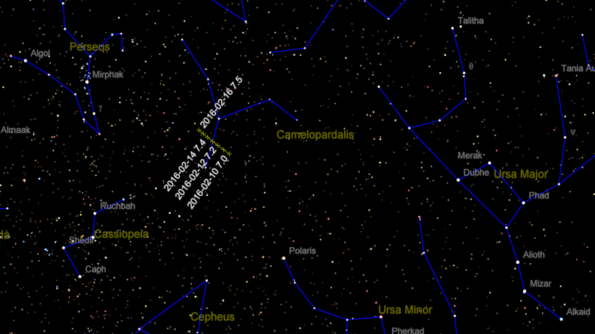
Comet Catalina’s path for the next week. Note that it is fading fast. It will take binoculars or a small telescope to spot the comet which will not show a tail visually. Created using Stellarium.
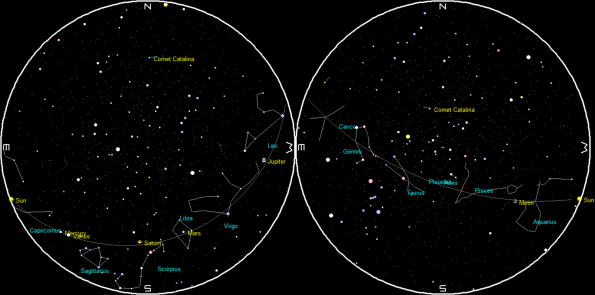
This is a chart showing the sunrise and sunset skies for February 10, 2016 showing the location of the planets, the Moon and Comet Catalina at that time. Created using my LookingUp program.
Some of these images above are shown smaller than actual size. Image expansion lately hasn’t worked. If you are using Firefox, right-click on the image, and then click on View Image.
02/09/2016 – Ephemeris – The Dog Star has a pup
Ephemeris for Fat Tuesday, Tuesday, February 9th. The Sun will rise at 7:52. It’ll be up for 10 hours and 9 minutes, setting at 6:02. The Moon, 1 day past new, will set at 7:39 this evening.
Sirius is the brightest night time star and is located in the southeast at 9 p.m. below and a bit left of Orion the Hunter. We’ve visited Sirius once before this winter. But there is another star in the Sirius system that is practically invisible due to Sirius’ dazzling glare. Its name is Sirius B, nicknamed the Pup, alluding to Sirius’ Dog Star title. The tiny star was suspected as far back as 1834 due to Sirius’ wavy path against the more distant stars. Sirius and the Pup have 50 year orbits of each other. The Pup was first seen by famed 19th century telescope maker Alvan Clark in 1862 while testing a new telescope. The Pup is a white dwarf star, as small as the Earth but with the mass of the sun, out of hydrogen fuel and slowly collapsing.
Times are for the Traverse City/Interlochen area of Michigan. They may be different for your location.
Addendum
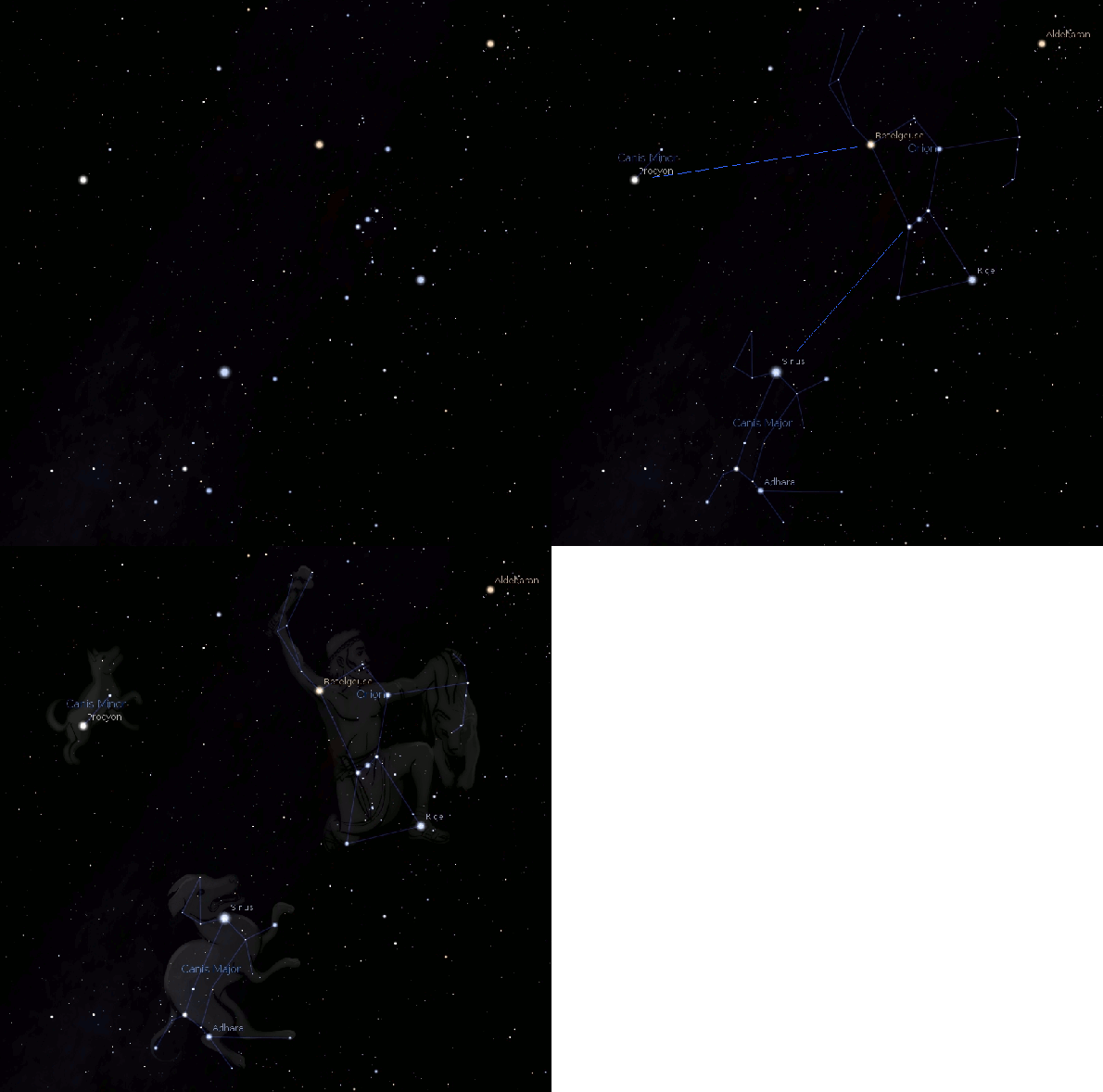
Orion and his hunting dogs revealed in animation. Created with Stellarium and GIMP.
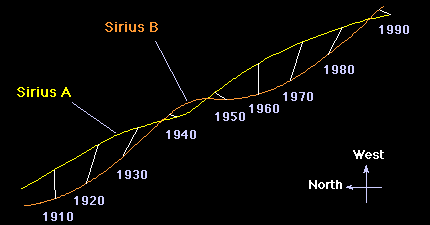
Sirius A & B’s path in the sky showing the wobble that betrayed the Pup’s presence. Credit Mike Guidry, University of Tennessee.
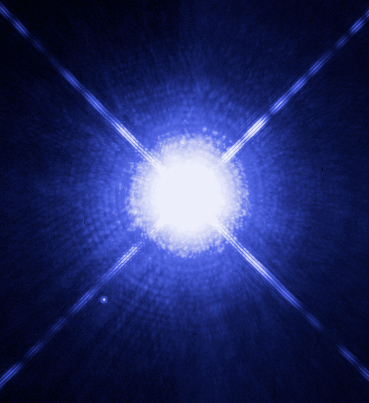
Sirius A and B (near the diffraction spike to the lower left), A Hubble Space Telescope photograph. Credit NASA, ESA.
02/08/2016 – Ephemeris – The celestial unicorn
Ephemeris for Monday, February 8th. The Sun will rise at 7:53. It’ll be up for 10 hours and 6 minutes, setting at 6:00. The Moon is new today, and won’t be visible.
Among all the constellations in the sky of animals real and mythical, there is also a unicorn. It’s called Monoceros, and inhabits the southeastern sky at 9 p.m. bounded by Orion on the right, Canis Major, the great dog below and Canis Minor, the little dog to the left. Unfortunately for observers without optical aid Monoceros, though large, is devoid of bright stars. Maybe that’s why no one sees unicorns anymore. It has many faint stars because the Milky Way runs through it. To the telescope it is a feast of faint nebulae or clouds of gas and dust, the birth place of stars, including the red rose of the Rosette Nebula whose central star cluster can be seen in a telescope but the nebulosity requires a camera to capture and store its light.
Times are for the Traverse City/Interlochen area of Michigan. They may be different for your location.
Addendum
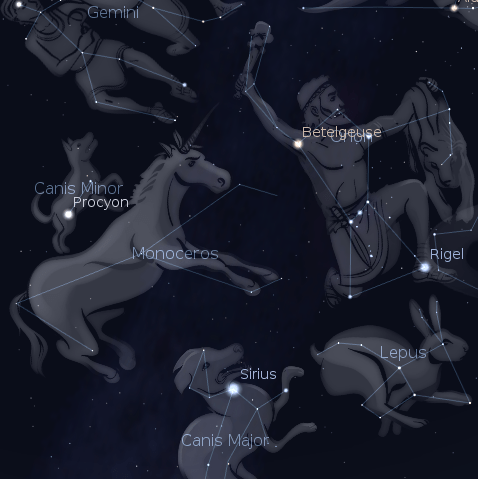
Monoceros the unicorn. Created using Stellarium.
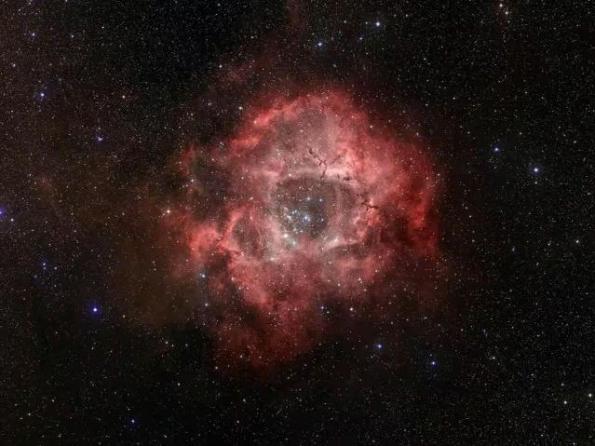
Rosette Nebula in the infrared from the Spitzer Space Telescope. Credit: NASA/JPL/Caltech
02/05/2016 – Ephemeris – Women in astronomy night at the GTAS tonight
Ephemeris for Friday, February 5th. The Sun will rise at 7:57. It’ll be up for 9 hours and 58 minutes, setting at 5:56. The Moon, 3 days before new, will rise at 6:12 tomorrow morning.
Tonight there will be a meeting of the Grand Traverse Astronomical Society at Northwestern Michigan College’s Rogers Observatory, featuring a graduate from NMC and the astronomy program: Becky Shaw who will present a talk Women in Astronomy. This is a second presentation of more female astronomers, the last was in November I especially recommend this for girls in school interested in the STEM fields, that is Science, Technology, Engineering and Math to find out the wonderful contributions these women have made. Astronomy, by the way encompasses all the STEM fields. The meeting starts at 8 p.m. and the observatory is located on Birmley Road, south of Traverse City. At 9 p.m. the will also be star party if it’s clear.
Times are for the Traverse City/Interlochen area of Michigan. They may be different for your location.
Addendum
Appropriate to our speaker’s topic: In the news now is Smith’s Cloud, discovered by Gail Smith (now Gail Bieger-Smith) in 1963 as an astronomy student at Leiden University in the Netherlands. In new studies with the Green Bank (Radio) Telescope and the Hubble Space Telescope the velocity and composition of the cloud has been measured. It somehow was ejected from the Milky Way some 70 million years ago, but it’s coming back! In 30 million years it will crash back in, hitting the Milky Way’s other gas clouds and will probably cause a burst of star formation of maybe 2 million new stars.
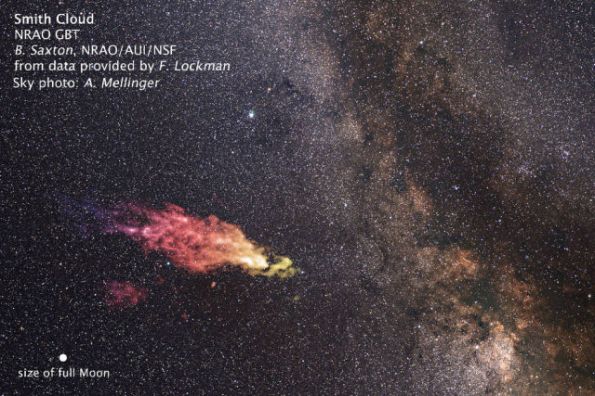
Smith’s cloud superimposed on the Milky Way. Smith’s Cloud is only visible at radio wavelengths, while the Milky Way shown is a visible photograph. Credit: Saxton/Lockman/NRAO/AUI/NSF/Mellinger.
02/04/2016 – Ephemeris – Orion is visible from everywhere
Ephemeris for Thursday, February 4th. The Sun will rise at 7:58. It’ll be up for 9 hours and 56 minutes, setting at 5:55. The Moon, half way from last quarter to new, will rise at 5:21 tomorrow morning.
The constellation of Orion the hunter is now due south at 9 p.m. It is an upright rectangle of bright stars, the shoulders and knees of this giant. In the center are three stars in a straight line, his belt, and from his belt hangs a sword. Orion is the most famous of all constellations world-wide, due to its bright stars, and straddles the celestial equator, so that it is visible at least in part from pole to pole. It contains the closest star forming region to us, the Great Orion Nebula seen easily in his sword with binoculars or small telescope. The Horse Head Nebula is found below the left belt star, but only in photographs. Another photographic feature is Barnard’s Loop, the partial shell of an ancient supernova to the left of Orion.
Times are for the Traverse City/Interlochen area of Michigan. They may be different for your location.
Addendum
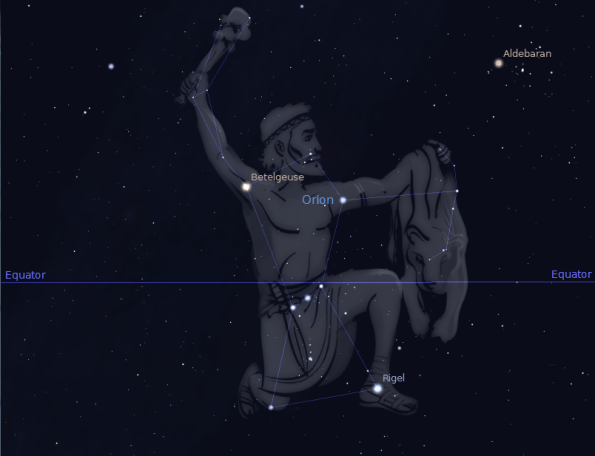
Orion from mid latitudes north of the equator. Orion would be upside down if viewed south of the equator. Created using Stellarium.
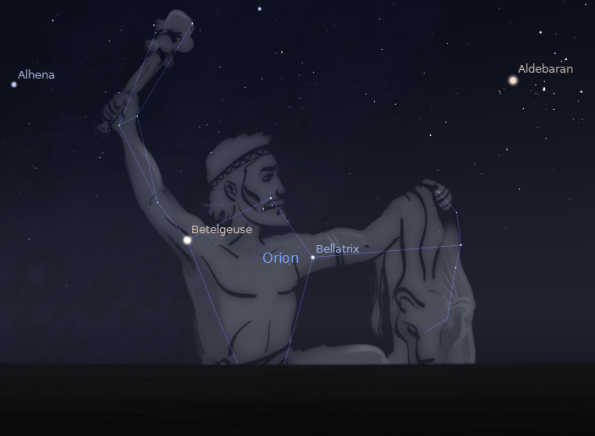
Orion from near the north pole. Created using Stellarium.
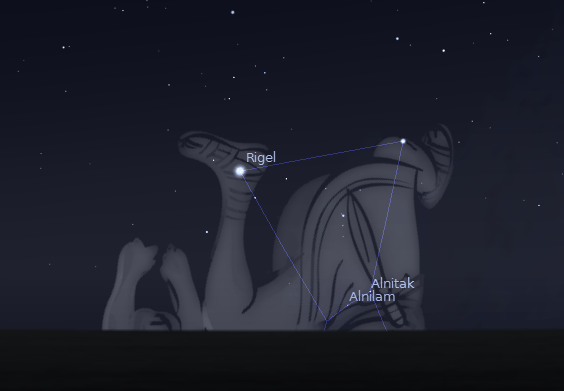
Orion from near the south pole. Created using Stellarium.
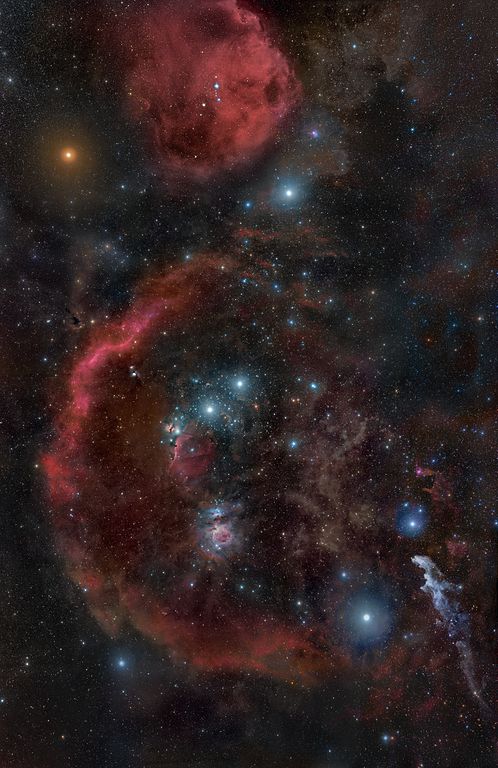
The nebulae in Orion including the Great Orion Nebula in the sword, the Horse Head Nebula below the leftmost star of Orion’s Belt named Alnitak. Barnard’s loop is the big arc on the left. Just above Alnitak is the Flame Nebula, I neglected to mention it in the program. It can be spotted in a telescope, especially if Alnitak is moved off the edge of the field of view. Credit Rogelio Bernal Andreo, via Wikipedia.
Note the nebula at the lower right. It’s the Witch’s Head Nebula, which I believe is shown brighter than it actually is. It’s being illuminated by the blue giant star Rigel to the left of it.
02/03/2016 – Ephemeris – Though a morning planet, Jupiter can be seen in the late evening
Ephemeris for Wednesday, February 3rd. The Sun will rise at 8:00. It’ll be up for 9 hours and 53 minutes, setting at 5:53. The Moon, 3 days past last quarter, will rise at 4:27 tomorrow morning.
Let’s check out the whereabouts of the bright naked eye planets. All the classical planets visible from antiquity are officially now in the morning sky. However Jupiter actually will rise at 9 p.m., in the east. Jupiter is still a morning planet since it’s not up at sunset. Mars will rise next at 1:45 a.m. in the east-southeast. It’s left of the bright star Spica. Saturn will rise at 4:05 a.m. in the east-southeast. The Moon will be below, left of it tomorrow morning. Venus will rise at 6:19 a.m. again in the east-southeast. Mercury will rise behind Venus at 6:36. Comet Catalina is up all night and is a binocular object in the dark expanse of the constellation Camelopardalis between the bowl of the Big Dipper and the W shape of Cassiopeia.
Times are for the Traverse City/Interlochen area of Michigan. They may be different for your location.
Addenda
Planets
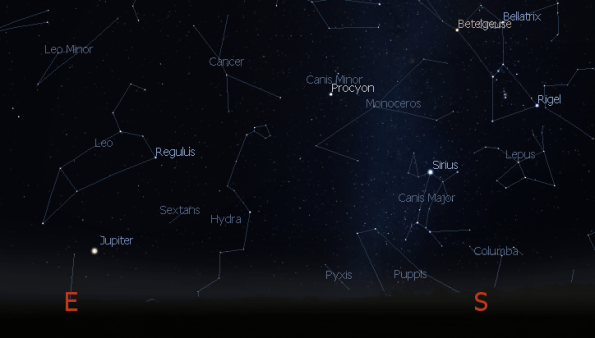
Jupiter low in the east at 10 p.m. on February 3rd, 2016. Created using Stellarium.
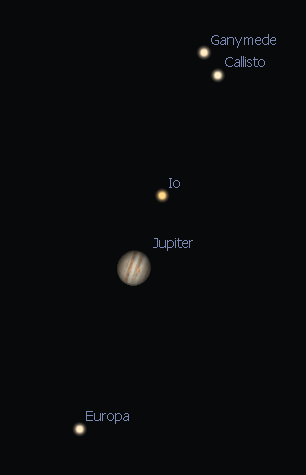
Jupiter and its moons as they would be seen in a telescope, at 10 p.m. February 3, 2016. I’d wait for an hour to let Jupiter rise above the thick atmosphere near the horizon for better clarity. Created using Stellarium.
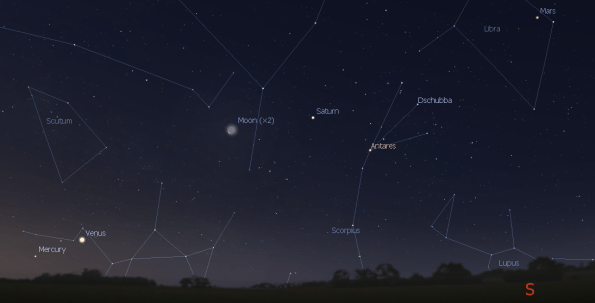
The planets in the morning sky at 7 a.m. on February 4, 2016. Jupiter is far to the west and out of this view. Created using Stellarium.
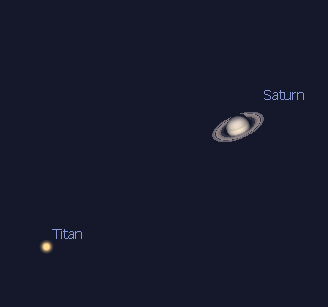
Saturn and its satellite Titan as they should appear in a telescope at 7 a.m. February 4, 2016
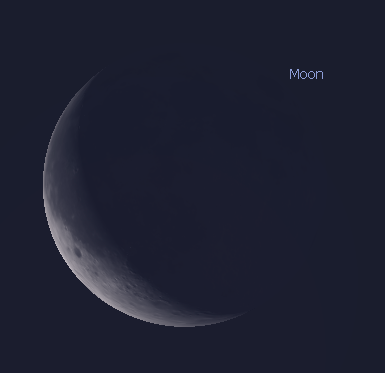
The Moon as it should appear in binoculars tomorrow morning at 7 a.m., February 4, 2016. Created using Stellarium.
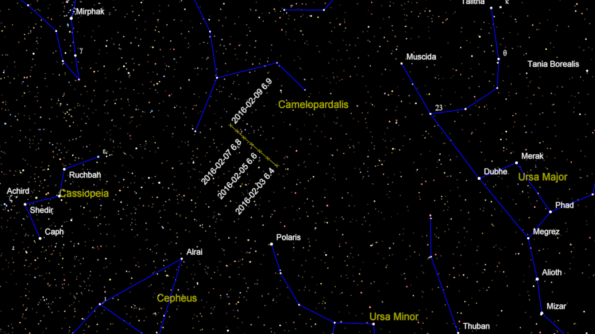
Comet Catalina’s path for the next week. Note that the magnitudes for the comet are about correct. It will take binoculars or a small telescope to spot the comet which will not show a tail visually. Created using Stellarium.
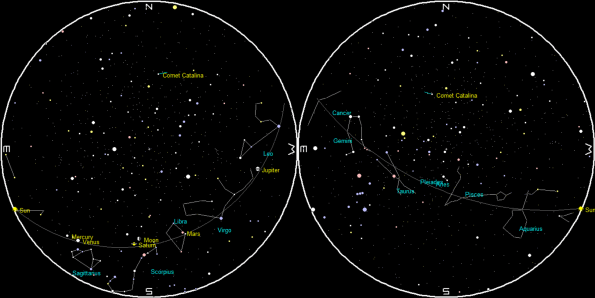
This is a chart showing the sunrise and sunset skies for February 3, 2016 showing the location of the planets, the Moon and Comet Catalina at that time. Created using my LookingUp program.
Off Topic
Stellarium
I’m now using Stellarium 0.14. It can detect older PCs and will not always crash, though I’m not thrilled with how it operates and some screen faults. The Portable Apps version has a patch that can be added to the application. The instructions for the patch are in the download page. Simply search “portable apps” to get started. The portable apps version worked better than the installed version, so I use the portable apps version. It turns out that my laptop can run 0.14, while my desktop cannot. The legacy version of Stellarium is 0.12.5.
It finally cleared up. For a while.
I bought myself a DSLR camera for my birthday/Christmas present a month and a half ago. I used to do a fair amount of astrophotography back before CCDs took over. I had some point and shoot digital cameras, which were not suitable for astrophotography. My last big spurge with film was for Comet Hale-Bopp in 1997.
But with the solar eclipse coming up next year the bug is biting again. I hate to brag but I’ve seen 4 total solar eclipses (1963, 1970, 1972, and 1979), plus 2 annular eclipses. I will recount my experiences with those eclipses in the year leading up to August 21, 2017.
In my film days I had developed a system for setting exposures for the Moon, planets, solar and lunar eclipses, and other possibly faint objects. It took a search to locate the data and used it when it finally cleared up on Ground Hog day. Below is one of the photos.
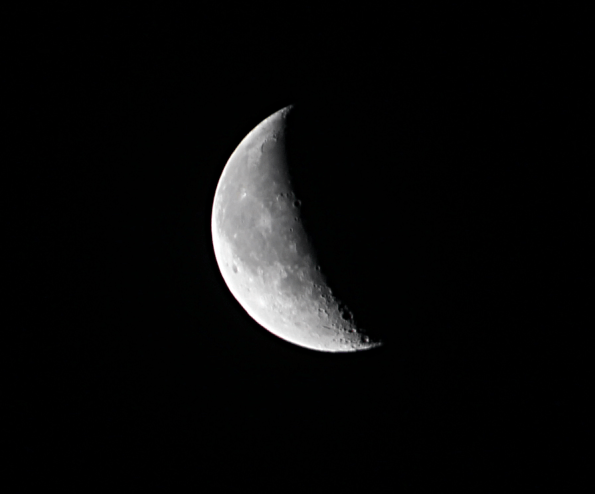
The fat crescent Moon at 7:02 a.m. February 2, 2016. ISO 100, 300mm focal length, f/11, 1/15 second.
 Bob Moler's Ephemeris Blog