Archive
05/31/2016 – Ephemeris – Previewing June’s bright skies
Ephemeris for Tuesday, May 31st. Today the Sun will be up for 15 hours and 20 minutes, setting at 9:20, and it will rise tomorrow at 6:00. The Moon, 2 days past last quarter, will rise at 3:55 tomorrow morning.
Tomorrow will be the first of June, so let’s preview June skies. There will be a lot of sunlight in June. The daylight hours will increase a bit from 15 hours and 21 minutes tomorrow to 15 hours and 34 minutes on the 20th, the solstice, retreating back to 15 hours 31 minutes at month’s end. At this time of the year the sunset times for Ludington, Interlochen, Petoskey and Mackinaw City are very nearly the same.* However the sunrise times are at their most divergent. With Ludington’s sunrise being 14 minutes later than Mackinaw City’s. The altitude of the sun above the southern horizon at local noon will increase from about 67 and a half degrees to 68 and three-quarters on the 20th. Local noon, when the sun is actually due south will occur at about 1:43 p.m.
Times are for the Traverse City/Interlochen area of Michigan. They may be different for your location.
* See http://ephemeris.bjmoler.org/calendar.htm
Addendum
June Star Chart
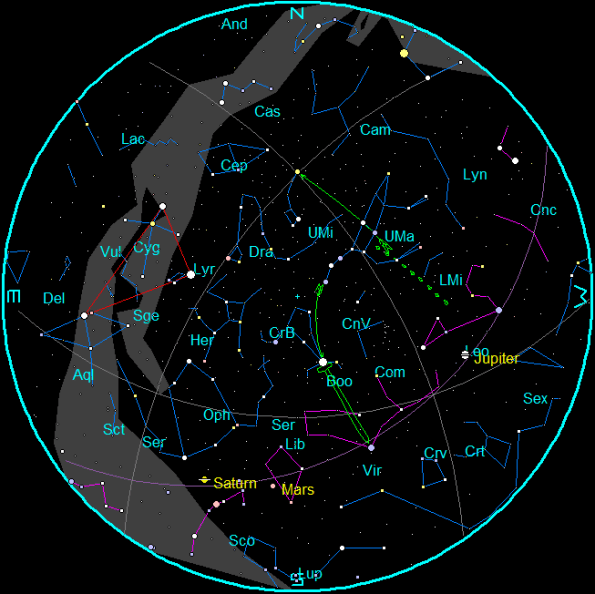
Star Chart for June 2016. Created using my LookingUp program. To enlarge in Firefox Right-click on image then click View image.
The planets and stars are plotted for the 15th at 11 p.m. EDT. That is chart time. Note, Traverse City is located approximately 45 minutes behind our time meridian. (An hour 45 minutes behind our daylight saving time meridian.) To duplicate the star positions on a planisphere you may have to set it to 1:45 earlier than the current time if you are near your time meridian.
Evening nautical twilight ends at 10:45 p.m. EDT on the 1st, increasing to 10:57 p.m. EDT on the 30th.
Morning nautical twilight starts at 4:36 a.m. EDT on the 1st, and decreasing to 4:35 a.m. EDT on the 30th.
Add a half hour to the chart time every week before the 15th and subtract a half hour for every week after the 15th. Before the 13th also subtract an hour for Standard Time.
For a list of constellation names to go with the abbreviations click here.
- Pointer stars at the front of the bowl of the Big Dipper point to Polaris the North Star
- A leaky Big Dipper drips on Leo
- Follow the arc of the handle of the Big Dipper to the star Arcturus
- Extend the arc to a spike to point to Spica.
- The Summer Triangle is outlined in red. Vega in Lyra (Lyr), Deneb in Cygnus (Cyg) and Altair in Aquila (Aql).
Calendar of Planetary Events
Credit: Sky Events Calendar by Fred Espenak and Sumit Dutta (NASA’s GSFC)
To generate your own calendar go to http://eclipse.gsfc.nasa.gov/SKYCAL/SKYCAL.html
Times are Eastern Time. Some additions made to aid clarity.
    Date    Time      Event
Jun 01  We            Venus: 1.5° W
    03  Fr  1:43 a.m. Saturn Opposition
    03  Fr  5:47 a.m. Moon-Mercury: 0.7° N
    03  Fr  6:55 a.m. Moon Perigee: 361100 km
    04  Sa 11:00 p.m. New Moon
    05  Su  4:59 a.m. Mercury Greatest Elongation: 24.2° W
    06  Mo  5:13 a.m. Moon North Dec.: 18.6° N
    06  Mo  5:34 p.m. Venus Superior Conjunction with the Sun.
    10  Fr 10:47 a.m. Moon-Regulus: 2.2° N
    11  Sa  3:35 p.m. Moon-Jupiter: 1.6° N
    11  Sa  6:20 p.m. Moon Ascending Node
    12  Su  4:10 a.m. First Quarter
    13  Mo  6:06 a.m. Mercury-Pleiades: 6.8° S
    15  We  8:00 a.m. Moon Apogee: 405000 km
    18  Sa  8:40 p.m. Moon-Saturn: 3.6° S
    18  Sa 11:39 p.m. Mercury-Aldebaran: 3.8° N
    20  Mo  7:02 p.m. Full Moon
    20  Mo  2:52 p.m. Moon South Dec.: 18.6° S
    20  Mo  6:35 p.m. Summer Solstice
    26  Su  1:28 a.m. Moon Descending Node
    27  Mo  2:19 p.m. Last Quarter
Jul 01                Venus: 6.8° E
05/30/2016 – Ephemeris – Mars is closest to the Earth of this go around today
Ephemeris for Memorial Day, Monday, May 30th. Today the Sun will be up for 15 hours and 18 minutes, setting at 9:20, and will rise tomorrow at 6:00. The Moon, 1 day past last quarter, will rise at 3:21 tomorrow morning.
Mars is the closest it gets to the Earth in this go-around today. Mars is the next planet out from the Sun. Earth is number 3 and Mars is number 4. Mars has a much more eccentric orbit than the Earth and varies from 128 million miles (207 million km) at its closest to the Sun, called perihelion to 155 million miles (249 million km) at aphelion. So at closest approach of Mars to the Earth the nearest distance can vary by nearly 30 million miles (42 million km). Mars moves slower in its orbit than does the Earth, taking 687 Earth days to orbit the Sun. That’s about 1 year, 10 ½ months. We catch up to Mars every 26 months or so, in a different part of its orbit. This time it will close to 46.7 million miles (75.2 million km) today.
Times are for the Traverse City/Interlochen area of Michigan. They may be different for your location.
Addendum
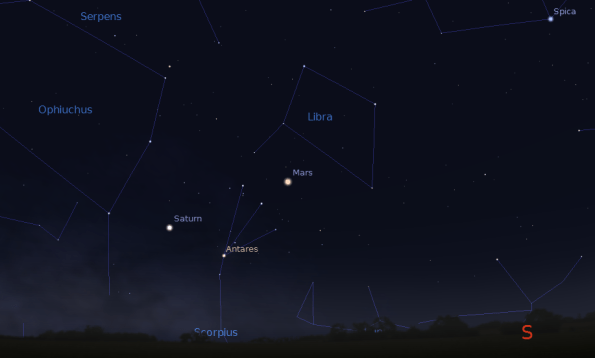
Mars finder chart for 11 p.m. May 30, 2016. Created using Stellarium.
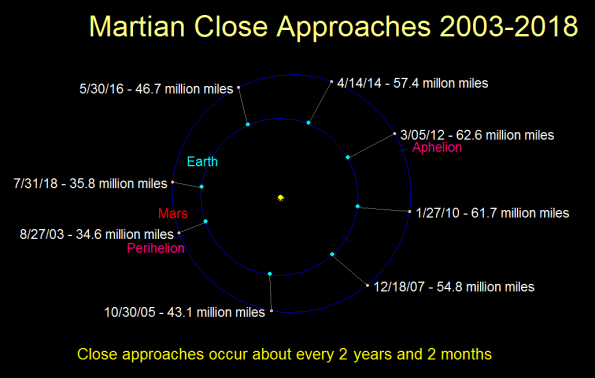
Mars closest approaches from 2003 to 2017. Created by my LookingUp program.
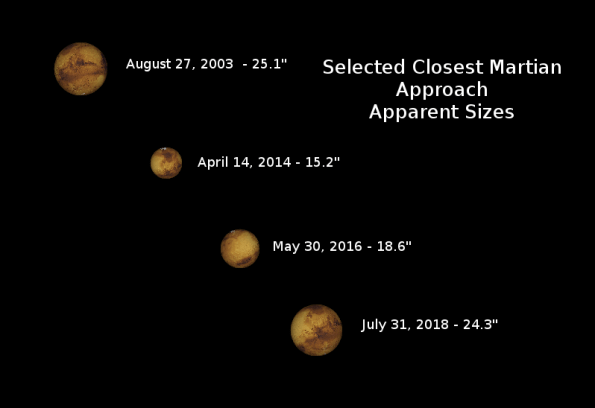
Selected Martian Closest Approaches Apparent sizes from 2003 to 2018. Created using Cartes du Ciel (Sky Charts).
05/27/2016 – Ephemeris – Alkaid, the star at the end of the Big Dipper
Ephemeris for Friday, May 27th. Today the Sun will be up for 15 hours and 14 minutes, setting at 9:17, and will rise tomorrow at 6:02. The Moon, 2 days before last quarter, will rise at 1:40 tomorrow morning.
The star at the end of the handle of the Big Dipper is named Alkaid. It is the bright star that’s closest to the zenith at 11 p.m. It is a rare blue-white star. Alkaid and Dubhe, at the other end of the Big Dipper are stars that do not belong to the Ursa Major Association. And thousands of years from now these two stars will leave the central stars of the dipper behind, and deform the Big Dipper. Over the millennia the Big Dipper would look like a tin cup. Near Alkaid are two popular deep sky objects. And being this far from the hazy band of the Milky Way one would guess that they would be galaxies. And they are. The Whirlpool Galaxy and the Pinwheel Galaxy. Two gorgeous spiral galaxies.
Times are for the Traverse City/Interlochen area of Michigan. They may be different for your location.
Addendum
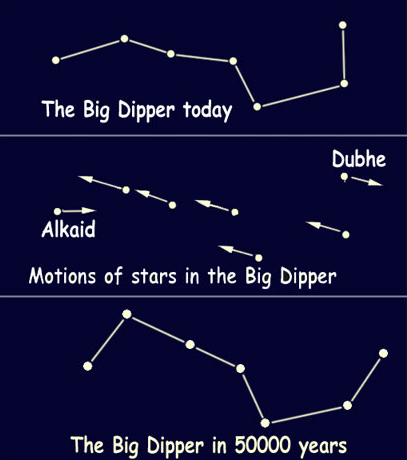
The change in the Big Dipper over time. Source: stargazerslounge.com. Ultimate source: Stellarium.
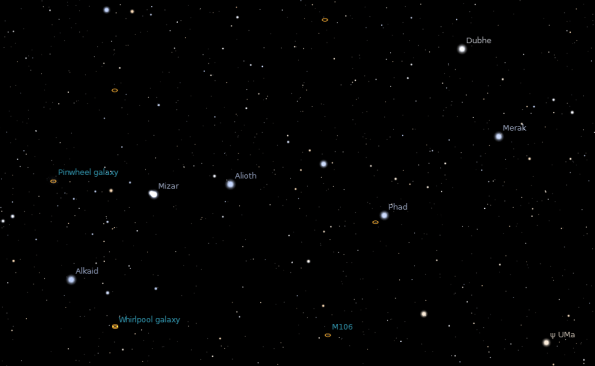
The Big Dipper and Alkaid with the Whirlpool (M51) and Pinwheel (M101) galaxies. Created using Stellarium.
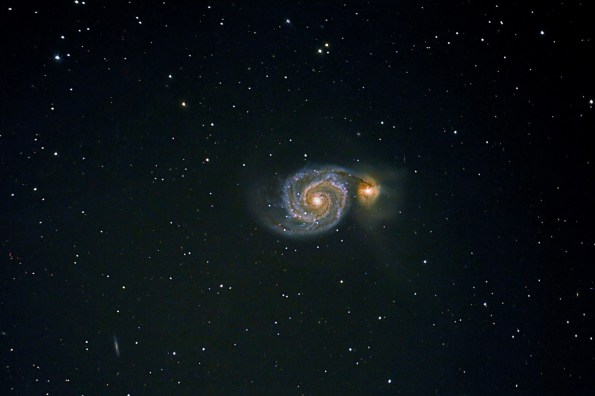
The Whirlpool Galaxy, M51. Credit Scott Anttila.
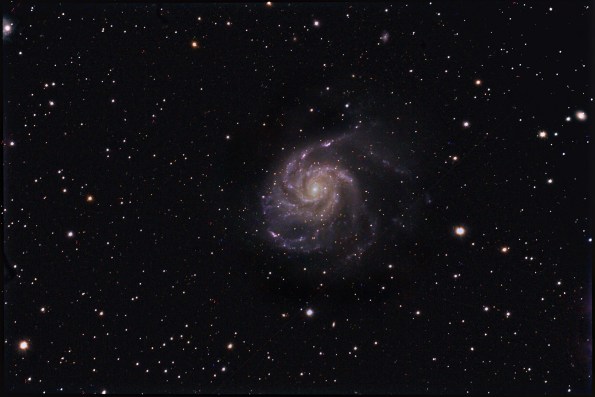
The Pinwheel Galaxy, M101. Credit Scott Anttila.
05/26/2016 – Ephemeris – Polaris the North Star
Ephemeris for Thursday, May 26th. Today the Sun will be up for 15 hours and 12 minutes, setting at 9:16, and will rise tomorrow at 6:03. The Moon, 3 days before last quarter, will rise at 1:02 tomorrow morning.
The star Polaris is perhaps the most important star in the northern hemisphere sky. That’s because it is nearly over the Earth’s north pole. It’s also called the North Star or the Pole Star. Polaris can be found by using the two stars at the front of the bowl of the Big Dipper, These two stars, we call Pointer Stars do point very accurately to Polaris. It is not the brightest star as some think, but a brighter than average star in a most unique position in the sky. During the lifetimes of those now living Polaris will be getting slowly closer to the pole. It won’t reach it, but in 100 years will begin to recede from the pole. The altitude of Polaris in degrees approximately equals ones latitude.
Times are for the Traverse City/Interlochen area of Michigan. They may be different for your location.
Addendum
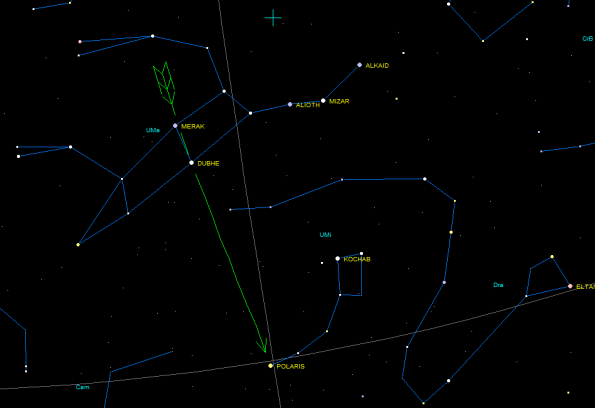
Looking North at the Big Dipper pointing at Polaris. Created using my Looking Up program.
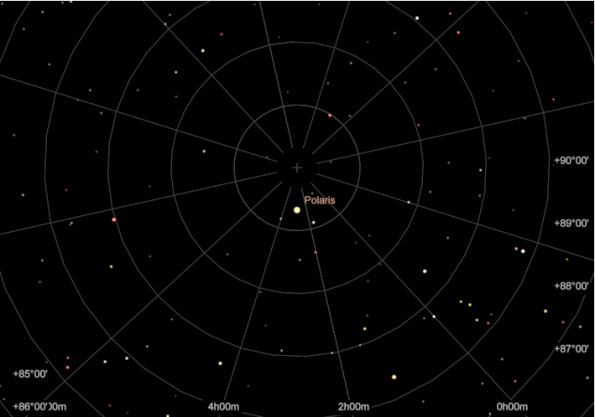
Closeup of Polaris and the Celestial North Pole. The declination lines are 1 degree apart. Created using Cartes du Ciel (Sky Charts).
05/25/2016 – Ephemeris – Two official evening planets and another also visible in the evening
Ephemeris for Wednesday, May 25th. Today the Sun will be up for 15 hours and 10 minutes, setting at 9:15, and will rise tomorrow at 6:03. The Moon, half way from full to last quarter, will rise at 12:21 tomorrow morning.
Let’s see what the bright naked eye planets are up to. Jupiter is in the south in the early evening, moving to the southwest. It will set at 3:01 a.m. It’s below the stars of Leo this year. Binoculars can make out some of Jupiter’s moons, but a telescope is required to see all four bright moons and Jupiter’s cloud features. Mars is now up at sunset. It’s above and right of its look-a-like star Antares, whose name means Rival of Mars. Mars will move due south at 1:17 a.m. and will set at 6:48 a.m. Mars is still inching closer to the Earth now, only 46.9 million miles (75.6 million km) away. It will be closest to the Earth next Monday. Saturn will rise at 9:37 p.m. in the east-southeast. It’s to the left of Mars, and once it’s been up for an hour is a beautiful sight in any telescope.
Times are for the Traverse City/Interlochen area of Michigan. They may be different for your location.
Addendum
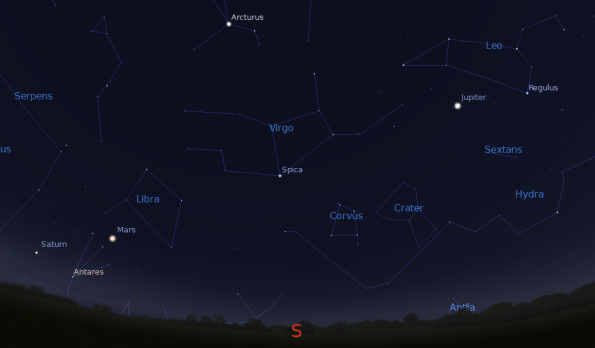
The evening sky tonight with Jupiter, Mars and Saturn at 10:30 p.m. May 25, 2016. Created using Stellarium.
Jupiter and Mars are officially in the evening sky because they are up before sunset. Saturn will reach opposition from the Sun on June 3rd, then it will be an evening planet too.
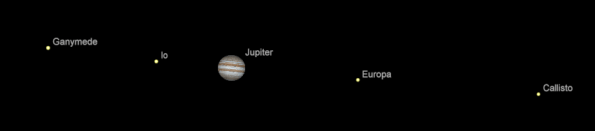
Jupiter and its Galilean moons at 10:30 p.m. May 25, 2016. Jupiter’s apparent diameter will be 37.9″. Created using Cartes du Ciel (Sky Charts).
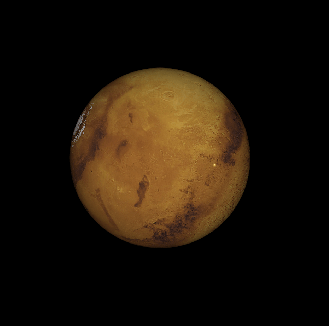
Mars as it might be seen in a large telescope with high power at 10:30 p.m. May 25, 2016. Mars apparent diameter is 18.5″. The central meridian will be 179.11 degrees. Syrtis Major is the large feature in the north near the polar cap. Created using Cartes du Ciel (Sky Charts).
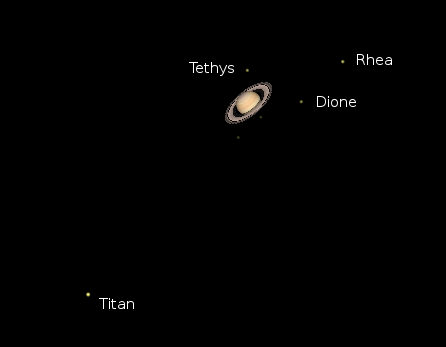
Saturn and its moons at 10:30 p.m. May 25, 2016. The apparent diameter of the planet will be 18.4″. The rings span 42.9″, a bit larger than the apparent diameter of Jupiter. Created using Cartes du Ciel (Sky Charts).
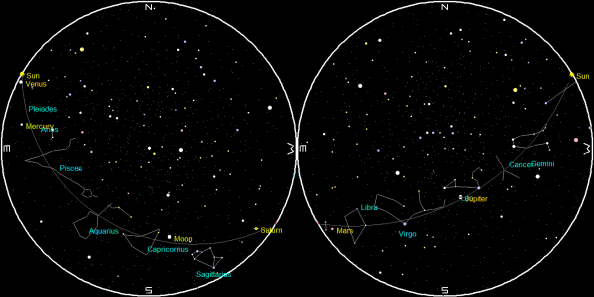
Planets at Sunrise and Sunset of a single night starting with sunset on the right on May 25, 2016. The night ends on the left with sunrise on May 26. If you are using Firefox right-click on the image and select View Image to enlarge the image. That goes for all the large images.
05/24/2016 – Ephemeris – Follow the spike to Spica
Ephemeris for Tuesday, May 24th. Today the Sun will be up for 15 hours and 9 minutes, setting at 9:14, and will rise tomorrow at 6:04. The Moon, 3 days past full, will rise at 11:35 this evening.
Just about due south at 11 p.m. is the bright star Spica which can be found from all the way back overhead to the Big Dipper. Follow the arc of the handle of the Big Dipper to the bright star Arcturus high in the south, southeast. Then straighten the curve of the arc to a straight spike which points to Spica. Arcturus is much brighter than Spica and has an orange tint to Spica’s bluish hue. In fact Spica is the bluest of the 21 first magnitude stars. That means that it is hot. Actually Spica is really two blue stars orbiting each other in 4 days. Spica is 250 light years away, which is reasonably close. Spica was an important star to the ancients. One temple was built, and aligned to its setting point.
Times are for the Traverse City/Interlochen area of Michigan. They may be different for your location.
Addendum
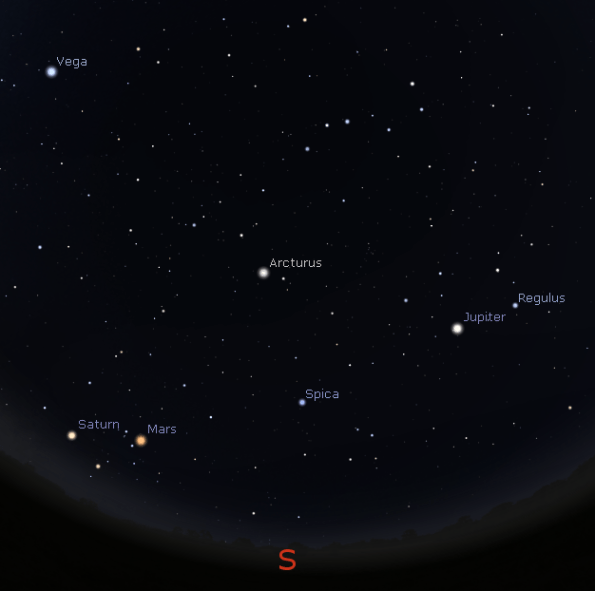
The evening sky to the south. All the finder stars are there, so follow the arc of the Big Dipper’s handle to Arcturus. Straighten it to a spike that points to Spica. Created using Stellarium.
05/23/2016 – Ephemeris – Mars was at opposition yesterday and will be closest next Monday
Ephemeris for Monday, May 23rd. Today the Sun will be up for 15 hours and 7 minutes, setting at 9:13. The Moon, 2 days past full, will rise at 10:45 this evening. Tomorrow the Sun will rise at 6:05.
Yesterday the planet Mars passed a point where it was opposite in the sky from the Sun. Astronomers call it opposition. This is a time when a planet is normally its closest to the Earth, since the Earth is more of less directly between the planet and the Sun. But due to Mars’ quite elliptical orbit, it is still approaching the Sun, and though the Earth is nudging ahead of it a bit, Mars won’t be closest to the Earth until next Monday, the 30th, 8 days after opposition. On that day it will be about 650 thousand miles (1 million, 46 thousand km) closer to the Earth than it was yesterday. On the 30th that will be 46.7 million miles (76.2 million km) away. The next closest approach in 26 months will be a bit closer yet.
Times are for the Traverse City/Interlochen area of Michigan. They may be different for your location.
Addendum
Mars closest approaches from 2003 to 2018. Created by my LookingUp program.
Selected Martian Closest Approaches Apparent Sizes from 2003 to 2018. Created using Cartes du Ciel (Sky Charts). Note that ” is seconds of arc. 1″ = 1/3600 of a degree. The Moon and Sun are about 1,800 seconds of arc in diameter.
Also note that at the star party last Saturday night Mars looked great, even though it was low in the sky.
05/20/2016 – Ephemeris – Astronomical outreach events this weekend
Ephemeris for Friday, May 20th. Today the Sun will be up for 15 hours and 1 minute, setting at 9:10. The Moon, 1 day before full, will set at 6:22 tomorrow morning. Tomorrow the Sun will rise at 6:08.
The Grand Traverse Astronomical Society will be part of two events this weekend. Saturday evening society members will be at the Sleeping Bear Dunes National Lakeshore Dune Climb parking lot closest to the dune starting at 9 p.m. for a star party viewing the planets Jupiter, Mars and Saturn and the full moon. There will be some actual star observing too. Folks are urged to park in the last two rows. On Sunday the society will be part of the Northwestern Michigan College’s Barbecue, with telescopes to observer the Sun safely and exhibits of photographs and actual meteorites, and videos in the Health and Science Building. For those who missed it we’ll have photographs of last week’s transit of Mercury, and maybe a video or two.
Times are for the Traverse City/Interlochen area of Michigan. They may be different for your location.
Addendum
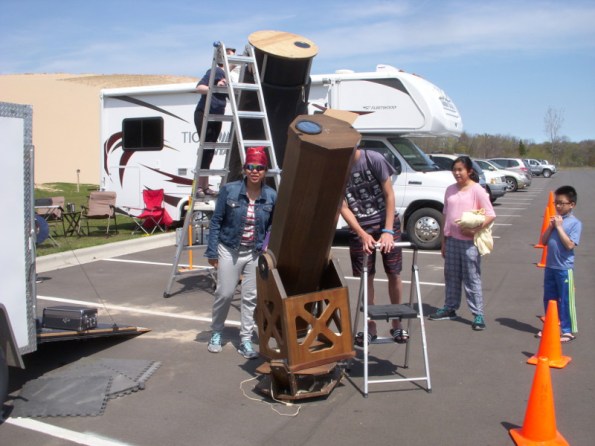
Two of the telescopes that will be used at the Sleeping Bear Dunes star party Saturday night. Taken at the transit of Mercury by Emmett Holmes, whose telescope is in the foreground.
05/19/2016 – Ephemeris – Daylight Saving Time in West Michigan
Ephemeris for Thursday, May 19th. Today the Sun will be up for 14 hours and 59 minutes, setting at 9:09. The Moon, 2 days before full, will set at 5:49 tomorrow morning. Tomorrow the Sun will rise at 6:08.
It is nearing summer and the powers that be have bequeathed on us daylight saving time, even starting it before the end of winter since 2007. It is a thing that amateur astronomers hate. This time of year through the end of July the Sun just sets too late, and if one has a day job, it’s nearly impossible to stay up long enough to start observing at 11 p.m. or midnight, and be bright-eyed and bushy-tailed the next morning. Nautical twilight, when the sea horizon is no longer discernible ends at 10:28 p.m. tonight, and astronomical twilight, when it’s pitch dark, ends at 11:19. It gets worse the farther north and west you go in the Eastern time zone. At least this year we have three planets to entertain us in the evening twilight.
Times are for the Traverse City/Interlochen area of Michigan. They may be different for your location.
Addendum

Our place in the Eastern Time Zone. Source http://www.nationsonline.com. If you are using Firefox right-click on the map and select View Image to enlarge.
We are near longitude W 86°. Our Eastern Standard time meridian is W 75°, which runs through Philadelphia, which I’ve added to the map, southwest of New York. With 15° per hour that makes that 44 minutes behind Philadelphia. Theoretically time zones should extend 30 minutes on either side of a standard time meridian.
During daylight time our time meridian is W 60°, which is off the map. That meridian just ticks the eastern end of Nova Scotia in Canada. For us near 45° north latitude astronomical twilight ends shortly after midnight.
05/18/2016 – Ephemeris – Three bright planets and the Moon grace the evening sky
Ephemeris for Wednesday, May 18th. Today the Sun will be up for 14 hours and 57 minutes, setting at 9:08. The Moon, 3 days before full, will set at 5:19 tomorrow morning. Tomorrow the Sun will rise at 6:09.
Let’s see what the bright naked eye planets are up to. Jupiter is in the south in the early evening, moving to the southwest. It will set at 3:28 a.m. It’s below the stars of Leo this year. Binoculars can make out some of Jupiter’s moons, but a telescope is required to see all four bright moons and Jupiter’s cloud features. Mars will rise at 9:26 p.m. in the east-southeast. It’s above and right of its look-a-like star Antares, whose name means Rival of Mars. Mars is getting closer to the Earth now, only 48 million miles (77 million km) away. It will be closest to the Earth on the 30th. Saturn will rise at 10:11 p.m. in the east-southeast. It’s to the left of Mars, and once it’s been up for an hour is a beautiful sight in any telescope.
Times are for the Traverse City/Interlochen area of Michigan. They may be different for your location.
Addendum
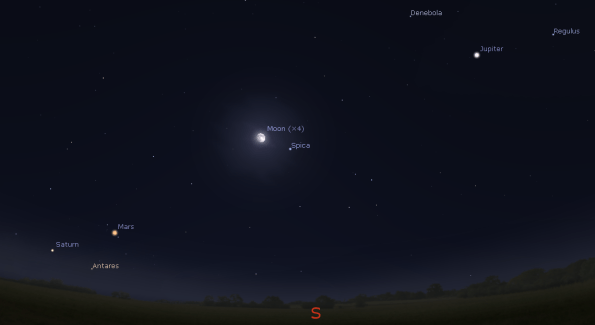
The Moon, Jupiter, Mars and Saturn at 11 p.m. May 18, 2016. Created using Stellarium.
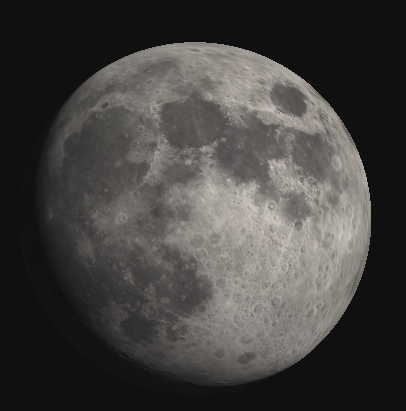
The Moon as it might be seen in binoculars at 11 p.m., May 18, 2016. Created using Stellarium.
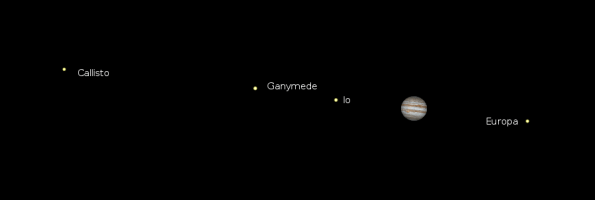
Jupiter and its moons as they might be seen through a telescope at 11 p.m. May 18, 2016. It’s 38.7″ in equatorial diameter. The Great Red Spot will cross the planet’s central meridian at 11:38 p.m. Created using Cartes du Ciel (Sky Charts).
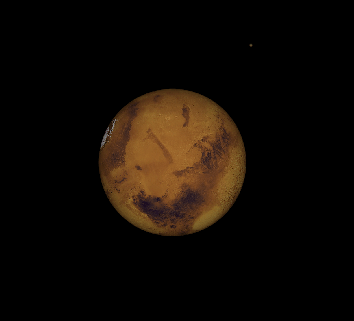
Mars as it might be seen in a large telescope with high power at 11 p.m. May 18, 2016. Mars apparent diameter is 18.2″. The central meridian will be 248.08 degrees. Syrtis Major is the large feature in the north near the polar cap. Created using Cartes du Ciel (Sky Charts).
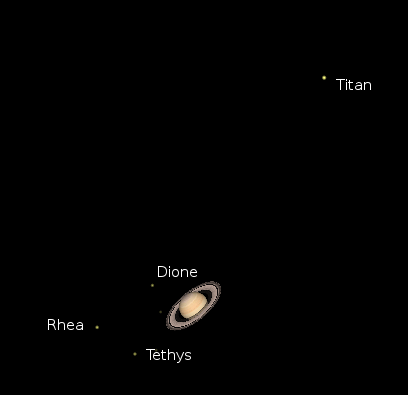
Saturn and its moons at 11 p.m. May 18, 2016. The apparent diameter of the planet will be 18.4″. The rings span 42.8″, a bit larger than the apparent diameter of Jupiter. Created using Cartes du Ciel (Sky Charts).
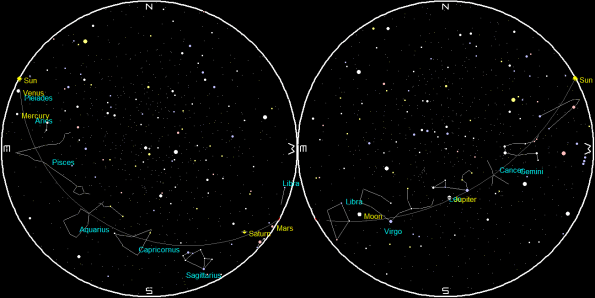
Planets at Sunrise and Sunset of a single night starting with sunset on the right on May 18, 2016. The night ends on the left with sunrise on May 19. If you are using Firefox right-click on the image and select View Image to enlarge the image. That goes for all the large images.
 Bob Moler's Ephemeris Blog