Archive
04/14/2014 – Ephemeris – Why does Easter occur on a different Sunday every year?
The answer is astronomical!
Ephemeris for Good Friday, Friday, April 14th. The Sun will rise at 6:59. It’ll be up for 13 hours and 26 minutes, setting at 8:26. The Moon, 3 days past full, will rise at 11:48 this evening.
Easter will be celebrated by western and eastern christian churches this Sunday. Easter is a movable feast in that it falls on a different date each year following the first full moon of spring. It’s an attempt to follow the Jewish Passover, which starts on the 15th of the month of Nisan. Being a lunar calendar the 15th the generally the night of the full moon. And since the Last Supper was a Seder, the Christian church wanted to follow Passover as closely as possible using the Roman solar based calendar where the year was 365.25 days long. Passover started at sunset this past Monday night. The western churches eventually adopted the Gregorian calendar to keep in sync with the seasons. The Eastern churches did not, however Easter is late enough this year so they both fall on the same date.
The times given are for the Traverse City/Interlochen area of Michigan. They may be different for your location.
Addendum
The seasonal, or officially the Tropical Year, from vernal equinox to vernal equinox is approximately 365.24220 days long, about 11 1/2 minutes shorter than the Julian (after Julius Caesar) Calendar year. The Julian Calendar kept up with the year by having three 365 ordinary years and one leap year of 366 days. It over corrects. To make the calculation for Easter easier in the various dioceses of the far-flung church, the vernal equinox, the day the Sun crosses the celestial equator, heading northward was defined as March 21st. The actual vernal equinox was falling behind the Julian Calendar by 0.8 days every century.
By 1582 the Roman Catholic Church under Pope Gregory XIII decided to correct the problem. By then the real vernal equinox occurred on March 11th. Easter is supposed to be a spring feast, and using March 21st as the vernal equinox would eventually push Easter into summer. The Pope instituted a commission to look into the problem. This commission headed by Christophorus Clavius* came up with what we know as the Gregorian Calendar. First, eliminate 10 days from the calendar. This was done in October 1582 between October 4th and 15th. Then to keep the calendar in sync with the actual year it was decreed that leap years would continued for years divisible by 4; except that century years, those divisible by 100 be ordinary years, except those by also divisible by 400. Thus the year 1900 was an ordinary year, but the year 2000 was a leap year, and the year 2100 will be an ordinary year. Adoption of this as a civil calendar took 400 years to be universal.
The Greek Orthodox and other eastern churches kept the Julian Calendar, so on occasion their Easter is sometimes celebrated in May. The Jewish Calendar is, as I alluded to in the program transcript, a lunar calendar. It has a relationship to the Julian Calendar in that 19 Julian Years equals 235 lunar months almost exactly. This is called the Metonic Cycle. Those 235 months equal 12 lunar years of 12 and 13 months. So without correction Passover too will slowly head into summer in millennia to come.
* Clavius was honored by having a large, rather spectacular crater on the Moon named for him. Search these posts for Clavius to find it.
04/13/2017 – Ephemeris – Venus is in the morning sky
Ephemeris for Thursday, April 13th. The Sun will rise at 7:01. It’ll be up for 13 hours and 23 minutes, setting at 8:25. The Moon, 2 days past full, will rise at 10:52 this evening.
Venus is beginning to make its morning appearance now, rising just before 6 a.m. It’s north and west of the Sun, but it’s path away from the Sun is at a low angle to the horizon. Venus is now in its crescent phase, which is getting fatter, as it separates from the Sun. It is also getting smaller in our telescopes as it recedes from us. Venus has no natural satellites, however it currently has a small robotic one. It is Japan’s Akatsuki or Dawn spacecraft. Launched in 2010, it failed to fire its rocket engine for the entire time needed to drop it into orbit of Venus. The engineers devised a plan to chase Venus for 5 years and gently maneuver the spacecraft into orbit using only its attitude thrusters. This they accomplished in December of 2015.
The times given are for the Traverse City/Interlochen area of Michigan. They may be different for your location.
Addendum
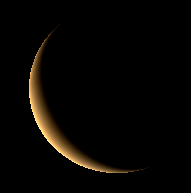
Telescopic Venus as created with Stellarium for early morning April 14, 2017. Stellarium is coloring Venus as it would be colored low in the sky.
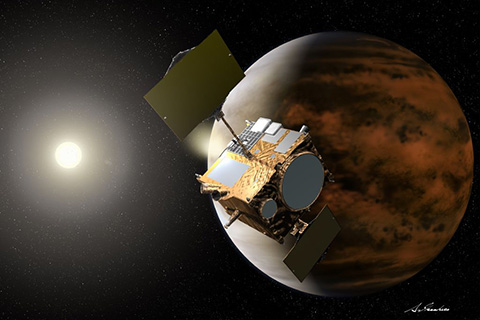
Artists drawing of Akatsuki orbiting Venus. Credit Japanese Institute of Space and Astronautical Science (ISAS)
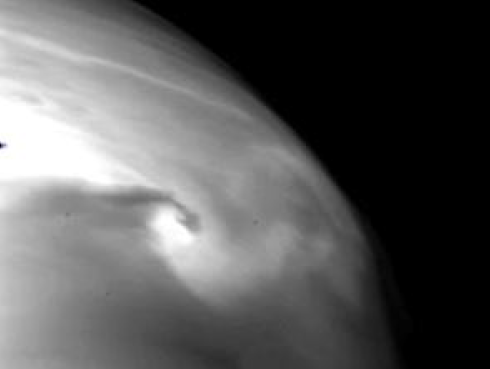
A localized vortex in the clouds of Venus captured by Akatsuki. Credit ISAS.
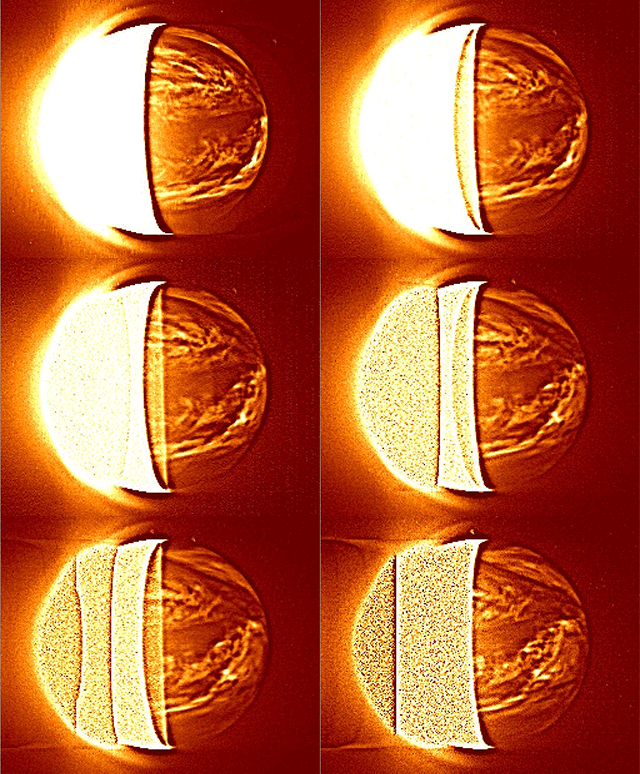
An animation of the clouds rotating on Venus’ night side by Akatsuki. Credit ISAS
04/12/2017 – Ephemeris – It’s Wednesday, do you know where your bright planets are?
Ephemeris for Wednesday, April 12th. The Sun will rise at 7:03. It’ll be up for 13 hours and 20 minutes, setting at 8:23. The Moon, 1 day past full, will rise at 9:53 this evening.
Tonight is Yuri’s Night the anniversary of Yuri Gagarin’s first human orbital flight in 1961. Now celebrated around the world. Mars is still in the west after sunset and fading. It will set at 11:08 p.m. Coming to dominate the evening sky low in the east in evening twilight is Jupiter. It will rise to be low in the east-southeast at 10 p.m. At 6 a.m. Jupiter is still hanging on in the western sky, and will be below and right of the Moon at that time. At the same time Saturn be about due south. It will rise in the east-southeast at 1:38 a.m. tomorrow. Venus is beginning to make an appearance in the morning sky. It will rise at 5:40 tomorrow morning but will have to compete with the ever brightening twilight in the morning, but each morning it will rise about 6 minutes earlier.
The times given are for the Traverse City/Interlochen area of Michigan. They may be different for your location.
Addendum
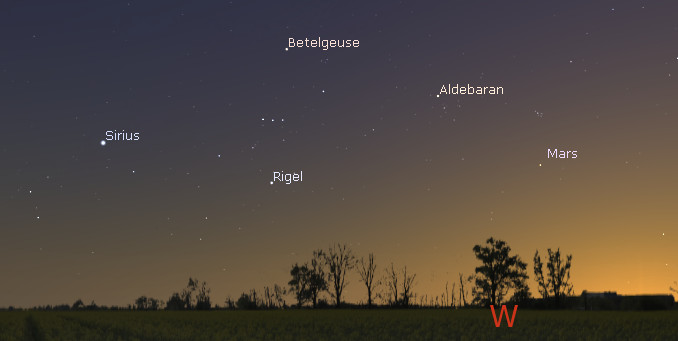
Mars in the west with bright stars at 9 p.m. April 12, 2017. Created using Stellarium.
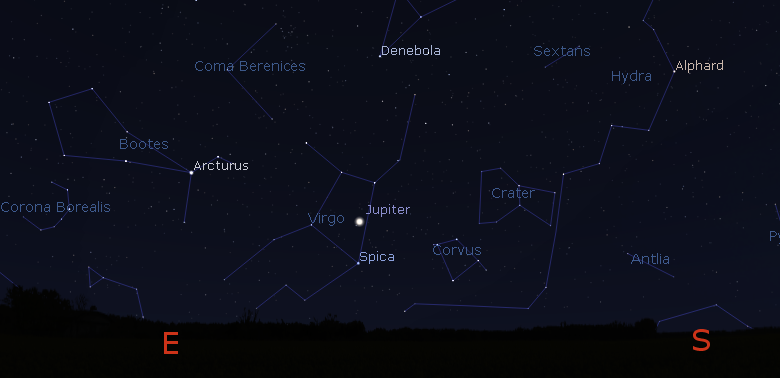
Jupiter in dark skies with some southern spring constellations on April 12, 2017. Created using Stellarium.
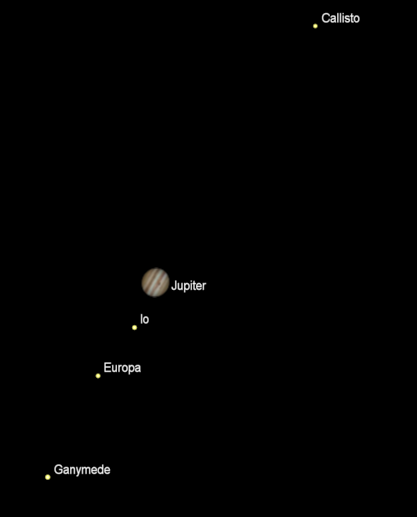
Jupiter and moons at 10 p.m. April 12, 2017 The Great Red Spot is near the central meridian of the planet at that time. Created using Cartes du Ciel (Sly Charts).
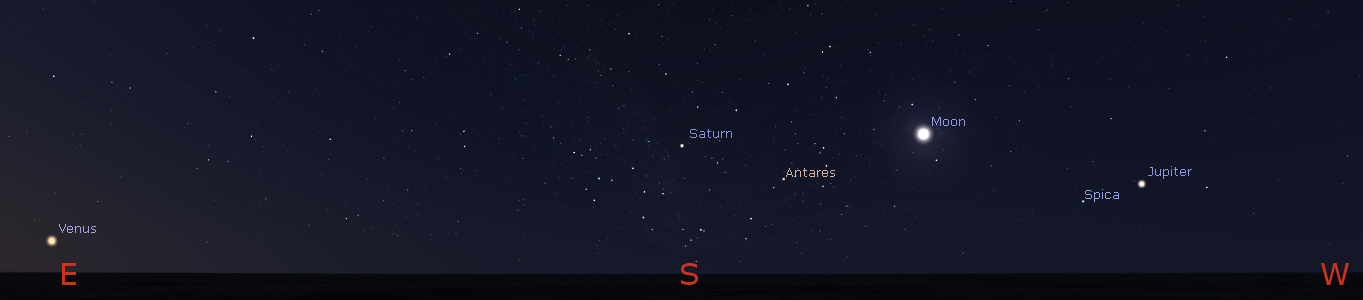
Jupiter, the Moon, Saturn and Venus at the eastern horizon at 6 a.m. April 13, 2017. Created using Stellarium.
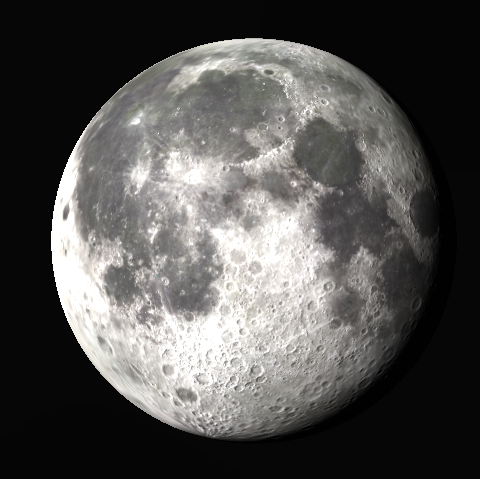
The waning gibbous Moon as it might be seen in binoculars at 6 a.m. April 13, 2017. Created using Stellarium.
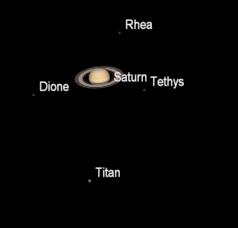
Saturn and moons in telescopes at 6 a.m. April 13, 2017. Created using Cartes du Ciel (Sky Charts).
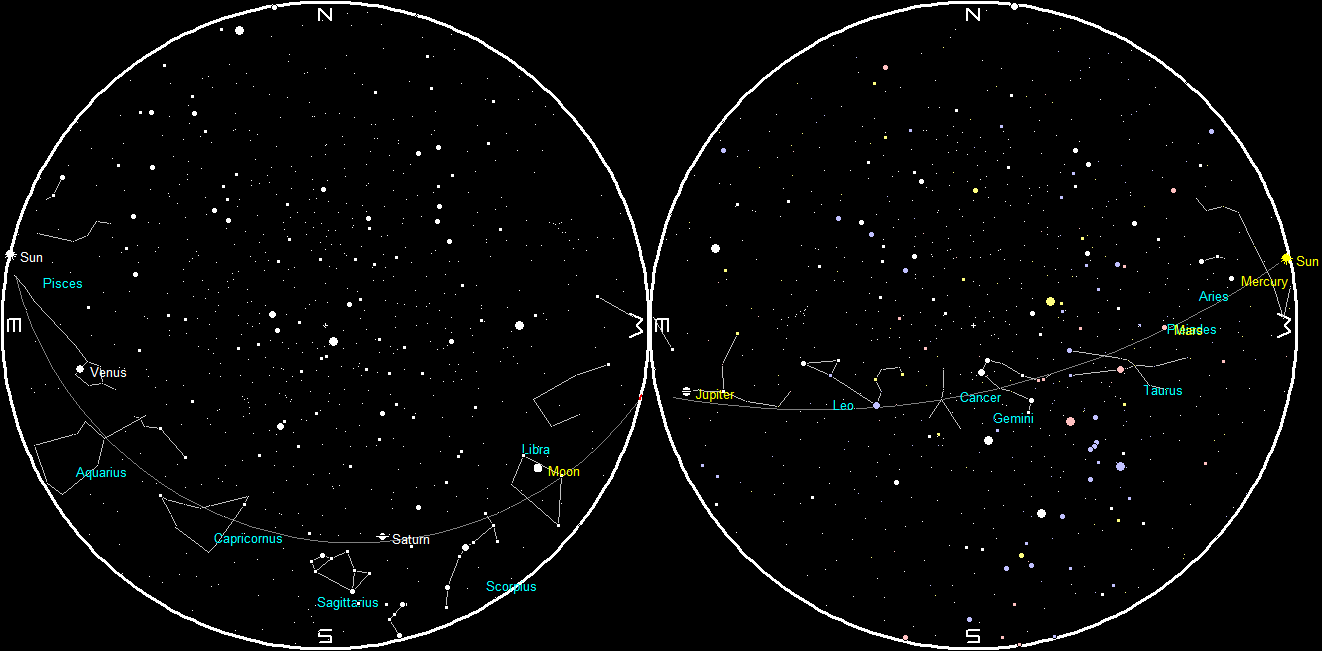
Planets and the Moon at sunset and sunrise of a single night starting with sunset on the right on April 12, 2017. The night ends on the left with sunrise on April 13. Click on the image to enlarge. Created using my LookingUp program.
04/11/2017 – Ephemeris – What’s under Jupiter’s cloud tops?
Ephemeris for Tuesday, April 11th. The Sun will rise at 7:04. It’ll be up for 13 hours and 17 minutes, setting at 8:22. The Moon, at full today, will rise at 8:54 this evening.
I made an error in yesterday’s on-air program which I fixed before posting this blog version. The moon Io will be over the face of Jupiter from when it rises tonight until 8:58 p.m.*, thereafter it will be seen just to the west of the planet. What we see of Jupiter are its cloud tops. Planetary astronomers have some very educated guesses as to what lies beneath them. An atmosphere of mainly hydrogen and helium, ending in a hot liquid ocean of hydrogen. Beneath that a core of metallic hydrogen that generates the planet’s huge magnetic field. Below that maybe a core of solid iron and other metals. NASA’s Juno spacecraft now orbiting Jupiter is tasked with finding out the interior structure by measuring the velocity of the spacecraft as it flies just above the cloud tops of this giant planet.
The times given are for the Traverse City/Interlochen area of Michigan. They may be different for your location.
* Observers in other locations around the world can check out the table from yesterday’s post of other Jovian satellite events after this entry is posted at 4:01 UT, April 11, 2017.
Addendum
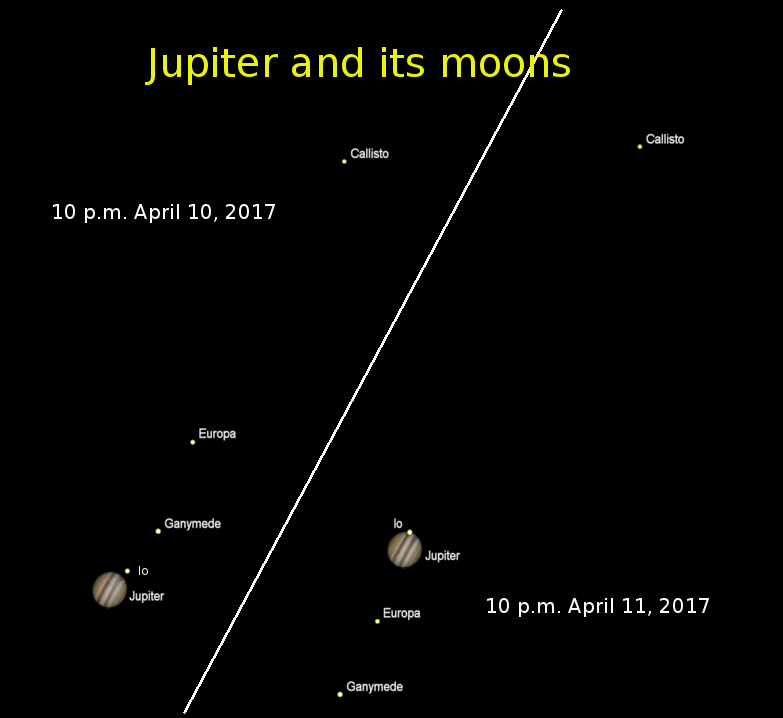
Jupiter and its moons in a telescope at 10 p.m. both April 10th & 11th, 2017. Created using Cartes du Ciel (Sky Charts).
For a year’s worth of Jovian satellite events and when the Great Red Spot crosses Jupiter’s central meridian, go to: http://www.projectpluto.com/jevent.htm.
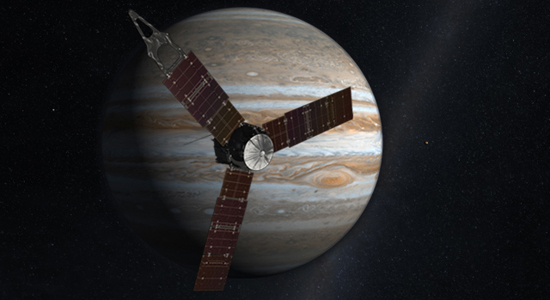
The Juno spacecraft. Credit: NASA.
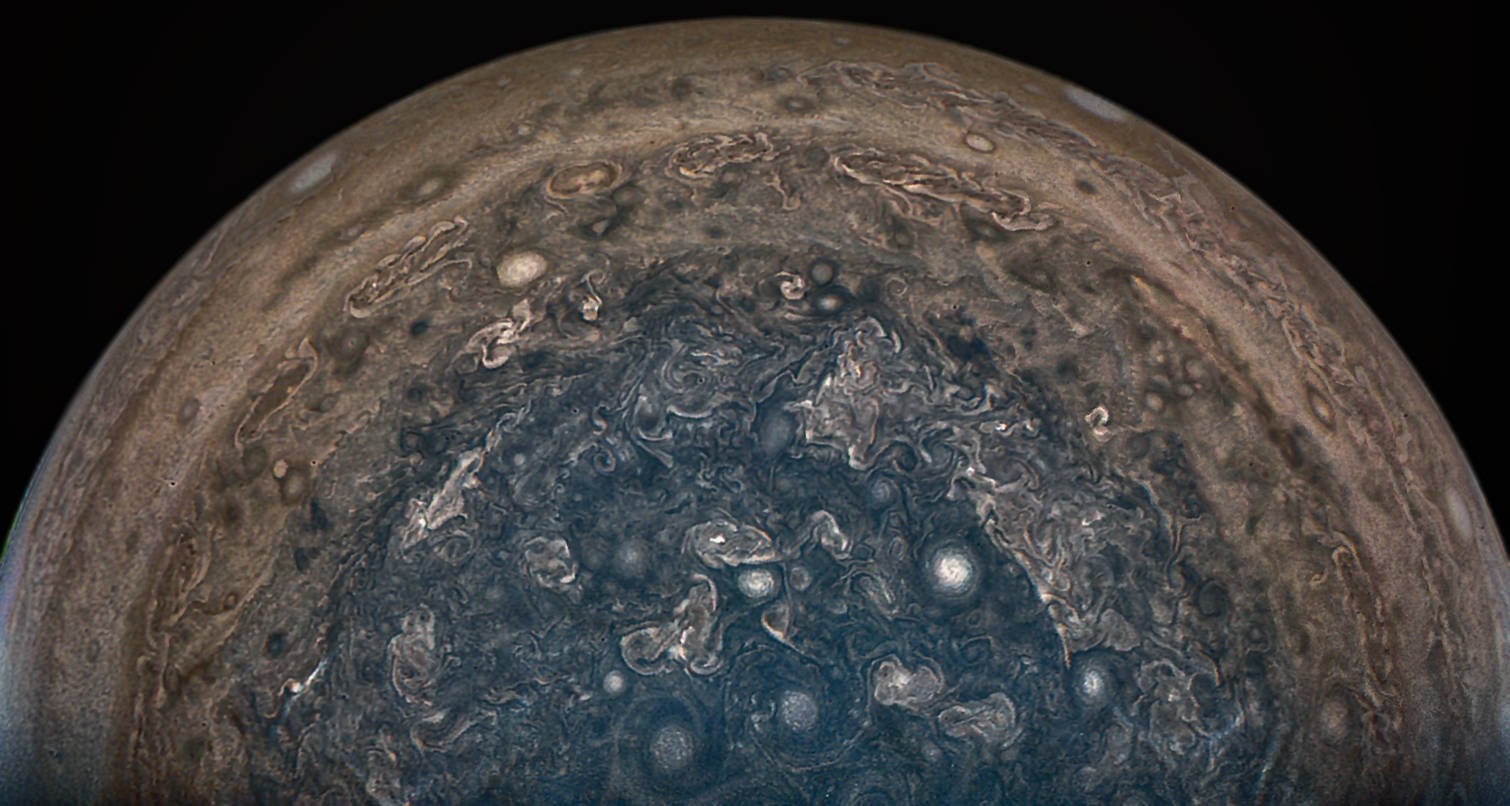
A February 2, 2017 Juno image of Jupiter’s south pole and its chaotic storm clouds. I think I have a paisley tie that looks like that. Credit NASA/JPL-Caltech/SwRI/MSSS/John Landino.
04/10/2017 – Ephemeris – Jupiter takes over as king of the evening sky
Ephemeris for Monday, April 10th. The Sun will rise at 7:06. It’ll be up for 13 hours and 14 minutes, setting at 8:21. The Moon, 1 day before full, will set at 7:36 tomorrow morning.
By the time we see the Moon tonight it will be about 5 hours from officially being full. However bright planet Jupiter should be easily visible about 5 moon diameters to the right and a bit above the Moon. In a small telescope it is easy to see the disk of Jupiter, and possible see the cloud bands in the atmosphere, due to the planet’s rapid rotation, of less than 10 hours. Jupiter’s mass is over 300 times the Earth’s, while one could squeeze over a thousand Earth’s into its volume. Jupiter has something like 67 satellites, but only for are visible in small to medium telescopes. Tonight they will be strung out all on one side of Jupiter, tomorrow night two will be on the other side of the planet, and another will be playing peek-a-boo in front of Jupiter.
The times given are for the Traverse City/Interlochen area of Michigan. They may be different for your location.
Addendum
Jupiter and its moons in a telescope at 10 p.m. both April 10th & 11th, 2017. Created using Cartes du Ciel (Sky Charts).
| Event | Date & Time EDT | Date & Time UT |
| Io Occultation Start | 10 April 2017 10:31 p.m. | 11 April 2017 2:31 |
| Io Eclipse ends | 11 April 2017 12:28 a.m. | 11 April 2017 4:46 |
| Ganymede Occultation start | 11 April 2017 4:28 a.m. | 11 April 2017 8:28 |
| Ganymede Eclipse end | Not visible | 11 April 2017 11:02 |
| Europa Occultation start | Not visible | 11 April 2017 18:44 |
| Europa Eclipse ends | Not visible | 11 April 2017 21:19 |
| Io Transit starts | Not visible | 11 April 2017 23:48 |
| Io Shadow ingress | Not visible | 11 April 2017 23:54 |
| Io Transit ends | 11 April 2017 8:58 p.m. | 12 April 2017 1:58 |
| Io Shadow egress | 11 April 2017 10:05 p.m. | 12 April 2017 2:05 |
Where times EDT show as not visible, Jupiter is below the horizon. Date and time UT are for observers in other locations. UT is Universal Time, or Greenwich Mean Time.
Occultation = moon passes behind Jupiter
Eclipse = moon in Jupiter’s shadow
Transit = moon passes in front of Jupiter
Shadow = moon’s shadow is cast on the face of Jupiter
04/07/2017 – Ephemeris – Learn about light pollution tonight
Ephemeris for Friday, April 7th. The Sun will rise at 7:12. It’ll be up for 13 hours and 5 minutes, setting at 8:17. The Moon, half way from first quarter to full, will set at 6:11 tomorrow morning.
This evening at 8 p.m. the Grand Traverse Astronomical Society will hold its monthly meeting at Northwestern Michigan College’s Rogers Observatory featuring a talk by observatory director Jerry Dobek about light pollution and what can be done about it to help preserve our dark night skies. I expect he will give us a progress report on the effort to make the Sleeping Bear Dunes National Lakeshore a Dark Sky Park. Special emphasis will be LEDs, now that they are proliferating, the good the bad and the ugly. At 9 p.m. there will be a star party with the gibbous Moon and Jupiter at opposition from the Sun and about at its closest to us at 414 million miles (666 million km) away.
Times are for the Traverse City/Interlochen area of Michigan. They may be different for your location.
Addendum
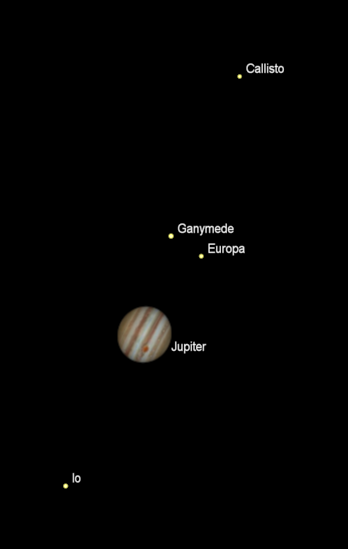
Jupiter and its moons as it should appear tonight at 10 p.m. April 7, 2017 (2 hr UT April 8). Note also the Great Red Spot, which may be paler than it appears here. I double checked the transit time of the red spot across Jupiter’s central meridian, which is predicted for 10:42 p.m. (2:42 UT, April 8) across Jupiter’s central meridian. The position of the Red Spot is correct for 10 p.m.
Times are from Project Pluto: https://www.projectpluto.com/jeve_grs.htm
04/06/2017 – Ephemeris – Jupiter will be opposite the Sun in the sky tomorrow
Ephemeris for Thursday, April 6th. The Sun will rise at 7:13. It’ll be up for 13 hours and 2 minutes, setting at 8:16. The Moon, 3 days past first quarter, will set at 5:39 tomorrow morning.
The planet Jupiter now rises around sunset. Tomorrow at 4:58 p.m. it will be officially in opposition from the Sun. This isn’t some conflict, but the simple fact that Jupiter will be opposite the Sun in our sky. It then will become an evening planet and in the next month or so will become a dazzling fixture in our evening sky, that it is now later in the evening. Jupiter is the second brightest planet after Venus, which is now emerging from the morning Sun’s twilight glare. Watch for it in next Wednesday’s planet report. Though the second brightest planet Jupiter by far is the largest planet. It’s mass exceeds the combines masses of all the other planets times two. Currently NASA’s Juno spacecraft is orbiting it.
Times are for the Traverse City/Interlochen area of Michigan. They may be different for your location.
Addendum
In a telescope the Jupiter system is quite dynamic. It’s four largest moons change position from night to night, and sometimes while you watch. The satellites sometimes duck behind Jupiter or through its shadow, or pass in front of the planet, casting their shadow on it. Close observation of Jupiter reveals details in its clouds. It rotates in less than 10 hours, over twice as fast as the Earth, which apparently whips the clouds into alternate light colored zones and darker brownish belts. There’s the Great Red Spot, which last I spotted it has faded to a pale pink, and located in the south edge of the south equatorial belt. The clouds rotate faster at the equator than at higher latitudes.
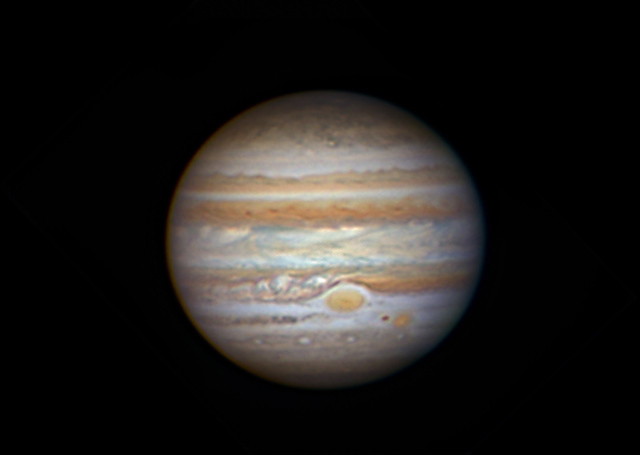
Jupiter with its Great Red Spot November 18, 2012 by Scott Anttila.
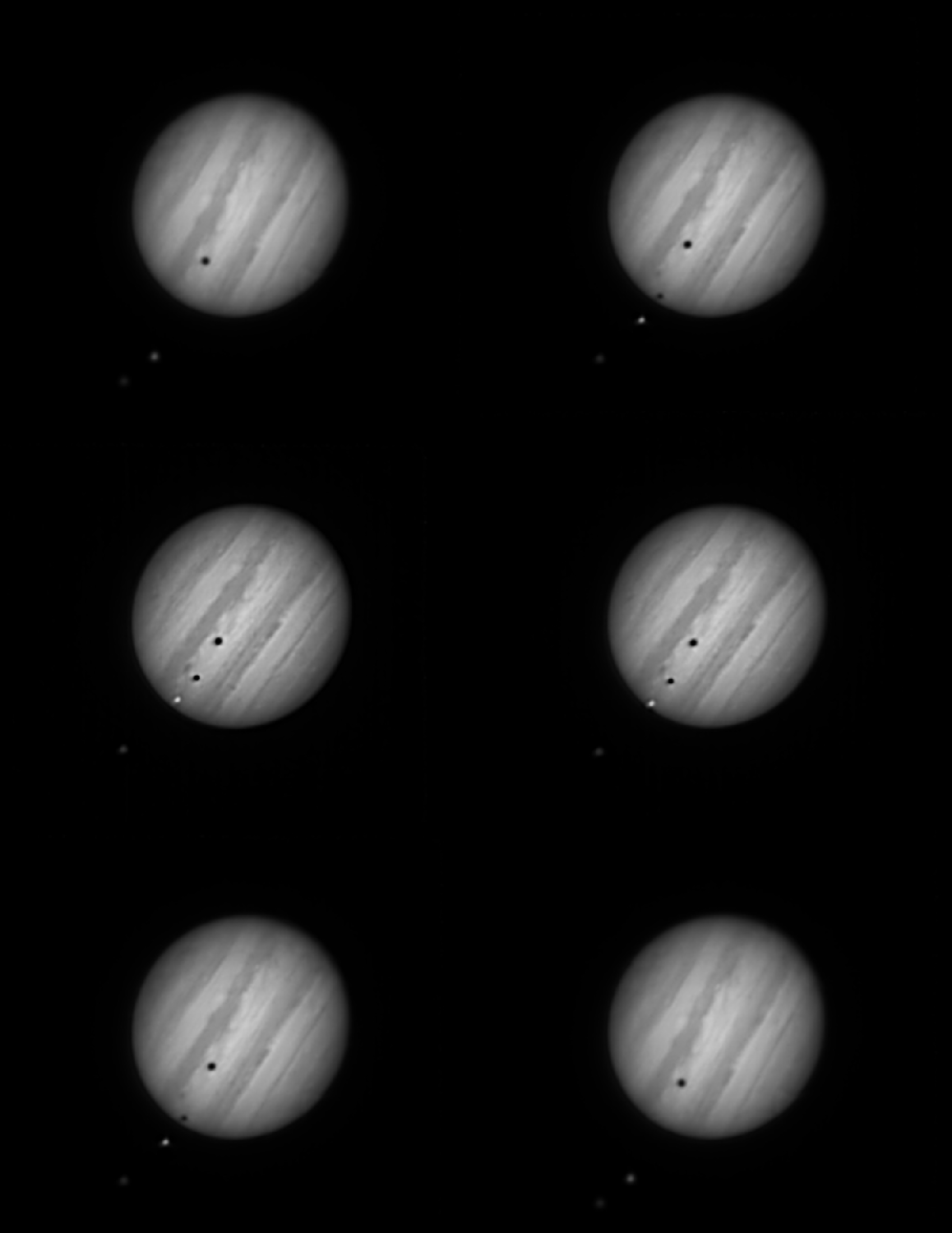
Rocking animation of the early stages of the shadow show on Jupiter. Callisto’s shadow already on the planet while Io’s shadow is just entering. Also Io’s transit is starting., following it’s shadow on the planet. Credit: Scott Anttila
04/05/2017 – Ephemeris – It’s Wednesday, do you know where your bright planets are?
Ephemeris for Wednesday, April 5th. The Sun will rise at 7:15. It’ll be up for 12 hours and 59 minutes, setting at 8:15. The Moon, 2 days past first quarter, will set at 5:04 tomorrow morning.
In the evening twilit sky tonight will feature the elusive planet Mercury. This tiny planet might be seen to the upper right of the Sun’s setting point starting about 9 p.m. It will set at 9:55 p.m. Mercury is getting rapidly fainter because it’s now exhibiting a diminishing crescent to us. It takes a good telescope and very steady skies to spot Mercury’s phase. Mars is still hanging on, in the west above and left of Mercury, and will set at 11:09 p.m. Jupiter will rise about sunset a half hour before the star Spica, which it will be seen to hang out with this year. Jupiter will be still seen in the morning sky low in the southwest at 6 a.m. Saturn then is in the south above the Teapot figure of Sagittarius. It will rise at 2:06 a.m. in the east-southeast.
Times are for the Traverse City/Interlochen area of Michigan. They may be different for your location.
Addendum
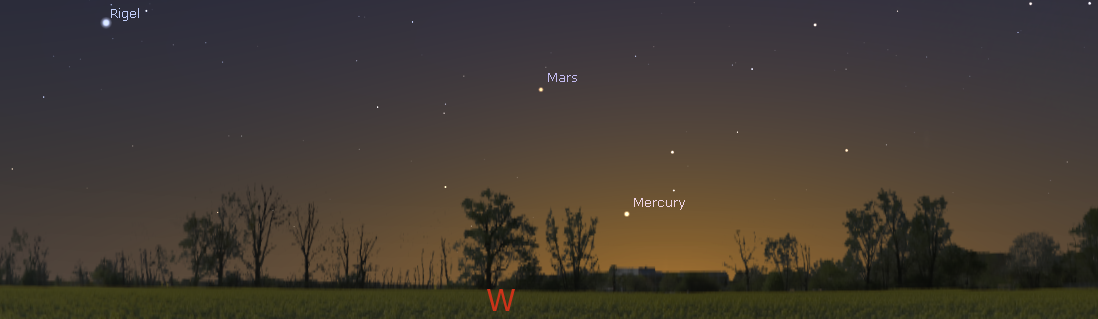
Mercury and Mars low in the west at 9 p.m. April 5, 2017. Created using Stellarium.
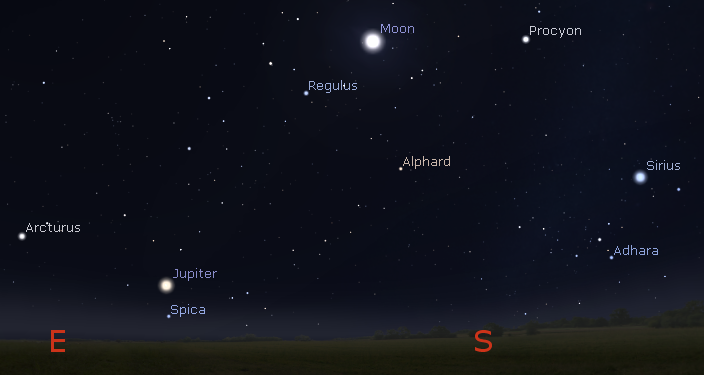
Jupiter and the Moon at 9:30 p.m. Created using Stellarium.
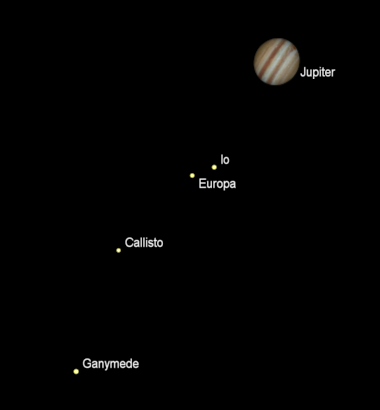
Jupiter and its moons as they might be seen in a telescope at 11 p.m. April 5, 2017. It is usually best to let planets rise a bit to minimize the atmospheric effects on the image. Created using Cartes du Ciel.
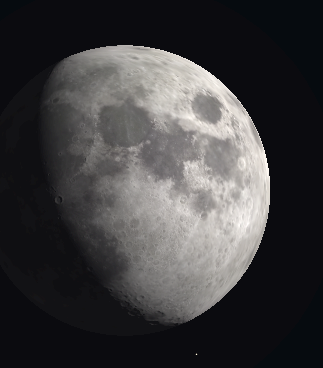
The Moon as it might be seen in binoculars at 9:30 p.m. April 5, 2016. Note the prominent crater Copernicus emerging into sunlight on the left of the Moon. Created using Stellarium.
If you’d like to check out the Moon in a telescope tonight, check out this posting : https://bobmoler.wordpress.com/2014/03/10/03102014-ephemeris-observibg-the-moon-tonight-and-the-crater-copernicus/
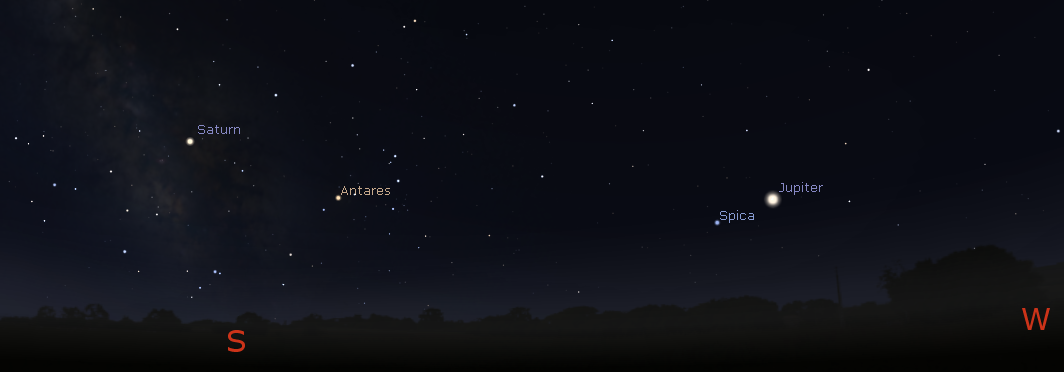
The planets visible at 6 a.m. April 6, 2017 Venus is just below the eastern horizon at this hour. Created using Stellarium.
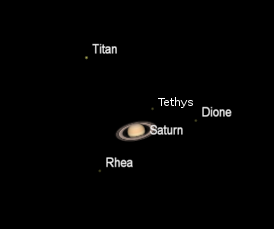
Saturn and its moons at 6 a.m. April 6th, 2017. Created using Cartes du Ciel (Sky Charts).
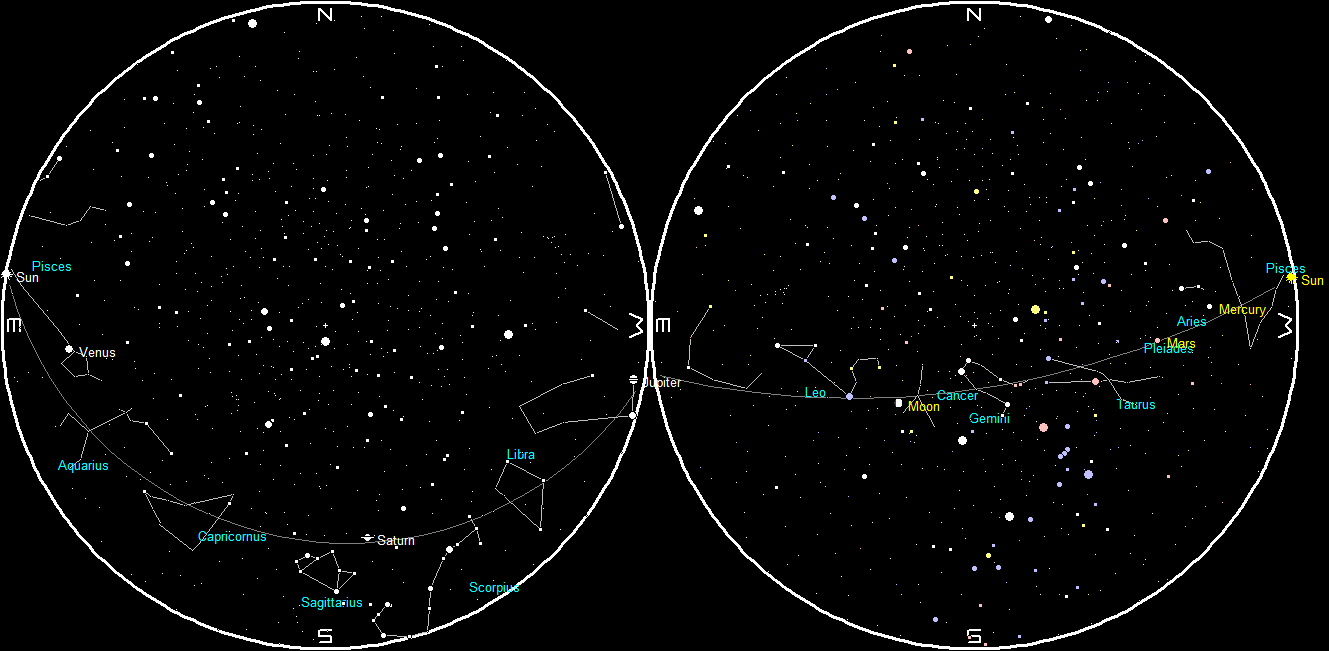
Planets and the Moon at sunset and sunrise of a single night starting with sunset on the right on April 5, 2017. The night ends on the left with sunrise on April 6. Click on the image to enlarge. Created using my LookingUp program.
A comet dramatically brightens
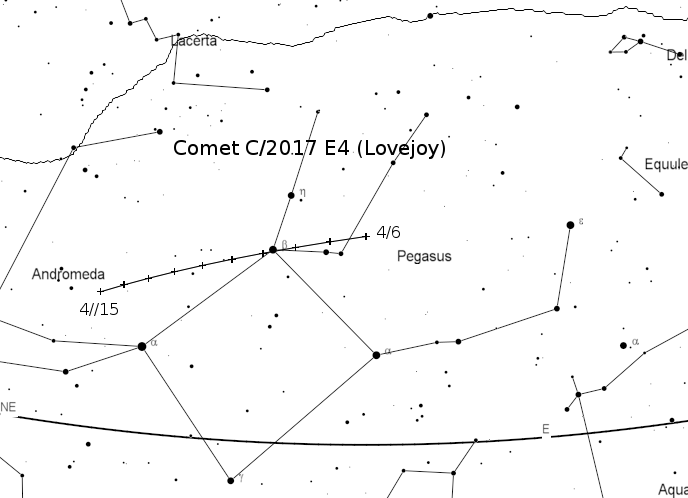
Here is the track for Comet 2017 E4 Lovejoy. This comet was expected to be 14th magnitude, but it’s brightness shot up to around 6.5, within range of binoculars. I’m only plotting 10 days. It should be brightest about mid-month, but is poorly placed for observation, plus we’re fighting a bright Moon. The curved horizontal line near the bottom is the Horizon on April 4, 2017. Created using Cartes du Ciel.
Universe today has lots more on the new Comet Lovejoy here: https://www.universetoday.com/134848/surprise-comet-e4-lovejoy-brightens/
04/04/2017 – Ephemeris – First relaunch and recovery of a rocket booster
Ephemeris for Tuesday, April 4th. The Sun will rise at 7:17. It’ll be up for 12 hours and 56 minutes, setting at 8:14. The Moon, 1 day past first quarter, will set at 4:24 tomorrow morning.
Last Thursday SpaceX launched a communications satellite, SES-10 toward geostationary orbit using a used Falcon 9 first stage booster, that landed last April. To them it’s not a used rocket but a flight proven booster. Elon Musk, SpaceX CEO is not going to try launch this booster a third time, but will give it to the Cape Kennedy Visitors Center. Re-usability is the key, according to Musk to his plans to get to Mars and to possibly reduce the cost of getting payloads into orbit by as much as 30% than his already lowest prices in the industry. Besides landing the booster on their automated drone ship, they were able to recover the two halves of the fairing that protects a satellite as it ascends through the atmosphere.
Times are for the Traverse City/Interlochen area of Michigan. They may be different for your location.
Addendum
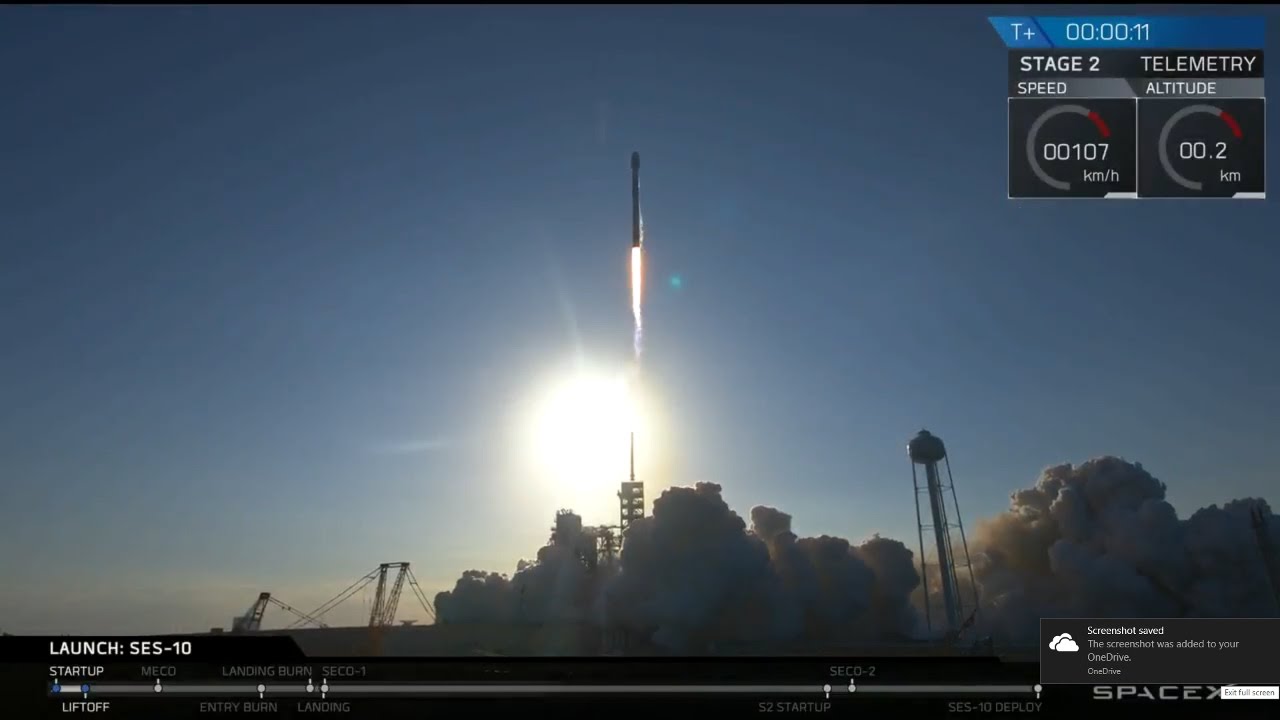
The second launching of this particular booster with the SES-10 satellite. Credit SpaceX video feed.
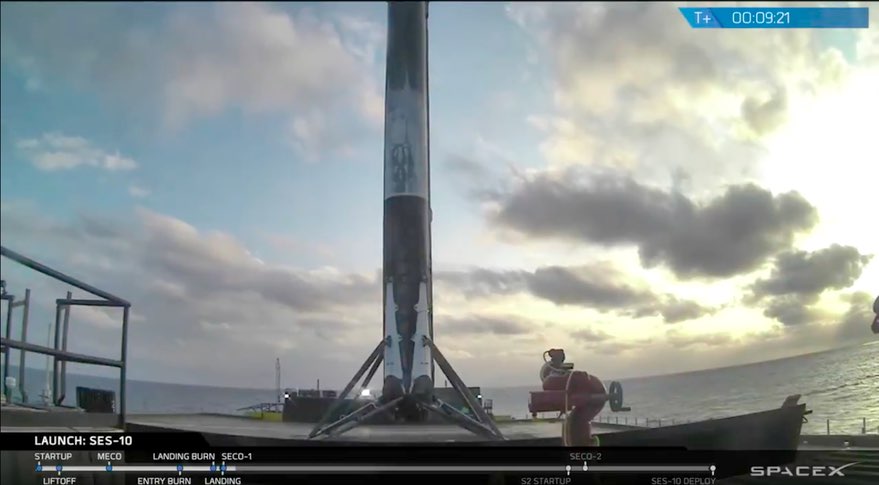
The video feed cut out during the landing of the booster, but the next shot was of the booster standing upright on the drone ship. Credit SpaceX video feed.
04/03/2017 – Ephemeris – A two bit* Moon today
Ephemeris for Monday, April 3rd. The Sun will rise at 7:19. It’ll be up for 12 hours and 53 minutes, setting at 8:12. The Moon, at first quarter today, will set at 3:38 tomorrow morning.
The Moon will be at exactly first quarter at 2:12 this afternoon (18:12 UT). By this evening for us the terminator line, which is the sunrise line on the Moon as the Moon’s phase waxes will be bowed to the left a bit. The names of the primary phases of the Moon are a bit odd. The quarter moons are named for their positions one quarter or 90 degrees from the Sun. The full moon describes it appearance as fully illuminated. New moon is odd too. To the Jews and the Arabs the New moon was the name for the first sighting of the crescent Moon after it disappeared from the morning sky. Astronomers use that term today for when the Moon is in conjunction with the Sun, day zero of a lunation or lunar month, about a day before its first appearance in the evening.
Times are for the Traverse City/Interlochen area of Michigan. They may be different for your location.
* If “two bit” is foreign to you. It dates back to US colonial times when the most prevalent coin around was the Spanish Dollar, also known as a piece of eight. A quarter of that was two bits, 25 cents in modern parlance. It lives on in the tune and knock sequence “Shave and a haircut, two bits” or five rapid knocks a pause and two more. See the movie “Who Framed Roger Rabbit?”.
Addendum
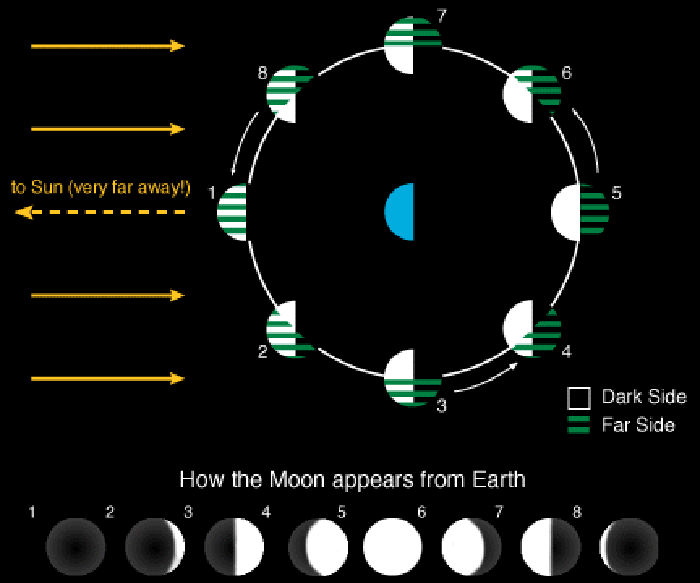
This is the best diagram of the Moon’s phases and how the it appears from the Earth. Credit http://planetfacts.org/phases-of-the-moon/ which I recommend.
However I do not like the label Dark Side. It is simply the night side. The Far Side is what many people mistakenly call the dark side, because we can never see it from the Earth. However the far side sees more sunlight than the near side. One, it is never darkened by an eclipse of the Moon, because it’s night-time there normally at that time. Two, at new moon it is fully facing the Sun, and also a quarter of a million miles closer to the Sun than the Earth is. So how can it be the dark side. Really. Come on people.
 Bob Moler's Ephemeris Blog