Archive
06/29/2018 – Ephemeris – Previewing July skies
Ephemeris for Friday, June 29th. Today the Sun will be up for 15 hours and 32 minutes, setting at 9:32, and it will rise tomorrow at 6:00. The Moon, 1 day past full, will rise at 10:38 this evening.
Lets preview July’s skies. The Sun, having reached its northern solstice, is beginning to slide southward again, at first imperceptibly, then with greater speed. The daylight hours will decrease from 15 hours and 30 minutes Sunday to 14 hours 41 minutes at month’s end. The daylight hours will be slightly shorter south of Interlochen, and slightly longer to the north. The altitude of the Sun at local noon, when the Sun is due south will decrease from 68 degrees today to 63 degrees at month’s end. The Sun will be a degree lower in the Straits area. Despite the warmth, the Earth will reach its greatest distance from the Sun on Friday the 6th. The planets visible this month in the evening are Venus, Jupiter, Saturn and later, Mars.
The times given are for the Traverse City/Interlochen area of Michigan. They may be different for your location.
Addendum
July Evening Star Chart
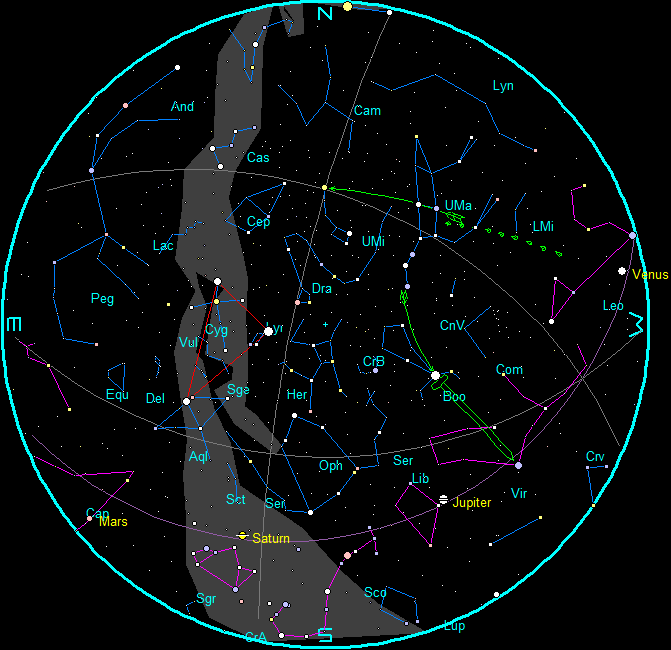
Star Chart for July 2018 (11 p.m. EDT July 15, 2018). Created using my LookingUp program. Click on image to enlarge.
The planets and stars are plotted for the 15th at 11 p.m. EDT in the evening and 4:30 a.m. for the morning chart. These are the chart times. Note that Traverse City is located approximately 45 minutes behind our time meridian. (An hour 45 minutes behind our daylight saving time meridian during EDT). To duplicate the star positions on a planisphere you may have to set it to 1 hour 45 minutes earlier than the current time.
Note the chart times of 11 p.m. and 4:30 a.m. are for the 15th. For each week before the 15th add ½ hour (28 minutes if you’re picky). For each week after the 15th subtract ½ hour. The planet positions are updated each Wednesday on this blog. For planet positions on dates other than the 15th, check the Wednesday planet posts on this blog.
July Morning Star Chart
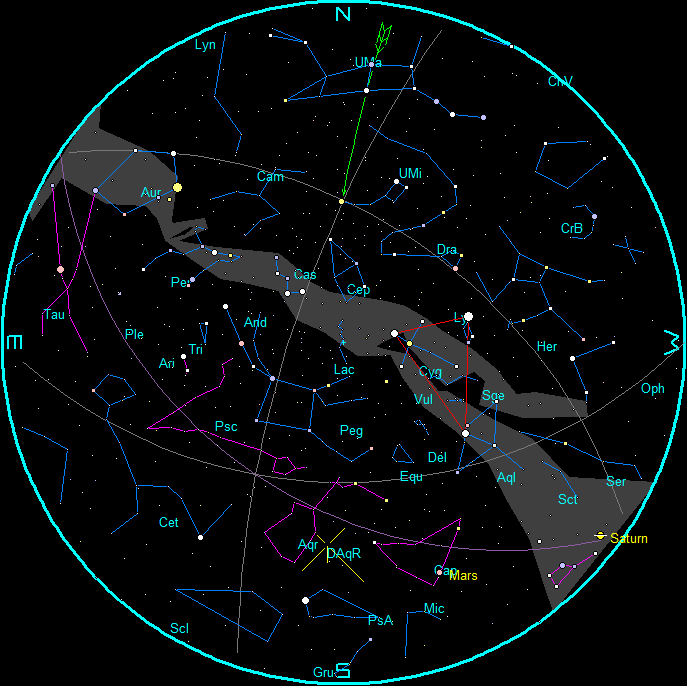
Star Chart for July 2018 mornings based on 4:30 a.m. July 15th. Created using my LookingUp program. Click on image to enlarge.
For a list of constellation names to go with the abbreviations click here.
Star chart annotations
- Pointer stars at the front of the bowl of the Big Dipper point to Polaris the North Star.
- Leaky Big Dipper drips on Leo.
- Follow the arc of the handle of the Big Dipper to the star Arcturus and
- Continue with a spike to Spica.
- The Summer Triangle is in red.
- DAqR – Delta Aquariid meteor shower radiant
Twilight
Evening nautical twilight ends at 11:00 p.m. EDT on the 1st, decreasing to 10:28 p.m. EDT on the 31st.
Evening astronomical twilight ends at 12:03 a.m. EDT on the 1st, decreasing to 11:28 a.m. EDT on the 31st.
Morning astronomical twilight starts at 3:38 a.m. EDT on the 1st, and increasing to 4:28 a.m. EDT on the 31st.
Morning nautical twilight starts at 4:41 a.m. EDT on the 1st, and increasing to 5:17 a.m. EDT on the 31st.
NASA Calendar of Planetary Events
Date        Time    Event
Jul 01  Su          Venus: 40.7° E
    04  We  1:39 am Mercury-Beehive: 0.6° S
    06  Fr  3:51 am Last Quarter
    06  Fr 11:59 am Aphelion: 1.0167 AU
    09  Mo  7:36 pm Venus-Regulus: 1° N
    10  Tu  5:30 am Moon-Aldebaran: 1.1° S
    12  Th 12:59 am Mercury Elongation: 26.4° E
    12  Th  8:01 am Moon North Dec.: 20.8° N
    12  Th 10:48 pm New Moon
    12  Th 11:01 pm Partial Solar Eclipse (S Australia)
    13  Fr  4:28 am Moon Perigee: 357400 km
    13  Fr 10:50 pm Moon Ascending Node
    14  Sa  6:04 pm Moon-Mercury: 2.2° S
    15  Su 12:14 pm Moon-Regulus: 1.7° S
    15  Su 11:31 pm Moon-Venus: 1.6° S
    19  Th  3:52 pm First Quarter
    20  Fr  7:57 pm Moon-Jupiter: 4.8° S
    25  We  2:10 am Moon-Saturn: 2.2° S
    25  We  4:55 pm Moon South Dec.: 20.8° S
    27  Fr  1:31 am Mars Opposition
    27  Fr  1:44 am Moon Apogee: 406200 km
    27  Fr  4:21 pm Full Moon
    27  Fr  4:22 pm Total Lunar Eclipse (S.America, Europe, Africa, Asia)
    27  Fr  6:40 pm Moon Descending Node
    28  Sa  4:50 pm Delta Aquarid Shower: ZHR = 20
    31  Tu  3:51 am Mars closest to the Earth 57.59 mkm
Aug 01  We          Venus: 45.1° E
Sky Events Calendar by Fred Espenak and Sumit Dutta (NASA’s GSFC),
http://eclipse.gsfc.nasa.gov/SKYCAL/SKYCAL.html
If you go to the above site you can print out a list like the above for the entire year
or calendar pages for your time zone.
Sun and Moon Rising and Setting Events
     LU                  Ephemeris of Sky Events for Interlochen/TC
     July, 2018    Local time zone: EDT
     +-----------------------------------------------------------------------+
     | DATE |  SUN     SUN  DAYLIGHT|   TWILIGHT*    |MOON  RISE OR    ILLUM |
     |      |  RISE    SET    HOURS |  END    START  |PHASE SET** TIME FRACTN|
     +=======================================================================+
     |Sun  1| 06:01a  09:32p  15:30 | 10:57p  04:35a |      Rise 11:49p   88%|
     |Mon  2| 06:01a  09:31p  15:30 | 10:56p  04:36a |      Rise 12:19a   81%|
     |Tue  3| 06:02a  09:31p  15:29 | 10:56p  04:37a |      Rise 12:47a   72%|
     |Wed  4| 06:02a  09:31p  15:28 | 10:56p  04:37a |      Rise 01:13a   63%|
     |Thu  5| 06:03a  09:30p  15:27 | 10:55p  04:38a |      Rise 01:39a   53%|
     |Fri  6| 06:04a  09:30p  15:26 | 10:54p  04:39a |L Qtr Rise 02:06a   43%|
     |Sat  7| 06:04a  09:30p  15:25 | 10:54p  04:40a |      Rise 02:36a   33%|
     +------+-----------------------+----------------+-----------------------+
     |Sun  8| 06:05a  09:29p  15:24 | 10:53p  04:41a |      Rise 03:10a   23%|
     |Mon  9| 06:06a  09:29p  15:22 | 10:52p  04:42a |      Rise 03:50a   14%|
     |Tue 10| 06:07a  09:28p  15:21 | 10:51p  04:43a |      Rise 04:38a    7%|
     |Wed 11| 06:08a  09:28p  15:20 | 10:51p  04:44a |      Rise 05:36a    2%|
     |Thu 12| 06:08a  09:27p  15:18 | 10:50p  04:46a |New   Set  09:09p    0%|
     |Fri 13| 06:09a  09:26p  15:17 | 10:49p  04:47a |      Set  10:04p    1%|
     |Sat 14| 06:10a  09:26p  15:15 | 10:48p  04:48a |      Set  10:50p    5%|
     +------+-----------------------+----------------+-----------------------+
     |Sun 15| 06:11a  09:25p  15:14 | 10:47p  04:49a |      Set  11:29p   12%|
     |Mon 16| 06:12a  09:24p  15:12 | 10:46p  04:50a |      Set  12:02a   21%|
     |Tue 17| 06:13a  09:24p  15:10 | 10:44p  04:52a |      Set  12:32a   31%|
     |Wed 18| 06:14a  09:23p  15:08 | 10:43p  04:53a |      Set  01:01a   41%|
     |Thu 19| 06:15a  09:22p  15:07 | 10:42p  04:54a |F Qtr Set  01:29a   52%|
     |Fri 20| 06:16a  09:21p  15:05 | 10:41p  04:56a |      Set  01:57a   62%|
     |Sat 21| 06:17a  09:20p  15:03 | 10:40p  04:57a |      Set  02:28a   72%|
     +------+-----------------------+----------------+-----------------------+
     |Sun 22| 06:18a  09:19p  15:01 | 10:38p  04:58a |      Set  03:03a   80%|
     |Mon 23| 06:19a  09:18p  14:59 | 10:37p  05:00a |      Set  03:41a   87%|
     |Tue 24| 06:20a  09:17p  14:57 | 10:36p  05:01a |      Set  04:25a   93%|
     |Wed 25| 06:21a  09:16p  14:55 | 10:34p  05:03a |      Set  05:13a   97%|
     |Thu 26| 06:22a  09:15p  14:53 | 10:33p  05:04a |      Set  06:06a   99%|
     |Fri 27| 06:23a  09:14p  14:50 | 10:31p  05:05a |Full  Rise 09:16p  100%|
     |Sat 28| 06:24a  09:13p  14:48 | 10:30p  05:07a |      Rise 09:51p   99%|
     +------+-----------------------+----------------+-----------------------+
     |Sun 29| 06:25a  09:12p  14:46 | 10:28p  05:08a |      Rise 10:23p   96%|
     |Mon 30| 06:26a  09:10p  14:44 | 10:27p  05:10a |      Rise 10:51p   91%|
     |Tue 31| 06:27a  09:09p  14:41 | 10:25p  05:11a |      Rise 11:17p   85%|
     +-----------------------------------------------------------------------+
     * Nautical Twilight
     ** Moonrise or moonset, whichever occurs between sunrise and sunset
Ephemeris of Sky Events is created with my DOS version LookingUp program.
06/28/2018 – Ephemeris – Saturn at opposition, what it means
Ephemeris for Thursday, June 28th. Today the Sun will be up for 15 hours and 32 minutes, setting at 9:32, and it will rise tomorrow at 6:00. The Moon, at full today, will rise at 9:54 this evening.
Just before midnight last night Saturn was in opposition to the Sun. We’re not talking about an argument here. To the astronomer opposition simply means that a planet, in this case Saturn, is 180 degrees from the Sun, or opposite the Sun in the sky. It is a time when the planet rises at sunset and sets at sunrise. It is also a time when the planet is around its closest to the Earth. It’s not a big deal for Saturn, which is almost 10 times farther from the Sun than we are. However it is a big deal for a nearby planet like Mars, which at the end of July will be closer to us than at any time since 2003, at 35.8 million miles. That’s a big deal since Mars is a small planet, a bit more than half the size of the Earth.
The times given are for the Traverse City/Interlochen area of Michigan. They may be different for your location.
Addendum
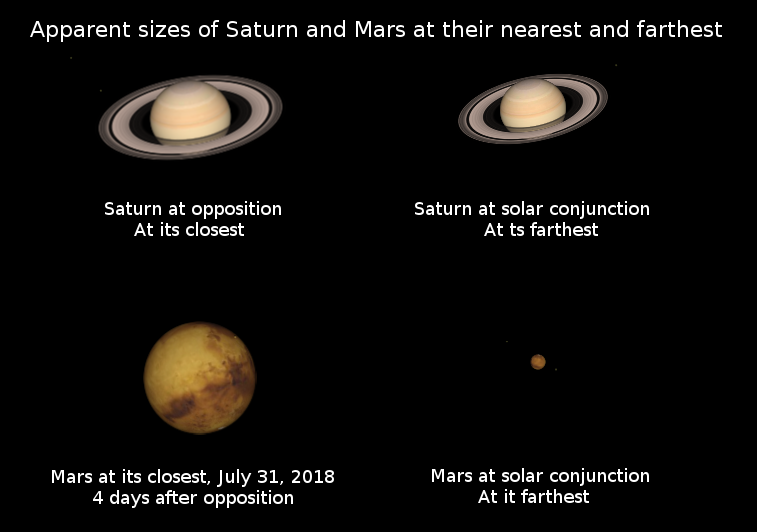
The apparent sizes of Saturn and Mars as seen from the Earth at opposition and solar conjunction. All at the same scale. Created using Cartes du Ciel (Sky Charts).
06/27/2018 – Ephemeris – Our Wednesday look at the bright planets
Wednesday, June 27th. Today the Sun will be up for 15 hours and 33 minutes, setting at 9:32, and it will rise tomorrow at 5:59. The Moon, 1 day before full, will set at 6:27 tomorrow morning.
It’s Wednesday again and time to look for and at the bright planets. Three of them are in the evening sky. The brilliant beacon of Venus will be visible in the western twilight from about 9:50 p.m. until it sets at 11:53 p.m. Mercury is far below and right of it, setting at 10:59 p.m. Jupiter will be in the south as it gets dark. Jupiter is only outshone by Venus and the Moon, though Mars will outshine it next month at its closest. Jupiter will set at 3:05 a.m. Binoculars will show it to be bigger than star-like in size. Saturn which is opposite the Sun in the sky today will rise as the Sun sets. It’s right below the Moon tonight. Mars will rise at 11:39 p.m. and is now outshining Saturn.
The times given are for the Traverse City/Interlochen area of Michigan. They may be different for your location.
Addendum
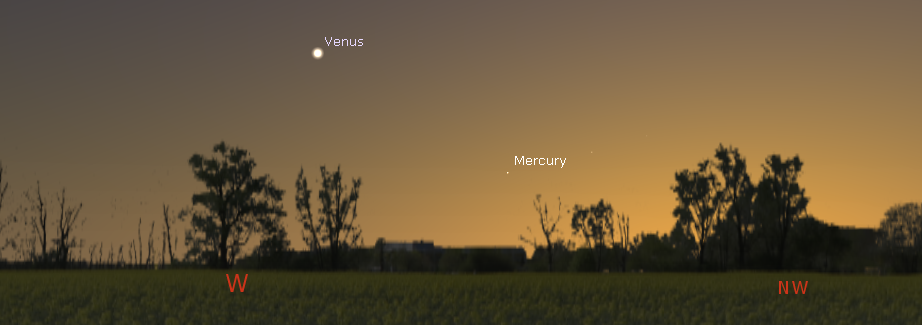
Venus and Mercury low in the western sky ay 10 p.m. June 27, 2018. Click on image to enlarge. Created using Stellarium.
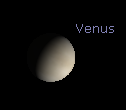
Telescopic appearance of Venus on June 27, 2018. A moon filter helps cut down the glare to be able to more easily see the phase. Created using Stellarium.
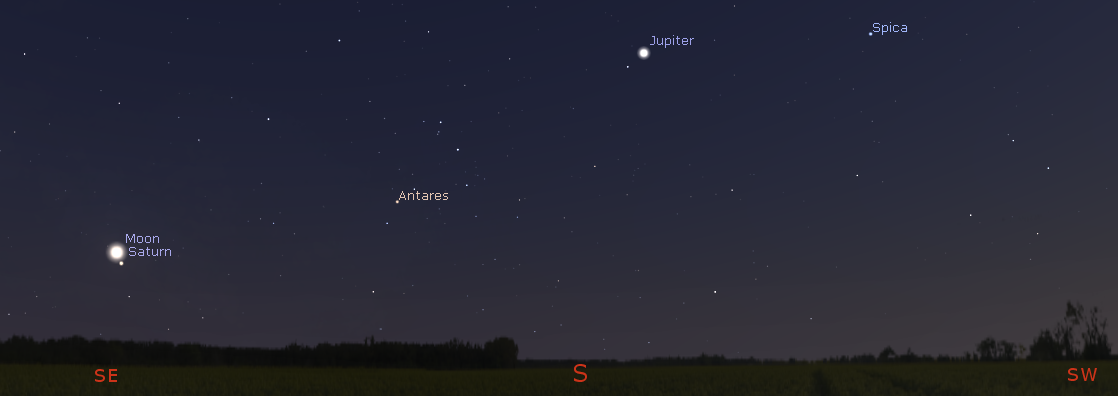
Jupiter, Saturn and the Moon tonight at 10:30 p.m. on June 27, 2018. Click on the image to enlarge. Created using Stellarium.
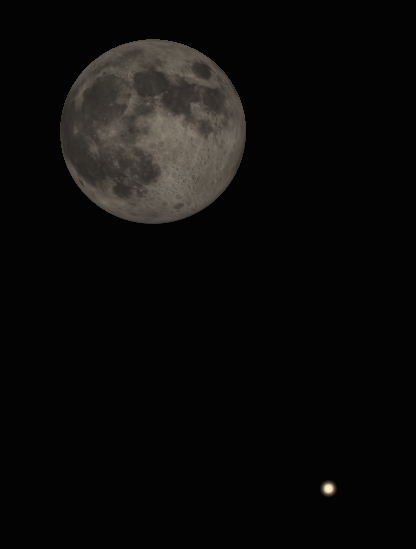
The Moon and Saturn as they might appear in binoculars at 10:30 p.m. June 27, 2018. Created using Stellarium.
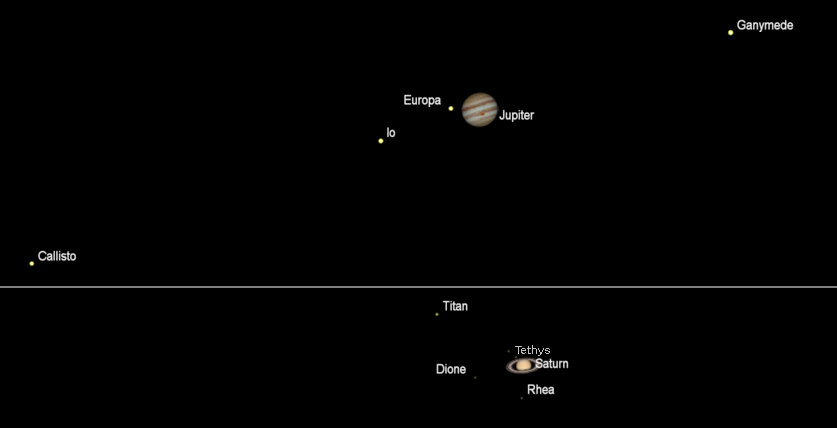
Jupiter and Saturn with the same magnification at 10:30 p.m. June 27, 2018. Information on Europa events and the Great Red Spot is below. Created using Cartes du Ciel (Sky Charts).
Moon   Event            Universal Time    Local Time
Europa Transit start    28 Jun 2018 3:30  27 Jun 2018 11:30 p.m.
Europa Shadow start     28 Jun 2018 5:34  28 Jun 2018  1:34 a.m.
Europa Transit end      28 Jun 2018 5:44  28 Jun 2018  1:44 a.m.
Europa Shadow end       28 Jun 2018 7:49  28 Jun 2018  3:49 a.m.
Great Red Spot Transit  28 Jun 2018 2:32  27 Jun 2018 10:32 p.m.
Source of Jovian events: https://www.projectpluto.com/jevent.htm
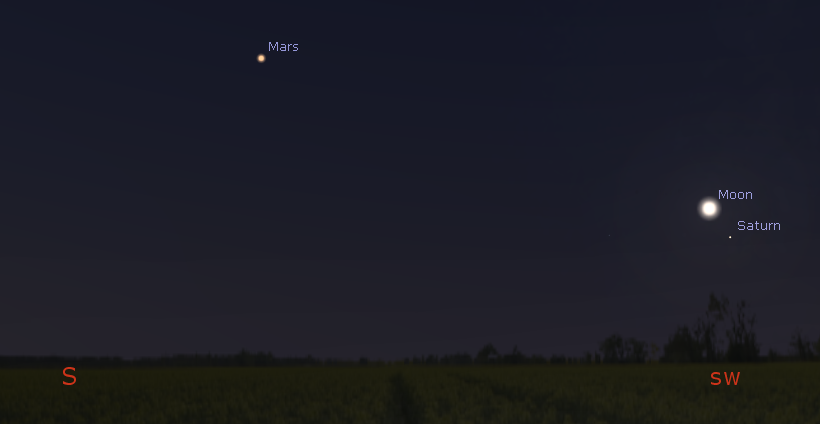
Mars, Saturn and the Moon at 5 a.m. June 28, 2018. Click on the image to enlarge. Created using Stellarium.
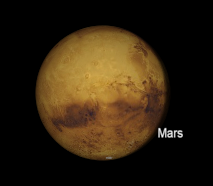
Greatly enlarged telescopic Mars at 5 a.m. June 28, 2018. Note that the dark albedo features may be covered by a global dust storm currently raging on the Red Planet. Created using Cartes du Ciel (Sky Charts).
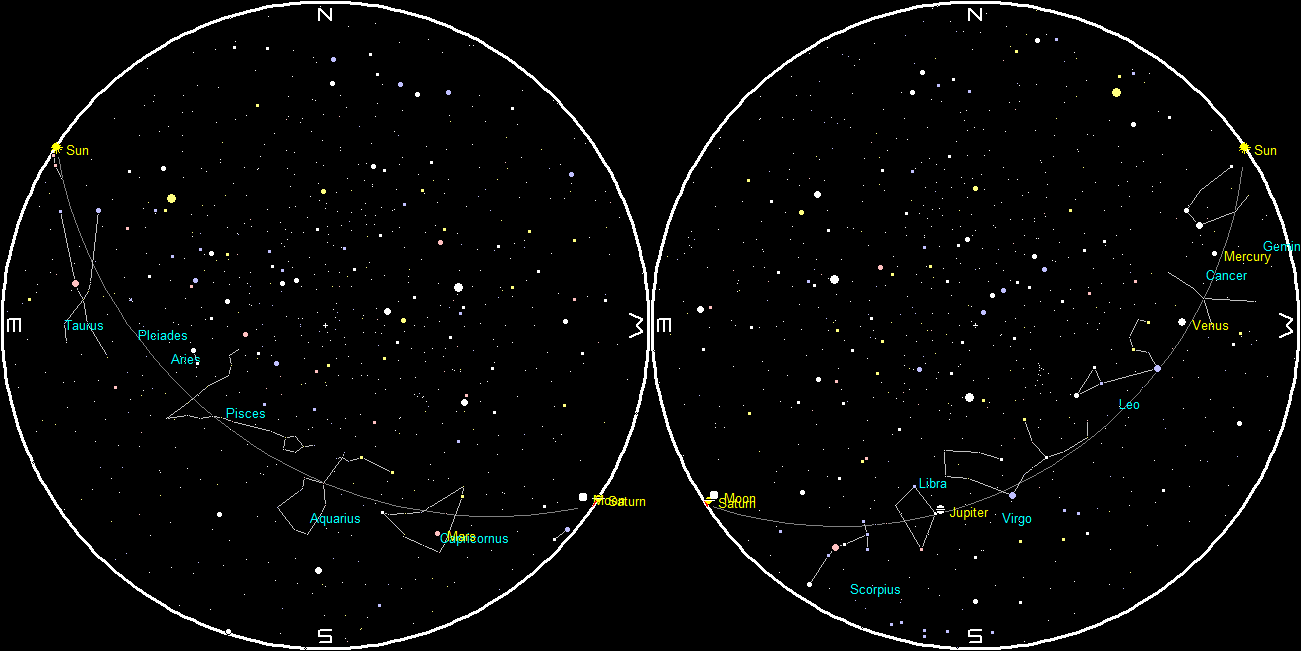
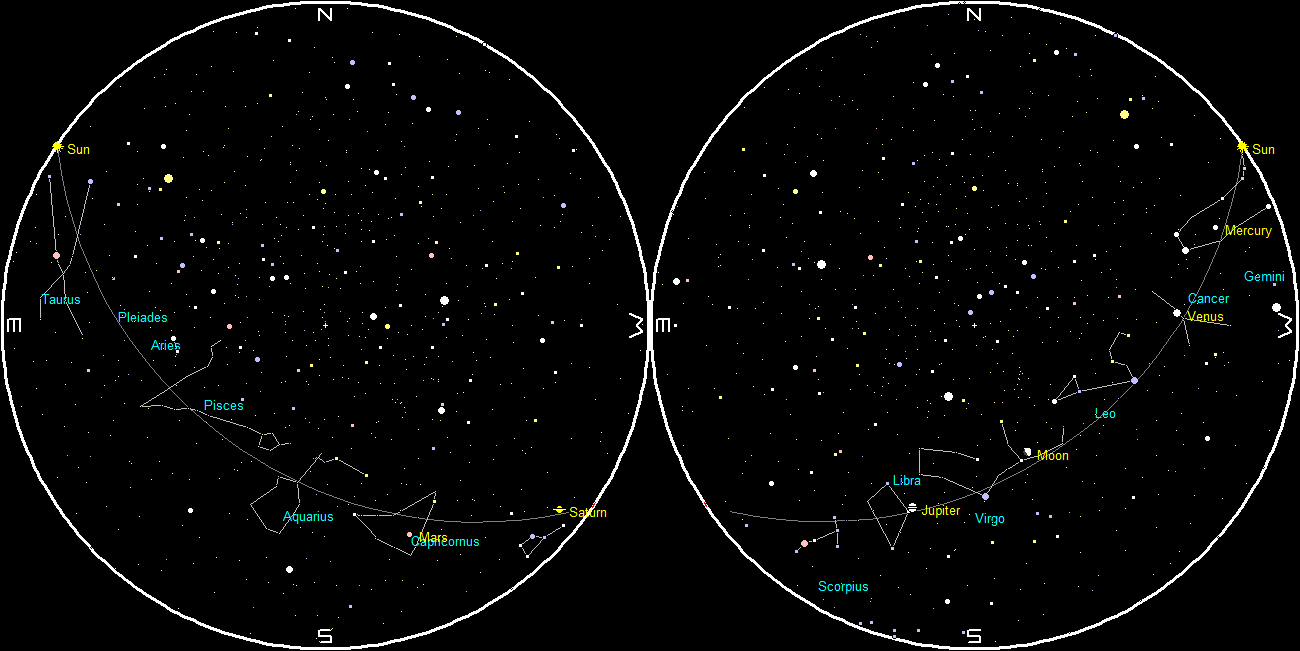
Planets and the Moon at sunset and sunrise of a single night starting with sunset on the right on June 27, 2018. The night ends on the left with sunrise on the 28th. Click on the image to enlarge. Created using my LookingUp program.
06/26/2018 – Ephemeris – Latest sunset of the year
Ephemeris for Tuesday, June 26th. Today the Sun will be up for 15 hours and 33 minutes, setting at 9:32, and it will rise tomorrow at 5:59. The Moon, 2 days before full, will set at 5:42 tomorrow morning.
Today is the day of the latest sunset, at least for around latitude 45 degrees north. It will be within the same minute for the next 5 days, before it retreats. By the end of July sunset will be at 9:09 p.m. The lopsidedness of the dates of earliest sunrise and latest sunset is caused by two factors. The Sun’s high latitude or declination above the equator, which makes it appear to move faster, countered in the summer by the fact that the Earth is almost at its farthest from the Sun, which makes it appear to be slower. These effects are why sundials don’t keep proper clock time without the adjustment of the equation of time to the readout, or fancy sundials that take that into account.
The times given are for the Traverse City/Interlochen area of Michigan. They may be different for your location.
Addendum
In a post from last year I looked at the equation of time: https://bobmoler.wordpress.com/2017/03/13/03132017-ephemeris-more-thoughts-about-yesterdays-time-change/
06/25/2018 – Ephemeris – Andromeda’s Parachute
Ephemeris for Monday, June 25th. Today the Sun will be up for 15 hours and 34 minutes, setting at 9:32, and it will rise tomorrow at 5:58. The Moon, 3 days before full, will set at 5:02 tomorrow morning.
A recent post of Dr. Phil Plait’s Bad Astronomy Blog caught my eye. The object discovered is being called Andromeda’s Parachute. It has three relatively bright star-like points arranged in an arc like a parachute canopy, with another star-like point beneath it as the parachutist. It is the light from a single quasar, an active galaxy nucleus being split up by the gravitational lens of a closer, but dimmer galaxy in between us and the quasar. It’s very beautiful, and within reach of only the biggest telescopes. It was discovered using the Pan-STARRS telescope on Haleakala in Maui by George Nelson.
The times given are for the Traverse City/Interlochen area of Michigan. They may be different for your location.
Addendum
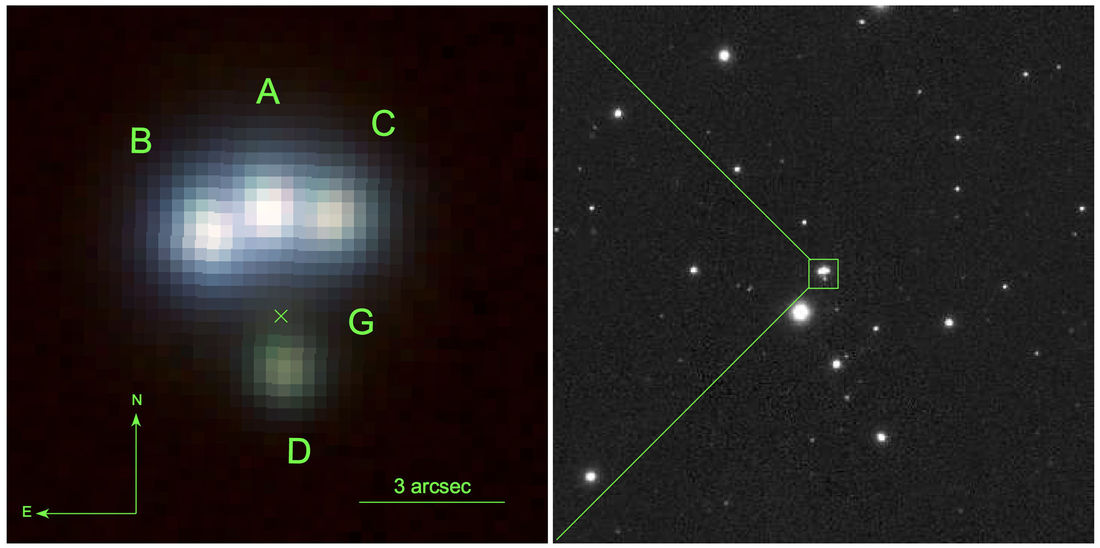
Quadruple quasar dubbed Andromeda’s parachute. The four images (A-D) of the quadruply lensed quasar J014709+463037 can be seen in this deep image taken by the Pan-STARRS telescope. The lensing galaxy (G) is marked by an X. Credit: Berghea et al.
The Bad Astronomer’s original post
06/24/2018 – I’ll be out at the Sleeping Bear National Lakeshore Dune Climb tonight
I’m hoping to be out there and set up before 9 p.m. It’s a planet fest of sorts with Venus, Jupiter and Saturn plus a nearly full Moon. Sorry, Mars won’t rise till nearly midnight. Dress warmly, it’s supposed to get down into the 50’s, and with a north wind, may seem even colder.
See you there?
Keep looking up!
06/24/2018 – Ephemeris Extra – Mars Summers
This is a reprint of “Mars Summer” which I wrote for the Grand Traverse Astronomical Society newsletter Stellar Sentinel’s June 2018 issue.
The planet Mars has oppositions from the Sun about every 26 months more or less. These oppositions are a time when Mars is closest to the Earth for its position in orbit. It’s distance at these times range from 34.6 to almost 63 million miles, a range of almost 2 to 1. This is because Mars has a very elliptical orbit as can be seen below.
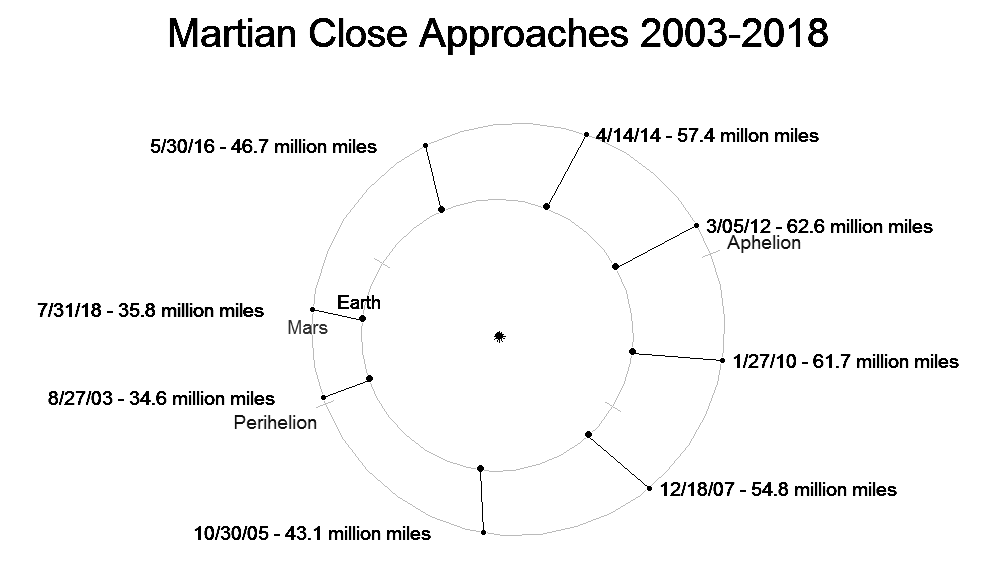
Mars closest approaches to the Earth from August 27, 2003 to July 31, 2018. Diagram created using Bob Moler’s LookingUp program.
Especially close approaches to the Earth occur every 15 or 17 years in the latter half of summer in those years. My first close approach was September 7, 1956. It was a famous one for the time. Professional astronomers of that time were pretty sure that Mars didn’t have canals, features that were ‘discovered’ by Giovanni Schiaparelli in 1877. To him the features were grooves or channels. Unfortunately the Italian word for them was canali. The world press proclaimed that there were “canals” on Mars. Canals by definition are artificial and require canal builders, Martians by inference.
Like I said, professional astronomers had discounted them by 1956. But science fiction read by young impressionable amateur astronomers like myself talked about old races of Martians hoarding every last drop of water. So maybe we believed. With my 5 inch reflector I observed the polar cap and the large dark feature Syrtis Major.
My next close approach of Mars was August 12, 1971. That summer I was working out of town and in the midst of a move from Grand Rapids to Traverse City, so was unable to observe Mars properly.
In the summer and autumn of 1973 I was able to do an observing program of Mars when it was almost as close as in 1971, drawing its features. I found out that to really observe a planet it takes time to educate the eye and brain to see faint, fuzzy detail. And since I didn’t believe in canals by this time, I didn’t see them.
The next close approach was September 22, 1988. The first “Mars Night” held by the society. We had a great turnout. But Mars was tiny as seen in telescopes. At best it was 23.81 seconds of arc in diameter. The Moon and Sun are about 1,800 seconds in diameter. It would be a bit larger than half the apparent diameter of Jupiter at average distance.
On August 27, 2003 Mars came closer than at any time in 50,000 years some astronomers said. The society held its second “Mars Night” at the Rogers Observatory, and wow, the lines of people ran down the drive and onto the shoulder of the road. As in 1988, I was stationed on the lawn at the front of the observatory with the portable Celestron 11 telescope, which actually gave clearer views than the 14 inch telescope in the dome. (Hot bodies in dome make for lousy seeing.)
2003 is also memorable or rather infamous for the “Mars Hoax” email. Proclaiming that Mars would appear as large as the Moon on August 27th. This hoax has been propagated every two years since. I expect 2018 to be a banner year for the resurrection of the hoax.
We come to this year, 2018, 15 years after the 2003 closest approach. Mars will reach opposition on July 27th. It’s closest approach to the Earth will be on July 31st, at the distance of 35,784,000 miles. The reason the dates aren’t the same is that Mars will still be a month before reaching perihelion, its closest to the Sun, so it’s getting even closer than at the time of opposition.
The Mars oppositions of October 2020, December 2022, January 2025 and February 2027 will be of increasing distances up to 63.0 million miles. This will be followed by oppositions of decreasing distances in March 2029, May 2031, and July 2033 leading to another close approach on September 11, 3035 at 35.4 million miles.
However by 2035 there may be humans on Mars waving back at us. It’s odd that anyone on Mars at the time probably wouldn’t be able to see the Earth at that time. Martian oppositions for us, are the time of inferior conjunctions of Earth with the Sun. We’d be lost in the Sun’s glare.
For the very closest views of Mars get on the Internet and search for Mars Curiosity, Mars Opportunity and Mars Hirise. No telescope required.
06/22/2018 – Ephemeris – Sun ‘n Star Party scheduled for tomorrow June 23
Ephemeris for Friday, June 22nd. Today the Sun will be up for 15 hours and 34 minutes, setting at 9:32, and it will rise tomorrow at 5:57. The Moon, 2 days past first quarter, will set at 3:25 tomorrow morning.
Tomorrow afternoon and evening will be what we call a Sun & Star Party at the Sleeping Bear Dunes National Lakeshore. This event will be held at the Dune Climb. From 4 to 6 p.m., the Sun will be featured using two types of telescopes, one showing the sun’s photosphere in what we call white light, hoping the Sun will produce a sunspot of two, and another showing the chromosphere above it in the light of hydrogen giving a completely different view with possibly more activity. Starting at 9 p.m. will be a star party, actually really a planet party, viewing the planets Venus, Jupiter and Saturn, plus the Moon. There will be other objects visible in the deepening twilight. The event is due to the cooperation of the Grand Traverse Astronomical Society and the park rangers.
Update: The Sun and Star Parties are subject to cancellation separately based on weather. Check back to this here if there is a cancellation or call the park at 231-326-4700. The park’s web page for this event is here. If Saturday night star party is cancelled, some members of the society will hold their own observation session at the Dune Climb Sunday night. Notification will be posted by 7 p.m. here if that event will take place. We also invite anyone with a telescope and experienced in its use to join us. For anyone who wants to have us look at their telescope or give them tips, come to our NMC Rogers observatory star parties which are listed on our society web site: http://www.gtastro.org. Those star parties are less hectic.
The times given are for the Traverse City/Interlochen area of Michigan. They may be different for your location.
Addendum
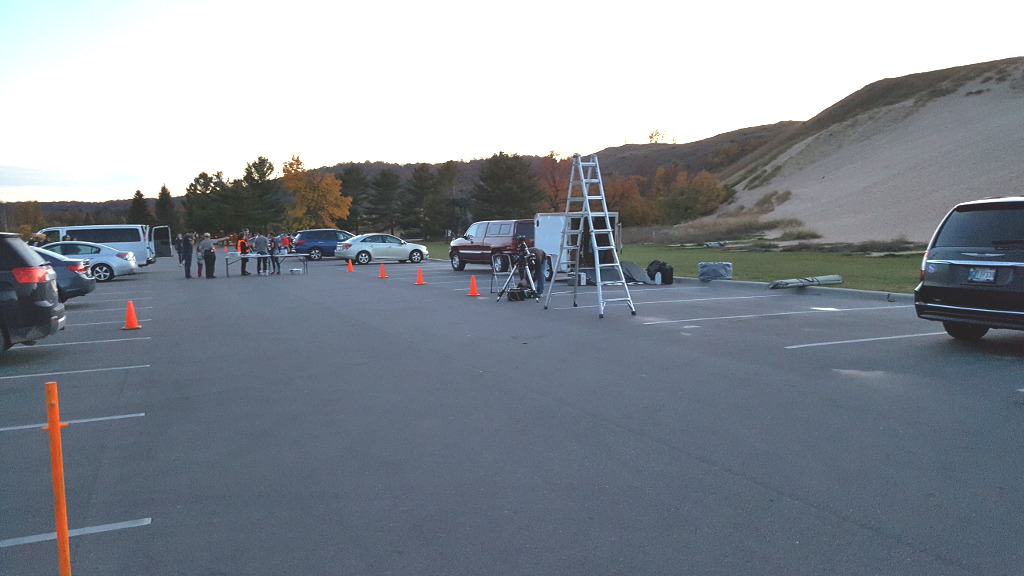
This in the beginning of setup for the October 21, 2917 star party at the dune climb. Taken early while there was enough light. The dune blocks up to 12 degrees from the southwest to northwest, but the rest of the horizon is quite low. Venus will be high enough to clear the dune for most of the evening.
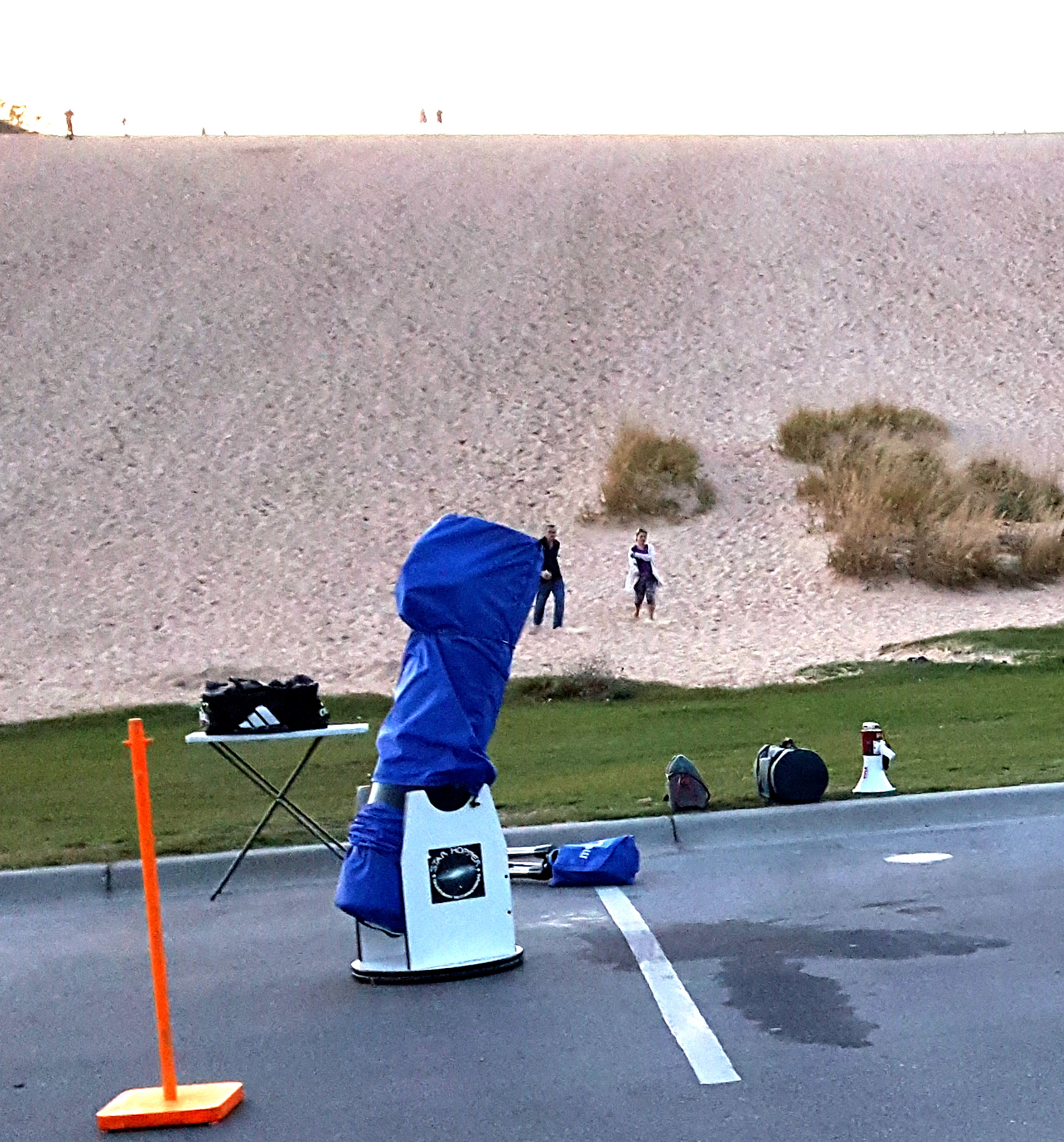
My equipment at the Dune Climb on October 21, 2017. My 11″ Dobsonian is in the foreground. The tripod for my Celestron 8 is laying on the ground behind it yet to be set up.
I pointed the Dobsonian at a variety of deep sky objects, while the C8 was pointed to Saturn and tracking that night.
06/21/2018 – Ephemeris – Yay, summer is here!
Ephemeris for Thursday, June 21st. Today the Sun will be up for 15 hours and 34 minutes, setting at 9:32, and it will rise tomorrow at 5:57. The Moon, 1 day past first quarter, will set at 2:57 tomorrow morning.
Welcome to summer! It began at 6:07 this morning. If you remember back to winter and the beautiful constellation of Orion. Some folks could trace the club he was holding over his head off the red star Betelgeuse. The Sun now appears above that. If you remember Gemini the twins, well the Sun is off Castor’s big toe. That’s all pretty high in the sky and giving us 15 hours and 34 minutes of daylight. That’s why summer’s so hot. This despite the fact that in two weeks we will be the farthest we get from the Sun all year. The 3 million mile difference in the Sun’s annual distance is peanuts compared to the seasonal fluctuations caused by the tilt of the Earth’s axis.
The times given are for the Traverse City/Interlochen area of Michigan. They may be different for your location.
Addendum
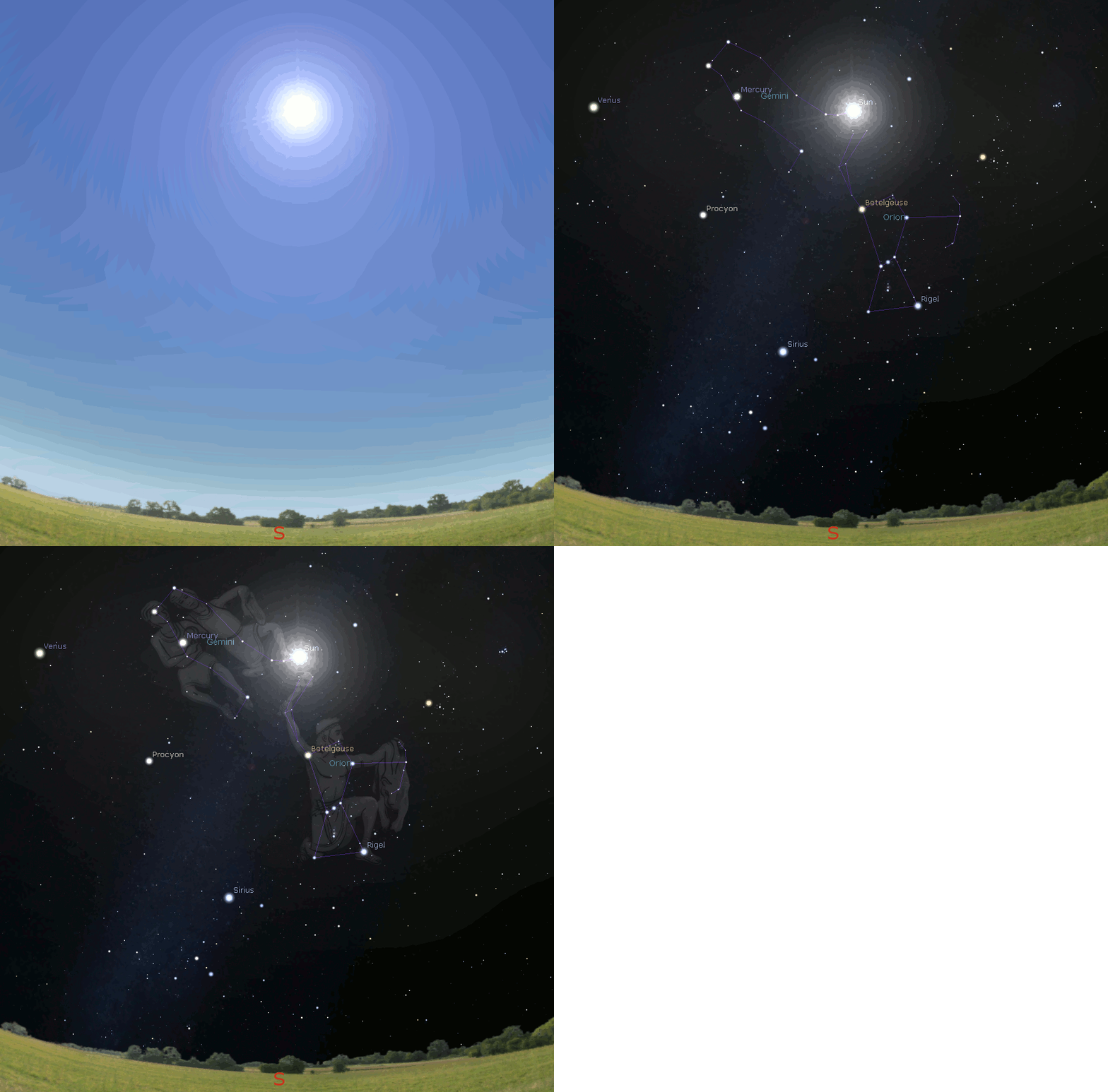
The Sun with its position with the stars at the summer solstice, June 2018. Click on the image to enlarge. Created using Stellarium and GIMP.
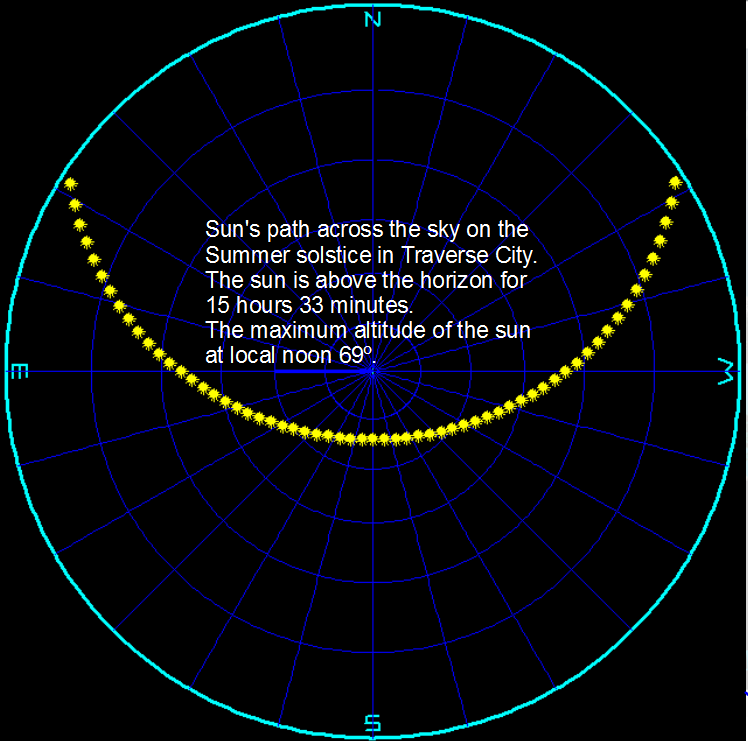
The sun’s daily path through the sky from horizon to horizon on the first day of summer, the summer solstice. Grid lines are 15° apart. The Sun os plotted at 15 minute intervals. Credit: My LookingUp program.
06/20/2018 – Ephemeris – Let’s check out the bright planets for this week
Ephemeris for Wednesday, June 20th. Today the Sun will be up for 15 hours and 34 minutes, setting at 9:31, and it will rise tomorrow at 5:57. The Moon, at first quarter today, will set at 2:29 tomorrow morning.
It’s Wednesday again and time to look for and at the bright planets. Three of them are in the evening sky. The brilliant beacon of Venus will be visible in the western twilight from about 9:50 p.m. until it sets at 11:59 p.m. Mercury is far below and right of it, setting at 10:48 p.m. Jupiter will be in the south as it gets dark. Jupiter is only outshone by Venus and the Moon. And after Venus sets will have the night to itself as the brightest star-like object until it sets at 3:34 a.m. Binoculars will show it to be bigger than star-like in size. Saturn will rise at 9:46 p.m. in the east-southeast. Mars will rise at 12:07 a.m. and is now outshining Saturn, and in July and August will even outshine Jupiter.
The times given are for the Traverse City/Interlochen area of Michigan. They may be different for your location.
Addendum
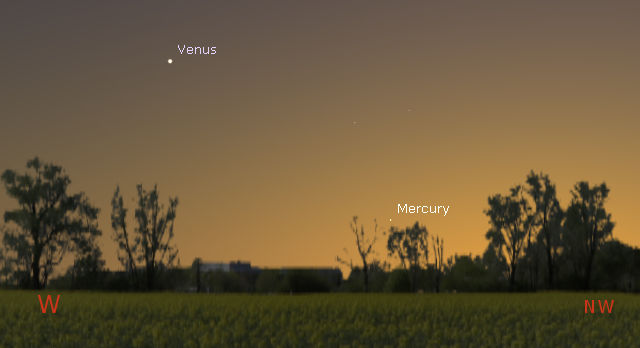
Venus and Mercury at 10 p.m., about a half hour after sunset, June 20, 2018. Created using Stellarium.
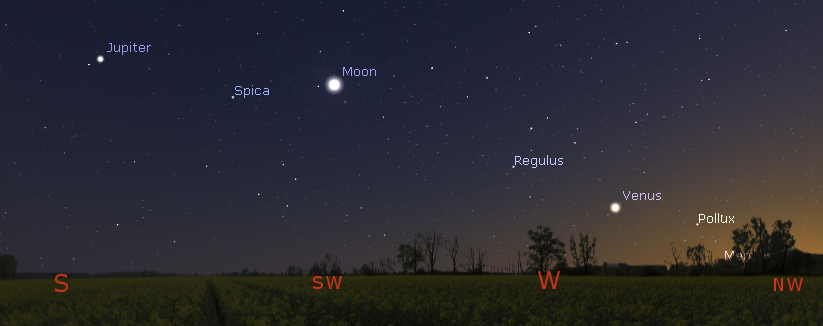
Venus, the Moon and Jupiter at 10:30 p.m., about an hour after sunset, on June 20, 2018. Created using Stellarium.
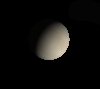
The phase exhibited by Venus in a telescope on June 20, 2018. Created using Stellarium.
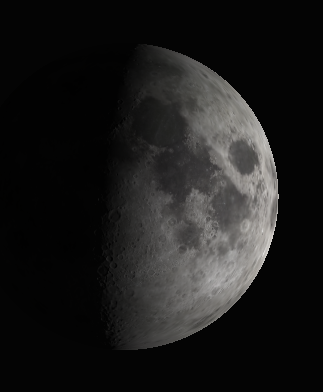
The moon as it might be seen in binoculars at 10:30 p.m. June 20, 2018. Created using Stellarium.
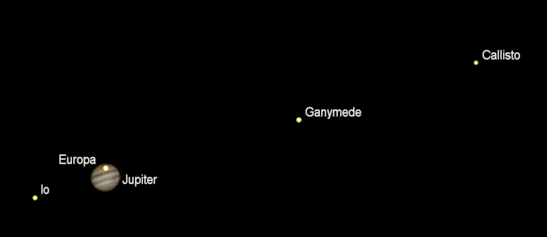
Jupiter and moons at 10:30 p.m. June 20, 2018. The image shows Europa in transit of Jupiter. A satellite is normally invisible against the face of Jupiter, but its shadow can be seen falling on the planet. Created using Cartes du Ciel (Sky Charts).
Satellite  Event        Local Date/Time       Universal Date/Time
Europa:   Transit start 20 Jun 2018  9:06 pm  21 Jun 2018 1:06
Europa:   Shadow start  20 Jun 2018 10:57 pm  21 Jun 2018 2:57
Europa:   Transit end   20 Jun 2018 11:20 pm  21 Jun 2018 3:20
Europa:   Shadow end    21 Jun 2018  1:12 am  21 Jun 2018 5:12
Source of satellite events: https://www.projectpluto.com/jevent.htm
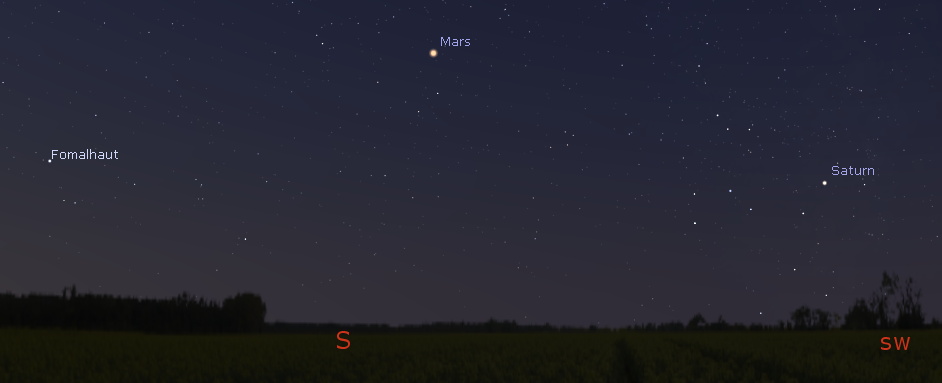
Morning planets at 5 a.m. June 21, 2018. Click on image to enlarge. Created using Stellarium.
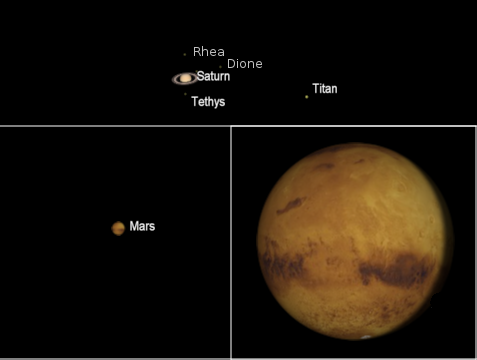
Saturn and Mars with the same magnification with an inset of Mars at higher magnification at 5 a.m. June 21, 2018. Created using Cartes du Ciel (Sky Charts).
Note on the inset image. The south polar cap is probably larger than shown. Also with the dust storm in progress the dark features may be obscured. The dust storm clouds appear brighter than the normal surface of the planet.
Planets and the Moon at sunset and sunrise of a single night starting with sunset on the right on June 20, 2018. The night ends on the left with sunrise on the 21st. Click on the image to enlarge. Created using my LookingUp program.
 Bob Moler's Ephemeris Blog