Archive
09/30/2019 – Ephemeris – Autumn Stars talk tonight
Ephemeris for Monday, September 30th. Today the Sun will be up for 11 hours and 46 minutes, setting at 7:25, and it will rise tomorrow at 7:40. The Moon, 2 days past new, will set at 8:55 this evening.
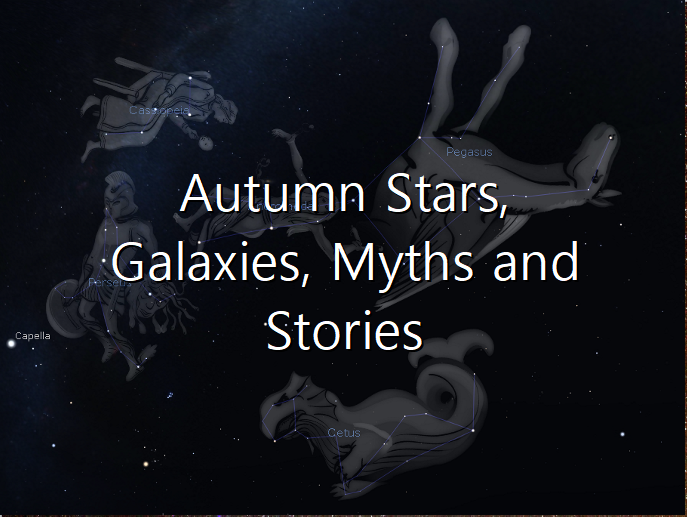
I will be giving a presentation Autumn Stars, Galaxies Myths, and Stories tonight at the Woodmere Avenue branch of the Traverse Area District Library at 7 p.m. Afterward if it’s clear members of the Grand Traverse Astronomical Society will bring their telescopes out to view Jupiter and Saturn. In the autumn season we lose the southern part of the Milky Way in the southwest, but there are number of of constellations that tell a famous story, that’s even made it to the cinema twice in recent years. There’s a star that evilly winks at us, and a huge galaxy the is visible to the naked eye that will crash into our Milky Way galaxy in the far future. Also the Native Americans around here have a constellation that paints the fall colors.
The times given are for the Traverse City/Interlochen area of Michigan. They may be different for your location.
Addendum
09/27/2019 – Ephemeris – Apollo 50th anniversary talk tonight in Thompsonville
Ephemeris for Friday, September 27th. Today the Sun will be up for 11 hours and 55 minutes, setting at 7:31, and it will rise tomorrow at 7:36. The Moon, 1 day before new, will rise at 7:09 tomorrow morning.
Tonight to commemorate the 50th anniversary the Apollo 11 landing on the Moon, I will present the illustrated talk Apollo and the Race to the Moon at 7 p.m. at the Betsie Valley District Library in Thompsonville. Afterwards, if it’s clear, members of the Grand Traverse Astronomical Society will host a star party featuring Saturn and Jupiter and some of the brighter deep sky objects. In the talk I’ll explore the Apollo 11 mission, the engineers, astronauts and all the crewed and robotic missions that paved the way for the successful lunar landings. I’ll also look at the Soviet space program their triumphs, plans, and ultimate failure to beat the Americans to the Moon.
The times given are for the Traverse City/Interlochen area of Michigan. They may be different for your location.
Addendum

Apollo and the Race to the Moon Title slide
09/26/2019 – Ephemeris – Looking for Andromeda
Ephemeris for Thursday, September 26th. Today the Sun will be up for 11 hours and 58 minutes, setting at 7:33, and it will rise tomorrow at 7:35. The Moon, 2 days before new, will rise at 5:49 tomorrow morning.
In the east at 9 this evening can be found a large square of stars, the Great Square of Pegasus the flying horse. The square is standing on one corner. What look like its hind legs stretching to the left from the left corner star is another constellation, Andromeda the chained maiden. She is seen in the sky as two diverging curved strings of stars that curve upward. She was rescued by the hero Perseus, a nearby constellation, riding his steed Pegasus. Andromeda’s claim to astronomical fame is the large galaxy seen with the unaided eye just above the upper line of stars, the Great Andromeda Galaxy, about 2 and a half million light years away. To the unaided eye the galaxy appears as a small smudge of light. In binoculars the galaxy is a delicate spindle of light.
The times given are for the Traverse City/Interlochen area of Michigan. They may be different for your location.
Addendum
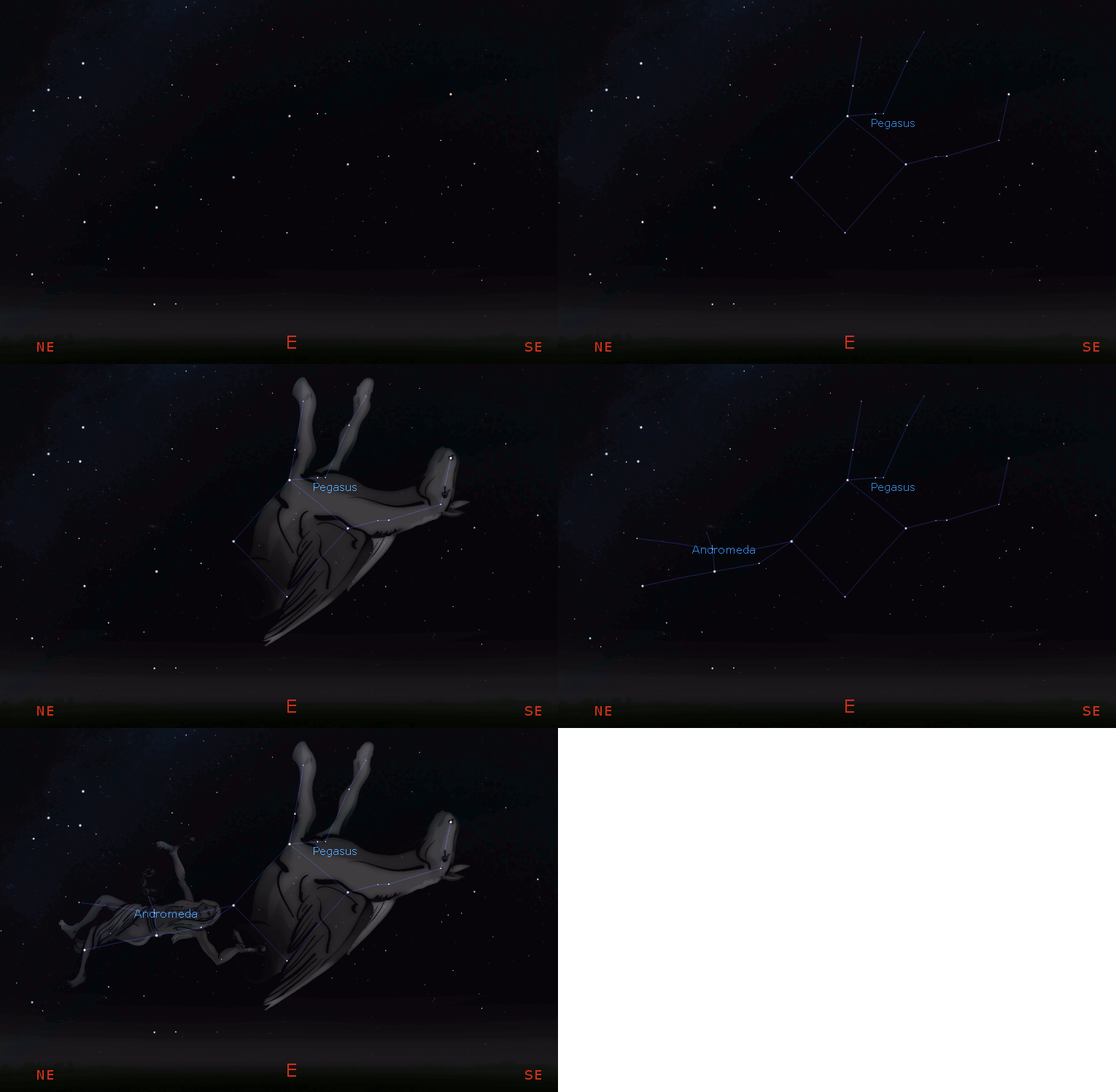
Pegasus & Andromeda animated finder chart for 9 p.m. in late September. Created using Stellarium and GIMP.
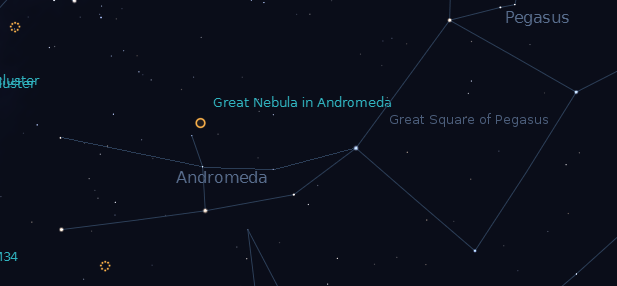
Andromeda at 9 p.m. with the Great Andromeda Galaxy. Created using Stellarium.
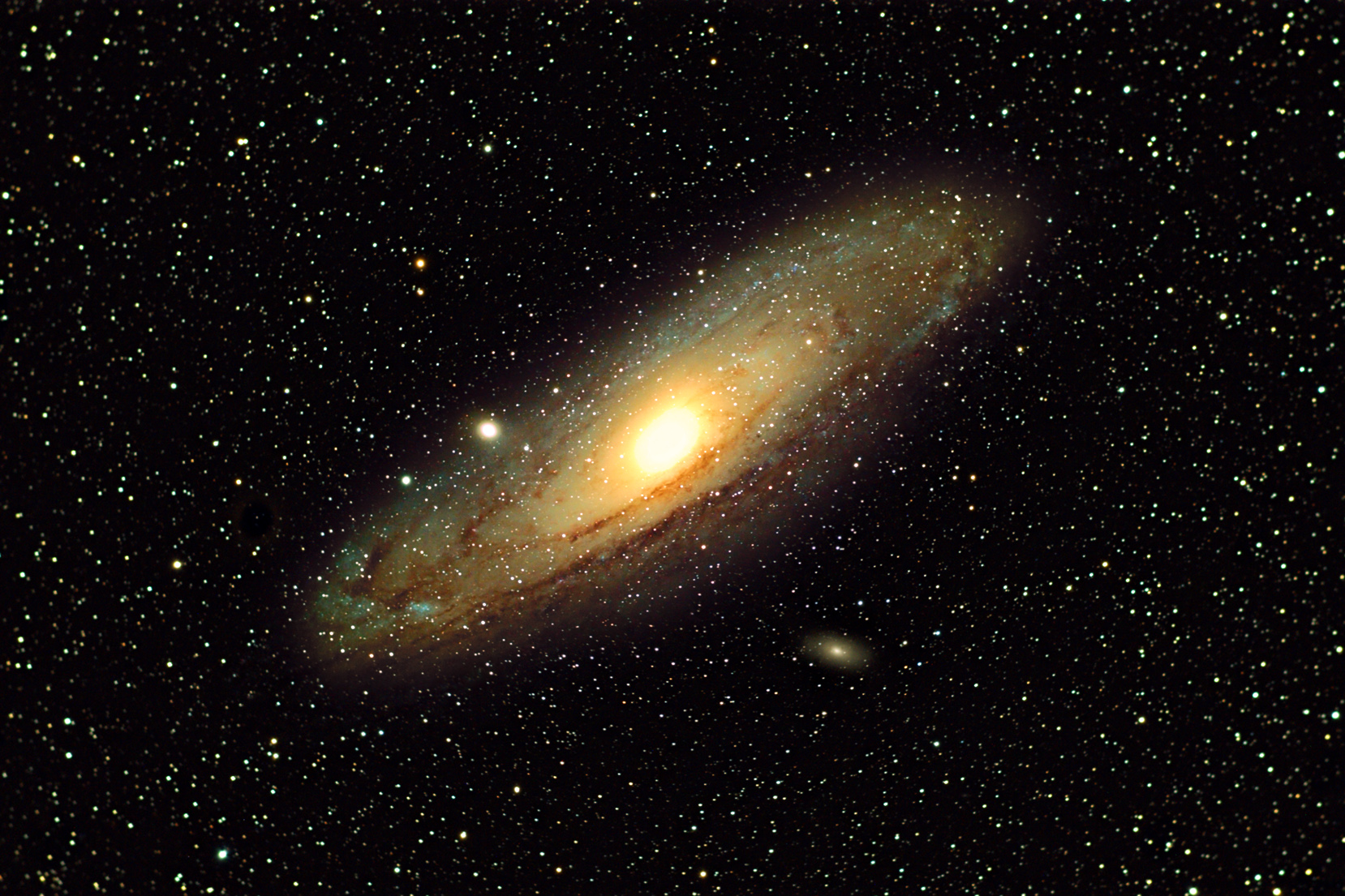
The Great Andromeda Galaxy (M31). Image taken by Scott Anttila.
09/25/2019 – Ephemeris – Where are all the bright planets?
Ephemeris for Wednesday, September 25th. Today the Sun will be up for 12 hours and 1 minute, setting at 7:34 p.m., and it will rise tomorrow at 7:34 a.m. The Moon, 3 days before new, will rise at 4:30 tomorrow morning.
Let’s look at the planets for this week. Mars, Venus and Mercury are too close to the Sun to be seen. Venus and Mercury are on the evening or east side of the Sun, Mars is on the west or morning side. Bright Jupiter will be low in the southwestern sky as it gets dark. With steadily held binoculars a few of the 4 largest satellites of Jupiter can be seen. Three of the four Jupiter’s Galilean satellites can be easily spotted in telescopes this evening. The moon Europa will be transiting across the face of the planet. Jupiter will set at 10:53 p.m. Saturn, the ringed planet, will be in the southern sky in the evening. It will pass the meridian, due south at 8:25 p.m. and will set at 12:51 a.m.
The times given are for the Traverse City/Interlochen area of Michigan. They may be different for your location.
Addendum
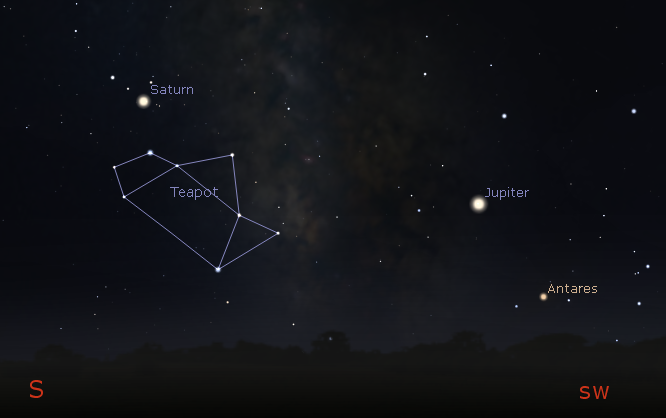
Jupiter and Saturn with the Teapot asterism of Sagittarius of the southern sky at 9 p.m. September 25, 2019. Created using Stellarium.
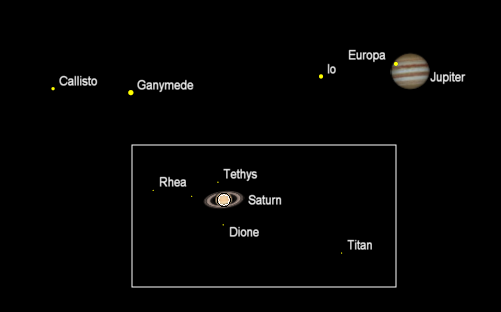
Telescopic views of Jupiter and Saturn with the same magnification at 9 p.m. September 25, 2019. Created using Cartes du Ciel (Sky Charts).
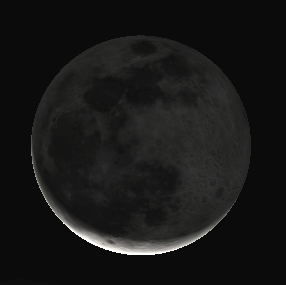
The waning crescent Moon at 6 a.m. September 26, 2019. Created using Stellarium.
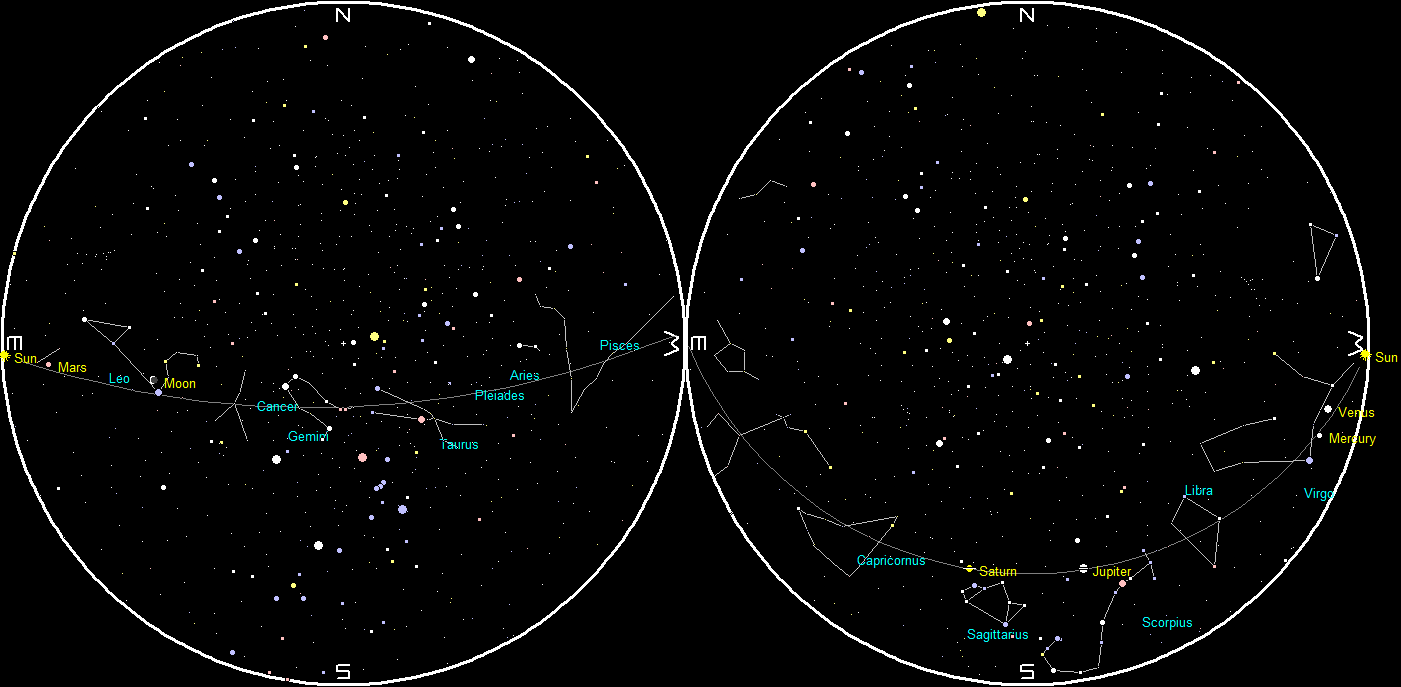
Planets and the Moon at sunset and sunrise of a single night starting with sunset on the right on September 25, 2019. The night ends on the left with sunrise on the 26th. Click on the image to enlarge. Created using my LookingUp program.
09/24/2019 – Ephemeris – Cassiopeia the “W” shaped constellation
Ephemeris for Tuesday, September 24th. Today the Sun will be up for 12 hours and 4 minutes, setting at 7:36, and it will rise tomorrow at 7:33. The Moon, 3 days past last quarter, will rise at 3:13 tomorrow morning.
The stars of the autumn skies slowly are replacing the summer stars from the east. Look in the northeastern sky by 9 p.m. and you can find the W shaped constellation of Cassiopeia the queen. Cassiopeia is so far north that it never sets for us in Michigan. It is opposite the pole star Polaris from the Big Dipper. There’s a dim star that appears above the middle star of the W which turns the W into a very crooked backed chair. Cassiopeia, in Greek mythology, represents a queen of ancient Ethiopia, the W represents the profile of her throne. She enters in to the great autumn story whose other characters are also seen in the stars as the constellations Andromeda, Pegasus, Perseus, Cetus and her husband Cepheus.
For my retelling of the Greek myth that links these autumn constellations click here.
The times given are for the Traverse City/Interlochen area of Michigan. They may be different for your location.
Addendum
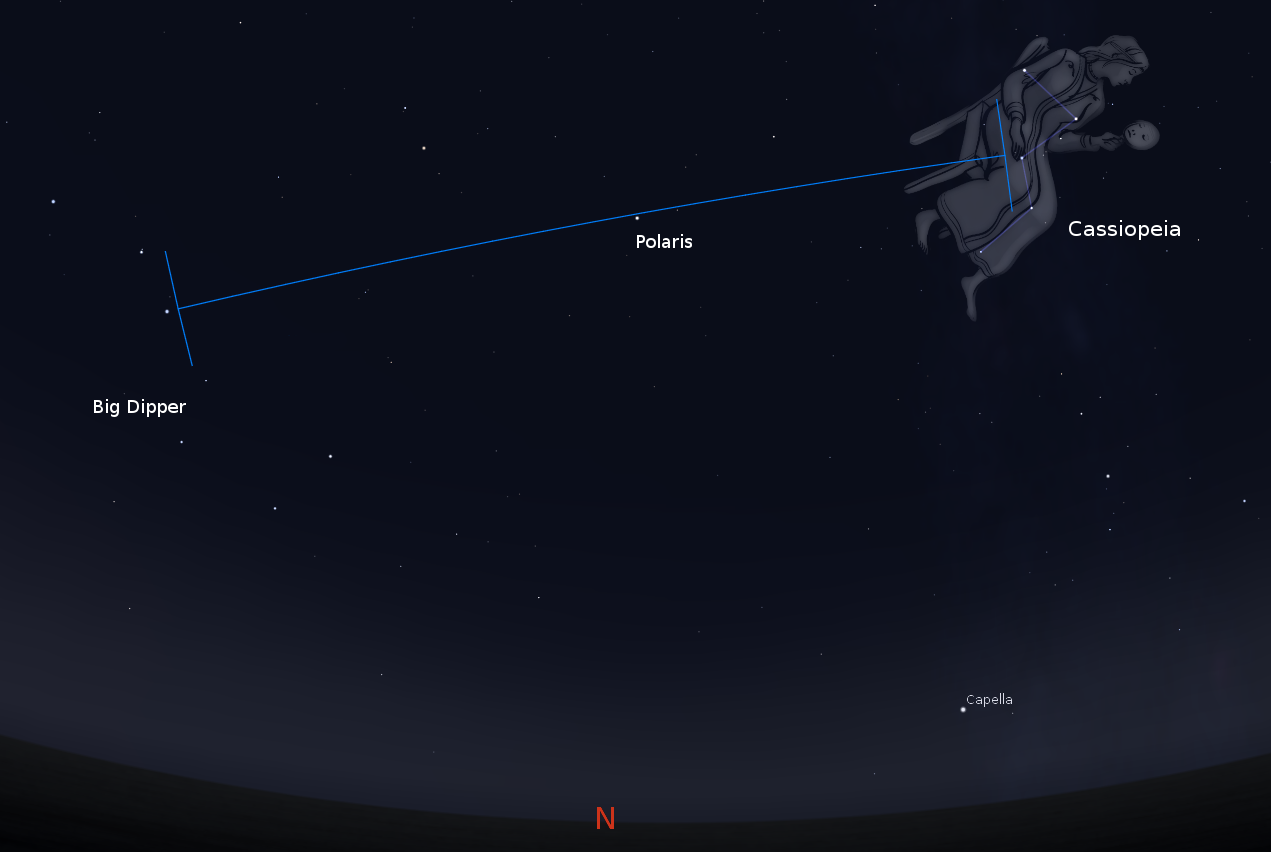
Cassiopeia, in the northeast is opposite Polaris from the Big Dipper. For 9 p.m. in late September. Created using Stellarium. Artistic credit: Johan Meuris.
09/23/2019 – Ephemeris – Fall has fallen upon us
Ephemeris for Monday, September 23rd. Today the Sun will be up for 12 hours and 7 minutes, setting at 7:38, and it will rise tomorrow at 7:32. The Moon, 2 days past last quarter, will rise at 2:01 tomorrow morning.
Fall has, well… fallen upon us and in a few weeks so will the leaves. At 3:49 (7:49 UT) this morning the Sun crossed overhead at the Earth’s equator heading south. At that same time the Sun theoretically set at the north pole and rose at the south pole. The day is called the autumnal equinox and the daylight hours today is 12 hours and 7 minutes instead of 12 hours exactly. That’s due to our atmosphere and our definition of sunrise and sunset. The reason for the cooler weather for us north of the equator now and the cold weather this winter is that the length of daylight is shortening, and the Sun rides lower in the sky, spreading its heat over a larger area, thus diluting its intensity.
The times given are for the Traverse City/Interlochen area of Michigan. They may be different for your location.
Addendum
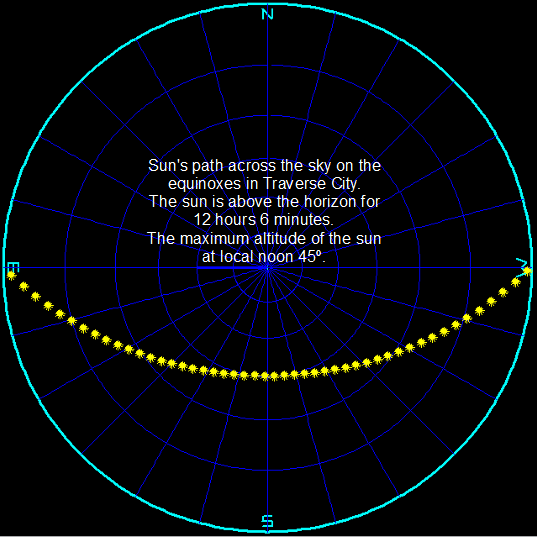
The Sun’s path through the sky on the equinox day from Traverse City, MI. Created using my LookingUp program.

That is not a pumpkin on the head of the motorcyclist. That’s the Sun rising as I’m traveling east on South Airport Road south of Traverse City Mi. on the autumnal equinox. This is the east-west section of the road. The Sun is rising over the hills some 6 miles to the east. Credit: Bob Moler.
09/20/2019 – Ephemeris – Two local astronomy events this weekend
Ephemeris for Friday, September 20th. Today the Sun will be up for 12 hours and 17 minutes, setting at 7:44, and it will rise tomorrow at 7:28. The Moon, 1 day before last quarter, will rise at 11:19 this evening.
There are two local astronomical events tomorrow. The Leland Heritage Celebration will take place from 10 a.m. to 4 p.m. at Fishtown in Leland. The Grand Traverse Astronomical Society will be there to show the Sun through member’s telescopes, maybe spot the Moon plus give out NASA items for the kids. That evening from 9 to 11 p.m. members of the society will move to the Sleeping Bear Dunes National Lakeshore’s Dune Climb for this month’s star party featuring the planets Jupiter and Saturn and the wonders of the summer Milky Way. Rain will affect the Leland event, and heavy overcast will affect the Dunes event. Last month’s Dune event appeared earlier in the day to be clouded out, but it did clear up later on.
The times given are for the Traverse City/Interlochen area of Michigan. They may be different for your location.
Addendum
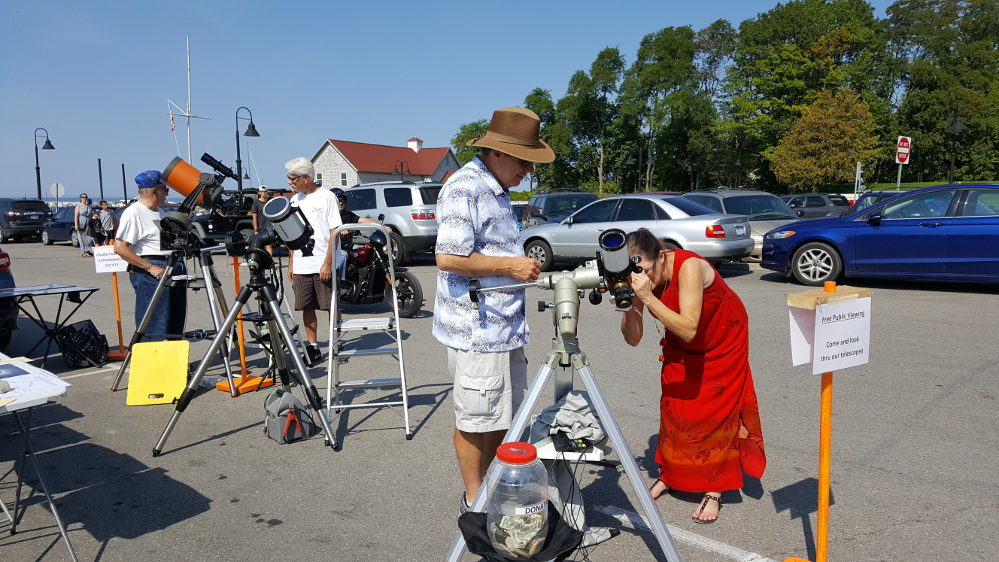
Don Flegel, in the foreground, with the society’s solar telescope assisting a person viewing the Sun at he Leland Heritage Festival 2017 at Fishtown. Don Flegel, in the foreground, with the society’s solar telescope assisting a person viewing the Sun at he Leland Heritage Festival 2017 at Fishtown. Man in the background in the blue cap is Gary Carlisle. Telescope in the middle is mine.
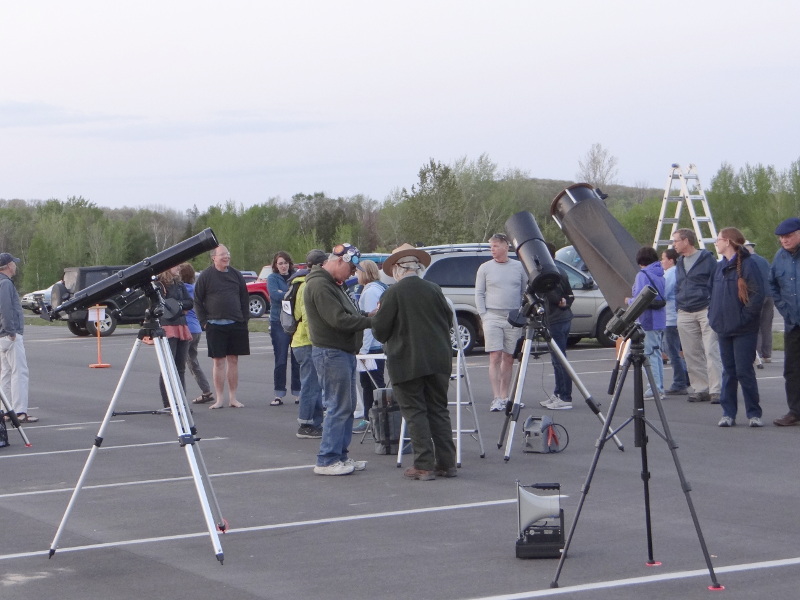
Preparing to start the May star party 3 years ago at the Dune Climb. A few of the telescopes are visible including the GTAS 25″ “Emmettron” telescope at the far right. Credit: Eileen Carlisle.
09/19/2019 – Ephemeris – The celestial upside down flying horse
Ephemeris for Thursday, September 19th. Today the Sun will be up for 12 hours and 20 minutes, setting at 7:46, and it will rise tomorrow at 7:27. The Moon, 2 days before last quarter, will rise at 10:42 this evening.
Rising and almost half way up the sky in the east at as it gets dark around 9 p.m. can be found one of the great autumn constellations: Pegasus the flying horse of Greek myth. Its most visible feature is a large square of four stars, now standing on one corner. This feature, called the Great Square of Pegasus, represents the front part of the horse’s body. The horse is quite aerobatic, because it is seen flying upside down. Remembering that fact, the neck and head is a bent line of stars emanating from the right corner star of the square. Its front legs can be seen in a gallop extending to the upper right from the top star of the square. From the left star extend, not hind legs but the constellation of Andromeda, rescued with the help of Pegasus.
For my retelling of the Greek myth that links these two and other autumn constellations click here.
The times given are for the Traverse City/Interlochen area of Michigan. They may be different for your location.
Addendum
Pegasus & Andromeda animated finder chart for 9 p.m. September 19, 2019. Click on the iamge to enlarge. Created using Stellarium and GIMP.
Ephemeris Extra – The Great Star Story of Autumn
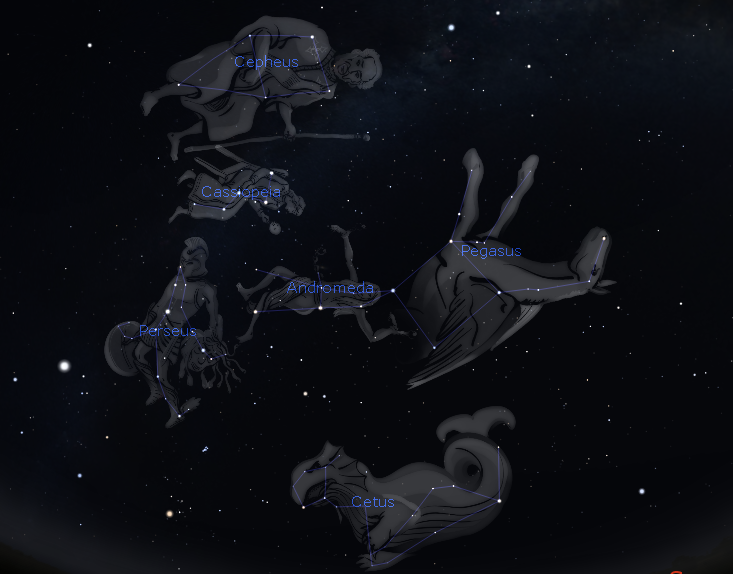
The constellations of the great star story of autumn. Looking southeast on October 31 at 10 p.m. Created using Stellarium.
The great star wheel of the sky rolls on. In the evening sky gone are the stars of spring, and going are the southern stars of summer. In the morning sky before sunrise the stars of an early winter evening.
A constant in both skies are the stars of autumn: rising in the evening and setting in the morning. In no other part of the sky do so many constellations take part in a single story
The constellations, as seen above are Cepheus, Cassiopeia, Andromeda, Perseus, Pegasus, and Cetus. And their story goes like this:
In distant Ethiopia a crisis was brewing. King Cepheus and Queen Cassiopeia were at wits end as how to stop it. A giant sea monster named Cetus was ravaging the country’s coastal cities destroying them and devouring the inhabitants.
The king and queen consulted the temple oracle as to what happened and what could be done to save their country. The oracle intoned gravely that the fault was Cassiopeia’s. Suddenly the queen knew what happened. Cassiopeia was very beautiful and she had vainly boasted to all who could hear that she was more beautiful than even the sea nymphs, the lovely daughters of the sea god Poseidon.
The sea nymphs had heard of Cassiopeia’s boast and complained to their father. Poseidon, like any father, was angered, and being a god was able to do something about. Being a god means never having to say your sorry when you do something really mean. He loosed the monster Cetus upon the Ethiopians.
The oracle said that to appease the monster and Poseidon Cassiopeia would have to sacrifice her daughter the Princess Andromeda to the monster. That is how young Andromeda was chained to the rocks on the sea shore to await her doom…
Far away in ancient Greece a wedding was about to take place between the beautiful Princess Danaë and King Polydectes. Danaë’s son Perseus, fathered by Zeus, but that’s another story, wasn’t too happy about the proposed union, and Polydectes wanted the boy gone.
When Perseus asked Polydectes what he wanted for a wedding gift, he said, “I want the head of Medusa.” The boy immediately and foolhardedly agreed to get it for him.
Merdusa, it turns out, was one of three sisters, the Gorgons, who had snakes for hair. They were so ugly that one glimpse of them would turn the beholder to stone. Medusa was the only mortal one.
Luckily Perseus had the favor of the god Hermes and Athene. They armed him with Hermes’ winged sandals, a helmet that made him invisible, a pouch that would expand to hold an object of any size, a shiny mirror shield, and a sword.
Thus armed Perseus was told to find the Graiae or the gray women, who could tell him where the lair of the Gorgons was. They were three in number and shared but one eye and one tooth among them which they passed from one to another to use.
The Graiae refused to help Perseus. But he was able to force them to help by snatching their one eye while it was being passed from one to another. They told him that the Gorgons dwelt in the shore of the river Ocean at the edge of the world in perpetual twilight.
In approaching the lair of the Gorgons Perseus put on the helmet of invisibility. He approached Medusa stepping backwards, cautiously peering only at Medusa’s indistinct image in his shield. Perseus then swept his sword in a backhanded way and managed to sever Medusa’s head. It is said that Athene guided his hand.
Amazingly, springing full grown from Medusa’s blood was the winged white stallion Pegasus. After placing Medusa’s head in the pouch, Perseus mounted Pegasus for the trip home.
Cruising high in the sky over the Ethiopian coast Perseus spotted a horrific sight. There far below the beautiful Andromeda, in chains; her screams reaching his ears. Then he spotted why she was screaming. A short distance away, crawling out of the surf was the monster Cetus, heading towards Andromeda. Perseus immediately sizes up the situations and swooped with Pegasus down to a spot between Andromeda and the monster. Then, burying his head in his shoulder drew out the head of Medusa from the pouch and held it in front of Cetus. The head was as lethal in death as in life, and the monster was promptly turned to stone. Replacing the head in the pouch, Perseus freed Andromeda. They flew off to, well supposedly, live happily ever after.
Oh yes. Perseus did present the head of Medusa to his step father Polydectes. He, of course, was also turned to stone when he laid eyes on it.
There you have it a story connecting the autumn constellations of Cepheus, Cassiopeia, Andromeda, Perseus, Pegasus and Cetus.
Cepheus is a dim church steeple of a constellation. Its dim star Delta is a variable star, the prototype of an important class of distance measuring stars called Cephieds in its honor. Cassiopeia is the famous W shaped constellation that along with Cepheus doesn’t set at our latitude.
Perseus looks to me more like the cartoon roadrunner than a hero. As the ancients saw him, he is holding the head of Medusa, whose still glittering eye is the star Algol, a variable star which ghastly winks at us every 2 days and 21 hours.
Andromeda’s modern claim to fame is the great galaxy that lies beyond her stars, the Great Andromeda Galaxy which has the designation M31. The galaxy is faintly visible to the unaided eye on dark nights. The farthest you can see without optical aid. The galaxy lies some 2.5 million light years away.
Pegasus can be easily found by the square of stars the form his body. It’s called the Great Square of Pegasus.
What can be said about Cetus. It now represents a whale, not a monster. Its star Mira, which means “Wonderful”, slowly varies in brightness over 330 days from a star barely visible in binoculars to a 2nd or 3rd magnitude star.
Look up on an autumn evening and recapture the wonder the ancients had as they looked upward at the stars.
09/18/2019 – Ephemeris – Checking out the whereabouts of the bright planets
Ephemeris for Wednesday, September 18th. Today the Sun will be up for 12 hours and 23 minutes, setting at 7:48, and it will rise tomorrow at 7:26. The Moon, 3 days before last quarter, will rise at 10:11 this evening.
Let’s look at the planets for this week. Mars, Venus and Mercury are too close to the Sun to be seen. Venus and Mercury are on the evening or east side of the Sun, Mars is on the west or morning side. Bright Jupiter will be low in the southwestern sky as it gets dark. With steadily held binoculars a few of the 4 largest satellites of Jupiter can be seen. Three of the four Jupiter’s Galilean satellites can be easily spotted in telescopes this evening. The moon Europa will appear very close to the planet. Jupiter will set at 11:21 p.m. Saturn, the ringed planet, will be in the southern sky in the evening. It will pass the meridian, due south at 8:52 p.m. and will set at 1:19 a.m.
The times given are for the Traverse City/Interlochen area of Michigan. They may be different for your location.
Addendum
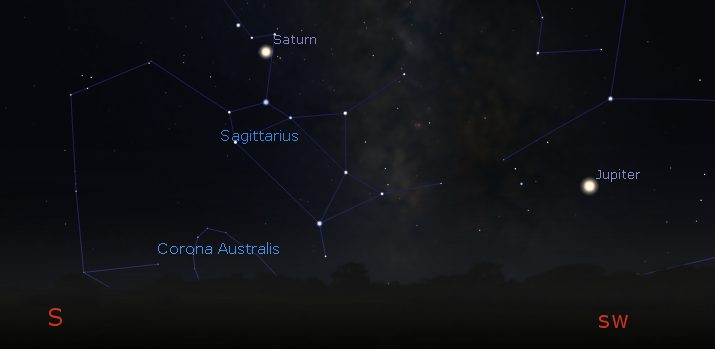
Jupiter and Saturn with the constellations of the southern summer sky at 10 p.m. September 18, 2019. Created using Stellarium.
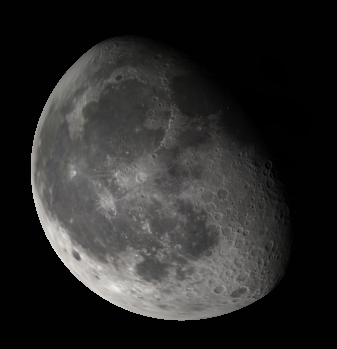
The waning gibbous Moon at 11 p.m. September 18, 2019. Created using Stellarium.
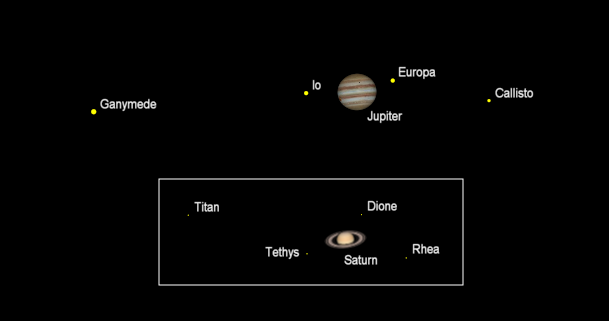
Telescopic views of Jupiter and Saturn with the same magnification at 10 p.m. September 18, 2019. Created using Cartes du Ciel (Sky Charts).
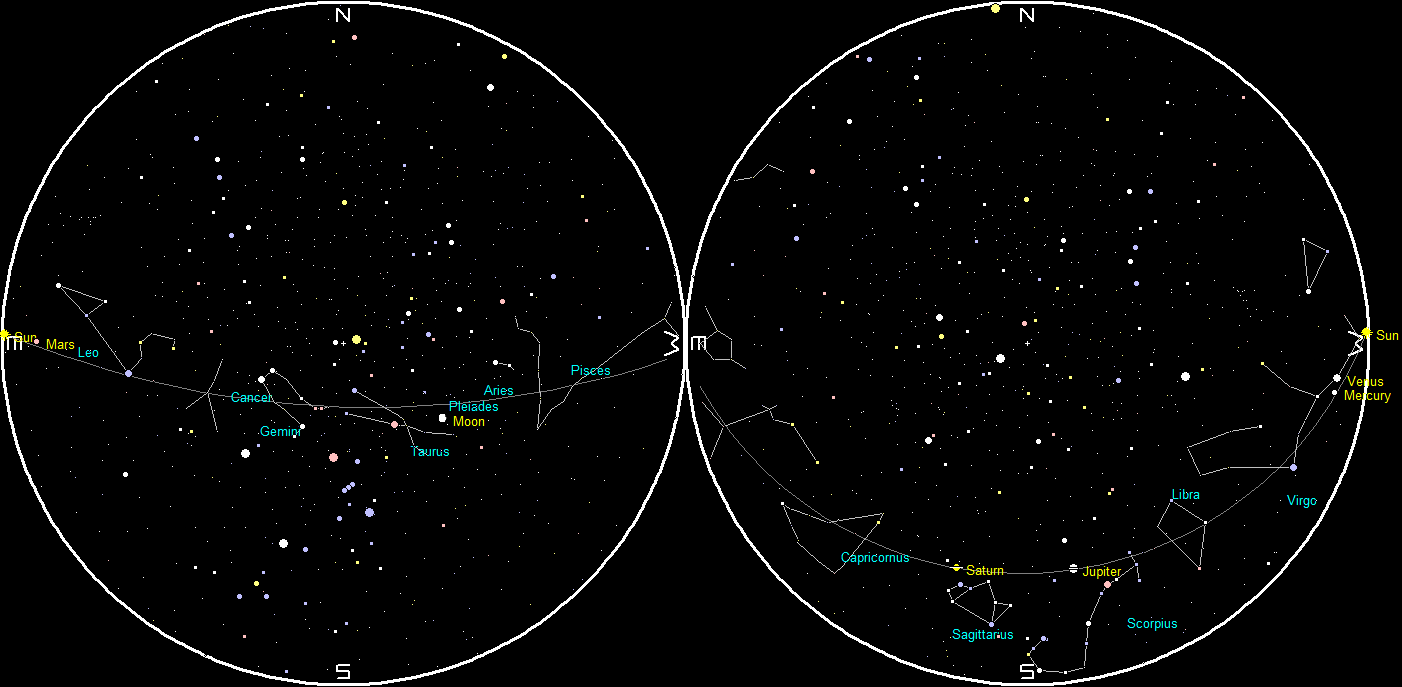
Planets and the Moon at sunset and sunrise of a single night starting with sunset on the right on September 18, 2019. The night ends on the left with sunrise on the 19th. Click on the image to enlarge. Created using my LookingUp program.
 Bob Moler's Ephemeris Blog