Archive
03/17/2020 – Ephemeris – A planetary traffic jam tomorrow morning
Ephemeris for St. Patrick’s Day, Tuesday, March 17th. Today the Sun will be up for 12 hours and 1 minute, setting at 7:52, and it will rise tomorrow at 7:48. The Moon, 1 day past last quarter, will rise at 5:12 tomorrow morning.
What I’m going to talk about today is the confluence of the Moon and planets, none of which is green for St. Patrick’s day. The event actually takes place tomorrow morning, which looks like a real planet traffic jam. Of course it just looks like it. The Moon is about 240 thousand miles (390 thousand km) away, Mars is 146 million miles (235 million km), and Jupiter is three and a half times farther away than Mars, and Saturn is twice as far away as Jupiter. These are seen in the southeast, from right to left are Mars, and Jupiter, close together and Saturn a bit farther away. The crescent Moon will pass south of Mars at 4:19 a.m., and Jupiter at 6:18 a.m. The Moon will pass south of Saturn at 8 p.m. tomorrow night while they are below the horizon. By the time they rise Thursday morning the Moon will be a ways left and below Saturn.
The event times given are for the Traverse City/Interlochen area of Michigan. They may be different for your location.
Addendum
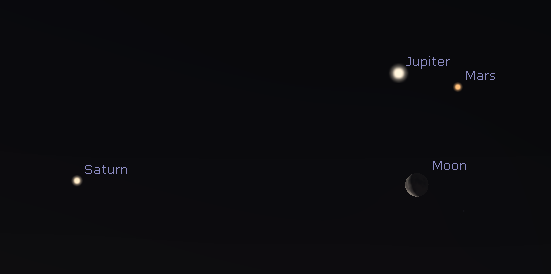
Mars, Jupiter, Saturn and Moon traffic Jam as it will appear in the southeast at 7 a.m. March 18, 2020. Created using Stellarium.
03/16/2020 – Ephemeris – The Fisher signals maple sugaring season
Ephemeris for Monday, March 16th. Today the Sun will be up for 11 hours and 58 minutes, setting at 7:50, and it will rise tomorrow at 7:50. The Moon, at last quarter today, will rise at 4:21 tomorrow morning.
As the weather warms up with days above freezing and nights below freezing its time to tap maple trees for their sweet sap. The Anishinaabe native people of this area had a legend that a magical animal called the Fisher, who brought summer to the Earth, signals this season by rising high in the northeast. The Fisher or Ojiig is seen in the stars where the official constellation of Ursa Major, the great bear and the popular asterism the Big Dipper is. The Fisher’s claim to immortality is that he and some of his animal friends were able to break through the dome of the sky to release the warm air from above to heat the Earth. For his trouble he was killed, but the Great Spirit placed him in the sky where we see him today.
The event times given are for the Traverse City/Interlochen area of Michigan. They may be different for your location.
Addendum
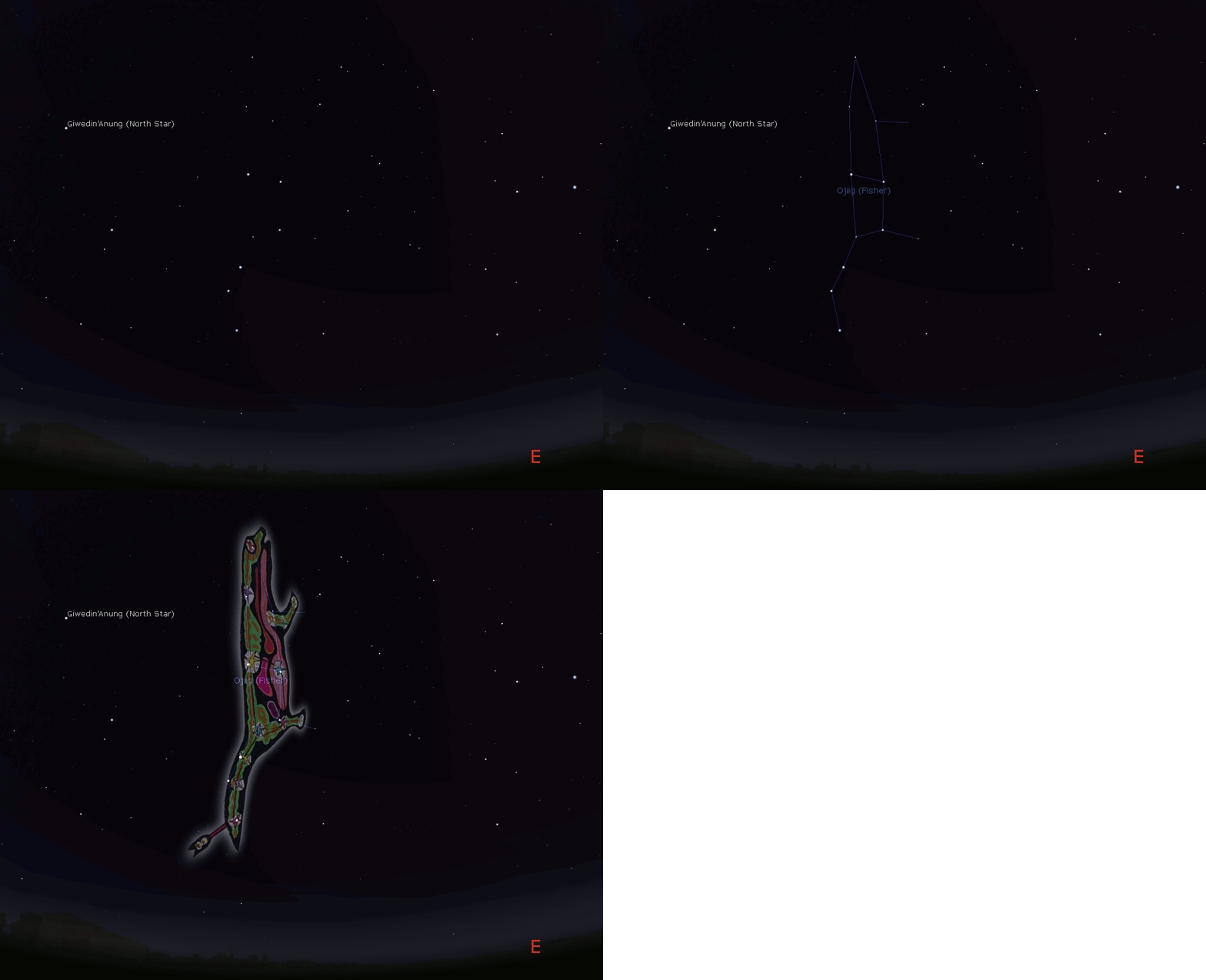
Finding the Big Dipper and the Fisher around 9 p.m. Click on the image to enlarge. Created using Stellarium and GIMP.
03/13/2020 – Ephemeris – Looking for Cancer the crab
Ephemeris for Friday, March 13th. Today the Sun will be up for 11 hours and 49 minutes, setting at 7:47, and it will rise tomorrow at 7:56. The Moon, 3 days before last quarter, will rise at 1:01 tomorrow morning.
Between the stars Castor and Pollux in Gemini high in the southeast and the star Regulus in Leo the Lion in the east-southeast lies the dimmest constellation of the zodiac, Cancer the crab. To me its 5 brightest stars make an upside down Y. There’s the stars in the center of the constellation Asellus Borealis and Asellus Australis, the north and south donkeys. There’s a fuzzy spot between and just west of them called Praesepe, the manger from which they are supposedly eating. In binoculars it resolves into a cluster of stars called the Beehive cluster. We amateur astronomers also know it as M44, the 44th object on 18th century comet hunter Charles Messier’s list of fuzzy objects that might be mistaken for comets.
The event times given are for the Traverse City/Interlochen area of Michigan. They may be different for your location.
Addendum

Cancer the crab finder chart. Note the beehive cluster, also known to amateur astronomers as M44, along with other catalog names. Prior to the invention of the telescope this cluster was known as Praesepe which means “Manger”. Click on the image to enlarge. Created using Stellarium and GIMP.
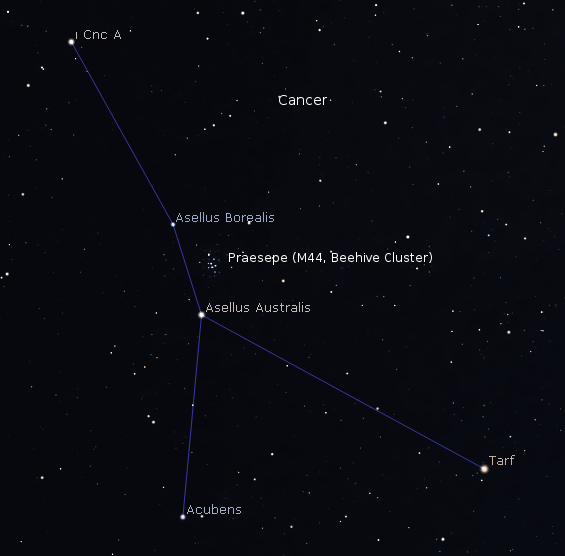
The constellation Cancer with star names and Praesepe. Asellus Borealis, the Northern Donkey; and Asellus Australis, the Southern Donkey are next to Praesepe the manger. Created using Stellarium.
We only hear about a manger at Christmas time. It is simply a trough that horses, donkeys, and cattle eat from.
03/12/2020 – Ephemeris – The mythology behind the constellation of Gemini
Ephemeris for Thursday, March 12th. Today the Sun will be up for 11 hours and 46 minutes, setting at 7:45, and it will rise tomorrow at 7:57. The Moon, 3 days past full, will rise at 11:45 this evening.
Lets look at the next to last of the winter constellations, and member of the Zodiac. The constellation Gemini, the Twins is visible high in the southeast, above and left of Orion the hunter at 9 p.m. The namesake stars of the two lads, will be at the left end of Gemini, nearly vertically aligned. Castor is above, Pollux below. From them can be traced two lines of stars extending toward Orion that outline the two. In Greek mythology the lads were half brothers, Castor was fathered by a mere mortal, while Pollux was fathered by Zeus in the famous Leda and the swan affair and immortal, but were born together as twins. When Castor was killed during the quest for the Golden Fleece, Pollux pleaded with Zeus to let him die also, so he placed them together in the sky so they could be together forever.
The event times given are for the Traverse City/Interlochen area of Michigan. They may be different for your location.
Addendum
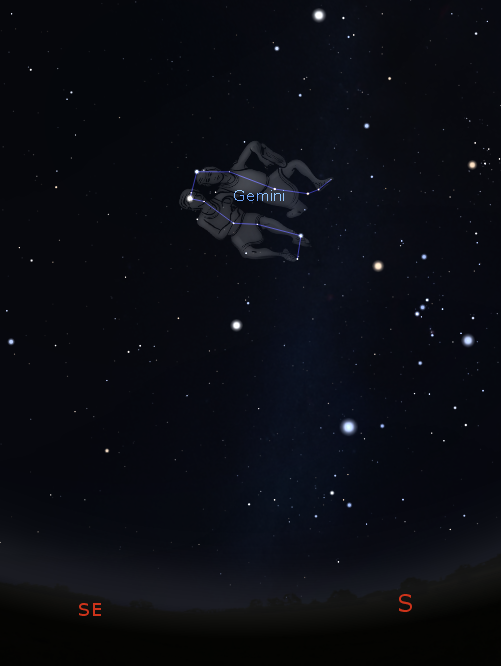
Gemini finder looking south-southeast around 9 p.m. March 10th, 2020. Created using Stellarium.
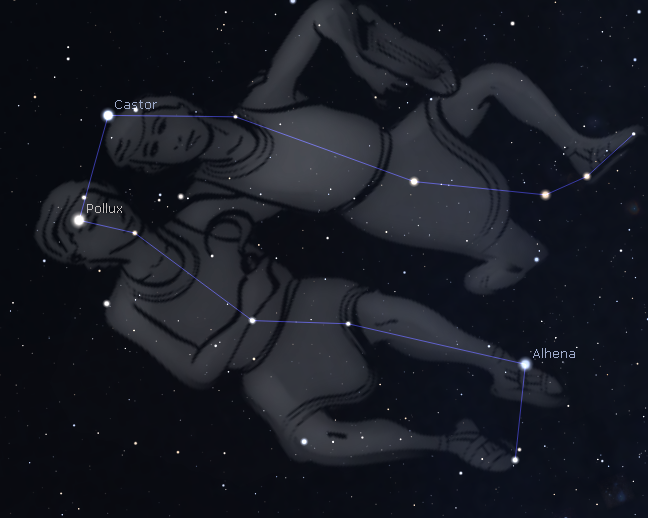
Castor and Pollux namesakes of the twins of Gemini in its position around 9 p.m. EDT March 12th. Created using Stellarium.
03/11/2020 – Ephemeris – Let’s look at the naked-eye planets for this week
Ephemeris for Wednesday, March 11th. Today the Sun will be up for 11 hours and 42 minutes, setting at 7:44, and it will rise tomorrow at 7:59. The Moon, 2 days past full, will rise at 10:26 this evening.
Let’s look at the naked-eye planets for this week. Venus is our evening star shining brightly in the west for most of the evening. It will set at 11:49 p.m. The rest of the planet action is in the morning sky where there are three planets close together in the southeast. Mars will rise first at 5:11 a.m. It’s getting as bright as a first magnitude star because it’s down to 151 million (243 million km) miles away, as the Earth slowly overtakes it at the rate of about 6 million miles (9 million km) a week. It’s brighter than the star Antares in the southwest. Bright Jupiter will rise at 5:23 a.m. And lastly, Saturn will rise at 5:43 a.m. Mars is catching up to Jupiter and Saturn. It will pass south of Jupiter on the 20th, and Saturn on the 31st. It might be worth getting up for before 7 a.m. to view.
The event times given are for the Traverse City/Interlochen area of Michigan. They may be different for your location.
Addendum
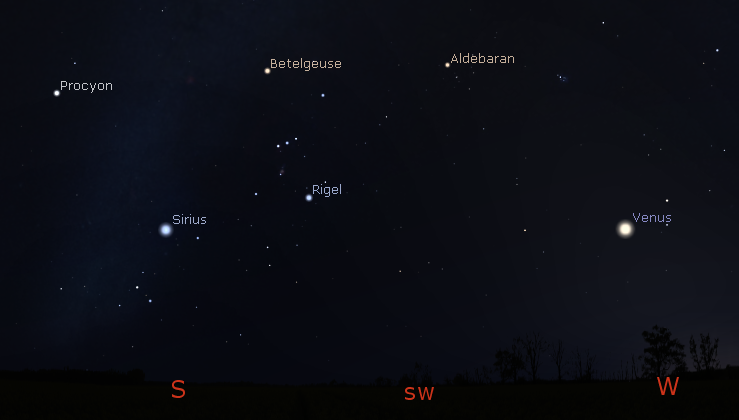
Venus and evening bright stars tonight at 9 p.m., March 11, 2020. Click on the image to enlarge. Created using Stellarium.
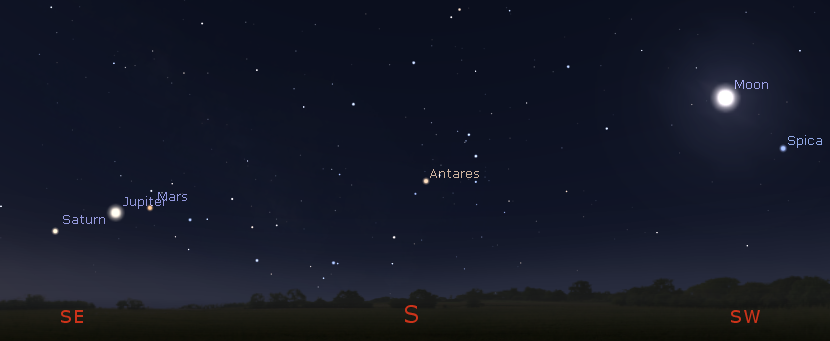
Morning Planets and the Moon at 7 a.m. tomorrow morning March 12, 2020. Click on the image to enlarge. Created using Stellarium.
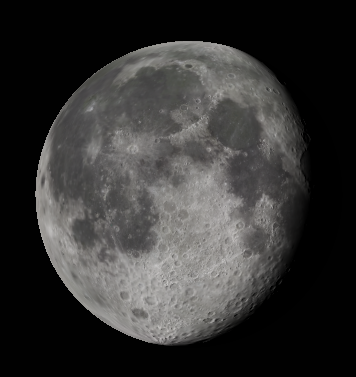
Binocular Moon tomorrow morning at 7 a.m. March 12, 2020. Created using Stellarium.
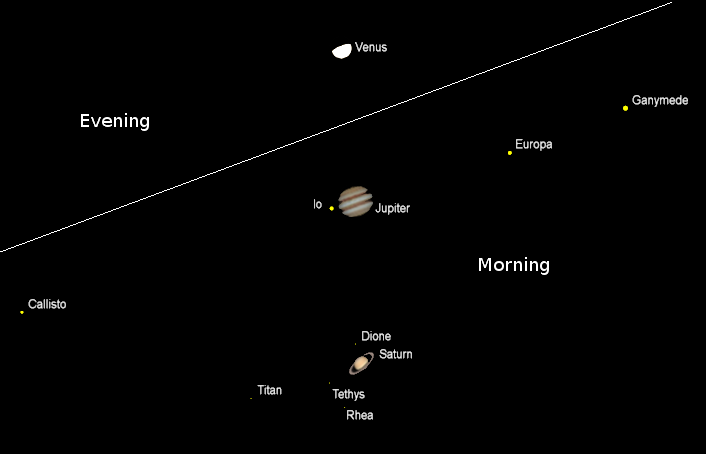
The planets as seen in a telescope with the same magnification. Venus in the evening and Jupiter and Saturn in the morning on the night of March 11/12, 2020. Apparent diameters: Venus, 20.7″; Jupiter, 35.1″; Saturn, 15.7″, rings, 36.6″. Mars at 5.8″ won’t be added until it reaches 10″. The ” symbol means seconds of arc (1/3600th of a degree.) Created using Cartes du Ciel (Sky Charts).
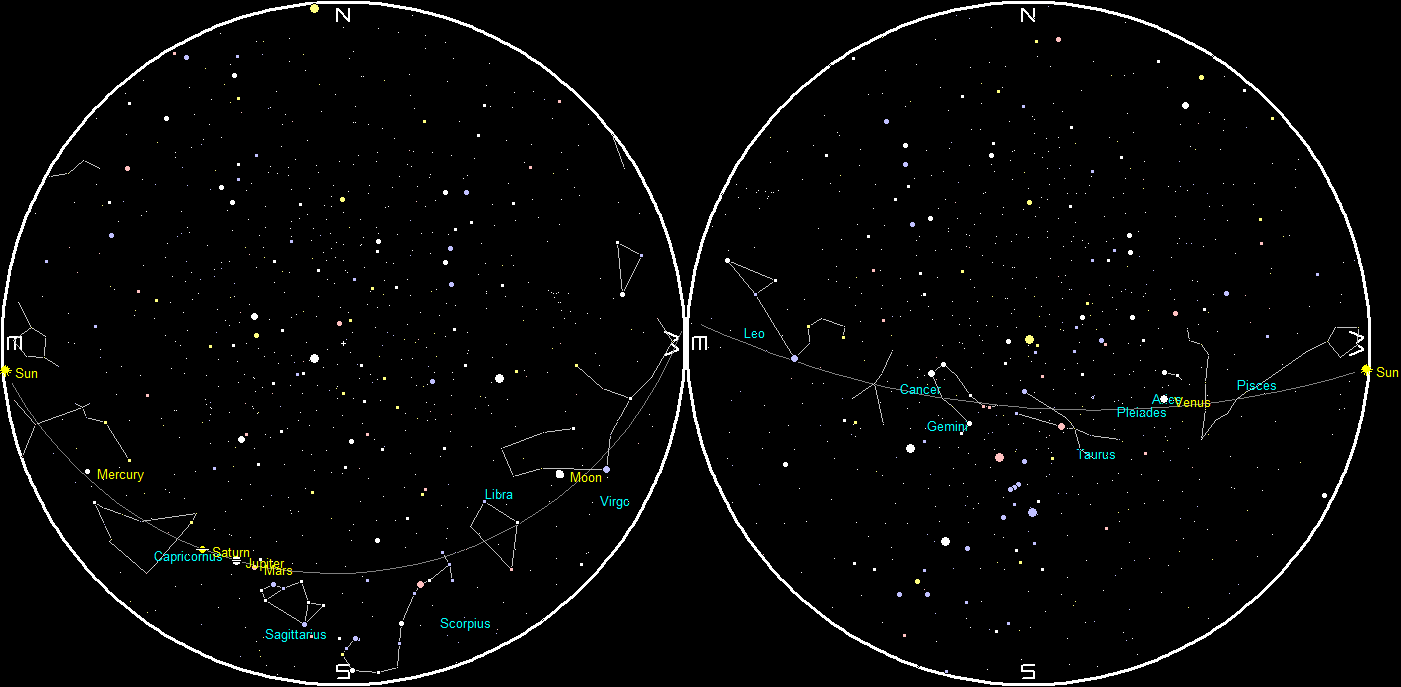
Planets and the Moon at sunset and sunrise of a single night starting with sunset on the right on March 11, 2020. The night ends on the left with sunrise on the 12th. Click on the image to enlarge. Created using my LookingUp program.
03/10/2020 – Ephemeris – A Closeup look at Gemini’s namesake stars
Ephemeris for Tuesday, March 10th. Today the Sun will be up for 11 hours and 39 minutes, setting at 7:43, and it will rise tomorrow at 8:01. The Moon, 1 day past full, will rise at 9:07 this evening.
At 9 p.m. the constellation of Gemini the twins will be seen high in the south-southeast. The namesake stars of the two lads are the two bright stars at the upper left of the constellation. Pollux the pugilist, or boxer, is the lower of the two, while Castor, the horseman, is the other star, or rather a six star system. In telescopes two close stars may be seen each is a spectroscopic binary, meaning the two stars can be detected by the rainbow colors of light from the star. A faint nearby spectroscopic binary also belongs. Pollux, though a single star, does have at least one planet, over twice the mass of Jupiter orbiting it at a distance somewhat greater than Mars is from the Sun. Pollux is 34 light years away while Castor is 50 light years away.
The event times given are for the Traverse City/Interlochen area of Michigan. They may be different for your location.
Addendum
Gemini finder looking south-southeast at 9 p.m. March 10th, 2020. Created using Stellarium.
Castor and Pollux namesakes of the twins of Gemini in its position at 9 p.m. EDT March 10th. Created using Stellarium.
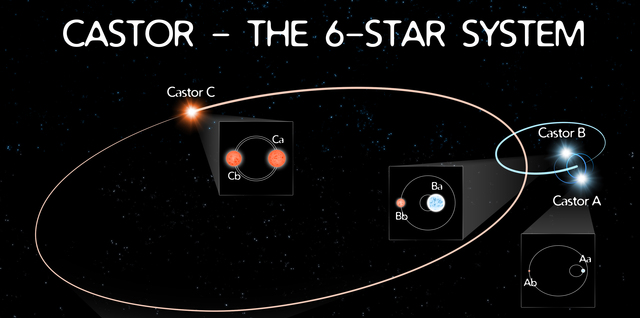
The Castor star system exploded in this JPL/NASA infographic.
03/09/2020 – A NASA mission to the Trojans, strange asteroids in Jupiter’s orbit
Ephemeris for Monday, March 9th. Today the Sun will be up for 11 hours and 36 minutes, setting at 7:41, and it will rise tomorrow at 8:03. The Moon, at full today, will rise at 7:46 this evening.
Lucy is a NASA mission (https://www.nasa.gov/content/goddard/lucy-the-first-mission-to-jupiter-s-trojans) whose name is not some tortured acronym. It is named for a Beatles tune and a hominid fossil found in Africa. It will set off in October next year to study two groups of strange asteroids, Jupiter’s Trojan asteroids. These asteroids lie in two swarms in Jupiter’s orbit averaging 60 degrees ahead and 60 degrees behind Jupiter. They congregate around two gravitational points in the Jupiter-Sun system called Lagrangian points, specifically L4 ahead of Jupiter and L5 behind. The Lucy spacecraft will put itself in such an orbit that it can loop between the Earth’s orbit and each of the two Trojan swarms passing by several of the asteroids. In general the names given to the asteroids are for the characters from Homer’s Iliad. The L4 group named or the Greeks and the L5 group named for the Trojans. I’ll be visiting this mission and that of Trojan asteroids in the future. The Earth actually has one known Trojan asteroid.
The times given are for the Traverse City/Interlochen area of Michigan. They may be different for your location.
Addendum:
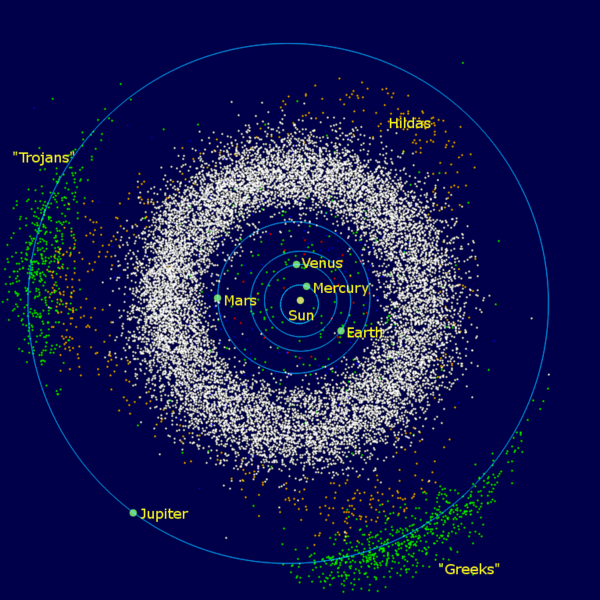
The inner solar system with Jupiter’s Trojan asteroids. The Hilda asteroids have orbital periods of 2/3rds Jupiter’s period. Their elliptical orbits rise from the asteroid belt (white dots) to the L3, L4 and L5 points respectively. Credit: Mdf at English Wikipedia.
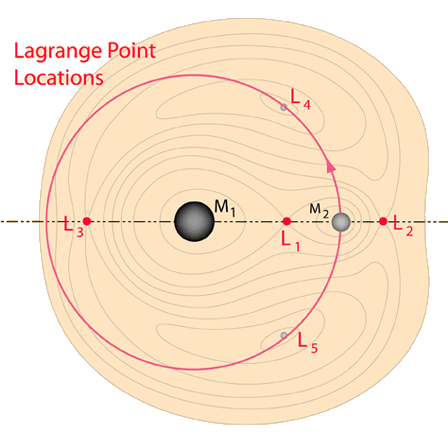
The 5 Lagrange points about two bodies orbiting each other. The Lagrange or Lagrangian points of gravitational equilibrium were discovered by Joseph-Louis Lagrange (1736-1813). Credit Georgia State University.
03/06/2020 – Ephemeris – Tonight Becky Shaw presents one of the first women in STEM: Hypatia of Alexandria
Ephemeris for Friday, March 6th. Today the Sun will be up for 11 hours and 27 minutes, setting at 6:37, and it will rise tomorrow at 7:08. The Moon, 3 days before full, will set at 6:15 tomorrow morning.
This evening the Grand Traverse Astronomical Society will meet the Northwestern Michigan College’s Rogers Observatory on Birmley Road between Garfield and Keystone roads at 8 p.m. The presentation will be by Becky Shaw on one of the first female astronomers Hypatia of Alexandria. Besides excelling in astronomy Hypatia was one of the greatest philosophers of her day in the 4th and 5th centuries CE. She had an unfortunate end being murdered by a mob in 415. After the meeting, at about 9 p.m. there will be observing, weather permitting, of the Moon and the planet Venus, and maybe the Great Orion Nebula. The Pleiades star cluster will also look great in binoculars, so bring ‘em if you’ve got ‘em.
The times given are for the Traverse City/Interlochen area of Michigan. They may be different for your location.
03/05/2020 – Ephemeris – Apparently Betelgeuse, though dimming wasn’t cooling as expected
Ephemeris for Thursday, March 5th. Today the Sun will be up for 11 hours and 24 minutes, setting at 6:36, and it will rise tomorrow at 7:10. The Moon, 3 days past first quarter, will set at 5:31 tomorrow morning.
Betelgeuse, the red star in the constellation Orion’s shoulder has apparently stopped dimming and has begun to brighten. The guesses as to the cause of the dimming are many. One suggested by a photograph taken of the star in December shows the southern half dimmed like it was covered by something. Betelgeuse out gasses lots of material, some of which condenses into dust. Could some of this dust mask the star and make it dimmer? I suspect that we’ll find out before too long. Many astronomers are wishing Betelgeuse would explode in a core collapse or type 2 supernova. At its approximate 700 light year distance we’d be safe, though a bazillion neutrinos would pass harmlessly through each one of us just before the light would get here.
The times given are for the Traverse City/Interlochen area of Michigan. They may be different for your location.
Addendum
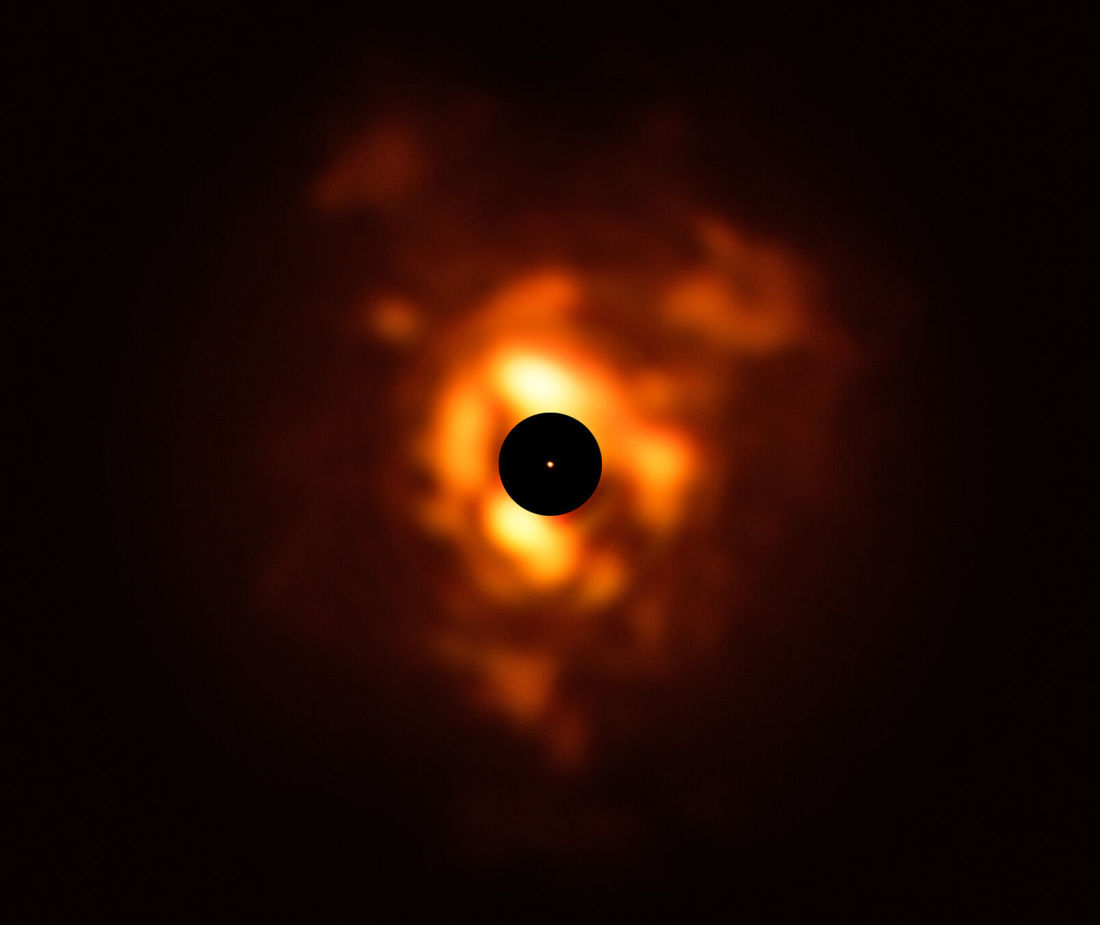
An image of the star Betelgeuse taken in infrared shows it’s surrounded by a vast cloud of dust that erupted from the surface (the bright star itself is masked out, though an image of it has been superposed there for scale — it’s about the size of the orbit of Jupiter, over a billion km wide). Credit: ESO/P. Kervella/M. Montargès et al., Acknowledgement: Eric Pantin via Phil Plait’s Bad Astronomy blog on syfy.com.
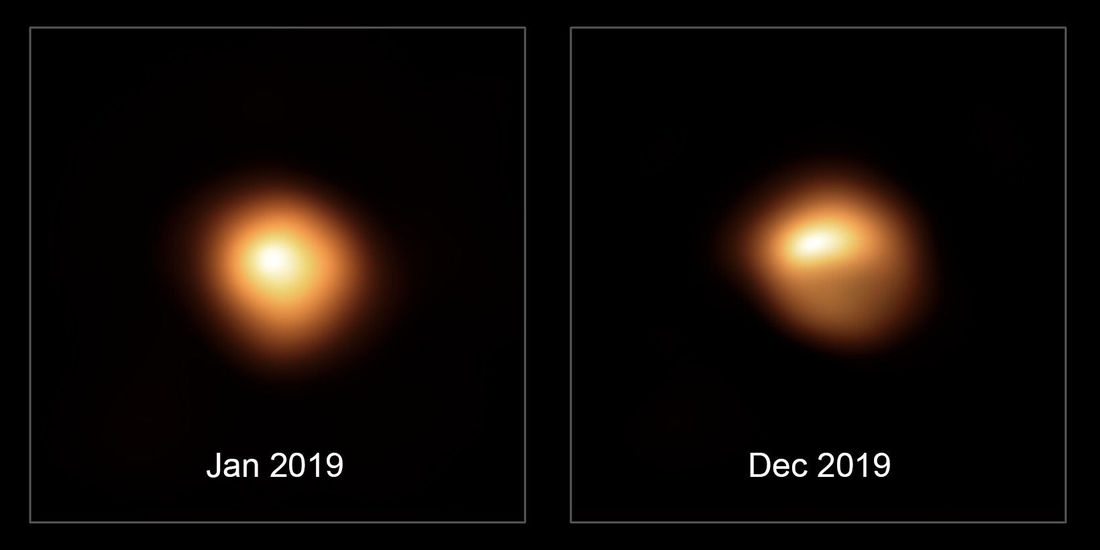
This comparison image shows the star Betelgeuse before and after its unprecedented dimming. The observations, taken with the SPHERE instrument on ESO’s Very Large Telescope in January and December 2019, show how much the star has faded and how its apparent shape has changed. Credit: ESO/M. Montargès et al.
More on this from Dr. Phil Plait’s Bad Astronomy blog on syfy.com: https://www.syfy.com/syfywire/mea-culpa-betelgeuse-and-its-dusty-convective-pulsations
03/04/2020 – Ephemeris – Let’s look at the naked-eye planets for this week
Ephemeris for Wednesday, March 4th. Today the Sun will be up for 11 hours and 21 minutes, setting at 6:35, and it will rise tomorrow at 7:12. The Moon, 2 days past first quarter, will set at 4:39 tomorrow morning.
Let’s look at the naked-eye planets for this week. Venus is our evening star shining brightly in the west for most of the evening. It will set at 10:34 p.m. The rest of the planet action is in the morning. Mars will rise in the southeast at 4:19 a.m. It’s getting as bright as a first magnitude star because it’s 157 million (253 million km) miles away, and it’s getting slowly closer to the Earth at the rate of about 6 million miles (9 million km) a week. However it’s brighter than Betelgeuse. Jupiter will rise at 4:46 a.m. Lastly, Saturn will rise at 5:14 tomorrow morning. Mars is catching up to Jupiter and Saturn. It will pass south of Jupiter on the 20th, and Saturn on the 31st. It might be worth getting up for before 6 a.m. to spot.
The times given are for the Traverse City/Interlochen area of Michigan. They may be different for your location.
Addendum
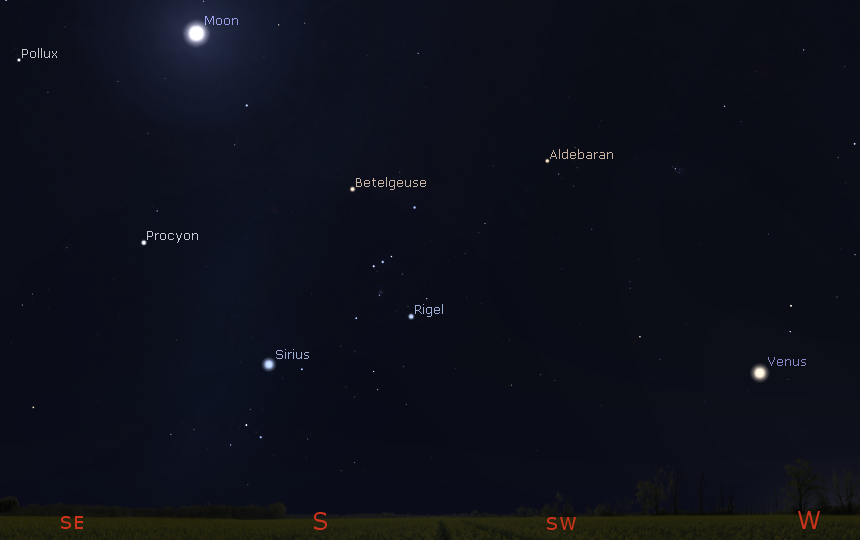
Venus, the bright winter stars and the Moon tonight, 8 p.m. March 4, 2020. Click on the image to enlarge. Created using Stellarium.
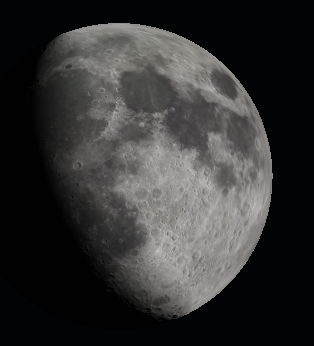
The gibbous Moon as it might appear in binoculars at 8 p.m. March 4, 2020. Created using Stellarium.
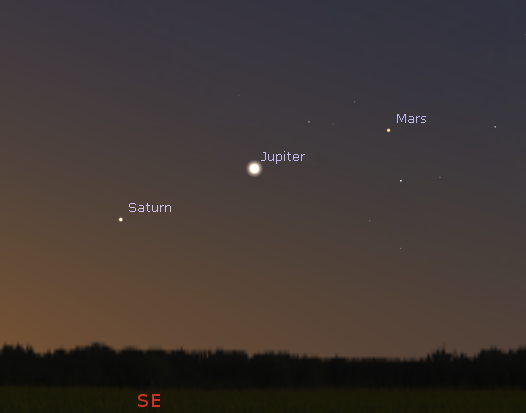
The naked-eye planets visible in the morning at 6:30 a.m. tomorrow, March 5, 2020. Created using Stellarium.
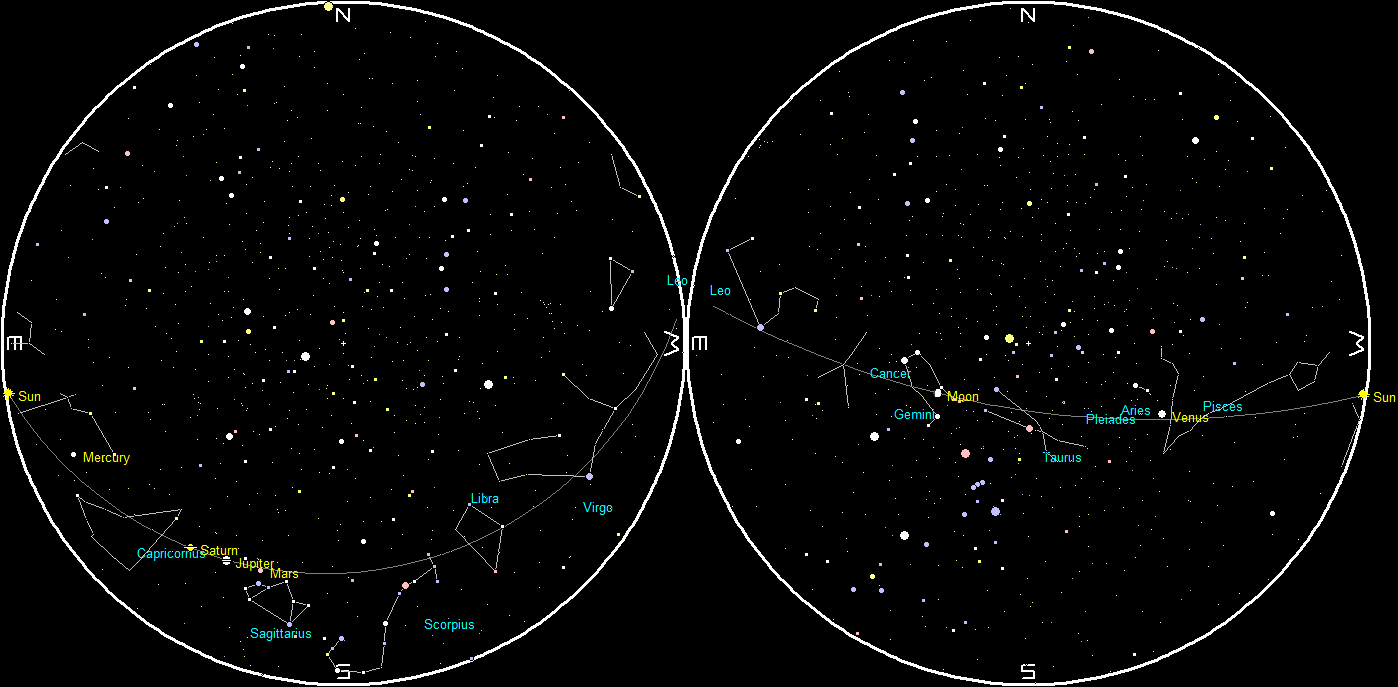
Planets and the Moon at sunset and sunrise of a single night starting with sunset on the right on March 4, 2020. The night ends on the left with sunrise on the 5th. Click on the image to enlarge. Created using my LookingUp program.
 Bob Moler's Ephemeris Blog