Archive
04/16/2020 – Ephemeris – Comet C/2019 Y4 (ATLAS)
One of the problems that can happen when you record programs several days before they are aired is that events can get ahead of you. Comet ATLAS is disintegrating and won’t get any brighter than it already is. This program was written and recorded before I realized that it was falling apart.
This is Bob Moler with Ephemeris for Thursday, April 16th. Today the Sun will be up for 13 hours and 33 minutes, setting at 8:29, and it will rise tomorrow at 6:54. The Moon, 2 days past last quarter, will rise at 5:05 tomorrow morning.
There’s a new comet about, which may reach naked-eye visibility next month. It is comet C/2019 Y4 (ATLAS). It was discovered three days after Christmas last year by the apocalyptic sounding Asteroid Terrestrial-Impact Last Alert System (ATLAS), run out of the University of Hawai’i. Despite the name of the search system the comet they snagged will not come close to the Earth, contrary to some misleading posts on social media. Comet ATLAS, yes it’s an acronym, could reach first magnitude when it’s close to the Sun at the end of May, but will be in the bright evening twilight by then. I don’t think that it can be picked up in binoculars yet. I’ll have more about it tomorrow.
The event times given are for the Traverse City/Interlochen area of Michigan. They may be different for your location.
Addendum
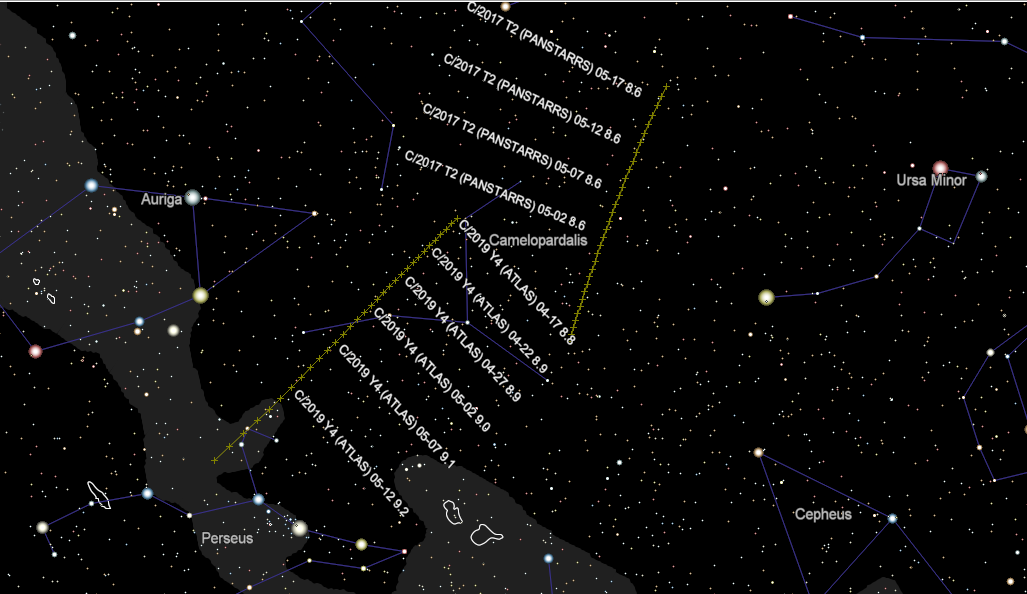
This image starts at 10 p.p. looking north-northwest. Also plotted was Comet PANSTARRS. I removed some of its labels that plotted over the ATLAS labels. The labels have the comet name, month-day and magnitude. Any magnitude value greater than 6.0 is invisible to the naked-eye. We were hoping that ATLAS would get a lot brighter. Click on the image to enlarge. Created using Cartes du Ciel (Sky Charts).
04/15/2020 – Ephemeris – Let’s look at the naked-eye planets for this week
This is Bob Moler with Ephemeris for Wednesday, April 15th. Today the Sun will be up for 13 hours and 30 minutes, setting at 8:28, and it will rise tomorrow at 6:55. The Moon, 1 day past last quarter, will rise at 4:34 tomorrow morning.
Let’s look at the naked-eye planets for this week. Venus is our evening star shining brightly in the west above the Pleiades. It will set at 12:37 a.m. The rest of the planet action is in the morning sky where there are three planets nearly evenly spread out in the southeast. Bright Jupiter will rise first at 3:21 a.m. Followed by Saturn at 3:38 a.m. Mars, left of Saturn and nearest to the Moon tomorrow morning, will rise at 4:14 a.m. It’s now down to 125 million (201 million km) miles away, as the Earth slowly overtakes it at the rate of about 5 million miles (8 million km) a week. Mars will be closest to us in October at about 39 million miles (62 million km). Not quite as close as it was 2 years ago, but closer than it will get for the next 15 years.
The event times given are for the Traverse City/Interlochen area of Michigan. They may be different for your location.
Addendum
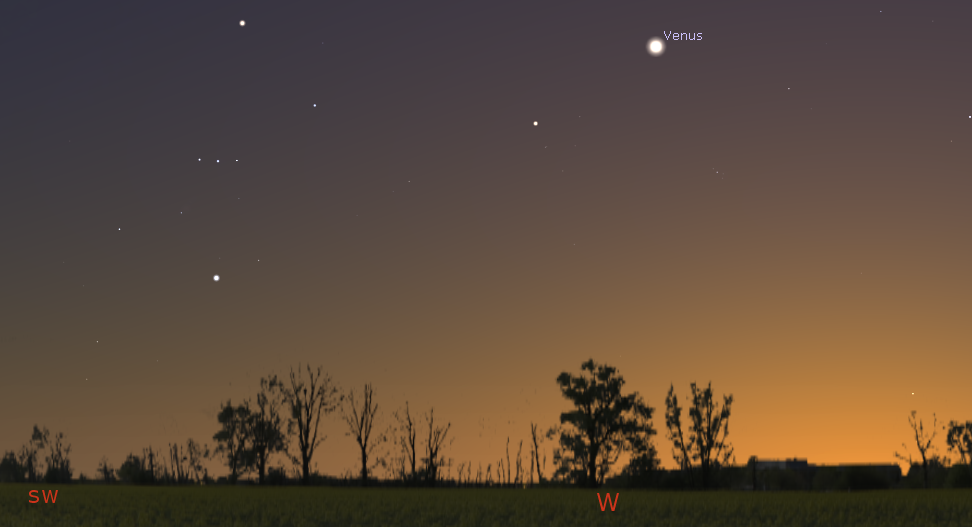
Venus in twilight at 9 p.m. tonight April 15, 2020, a half hour or so after sunset. Click on the image to enlarge. Created using Stellarium.
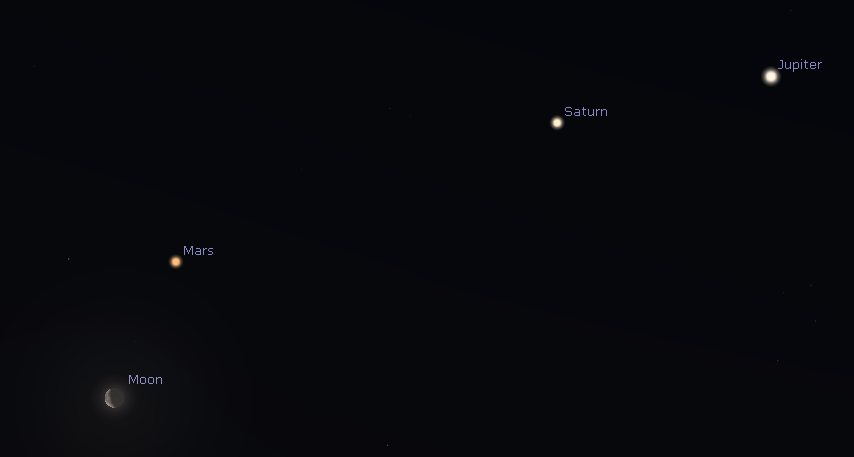
The Morning planets and the Moon at 6 a.m. tomorrow April 16, 2020. Click on the image to enlarge. Created using Stellarium.
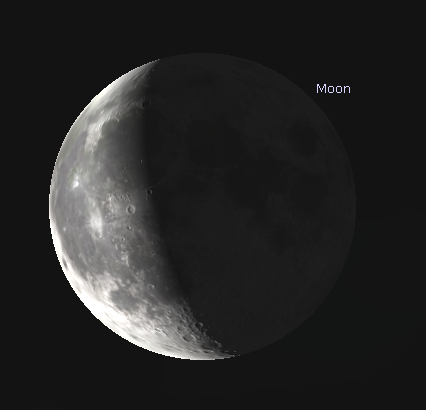
The crescent Moon as it might be seen in binoculars at 6 a.m. tomorrow April 16, 2020. Created using Stellarium.
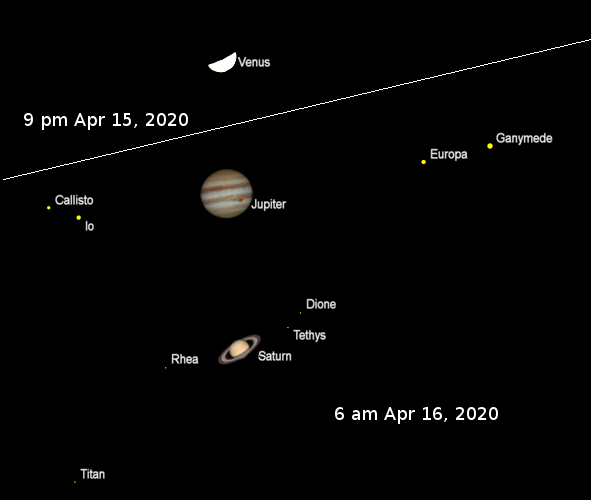
The planets as seen in a telescope with the same magnification. Venus in the evening and Jupiter and Saturn in the morning on the night of April 15/16, 2020. Apparent diameters: Venus, 31.01″; Jupiter, 38.84″; Saturn, 16.53″, rings, 38.51″. Mars at 6.99″ won’t be added until it reaches 10″. The ” symbol means seconds of arc (1/3600th of a degree.) Created using Cartes du Ciel (Sky Charts).
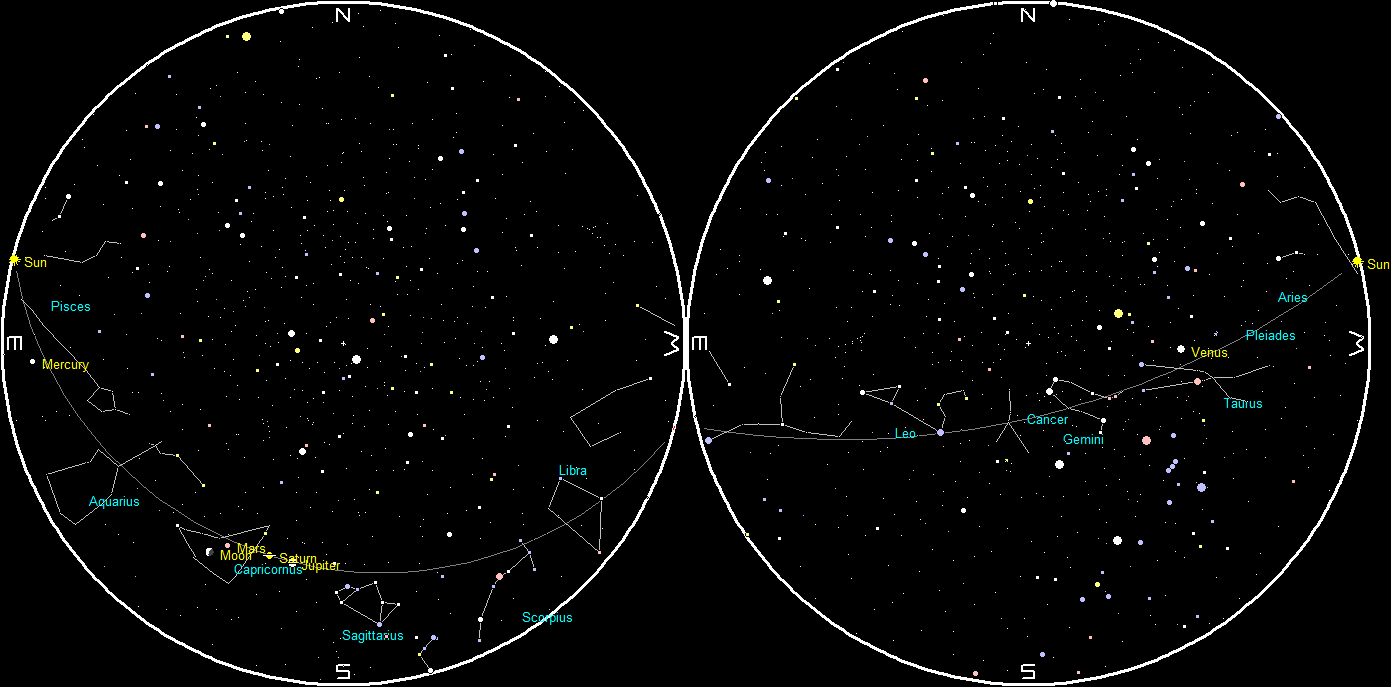
Planets and the Moon at sunset and sunrise of a single night starting with sunset on the right on April 15, 2020. The night ends on the left with sunrise on the 16th. The planet traffic jam in the morning sky unfortunately overlays planets and labels. Click on the image to enlarge. Created using my LookingUp program.
04/14/2020 – Ephemeris – The Moon will be hanging out with the morning planets tomorrow
This is Ephemeris for Tuesday, April 14th. Today the Sun will be up for 13 hours and 28 minutes, setting at 8:27, and it will rise tomorrow at 6:57. The Moon, at last quarter today, will rise at 3:56 tomorrow morning.
Tomorrow morning the Moon will be in the midst of passing the three morning planets, from right to left: Jupiter, Saturn and Mars. Specifically, the last quarter Moon will be below Saturn at 6 a.m. Mars is traveling east rapidly. Its rise times decrease by only two minutes a day compared to the 4 minutes a day for the stars, so it won’t enter the evening sky until October, while Jupiter and Saturn will enter the evening sky in July. A planet is considered to be in the morning sky if it rises after sunset, and in the evening sky if it rises before sunset. Rising in the morning is definitely after sunset. The dividing point is when a superior* planet is at opposition from the Sun when it enters the evening sky, or in conjunction with the Sun when it enters the morning sky.
The event times given are for the Traverse City/Interlochen area of Michigan. They may be different for your location.
* Superior planets have orbits outside the Earth’s orbit: Mars, Jupiter, Saturn, Uranus and Neptune.
Addendum
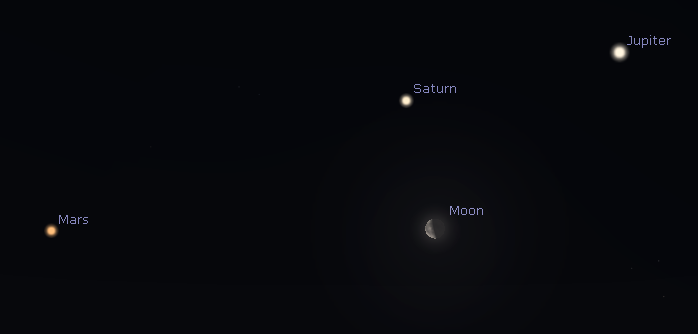
Morning planets and Moon in the south-southeast tomorrow morning at 6 a.m. April 15, 2020. Click on image to enlarge. Created using Stellarium.
04/13/2020 – Ephemeris – The story of Callisto and Arcas or Ursa Major and Boötes
This is Ephemeris for Monday, April 13th. Today the Sun will be up for 13 hours and 25 minutes, setting at 8:26, and it will rise tomorrow at 6:59. The Moon, 1 day before last quarter, will rise at 3:09 tomorrow morning.
Appearing mid way up the sky in the east at 10 p.m. is the kite shaped constellation of Boötes the herdsman. The bright star Arcturus is at the bottom-right of the kite, pointed to by the arc of the handle of the Big Dipper, above it. In one Greek myth Boötes represents a young hunter named Arcas, son of Callisto, a beautiful young lady who had the misfortune of being loved by Zeus the chief of the Greek gods. Zeus’ wife Hera, found out about the affair, and since she couldn’t punish Zeus, turned the poor woman into an ugly bear. Arcas, unaware of the events surrounding his mother’s disappearance in his youth was about to kill the bear when Zeus intervened and placed them both in the sky to save her. To this day Boötes continues to chase the Great Bear, Ursa Major, around the pole of the sky each night.
The event times given are for the Traverse City/Interlochen area of Michigan. They may be different for your location.
Addendum
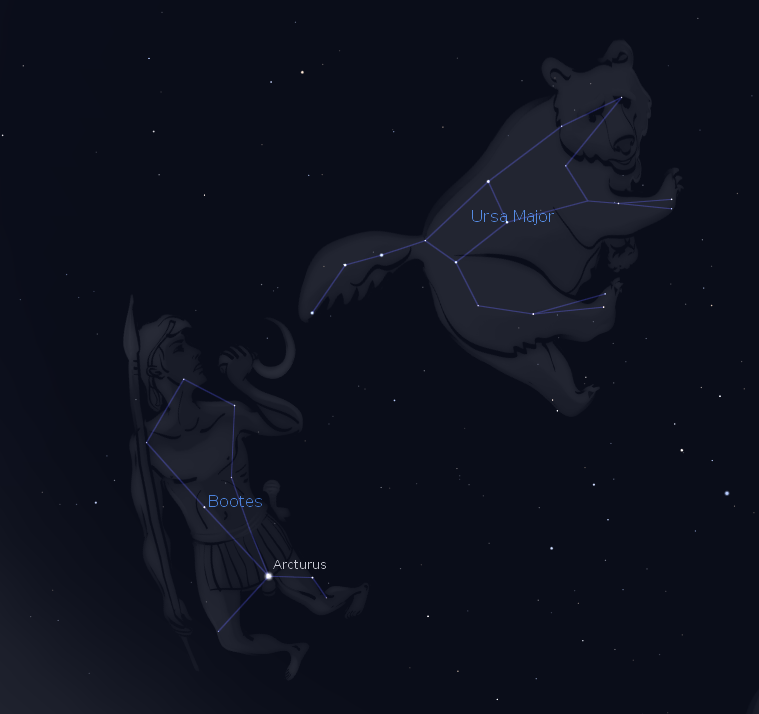
Bootes and Ursa Major aka Arcas chasing Callisto around the pole of the sky. Created using Stellarium.

Arcas about to slay the bear by the 17th century artist Baur. Source: University of Virginia Electronic Text Center
04/10/2010 – Ephemeris – The constellations of Ursa Major and Ojiig
This is Ephemeris for Good Friday, Friday, April 10th. Today the Sun will be up for 13 hours and 15 minutes, setting at 8:22, and it will rise tomorrow at 7:04. The Moon, 3 days past full, will rise at 11:54 this evening.
The constellation of Ursa Major, or great bear was well-known to the ancient Greeks and Native Americans. Today, however, many of us can recognize only part of it as the Big Dipper. The whole bear can be easily seen only in a dark sky, at 10 p.m. it’s high in the northeast with feet to the south. The stars in front of the bowl are the front part of his body and head. The bowl of the Big Dipper is his rump, and the handle his long tail. The Native Americans, saw those three stars as three hunters following the bear. The tribes of the Great Lakes region saw it as the Fisher or Ojiig , who brought summer to the Earth. These stars here do make a convincing bear, except for the tail, when seen on a dark night. The weasel-like Fisher fits the stars completely.
The event times given are for the Traverse City/Interlochen area of Michigan. They may be different for your location.
Addendum

The Big Dipper/Great Bear/Fisher as seen by western and Anishinaabe people. Created using Stellarium and GIMP.
The constellation art is part of the latest versions of Stellarium. Ojibwe (Anishinaabe) constellation art by Annette S Lee and William Wilson from Ojibwe Sky Star Map Constellation Guide, ISBN 978-0-615-98678-4.
Here’s the story of how the Fisher brought summer to the Earth: https://bobmoler.wordpress.com/2012/10/11/the-story-of-the-fisher-star/
04/09/2020 – Ephemeris – How to find the constellation of Leo the lion
This is Ephemeris for Thursday, April 9th. Today the Sun will be up for 13 hours and 12 minutes, setting at 8:21, and it will rise tomorrow at 7:06. The Moon, 2 days past full, will rise at 10:36 this evening.
At 10 p.m. the spring constellation of Leo the lion will be high in the south-southeast. It can be found by locating the Big Dipper high in the northeast and imagining that a hole were drilled in the bowl to let the water leak out. It would drip on the back of this giant cat. The Lion is standing or lying facing westward. His head and mane are seen in the stars as a backwards question mark. This group of stars is also called the sickle. The bright star Regulus is at the bottom, the dot at the bottom of the question mark. A triangle of stars, to the left of Regulus, is the lion’s haunches. Leo contains some nice galaxies visible in moderate sized telescopes. The stars in Leo’s part of the sky are fewer than those in the winter sky.
The event times given are for the Traverse City/Interlochen area of Michigan. They may be different for your location.
Addendum
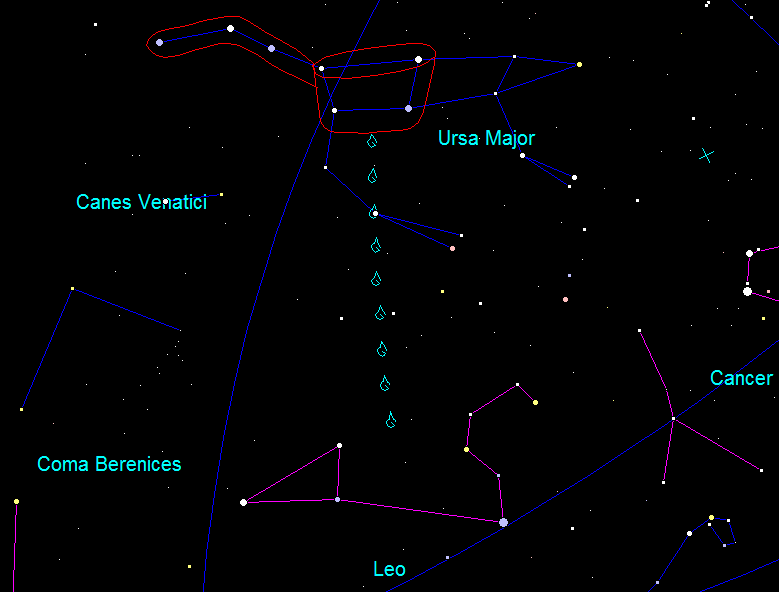
Leaky Big Dipper drips on Leo. Created using my LookingUp program.
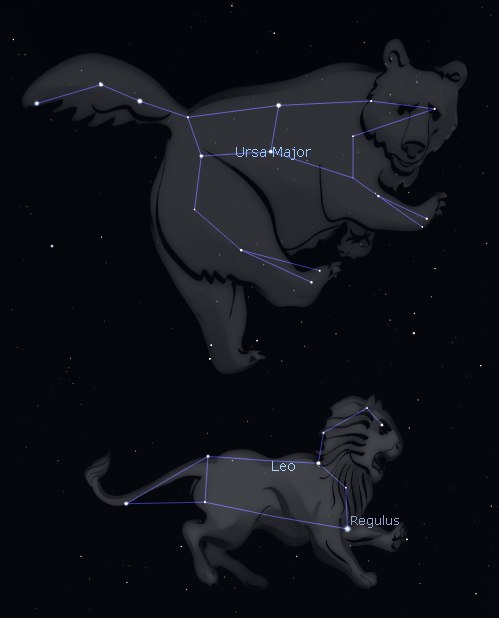
Ursa Major with the Big Dipper in her hind end and Leo. Created using Stellarium and GIMP.
04/08/2020 – Ephemeris – Morning planets are not practicing social distancing
Note: It seems the title is appropriate to our current predicament even though I hadn’t thought about it when I wrote and recorded the radio script that follows last Sunday.
This is Ephemeris for Wednesday, April 8th. Today the Sun will be up for 13 hours and 9 minutes, setting at 8:19, and it will rise tomorrow at 7:08. The Moon, 1 day past full, will rise at 9:16 this evening.
Let’s look at the naked-eye planets for this week. Venus is our evening star shining brightly in the west above the Pleiades. It will set at 12:33 a.m. The rest of the planet action is in the morning sky where there are three planets nearly evenly spread out in the southeast. Bright Jupiter will rise first at 3:46 a.m. Followed by Saturn at 4:05 a.m. Mars, left and below Saturn will rise at 4:27 a.m. It’s now as bright as a first magnitude star because it’s down to 130 million miles (209 million km) away, as the Earth slowly overtakes it at the rate of about 5 million miles (8 million km) a week. It’s brighter than the star Antares in the southwest. Mars will be closest to us in October, which makes a good time to launch spacecraft to it few months before then.
The event times given are for the Traverse City/Interlochen area of Michigan. They may be different for your location.
Addendum
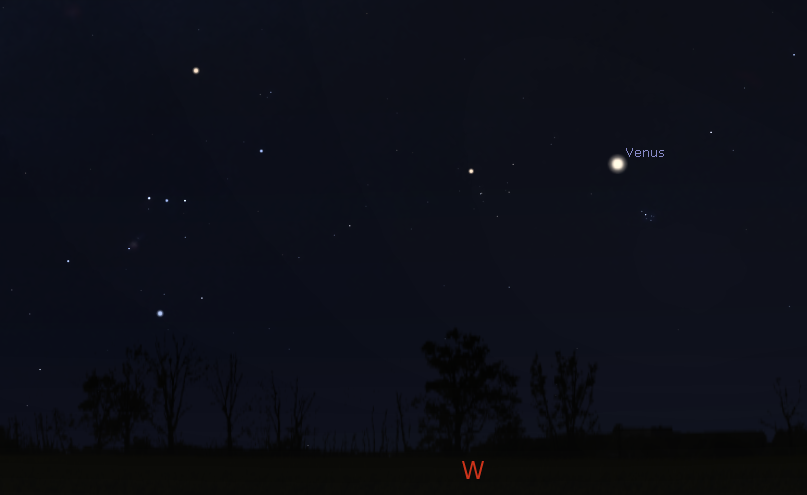
Venus in the evening with the setting winter stars including those in Orion and Taurus at 10 p.m. April 8, 2020. Click on the image to enlarge. Created using Stellarium.
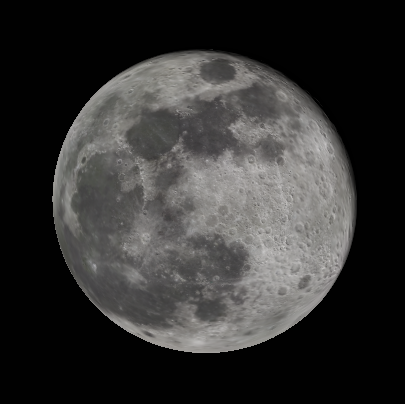
The Moon as it might be seen in binoculars at 10 p.m. April 8, 2020. Created using Stellarium.
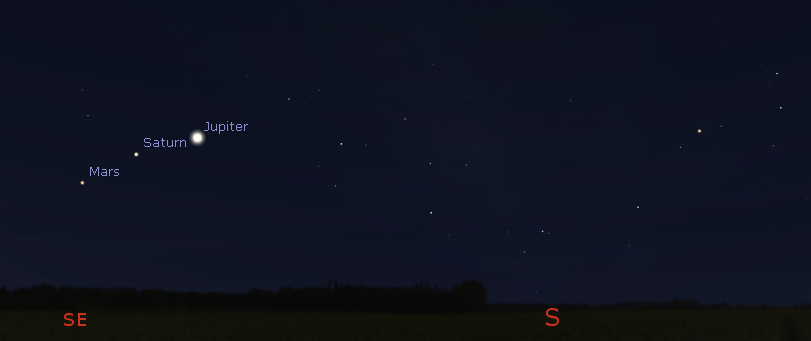
The morning planets and the southern summer stars in the moonlight at 6 a.m. April 9, 2020. The bright star on the right is Antares. Click on the image to enlarge. Created using Stellarium.
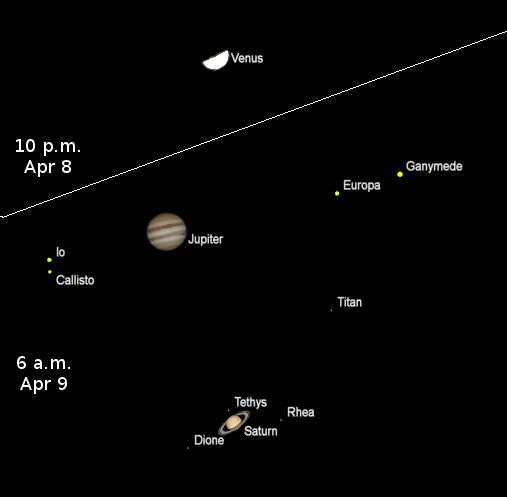
The planets as seen in a telescope with the same magnification. Venus in the evening and Jupiter and Saturn in the morning on the night of April 8/9, 2020. Apparent diameters: Venus, 28.21″; Jupiter, 38.00″; Saturn, 16.34″, rings, 38.07″. Mars at 6.72″ won’t be added until it reaches 10″. The ” symbol means seconds of arc (1/3600th of a degree.) Created using Cartes du Ciel (Sky Charts).
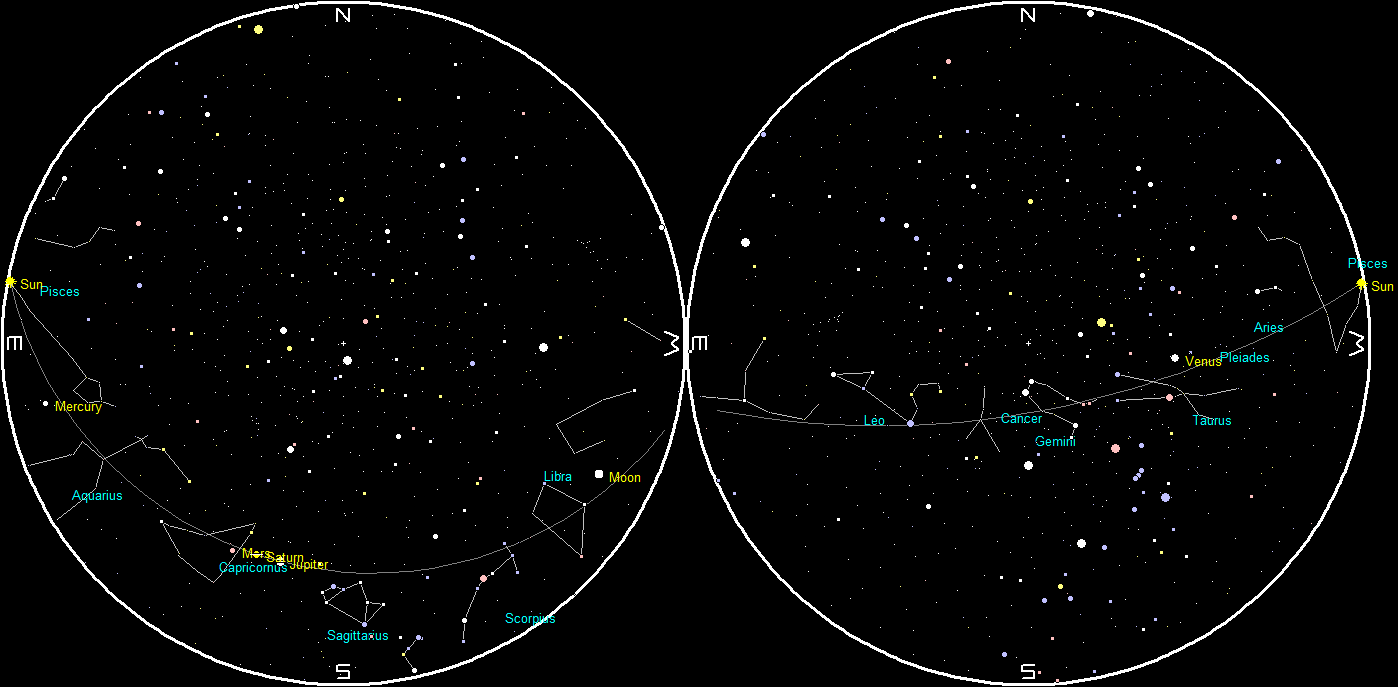
Planets and the Moon at sunset and sunrise of a single night starting with sunset on the right on April 8, 2020. The night ends on the left with sunrise on the 9th. The planet traffic jam in the morning sky unfortunately overlays planets and labels. Click on the image to enlarge. Created using my LookingUp program.
04/07/2020 – Ephemeris – Today is the Paschal full moon
This is Ephemeris for Tuesday, April 7th. Today the Sun will be up for 13 hours and 6 minutes, setting at 8:18, and it will rise tomorrow at 7:09. The Moon, at full today, will rise at 7:55 this evening.
Tonight’s full moon is the Paschal full moon, the first full moon of spring which is tomorrow in the Holy Land, so Passover begins at sunset tomorrow. Easter for western churches falls on the first Sunday after the first full moon of spring, which is this next Sunday the 12th. Orthodox Easter rule adds that it must fall after Passover,a week long observance, which pushes their Easter celebration to a week later, April 19th. Both Christian churches attempt to mimic the Jewish Lunar Calendar by setting Easter by the first full moon of spring using solar based calendars and assuming that spring started on March 21st. This year actual spring started on the 20th in the Holy Land, and 19th here by 10 minutes, in our Gregorian Calendar and 13 days earlier by the old Julian Calendar. This is all very complicated.
The event times given are for the Traverse City/Interlochen area of Michigan. They may be different for your location.
04/06/2020 – Ephemeris – Tomorrow’s full moon is special in two ways
This is Ephemeris for Monday, April 6th. Today the Sun will be up for 13 hours and 3 minutes, setting at 8:17, and it will rise tomorrow at 7:11. The Moon, 1 day before full, will set at 7:21 tomorrow morning.
The Moon will be full tomorrow, and also it will reach perigee, that is, its closest to the Earth of its current orbit, and for 2020. That makes it a super moon. The orbit of the Moon is affected by the Sun, Venus, and Jupiter mostly. So all perigees are not equally close. At perigee tomorrow the Moon will be 221,772 miles (356,907* km). I its most distant point from the Earth of 252,564 miles (406,462* km). We won’t notice it because it will be nearly new at that time. Tomorrow’s full moon will be special in another way, because it it the full moon that announces Easter for both Christian churches, east and west, and Passover for the Jews. I’ll talk more about that tomorrow.
The event times given are for the Traverse City/Interlochen area of Michigan. They may be different for your location.
* According to Astronomical Tables of the Sun, Moon and Planets Third Edition by Jean Meeus.
4/03/2020 – Ephemeris – Tonight Venus appears among the stars of the Pleiades
This is Bob Moler with Ephemeris for Friday, April 3rd. Today the Sun will be up for 12 hours and 54 minutes, setting at 8:13, and it will rise tomorrow at 7:17. The Moon, 2 days past first quarter, will set at 5:48 tomorrow morning.
This evening the brilliant evening star, the planet Venus will appear within the Pleiades or Seven Sisters star cluster. Venus will slowly pass the Pleiades for the next few days. By the end of the month the Pleiades will be pretty much lost in the twilight. Evening star gazers will again pick it up late on September evenings, rising in the northeast. Venus, itself appears as a tiny crescent in small telescopes, and in May the tiny crescent will even be visible in binoculars. Venus reflects about 77 percent of the sunlight it receives because it is completely socked in by clouds. Clouds of a sulfuric acid mist. It is not a nice place. Surface temperature averages 867 degrees, and the atmospheric pressure is 90 times that of Earth.
The event times given are for the Traverse City/Interlochen area of Michigan. They may be different for your location.
Addendum
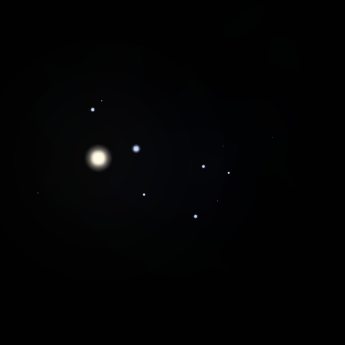
binocular view of Venus and the Pleiades tonight at 10 p.m. EDT April 3, 2020. (2 hr UT April 4) Created using Stellarium. Note: More stars may be visible. There will be a bright Moon out masking the dimmer members of the cluster. Your results may vary.
Update 04/03/2020 10:10 p.m. EDT
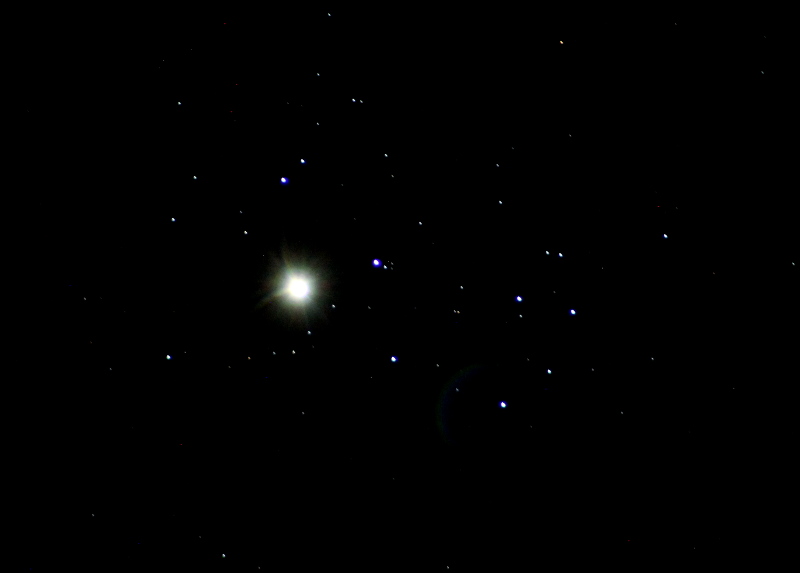
Photo of Venus and Pleiades taken at 9:37 p.m. EDT with Canon EOS Rebel T5, 300mm fl. f/5.6, 2 sec, ISO 3200, unguided. by myself.
 Bob Moler's Ephemeris Blog