Archive
08/17/2020 – Ephemeris – The Milky Way’s Great Rift.
This is Ephemeris for Monday, August 17th. Today the Sun will be up for 13 hours and 56 minutes, setting at 8:44, and it will rise tomorrow at 6:49. The Moon, 1 day before new, will rise at 5:53 tomorrow morning.
High overhead the Milky Way is seen passing through the Summer Triangle of three bright stars. Here we find the Milky Way splits into two sections. The split starts in the constellation of Cygnus the Swan or Northern Cross very high in the east. The western part of the Milky Way ends southwest of Aquila the eagle. This dark dividing feature is called the Great Rift. Despite the lack of stars seen there, it doesn’t mean that there are fewer stars there than in the brighter patches of the Milky Way. The rift is a great dark cloud that obscures the light of the stars behind it. Sometimes binoculars can be used to find the edges of the clouds of the rift, as stars numbers drop off suddenly. This is especially easily seen in Aquila.
The event times given are for the Traverse City/Interlochen area of Michigan. They may be different for your location.
Addendum
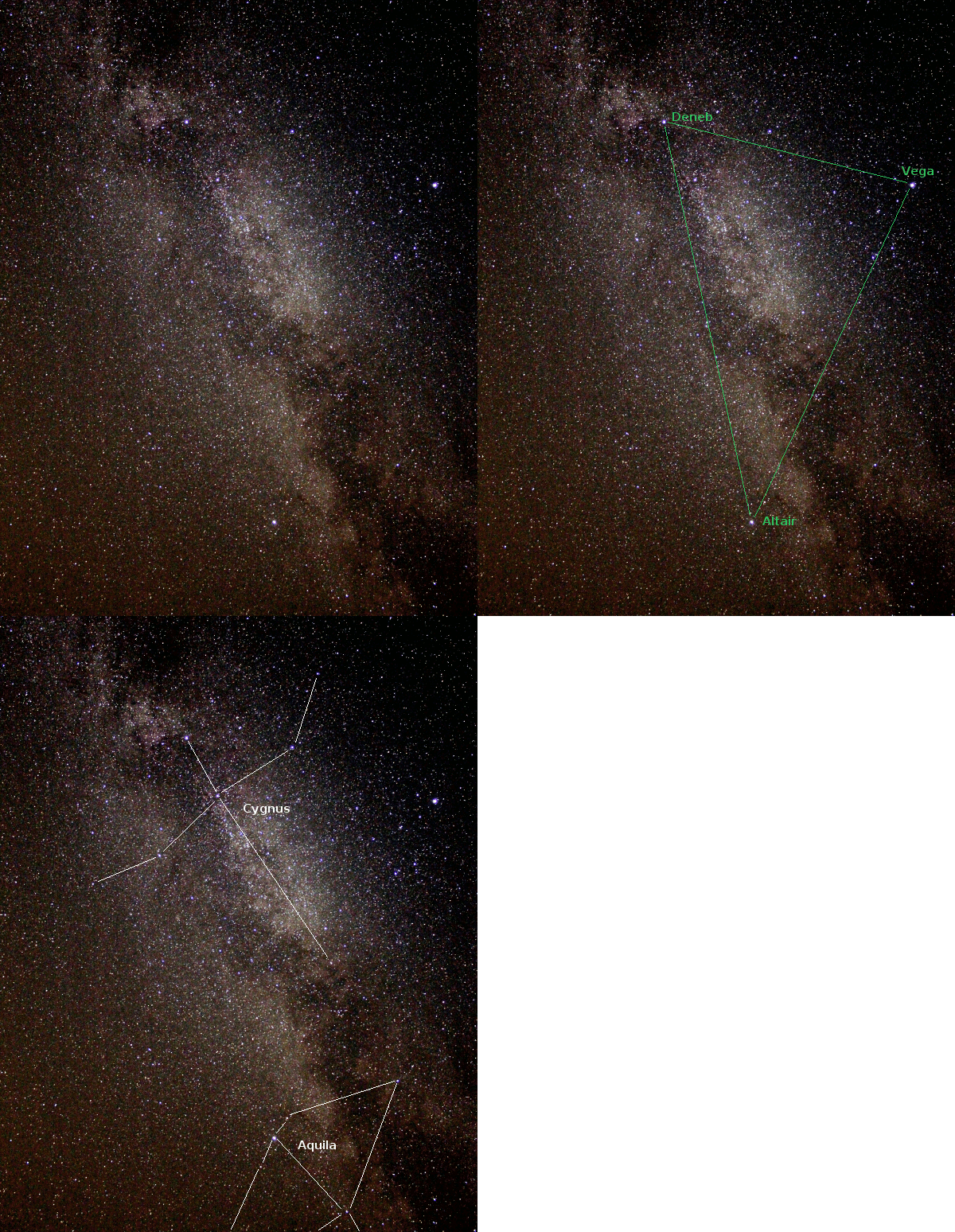
The Great Rift finder animation as seen in the Summer Triangle, also showing the constellations of Cygnus the swan and the the northern part of Aquila the Eagle. This image a stack of 5 30 second exposures taken the morning of the Perseid meteor shower in a vain attempt to capture some meteors.
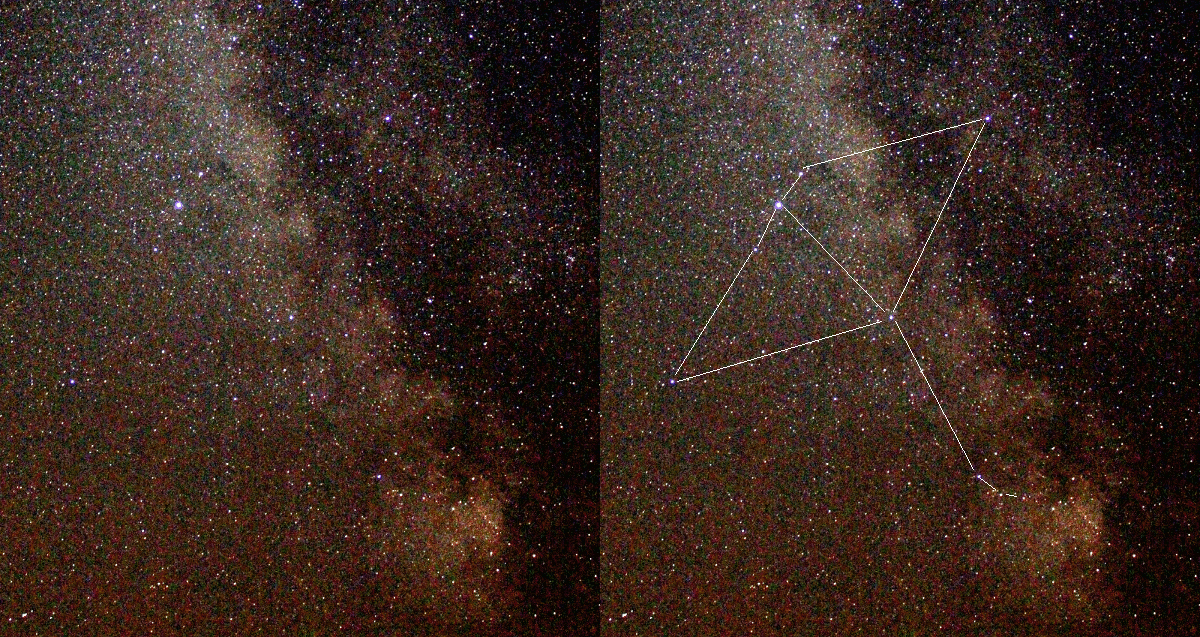
Annotated and animated photograph taken of Aquila August 13, 2018 during the Perseid meteor shower, the same night the image above. Taken by me and processed using Registax and GIMP.
08/14/2020 – Ephemeris – Seeing the summer Milky Way
This is Bob Moler with Ephemeris for Friday, August 14th. Today the Sun will be up for 14 hours and 4 minutes, setting at 8:49, and it will rise tomorrow at 6:45. The Moon, 3 days past last quarter, will rise at 2:39 tomorrow morning.
Now is the time the summer Milky Way is displayed to its fullest to the southern horizon. We have a week before the Moon begins to encroach on our dark skies after 10 pm. City folk come to our area and are sometimes fooled by the brightness and expanse of the Milky Way and think it’s a cloud. Yes those are clouds indeed, but they are star clouds. Binoculars will begin to show them to be millions of stars, each too faint to be seen individually to the eye, but whose combined glow give the impression of a luminous cloud. Binoculars are the ideal tool to explore the Milky Way. Objects still too fuzzy can be checked out with a telescope to reveal their true nature. The dark nights of August and September are my favorites.
The event times given are for the Traverse City/Interlochen area of Michigan. They may be different for your location.
Addendum
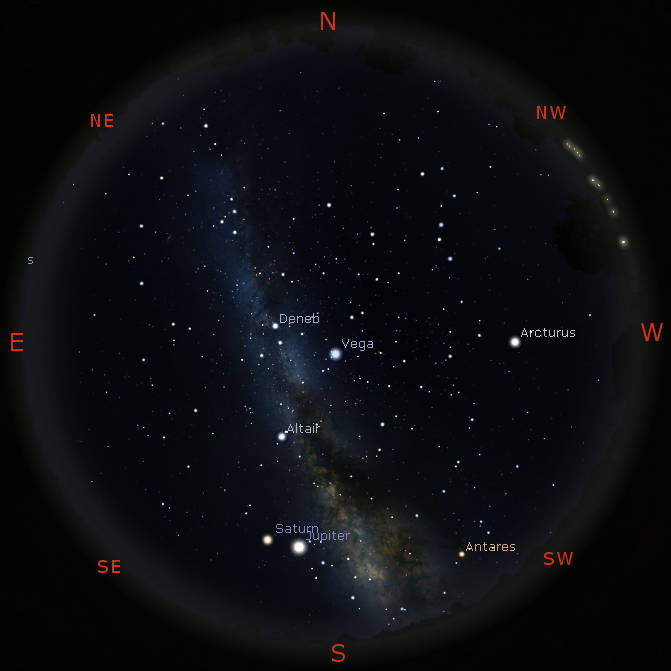
The summer Milky Way spans the sky dome at 11 pm tonight, August 14, 2020. Created using Stellarium.
08/13/2020 – Ephemeris – Sagittarius the archer, morphs into a teapot
This is Bob Moler with Ephemeris for Thursday, August 13th. Today the Sun will be up for 14 hours and 7 minutes, setting at 8:50, and it will rise tomorrow at 6:44. The Moon, 2 days past last quarter, will rise at 1:53 tomorrow morning.
Due south and low in the sky at 10:30 p.m. now is one of my favorite asterisms the Teapot of the constellation Sagittarius. Sagittarius classically represents a centaur with a bow and arrow aimed at the heart of the constellation Scorpius to its west. I can find the bow and arrow here, but the half man half horse figure of the centaur eludes me. However the stout little teapot of the children’s song is quite obvious, with its base, lid on top, handle to the left and the spout to the right. To make things more realistic the bright Milky Way seems to rise like steam from its spout. As the night goes on the Teapot slides westward and appears to tilt, pouring its tea on the southwestern horizon. Jupiter and Saturn are just to the left of it now.
The event times given are for the Traverse City/Interlochen area of Michigan. They may be different for your location.
Addendum
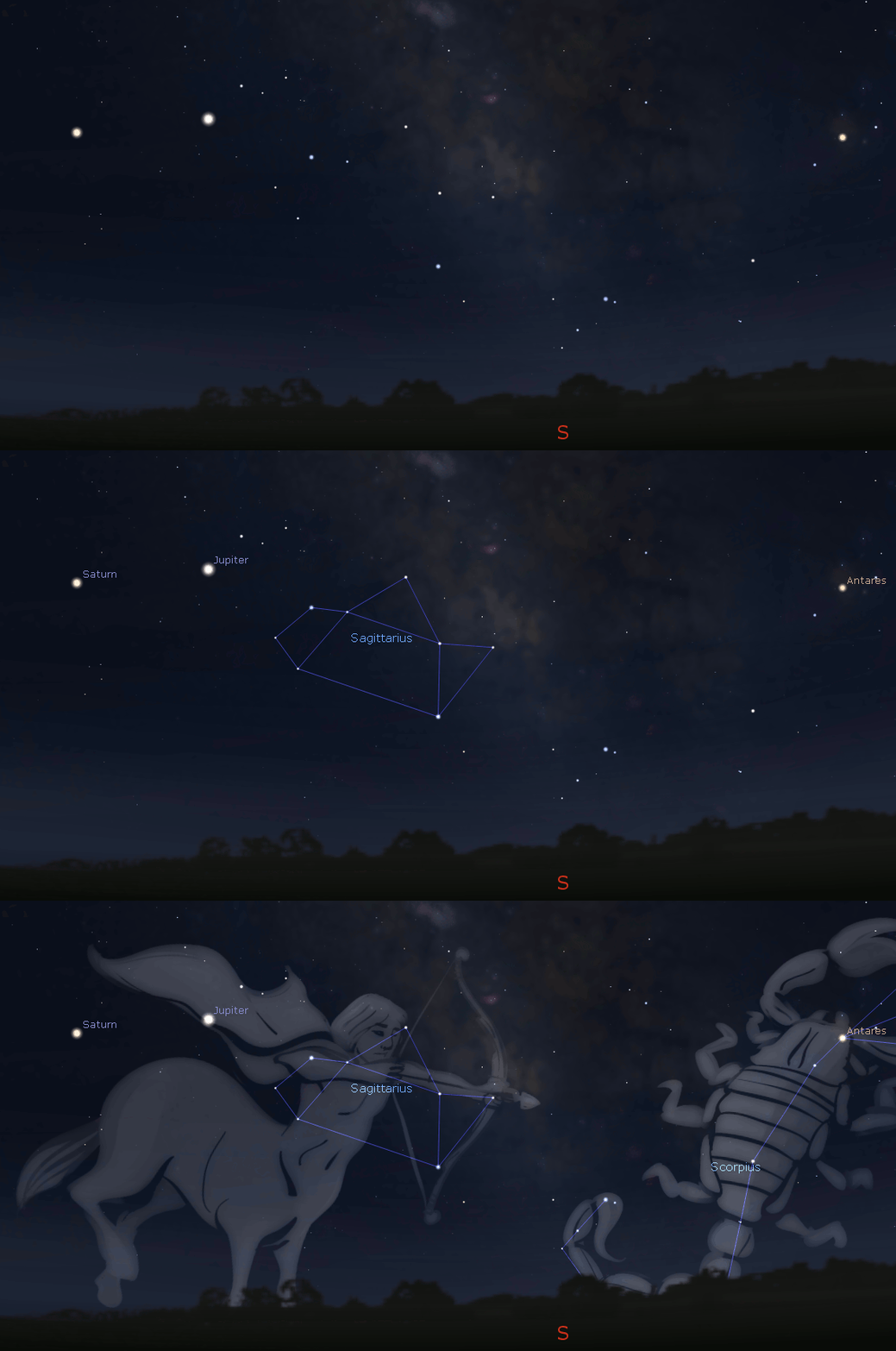
Sagittarius-Teapot finder animation for 10 pm August 13, 2020. Click on the image to enlarge. Created using Stellarium and GIMP.
08/12/2020 – Ephemeris – Let’s look at a the naked-eye planets for this week
This is Ephemeris for Wednesday, August 12th. Today the Sun will be up for 14 hours and 10 minutes, setting at 8:52, and it will rise tomorrow at 6:43. The Moon, 1 day past last quarter, will rise at 1:16 tomorrow morning.
Let’s look at a the naked-eye planets for this week. Jupiter and Saturn are both low in the south-southeastern sky at 10 pm. Jupiter is the very bright one. To the left of it will be Saturn. They now seem to be separating a bit due to the Earth’s motion now, but they will cross paths in December. Both planets will be up most of the night with Jupiter setting first at 4:02 tomorrow morning and Saturn following at 4:44 am. The next planet visible will be Mars which will rise at 11:22 pm. Its now down to 54.3 million miles (87.5 million kilometers) away, as the Earth slowly overtakes it at the rate of about 3.4 million miles (5.4 million kilometers) a week. Brilliant Venus will rise at 3:09 am in the east-northeast and is as far west from the Sun as it can get today.
The event times given are for the Traverse City/Interlochen area of Michigan. They may be different for your location.
Addendum
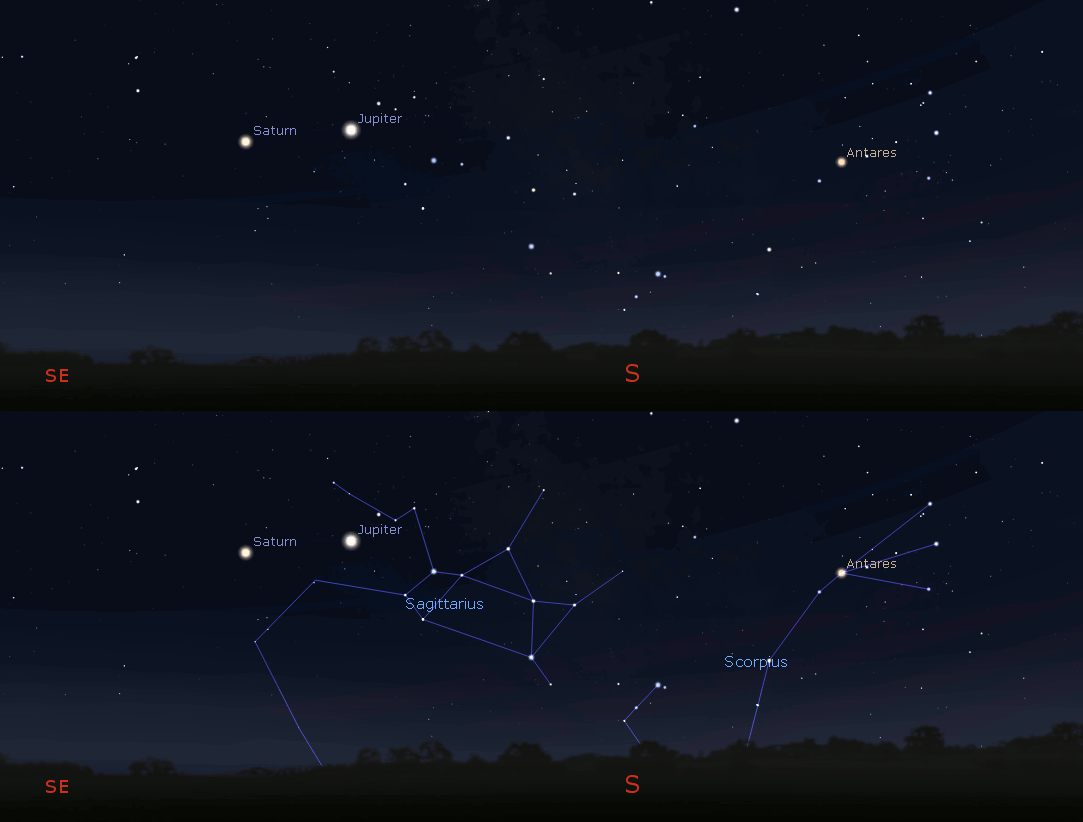
Jupiter and Saturn animation at 10 pm with Sagittarius and Scorpius constellation lines. Click on the image to enlarge. Created using Stellarium and GIMP.
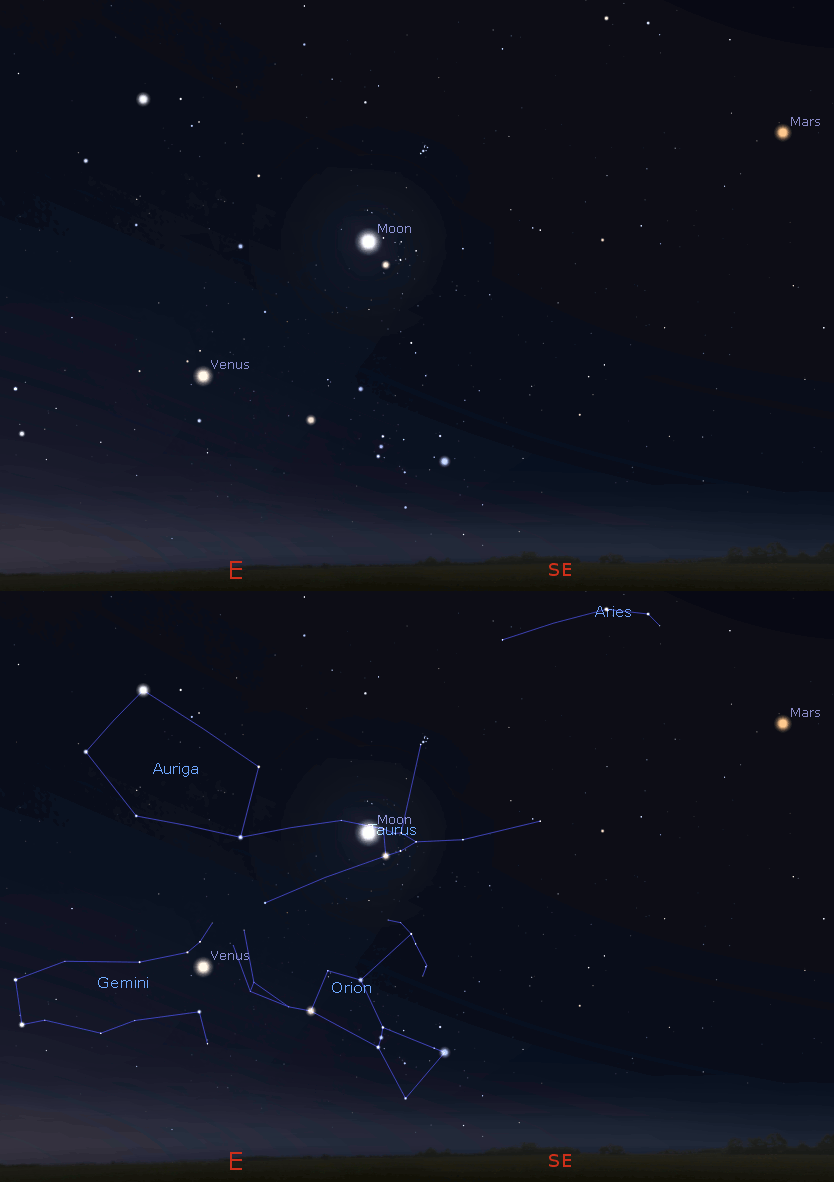
The morning planets and the Moon as seen at 5:30 am or about an hour before sunrise tomorrow morning August 13, 2020 with and without the lines delineating nearby constellations. Click on the image to enlarge. Created using Stellarium.
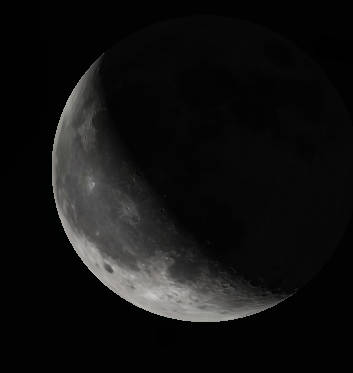
The Moon as it might be seen in binoculars at 5:30 am tomorrow August 13, 2020. Created using Stellarium.
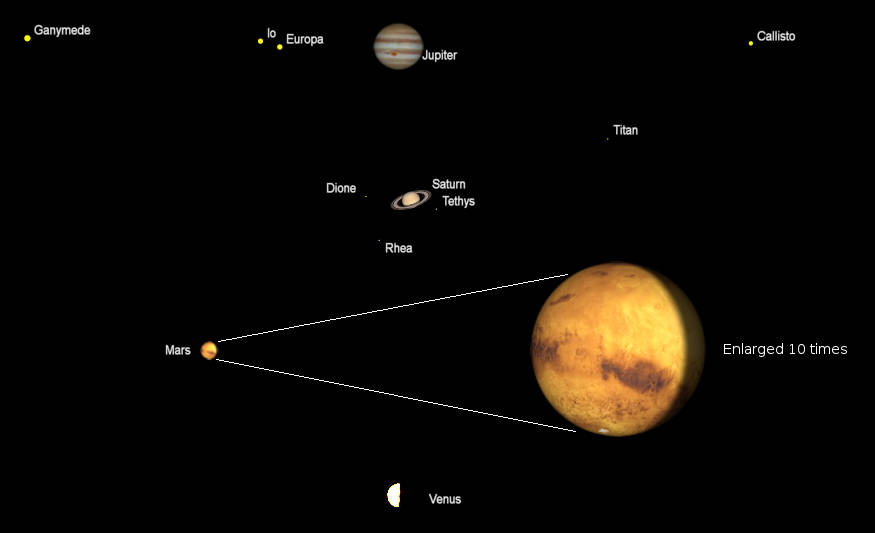
The planets as seen in a telescope (north up) with the same magnification (Jupiter and Saturn) tonight at 10 pm August 12 and (Venus and Mars) 5:30 am tomorrow August 13, 2020. Apparent diameters: Jupiter, 46.31″; Saturn, 18.32″, rings, 42.67″, Mars, 16.18″, and Venus 23.49″. Mars also displays an enlargement showing surface detail. The ” symbol means seconds of arc (1/3600th of a degree.) Created using Cartes du Ciel (Sky Charts).
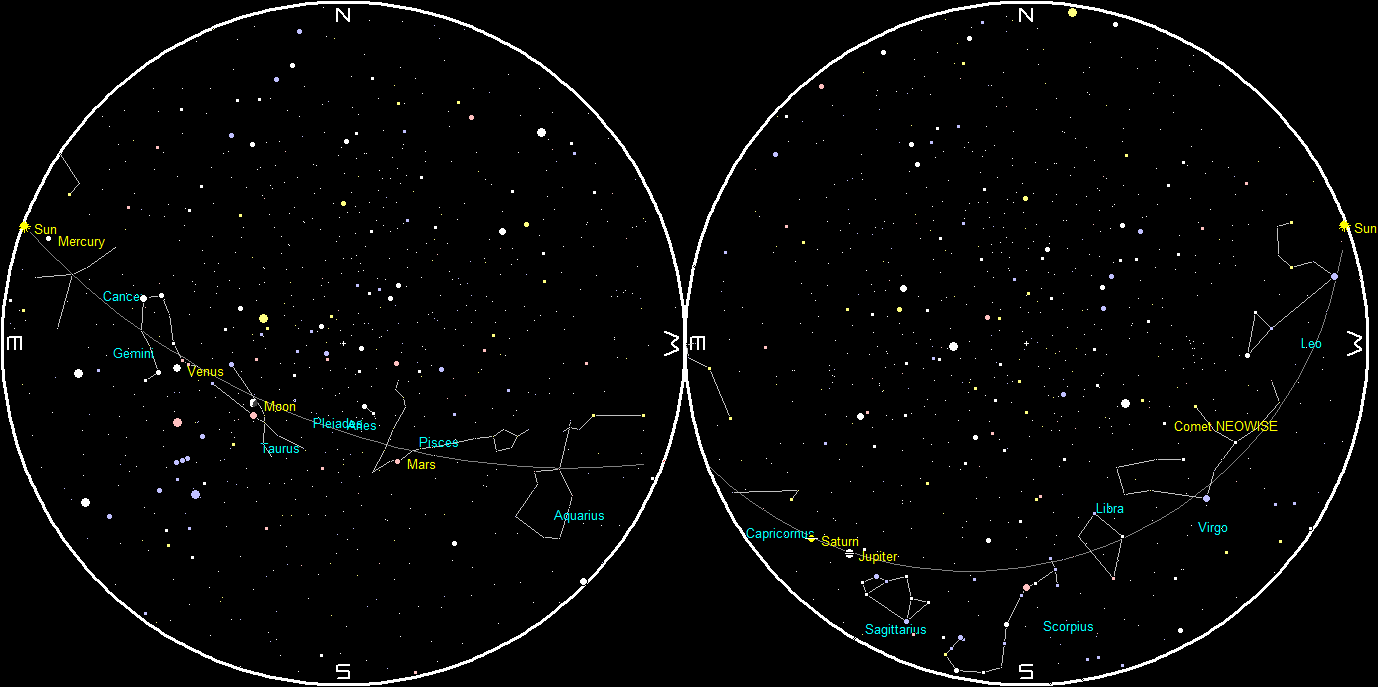
Planets and the Moon at sunset and sunrise of a single night starting with sunset on the right on August 12, 2020. The night ends on the left with sunrise on the 13th. Click on the image to enlarge. Created using my LookingUp program.
08/11/2020 – Ephemeris – Tonight is the peak of the Perseid Meteor shower
This is Bob Moler with Ephemeris for Tuesday, August 11th. Today the Sun will be up for 14 hours and 12 minutes, setting at 8:53, and it will rise tomorrow at 6:42. The Moon, at last quarter today, will rise at 12:46 tomorrow morning.
This evening and tomorrow morning we should see the peak of the Perseid Meteor Shower. There is the expected broad peak of the shower which for us is after sunrise. However the meteoroid stream isn’t monolithic. Each pass of the comet in the inner solar system superimposes its debris on the general stream, so we will have increased activity all night tonight and even into the next few mornings. In general Perseid meteors will be seen to come from the northeast. The evening view will be not hampered by the Moon until it rises at 12:46 am which will drown out the dimmer meteors. The best time to view is from about 10 or 10:30 pm to 12:46 am. The Perseids are the most active meteor shower visible in warm weather, with a possible over 50 meteors per hour.
The event times given are for the Traverse City/Interlochen area of Michigan. They may be different for your location.
Addendum
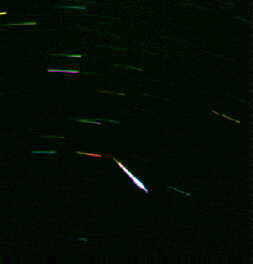
My best Perseid photo. From the 1970’s.
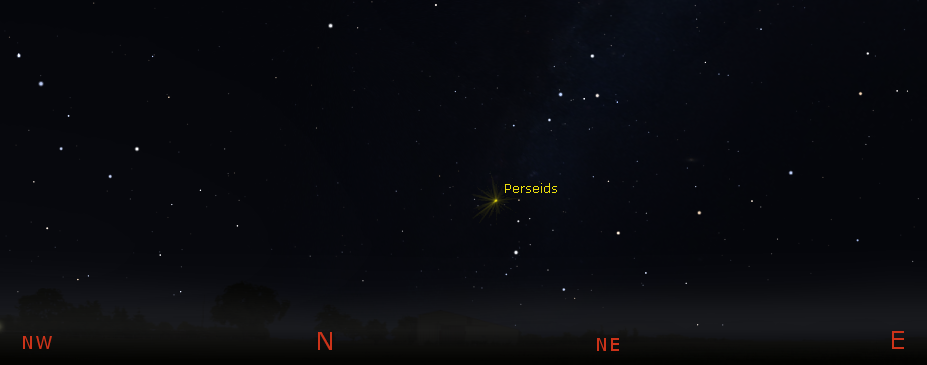
Perseid radiant at 11 pm, August 11th at the top of the constellation of Perseus, below the W shaped constellation of Cassiopeia. Click on the image to enlarge. Created using Stellarium.
08/10/2020 – Ephemeris – The celestial eagle: Aquila
This is Bob Moler with Ephemeris for Monday, August 10th. Today the Sun will be up for 14 hours and 15 minutes, setting at 8:55, and it will rise tomorrow at 6:41. The Moon, 1 day before last quarter, will rise at 12:20 tomorrow morning.
Aquila the eagle is a constellation that lies in the Milky Way. It’s in the southeastern sky as it gets dark. Its brightest star, Altair is one of the stars of the Summer Triangle, a group of three bright stars dominating the eastern sky in the evening now. Altair, in the head of the eagle, is flanked by two slightly dimmer stars, the shoulders of the eagle. The eagle is flying northeastward through the Milky Way. Its wings are seen in the wing tip stars. A curved group of stars to the lower right of Altair is its tail. Within Aquila the Milky Way shows many dark clouds as part of the Great Rift that splits it here. The other summer bird is Cygnus the swan above and left of Aquila, flying in the opposite direction.
The event times given are for the Traverse City/Interlochen area of Michigan. They may be different for your location.
Addendum
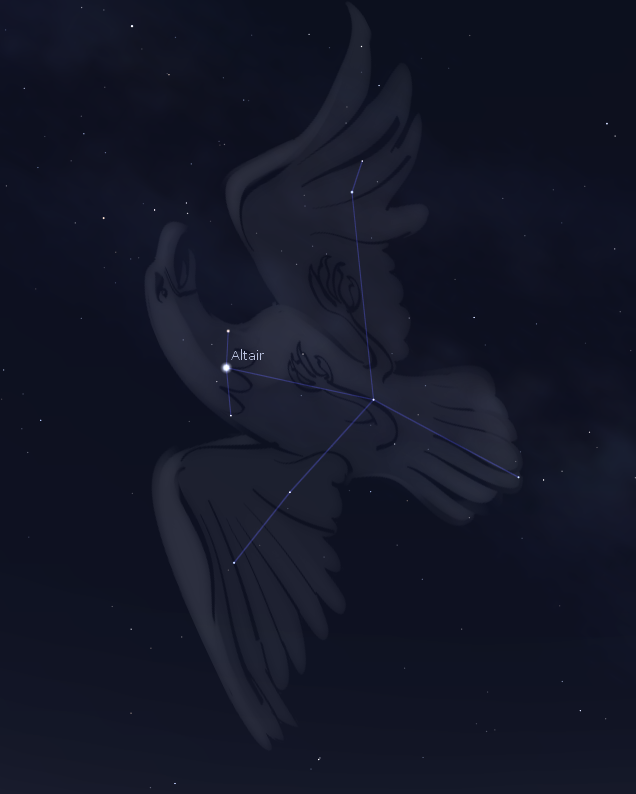
Aquila the Eagle in the southeastern sky. Created using Stellarium.
Annotated and animated photograph taken of Aquila August 13, 2018 during the Perseid meteor shower. Alas, no Perseids in this photograph. Taken by me and processed using Registax and GIMP.
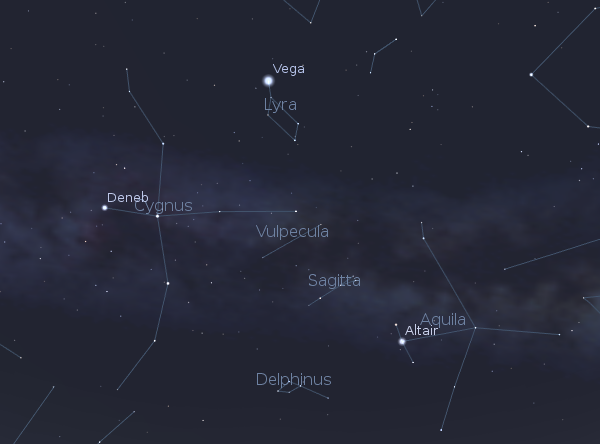
Deneb with the other stars and constellations in the Summer Triangle. Created using Stellarium.
08/07/2020 – Ephemeris – An online astronomy meeting and star party tonight
This is Ephemeris for Friday, August 7th. Today the Sun will be up for 14 hours and 23 minutes, setting at 8:59, and it will rise tomorrow at 6:37. The Moon, half way from full to last quarter, will rise at 11:16 this evening.
The Grand Traverse Astronomical Society will host a virtual meeting tonight at 9 pm followed by a virtual star party at 10 pm. It is via the Zoom app a link can be found on the society’s website gtastro.org. It will be hosted by Dr. Jerry Dobek, astronomy professor at Northwestern Michigan College. During a virtual star party the images are produced real time or near real time using a telescope mounted CCD camera. That is if it’s clear. Images of dimmer objects like star clusters or nebulae, what we call DSOs or deep sky objects may take exposures of several seconds or minutes to build up an image. But have the advantage of being in color. We are quite color blind at low light levels.
The event times given are for the Traverse City/Interlochen area of Michigan. They may be different for your location.
08/06/2020 – Ephemeris – Looking at Saturn through a small telescope
This is Bob Moler with Ephemeris for Thursday, August 6th. Today the Sun will be up for 14 hours and 25 minutes, setting at 9:01, and it will rise tomorrow at 6:36. The Moon, 3 days past full, will rise at 10:55 this evening.
The planet Saturn is just to the left or east of Jupiter in the southeastern evening sky. In steadily held binoculars Saturn is not star-like, but it’s not round either. It’s a small oval dot. The oval or ellipse is due to its rings of small icy bodies that orbit the planet over its equator. A telescope in needed to appreciate those rings to their fullest extent. Saturn’s largest moon Titan will be visible tonight in line with the eastern extent of the rings. Saturn, like the Earth has an axial tilt. In its case it’s 26 degrees. And the rings orbit over Saturn’s equator. So as Saturn orbits the Sun in it’s nearly 30 year orbit the aspect of the rings change over that period. The ellipse shape of the rings are getting thinner now, and in 5 years they will be seen to disappear for a bit.
The event times given are for the Traverse City/Interlochen area of Michigan. They may be different for your location.
Addendum
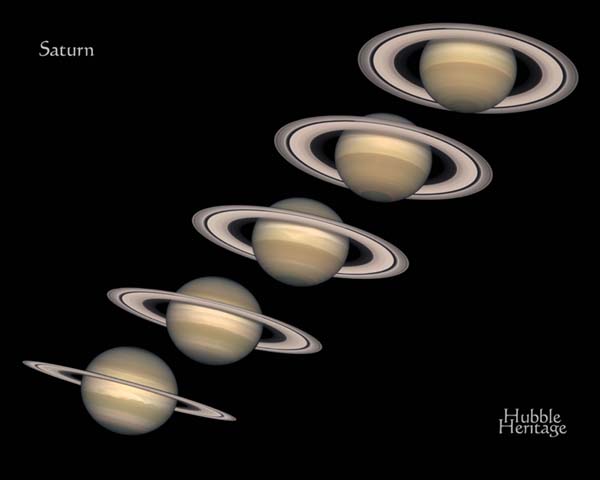
How the appearance of the rings change as Saturn orbits the Sun. The rings were at their widest in 2017. They are closing and will be edge-on again in 2025. When edge-on the rings literally disappear. Despite being 150,000 miles wide as we look at the planet, they are generally less than 66 feet (20 meters) in thickness. Credit: NASA Hubble.
08/05/2020 – Ephemeris – Let’s look at the naked-eye planets for this week
This is Bob Moler with Ephemeris for Wednesday, August 5th. Today the Sun will be up for 14 hours and 28 minutes, setting at 9:02, and it will rise tomorrow at 6:35. The Moon, 2 days past full, will rise at 10:32 this evening.
Let’s look at the naked-eye planets for this week. Jupiter and Saturn are both low in the southeastern sky in the evening. Jupiter is the very bright one. To the left of it will be Saturn. They now seem to be separating a bit due to the Earth’s motion now, but they will cross paths in December. Both planets will be up most of the night with Jupiter setting first at 4:33 am tomorrow morning and Saturn following at 5:14 am. The next planet visible will be Mars which will rise at 11:43 pm. Its now down to 57.7 million miles (92.9 million km) away, as the Earth slowly overtakes it at the rate of about 3.4 million miles (5.5 million km) a week. Brilliant Venus will rise at 3:09 am in the east-northeast as our Morning Star.
The event times given are for the Traverse City/Interlochen area of Michigan. They may be different for your location.
Addendum
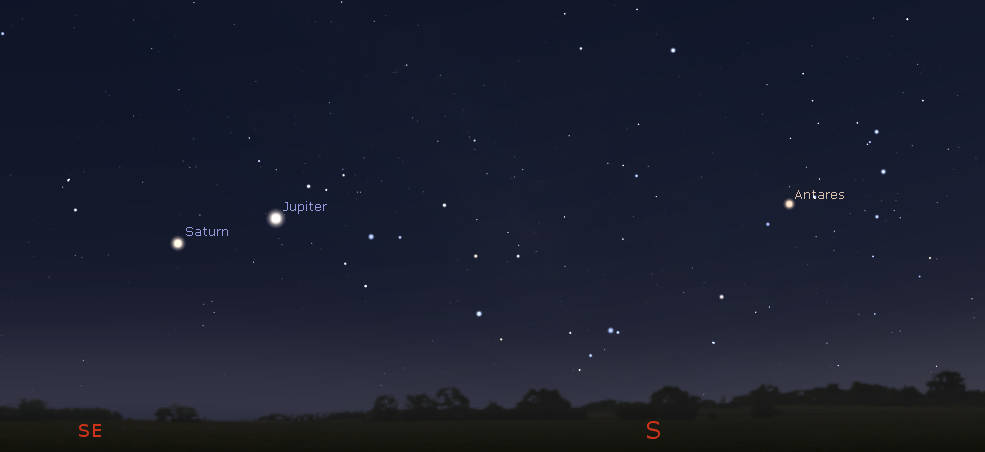
Evening planets Jupiter and Saturn seen in the southeast along with the constellations of Sagittarius (looks like a teapot) and Scorpius at 10 pm, about 45 minutes after sunset tonight August 5, 2020. Click on the image to enlarge. Created using Stellarium.
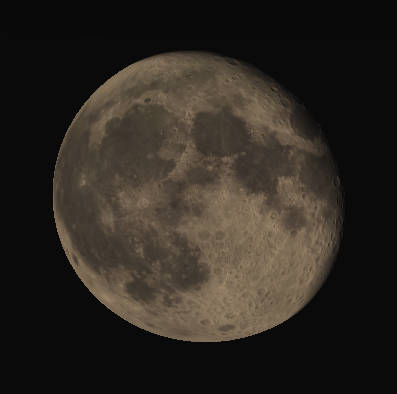
The Moon as it might be seen in binoculars at 11 pm tonight August 5, 2020, about a half hour after it rises. Created using Stellarium.
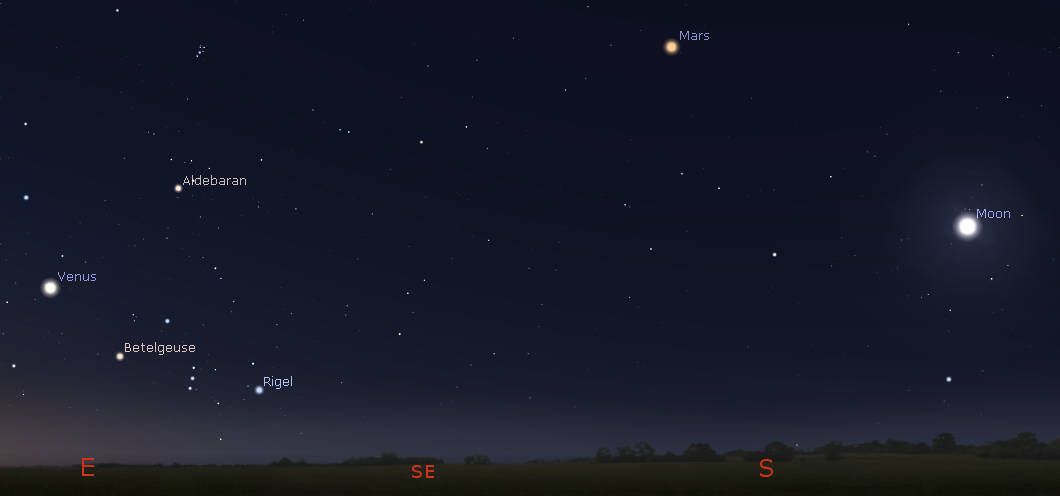
The morning planets and the Moon as seen at 5:30 am or about an hour before sunrise tomorrow morning August 6, 2020. Note the winter constellation of Orion rising in the east with its two brightest stars Betelgeuse and Rigel labeled. Click on the image to enlarge. Created using Stellarium.
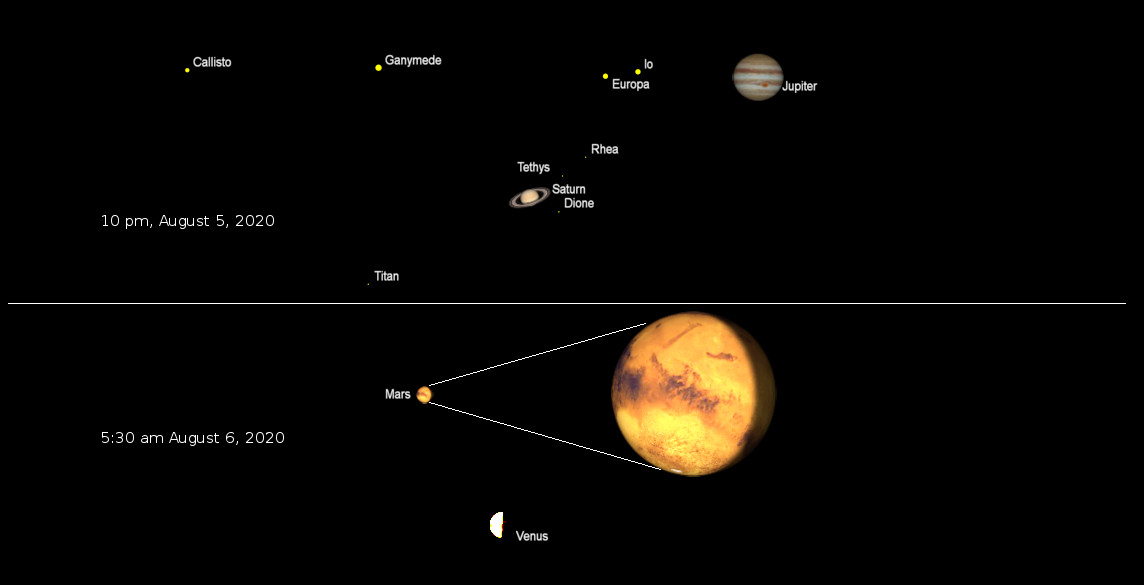
The planets as seen in a telescope (north up) with the same magnification tonight and tomorrow, August 5/6, 2020. Apparent diameters: Jupiter, 46.85″; Saturn, 18.40″, rings, 42.85″ at 10 pm. Mars, 15.26″, and Venus 25.46″. At 5:30 am. Mars also displays an enlargement showing surface detail. The ” symbol means seconds of arc (1/3600th of a degree.) Created using Cartes du Ciel (Sky Charts).
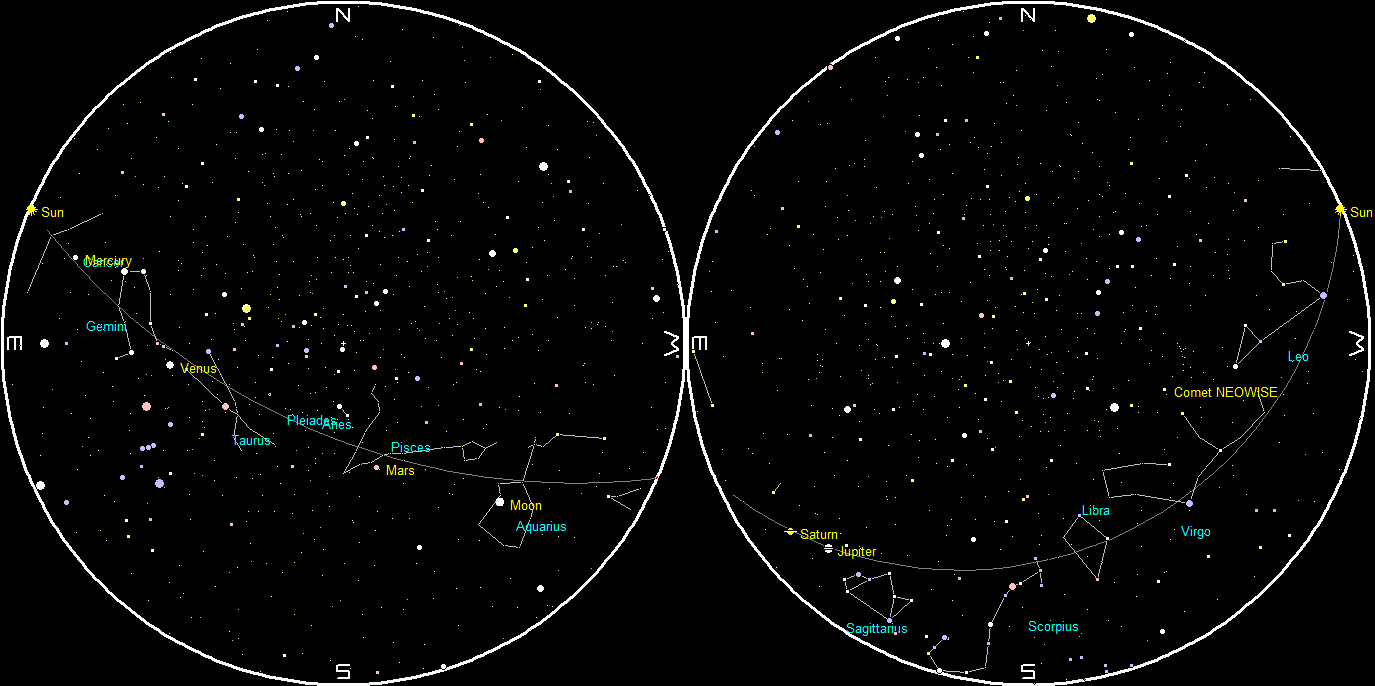
Planets and the Moon at sunset and sunrise of a single night starting with sunset on the right on August 5, 2020. The night ends on the left with sunrise on the 6th. Click on the image to enlarge. Created using my LookingUp program.
08/04/2020 – Ephemeris – Viewing Jupiter and its moons with binoculars or small telescope
This is Ephemeris for Tuesday, August 4th. Today the Sun will be up for 14 hours and 30 minutes, setting at 9:03, and it will rise tomorrow at 6:34. The Moon, 1 day past full, will rise at 10:06 this evening.
The planet Jupiter is a fine object to view with just about any optical aid be it a pair of binoculars, spotting scope or telescope. In binoculars, if held steady or mounted on a tripod Jupiter itself will no longer look star-like, but a tiny disk. Several of Jupiter’s moons can also be seen. With a telescope four of them can be seen, the same four Galileo discovered 410 years ago. At 10 pm they will be in the same order of distance from the planet that they actually are. The two nearest will be on the west side of the planet Io the closest, the Europa the next moon out. On the east side there is the third farthest Ganymede, and farthest out is Callisto. Their orbits are nearly edge on to us, so they shuttle from one side to the other of the planet.
The event times given are for the Traverse City/Interlochen area of Michigan. They may be different for your location.
Addendum
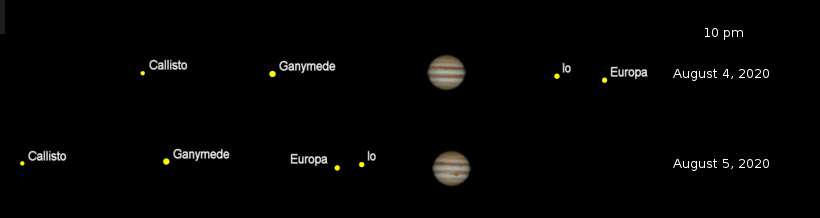
Jupiter and its Galilean moons for tonight and tomorrow night August 4 & 5, 2020. Those moons really move from night to night. This is shown north at the top, east to the left. Based on telescope design the image presented could be inverted, mirror image or both. Created using Cartes du Ciel (Sky Charts).
Due to the lack of time (59 seconds) I could only cover the moons. I’ll address Jupiter’s cloud features at another time. Can’t wait? Here’s a link: https://bobmoler.wordpress.com/2018/05/22/05-22-2018-ephemeris-seeing-detail-on-the-face-of-jupiter-with-a-small-telescope/
 Bob Moler's Ephemeris Blog