Archive
11/16/2020 – Ephemeris – How to find the Pleiades or Seven Sisters
This is Ephemeris for Monday, November 16th. Today the Sun will be up for 9 hours and 31 minutes, setting at 5:13, and it will rise tomorrow at 7:43. The Moon, 1 day past new, will set at 6:31 this evening.
A marvelous member of the autumn skies can be found low in the east after 8 in the evening. It is the famous star cluster called the Pleiades or the Seven Sisters. I might also add the ‘Tiny Dipper’. Many people can spot a tiny dipper shape in its six or seven stars, and mistake it for the Little Dipper. When I was nearsighted*, though corrected, I never had been able to see more than a few stars and a bit of fuzz. However, with binoculars, even I could see over a hundred stars appear along with the dipper shape of the brightest. The fuzz I saw was unresolved stars, but in photographs the Pleiades actually contain wisps of the gas and dust they are currently passing through. In Greek mythology the sisters were daughters of the god Atlas. I’ll be revisiting the Pleiades several times this autumn, winter, and as they disappear in the west in evening twilight next spring.
The event times given are for the Traverse City/Interlochen area of Michigan. They may be different for your location.
*My vision was corrected with cataract surgery a few years ago. The Pleiades now have a granular appearance now.
Addendum
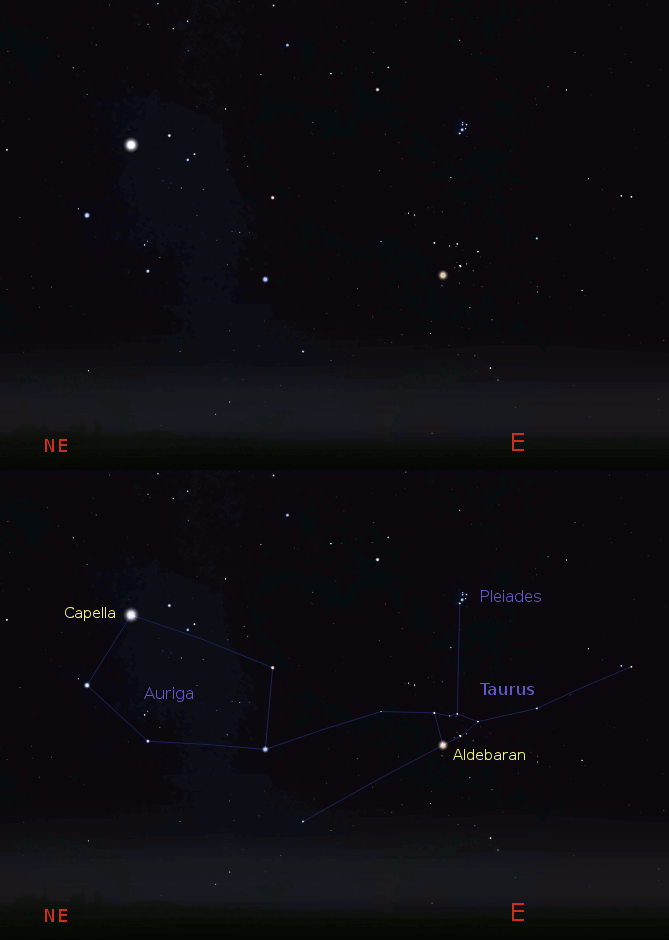
Pleiades finder animation looking east at 8 pm, November 16th. Click on the image to enlarge. Created using Stellarium.
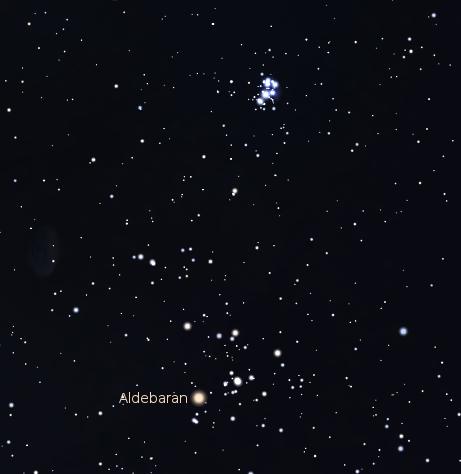
Aldebaran in the ‘V’ shape of the Hyades (The face of Taurus the bull) with the Pleiades above. Created using Stellarium.
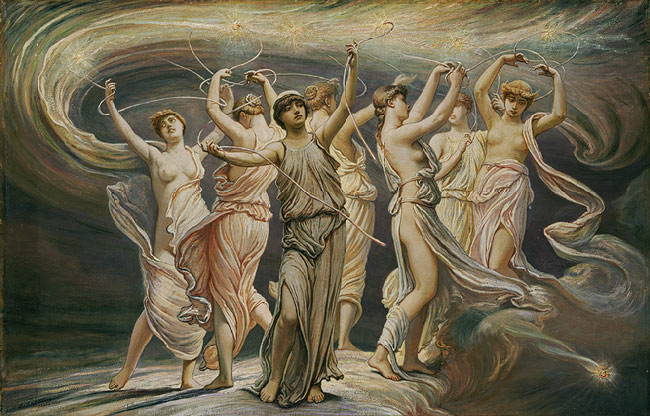
The Greek Pleiades a painting by Elihu Vedder in the Metropolitan Museum of Art, New York City. Public Domain.
11/13/2020 – Ephemeris – Finding Perseus the hero in the stars
This is Ephemeris for Friday, November 13th. Today the Sun will be up for 9 hours and 38 minutes, setting at 5:16, and it will rise tomorrow at 7:39. The Moon, 2 days before new, will rise at 6:41 tomorrow morning.
About a third the way from the east northeastern horizon to the zenith at 8 p.m. and below the letter W shaped constellation of Cassiopeia the queen is Perseus the hero. It’s kind of an odd shape for a hero, To me it looks kinda like the cartoon roadrunner. To those who’re mathematically inclined its shape is also like the Greek letter pi on its side. It’s two brightest stars are Mirfak and Algol the demon star, the still winking eye of Medusa. Look at the area around Mirfak with binoculars and a large group of stars just below naked eye visibility will appear. It’s called the Alpha Persei Association. That’s because Mirfak is also known as Alpha Persei. The group is about 560 light years away, which means, though close, are farther away than the Pleiades, which is below and to the right of them.
The event times given are for the Traverse City/Interlochen area of Michigan. They may be different for your location.
Addendum
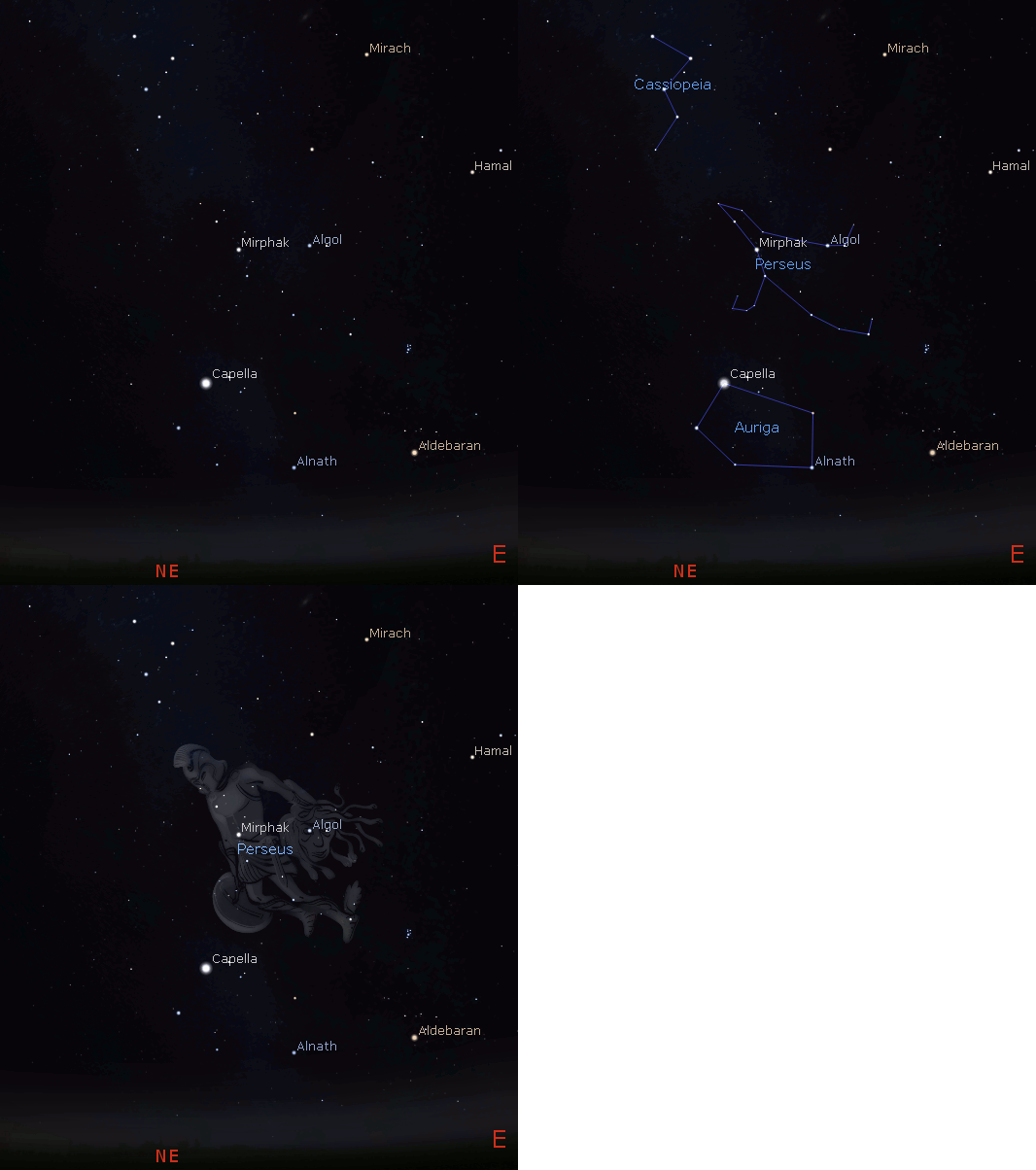
Perseus finder animation for 8 pm November 13, 2020. The star Mirphak in the image is generally spelled Mirfak and is also designated Alpha Persei.
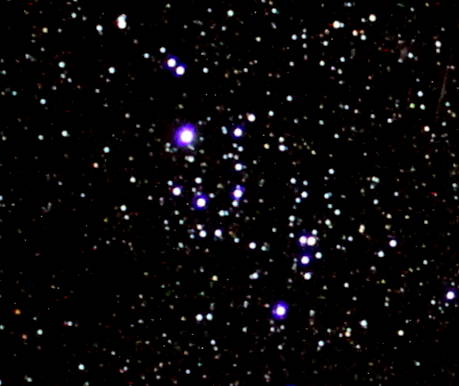
The Alpha Persei Association. The brightest star is Mirfak (Alpha Persei). This a an extreme crop from a photograph taken February 18, 2017, Canon EOS Rebel T5, 121 seconds, f/3.5, 18mm fl., ISO 3200. Credit Bob Moler.
11/12/2020 – Ephemeris – The Northern Taurid meteor shower is at its peak
This is Ephemeris for Thursday, November 12th. Today the Sun will be up for 9 hours and 40 minutes, setting at 5:17, and it will rise tomorrow at 7:37. The Moon, 3 days before new, will rise at 5:19 tomorrow morning.
The official peak of the North Taurid meteor shower is here. It’s a broad peak with a low per hour count that appears to be estimated from 5 to 15 meteors per hour. As such it doesn’t hold a candle to the Perseid meteor shower of August or the Geminids of December. However the Northern Taurid shower appears to have quite a few fireballs or really bright meteors. They seem to be most numerous at seven year intervals and the next peak year for fireballs is 2022. The Taurids will appear to come from Taurus the bull near the Pleiades star cluster low in the east in the early evening. Meteors are the streaks in the sky caused by tiny bits of rock hitting the atmosphere at interplanetary speeds and disintegrating.
The event times given are for the Traverse City/Interlochen area of Michigan. They may be different for your location.
Addendum
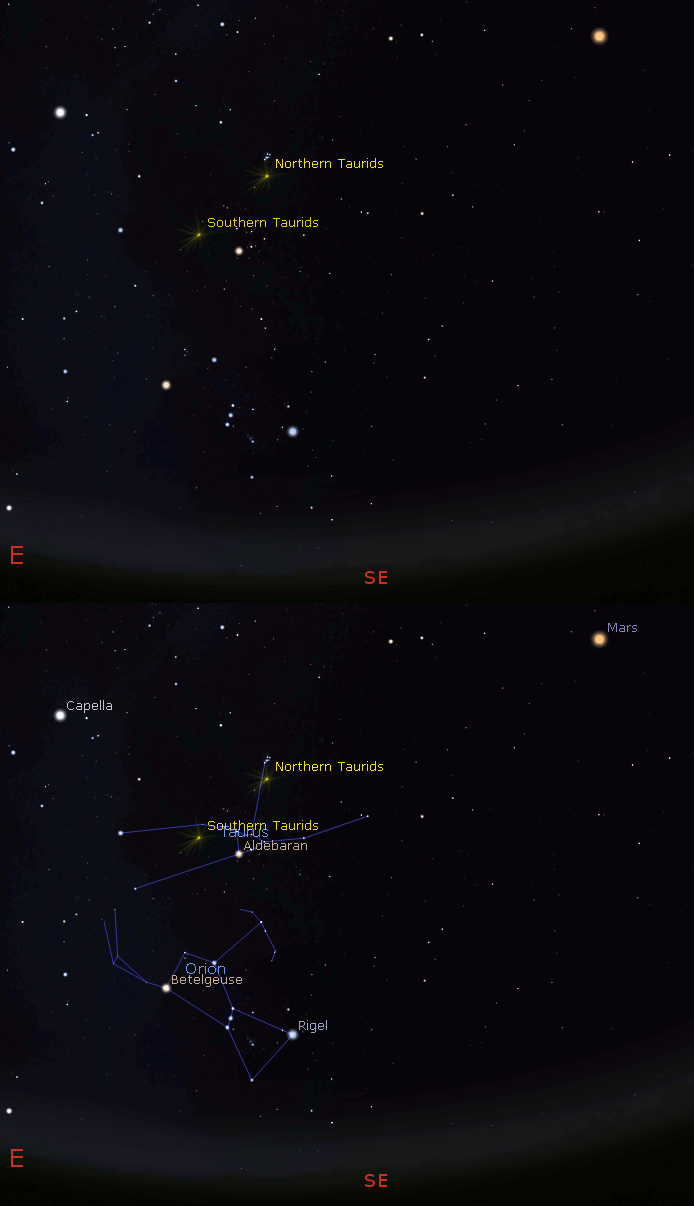
Finder chart for the radiants of the two Taurid meteor shower for about 11 pm for mid November. The Southern Taurids are ending, but a few may be spotted, while the Northern Taurids are near peak. The peak rate for the Northern Taurids has been estimated by various sources as being 5 to 15 meteors per hour. The Pleiades appears just above the Northern Taurid radiant. Compared to other meteor showers the Taurids appear to be a lot slower. Created using Stellarium and GIMP.
11/11/2020 – Ephemeris – Let’s look for the naked-eye planets for this week
This is Ephemeris for Veteran’s Day, Wednesday, November 11th. Today the Sun will be up for 9 hours and 43 minutes, setting at 5:18, and it will rise tomorrow at 7:36. The Moon, 3 days past last quarter, will rise at 4:00 tomorrow morning.
Let’s look for the naked-eye planets for this week. Jupiter and Saturn are both low in the southwestern sky at 8 pm. Jupiter is the very bright one. Above and left it will be the somewhat dimmer Saturn. They are closing slowly, so they will cross paths on December 21st and be seen in the same telescope field that evening. Jupiter will set first tonight at 9:24 with Saturn following at 9:46. Off in the southeast at that hour will be Mars. Its distance is increasing to 47.7 million miles (76.9 million km) away. Mars will set at 4:35 tomorrow morning. Brilliant Venus will rise at 4:46 am in the east as it retreats slowly toward the Sun. Making a morning appearance this week is Mercury which will rise at 5:52 am in the east.
The event times given are for the Traverse City/Interlochen area of Michigan. They may be different for your location.
Addendum
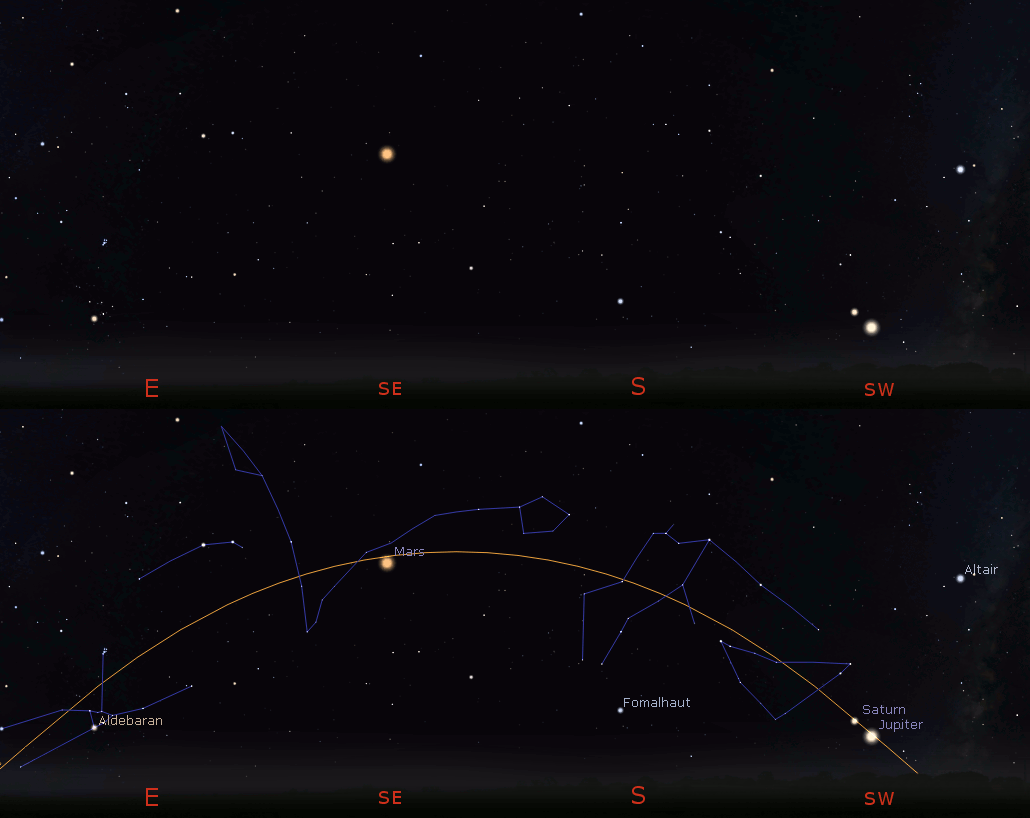
Evening planet finder animation for 8 pm November 11, 2020. The orange line is the ecliptic, the plane of the Earth’s orbit projected on the sky, and the path of the Sun through the year. All the planets can be found near that line. The zodiacal constellations from Taurus on the left to Capricornus on the right are shown without labels. Click on the image to enlarge. Created using Stellarium and GIMP.
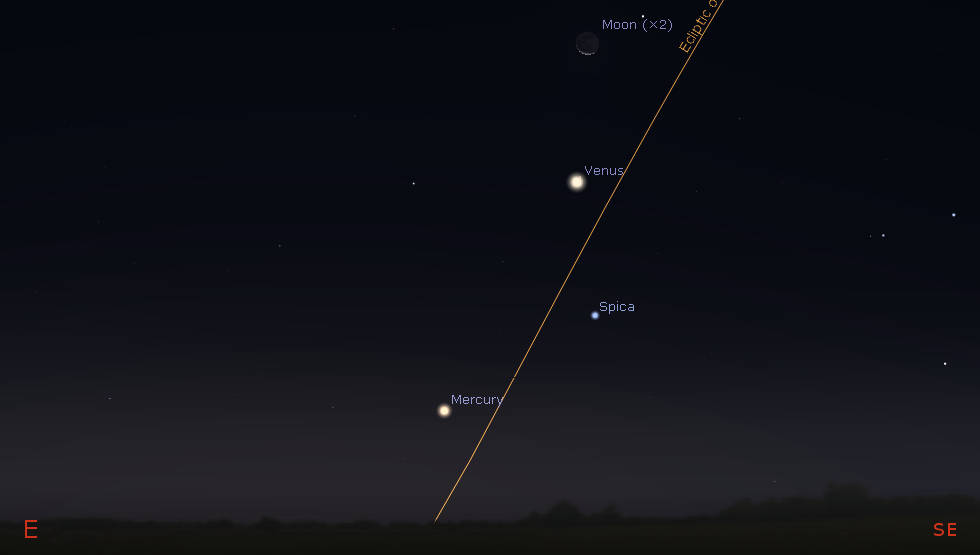
Mercury, Venus, and the Moon tomorrow morning November 12, 2020 at 6:30 am. The orange line is the ecliptic, the plane of the Earth’s orbit. It is the path of the Sun in the sky, The Moon is a crescent, and displayed at twice its apparent size. Over the next week Venus and Mercury will slide downward along the ecliptic in relation to the stars. Created using Stellarium.
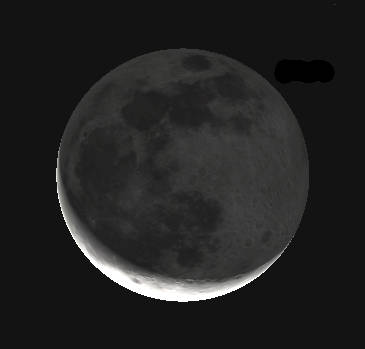
The thin crescent Moon as it might appear in binoculars with earthshine at 6:30 am, November 12, 2020. The very dark crater visible is Grimaldi a 134 mile or 222 kilometer diameter crater named after Francesco Grimaldi a 17th century Jesuit astronomer and physicist. Created using Stellarium.
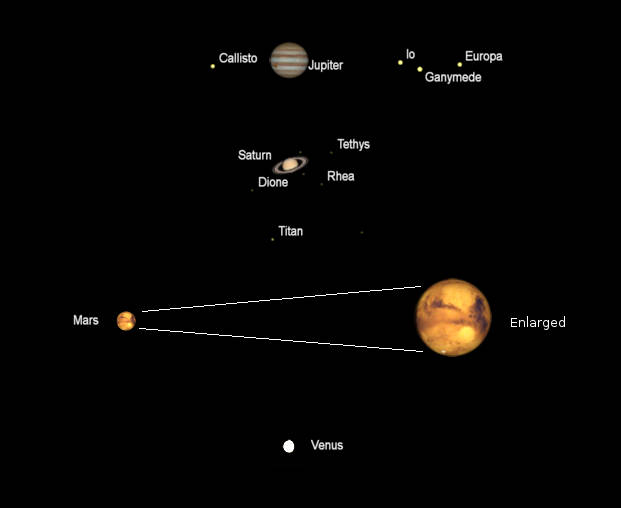
The planets as seen in a telescope (north up) with the same magnification for the night of November 11/12, 2020. Times of the display are: Jupiter and Saturn, 8 pm; Mars, 11 pm; Venus, 6:30 am. Apparent diameters: Jupiter, 35.90″; Saturn, 16.07″, rings, 37.43″. Mars, 18.04″, and Venus 12.49″. Mars also displays an enlargement showing surface detail. Mars was closest to the Earth this go round on October 6. The ” symbol means seconds of arc (1/3600th of a degree.) Created using Cartes du Ciel (Sky Charts).
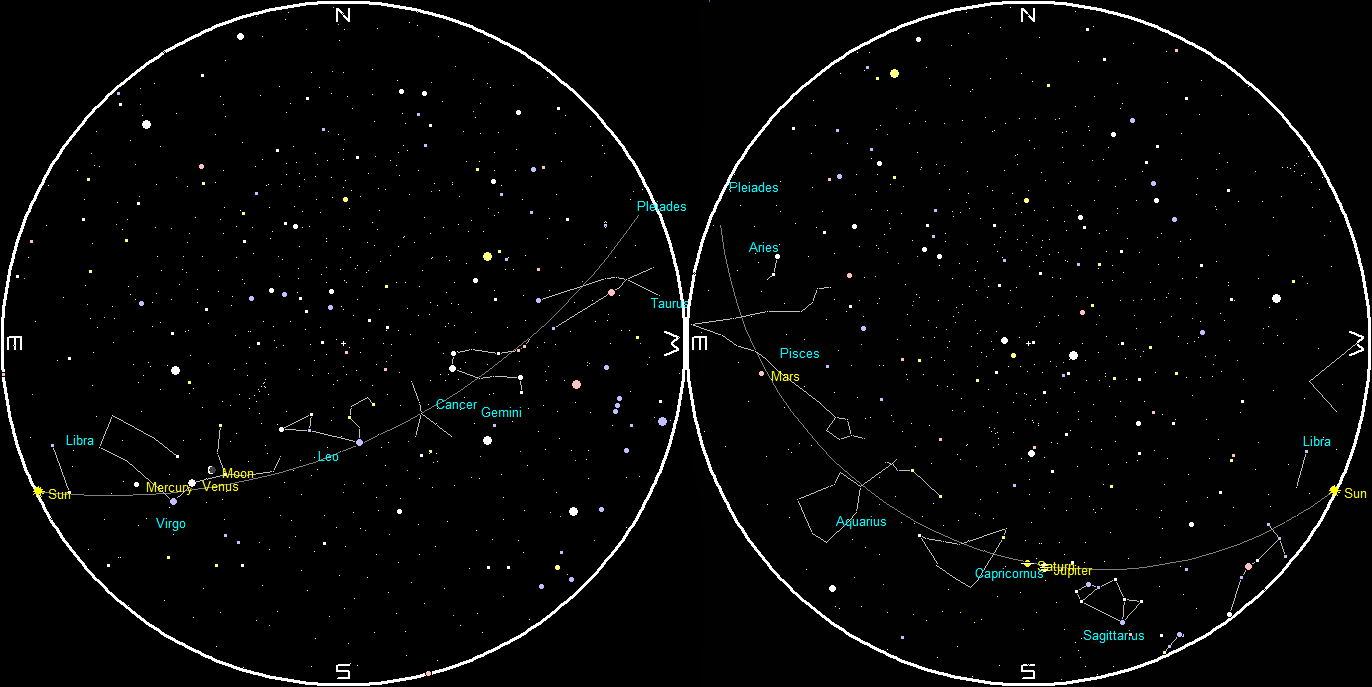
Planets and the Moon at sunset and sunrise of a single night starting with sunset on the right on November 11, 2020. The night ends on the left with sunrise on 12th. Click on the image to enlarge. Created using my LookingUp program.
11/10/2020 – Ephemeris – Mercury will reach it greatest separation from the Sun in the morning today
This is Bob Moler with Ephemeris for Tuesday, November 10th. Today the Sun will be up for 9 hours and 45 minutes, setting at 5:19, and it will rise tomorrow at 7:35. The Moon, 2 days past last quarter, will rise at 2:42 tomorrow morning.
Mercury will reach its greatest western elongation from the Sun near noon today (17:00 UT). That means it was visible this morning before sunrise in the east. And will be visible again tomorrow morning. The next Mercury greatest elongation will be January 24th, next year. It will be a greatest eastern elongation, which will be visible in the western sky in the evening after sunset. So western elongations are seen in the east and eastern elongations are seen in the west. The “from the Sun” is usually omitted in astronomical lists of events, but implied. Sounds a bit confusing, but it makes weird sense. Mercury’s morning appearance will last about a week before it get too low to easily spot, below and left of Venus.
The event times given are for the Traverse City/Interlochen area of Michigan. They may be different for your location.
Addendum
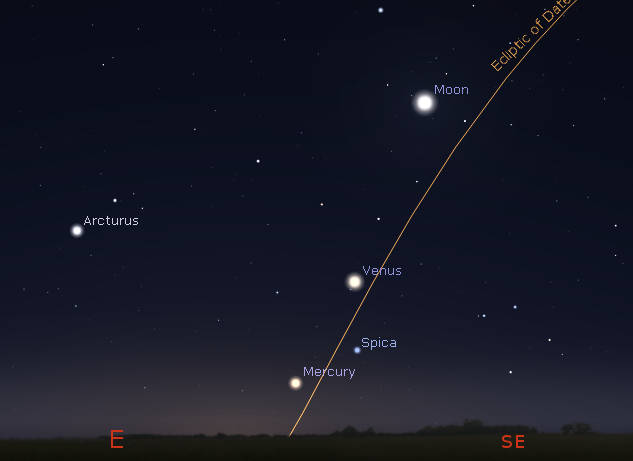
Mercury, Venus, Moon tomorrow morning November 11, 2020 at 6:30 am. The orange line is the ecliptic, the plane of the Earth’s orbit. It is the path of the Sun in the sky, The Moon and planets also stick close to that line. The Moon is a crescent, though that can’t be seen at this scale. Over the next week Venus and Mercury will slide downward along the ecliptic in relation to the stars, as will the Moon at greater speed. Created using Stellarium.
11/09/2020 – Ephemeris – Tiny Mercury makes an appearance in the morning sky
This is Ephemeris for Monday, November 9th. Today the Sun will be up for 9 hours and 48 minutes, setting at 5:20, and it will rise tomorrow at 7:33. The Moon, 1 day past last quarter, will rise at 1:26 tomorrow morning.
The tiny planet Mercury is now visible in the morning twilight. It will reach its greatest separation from the Sun in the morning sky. Astronomers call it “greatest western elongation”. It’s west of the Sun, but we’ll see it in the eastern sky as it rises at 5:49 am in the east-southeast. That’s an hour and 44 minutes before the Sun. By 6:15 or 6:30 am, it should be high enough to spot. That is if it’s clear, an iffy prospect this time of year. It will start to move back to the Sun and actually brighten retaining its best visibility for the next 7 days or so. Mercury has a very elliptical orbit of the Sun. During our two good seasons to view the planet, spring evenings and autumn mornings Mercury is closest to the Sun. Mercury is best seen in the southern hemisphere when its autumn morning appearances and spring evening appearances are seen when Mercury is farthest from the Sun.
The event times given are for the Traverse City/Interlochen area of Michigan. They may be different for your location.
Addendum
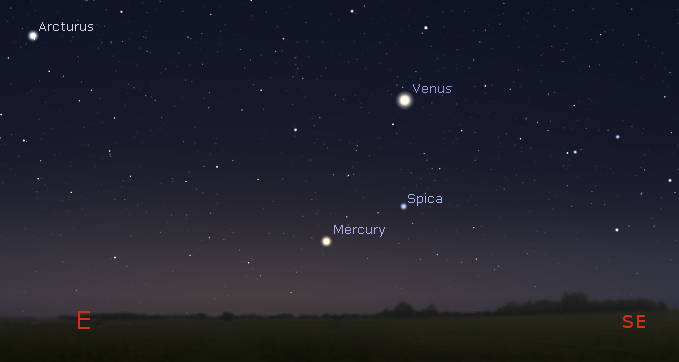
Mercury and Venus in the morning at 6:30 am. Created using Stellarium.
11/06/2020 – Ephemeris – Virtual Star Party or a presentation on the Great Andromeda Galaxy tonight!
This is Ephemeris for Friday, November 6th. Today the Sun will be up for 9 hours and 55 minutes, setting at 5:24, and it will rise tomorrow at 7:29. The Moon, 2 days before last quarter, will rise at 9:54 this evening.
The Grand Traverse Astronomical Society will host a virtual presentation or a virtual star party at 8 pm tonight. It is via the Zoom app for the smart phone, tablet or computer at zoom.us. Instructions and a link can be found on the society’s website gtastro.org. I will be giving the illustrated presentation on the Great Andromeda Galaxy if the night turns out to be cloudy. If clear Dr. Jerry Dobek, astronomy professor at Northwestern Michigan College will be hosting the star party. During a virtual star party the images are produced real time using a telescope mounted CCD camera. The planets Jupiter, Saturn and Mars are in the evening sky along with the Great Andromeda Galaxy and other wonders of the heavens.
11/05/2020 – Ephemeris – Water found on the daylit side of the Moon
This is Ephemeris for Thursday, November 5th. Today the Sun will be up for 9 hours and 58 minutes, setting at 5:25, and it will rise tomorrow at 7:28. The Moon, 3 days before last quarter, will rise at 8:55 this evening.
Last week NASA announced some results from their SOFIA airborne observatory. They had detected the spectral signature of water in a large crater on the Moon named Clavius. This was a high latitude crater, 58.6 degrees south. Supposedly one could process a cubic meter of the regolith to extract a half liter of water. Clavius, which science fiction fans will note was the location of the American base on the Moon in 2001 a Space Odyssey. It is also one of my favorite lunar craters, one of the largest with a distinctive arc of diminishingly sized craters in its floor. As far as resources go, we’ve just literally scratched the surface of the Moon in its equatorial regions with our Apollo and other country’s robotic missions.
The event times given are for the Traverse City/Interlochen area of Michigan. They may be different for your location.
Addendum
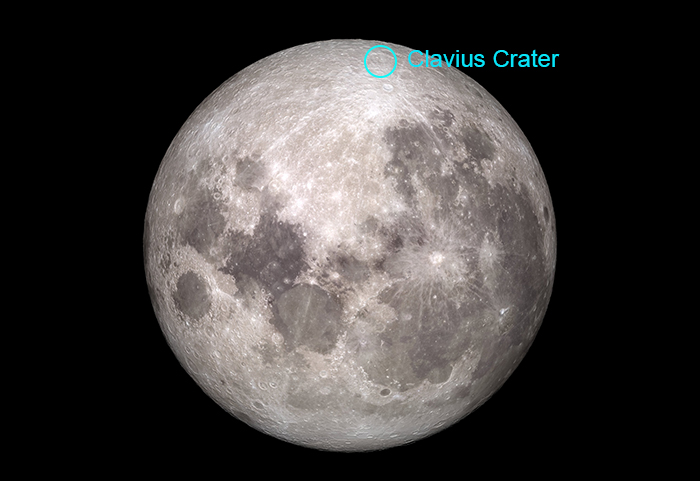
The Moon as seen from Australia (south up) with the crater Clavius circled. This is the same view of the Moon that users of a Newtonian reflector telescope in the northern hemisphere see, and how I first explored the Moon with my reflecting telescope. Source abc.net.au.
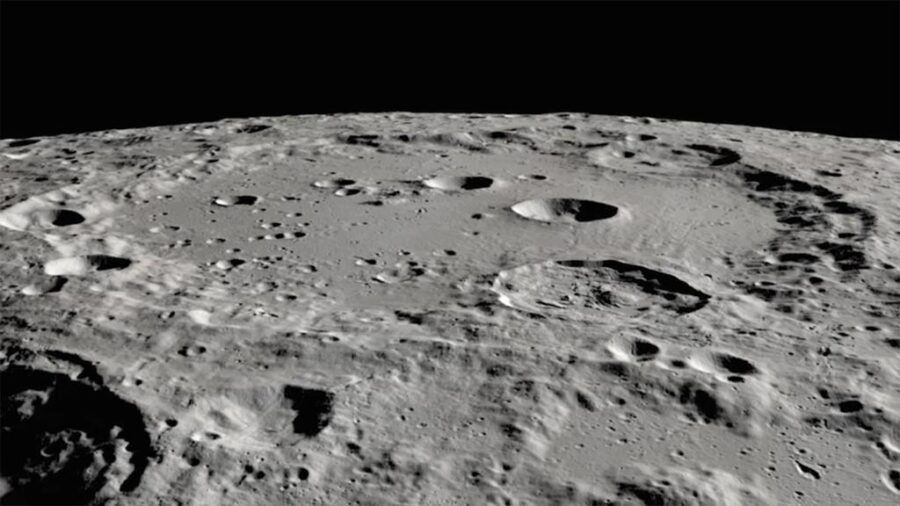
Closeup of Clavius from the Lunar Reconnaissance Orbiter. Credit: NASA/LRO.

The SOFIA Airborne Observatory. A modified Boeing 747 with a 106 inch (2.7 meter) telescope mounted crosswise in its fuselage. It is a joint project between NASA and the German Aerospace Center (DLR) and for some reason always on the verge of being canceled. Credit: NASA.
SOFIA is of course an acronym for Stratospheric Observatory for Infrared Astronomy. For more on SOFIA click here: https://www.nasa.gov/mission_pages/SOFIA/index.html.
11/04/2020 – Ephemeris – Let’s find the naked-eye planets for this week
This is Ephemeris for Wednesday, November 4th. Today the Sun will be up for 10 hours and 1 minute, setting at 5:26, and it will rise tomorrow at 7:26. The Moon, half way from full to last quarter, will rise at 8:04 this evening.
Let’s find the naked-eye planets for this week. Jupiter and Saturn are both low in the southwestern sky at 8 pm. Jupiter is the very bright one. Above and left it will be the somewhat dimmer Saturn. They are closing slowly, so they will cross paths on December 21st and be in the same telescope field that evening. Jupiter will set first tonight at 9:42 with Saturn following at 10:07. Off in the southeast at that hour will be Mars. Since the it was closest 29 days ago its distance has increased to 45.0 million miles (72.4 million kilometers) away. Mars will set at 5:04 tomorrow morning. Brilliant Venus will rise at 4:29 am in the east as it retreats slowly toward the Sun. Beginning to make a morning appearance now will be Mercury rising at 5:52 a.m. in the east.
The event times given are for the Traverse City/Interlochen area of Michigan. They may be different for your location.
Addendum
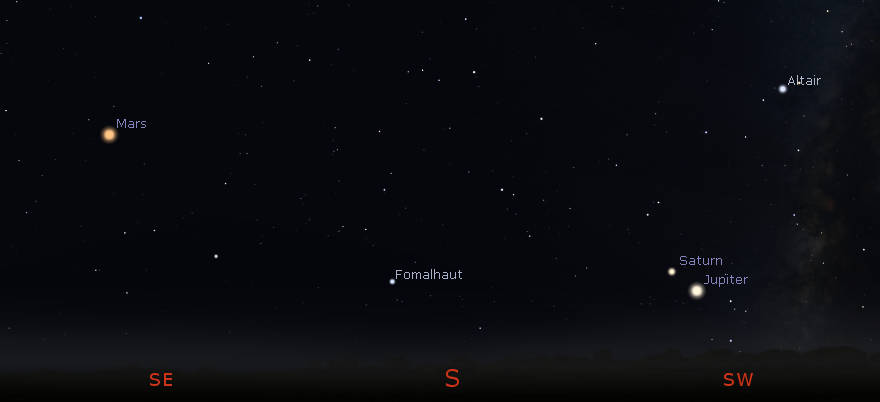
The evening planets and the Moon at 8 pm, just before the Moon will rise, tonight, November 4, 2020. Created using Stellarium.
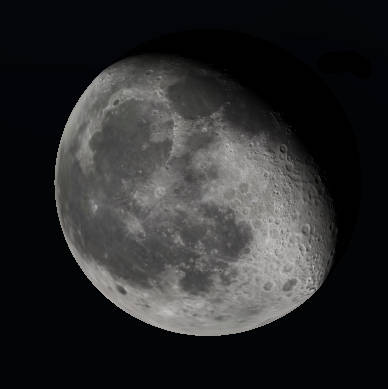
The waning gibbous Moon as it might be seen in binoculars or a small telescope at 9 pm tonight November 4, 2020. Created using Stellarium.
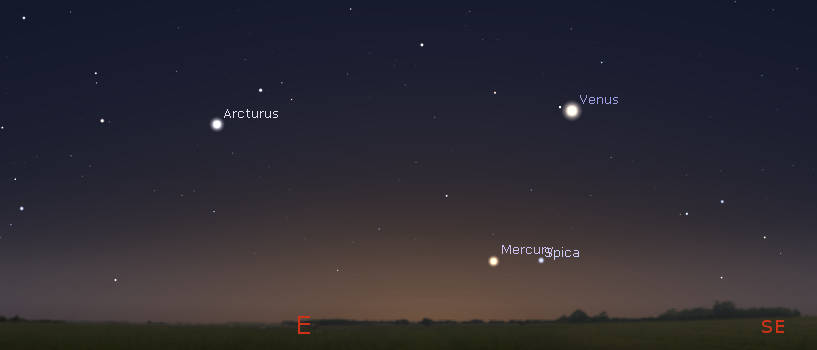
The morning planets Venus and Mercury visible tomorrow at 6:30 am, November 5, 2020 with some of the stars of morning. Click on the image to enlarge. Created using Stellarium.
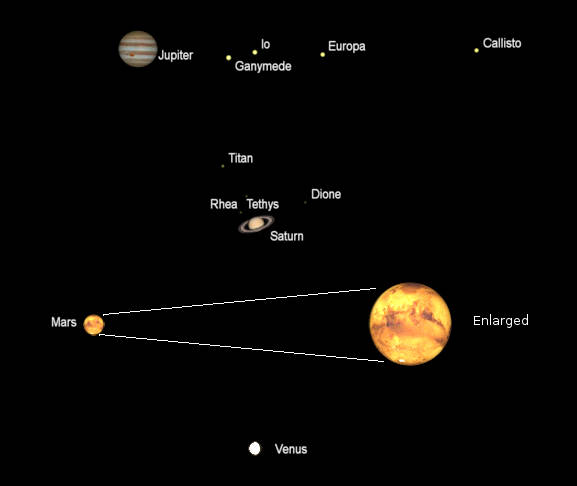
The planets as seen in a telescope (north up) with the same magnification for the night of November 4/5, 2020. Times of the display are: Jupiter and Saturn, 8 pm; Mars, 10 pm; Venus, 6:30 am. Apparent diameters: Jupiter, 36.55″; Saturn, 16.24″, rings, 37.83″. Mars, 19.34″, and Venus 12.87″. Mars also displays an enlargement showing surface detail. Mars was closest to the Earth this go-a-round on October 6. The ” symbol means seconds of arc (1/3600th of a degree.) Created using Cartes du Ciel (Sky Charts).
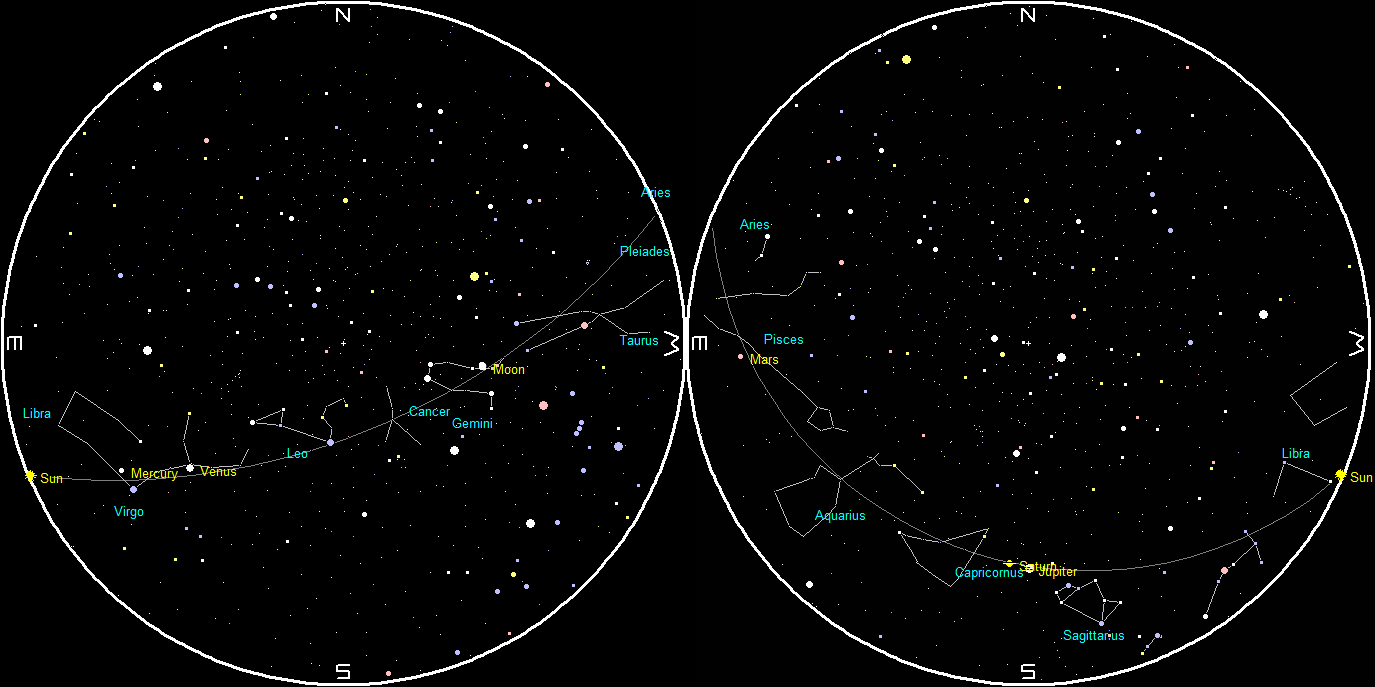
Planets and the Moon at sunset and sunrise of a single night starting with sunset on the right on November 4, 2020. The night ends on the left with sunrise on 5th. Click on the image to enlarge. Created using my LookingUp program.
11/03/2020 – Ephemeris – Two meteor showers emanating from Taurus
This is Ephemeris for Election Day, Tuesday, November 3rd. Today the Sun will be up for 10 hours and 3 minutes, setting at 5:27, and it will rise tomorrow at 7:25. The Moon, 3 days past full, will rise at 7:22 this evening.
November is a month of low grade meteor showers. The first two are related showers from the same comet. They are the South Taurid and North Taurid meteor showers. The South Taurid meteor shower peaks on October 10th, while the North Taurid meteor shower peaks on November 12th. The both have Encke’s Comet as their source. Encke’s official name is 2P/Encke named after Johann Franz Encke who calculated it’s orbit after it had been observed on three earlier appearances including by Charles Messier and Caroline Herschel, sister of William Herschel, astronomer and composer. Encke has the shortest period of any reasonably bright comet of 3.3 years. The other notable meteor shower this month is the Leonids which we’ll visit later.
The event times given are for the Traverse City/Interlochen area of Michigan. They may be different for your location.
Addendum
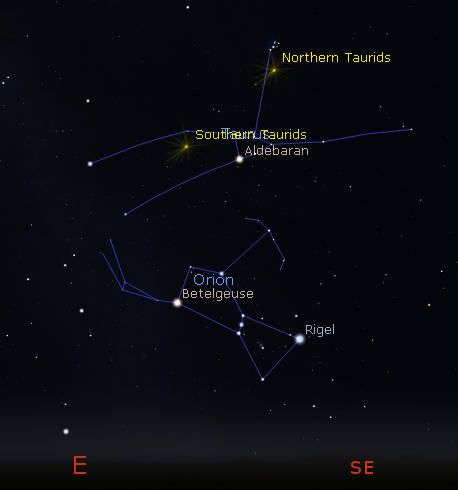
The radiants of the Northern and Southern Taurid meteor showers at 11 pm November 12, 2020. Both these radiants move eastward with time due to the Earth’s orbital motion. The activity dates of the two meteor showers overlap. The Southern Taurids are active between September 10 to November 20, while the Northern Taurids are active between October 20 to December 10. Both have peak rates of 5-10 meteors per hour. Created using Stellarium.
 Bob Moler's Ephemeris Blog