Archive
12/17/2020 – Ephemeris – Betelgeuse, Betelgeuse… Nope not saying it again
This is Bob Moler with Ephemeris for Thursday, December 17th. Today the Sun will be up for 8 hours and 48 minutes, setting at 5:03, and it will rise tomorrow at 8:15. The Moon, 3 days past new, will set at 8:18 this evening.
The constellation Orion the hunter will have completely risen by 8 pm this evening. The leftmost bright red star in his shoulder is Betelgeuse. It’s phonetically spelled name (Beetle Juice) made the title of a movie in 1988. A year ago it’s dramatic dimming for a while caused some to wonder that it was about to explode in a supernova. Betelgeuse does normally vary a bit in brightness, but that was the most ever recorded. It’s a red giant star with a mass of 16 to 19 times the Sun’s. Its distance is thought to be about 550 light years away. It is difficult to measure the distance of single bright stars, even with satellites. Its age is maybe 8 to 8 ½ million years old out of a life expectancy of 10 million years, compared to the Sun’s 10 billion year life expectancy.
The event times given are for the Traverse City/Interlochen area of Michigan. They may be different for your location.
Addendum
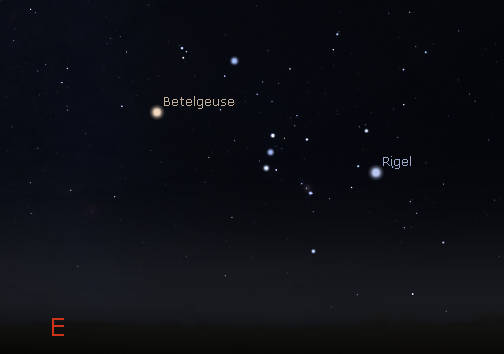
Orion at 8 pm or about 3 hours after sunset in mid December. Its seven brightest stars make an unmistakable pattern with only Betelgeuse and Rigel labeled. Created using Stellarium.
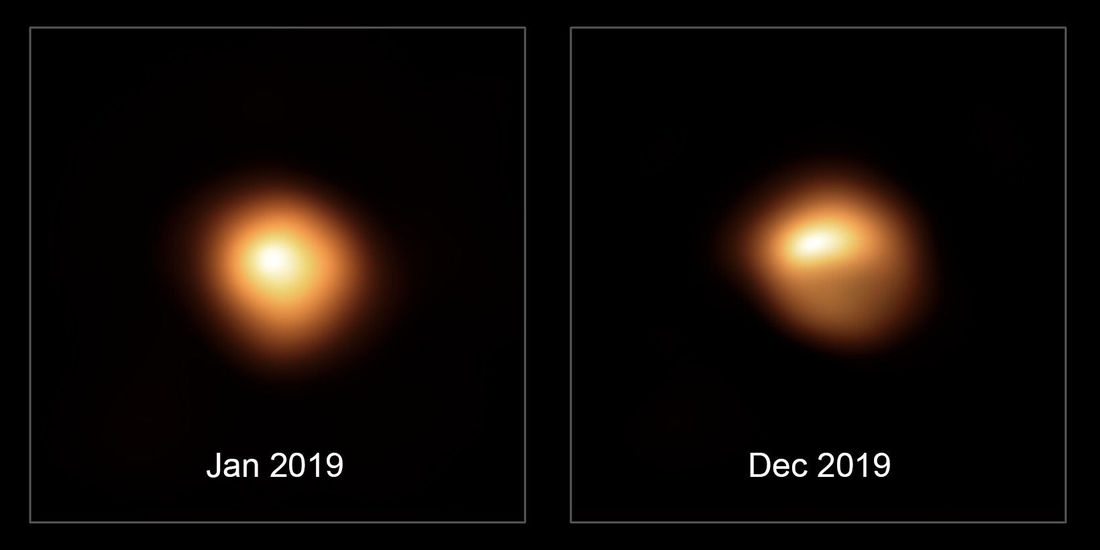
This comparison image shows the star Betelgeuse before and after its unprecedented dimming. The observations, taken with the SPHERE instrument on ESO’s Very Large Telescope in January and December 2019, show how much the star has faded and how its apparent shape has changed. Credit: ESO/M. Montargès et al.
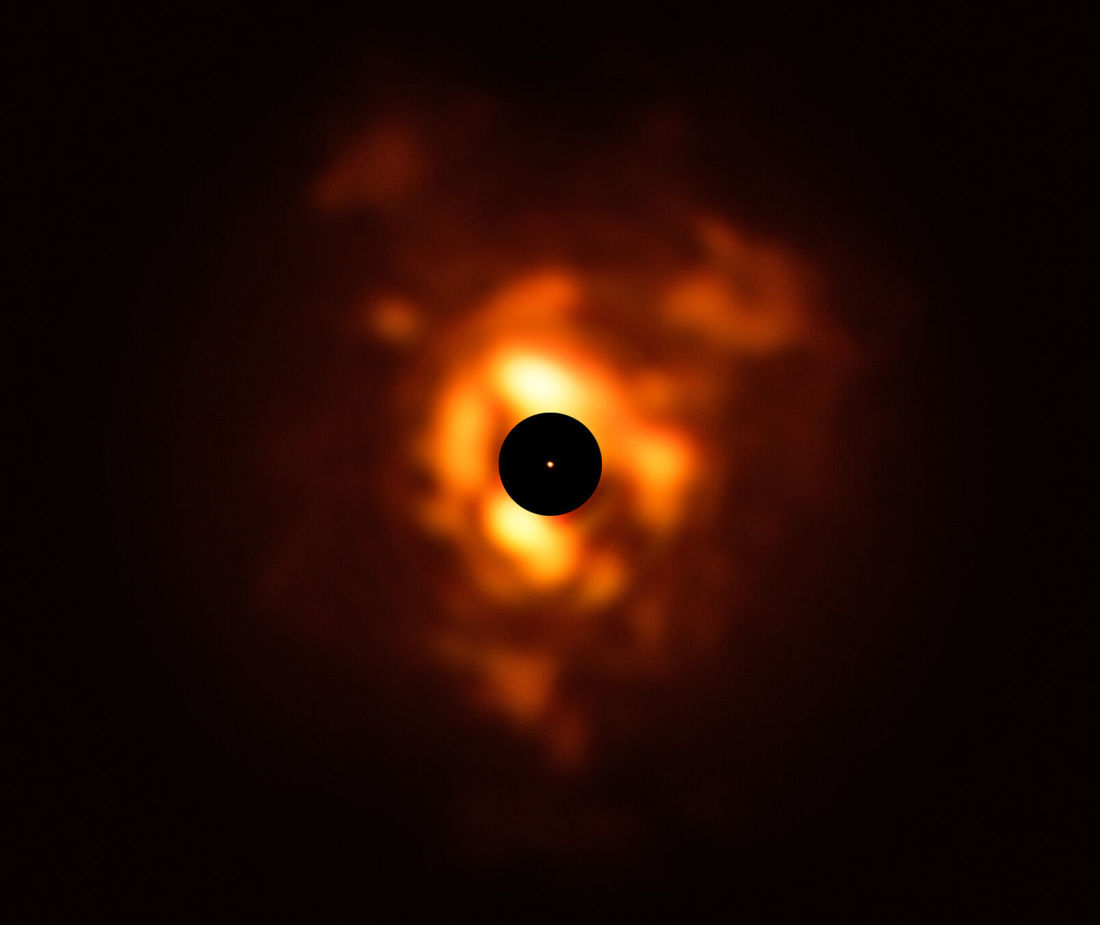
An image of the star Betelgeuse taken in infrared shows it’s surrounded by a vast cloud of dust that erupted from the surface (the bright star itself is masked out, though an image of it has been superposed there for scale — the star is about the size of the orbit of Jupiter, over a billion km wide). Credit: ESO/P. Kervella/M. Montargès et al., Acknowledgement: Eric Pantin via Phil Plait’s Bad Astronomy blog on syfy.com.
12/16/2020 – Ephemeris – Let’s look for the naked-eye planets for this week
This is Bob Moler with Ephemeris for Wednesday, December 16th. Today the Sun will be up for 8 hours and 48 minutes, setting at 5:03, and it will rise tomorrow at 8:14. The Moon, 2 days past new, will set at 7:09 this evening.
Let’s look for the naked-eye planets for this week. Jupiter and Saturn are both low in the southwestern sky from 6 to 7 pm. Jupiter is the very bright one. Above and left it by half a degree or one moon width will be dimmer Saturn. Below them tonight will be the thin crescent Moon. They will cross paths for us on the evening of December 21st and be seen in the same low power telescope field that evening. Jupiter will set first tonight at 7:40 pm with Saturn following four minutes later. Quite high in the southeast at that hour will be Mars, still in Pisces. Mars’ distance is increasing to 71 million miles (114 million kilometers) away. It will set at 2:55 tomorrow morning. Brilliant Venus will rise at 6:16 am in the east-southeast as it seems to retreat slowly toward the Sun, but actually it’s heading way around behind the Sun.
The event times given are for the Traverse City/Interlochen area of Michigan. They may be different for your location.
Addendum
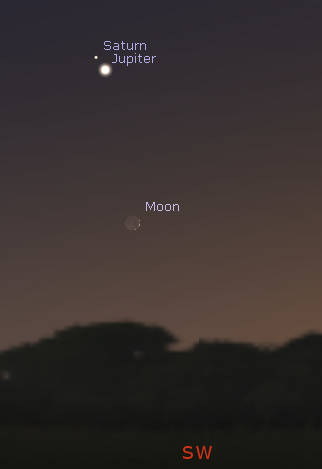
Jupiter and Saturn with Moon at 6 pm tonight December 16, 2020. Created using Stellarium.
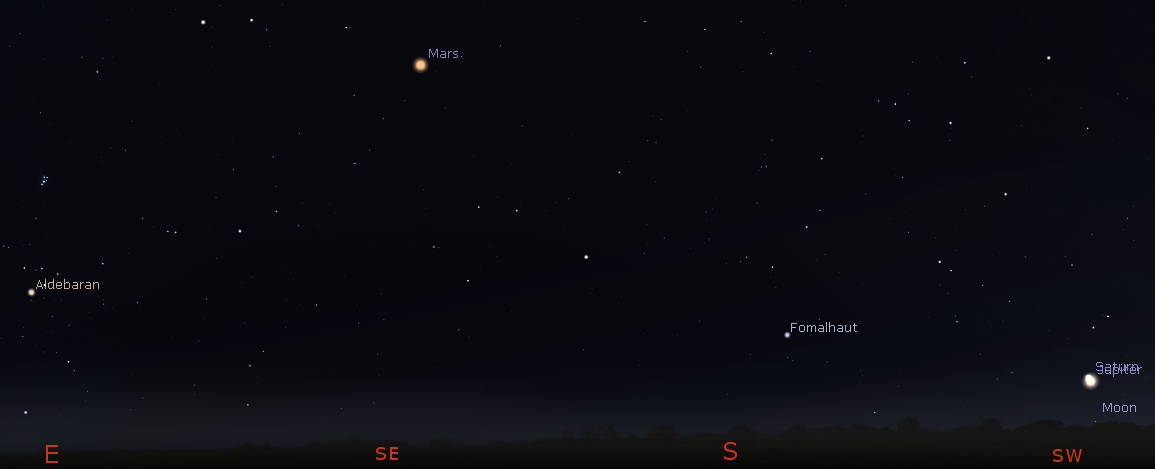
Evening planet panorama showing Mars, Jupiter, Saturn and the Moon setting at 6:30 pm December 16, 2020. Click on the image to enlarge. Created using Stellarium.
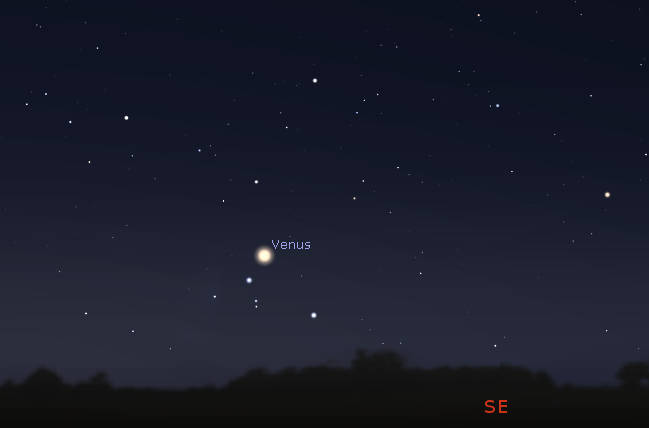
Venus low in the southeast at 7 am December17, 2020. Venus is all by its lonesome in the morning sky. No need for a panorama, so we’re zoomed in a bit. The morning sky has is not as friendly to morning planets as it was earlier in autumn season as we embark into winter next week. Created using Stellarium.
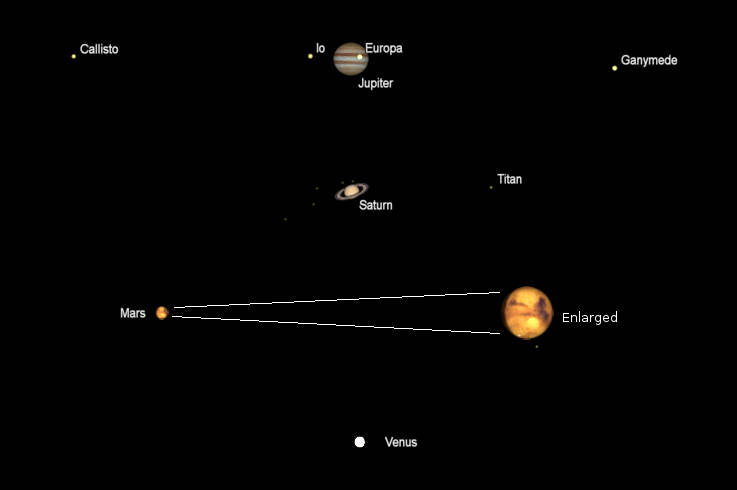
The planets as seen in a telescope (north up) with the same magnification for the night of December 16/17, 2020. Times of the display are: Jupiter and Saturn, 6 pm and Mars, 8 pm; Venus, 7 am. Apparent diameters: Jupiter, 33.49″; Saturn, 15.41″, rings, 35.90″; Mars, 12.20″, and Venus, 11.10″. Europa is transiting Jupiter and will be generally invisible. Mars also displays an enlargement showing surface detail. Mars was closest to the Earth this go-a-round on October 6. The ” symbol means seconds of arc (1/3600th of a degree.) Created using Cartes du Ciel (Sky Charts).
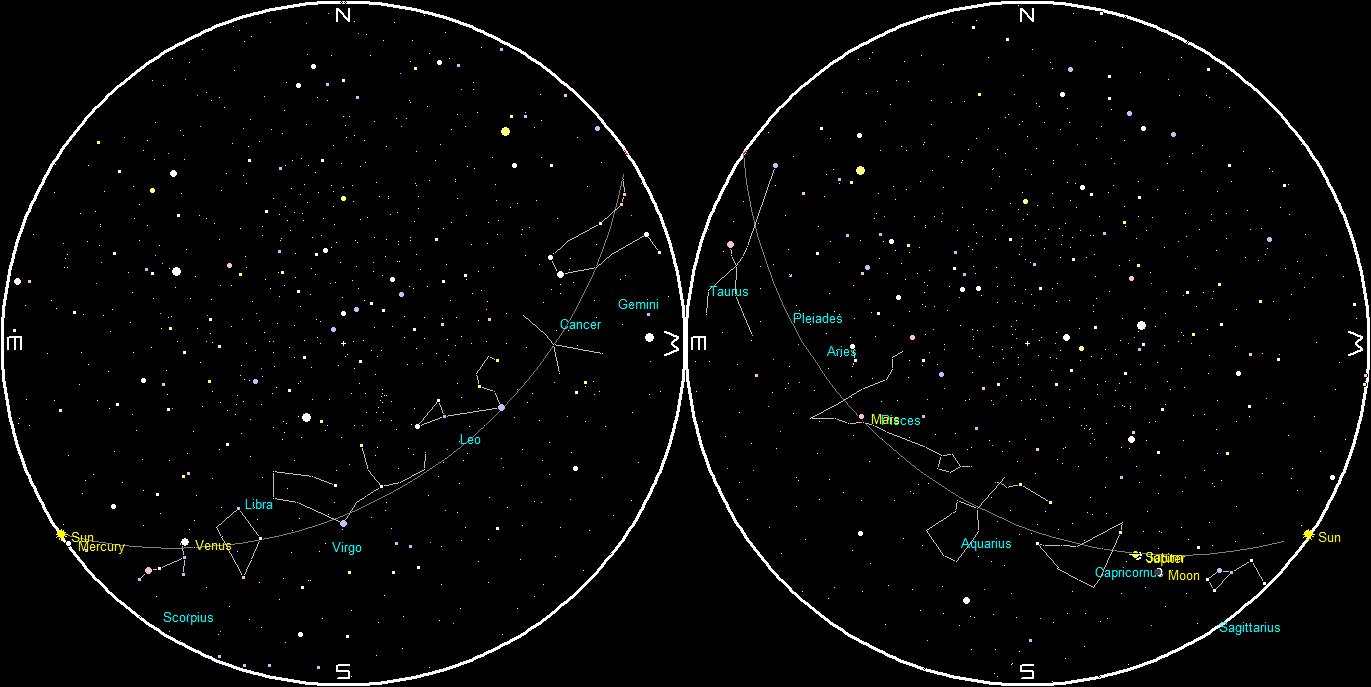
Planets and the Moon at sunset and sunrise of a single night starting with sunset on the right on December 16, 2020. The night ends on the left with sunrise on the 17th. I’m afraid that the labels for Jupiter and Saturn will overlap, since the planets are getting very close. Click on the image to enlarge. Created using my LookingUp program.
12/15/2020 – Ephemeris – Hyades, the face of Taurus the bull
This is Ephemeris for Tuesday, December 15th. Today the Sun will be up for 8 hours and 49 minutes, setting at 5:02, and it will rise tomorrow at 8:14. The Moon, 1 day past new, will set at 6:03 this evening.
The face of the constellation Taurus the bull looks like the letter V sideways above the rising Orion the Hunter in the east at 9 p.m. The bright star at the tip of a letter V of stars is Aldebaran. Look with binoculars at the letter V shape and you will see the stars of the Hyades star cluster The Hyades is the closest star cluster to us, at about 153 light years. And is important for that reason. Before satellites like Hipparcos and Gaia the Hyades was the only star cluster that could be directly measured by a technique called parallax, using the radius of the Earth’s orbit as one side of a surveyors enormous triangle. Its many stars at the same distance were used to determine distances of star clusters even farther away. Additional techniques based on the distance of the Hyades allowed us to measure distances to the nearest galaxies.
The event times given are for the Traverse City/Interlochen area of Michigan. They may be different for your location.
Addendum
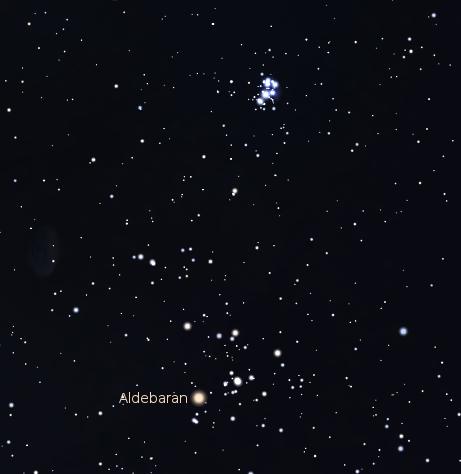
Aldebaran in the ‘V’ shape of the Hyades (The face of Taurus the bull) with the Pleiades above. Aldebaran is not part of the Hyades, being about halfway between us and the cluster. Created using Stellarium.
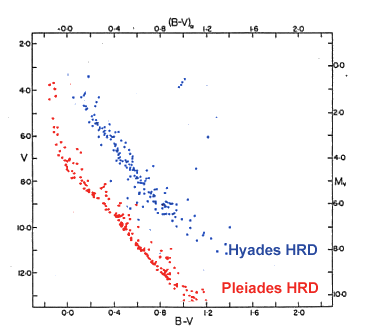
HR diagram showing the Hyades and Pleiades. Credit: European Southern Observatory.
The Hertzsprung–Russell diagram or HR diagram is one of the great astronomical tools developed in the early 20th century by plotting stars by surface temperature horizontally (hot to cool, left to right) and brightness vertically. It turns out that stars in the prime of life and shining via converting hydrogen to helium lie on a diagonal line from hot and bright from the upper left to cool and dim to the lower right. The line is called the main sequence. In plotting the Hyades stars against other star cluster stars the vertical displacement of the main sequence line is a function of the relative distances of the two star clusters from us. This is just one of the uses of the HR diagram.
12/14/2020 – Ephemeris – A total solar eclipse will occur today
This is Ephemeris for Monday, December 14th. Today the Sun will be up for 8 hours and 49 minutes, setting at 5:02, and it will rise tomorrow at 8:13. The Moon is new today, and won’t be visible.
Some lucky folks in South America, specifically located in a narrow path crossing Chile and Argentina will see a total eclipse of the Sun in a few hours. For us, the Moon is too far south to cover the Sun. This is the last eclipse of the year. We will get to see part of the next solar eclipse to occur. On the morning of June 10th, next year the Sun will rise as it is partially eclipsed for Michigan, with the Moon already leaving the Sun’s disk. That eclipse will not be total, but an annular eclipse, with the Moon too far away to cover the Sun completely, leaving a bright ring or annulus of the Sun, what some describe as a ring of fire. That effect will be seen in western Ontario, through the arctic, ending in Siberia.
The event times given are for the Traverse City/Interlochen area of Michigan. They may be different for your location.
Addendum
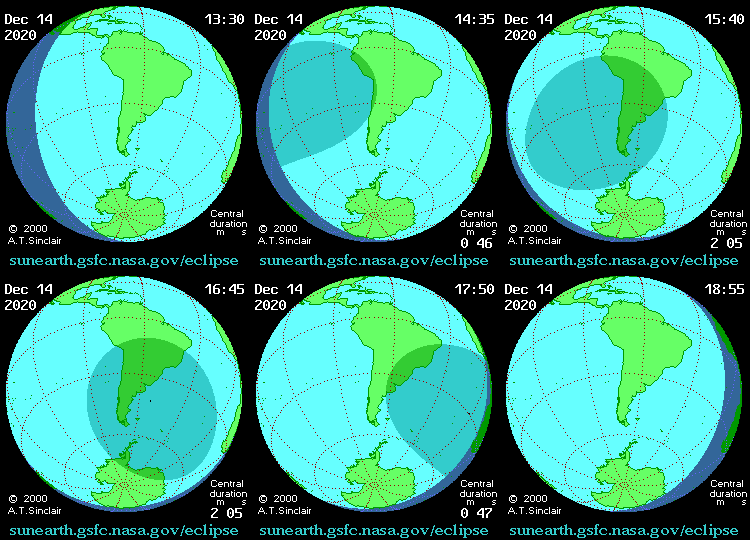
Animation of the path of the December 14, 2020, total solar eclipse. The penumbra of the Moon’s shadow is shown in gray, where the Sun will be partially eclipsed. The black dot near the center of the penumbra is the Moon’s umbra, where the face of the Sun is totally eclipsed. Credit: NASA/Goddard Space Flight Center.
12/11/2020 – Ephemeris Extra – Venus will hide behind the Moon for W US, Canada and N Pacific Tomorrow
Tomorrow Saturday, December 12, 2020 Venus will be occulted, or covered, by the thin crescent Moon for the area bounded in the map below. The southern boundary is a thin red line denoting that the event will take place in daylight. For safety sake observe the event from the shadow of a building open to the sky west of the Sun to not inadvertently point binoculars or telescope toward the Sun and cause permanent damage to your eyes. Venus is visible in the daytime. A program like Stellarium will help in locating Venus and determination of the time of the event for your location. Also, for Stellarium, in the configuration window’s Tool tab make sure “Topocentric coordinates” is checked.
The event will NOT be visible from Michigan.
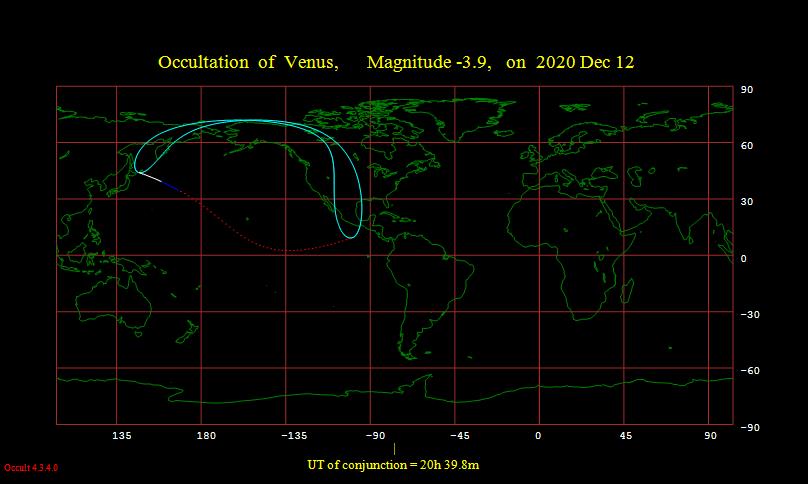
Occultation of Venus World map 12/12/2020. The occultation will be visible within the bounded area. For the area that looks like a lazy figure 8 the occultation will start (on the left) or end as Venus and the Moon rises or sets. For most areas within the bounded area the occultation is a daytime event. Credit Occult4.
12/11/2020 – Ephemeris – More on the Geminid meteor shower peaking this weekend
This is Ephemeris for Friday, December 11th. Today the Sun will be up for 8 hours and 51 minutes, setting at 5:02, and it will rise tomorrow at 8:11. The Moon, 3 days before new, will rise at 5:33 tomorrow morning.
This weekend and specifically Sunday evening to Monday morning the Geminid meteor shower will be at its peak, with up to 120 meteors appearing an hour in the early morning hours of Monday. The meteors will appear to come from near the star Castor, the northernmost star of the constellation of Gemini the twins. Castor and Pollux are the namesake stars at the head of Gemini. While they will seem to come from a specific point in the sky, they will be seen all over the sky, and be traced back to the point. They are coming in on parallel trajectories, just as straight railroad tracks recede to a point in the distance. Let’s hope for clear skies. The meteor shower lasts all night.
The event times given are for the Traverse City/Interlochen area of Michigan. They may be different for your location.
Addendum
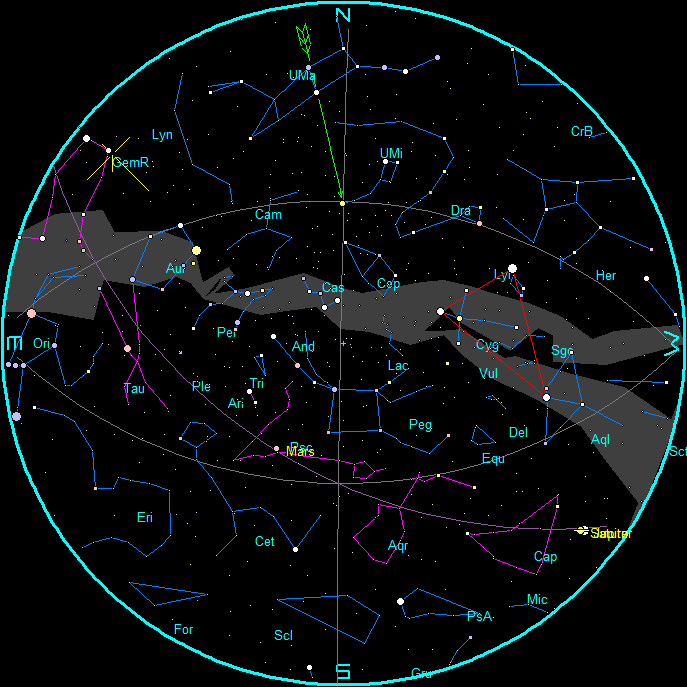
Star Chart for 7 pm, or about 2 hours after sunset. December 13, 2020. Click on image to enlarge. GemR is the location of the Geminid radiant low in the northeast. Click on image to enlarge. Created using my LookingUp program.
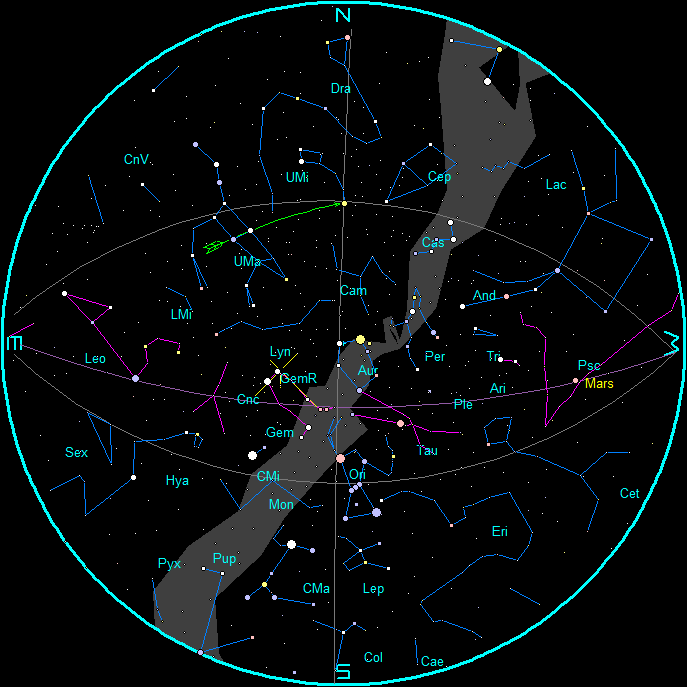
All sky chart of the Geminid Radiant 1 am Dec 14, 2020. GemR is the location of the Geminid radiant nearly overhead in the southeast.
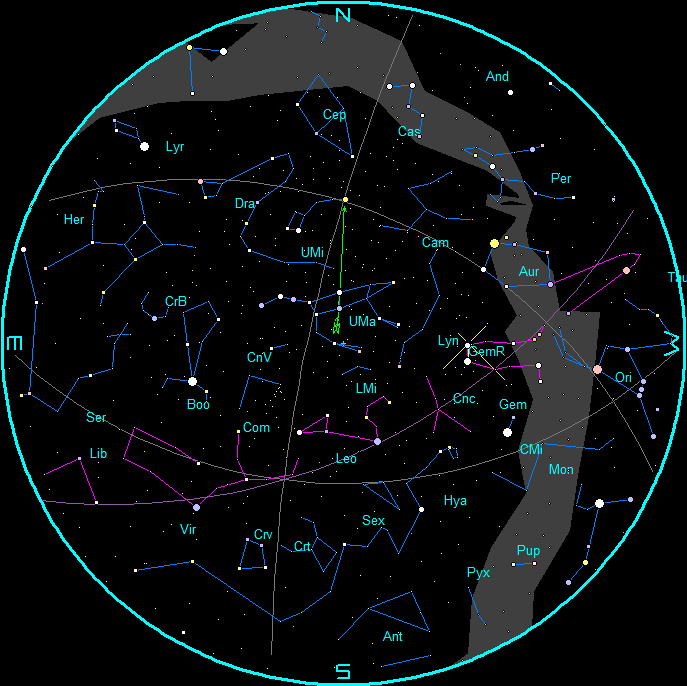
All sky chart of the Geminid Radiant 6 am Dec 14, 2020. GemR is the location of the Geminid radiant in the west.
12/10/2020 – Ephemeris – The Geminid meteor shower will reach its peak Sunday evening and Monday Morning December 13/14, 2020
This is Bob Moler with Ephemeris for Thursday, December 10th. Today the Sun will be up for 8 hours and 52 minutes, setting at 5:02 pm which will signal the beginning of the Jewish feast of Chanukah. Sunrise tomorrow will be at 8:10 am. The Moon, 3 days past last quarter, will rise at 4:13 tomorrow morning.
The Geminid meteor shower, the most active meteor shower of the year will be at its most active Sunday night and Monday morning. This year the Moon will be new on Monday and won’t interfere. Our problem is that it’s December, one of the cloudiest months of the year. The Geminid meteors will seem to come from near the star Castor, the second brightest star in Gemini. The actual source of the meteors is the asteroid or rock comet Phaethon. If it is an asteroid it comes closest to the Sun of any asteroid. It has been observed by spacecraft shedding dust when it’s heated near the Sun. It is probably a dead comet.
The event times given are for the Traverse City/Interlochen area of Michigan. They may be different for your location.
Addendum
Star Chart for 7 pm, or about 2 hours after sunset. December 13, 2020. Click on image to enlarge. Click on image to enlarge. Created using my LookingUp program.
All sky chart of the Geminid Radiant 1 am, or about 7 hours after sunset, Dec 14, 2020. Click on image to enlarge.
All sky chart of the Geminid Radiant 6 am, or about 2 hours before sunrise, Dec 14, 2020. Click on image to enlarge.
12/09/2020 – Ephemeris – A look at the naked-eye planets for this week
This is Ephemeris for Wednesday, December 9th. Today the Sun will be up for 8 hours and 53 minutes, setting at 5:02, the earliest sunset, and it will rise tomorrow at 8:09. The Moon, 2 days past last quarter, will rise at 2:55 tomorrow morning.
Let’s look for the naked-eye planets for this week. Jupiter and Saturn are both low in the southwestern sky from 6 to 7 pm. Jupiter is the very bright one. Above and left it by one and a half degrees or three moon widths will be dimmer Saturn. They are slowly closing, so they will cross paths for us on the evening of December 21st and be seen in the same low power telescope field that evening. Jupiter will set first tonight at 8 pm with Saturn following at 8:08. Quite high in the southeast at that hour will be Mars, still in Pisces. Mars’ distance is increasing to 65.3 million miles (105.2 million km) away. It will set at 3:10 tomorrow morning. Brilliant Venus will rise at 5:58 am in the east-southeast as it retreats slowly towards the Sun, but actually it’s heading around behind the Sun.
The event times given are for the Traverse City/Interlochen area of Michigan. They may be different for your location.
Addendum
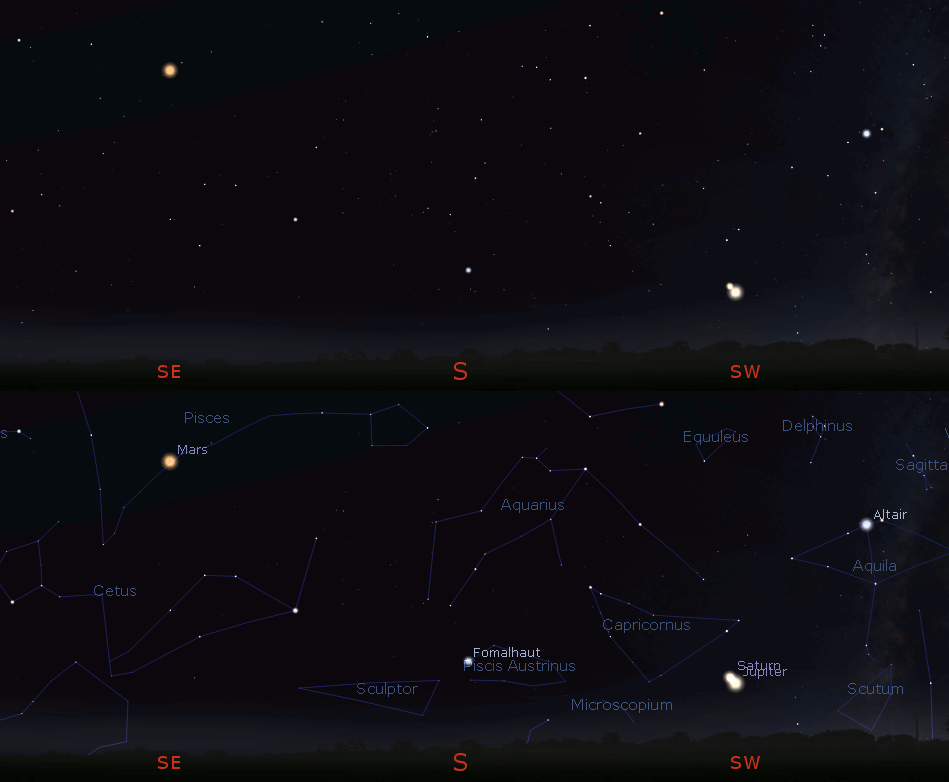
The evening planets seen at 6:30 pm or about an hour and a half after sunset December 9, 2020. Animation showing non-annotated sky and then with annotations. Click on the image to enlarge. Created using Stellarium and GIMP.
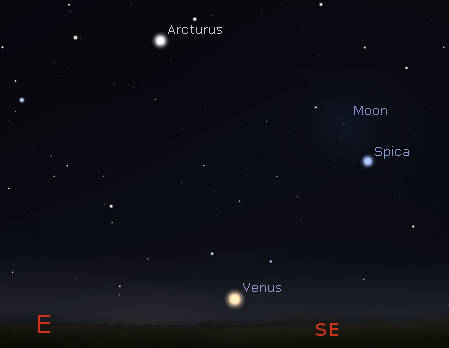
Venus and the waning crescent Moon at 6:30 am on December 10, 2020. Created using Stellarium.
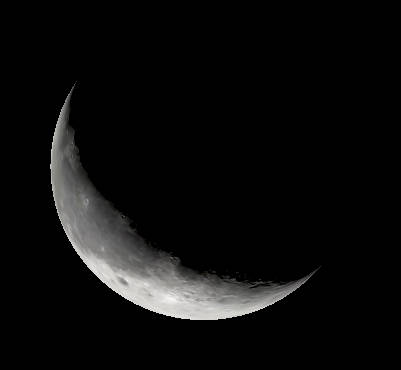
The waning crescent Moon as it might appear in binoculars or a small telescope at 6:30 am December 10, 2020. Created using Stellarium.
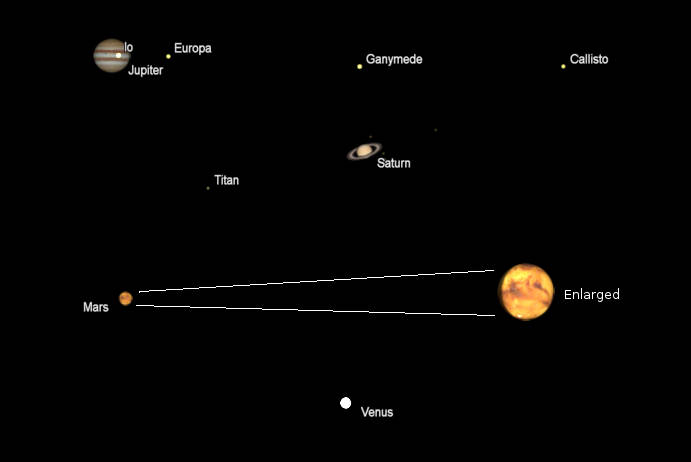
The planets as seen in a telescope (north up) with the same magnification for the night of December 9/10, 2020. Times of the display are: Jupiter, Saturn and Mars, 6:30 pm; Venus, 6:30 am. Apparent diameters: Jupiter, 33.85″; Saturn, 15.51″, rings, 36.13″; Mars, 13.18″, and Venus 11.32″. Io is transiting Jupiter and will be generally invisible. Mars also displays an enlargement showing surface detail. Mars was closest to the Earth this go-a-round on October 6. The ” symbol means seconds of arc (1/3600th of a degree). Created using Cartes du Ciel (Sky Charts).
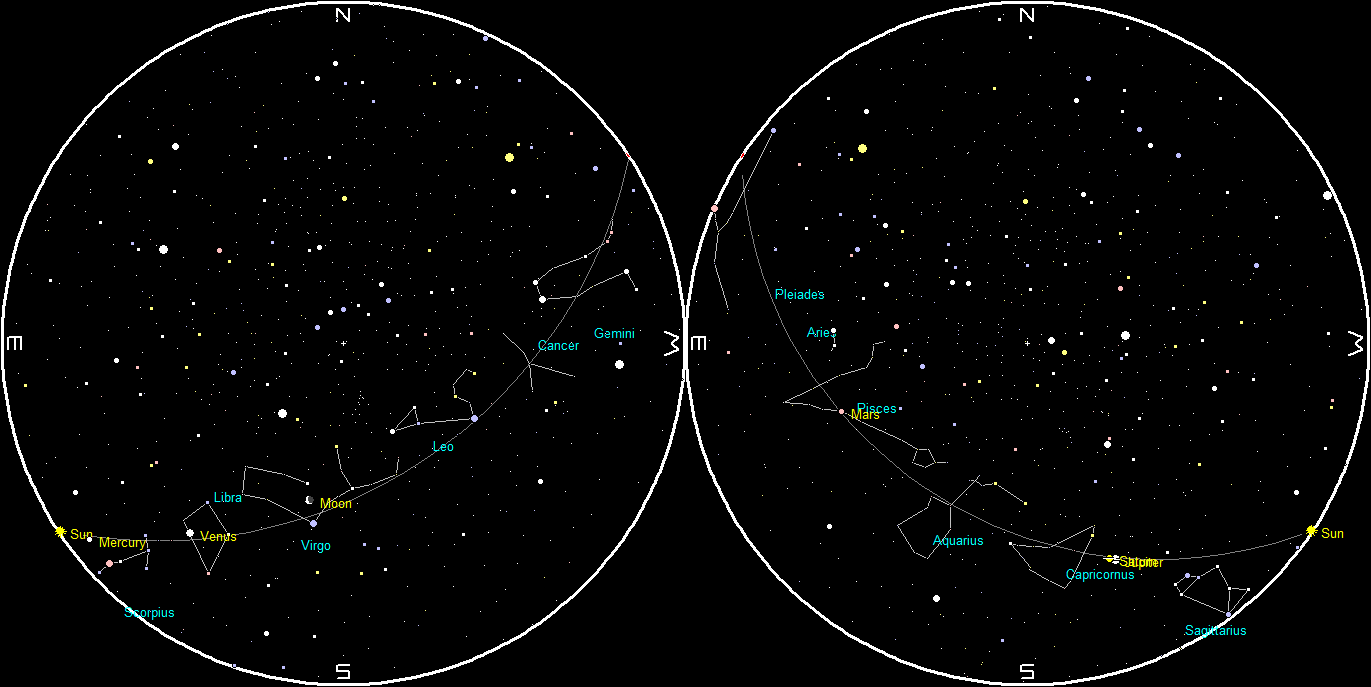
Planets and the Moon at sunset and sunrise of a single night starting with sunset on the right on December 9, 2020. The night ends on the left with sunrise on the 10th. I’m afraid that the labels for Jupiter and Saturn will overlap, since the planets are getting very close. Click on the image to enlarge. Created using my LookingUp program.
12/08/2020 – Ephemeris – Finding Taurus the bull
This is Ephemeris for Tuesday, December 8th. Today the Sun will be up for 8 hours and 54 minutes, setting at 5:02, and it will rise tomorrow at 8:08. The Moon, 1 day past last quarter, will rise at 1:39 tomorrow morning.
Orion is the big splashy constellation in the east southeast by 9 in the evening. Above it is another famous constellation Taurus the bull. Its face is a letter V shape of stars on its side with the open end of the V to the left. The bright star at the lower left end of the sideways V is the ruddy star Aldebaran, the Bull’s angry bloodshot eye. The bull is charging down at Orion. The Pleiades, also known as the seven sisters, is the cluster of stars in his shoulder, above the V. The stars in the face of Taurus, except for Aldebaran belong to a star cluster like the Pleiades, but closer and older, called the Hyades. In Greek mythology the Hyades are half sisters to the Pleiades, all fathered by the god Atlas.
The event times given are for the Traverse City/Interlochen area of Michigan. They may be different for your location.
Addendum
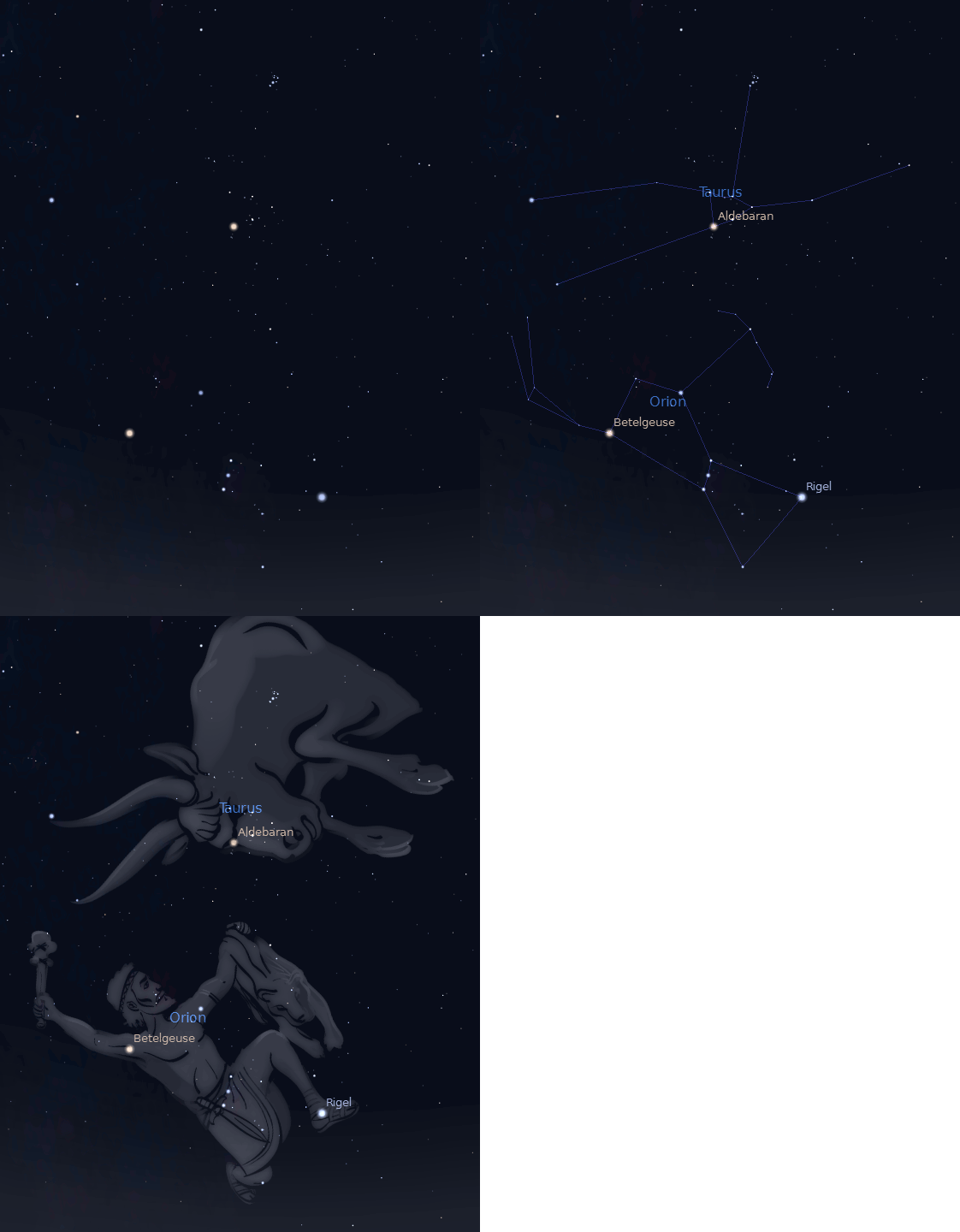
Three views of Taurus the bull and Orion the hunter for 9 p.m. on December 8th. Created using Stellarium and GIMP.
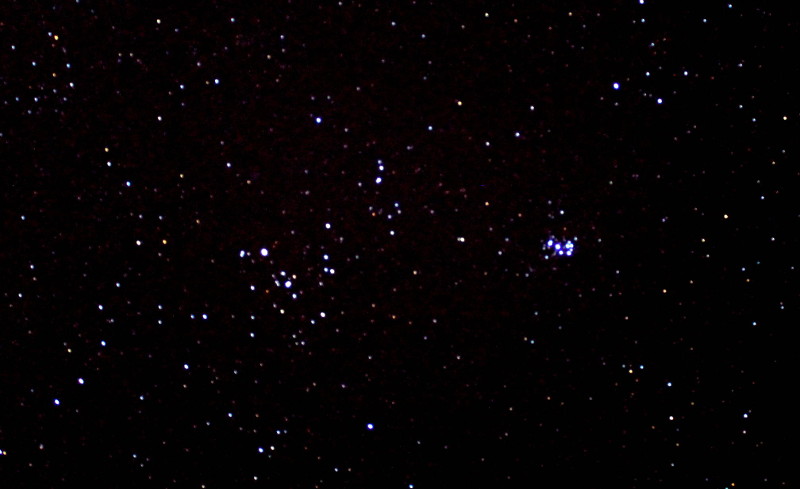
The Pleiades (right) and the Hyades (left) in this photograph I took January 4, 2016. The orientation is a bit different from how it appears in early December.
12/07/2020 – Ephemeris – Looking forward to the best of winter: Orion
This is Ephemeris for Monday, December 7th. Today the Sun will be up for 8 hours and 55 minutes, setting at 5:02, and it will rise tomorrow at 8:07. The Moon, at last quarter today, will rise at 12:25 tomorrow morning.
Orion, the central constellation of the winter evening sky will be completely risen by 9 this evening. Then it can be seen low in the east-southeast it’s upright rectangle of stars tilted to the left. The topmost star to the left in this rectangle is the famous red giant star Betelgeuse, which is reportedly dimming again. It’s in Orion’s shoulder. In his other shoulder is Bellatrix, a name known to Harry Potter fans. In his knees are Rigel, a blue-white giant star and Saiph. In the center of the rectangle are three stars in a straight line, now almost vertically arranged, Orion’s belt. And below his belt what seem to be three more stars, his sword. In the center of the sword stars can be found, with binoculars or telescope, Orion’s most famous feature, the Great Orion Nebula.
The event times given are for the Traverse City/Interlochen area of Michigan. They may be different for your location.
Addendum
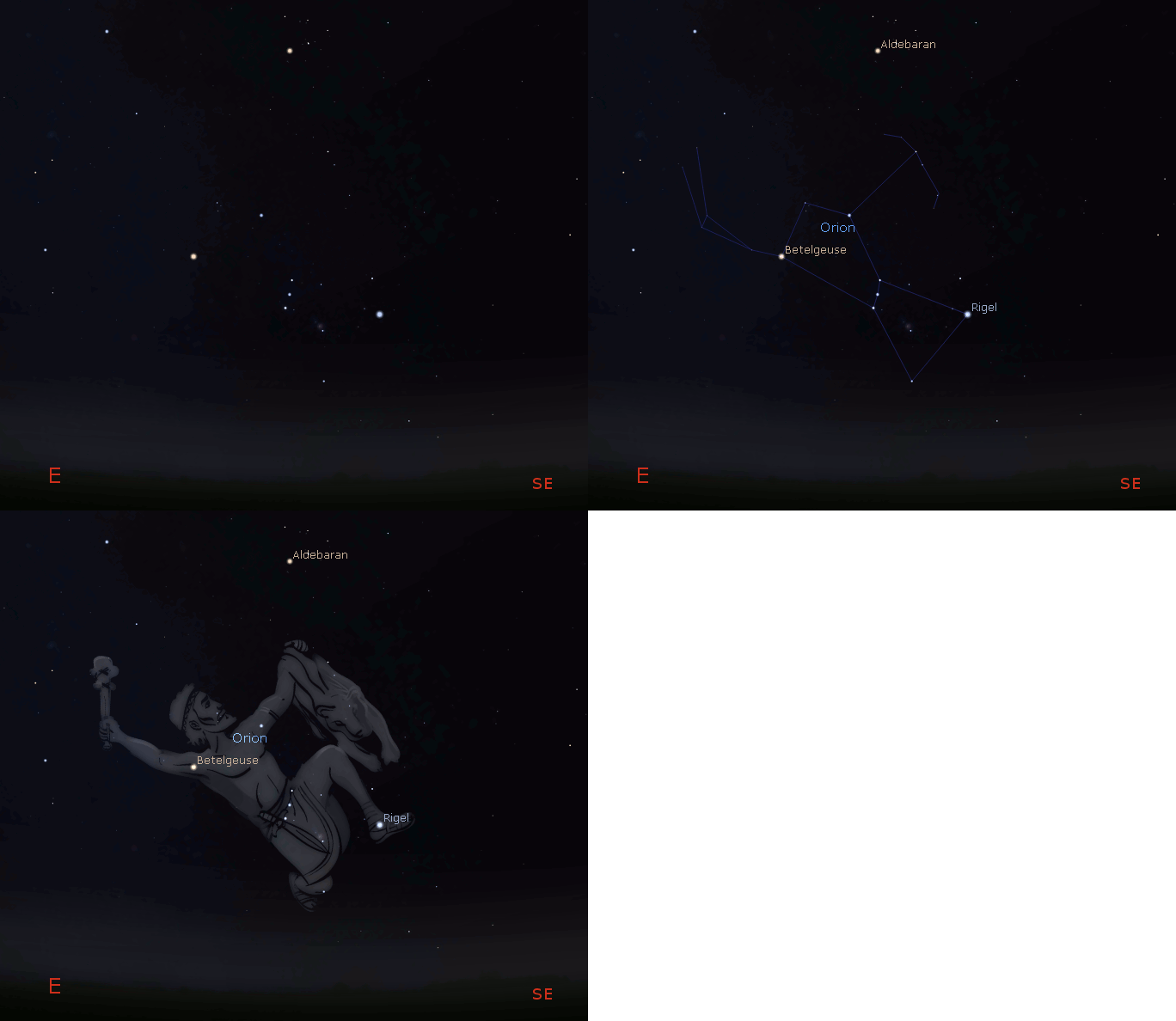
Orion early December finder animation for 9 pm December 7th. Created using Stellarium and GIMP.
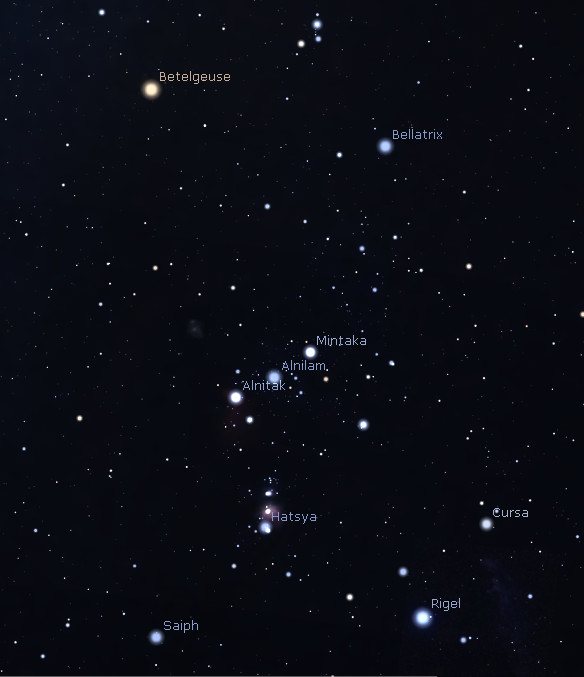
Orion’s named stars including the belt stars. Cursa, though named belongs to the neighboring constellation Eridanus the river. Created using Stellarium.
 Bob Moler's Ephemeris Blog