Archive
03/31/2022 – Ephemeris – Previewing April Skies
This is Ephemeris for Thursday, March 31st. Today the Sun will be up for 12 hours and 43 minutes, setting at 8:09, and it will rise tomorrow at 7:23. The Moon, 1 day before new, will rise at 7:51 tomorrow morning.
The 4th month of the year begins tomorrow. Daylight hours in the Interlochen/Traverse City area will increase from 12 hours and 46 minutes tomorrow to 14 hours and 12 minutes on April 30th. The altitude, or angle, of the Sun above the southern horizon at local noon will be 50 degrees tomorrow and will ascend to 60 degrees on April 30th. The altitude of the Sun in the Straits area will be a degree lower, but their daylight hours will be a bit longer. The actual time of local apparent noon, when the Sun passes due south, will be about 1:43 p.m. The Lyrid meteor shower will reach its peak on the afternoon of the 22nd. So the hours from 10 pm and 3am on the 21st and 22nd will be the best time to see them in dark skies.
The astronomical event times given are for the Traverse City/Interlochen area of Michigan (EDT, UT – 4 hours). They may be different for your location.
Addendum
April Evening Star Chart
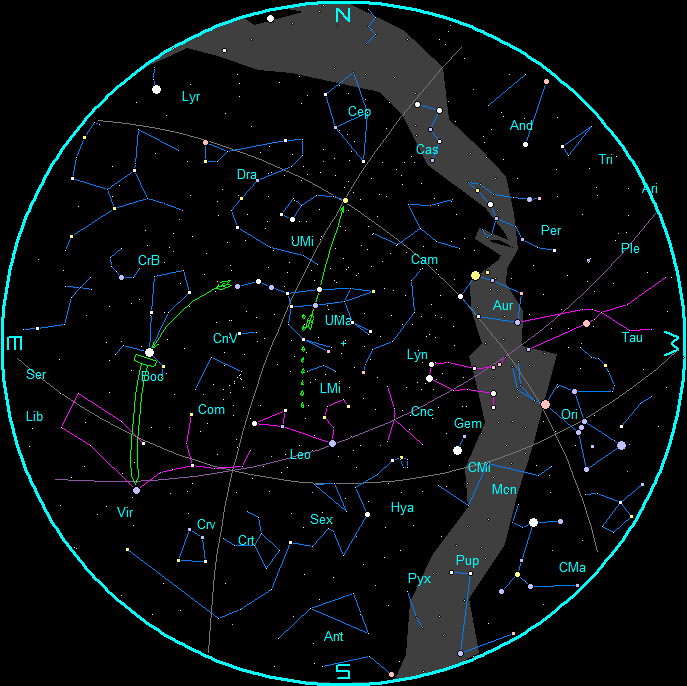
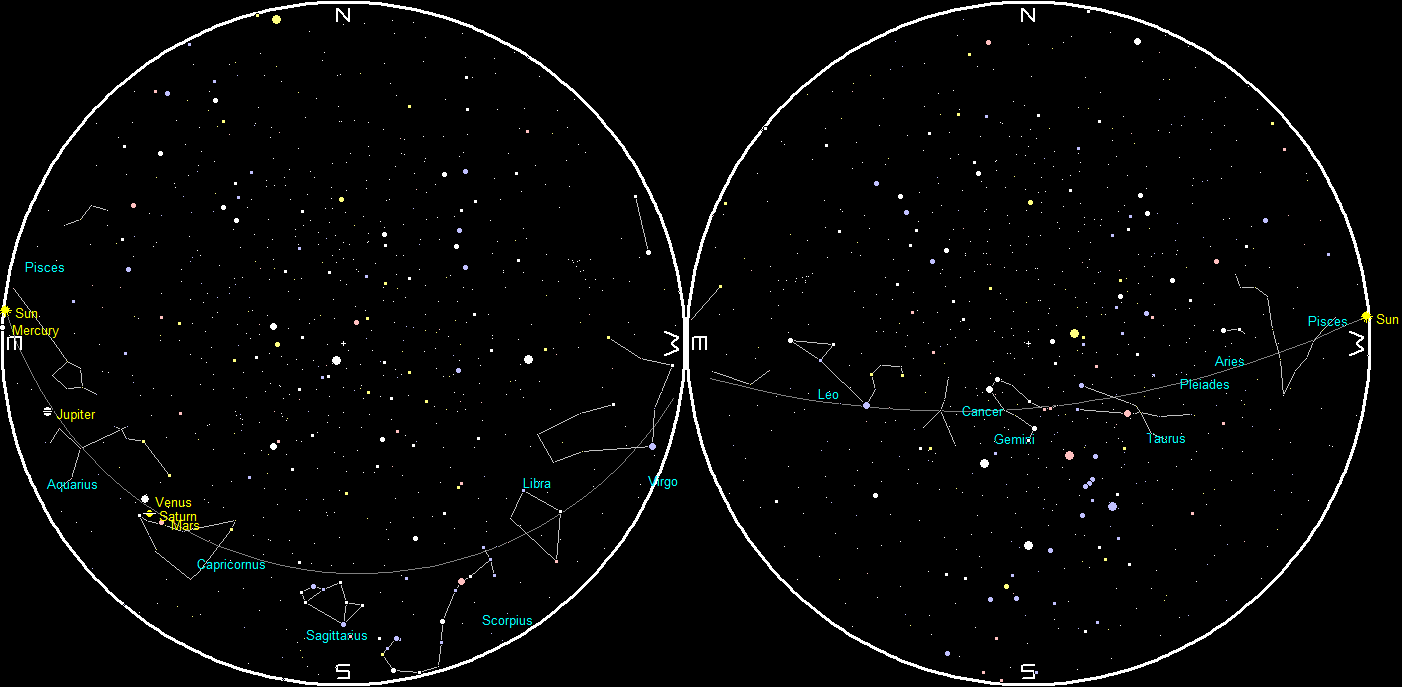
Star Chart for April 2022 (10 p.m. EDT, April 15, 2022). Click on image to enlarge. Created using my LookingUp program. Click on image to enlarge. Created using my LookingUp program.
April Morning Star Chart
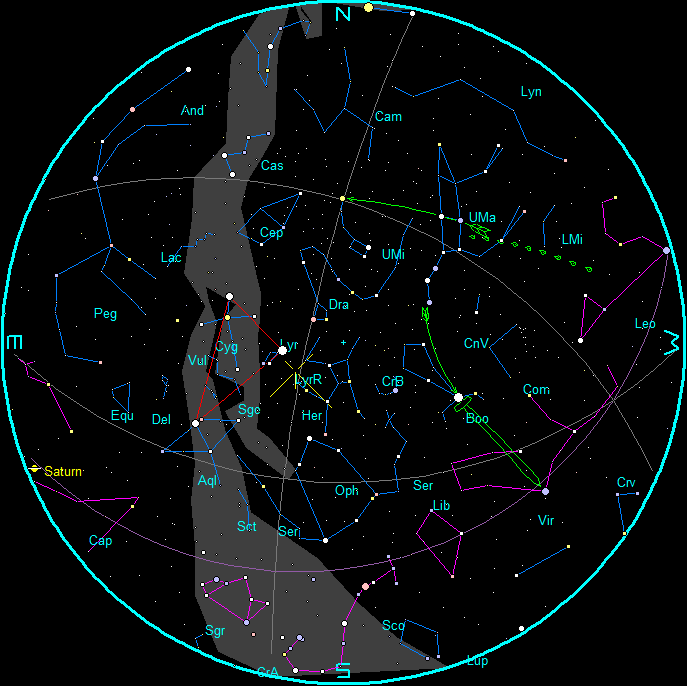
Star Chart for April mornings, 2022 (5 a.m. EDT, April 15, 2022). Click on image to enlarge. Created using my LookingUp program.
For a list of constellation names to go with the abbreviations, click here.
- Pointer stars at the front of the bowl of the Big Dipper point to Polaris, the North Star.
- The leaky bowl of the Big Dipper drips on Leo.
- Follow the arc of the handle of the Big Dipper to the star Arcturus, then
- Follow the spike to Spica.
- The Summer Triangle appears in red.
- LyrR is the radiant of the Lyrid meteor shower, which will reach peak on the afternoon of the 22nd.
Twilight Limits, Nautical and Astronomical
| EDT | |||||||
| Morning | Twilight | Evening | Twilight | Dark | Night | Moon | |
| Date | Astro. | Nautical | Nautical | Astro. | Start | End | Illum. |
| 2021-04-01 | 5h46m | 6h23m | 21h18m | 21h54m | 21h54m | 0h11m | 0.74 |
| 2021-04-02 | 5h44m | 6h21m | 21h19m | 21h56m | 21h56m | 1h29m | 0.64 |
| 2021-04-03 | 5h42m | 6h19m | 21h20m | 21h57m | 21h57m | 2h42m | 0.52 |
| 2021-04-04 | 5h39m | 6h17m | 21h22m | 21h59m | 21h59m | 3h44m | 0.42 |
| 2021-04-05 | 5h37m | 6h15m | 21h23m | 22h01m | 22h01m | 4h35m | 0.31 |
| 2021-04-06 | 5h35m | 6h13m | 21h25m | 22h02m | 22h02m | 5h16m | 0.22 |
| 2021-04-07 | 5h33m | 6h11m | 21h26m | 22h04m | 22h04m | 5h33m | 0.14 |
| 2021-04-08 | 5h31m | 6h09m | 21h27m | 22h05m | 22h05m | 5h31m | 0.08 |
| 2021-04-09 | 5h28m | 6h07m | 21h29m | 22h07m | 22h07m | 5h28m | 0.03 |
| 2021-04-10 | 5h26m | 6h05m | 21h30m | 22h09m | 22h09m | 5h26m | 0.01 |
| 2021-04-11 | 5h24m | 6h03m | 21h32m | 22h10m | 22h10m | 5h24m | 0 |
| 2021-04-12 | 5h22m | 6h01m | 21h33m | 22h12m | 22h12m | 5h22m | 0.01 |
| 2021-04-13 | 5h20m | 5h59m | 21h35m | 22h14m | 22h14m | 5h20m | 0.04 |
| 2021-04-14 | 5h17m | 5h57m | 21h36m | 22h16m | 23h12m | 5h17m | 0.08 |
| 2021-04-15 | 5h15m | 5h55m | 21h38m | 22h17m | – | 5h15m | 0.14 |
| 2021-04-16 | 5h13m | 5h53m | 21h39m | 22h19m | 0h14m | 5h13m | 0.22 |
| 2021-04-17 | 5h11m | 5h51m | 21h41m | 22h21m | 1h15m | 5h11m | 0.3 |
| 2021-04-18 | 5h09m | 5h49m | 21h42m | 22h23m | 2h12m | 5h09m | 0.39 |
| 2021-04-19 | 5h06m | 5h47m | 21h44m | 22h24m | 3h03m | 5h06m | 0.49 |
| 2021-04-20 | 5h04m | 5h45m | 21h45m | 22h26m | 3h47m | 5h04m | 0.59 |
| 2021-04-21 | 5h02m | 5h43m | 21h47m | 22h28m | 4h25m | 5h02m | 0.7 |
| 2021-04-22 | 5h00m | 5h41m | 21h48m | 22h30m | 4h56m | 5h00m | 0.79 |
| 2021-04-23 | 4h57m | 5h39m | 21h50m | 22h32m | – | – | 0.88 |
| 2021-04-24 | 4h55m | 5h37m | 21h51m | 22h34m | – | – | 0.94 |
| 2021-04-25 | 4h53m | 5h35m | 21h53m | 22h35m | – | – | 0.99 |
| 2021-04-26 | 4h51m | 5h34m | 21h55m | 22h37m | – | – | 1 |
| 2021-04-27 | 4h49m | 5h32m | 21h56m | 22h39m | – | – | 0.98 |
| 2021-04-28 | 4h46m | 5h30m | 21h58m | 22h41m | 22h41m | 23h06m | 0.94 |
| 2021-04-29 | 4h44m | 5h28m | 21h59m | 22h43m | 22h43m | – | 0.87 |
| 2021-04-30 | 4h42m | 5h26m | 22h01m | 22h45m | 22h45m | 0h25m | 0.78 |
Twilight calendar was generated using Cartes du Ciel (Sky Charts).
See my blog post: Twilight Zone for the definitions of the different periods of twilight here: https://bobmoler.wordpress.com/2018/09/27/.
NASA Calendar of Planetary Events
   Date     Time      Event
Apr  1  Fr            Venus: 46.1° W
     1  Fr   2:24 am  New Moon
     2  Sa   7:05 pm  Mercury Superior Conj.
     4  Mo   9:05 am  Moon Ascending Node
     4  Mo   9:16 pm  Moon-Pleiades: 4° N
     4  Mo   9:45 pm  Mars-Saturn: 0.3° N
     7  Th   3:11 pm  Moon Apogee: 404400 km
     8  Fr   4:15 am  Moon North Dec.: 26.9° N
     9  Sa   2:48 am  First Quarter
     9  Sa  11:14 am  Moon-Pollux: 2.4° N
    10  Su  12:27 pm  Moon-Beehive: 3.9° S
    16  Sa   2:55 pm  Full Pink Moon
    18  Mo  10:01 am  Moon Descending Node
    19  Tu  11:16 am  Moon Perigee: 365100 km
    21  Th   1:41 pm  Moon South Dec.: 26.9° S
    22  Fr   2:25 pm  Lyrid Shower: ZHR = 20
    23  Sa   7:56 am  Last Quarter
    24  Su   4:56 pm  Moon-Saturn: 4.6° N
    25  Mo   6:06 pm  Moon-Mars: 4.1° N
    26  Tu   9:51 pm  Moon-Venus: 4° N
    27  We   4:23 am  Moon-Jupiter: 3.8° N
    29  Fr   3:59 am  Mercury Elongation: 20.6° E
    29  Fr   3:29 pm  Mercury-Pleiades: 1.4° S
    30  Sa   3:56 pm  Venus-Jupiter: 0.2° N
    30  Sa   4:28 pm  New Moon
    30  Sa   4:42 pm  Partial Solar Eclipse (South Pacific and
                          Southern South America)
May  1  Su            Venus: 42.4° W
Sky Events Calendar by Fred Espenak and Sumit Dutta (NASA’s GSFC),
http://eclipse.gsfc.nasa.gov/SKYCAL/SKYCAL.html.
Sun and Moon Rising and Setting Events
     LU                  Ephemeris of Sky Events for Interlochen/TC
April, 2022    Local time zone: EDT
+-----------------------------------------------------------------------+
| DATE |  SUN     SUN  DAYLIGHT|   TWILIGHT*    |MOON  RISE OR    ILLUM |
|      |  RISE    SET    HOURS |  END    START  |PHASE SET** TIME FRACTN|
+=======================================================================+
|Fri  1| 07:23a  08:10p  12:46 | 09:15p  06:18a |New   Set  08:47p    1%|
|Sat  2| 07:21a  08:11p  12:50 | 09:16p  06:16a |      Set  09:55p    3%|
+------+-----------------------+----------------+-----------------------+
|Sun  3| 07:19a  08:12p  12:53 | 09:18p  06:14a |      Set  11:03p    8%|
|Mon  4| 07:18a  08:14p  12:56 | 09:19p  06:13a |      Set  12:10a   14%|
|Tue  5| 07:16a  08:15p  12:59 | 09:20p  06:11a |      Set  01:15a   21%|
|Wed  6| 07:14a  08:16p  13:02 | 09:22p  06:09a |      Set  02:16a   29%|
|Thu  7| 07:12a  08:17p  13:05 | 09:23p  06:07a |      Set  03:11a   38%|
|Fri  8| 07:10a  08:19p  13:08 | 09:25p  06:05a |      Set  03:58a   47%|
|Sat  9| 07:09a  08:20p  13:11 | 09:26p  06:03a |F Qtr Set  04:37a   57%|
+------+-----------------------+----------------+-----------------------+
|Sun 10| 07:07a  08:21p  13:14 | 09:28p  06:01a |      Set  05:10a   66%|
|Mon 11| 07:05a  08:22p  13:17 | 09:29p  05:59a |      Set  05:37a   75%|
|Tue 12| 07:03a  08:24p  13:20 | 09:31p  05:57a |      Set  06:01a   83%|
|Wed 13| 07:01a  08:25p  13:23 | 09:32p  05:55a |      Set  06:22a   90%|
|Thu 14| 07:00a  08:26p  13:26 | 09:34p  05:53a |      Set  06:43a   96%|
|Fri 15| 06:58a  08:27p  13:29 | 09:35p  05:51a |      Set  07:04a   99%|
|Sat 16| 06:56a  08:29p  13:32 | 09:37p  05:49a |Full  Rise 08:36p  100%|
+------+-----------------------+----------------+-----------------------+
|Sun 17| 06:55a  08:30p  13:35 | 09:38p  05:47a |      Rise 09:56p   98%|
|Mon 18| 06:53a  08:31p  13:38 | 09:40p  05:45a |      Rise 11:17p   93%|
|Tue 19| 06:51a  08:32p  13:41 | 09:41p  05:43a |      Rise 12:37a   86%|
|Wed 20| 06:49a  08:34p  13:44 | 09:43p  05:41a |      Rise 01:51a   77%|
|Thu 21| 06:48a  08:35p  13:47 | 09:44p  05:39a |      Rise 02:54a   67%|
|Fri 22| 06:46a  08:36p  13:50 | 09:46p  05:37a |      Rise 03:43a   56%|
|Sat 23| 06:45a  08:37p  13:52 | 09:47p  05:35a |L Qtr Rise 04:22a   44%|
+------+-----------------------+----------------+-----------------------+
|Sun 24| 06:43a  08:39p  13:55 | 09:49p  05:33a |      Rise 04:52a   33%|
|Mon 25| 06:41a  08:40p  13:58 | 09:50p  05:31a |      Rise 05:16a   24%|
|Tue 26| 06:40a  08:41p  14:01 | 09:52p  05:29a |      Rise 05:37a   15%|
|Wed 27| 06:38a  08:42p  14:04 | 09:53p  05:28a |      Rise 05:56a    8%|
|Thu 28| 06:37a  08:44p  14:06 | 09:55p  05:26a |      Rise 06:16a    4%|
|Fri 29| 06:35a  08:45p  14:09 | 09:57p  05:24a |      Rise 06:36a    1%|
|Sat 30| 06:34a  08:46p  14:12 | 09:58p  05:22a |New   Set  08:49p    0%|
+-----------------------------------------------------------------------+
* Nautical Twilight
** Moonrise or moonset, whichever occurs between sunrise and sunset
Generated using my LookingUp for DOS program.
03/30/2022 – Ephemeris – Let’s search for the naked-eye planets for this week
This is Ephemeris for Wednesday, March 30th. Today the Sun will be up for 12 hours and 40 minutes, setting at 8:07, and it will rise tomorrow at 7:25. The Moon, 2 days before new, will rise at 7:31 tomorrow morning.
Let’s search for the naked-eye planets for this week. There are no bright planets in the evening sky, so the planet action shifts to the morning sky. All five naked-eye planets are there, though Jupiter and Mercury are too close to the Sun to be seen. Late winter and early spring mornings aren’t the best for spotting planets close to the Sun, since they tend to lie low in the southeastern sky. Venus, Mars, and Saturn will rise within 6 minutes of each other by 5:46. By 6:30, they will be low in the east-southeast with much dimmer Mars to the left of Venus, with Saturn between and a bit below them. Monday, April 4th Mars will appear closest to Saturn, scooting below the ringed planet that evening, so they will appear close together both Monday and Tuesday mornings.
The astronomical event times given are for the Traverse City/Interlochen area of Michigan (EDT, UT – 4 hours). They may be different for your location.
Addendum
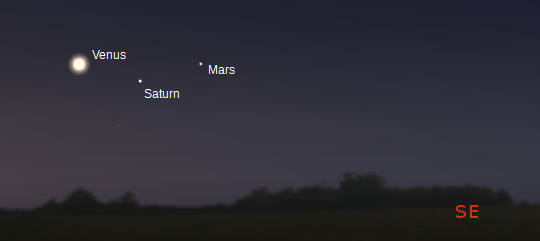
What the morning planets might appear as at 6:30 tomorrow morning, March 31, 2022. They may be brighter than they actually appear. Created using Stellarium.
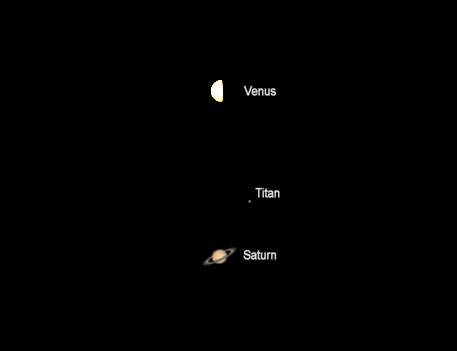
Telescopic views of the Venus and Saturn (north up) as they would be seen in a small telescope, with the same magnification, tomorrow morning at 6:30 am, March 31, 2022. I do not show planets less than 10 seconds of arc in diameter. Apparent diameters: Venus 23.52″, 55.0% illuminated; Saturn 15.78″, its rings 36.76″. Mars is not shown, its apparent diameter is 5.18″ and is 91.7% illuminated. The ” symbol means seconds of arc (1/3600th of a degree.) Created using Cartes du Ciel (Sky Charts).
The naked-eye planets and the Moon at sunset and sunrise on a single night, starting with sunset on the right on March 30, 2022. The night ends on the left with sunrise on the 31st. Notice that all the naked-eye planets are in the morning sky now, with the Moon still hanging out in the evening sky. Click on the image to enlarge it. Created using my LookingUp program.
03/08/2022 – Ephemeris – It’s International Women’s Day
03/29/2022 – Ephemeris – Finding zodiacal light
This is Ephemeris for Tuesday, March 29th. Today the Sun will be up for 12 hours and 37 minutes, setting at 8:06, and it will rise tomorrow at 7:27. The Moon, 3 days before new, will rise at 7:10 tomorrow morning.
The evening sky will stay dark for the rest of the week, so it’s time to look for the zodiacal light in the evening. It is a faint but towering glow that can be seen after the end of astronomical twilight on moonless nights. It is seen in the west in the evening in late winter and early spring. The axis of the glow is the ecliptic, the apparent annual path of the Sun in the sky, along which lie the constellations of the zodiac. It’s a glow whose wide base is in the west that extends upwards and to the left. Right now, the end of astronomical twilight is about 9:49 p.m. and advancing at a rate of a minute or two each night. Go to a spot with a dark western sky, no big cities or towns out that way. Zodiacal light is caused by dust spread out around the Sun.
The astronomical event times given are for the Traverse City/Interlochen area of Michigan (EDT, UT – 4 hours). They may be different for your location.
Addendum
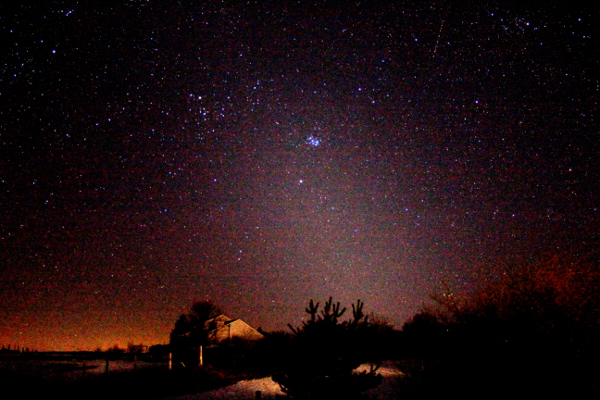
The western sky at 10:22 pm, March 25, 2019. Mars appears below the Pleiades in zodiacal light. Credit, mine – Canon EOS Rebel T5, 18mm f.l., f/3.5, 8 sec. ISO 12,800.
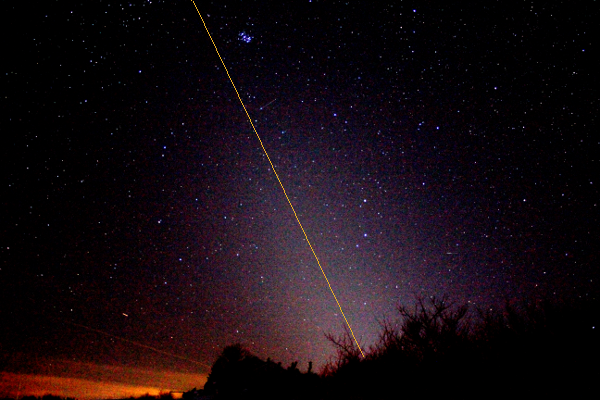
I’ve added the approximate ecliptic line from an image I took from a year earlier.
My article in April’s Stellar Sentinel, the newsletter of the Grand Traverse Astronomical Society, about zodiacal light.
One of the hardest of the night sky phenomena to spot is zodiacal light. The top picture above is my last photo of the zodiacal light. The photo is showing it brighter than it looks to the naked eye.
Zodiacal light is seen in the west in the evening in late winter and early spring and in the east in the morning in late summer and early autumn. The axis of the glow is near the ecliptic, the plane of the Earth’s orbit, along which lie the constellations of the zodiac.
This glow seems to have been first recorded by the Arabs around 630 CE. It was first recognized as a morning phenomenon as a false dawn, appearing before the first real glow of astronomical twilight. This false dawn was a big deal for the Islamic faithful, whose morning prayers must be made after the true dawn, or astronomical twilight, when the center of the Sun is 18° below the horizon.
How I usually recognize that I’m looking at the zodiacal light is kind of like not seeing the forest for the trees. That is, in certain parts of the sky, the sky doesn’t seem as dark as other parts. It helps to know where the zodiacal light is supposed to be. Once found, you’ll know what to look for, so finding it in the future will be easier.
In February 2017, on a relatively warm, but clear night, I went out to the Dune Climb at the Sleeping Bear Dunes. Part of the parking lot was plowed. I set up my tracking mount with my 5” scope that had a camera mount to photograph Orion and the Milky Way around Cassiopeia, Perseus and Taurus.
Having not thought about zodiacal light at the time, but while examining and processing the images later on, I began to notice that parts of the sky background not associated with the Milky Way were not as dark as I expected. It was on the side of the Milky Way closest to the ecliptic. These were telephoto shots, so the pyramidal shape of zodiacal light was not apparent. However, in recreating the sky at the time of the observations using Stellarium, it confirmed that it was the area where zodiacal light would be present.
What causes zodiacal light? The cause is dust, micron sized dust from comets and asteroids. Most of these lie in and near the plane of the solar system, which is why zodiacal light is centered on the ecliptic and the constellations of the zodiac and increases in brightness toward the Sun.
The free planetarium program Stellarium (stellarium.org) has added a zodiacal light effect in recent releases. Click on the Sky and viewing options icon at the left edge of the window, In the Sky tab there is a checkbox for zodiacal light and an intensity value to be selected. In order to see the effect, the Atmosphere icon at the bottom of the viewing window must be turned off. The effect is very subtle.
It is best seen around the vernal equinox in the evening and autumnal equinox tn the morning because at these times the ecliptic is closest to vertical. In the evening it tilts to the left, in the morning it tilts to the right. The closer one is to the equator, the more vertical the zodiacal light will appear. It would be a year-round phenomenon for observers in the tropics.
As an aside, Brian May, lead guitarist for the rock band Queen, with an uncanny resemblance to Sir Isaac Newton, earned a PhD in astrophysics in 2007 with his dissertation: A Survey of Radial Velocities in the Zodiacal Dust Cloud. It analyzed the motions of the particles of dust that make up the zodiacal dust cloud, which produces zodiacal light.
The best time to see this phenomenon will be the last week of March to the first few days of April 2022, before the Moon is a couple of days old.
03/28/2022 – Ephemeris – Finding the Great Bear
This is Ephemeris for Monday, March 28th. Today the Sun will be up for 12 hours and 34 minutes, setting at 8:05, and it will rise tomorrow at 7:29. The Moon, 3 days past last quarter, will rise at 6:47 tomorrow morning.
The Big Dipper is now reaching for the zenith in the northeast at 10 p.m. The seven bright stars are second to Orion in the west as the seven brightest stars in a constellation. If you looked up a list of constellations, you’d find that the Big Dipper isn’t there. Ursa Major or the Great Bear is the constellation of which the Big Dipper is a part. The seven bright stars of the dipper are the rump and long tail of this constellation. The rest of the bear, including his head and legs, are delineated by dimmer stars. An anatomical problem is its long tail, which was drawn in by the ancients of the old world. Their explanation was that a god had grabbed the bear’s stubby tail, whirled the bear around his head, and threw it into the sky, thus stretching its tail.
The astronomical event times given are for the Traverse City/Interlochen area of Michigan (EDT, UT – 4 hours). They may be different for your location.
Addendum
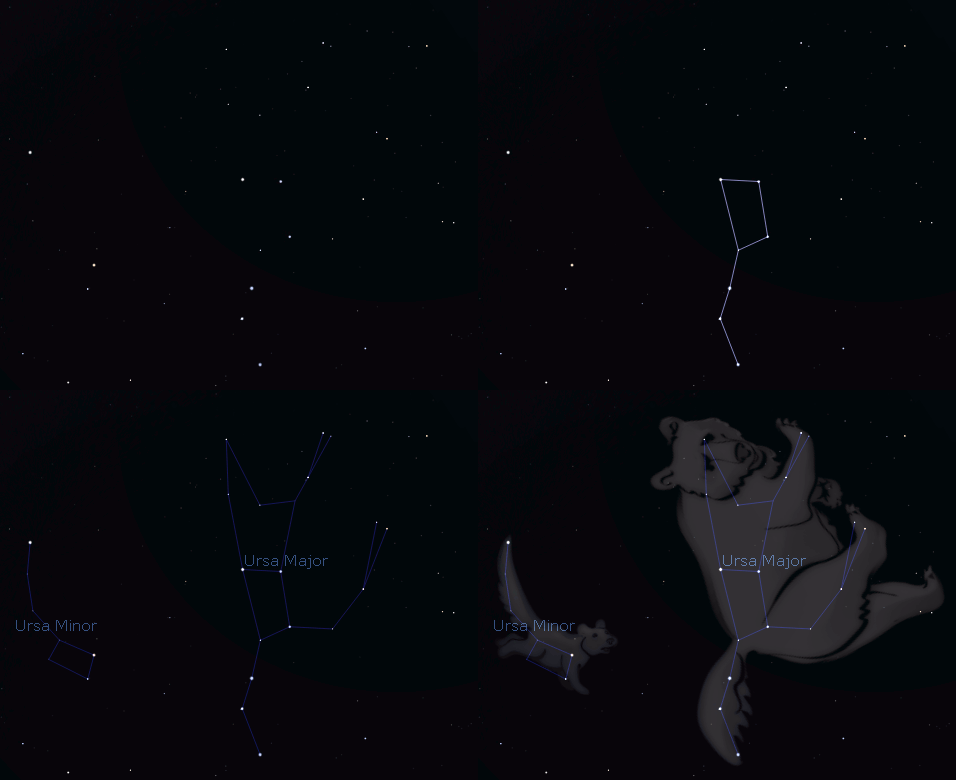
The Great Bear (Ursa Major) finder animation. It shows the stars only, then the Big Dipper, Then the lines of the constellations Ursa Major and Ursa Minor (Lesser Bear and Little Dipper) as a bonus, and finally the constellation artwork. The orientation is for about 9:30 pm on the latter days of March. We are looking high in the northeast. In Northern Michigan, the bear’s front paw is near the zenith at that time. Created using Stellarium and GIMP.
03/25/2022 – Ephemeris – Over the weekend there will be the continued gathering of morning planets
This is Bob Moler with Ephemeris for Friday, March 25th. Today the Sun will be up for 12 hours and 25 minutes, setting at 8:01, and it will rise tomorrow at 7:34. The Moon, at last quarter today, will rise at 4:56 tomorrow morning.
Over the weekend there will be the continued gathering of morning planets, Venus, Mars and Saturn, culminating on Monday morning when the waning crescent Moon will join the group by slipping beneath them. During the three day period between Saturday and Monday mornings at a specific time, like 6:45 am, about 45 minutes before sunrise, these planets will be in the east southeast and quite low in the sky. A low horizon in that direction will help, especially when the Moon joins the group, because it will be lower than the three planets. Over the weekend Venus and Mars will keep their separation with Mars to the right and a bit below Venus. Saturn will scoot below Venus, moving to the right. The Moon will move below the group Monday morning.
The astronomical event times given are for the Traverse City/Interlochen area of Michigan (EDT, UT – 4 hours). They may be different for your location.
Addendum
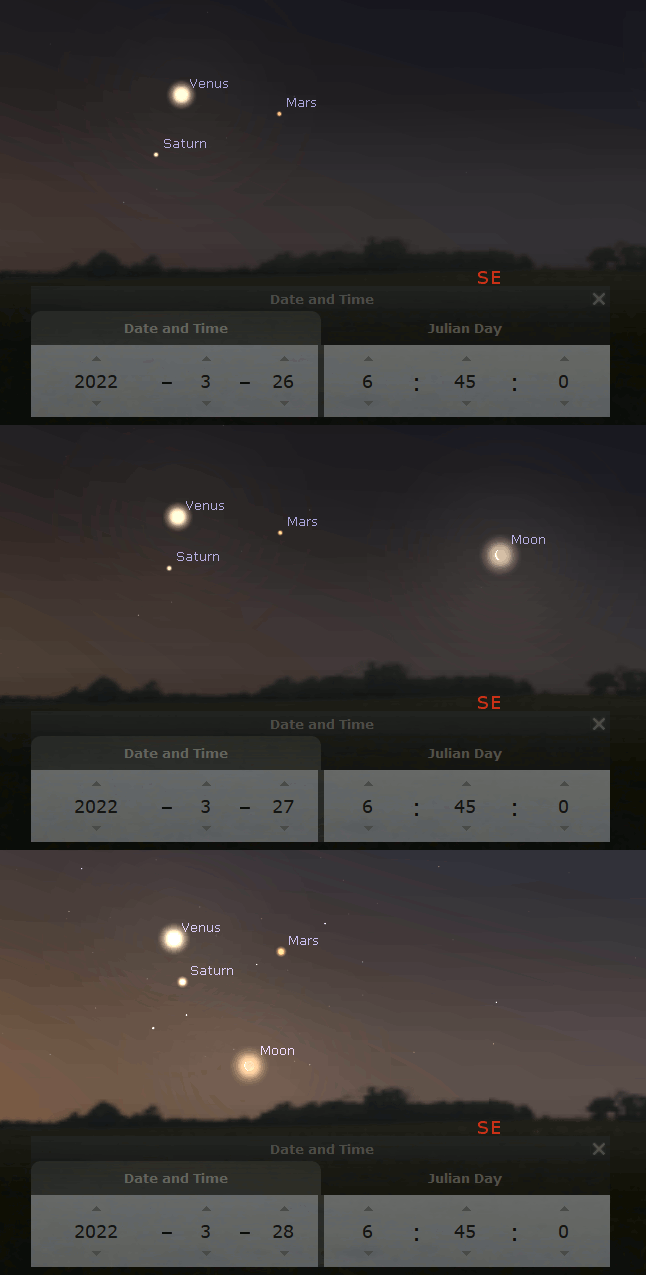
The grouping of Venus, Mars, Saturn and the Moon which will develop over the mornings of Saturday, March 26th through Monday, March 28, 2022. Created using Stellarium and GIMP.
03/24/2022 – Ephemeris – A native constellation that’s a warning
This is Bob Moler with Ephemeris for Thursday, March 24th. Today the Sun will be up for 12 hours and 22 minutes, setting at 8:00, and it will rise tomorrow at 7:36. The Moon, 1 day before last quarter, will rise at 3:59 tomorrow morning.
The Anishinaabe peoples of the Great Lakes Region, which include the Ottawa and Chippewa Indians, have several constellations of spring. The first of them is Curly Tail, or the Great Underwater Panther, who lurks under the ice in lakes. It uses the stars of Leo the lion’s backward question mark, in the southeast at 9:30 in the evening, as its curved tail and the small knot of stars that are the head of Hydra the water snake as its head. The head of Hydra is below the constellation of Cancer, and in the south-southwest and to the right of the backwards question mark of Leo. The warning he gives is to keep off the thinning ice or break through and be snatched by the great panther that lives below.
The astronomical event times given are for the Traverse City/Interlochen area of Michigan (EDT, UT – 4 hours). They may be different for your location.
Addendum
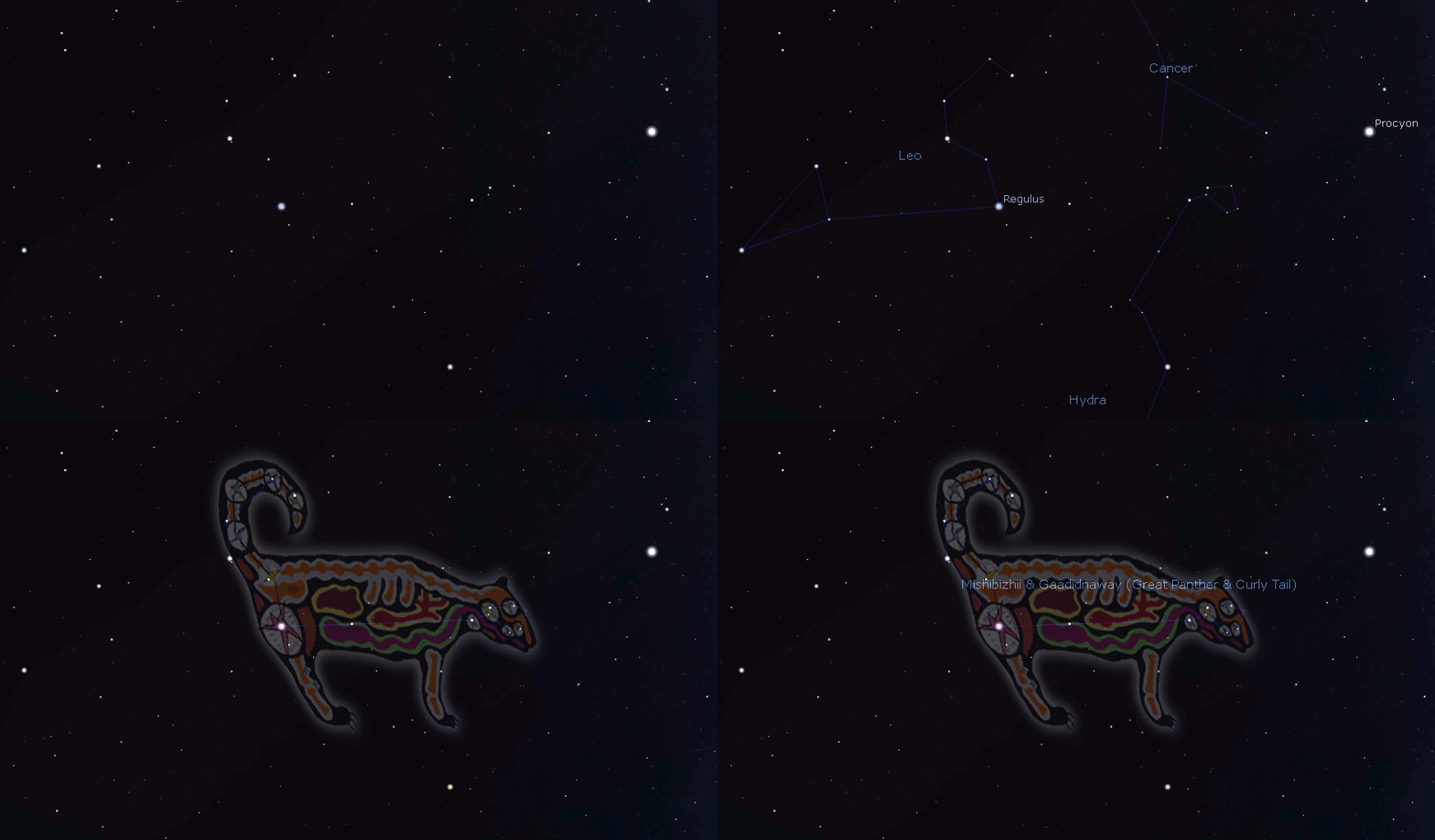
An animation showing the stars centered in the southeastern skies, the “official” constellations and the Anishinaabe constellation of Curly Tail and the Great (Underwater) Panther. Approximate time is 9:30 pm March 24th. Click on the image to enlarge. Created using Stellarium and GIMP.
03/23/2022 – Ephemeris – The search for the naked-eye planets moves to the morning sky
This is Bob Moler with Ephemeris for Wednesday, March 23rd. Today the Sun will be up for 12 hours and 18 minutes, setting at 7:59, and it will rise tomorrow at 7:38. The Moon, 2 days before last quarter, will rise at 2:50 tomorrow morning.
Let’s search for the naked-eye planets for this week. There are no bright planets in the evening sky. The planet action shifts to the morning sky. All five naked-eye planets are there, though Jupiter and Mercury are too close to the Sun to be seen. Late winter and early spring mornings aren’t the best for spotting planets close to the Sun, since they tend to lie low in the southeastern sky. Venus will rise at 5:46 tomorrow morning, Mars will rise at 5:51, and Saturn will rise at 6:10. By 7 am, they will be low in the southeast with much dimmer Mars at the 4 o’clock position below Venus, with Saturn lower, and at between the 7 and 8 o’clock position. Jupiter is just rising at that time.
The astronomical event times given are for the Traverse City/Interlochen area of Michigan (EDT, UT – 4 hours). They may be different for your location.
Addendum
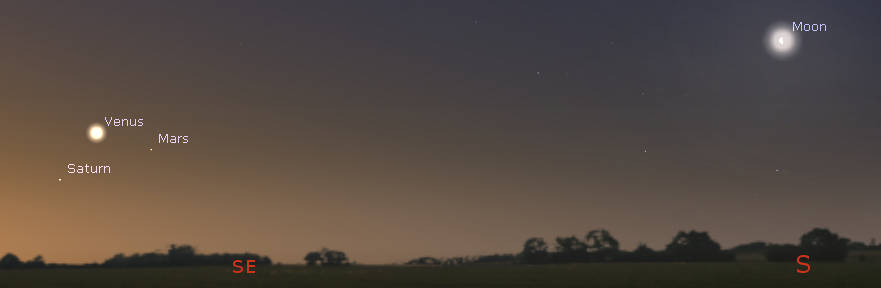
Morning planets and Moon at 7 am tomorrow morning, March 24, 2022. At that time Mars and Saturn may require binoculars to spot, however a quarter or a half an hour earlier they should be visible to the naked-eye.
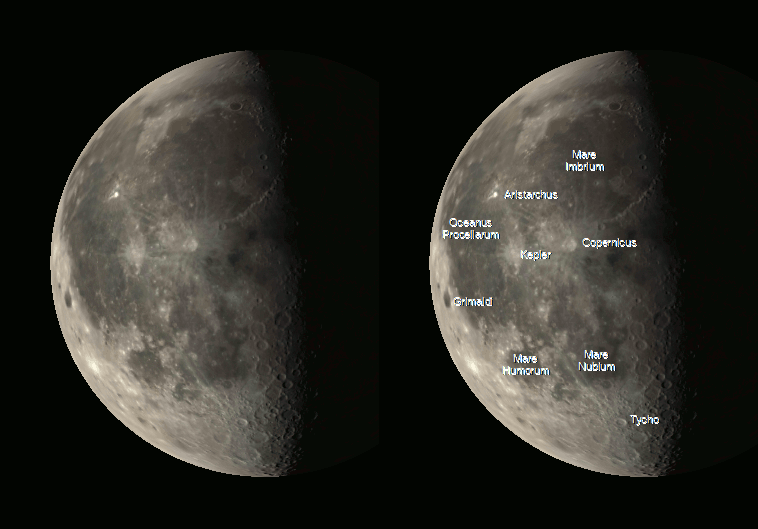
Waning gibbous Moon with animated labels. The Moon as it might appear in binoculars or a small telescope, with prominent lunar seas and craters labeled. I’ve retained the sea’s Latin names. Click on the image to enlarge it. Created using Stellarium, GIMP and LibreOffice.
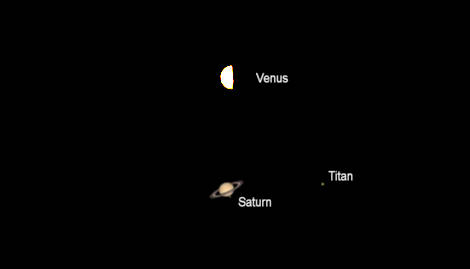
Telescopic views of the Venus and Saturn (north up) as they would be seen in a small telescope, with the same magnification, tomorrow morning at 7 am, March 24, 2022. I do not show planets less than 10 seconds of arc in diameter. Apparent diameters: Venus 23.52″, 51.6% illuminated; Saturn 15.66″, its rings 36.47″. Mars is not shown, its apparent diameter is 5.06″ and is 92.3% illuminated. The ” symbol means seconds of arc (1/3600th of a degree.) Created using Cartes du Ciel (Sky Charts).
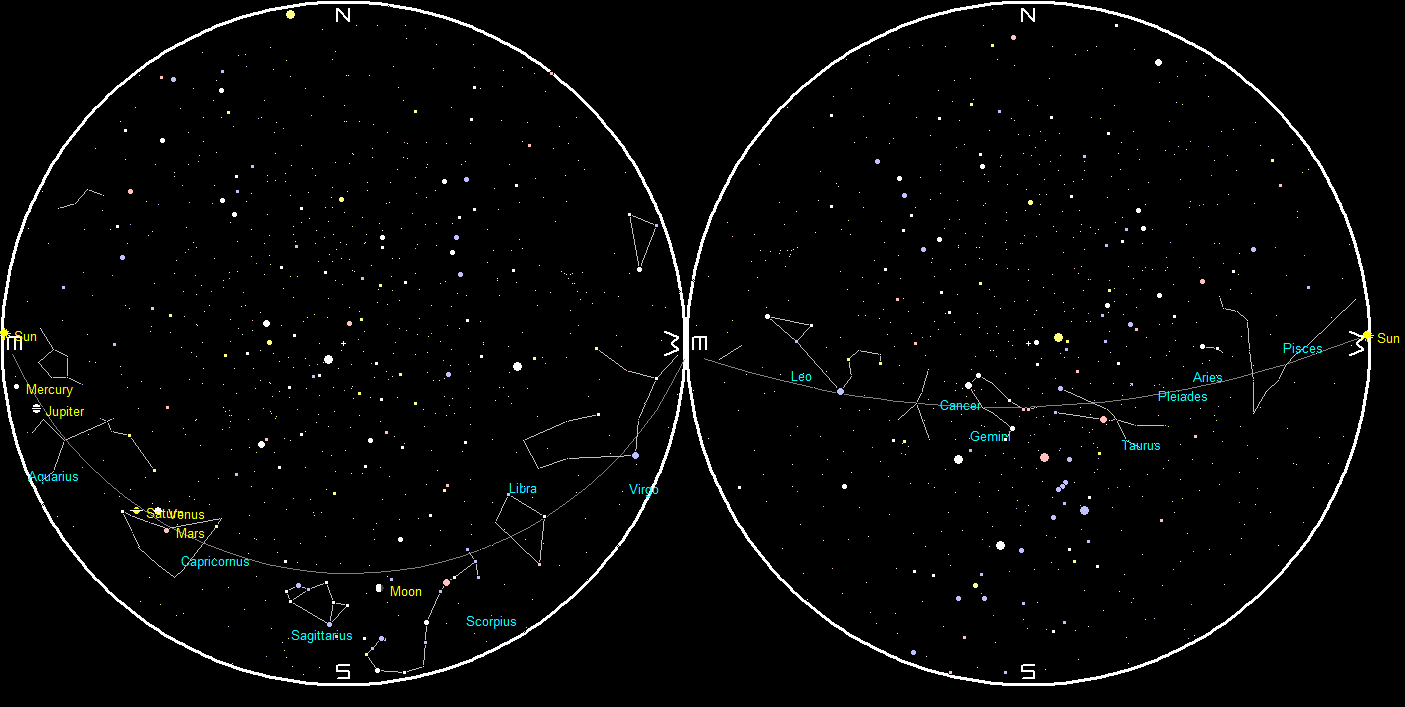
The naked-eye planets and the Moon at sunset and sunrise on a single night, starting with sunset on the right on March 23, 2022. The night ends on the left with sunrise on the 24th. Notice that all the naked-eye planets and the Moon are in the morning sky now. The labels for Saturn and Venus overlap. Click on the image to enlarge it. Created using my LookingUp program.
03/22/2022 – Ephemeris – James Webb Space Telescope has aligned its 18 segment mirror to act as one
This is Ephemeris for Tuesday, March 22nd. Today the Sun will be up for 12 hours and 15 minutes, setting at 7:57, and it will rise tomorrow at 7:40. The Moon, 3 days before last quarter, will rise at 1:34 tomorrow morning.
Last week, NASA and the Space Telescope Science Institute (STScI) released a photograph of the star they had been using to align the mirrors of the James Webb Space Telescope. What started a couple of months ago as a scattering of in and out of focus images of that star, are now coalesced into a single image. The six spikes on the very overexposed star are called diffraction spikes, caused by the straight edges of the hexagonal mirrors. The other objects in the field are distant galaxies. So even this calibration image appears to meet or exceed expectations. There is more work to be done in getting the other three instruments that will receive light from the telescope aligned and calibrated. We’re probably two months away from the first scientific image.
The astronomical event times given are for the Traverse City/Interlochen area of Michigan (EDT, UT – 4 hours). They may be different for your location.
Addendum
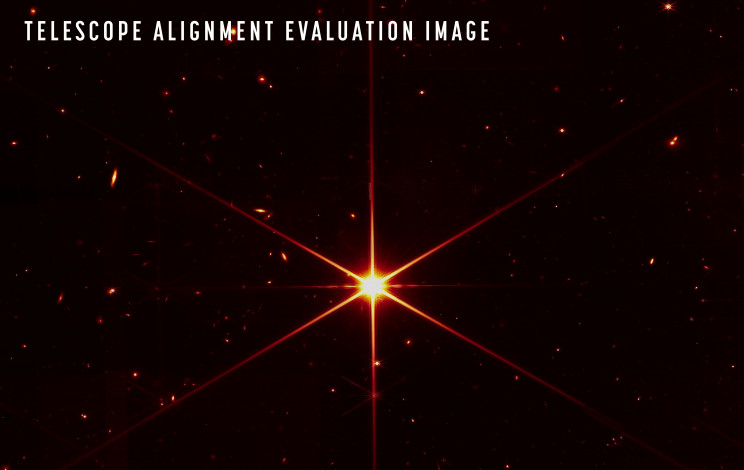
The alignment image of the James Webb Space Telescope after the 18 primary mirror segments have been aligned to act as a single mirror. Beside the alignment star showing its overexposed diffraction spikes, many faint galaxies can be seen. The alignment star, near the Big Dipper, is almost too faint to be seen in binoculars. Credit: NASA, Space Telescope Science Institute (STScI).
03/21/2022 – Ephemeris – Finding the celestial lion
This is Ephemeris for Monday, March 21st. Today the Sun will be up for 12 hours and 12 minutes, setting at 7:56, and it will rise tomorrow at 7:42. The Moon, 3 days past full, will rise at 12:15 tomorrow morning.
At 10 p.m. the spring constellation of Leo the lion will be fairly high in the southeast. It can be found by locating the Big Dipper high in the northeast and imagining that a hole were drilled in the bowl to let the water leak out. It would drip on the back of this giant cat. The Lion is standing or lying facing westward. His head and mane are seen in the stars as a backwards question mark. This group of stars is also called the Sickle. The bright star Regulus is at the bottom, the dot at the bottom of the question mark. A triangle of stars, to the left of Regulus, is the lion’s haunches. Leo contains some nice galaxies visible in moderate sized telescopes. The stars in Leo’s part of the sky are fewer than those in the winter sky.
The astronomical event times given are for the Traverse City/Interlochen area of Michigan (EDT, UT – 4 hours). They may be different for your location.
Addendum
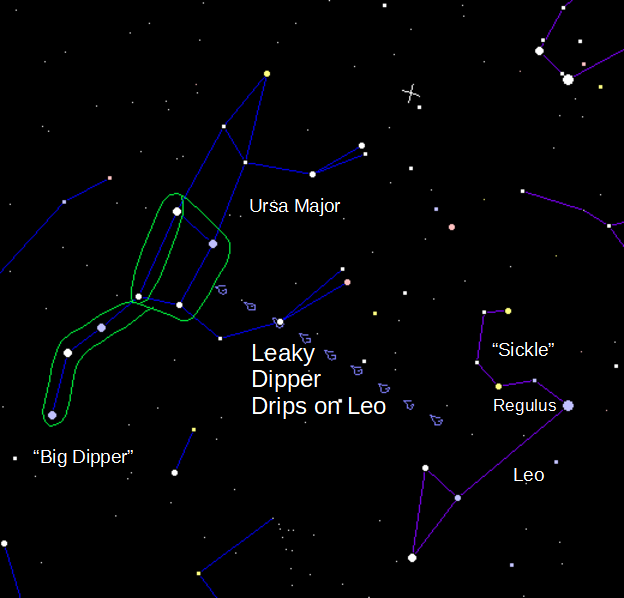
Leaky Big Dipper drips on Leo. The positions in the sky are for 10 pm local time, or about 2 hours after sunset. The little distorted cross at the top of the image marks the zenith. Look high in the east and southeast to see these stars. Created using my LookingUp program, GIMP and LibreOffice.
 Bob Moler's Ephemeris Blog