Archive
03/18/2022 – Ephemeris – Spring is two days away!
This is Ephemeris for Friday, March 18th. Today the Sun will be up for 12 hours and 3 minutes, setting at 7:52, and it will rise tomorrow at 7:47. The Moon, at full today, will rise at 8:28 this evening.
Sunday morning March 20th, at 11:33 am the Sun will cross overhead at the earth’s equator as it appears to head north, starting for us, the season of spring. It will be the vernal equinox. As you can tell from my intro, we’re already above 12 hours of daylight, and we’ll add another 3 plus hours of daylight before summer begins in three months. We are already adding about 3 minutes a day of daylight to that goal now, the maximum rate. With the Sun out longer and its ascension higher in the sky each day, it is rapidly adding energy to the Northern Hemisphere. We won’t feel that immediately. While the land rapidly absorbs heat, the oceans and lakes, especially the Great Lakes, are big heat sinks, taking much longer to warm up.
The astronomical event times given are for the Traverse City/Interlochen area of Michigan (EDT, UT – 4 hours). They may be different for your location.
Addendum
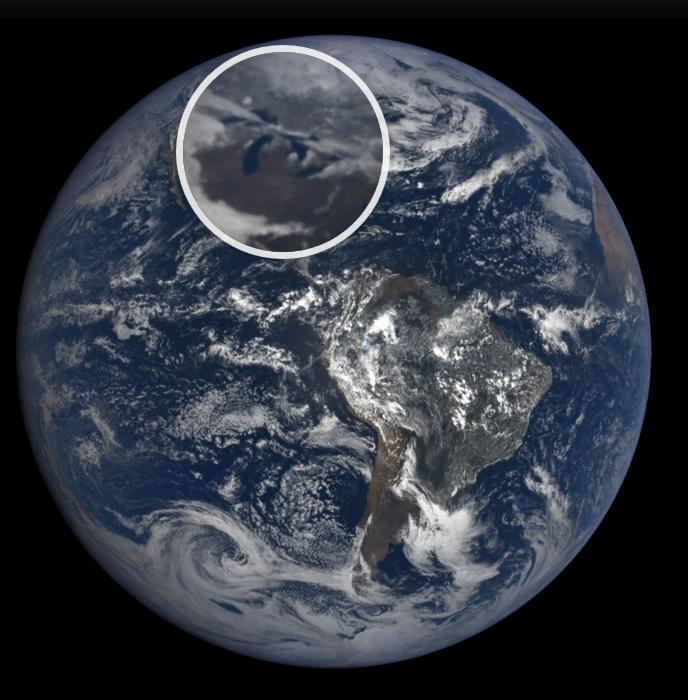
The Earth from 2 days before the vernal equinox 2018, with the North Pole not quite in sunlight. I’ve added a magnifying spot showing Michigan. It was a rare clear day when this image was taken. Credit NOAA/DSCOVR satellite/EPIC camera. The DSCOVR satellite is located in a halo orbit around the Sun-Earth Lagrange L1 point nearly a million miles sunward of the Earth.
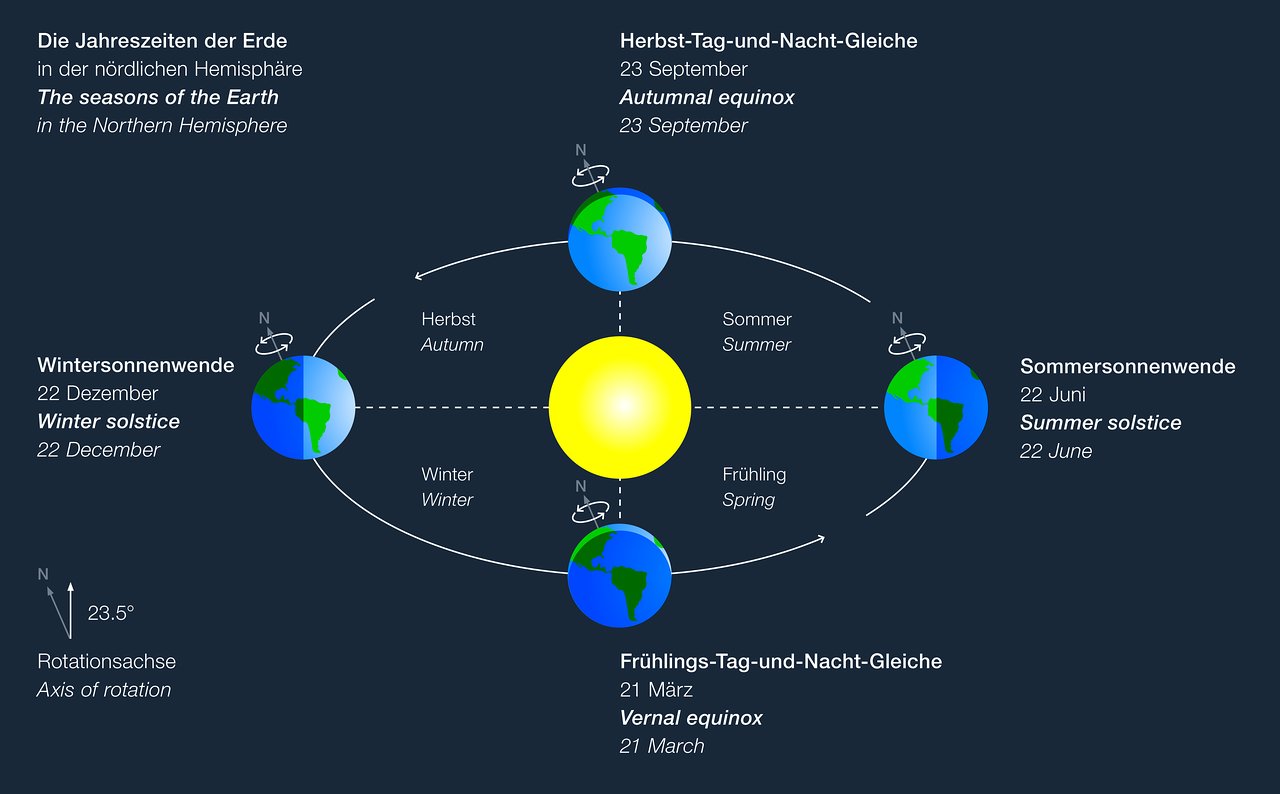
Earth’s position at the solstices and equinoxes. This is a not to scale oblique look at the Earth’s orbit, which is nearly circular. The Earth is actually farthest from the Sun on July 4th. The dates for the equinoxes and solstices are shown one day later than it is actually. Click on the image to enlarge. Credit: ESO (European Southern Observatory), which explains the captions in German and English.
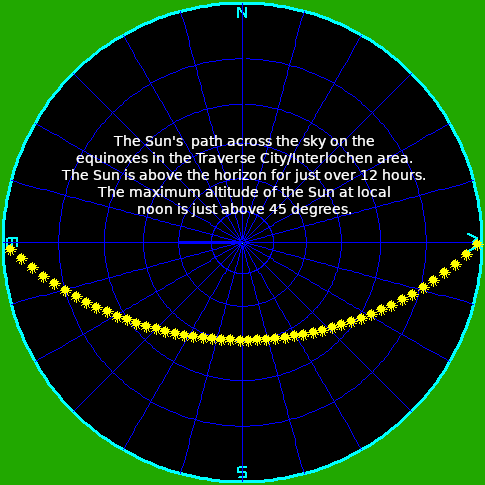
The Sun’s path through the sky on an equinox day from the Traverse City/Interlochen area in Michigan. The Sun is plotted every 15 minutes. This is a stereographic projection which compresses the image near the zenith and enlarges the image towards the horizon. Created using my LookingUp program.
03/17/2022 – Ephemeris – We have 12 hours of daylight and night today, three days early
This is Ephemeris for St. Patrick’s Day, Thursday, March 17th. Today the Sun will be up for 12 hours even, setting at 7:51, and it will rise tomorrow at 7:49. The Moon, 1 day before full, will set at 8:20 tomorrow morning.
Why is this the day of equal day and night, when the vernal equinox, which means “equal night” is still three days away? The difference is due to our atmosphere and our definition of sunrise and sunset. Our atmosphere makes objects near the horizon appear higher than they actually are, which hastens sunrise and retards sunset. Also, the instant of sunrise and sunset is when the top of the sun appears to touch the horizon, rather than when the Sun bisects the horizon. Plus, it’s moving about a degree a day (twice its diameter) against the stars. So by the time of the equinox, on Sunday the 20th, the time between sunrise and sunset will have progressed to 12 hours and 9 minutes. But it was close enough for the ancients who coined the term.
The astronomical event times given are for the Traverse City/Interlochen area of Michigan (EDT, UT – 4 hours). They may be different for your location.
Addendum
This works for the Interlochen area. It may be a different by a day for other locations, but for the northern latitudes, it will be before the true equinox day, March 20th here.
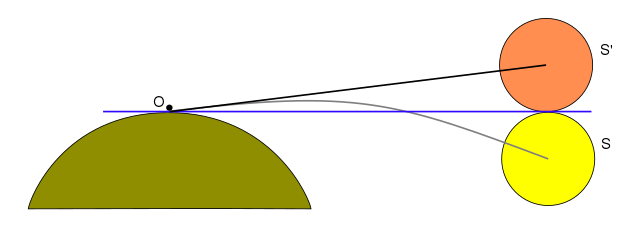
How the atmosphere bends the light of the Sun or Moon rising or setting to appear higher than it actually is. S is the actual position of the Sun, S’ is the apparent position of the Sun. The blue line is the observer O’s horizon. The gray line is the actual, though much exaggerated, light path bent or refracted by the Earth’s atmosphere. The black line is the apparent sight line to the Sun. Credit Francisco Javier Blanco González, 2017
03/16/2022 – Ephemeris – Let’s search for the naked-eye planets for this week
This is Ephemeris for Wednesday, March 16th. Today the Sun will be up for 11 hours and 57 minutes, setting at 7:50, and it will rise tomorrow at 7:51. The Moon, 2 days before full, will set at 7:59 tomorrow morning.
Let’s search for the naked-eye planets for this week. There are no bright planets in the evening sky. Jupiter, the last to leave, will stay too close to the direction of the Sun to be visible in the morning sky for at least a month. So that’s where the action shifts to. Jupiter joins Mercury, Saturn, Venus and Mars. Late winter and early spring mornings aren’t the best for spotting planets close to the Sun, since they tend to lie low in the southeastern sky. Venus will rise at 5:51 tomorrow morning and Mars will rise at 6:04. Saturn will rise at 6:40. By 7:15, they will be low in the southeast with much dimmer Mars at the 5 o’clock position below Venus, with Saturn much lower at the 8 o’clock position.
The astronomical event times given are for the Traverse City/Interlochen area of Michigan (EDT, UT – 4 hours). They may be different for your location.
Addendum
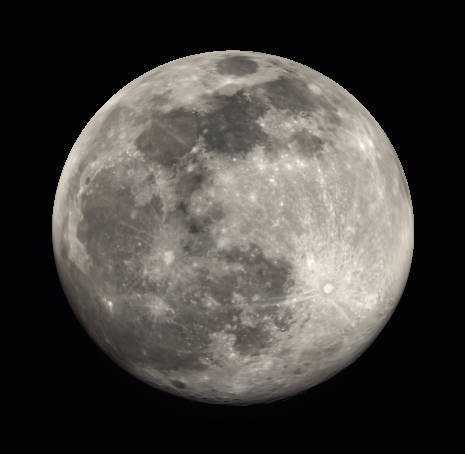
The Moon 2 days before full as it might appear in binoculars or small telescope, tonight, at 9 pm, March 16, 2022. Created using Stellarium.
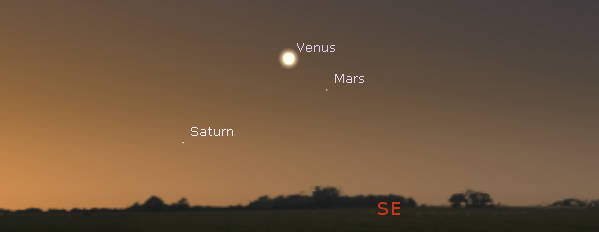
Morning planets Venus, Saturn and Mars at 7:15 am, or about 36 minutes before sunrise tomorrow, March 17, 2022. Binoculars may help in spotting Mars and Saturn. Over the week, these planets will continue to move away from the rising Sun. Well, all except Venus which will reach its greatest elongation, meaning separation from the Sun on Sunday, before beginning to slip back toward the Sun. Created using Stellarium.
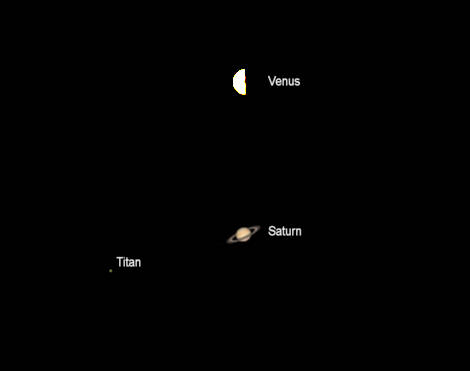
Telescopic views of the Venus and Saturn (north up) as they would be seen in a small telescope, with the same magnification, tomorrow morning at 7 15 am, March 17, 2022. I do not show planets less than 10 seconds of arc in diameter. Apparent diameters: Venus 25.49″, 48.0% illuminated; Saturn 15.55″, its rings 36.22″. Mars is not shown, its apparent diameter is 4.94″ and is 92.8% illuminated. The ” symbol means seconds of arc (1/3600th of a degree.) Created using Cartes du Ciel (Sky Charts).
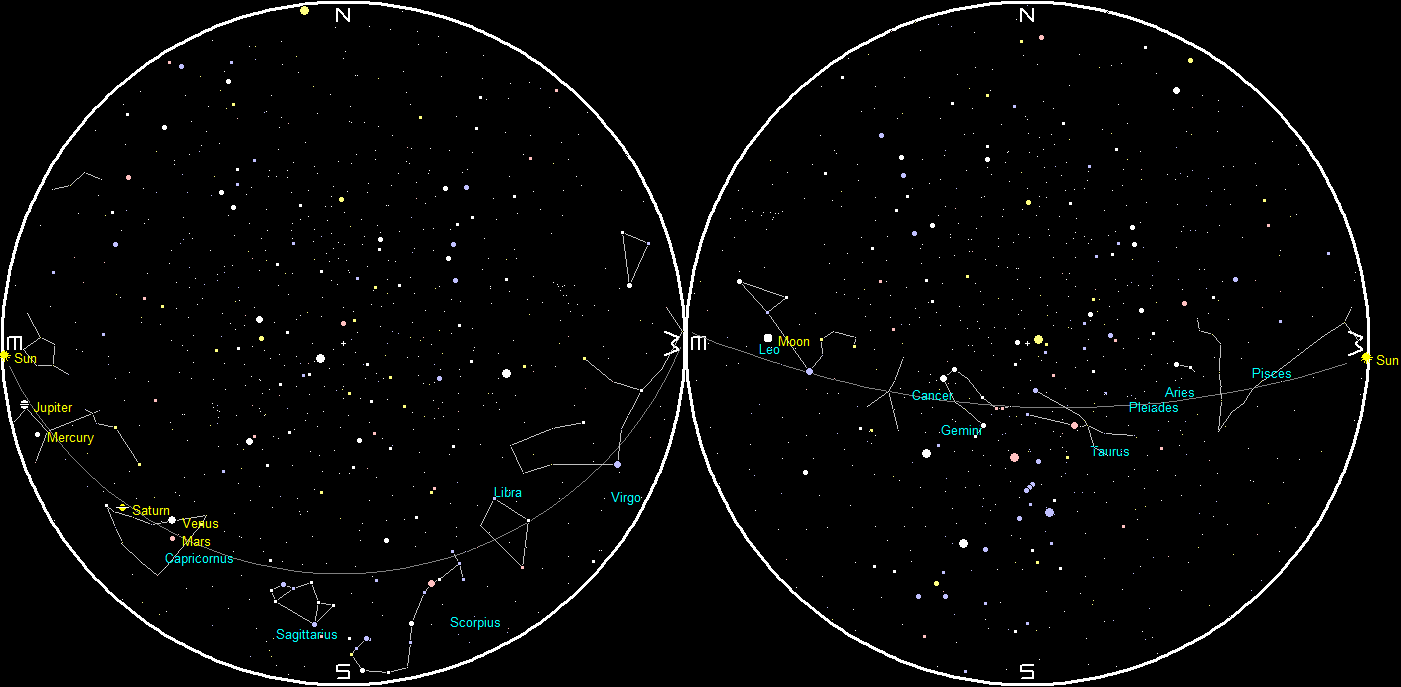
The naked-eye planets and the Moon at sunset and sunrise on a single night, starting with sunset on the right on March 16, 2022. The night ends on the left with sunrise on the 17th. Notice that all the naked-eye planets are in the morning sky now, with the Moon still hanging out in the evening sky. Click on the image to enlarge it. Created using my LookingUp program.
03/15/2022 – Ephemeris – The Ides of March and our calendar
This is Ephemeris for Ides of March, Tuesday, March 15th. Today the Sun will be up for 11 hours and 53 minutes, setting at 7:49, and it will rise tomorrow at 7:53. The Moon, 3 days before full, will set at 7:36 tomorrow morning.
The first day of spring is the vernal equinox, which occurs in our time zone on March 20th. The Ides of March, the 15th, is pretty close to the vernal equinox and was the start of the year for a time with the Romans. It was the date in 44 BC that Julius Caesar was assassinated. March, named after the god Mars, was also for a long time the first month of the year, even to the point of starting the year on the Ides of March. They, for a time, had 10 months in their year, and consigned the winter months to sixty nondescript days. Later, they added January and February in front of March, which is why our 9th through 12th months are named September the 7th to December the 10th month.
The astronomical event times given are for the Traverse City/Interlochen area of Michigan (EDT, UT – 4 hours). They may be different for your location.
03/14/2022 – Ephemeris – It’s Pi Day!
This is Ephemeris for Pi Day, Monday, March 14th. Today the Sun will be up for 11 hours and 50 minutes, setting at 7:47, and it will rise tomorrow at 7:55. The Moon, 4 days before full, will set at 7:10 tomorrow morning.
Mathematicians and scientists, both professional and amateur, celebrate Pi day to bake and eat pies. Actually, the Pi we’re talking about is the Greek letter π that signifies the ratio of the circumference of a circle to its diameter. March 14th can be written 3.14, π to two decimal places. Of course, if you wait until 4 pm to have your pie, you can have π to 4 decimal places, since 4 pm is the 16th hour of the day in military time. This gives 3.1416. The digits go on forever, never repeating a pattern. Some mathematicians prefer Tau Day, June 28th or 2 times π which is the more useful mathematical ratio of the circumference of a circle to its radius, which is 6.28 or 6.2832. However you slice it, π is a very useful number.
The astronomical event times given are for the Traverse City/Interlochen area of Michigan (EDT, UT – 4 hours). They may be different for your location.
Addendum

Here’s a link to NASA’s Pi Day Challenge: https://www.jpl.nasa.gov/edu/nasapidaychallenge/. The link also has a link for educators for STEM related challenges.
Since recording this program, I learned about another Pi day some celebrate. A well-known approximation of pi is the fraction 22/7ths. Europeans and others write dates in day/month order, so July 22nd is also a Pi Day: 22/7.
03/11/2022 – Ephemeris – Looking at the northern part of the Moon and the crater Plato
This is Ephemeris for Friday, March 11th. Today the Sun will be up for 11 hours and 41 minutes, setting at 6:43, and it will rise tomorrow at 7:00. The Moon, 1 day past first quarter, will set at 4:18 tomorrow morning.
As the Moon moves around the Earth, now one day past first quarter, more of it is revealed in sunlight. The top or north part of the moon is of interest now. The second-largest lunar sea, Mare Imbrium, or Sea of Showers, is now half illuminated by the advancing terminator, the sunrise line. That can be seen with the naked eye. With binoculars, in the mountains north or above Imbrium can be found the flat floored crater or walled plain called Plato. This crater is situated in the lunar Alps. Mountains on the Moon are named after their earthly counterparts. Visible in telescopes now will be the Alpine Valley cutting through the Alps just to the right of Plato. Each night from new to full, more of the Moon’s features are revealed near the terminator.
The astronomical event times given are for the Traverse City/Interlochen area of Michigan (EST, UT – 5 hours). They may be different for your location.
Addendum
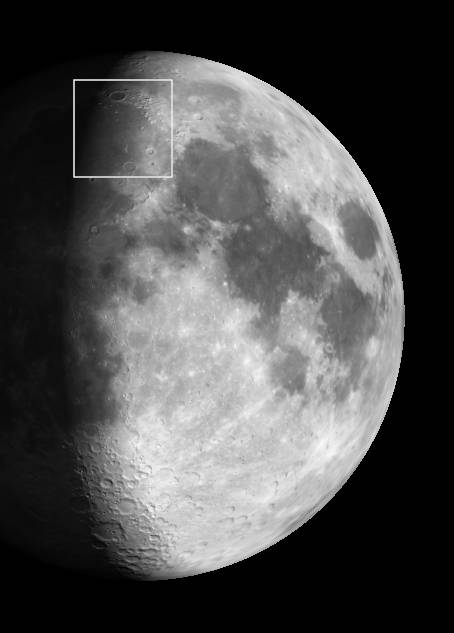
The Moon tonight, a day past first quarter, March 11, 2022, outlining the Mare Imbrium, crater Plato area, which is seen in detail below. Created using Virtual Lunar Atlas.
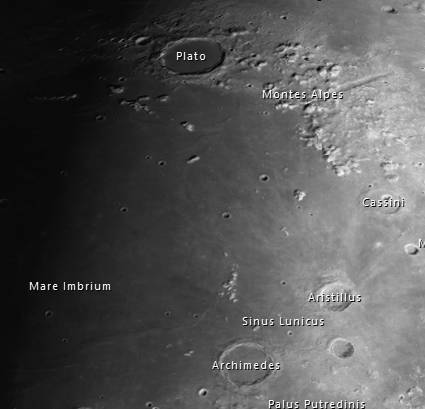
The Moon tonight, March 11, 2022, highlighting the crater Plato and lunar Alps. The Alpine Valley (Vallis Alpes), lies under the caption “Alpes” for the mountains. One of cool things to watch when the terminator is situated just right is to watch the shadows of the mountains retreat across Plato’s crater floor as the Sun rises. The shadows of the peaks appear very jagged as they retreat. Created using Virtual Lunar Atlas.
03/10/2022 – Ephemeris – Viewing the Moon at first quarter tonight
This is Ephemeris for Thursday, March 10th. Today the Sun will be up for 11 hours and 38 minutes, setting at 6:42, and it will rise tomorrow at 7:02. The Moon, at first quarter today, will set at 3:26 tomorrow morning.
By the time we spot the moon this evening, it will be over half a day from being exactly first quarter phase. Looking at the brighter part of the Moon in binoculars, which is at the bottom or south end. We are looking at the lunar highlands of mostly very old craters that extend back to the formation of the Moon, nearly 4.5 billion years ago, that weren’t obliterated by the asteroid strikes that created the darker maria or lunar seas half a billion years later. In small telescopes there is a vertical line of three large craters whose names, from largest to smallest and top down, are Ptolemaeus, Alphonsus, and Arzachel. Alphonsus is a curious crater. In 1958 a Soviet astronomer recorded a possible volcanic eruption or outgassing from the crater floor.
The astronomical event times given are for the Traverse City/Interlochen area of Michigan (EST, UT – 5 hours). They may be different for your location.
Addendum
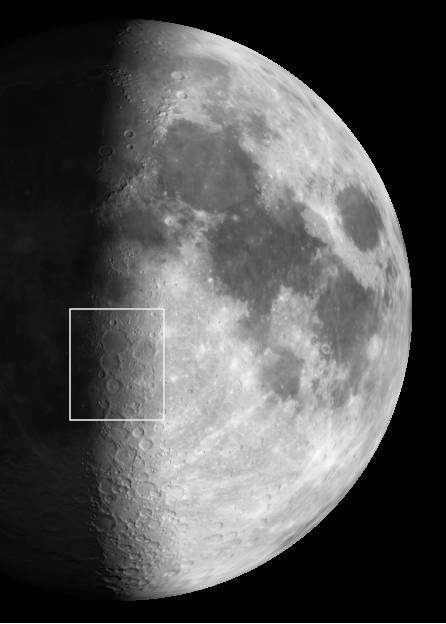
Lunar craters Ptolemaeus, Alphonsus and Arzachel outlined on the Moon’s disk, at first quarter, at 8 pm, March 10, 2022. Created using Virtual Moon Atlas.
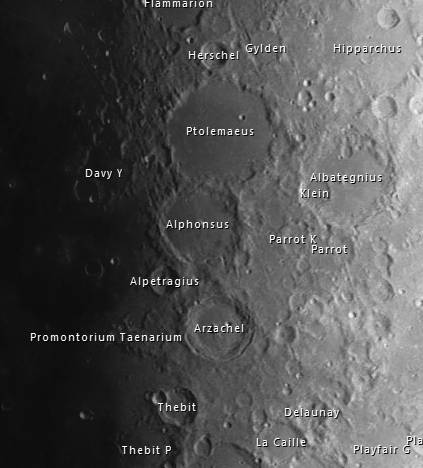
Closeup of lunar craters Ptolemaeus, Alphonsus and Arzachel, with other nearby craters, outlined above. Created using Virtual Moon Atlas.
03/09/2022 – Ephemeris – Let’s search for the naked-eye planets for this week
This is Ephemeris for Wednesday, March 9th. Today the Sun will be up for 11 hours and 35 minutes, setting at 6:41, and it will rise tomorrow at 7:04. The Moon, 1 day before first quarter, will set at 2:28 tomorrow morning.
Let’s search for the naked-eye planets for this week. There are no bright planets in the evening sky. Jupiter, the last to leave, will stay too close to the direction of the Sun to be visible in the morning sky for at least a month. So that’s where the action shifts. Jupiter joins Mercury, Saturn, Venus and Mars. Late winter and early spring mornings aren’t the best for spotting planets close to the Sun, since they tend to lie low in the southeastern sky. Saturn and Mercury are also too close to the direction of the Sun to be spotted now. Venus will rise at 4:55 tomorrow morning and Mars will rise at 5:16. By 6:15, they will be low in the southeast, with much dimmer Mars at the 5 o’clock position below Venus.
The astronomical event times given are for the Traverse City/Interlochen area of Michigan (EST, UT – 5 hours). They may be different for your location.
Addendum
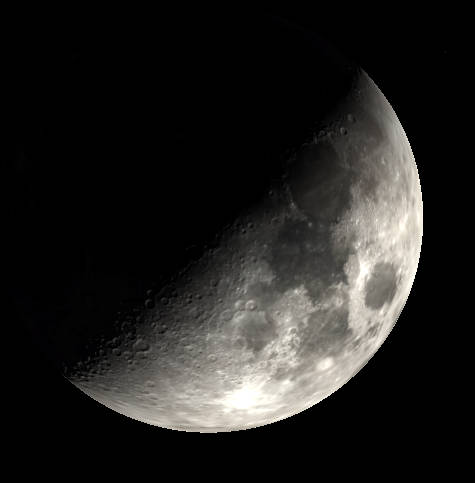
The waxing crescent Moon at 8 pm or an hour or so after sunset tonight, March 9, 2022. It is shown as it might be seen in binoculars or a small telescope. Created using Stellarium.
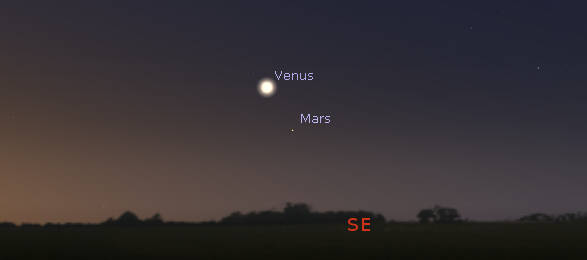
Morning planets Venus and Mars at 6:15 am, or about 45 minutes before sunrise tomorrow, March 10, 2022. Created using Stellarium.
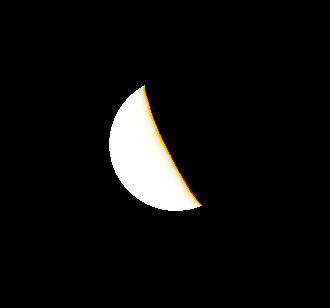
Venus through a telescope as it would appear before sunrise tomorrow morning, March 10, 2022. It’s shown larger than usual, since it’s the only planet that looks like anything in a small telescope now. Its apparent diameter is 27.78″, and it is 44.0% illuminated by the Sun. Mars has an apparent diameter of 4.83″, and is slightly gibbous at 93.3% illuminated. (” means seconds of arc. 1″ is 1/3600th of a degree). Created using Stellarium, which is also the source for the apparent diameters and the illuminated fraction of Venus and Mars.
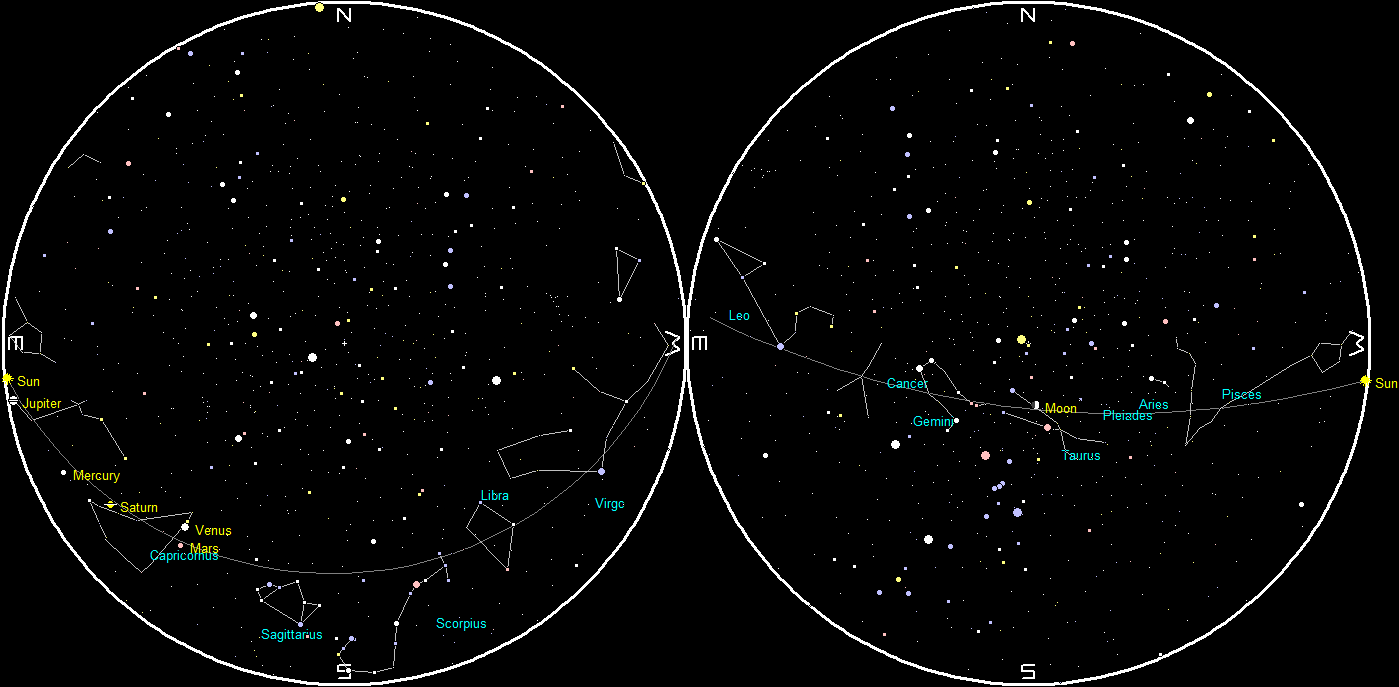
The naked-eye planets and the Moon at sunset and sunrise on a single night, starting with sunset on the right on March 9, 2022. The night ends on the left with sunrise on the 10th. Notice that all the naked-eye planets are in the morning sky now. Click on the image to enlarge it. Created using my LookingUp program.
03/08/2022 – Ephemeris – International Women’s Day
This is Ephemeris for International Women’s Day, Tuesday, March 8th. Today the Sun will be up for 11 hours and 32 minutes, setting at 6:39, and it will rise tomorrow at 7:06. The Moon, 2 days before first quarter, will set at 1:25 tomorrow morning.
The planet Venus is the only major planet named after a goddess. Satellites of the planets are named after both male and female deities. When asteroids were discovered between Mars and Jupiter they began to receive female deity names, however errant asteroids that that came close to the Earth’s orbit received male names. Venus, named after the Roman goddess of love, by convention, has female names for its land forms. But before that convention was adopted the first bright radar feature found on Venus, in 1967, was Maxwell Montes, named after James Clerk Maxwell whose work in the 19th century predicted radio waves. It is by reflected radio waves (radar) by which that feature had been found using the Arecibo radio telescope.
The astronomical event times given are for the Traverse City/Interlochen area of Michigan (EST, UT – 5 hours). They may be different for your location.
Addendum
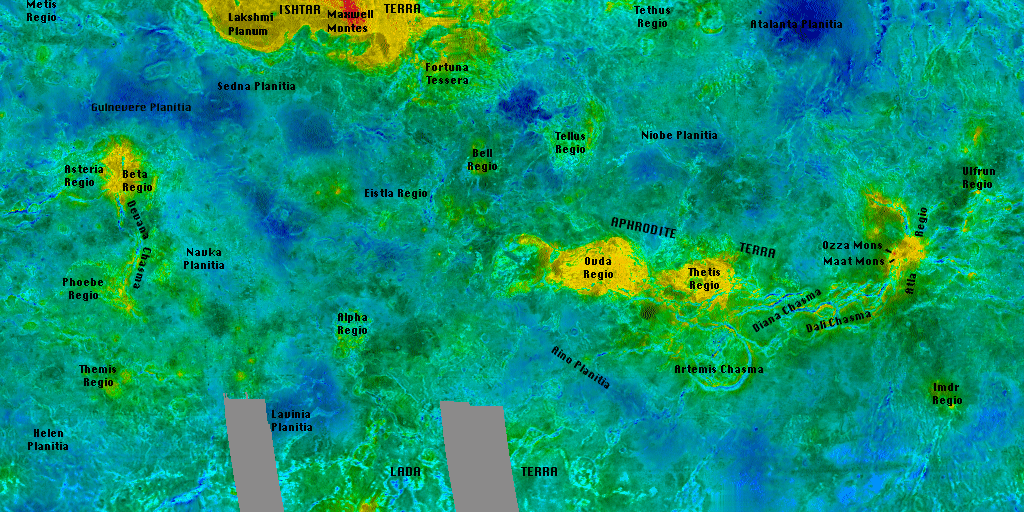
Radar map of Venus produced by the radar altimeter of the Pioneer Venus Orbiter, 1978-1992. Note Maxwell Montes at the top, part of Ishtar Terra, a continent-like land mass. Another large land mass is Aphrodite Terra in the center right. Click on the image to enlarge it. Credit: NASA.
03/07/2022 – Ephemeris – The Fisher announces the beginning of the Maple sugaring season
This is Ephemeris for Monday, March 7th. Today the Sun will be up for 11 hours and 28 minutes, setting at 6:38, and it will rise tomorrow at 7:07. The Moon, 3 days before first quarter, will set at 12:19 tomorrow morning.
March is a month of transitions. The stars of the winter skies, that is Orion and his merry band of bright stars, move to the west as those of spring rise in the east. The Big Dipper is ascending in the northeastern sky, after lying low in the north during the long dark evenings in the heart of winter. The dipper is the hind end of the Great Bear, officially Ursa Major. The Anishinaabe peoples of the Great Lakes region saw the Big Dipper as the hind end and tail of a magical creature called Fisher, or in their language Ojiig, who brought summer to the Earth. Its position in the sky around the pole announces the seasons. The Fisher’s ascension high into the northeastern sky signals this month’s maple sugaring season.
The astronomical event times given are for the Traverse City/Interlochen area of Michigan (EST, UT – 5 hours). They may be different for your location.
Addendum
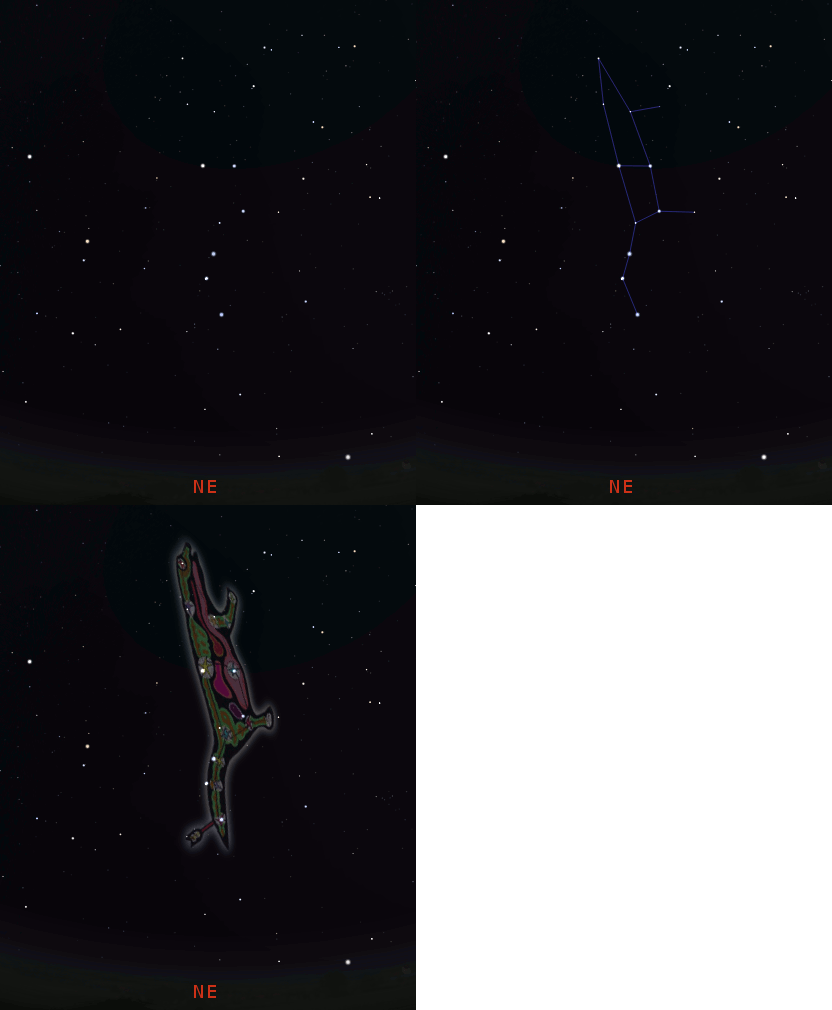
The Fisher announcing maple sugaring season – animation. Star positions for about 2 hours after sunset, near 45 degrees north latitude, for a week into March. Created using Stellarium and GIMP.
For the story of how the Fisher brought summer to the earth, and why he’s got an arrow sticking into his tail, click here.
 Bob Moler's Ephemeris Blog