Archive
Ephemeris: 11/30/2023 – Previewing December skies
This is Ephemeris for Thursday, November 30th. Today the Sun will be up for 9 hours and 5 minutes, setting at 5:04, and it will rise tomorrow at 7:59. The Moon, 3 days past full, will rise at 7:44 this evening. | December is the month with the shortest daylight hours. Winter will officially arrive at the winter solstice on the 21st at 10:28 p.m. There will be little movement in the sunset times: In the Traverse City/Interlochen area this will be from 5:03 Tomorrow, down to 5:02 and then advancing to 5:11 at the end of the month. There is more movement in the sunrise times which will advance from 7:59 am tomorrow to 8:20 am on the 31st. There is also little movement of daylight hours. The noontime Sun will hang around 22 to 23 degrees above the southern horizon all month. The Geminid meteors on the night of the14th and morning of the 15th will have dark skies all night. It is the most active shower of the year, difficult to view from here due to the cold and December’s cloudiness.
The astronomical event times given are for the Traverse City/Interlochen area of Michigan (EST, UT –5 hours). They may be different for your location.
Addendum
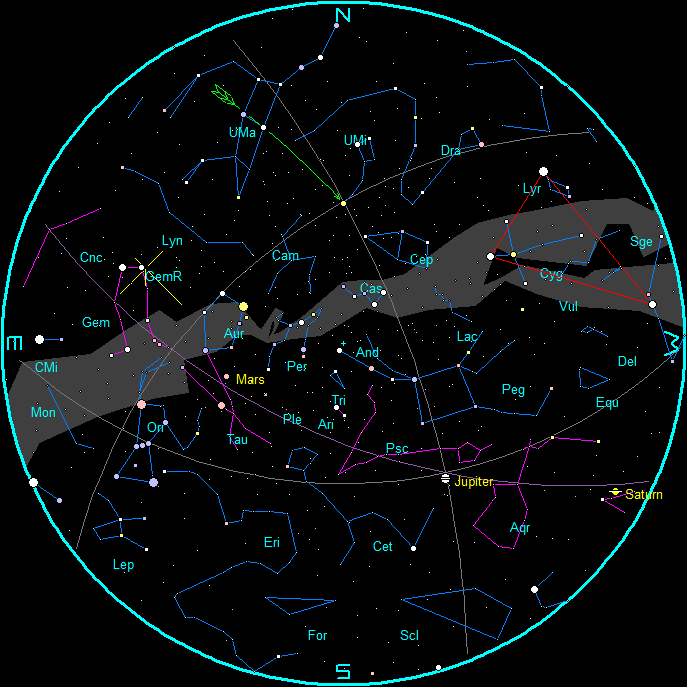
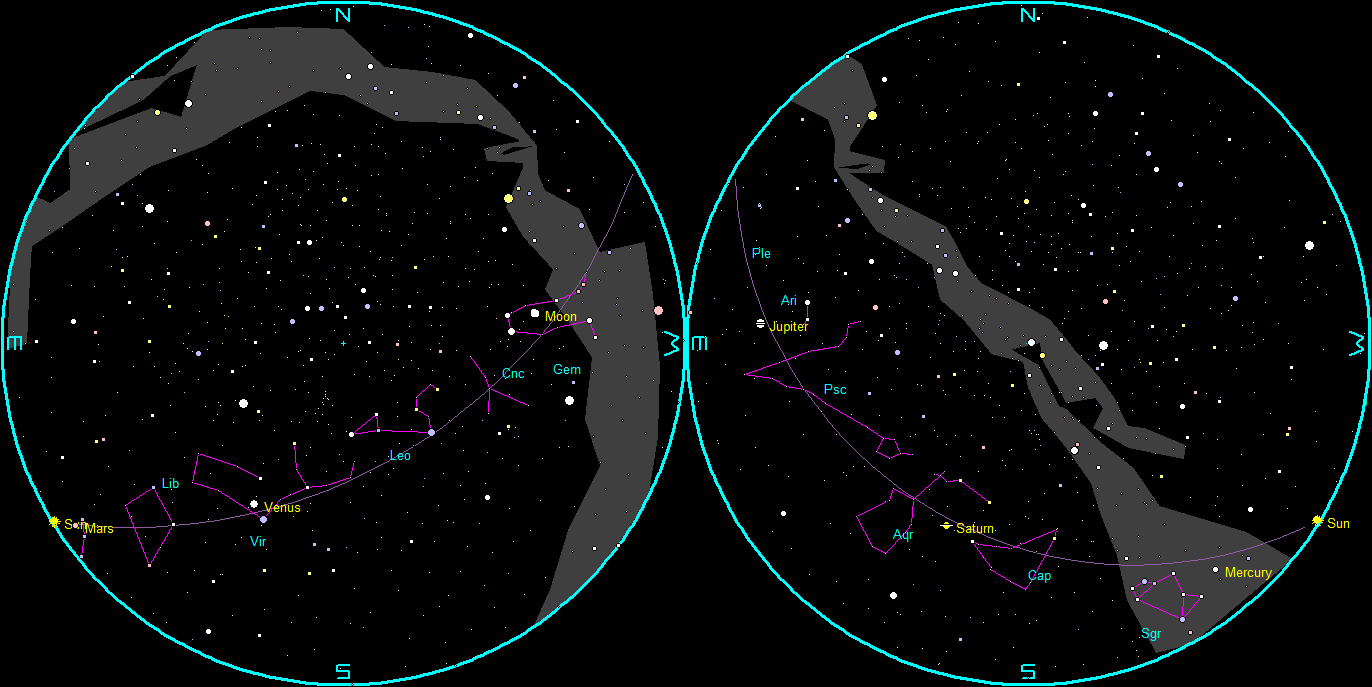
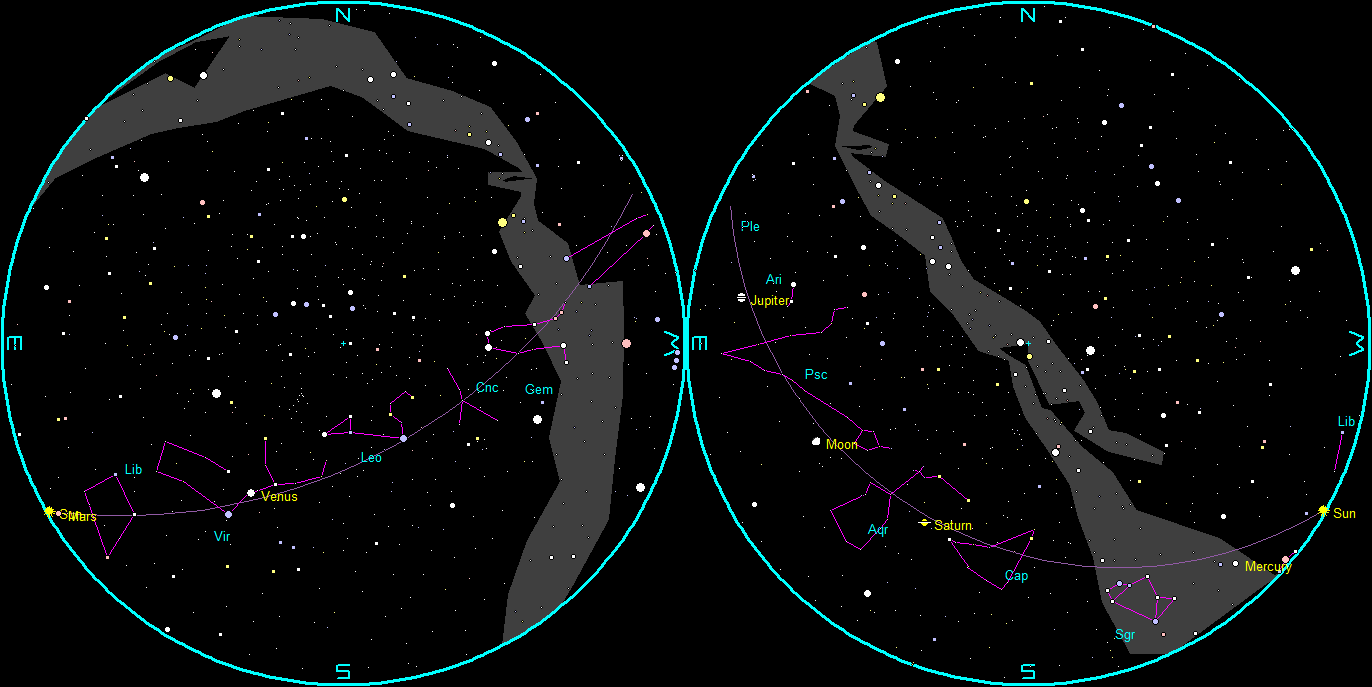
December Evening Star Chart
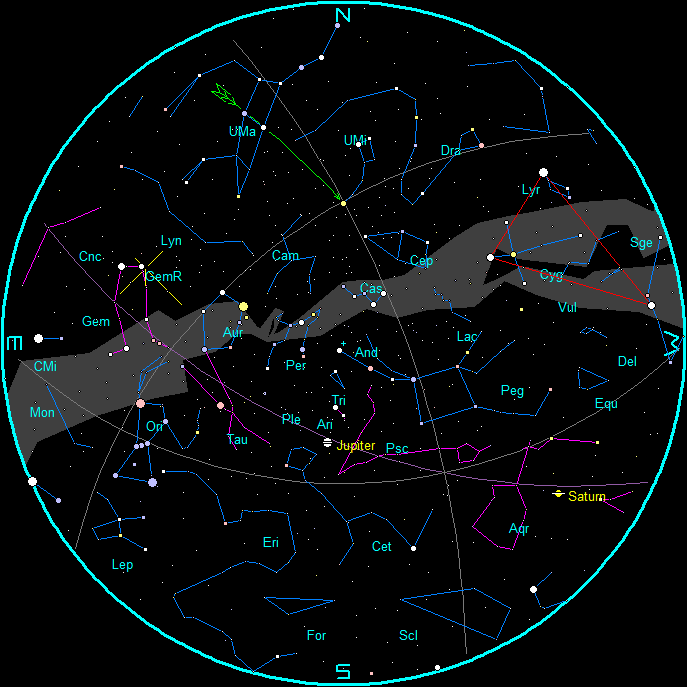
The planets and stars are plotted for the 15th at 9 pm EST in the evening and 6 a.m. for the morning chart. These are the chart times. Note that Traverse City is located approximately 45 minutes behind our time meridian, West 75° longitude. (An hour 45 minutes behind our daylight saving time meridian during EDT).
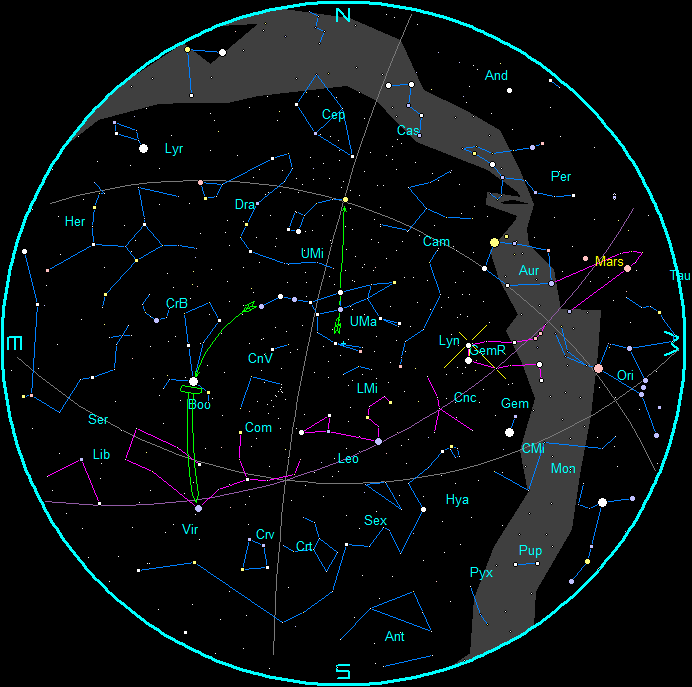
December Morning Star Chart
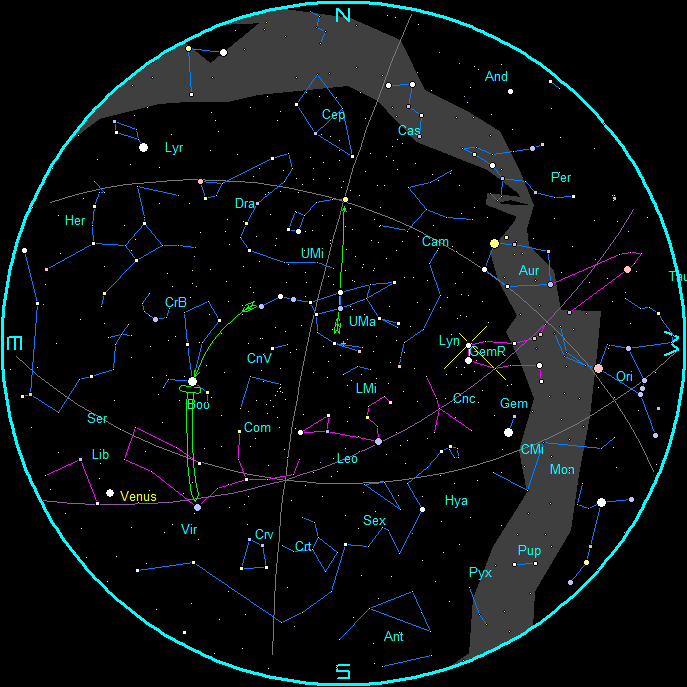
For a list of constellation names to go with the abbreviations, click here.
- Pointer stars at the front of the bowl of the Big Dipper point to Polaris, the North Star.
- The leaky bowl of the Big Dipper drips on Leo.
- Follow the arc of the handle of the Big Dipper to the star Arcturus, then
- Follow the spike to Spica.
- The Summer Triangle is in red.
- GemR on the star charts is the radiant of the Geminid meteor shower, which peaks on the evening of the 14th.
Twilight Limits, Nautical and Astronomical
| EST | |||||||
| Morning | Twilight | Evening | Twilight | Dark | Night | Moon | |
| Date | Astro. | Nautical | Nautical | Astro. | Start | End | Illum. |
| 2023-12-01 | 6h20m | 6h55m | 18h16m | 18h51m | 18h51m | 20h51m | 0.77 |
| 2023-12-02 | 6h21m | 6h56m | 18h16m | 18h51m | 18h51m | 21h58m | 0.69 |
| 2023-12-03 | 6h22m | 6h57m | 18h16m | 18h51m | 18h51m | 23h04m | 0.60 |
| 2023-12-04 | 6h23m | 6h58m | 18h15m | 18h51m | 18h51m | – | 0.51 |
| 2023-12-05 | 6h24m | 6h59m | 18h15m | 18h51m | 18h51m | 0h09m | 0.41 |
| 2023-12-06 | 6h25m | 7h00m | 18h15m | 18h50m | 18h50m | 1h12m | 0.32 |
| 2023-12-07 | 6h26m | 7h01m | 18h15m | 18h50m | 18h50m | 2h15m | 0.23 |
| 2023-12-08 | 6h27m | 7h02m | 18h15m | 18h50m | 18h50m | 3h21m | 0.15 |
| 2023-12-09 | 6h27m | 7h03m | 18h15m | 18h51m | 18h51m | 4h28m | 0.09 |
| 2023-12-10 | 6h28m | 7h04m | 18h15m | 18h51m | 18h51m | 5h40m | 0.04 |
| 2023-12-11 | 6h29m | 7h04m | 18h15m | 18h51m | 18h51m | 6h29m | 0.01 |
| 2023-12-12 | 6h30m | 7h05m | 18h16m | 18h51m | 18h51m | 6h30m | 0.00 |
| 2023-12-13 | 6h30m | 7h06m | 18h16m | 18h51m | 18h51m | 6h30m | 0.02 |
| 2023-12-14 | 6h31m | 7h07m | 18h16m | 18h51m | 18h51m | 6h31m | 0.06 |
| 2023-12-15 | 6h32m | 7h07m | 18h16m | 18h52m | 19h50m | 6h32m | 0.13 |
| 2023-12-16 | 6h33m | 7h08m | 18h16m | 18h52m | 21h12m | 6h33m | 0.22 |
| 2023-12-17 | 6h33m | 7h09m | 18h17m | 18h52m | 22h33m | 6h33m | 0.32 |
| 2023-12-18 | 6h30m | 7h05m | 18h13m | 18h49m | 23h51m | 6h30m | 0.43 |
| 2023-12-19 | 6h30m | 7h06m | 18h14m | 18h49m | – | 6h30m | 0.55 |
| 2023-12-20 | 6h31m | 7h06m | 18h14m | 18h50m | 1h07m | 6h31m | 0.66 |
| 2023-12-21 | 6h31m | 7h07m | 18h14m | 18h50m | 2h22m | 6h31m | 0.76 |
| 2023-12-22 | 6h32m | 7h07m | 18h15m | 18h50m | 3h37m | 6h32m | 0.85 |
| 2023-12-23 | 6h32m | 7h08m | 18h16m | 18h51m | 4h53m | 6h32m | 0.92 |
| 2023-12-24 | 6h33m | 7h08m | 18h16m | 18h52m | 6h09m | 6h33m | 0.97 |
| 2023-12-25 | 6h33m | 7h09m | 18h17m | 18h52m | – | – | 0.99 |
| 2023-12-26 | 6h34m | 7h09m | 18h17m | 18h53m | – | – | 1.00 |
| 2023-12-27 | 6h34m | 7h09m | 18h18m | 18h53m | – | – | 0.99 |
| 2023-12-28 | 6h34m | 7h10m | 18h19m | 18h54m | – | – | 0.95 |
| 2023-12-29 | 6h35m | 7h10m | 18h19m | 18h55m | 18h55m | 19h43m | 0.90 |
| 2023-12-30 | 6h35m | 7h10m | 18h20m | 18h56m | 18h56m | 20h50m | 0.84 |
| 2023-12-31 | 6h35m | 7h10m | 18h21m | 18h56m | 18h56m | 21h55m | 0.77 |
Twilight calendar was generated using Cartes du Ciel (Sky Charts).
See my blog post: Twilight Zone for the definitions of the different periods of twilight here: https://bobmoler.wordpress.com/2018/09/27/.
NASA Calendar of Planetary Events
Dec  1  Fr            Venus: 42.9° W
     1  Fr  11:21 pm  Moon-Beehive: 3.9° S
     4  Mo   8:59 am  Mercury Elongation: 21.3° E
     4  Mo   1:42 pm  Moon Apogee: 404,300 km
     5  Tu  12:49 am  Last Quarter
     8  Fr   9:05 am  Moon-Spica: 2.5° S
     8  Fr  10:24 am  Moon Descending Node
     9  Sa  11:53 am  Moon-Venus: 3.9° N
    12  Tu   6:32 pm  New Moon
    13  We   4:51 pm  Moon South Dec.: 28.2° S
    14  Th   2:02 pm  Geminid Shower: ZHR = 120!
    16  Sa   1:53 pm  Moon Perigee: 367,900 km
    17  Su   4:58 pm  Moon-Saturn: 2.5° N
    19  Tu   1:39 pm  First Quarter
    21  Th   8:54 am  Moon Ascending Node
    21  Th  10:28 pm  Winter Solstice
    22  Fr   9:20 am  Moon-Jupiter: 2.7° S
    22  Fr   1:45 pm  Mercury Inferior Conj.
    22  Fr  10:00 pm  Ursid Shower: ZHR = 10
    24  Su   2:37 am  Moon-Pleiades: 1.1° N
    26  Tu   4:50 pm  Moon North Dec.: 28.1° N
    26  Tu   7:33 pm  Full Cold Moon
    28  Th   6:51 am  Moon-Pollux: 1.9° N
    29  Fr   7:45 am  Moon-Beehive: 3.7° S
Jan  1  Mo            Venus: 37.4° W
All event times are given for UTC-5 Eastern Standard Time.
Sky Events Calendar by Fred Espenak and Sumit Dutta (NASA’s GSFC),
http://eclipse.gsfc.nasa.gov/SKYCAL/SKYCAL.html.
If you go to the above site, you can print out a list like the above for the entire year or calendar pages for your time zone.
Sun and Moon Rising and Setting Events
LU            Ephemeris of Sky Events for Interlochen/TC
December, 2023    Local time zone: EST
+-----------------------------------------------------------------------+
| DATE |  SUN     SUN  DAYLIGHT|   TWILIGHT*    |MOON  RISE OR    ILLUM |
|      |  RISE    SET    HOURS |  END    START  |PHASE SET** TIME FRACTN|
+=======================================================================+
|Fri  1| 07:59a  05:03p  09:04 | 06:13p  06:50a |      Rise 08:51p   79%|
|Sat  2| 08:00a  05:03p  09:02 | 06:12p  06:51a |      Rise 09:58p   71%|
+------+-----------------------+----------------+-----------------------+
|Sun  3| 08:01a  05:03p  09:01 | 06:12p  06:52a |      Rise 11:04p   62%|
|Mon  4| 08:02a  05:02p  08:59 | 06:12p  06:53a |      Rise 12:08a   52%|
|Tue  5| 08:04a  05:02p  08:58 | 06:12p  06:54a |L Qtr Rise 01:11a   43%|
|Wed  6| 08:05a  05:02p  08:57 | 06:12p  06:55a |      Rise 02:15a   34%|
|Thu  7| 08:06a  05:02p  08:56 | 06:12p  06:56a |      Rise 03:20a   25%|
|Fri  8| 08:07a  05:02p  08:55 | 06:12p  06:56a |      Rise 04:28a   17%|
|Sat  9| 08:08a  05:02p  08:54 | 06:12p  06:57a |      Rise 05:40a   10%|
+------+-----------------------+----------------+-----------------------+
|Sun 10| 08:08a  05:02p  08:53 | 06:12p  06:58a |      Rise 06:54a    5%|
|Mon 11| 08:09a  05:02p  08:52 | 06:12p  06:59a |      Rise 08:09a    1%|
|Tue 12| 08:10a  05:02p  08:51 | 06:12p  07:00a |New   Set  04:26p    0%|
|Wed 13| 08:11a  05:02p  08:50 | 06:12p  07:01a |      Set  05:22p    2%|
|Thu 14| 08:12a  05:02p  08:50 | 06:13p  07:01a |      Set  06:31p    5%|
|Fri 15| 08:13a  05:02p  08:49 | 06:13p  07:02a |      Set  07:50p   12%|
|Sat 16| 08:13a  05:03p  08:49 | 06:13p  07:03a |      Set  09:11p   20%|
+------+-----------------------+----------------+-----------------------+
|Sun 17| 08:14a  05:03p  08:48 | 06:13p  07:03a |      Set  10:32p   30%|
|Mon 18| 08:15a  05:03p  08:48 | 06:14p  07:04a |      Set  11:50p   41%|
|Tue 19| 08:15a  05:04p  08:48 | 06:14p  07:05a |F Qtr Set  01:06a   53%|
|Wed 20| 08:16a  05:04p  08:48 | 06:15p  07:05a |      Set  02:21a   64%|
|Thu 21| 08:16a  05:04p  08:48 | 06:15p  07:06a |      Set  03:37a   74%|
|Fri 22| 08:17a  05:05p  08:48 | 06:16p  07:06a |      Set  04:53a   83%|
|Sat 23| 08:17a  05:05p  08:48 | 06:16p  07:07a |      Set  06:08a   90%|
+------+-----------------------+----------------+-----------------------+
|Sun 24| 08:18a  05:06p  08:48 | 06:17p  07:07a |      Set  07:21a   96%|
|Mon 25| 08:18a  05:07p  08:48 | 06:17p  07:07a |      Set  08:25a   99%|
|Tue 26| 08:18a  05:07p  08:48 | 06:18p  07:08a |Full  Rise 04:30p  100%|
|Wed 27| 08:19a  05:08p  08:49 | 06:19p  07:08a |      Rise 05:30p   99%|
|Thu 28| 08:19a  05:09p  08:49 | 06:19p  07:08a |      Rise 06:35p   96%|
|Fri 29| 08:19a  05:10p  08:50 | 06:20p  07:09a |      Rise 07:43p   91%|
|Sat 30| 08:19a  05:10p  08:51 | 06:21p  07:09a |      Rise 08:50p   85%|
+------+-----------------------+----------------+-----------------------+
|Sun 31| 08:20a  05:11p  08:51 | 06:22p  07:09a |      Rise 09:55p   78%|
+-----------------------------------------------------------------------+
* Nautical Twilight
** Moonrise or moonset, whichever occurs between sunrise and sunset
Generated using my LookingUp for DOS program.
Ephemeris: 11/29/2023 – Where are the naked-eye planets this week?
This is Ephemeris for Wednesday, November 29th. Today the Sun will be up for 9 hours and 7 minutes, setting at 5:04, and it will rise tomorrow at 7:58. The Moon, 2 days past full, will rise at 6:42 this evening.
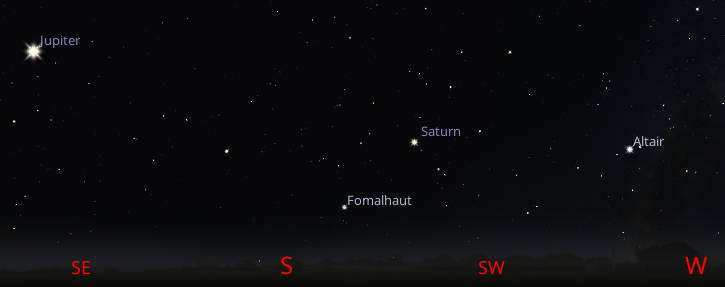
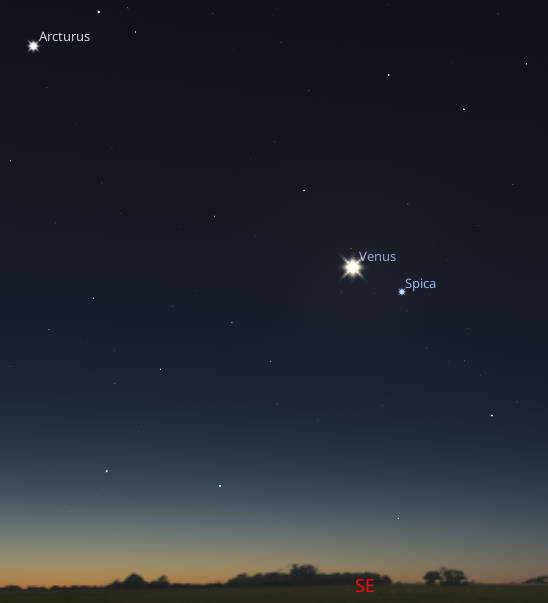
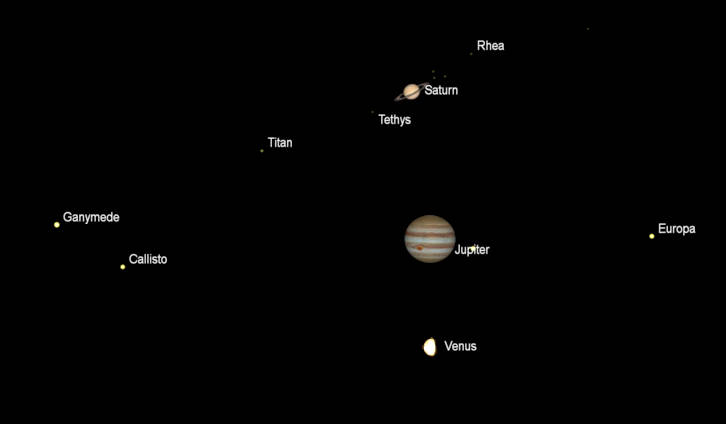
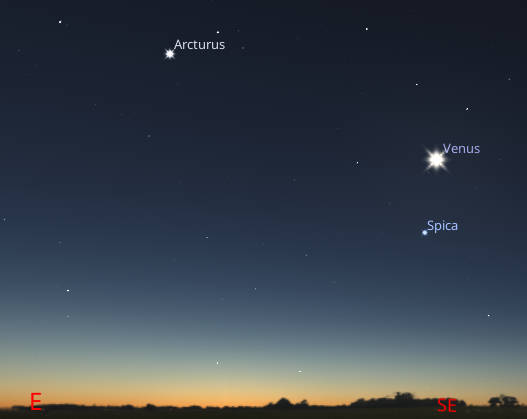
Let’s find out where the naked-eye planets have wandered off to this week. Three of those five planets are now visible, but Mercury sets too close to sunset to be seen, and Mars rises too close to sunrise. Saturn and Jupiter are the only evening planets visible. Saturn can be seen moving from the south-southwest to setting in the west-southwest in the evening. Ringed planet will be setting at 11:34 pm. Jupiter will be moving from the east-southeast to southwest and will be much higher in the sky during the evening hours than Saturn is, and will be up most of the night until 5:22 am. Venus, the brilliant morning star, will rise in the east-northeast at 4:09 am, and be a brilliant beacon in the morning.
The astronomical event times given are for the Traverse City/Interlochen area of Michigan (EST, UT –5 hours). They may be different for your location.
Addendum
Ephemeris: 11/28/2023 – The new Moon Race
This is Bob Moler with Ephemeris for Tuesday, November 28th. Today the Sun will be up for 9 hours and 8 minutes, setting at 5:05, and it will rise tomorrow at 7:57. The Moon, 1 day past full, will rise at 5:47 this evening.
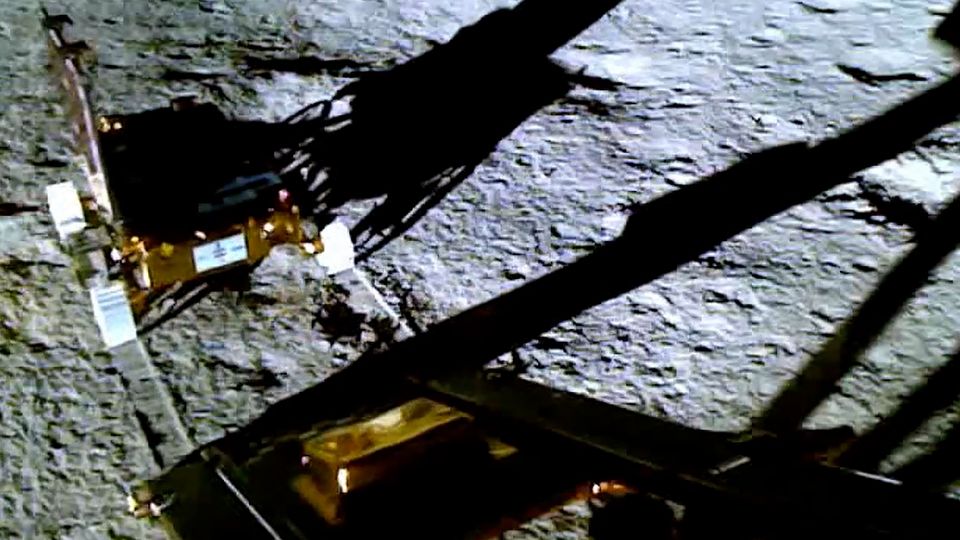
Now, in the third decade of the 21st century, 50 years since Neil Armstrong set foot on the moon, there’s now a big rush by many nations and some private companies to send missions to the moon, with orbiters and landers. The biggest and most expensive project is the United States Artemis project which has launched one of the SLS rockets to the moon and will send another one probably later next year in preparation for a landing, in a year or two after that. Earlier this year India successfully landed a probe on the Moon with a rover for less cost that it would take Hollywood to make a movie about it. They are making noises about sending a manned mission to the moon by 2040. Stay tuned, we have an exciting decade of lunar exploration coming up.
The astronomical event times given are for the Traverse City/Interlochen area of Michigan (EST, UT –5 hours). They may be different for your location.
Addendum

Ephemeris: 11/27/2023 – Seeing in low light levels
This is Bob Moler with Ephemeris for Monday, November 27th. Today the Sun will be up for 9 hours and 10 minutes, setting at 5:05, and it will rise tomorrow at 7:56. The Moon, at full today, will rise at 5:01 this evening.
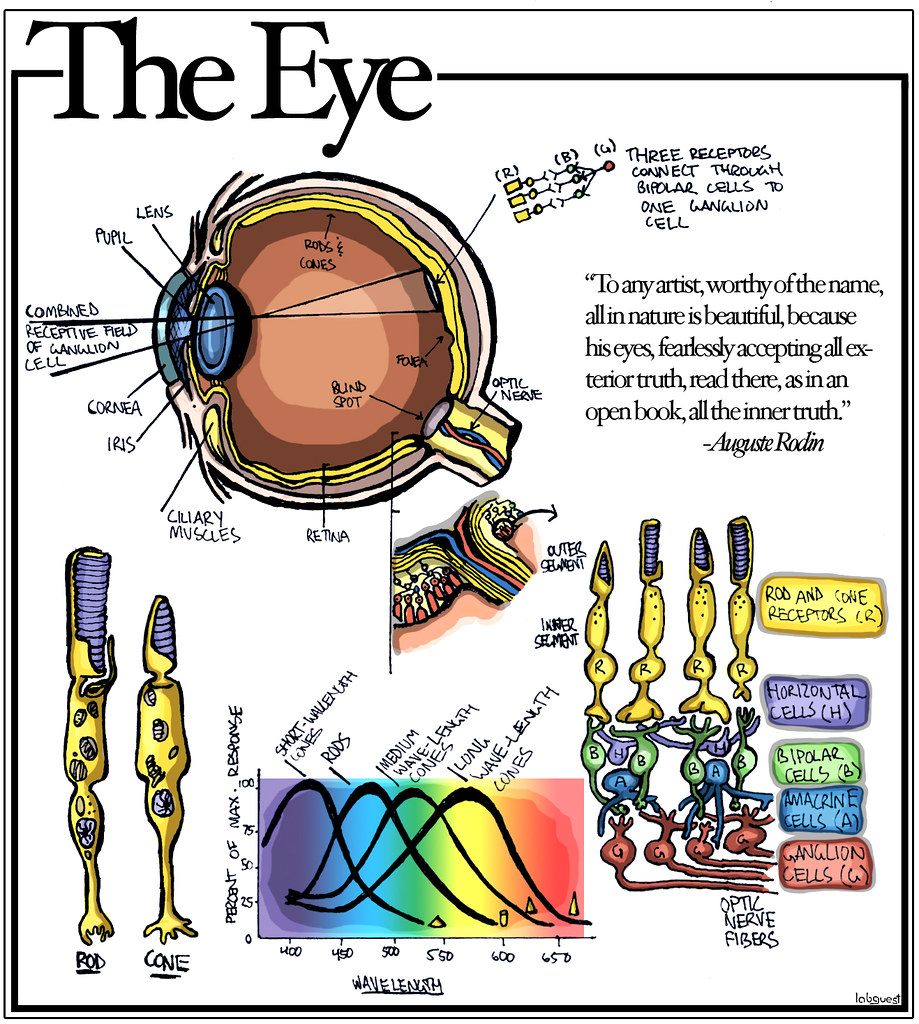
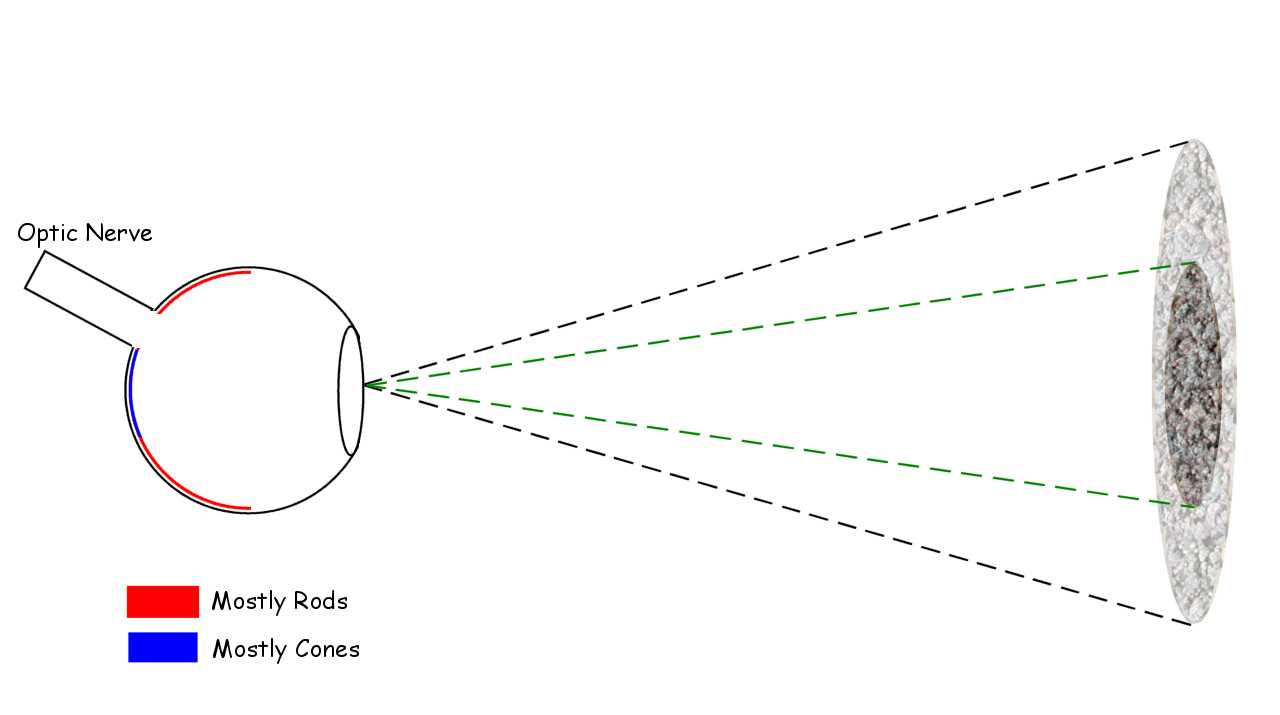
Today’s full moon is called the Beaver full moon actually the moon was exactly full at 4:16 this morning, so last night it was actually closer to full moon than it will be tonight. The bright full moon fills the sky with light so most of the fainter stars disappear. The sky looks gray when the moon is full, but it is just as blue as the daytime sky. It’s just that our eyes cannot discern color at low light levels. We sacrifice our color vision for night vision. Other animals can see in the dark much better than we can, though some of them do not have quite the color vision we have so viewing the skies and viewing the world around us is a compromise. We were evolved from creatures that were most active in the daytime and hid at night. My cats can see much better in the dark than I can. However, the other animals do not have the abilities we have to create tools and instruments to allow us to see better in the dark than they can.
The astronomical event times given are for the Traverse City/Interlochen area of Michigan (EST, UT –5 hours). They may be different for your location.
Addendum
Ephemeris: 11/24/2023 – Thoughts on Native American Heritage Day
This is Ephemeris for Native American Heritage Day, Friday, November 24th. Today the Sun will be up for 9 hours and 16 minutes, setting at 5:07, and it will rise tomorrow at 7:52. The Moon, 3 days before full, will set at 5:51 tomorrow morning.
My Heritage is from Northern and Eastern Europe, not one particular country. I have no desire to go or to learn too much more about The Old Countries. And growing up, I grew up in a white neighborhood went to white schools because people of other ethnicities didn’t live in our part of town so we had no mixing of cultures. So I grew up as an American with American cultural values, whatever that is. It was rather late in life, actually doing this program, that I got very interested in the culture of the Native Americans in our area the Anishinaabe, whose groups around here are the Chippewa, or Ojibwe and the Odawa, or Ottawa and learned of their stories and legends, especially those involving sky lore. I find it very interesting and just as rich as the culture we got from the Romans and Greeks. So from time to time on this program I’ll talk about various constellations and stories of our Native American neighbors.
The astronomical event times given are for the Traverse City/Interlochen area of Michigan (EST, UT –5 hours). They may be different for your location.
Addendum
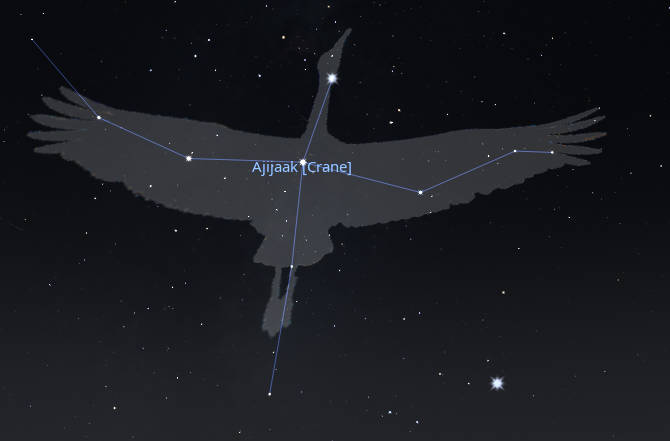
Ephemeris: 11/23/2023 – Celestial Navigation in the time of the Mayflower
This is Ephemeris for Thanksgiving Day, Thursday, November 23rd. Today the Sun will be up for 9 hours and 18 minutes, setting at 5:08, and it will rise tomorrow at 7:51. The Moon, 3 days past first quarter, will set at 4:33 tomorrow morning.
Being Thanksgiving it would be nice take a look at something astronomical about the day. Say celestial navigation in the day of the Mayflower. Back then one could find one’s latitude or position North and South of the equator by sighting the altitude of Sun at noon. Determining noon for one’s position took several sightings. Noon was the time of the highest altitude or angle that the sun was above the horizon. Several sighting would have to be made until one found the time that the sun was highest above the horizon and knowing the day of the year to get the Sun’s declination which is its latitude in the sky to calculate one’s own latitude. Estimating one’s longitude was a much more difficult proposition.
The astronomical event times given are for the Traverse City/Interlochen area of Michigan (EST, UT –5 hours). They may be different for your location.
Addendum

)
Ephemeris: 11/22/2023 – Where have the naked-eye planets wandered off to this week?
This is Ephemeris for Wednesday, November 22nd. Today the Sun will be up for 9 hours and 20 minutes, setting at 5:08, and it will rise tomorrow at 7:50. The Moon, 2 days past first quarter, will set at 3:17 tomorrow morning.
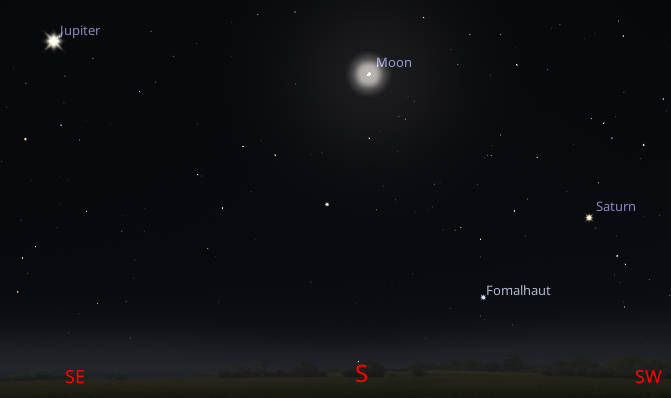
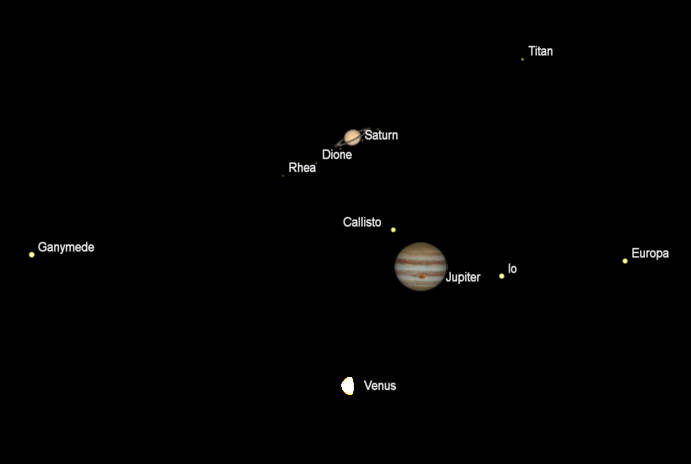
Let’s find out where the naked-eye planets have wandered off to this week. Three of those five planets are now visible, but Mercury sets too close to sunset to be seen. Mars is now a morning planet after passing conjunction with the Sun last Friday. So, Saturn and Jupiter are the only evening planets visible. Saturn can be seen moving from the south to the southwest in the evening. Saturn will be visible until 12:04 am. Jupiter is seen moving from low in the east-southeast to south-southeast in the evening. Only the Moon is brighter in the evening. Jupiter will be up most of the night until 5:54 am. The gibbous Moon is almost exactly centered between Saturn and Jupiter. Venus, the brilliant morning star, will rise in the east-northeast at 3:57 am.
The astronomical event times given are for the Traverse City/Interlochen area of Michigan (EST, UT –5 hours). They may be different for your location.
Addendum
Ephemeris: 11/21/2023 – Where I was 60 years ago tomorrow
This is Ephemeris for Tuesday, November 21st. Today the Sun will be up for 9 hours and 22 minutes, setting at 5:09, and it will rise tomorrow at 7:48. The Moon, 1 day past first quarter, will set at 2:00 tomorrow morning.
Sixty years ago tomorrow, November 22nd 1963, President John F Kennedy was assassinated in Dallas. On that day I was in Basic Training for the Air Force at Lackland Air Force Base just South of San Antonio, about 250 miles south of Dallas. Being in Basic Training meant we were pretty well cut off from the outside world as far as finding out what was happening. That day I happened to be serving KP and in the afternoon after washing all the pots and pans from lunch we were sitting around at the back of the Mess Hall when we found out from one of the cooks that Kennedy was shot. There were also rumors going around that they took out Vice President Johnson too. So we’re wondering if this was a massive assault on our government. I thought this was a hell of a time to join the military, we could be off to war soon.
The astronomical event times given are for the Traverse City/Interlochen area of Michigan (EST, UT –5 hours). They may be different for your location.
Ephemeris: 11/20/2023 – Observing the Moon tonight
This is Ephemeris for Monday, November 20th. Today the Sun will be up for 9 hours and 24 minutes, setting at 5:10, and it will rise tomorrow at 7:47. The Moon, at first quarter today, will set at 12:42 tomorrow morning.
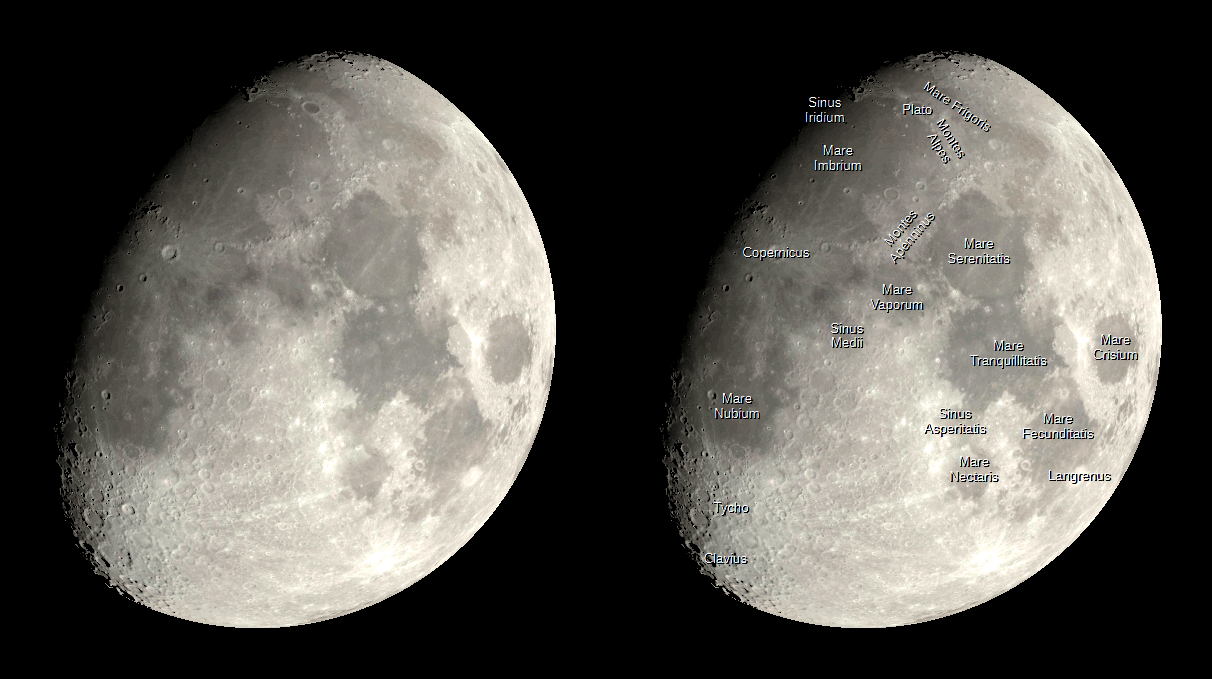
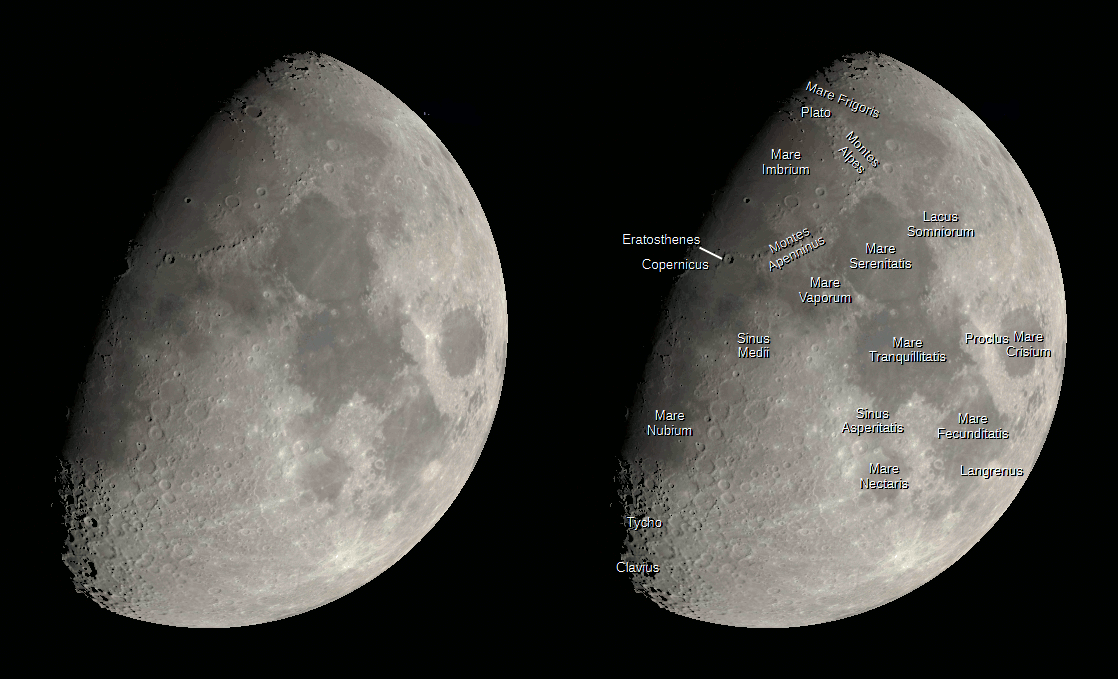
The moon was exactly first quarter at 5:50 this morning. By this evening it will be slightly gibbous. If I want to see the most detail on the Moon of any kind, the best time to observe it is within a few days of first quarter. More craters are visible, and other features are easier to see then. The southern part of the Moon or the bottom part, as we see it, is littered with craters. It’s called the lunar highlands, and they are really higher than the darker and flatter regions, which are called seas. There is no water in them but if the Moon did have water, that’s where it would be. There are a couple of mountain ranges which are actually the edges of a sea called Mare Imbrium that are just coming into view. They show up nicely with their shadows. It’s shadows that make the detail on the moon stand out, because the Moon basically is darker gray on lighter gray, so the only contrast is with shadows. That’s why I find the full moon to be so disappointing. No shadows.
The astronomical event times given are for the Traverse City/Interlochen area of Michigan (EST, UT –5 hours). They may be different for your location.
Ephemeris: 11/17/2023 – Observing this weekend’s Leonid meteor shower
This is Ephemeris for Friday, November 17th. Today the Sun will be up for 9 hours and 30 minutes, setting at 5:12, and it will rise tomorrow at 7:43. The Moon, 3 days before first quarter, will set at 8:45 this evening.
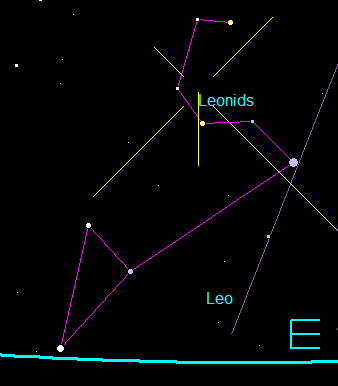
The Leonid meteor shower will reach peak this weekend. The normal peak will be actually this evening before the radiant, where the meteors seem to come from, rise which they will do at 11 pm. So tomorrow morning it would be a good time to see them. We only expect about 15 meteors an hour at peak. There is a possibility of another peak on the 21st which is Tuesday morning just before dawn composed of supposedly bright meteors from the passage of the comet crossed Earth’s orbit in 1767. So if it’s clear, and you’re willing to go outdoors and see what you can see of the Leonid meteor shower. The Leonids get really spectacular about every 33 years, and we’re about 8 or 9 years from now.
The astronomical event times given are for the Traverse City/Interlochen area of Michigan (EST, UT –5 hours). They may be different for your location.
Addendum
 Bob Moler's Ephemeris Blog