Archive
Ephemeris: 03/31/2025 – Finding Leo, the celestial lion
This is Ephemeris for Monday, March 31st. Today the Sun will be up for 12 hours and 44 minutes, setting at 8:09, and it will rise tomorrow at 7:23. The Moon, 2 days past new, will set at 11:39 this evening.
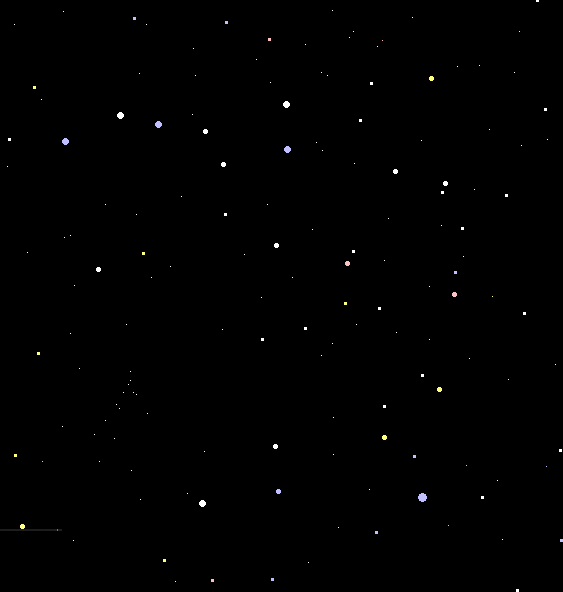
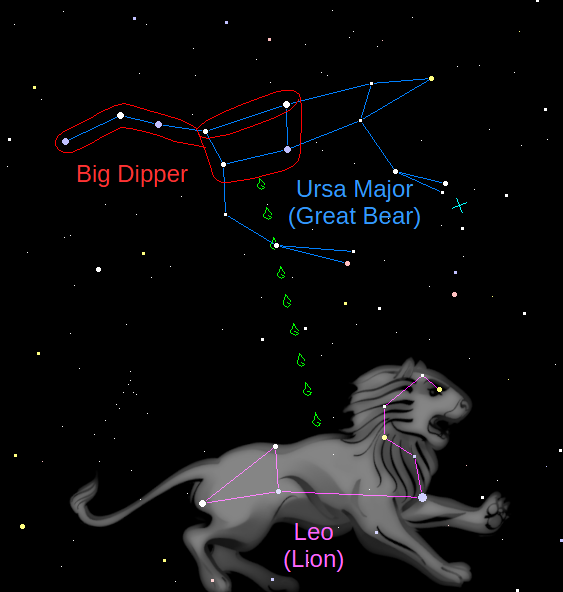
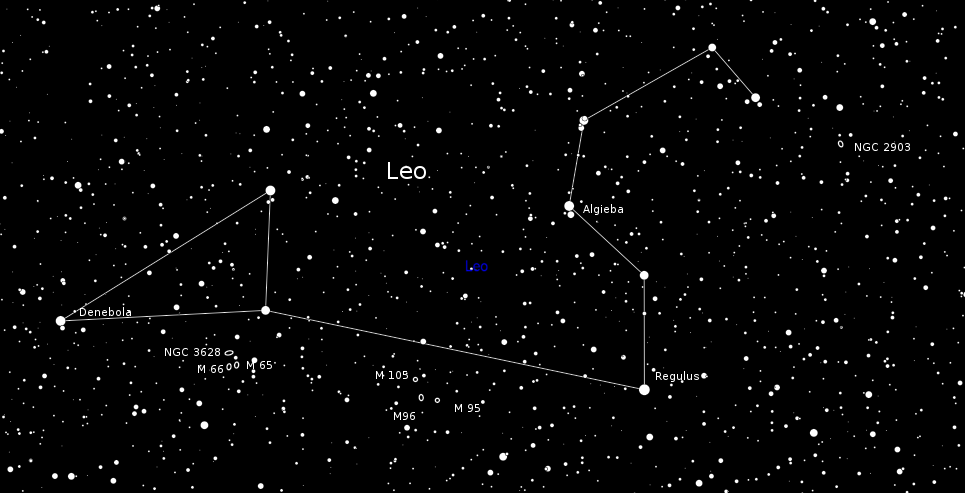
At 10 p.m. the spring constellation of Leo the lion will be high in the south-southeast. It can be found by locating the Big Dipper high in the northeast and imagining that a hole were drilled in the bowl to let the water leak out. It would drip on the back of this giant cat. The Lion is standing or lying facing westward. His head and mane are seen in the stars as a backwards question mark. This group of stars is also called the sickle. The bright star Regulus is at the bottom, the dot at the bottom of the question mark. A triangle of stars, to the left of Regulus, is the lion’s haunches. Leo contains some nice galaxies visible in moderate sized telescopes. The stars in Leo’s part of the sky are fewer than those in the winter sky.
The astronomical event times given are for the Traverse City/Interlochen area of Michigan (EDT, UT – 4 hours). Times will be different for other locations.
Addendum
Ephemeris: 03/28/25 – There’s a partial solar eclipse tomorrow, but not for Michigan
This is Bob Moler with Ephemeris for Friday, March 28th. Today the Sun will be up for 12 hours and 35 minutes, setting at 8:05, and it will rise tomorrow at 7:28. The Moon, 1 day before new, will rise at 7:29 tomorrow morning.
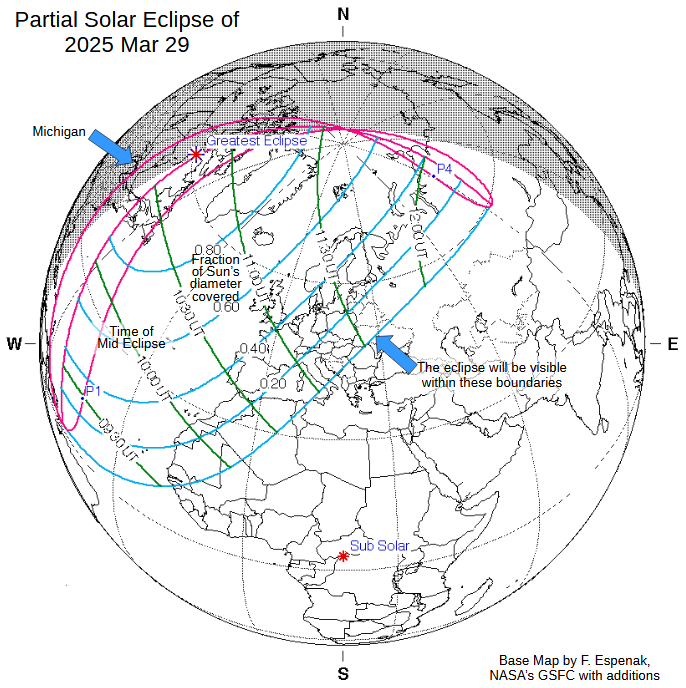
There will be a partial solar eclipse tomorrow morning which will end about 14 minutes before sunrise for Northwestern Lower Michigan. It will be visible to the east and north of here, including all the way to northern Asia. It belongs to the same eclipse season as our total lunar eclipse two weeks ago. Eclipse seasons occur twice a year and last about 35 days. During that time, since it’s a little bit longer than a lunar month, there will be at least 2 eclipses, one of each kind, lunar and solar. There’s a possibility of three, if there is a central lunar eclipse. Then there can be two partial solar eclipses, one to the extreme north, the other to the extreme south of the Earth. The eclipse seasons slip a bit earlier each year. Last year’s total solar eclipse occurred April 8th.
The astronomical event times given are for the Traverse City/Interlochen area of Michigan (EDT, UT – 4 hours). Times will be different for other locations.
Addendum
Ephemeris: 03/27/2025 – Cancer the celestial crab
This is Bob Moler with Ephemeris for Thursday, March 27th. Today the Sun will be up for 12 hours and 32 minutes, setting at 8:04, and it will rise tomorrow at 7:30. The Moon, 2 days before new, will rise at 7:08 tomorrow morning.
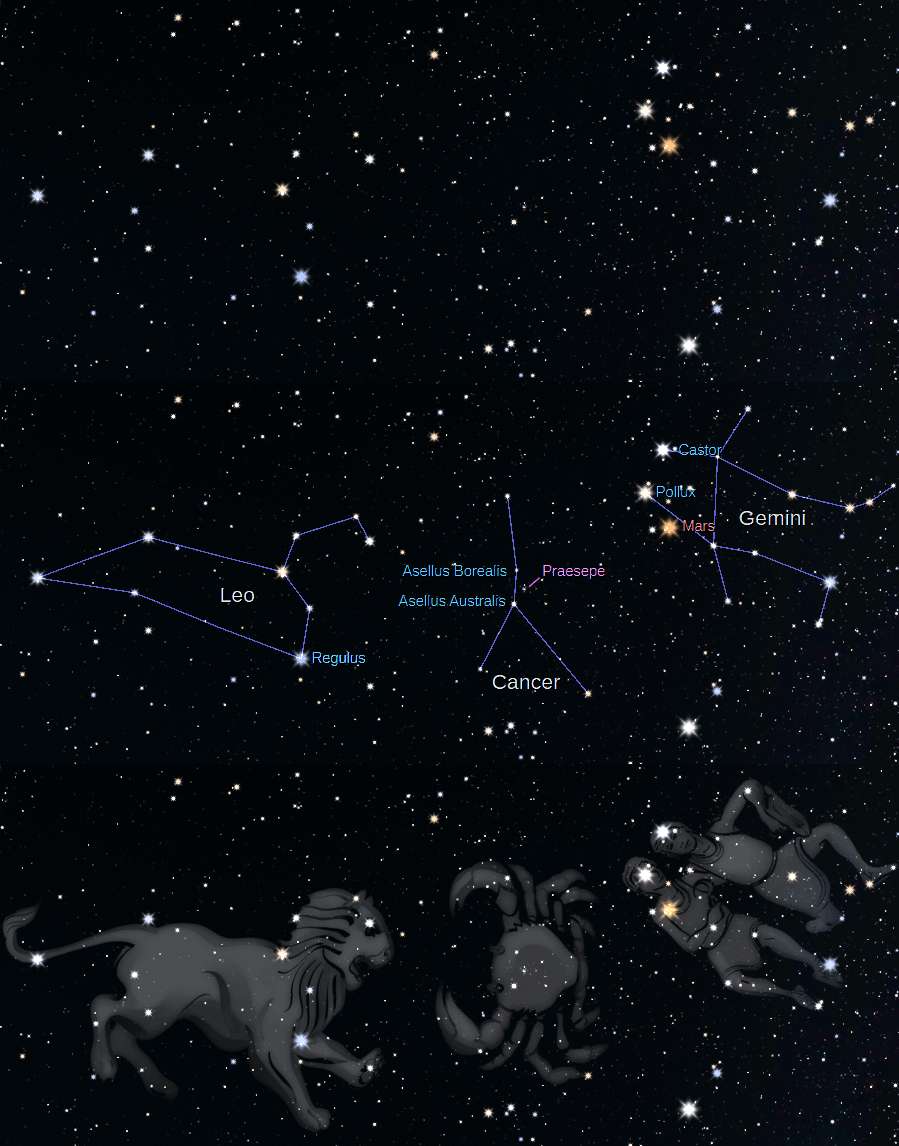
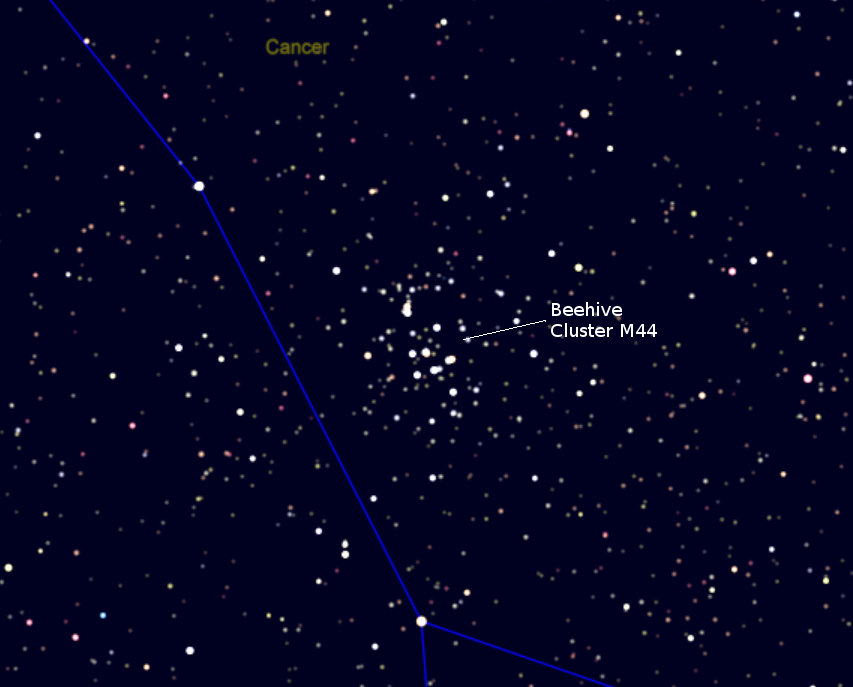
At 10 PM, between the stars Castor and Pollux in Gemini high in the southwest and the star Regulus in Leo the Lion in the southeast lies the dimmest constellation of the zodiac, Cancer the crab. To me its 5 brightest stars make an upside down Y. There are the stars in the center of the constellation Asellus Borealis and Asellus Australis, the north and south donkeys. There’s a fuzzy spot between and just west of them called Praesepe, the manger, from which they are eating hay. In binoculars, it resolves into a cluster of stars called the Beehive cluster. We amateur astronomers also know it as M44, the 44th object on 18th century comet hunter Charles Messier’s list of fuzzy objects that might be mistaken for comets.
The astronomical event times given are for the Traverse City/Interlochen area of Michigan (EDT, UT – 4 hours). Times will be different for other locations.
Addendum
Ephemeris: 03/26/2025 – Where have all the naked-eye planets wandered off to?
This is Bob Moler with Ephemeris for Wednesday, March 26th. Today the Sun will be up for 12 hours and 29 minutes, setting at 8:03, and it will rise tomorrow at 7:32. The Moon, 3 days before new, will rise at 6:47 tomorrow morning.
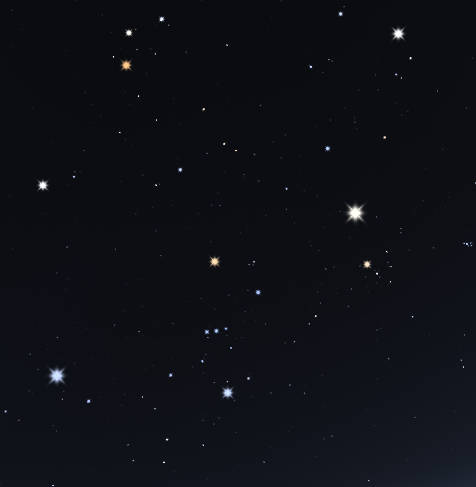
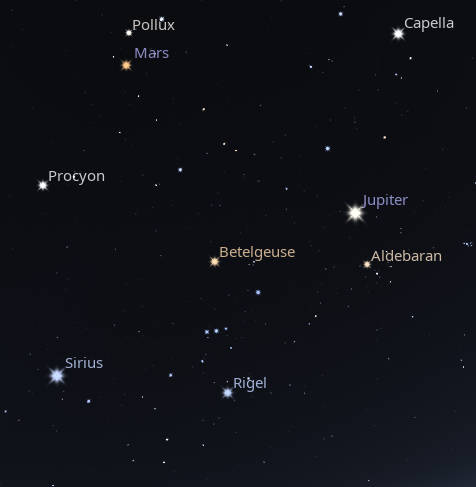
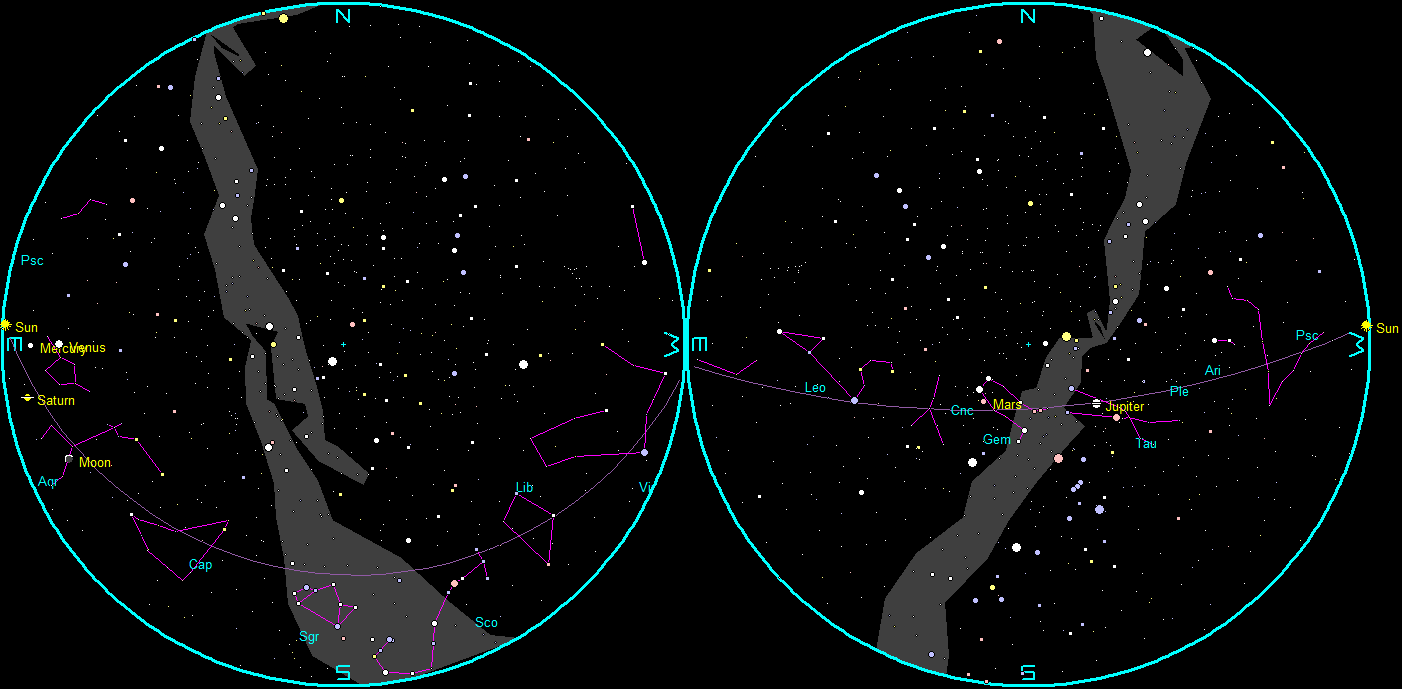
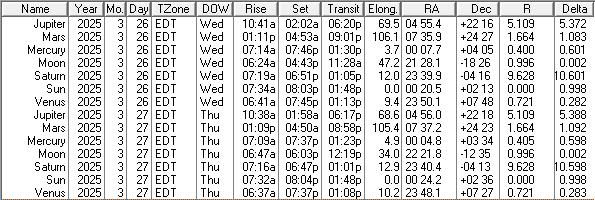
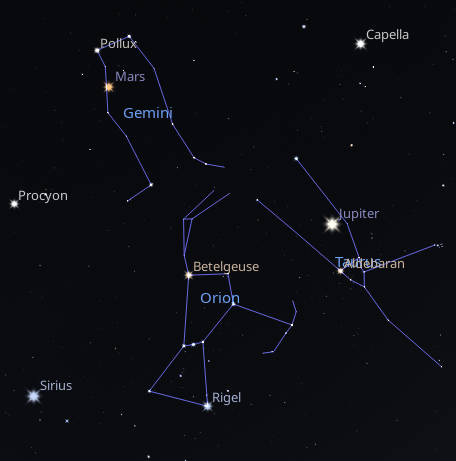
Let’s take our weekly look at the whereabouts of the naked-eye planets. At 9 PM this evening just two of the five naked eye planets will be out. Venus and Mercury have gone over to the dark… uh, morning side proceeded by Saturn, a month ago. Jupiter now becomes the brightest evening planet, our substitute evening star if you will. It will be high in the west-southwest at 9 PM. Below it is the bright star Aldebaran with the stars of the Hyades, the face of Taurus the bull, and farther to the right the star group the Pleiades or Seven Sisters. To its lower left, the great constellation of Orion. The rapidly fading Mars, with its distinctive reddish hue, is high in the south, with the stars Castor and Pollux in Gemini above it.
The astronomical event times given are for the Traverse City/Interlochen area of Michigan (EDT, UT – 4 hours). Times will be different for other locations.
Addendum

Ephemeris: 03/25/2025 – Spotting Zodiacal light
This is Ephemeris for Tuesday, March 25th. Today the Sun will be up for 12 hours and 26 minutes, setting at 8:02, and it will rise tomorrow at 7:34. The Moon, 3 days past last quarter, will rise at 6:24 tomorrow morning.
The evening sky will stay dark for the rest of the week, so it’s time to look for the zodiacal light in the evening. It is a faint but towering glow that can be seen after the end of astronomical twilight on moonless nights. It is seen in the west in the evening in late winter and early spring. The axis of the glow is the ecliptic, the apparent annual path of the Sun in the sky, along which lie the constellations of the zodiac. It’s a glow whose wide base is in the west that extends upwards and to the left. Right now, the end of astronomical twilight is about 10:05 p.m. and advancing at a rate of a minute or two each night. Go to a spot with a dark western sky, no big cities or towns out that way. Zodiacal light is caused by dust spread out around the Sun.
The astronomical event times given are for the Traverse City/Interlochen area of Michigan (EDT, UT – 4 hours). Times will be different for other locations.
Addendum
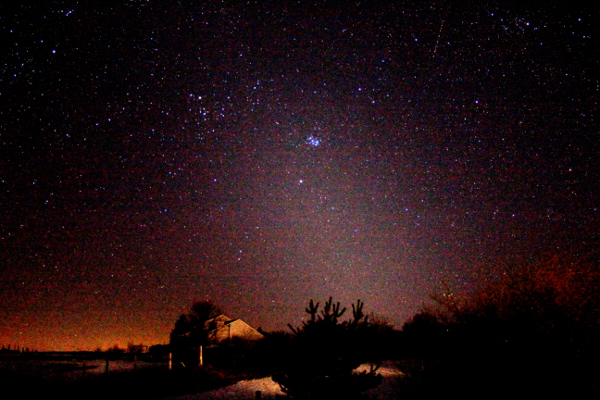
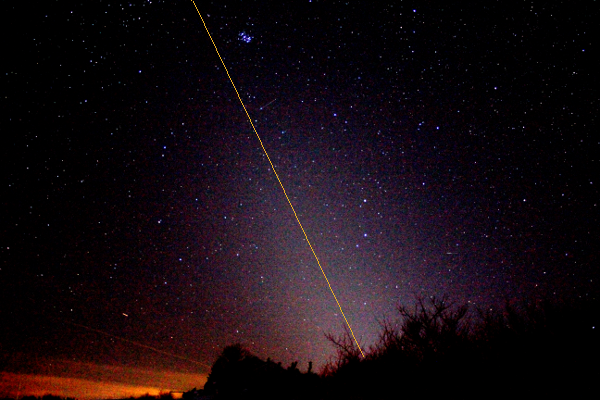
Zodiacal light will not be as obvious as it appears in the above photographs, where I got to play with brightness and contrast. It takes a bit of observation back and forth to spot the glow. Once found it will be easier to spot in future attempts. Zodiacal light can also be seen on fall mornings in the east before twilight begins. The glow will lean to the right instead of to the left.
Ephemeris: 03/24/2025 – Mercury crosses over to the morning side
This is Ephemeris for Monday, March 24th. Today the Sun will be up for 12 hours and 22 minutes, setting at 8:00, and it will rise tomorrow at 7:36. The Moon, 2 days past last quarter, will rise at 5:58 tomorrow morning.
Today, Mercury is at inferior conjunction with the Sun, two days after Venus. Mercury of course, this is in the middle of its retrograde motion period, moving westward against the stars, and for astrologers Mercury in retrograde is a big deal. I consider astrology is to astronomy as tea-leaf reading is to botany, so I dismiss it. Every once in a while Mercury, when it passes inferior conjunction, crosses in front of the face of the Sun for us. These are called transits, and are fairly rare. The last time was in November 2019 and the next time will be in November 2032 which is seven years from now. Mercury will move into the morning sky, where its appearance will not be favorable for us in the Northern Hemisphere.
The astronomical event times given are for the Traverse City/Interlochen area of Michigan (EDT, UT – 4 hours). Times will be different for other locations.
Addendum
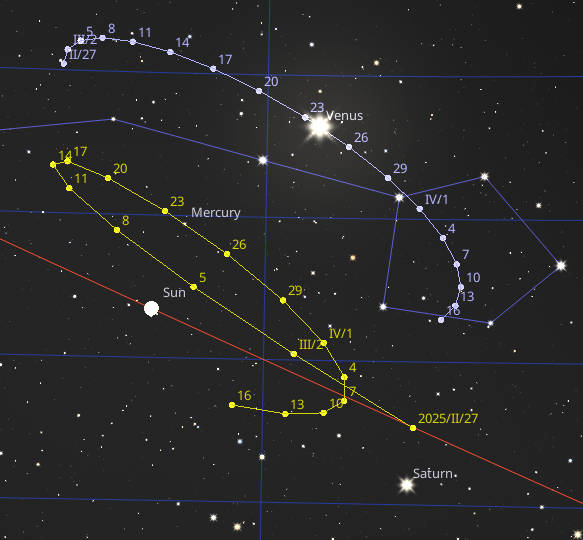
Retrograde loops are caused by looking at a moving planet from another moving planet, the Earth.
Ephemeris: 03/21/2025 – Venus will pass inferior conjunction with the Sun tomorrow
This is Ephemeris for Friday, March 21st. Today the Sun will be up for 12 hours and 13 minutes, setting at 7:56, and it will rise tomorrow at 7:41. The Moon, 1 day before last quarter, will rise at 3:55 tomorrow morning.
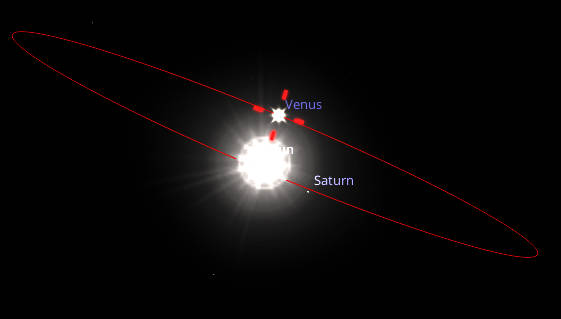
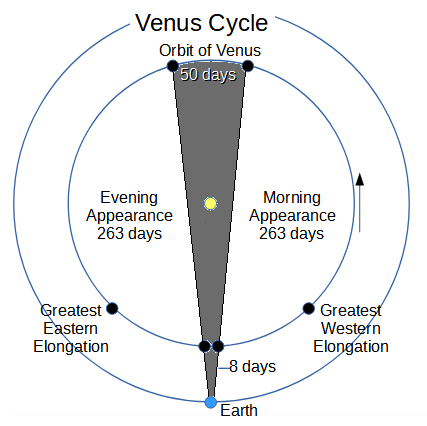
Tomorrow Venus will be in inferior conjunction with the Sun. That means that Venus will be moving between the Earth and the Sun, on its way from the evening sky to the morning sky. Venus’ orbit has an inclination to the Earth’s orbit of 3.4° and when we are closest to Venus as we are now only 26 million miles (42 million kilometers) away, that inclination gets exaggerated so that Venus is almost nine degrees north of the Sun. Venus gets about 8 million miles (13 million kilometers) closer to us than Mars ever gets. Of course when Mars gets that close it is fully illuminated. When Venus is at its closest we’re looking at its night side and couldn’t see anything even if we didn’t have the glare of the Sun.
The astronomical event times given are for the Traverse City/Interlochen area of Michigan (EDT, UT – 4 hours). Times will be different for other locations.
Addendum
Ephemeris: 03/20/2025 – Spring has sprung!
This is Ephemeris for Thursday, March 20th. Today the Sun will be up for 12 hours and 10 minutes, setting at 7:55, and it will rise tomorrow at 7:43. The Moon, 2 days before last quarter, will rise at 2:57 tomorrow morning.
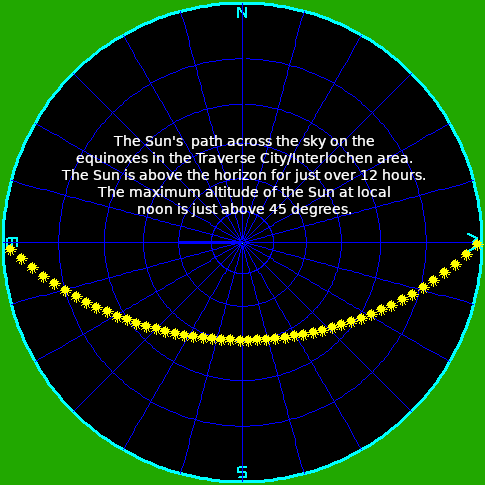
At 5:02 AM this morning the Sun passed overhead on the Earth’s equator heading northward beginning the season of spring. It is called the vernal or spring equinox also the March equinox if you didn’t care which hemisphere you lived in. Anyway, our daylight hours become longer and longer until June 21st the first day of summer. We have been seeing the effects of all this because all winter long the daylight hours have been getting longer and now in the last few weeks our temperatures have begun to rise, especially last Friday and Saturday. Along with the increased daylight hours the Sun is also getting higher in the sky giving us a more concentrated heating, it’s light and heat not being spread out as much as it was during the winter.
The astronomical event times given are for the Traverse City/Interlochen area of Michigan (EDT, UT – 4 hours). Times will be different for other locations.
Addendum
Ephemeris: 03/19/2025 – Suddenly there are only two planets visible in the evening
This is Ephemeris for Wednesday, March 19th. Today the Sun will be up for 12 hours and 7 minutes, setting at 7:54, and it will rise tomorrow at 7:45. The Moon, 3 days before last quarter, will rise at 1:53 tomorrow morning.
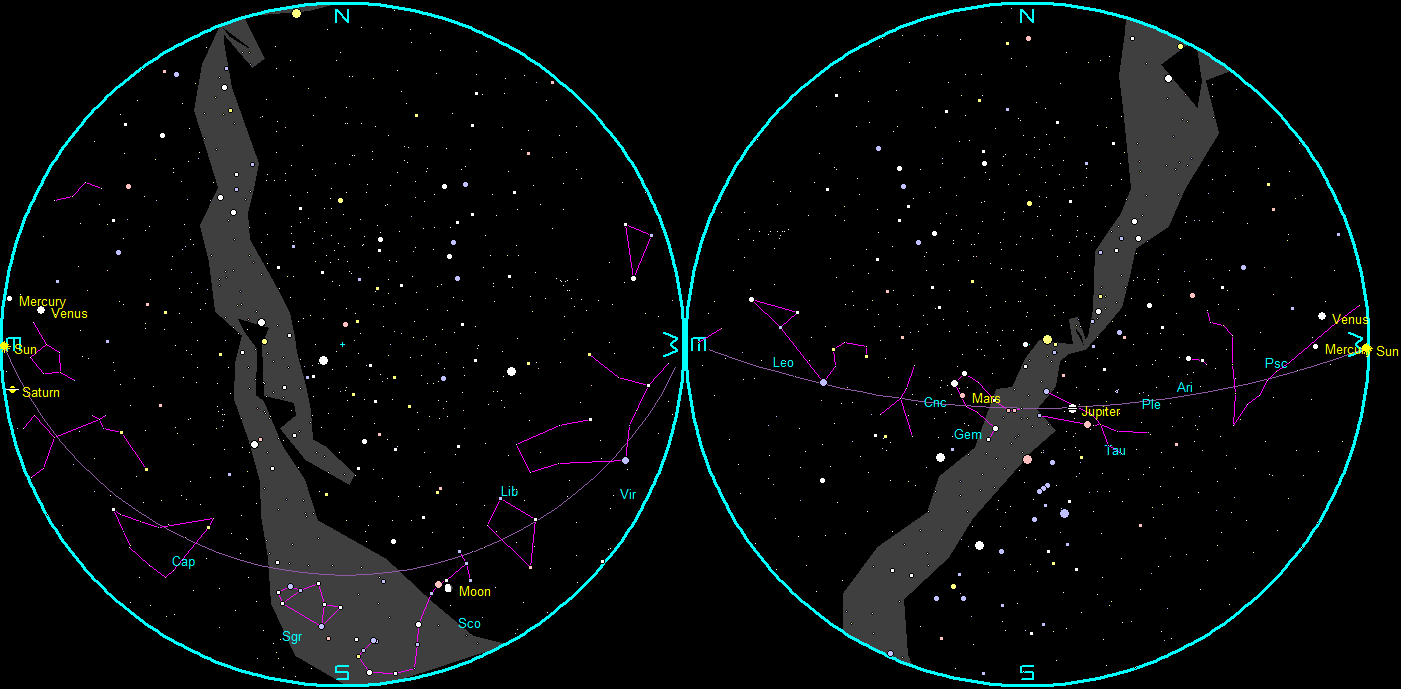
Let’s take our weekly look at the whereabouts of the naked-eye planets. At 9 PM this evening just two of the five naked eye planets will be out. Venus and Mercury are too close to the Sun in the twilight to be seen. Saturday and Monday Venus and then Mercury will pass between the Earth and the Sun to enter the morning sky. Jupiter, now becomes the brightest evening planet. It will be high in the southwest. Below it is the bright star Aldebaran with the stars of the Hyades, the face of Taurus the bull, and to the lower left, the great constellation of Orion, The rapidly fading Mars, with its distinctive reddish hue, is high in the south, with the stars Castor and Pollux in Gemini above it.
The astronomical event times given are for the Traverse City/Interlochen area of Michigan (EDT, UT – 4 hours). Times will be different for other locations.
Addendum
Ephemeris: 03/18/2025 – The Great Underwater Panther
This is Ephemeris for Tuesday, March 18th. Today the Sun will be up for 12 hours and 4 minutes, setting at 7:53, and it will rise tomorrow at 7:47. The Moon, halfway from full to last quarter, will rise at 12:47 tomorrow morning.
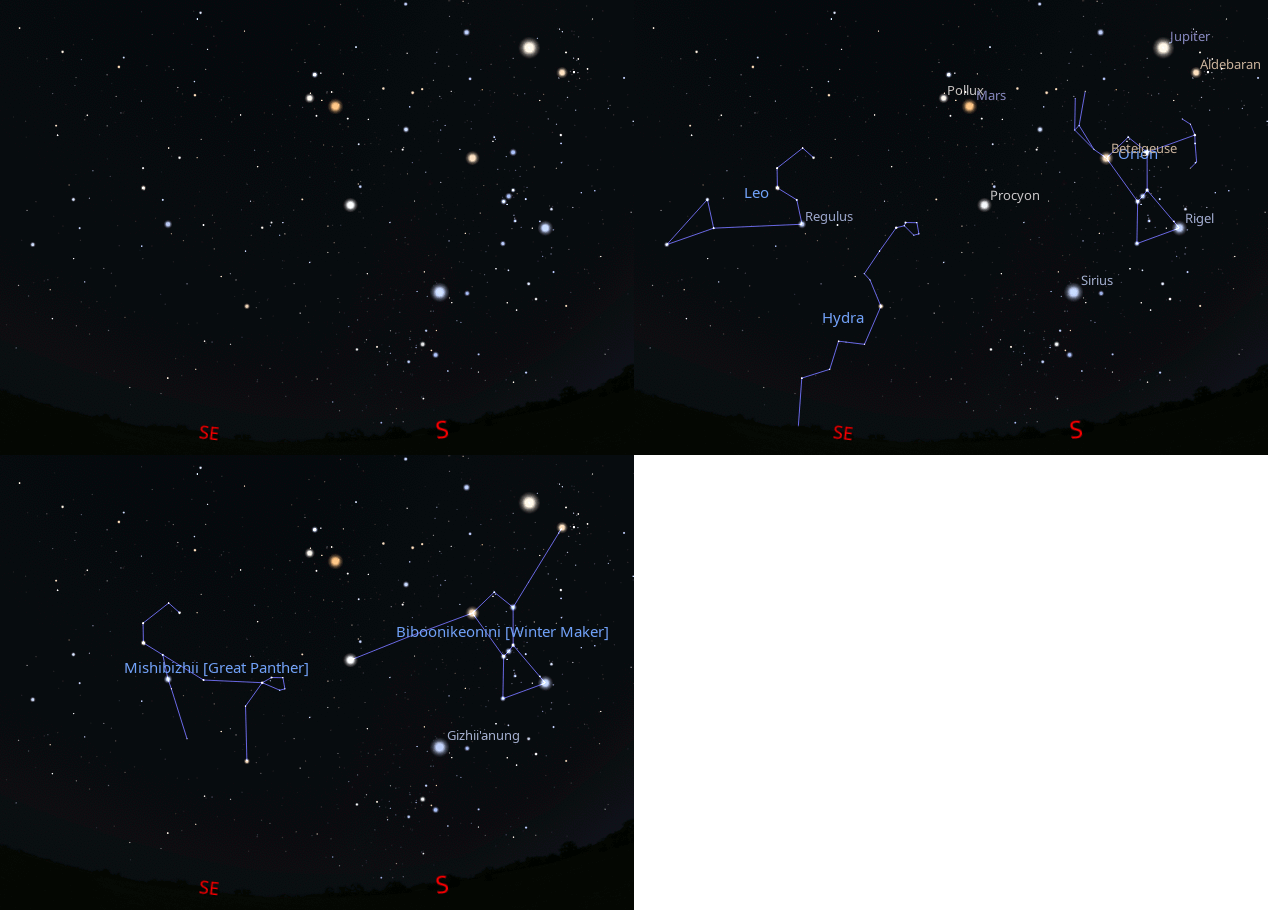
As Orion tilts into the southwest at 9 PM I’m reminded of our Anishinaabek native peoples here in Michigan who saw it as the Winter Maker slowly beginning to leave the scene in the southwest. At this time in the southeast is Curly Tail, the Great Panther. I first knew him as the Great Underwater Panther, which tells us where he lives… beneath the ice. He’s in the sky to warn us that the warmer weather of spring is coming, and the ice on the lakes and rivers is getting thin. Be careful to not fall through and drown, becoming a victim of the Great Panther. The stars of the panther include those of the head of Leo the lion the great backwards question mark, as his curly tail, to his head, the head of what we call Hydra the water snake.
The astronomical event times given are for the Traverse City/Interlochen area of Michigan (EDT, UT – 4 hours). Times will be different for other locations.
Addendum
 Bob Moler's Ephemeris Blog