Ephemeris: 04/07/2026 – The Artemis II crew made amazing observations of the Moon’s Far Side
This post was made late due to some WordPress posting issues last night.
This is Ephemeris for Tuesday, April 7th. Today the Sun will be up for 13 hours and 5 minutes, setting at 8:18, and it will rise tomorrow at 7:10. The Moon, 3 days before last quarter, will rise at 2:33 tomorrow morning.
Yesterday evening the Artemis 2 crew flew over the far side of the moon. The moon to us has a waning gibbous phase. The far side is actually a waxing crescent, so most of the far side was in night. They might have gotten a good look at Mare Orientale, which is right on the edge of the moon that we see from Earth. It is a double-walled sea that looks like a bulls eye. Now they’re on their way back to the earth and will splash down in the Pacific Ocean later this week. Unlike Apollo 8 which orbited the moon, they will not be flying over any proposed landing sites. They flew over the moon’s equator while Artemis 4 will attempt to land near the moon’s South Pole. Besides, the Lunar Reconnaissance Orbiter has surveyed it much better than they could have.
The astronomical event times given in this blog are for the Traverse City/Interlochen area of Michigan (Lat 44.7° N, Long 85.7° W; EST, UT – 5 hours) unless stated otherwise. Times will be different for other locations.
Addendum
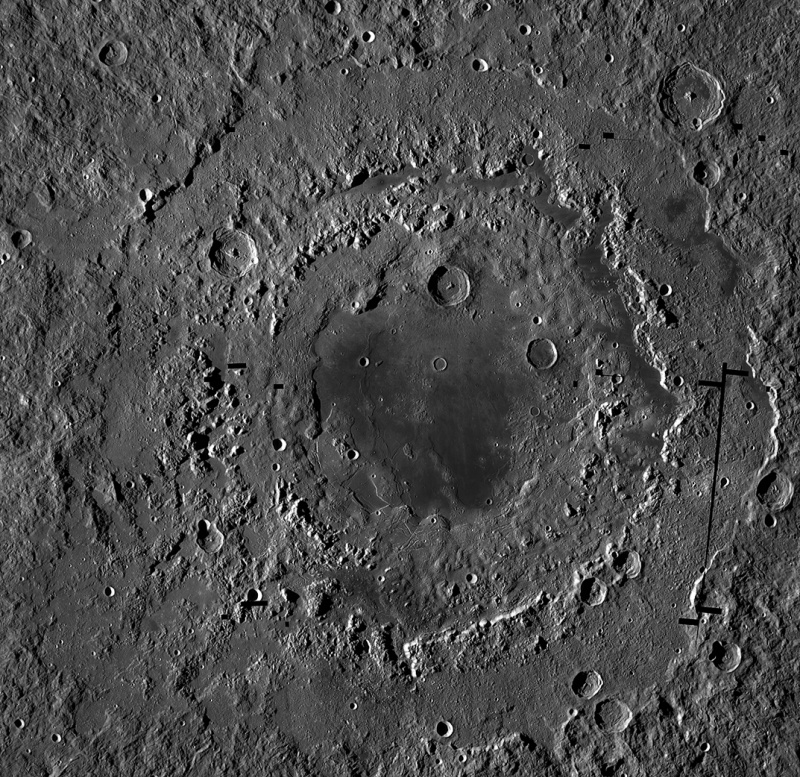
The script for the program seen above was written and recorded Sunday night April 5th before Artemis 2’s lunar flyby. This comment is made after the flyby on the late afternoon of April 6th. I speculated about Mare Orientale being something I wanted to have them investigate. And they did spend a great deal of time observing it, so we should expect some very nice photographs of it when they’re sent back. The image above is from the Lunar Reconnaissance Orbiter taken several years ago, at least. I find it a really cool feature.


Thank you, Bob, for your balanced comments.
I really appreciate them.
Other media are reporting about a “first solar eclipse observed from the moon”, when in fact it was merely a lunar occultation of the sun.
Or what they all claim to have “discovered”, even though the crew of Artemis II Integrity observed nothing what the Lunar Reconnaissance Orbiter or other space crafts hadn’t detected before; the crew simply observed the far side of the moon in it’s own shadow.
The same applies to the craters they have now christened and I am wondering if they were not bearing soviet names already.
Don’t get me wrong, I am excited to see the USA flying back to the moon with really brave people aboard, but the reporting of other media is just poor.
Kind regards from Cairo, Egypt
Michael Boebé
Hi Michael, thanks for the complement.
I agree about normal news coverage of the flyby of the moon. It seems that most major news outlets have fired all their science reporters so you’re left with people who don’t know anything about what they’re talking about. About the difference between eclipses and occultations, it’s an interesting question. Now I’m just a humble amateur astronomer, and to me, I find that the term eclipse is an imprecise one. While occultation is specific. That is one body being hidden by another body by being in front of it. Eclipse is a little bit different. We have, from the earth, solar eclipses and lunar eclipses. They are obviously different. The solar eclipse, to me the totality part of the solar eclipse is an occultation. And the other part is a transit. One body moving in front of the other but doesn’t completely hide it. In a lunar eclipse the moon enters the earth’s shadow, nothing is blocking it from our view it’s just not illuminated very well.
When observing Jupiter: when a moon ducks behind Jupiter it’s called an occultation, and when a moon is in Jupiter’s shadow it’s called an eclipse.
Then there are eclipsing variable stars. These are total or partial occultations.
As far as naming goes, space photography wasn’t that good back then (Late 50s, early 60s) Only the largest craters could be detected. The Soviets had only a few years advantage before the US Lunar Orbiters mapped both sides of the moon in much greater detail.
Hi Michael, thanks for the complement.
I agree about normal news coverage of the flyby of the moon. It seems that most major news outlets have fired all their science reporters so you’re left with people who don’t know anything about what they’re talking about. About the difference between eclipses and occultations, it’s an interesting question. Now I’m just a humble amateur astronomer, and to me, I find that the term eclipse is an imprecise one. While occultation is specific. That is one body being hidden by another body by being in front of it. Eclipse is a little bit different. We have, from the earth, solar eclipses and lunar eclipses. They are obviously different. The solar eclipse, to me the totality part of the solar eclipse is an occultation. And the other part is a transit. One body moving in front of the other but doesn’t completely hide it. In a lunar eclipse the moon enters the earth’s shadow, nothing is blocking it from our view it’s just not illuminated very well.
When observing Jupiter: when a moon ducks behind Jupiter it’s called an occultation, and when a moon is in Jupiter’s shadow it’s called an eclipse.
Then there are eclipsing variable stars. These are total or partial occultations.
As far as naming goes, space photography wasn’t that good back then (Late 50s, early 60s) Only the largest craters could be detected. The Soviets had only a few years advantage before the US Lunar Orbiters mapped both sides of the moon in much greater detail.