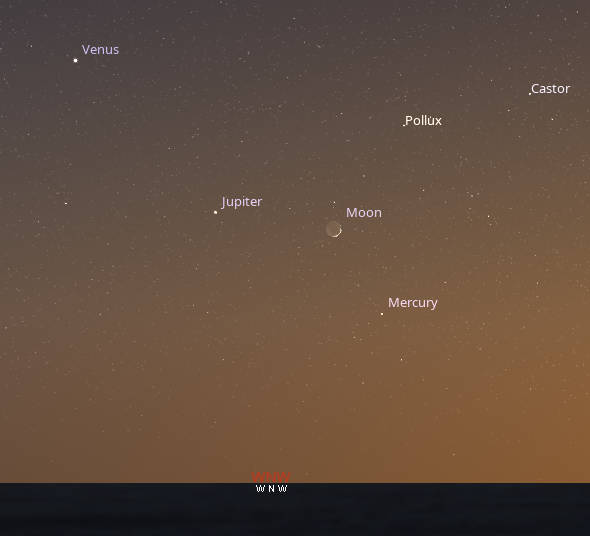
Ephemeris: 06/16/2026 – More pointers to help you find Mercury tonight
This is Bob Moler with Ephemeris for Tuesday, June 16th. Today the Sun will be up for 15 hours and 34 minutes, setting at 9:30, and it will rise tomorrow at 5:56. The Moon, 2 days past new, will set at 11:34 this evening.
The planet Mercury, which had its greatest elongation or separation east of the sun yesterday, is still visible in line with Venus and Jupiter down to the lower right. It is also below the thin crescent moon tonight. There are a couple of other stars which you might mistake for Mercury. They’re higher in the sky, above the Moon and to the upper right of Jupiter. These are some of our leftover winter stars, Castor and Pollux of Gemini. Pollux is the slightly brighter one and closer to Jupiter of the two. Mercury is below them. A pair of binoculars is really helpful in picking Mercury out from the twilight.It seems to increase the contrast between star-like objects from the background. Actually, binoculars make a great first telescope.
The astronomical event times given in this blog are for the Traverse City/Interlochen area of Michigan (Lat 44.7° N, Long 85.7° W; EDT, UT – 4 hours) unless stated otherwise. Times will be different for other locations.
Addendum