Archive
Ephemeris: 08/01/2025 – Preview August skies
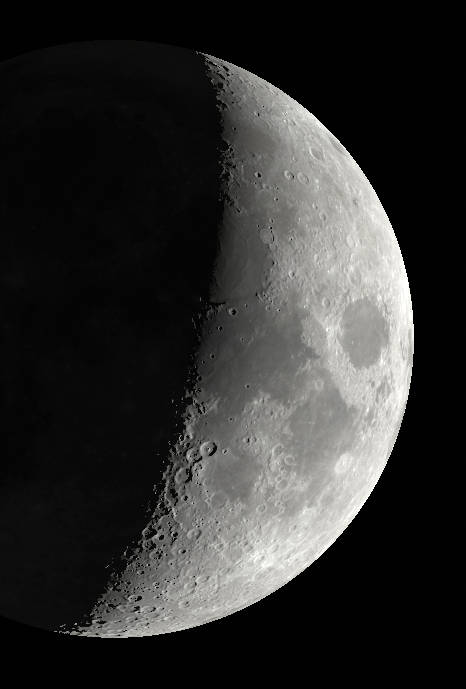
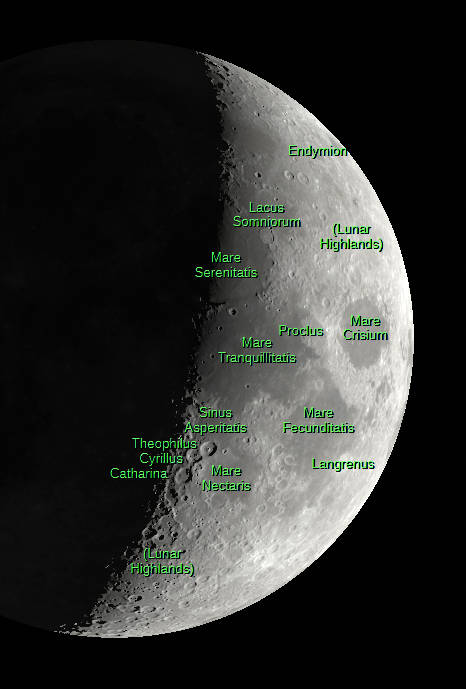
This is Bob Moler with Ephemeris for Friday, August 1st. Today the Sun will be up for 14 hours and 38 minutes, setting at 9:08, and it will rise tomorrow at 6:30. The Moon, at first quarter today, will set at 12:21 tomorrow morning.
Let’s look ahead at the month of August in the skies. Daylight hours will decrease from 14 hours and 38 minutes today to 13 hours 16 minutes on the 31st. The altitude of the Sun at local noon, that is, degrees of angle above the horizon, will decrease from 63 degrees today to just over 53 degrees on the 31st. Straits area listeners can subtract one more degree from those angles, but their daylight hours will be a few minutes longer. Local noon, when the Sun is due south, is about 1:43 p.m. The Perseid meteor shower will reach its peak on the afternoon of the12th. But, the waning gibbous Moon will interfere with all but the brightest meteors. So the best time to see them is after moonset in the morning for the next several days.
The astronomical event times given in this blog are for the Traverse City/Interlochen area of Michigan (Lat 44.7° N, Long 85.7° W; EDT, UT – 4 hours) unless stated otherwise. Times will be different for other locations.
Addendum
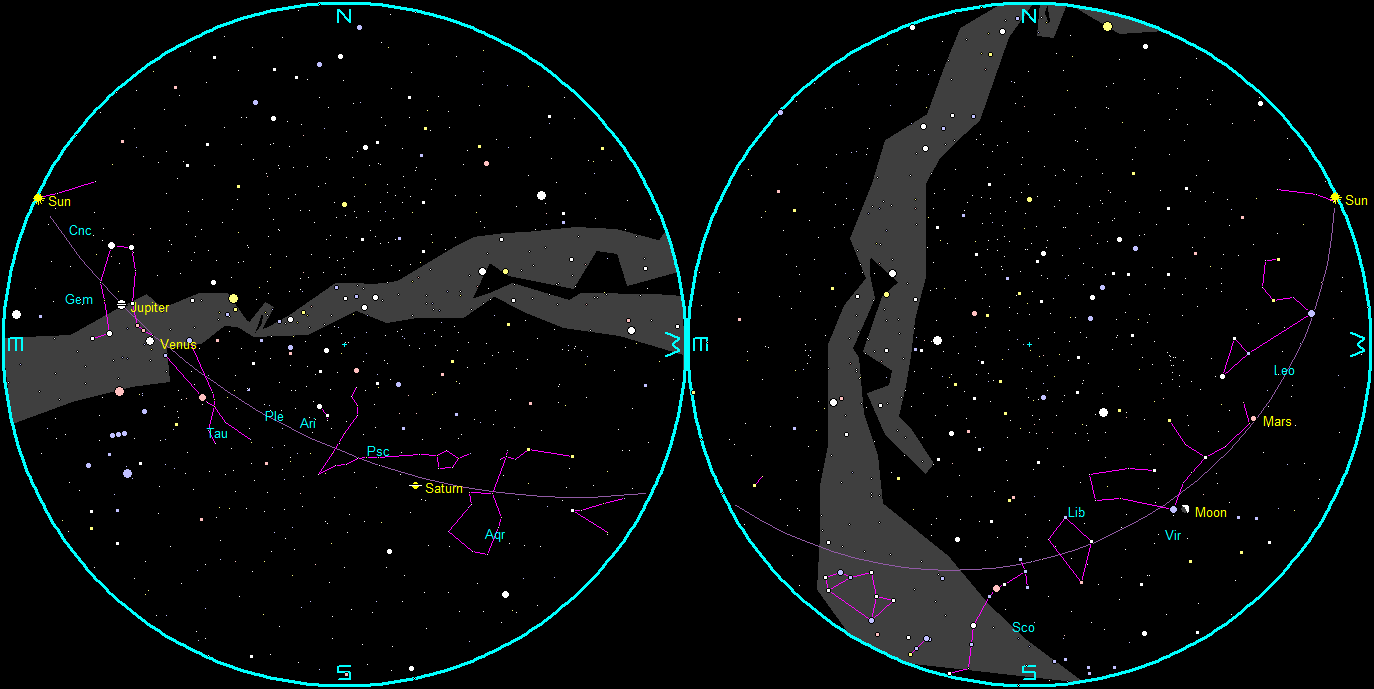
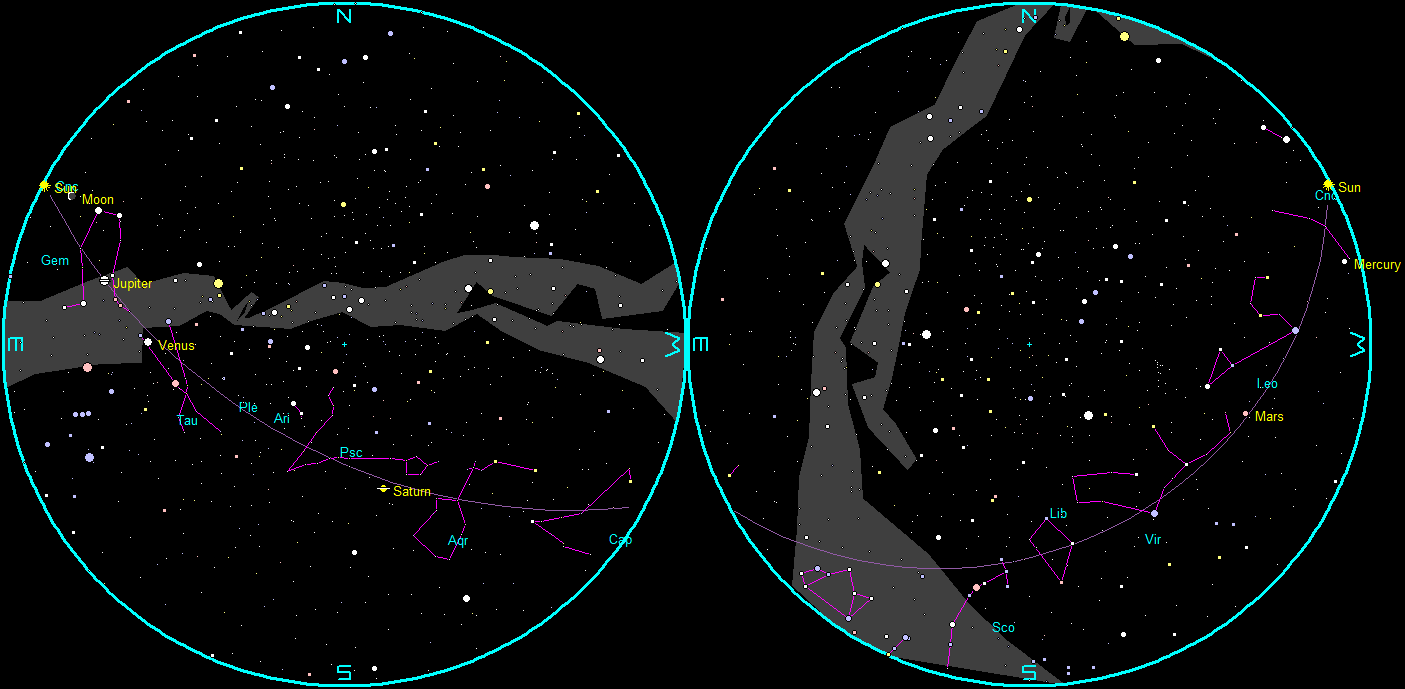
August Evening Star Chart
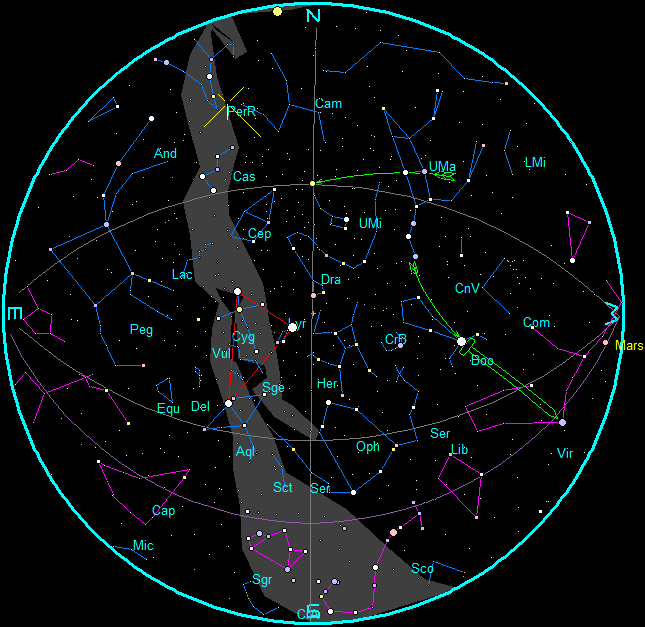
The planets and stars are plotted for the 15th at 10 pm EDT in the evening and 4:30 am on the 16th. These are the chart times. Note that Traverse City is located approximately 45 minutes behind our time meridian, West 75° longitude. (An hour 45 minutes behind our daylight saving time meridian during EDT). To duplicate the star positions on a planisphere you may have to set it to 1 hour 45 minutes earlier than the current time.
Note the chart times are for the mid-month. For each week before then, add ½ hour (28 minutes if you’re picky). For each week after then, subtract ½ hour. The planet positions are updated each Wednesday on this blog. See them for planet positions on dates other than the mid-month.
August Morning Star Chart
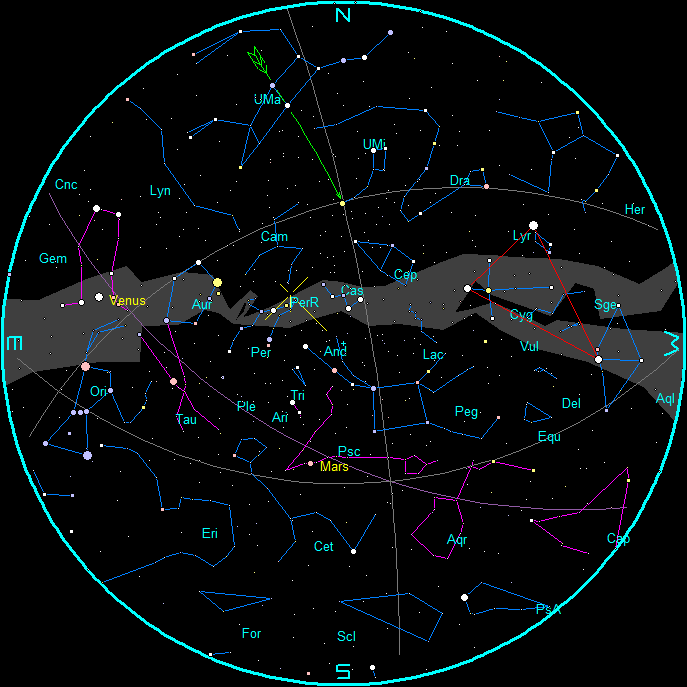
For a list of constellation names to go with the abbreviations, click here.
- Pointer stars at the front of the bowl of the Big Dipper point to Polaris, the North Star.
- Leaky dipper drips on Leo.
- Follow the arc of the handle of the Big Dipper to the star Arcturus, and
- Extend like a spike to Spica.
- The Summer Triangle is in red.
- PerR is the radiant of the Perseid meteor shower (Peaks on the afternoon of the 12th)
Twilight Limits, Nautical and Astronomical
| EDT | |||||||
| Morning | Twilight | Evening | Twilight | Dark | Night | Moon | |
| Date | Astro. | Nautical | Nautical | Astro. | Start | End | Illum. |
| 2025-08-01 | 4h27m | 5h16m | 22h26m | 23h15m | – | 4h27m | 0.57 |
| 2025-08-02 | 4h29m | 5h17m | 22h25m | 23h13m | 0h22m | 4h29m | 0.66 |
| 2025-08-03 | 4h31m | 5h19m | 22h23m | 23h10m | 0h50m | 4h31m | 0.75 |
| 2025-08-04 | 4h33m | 5h20m | 22h21m | 23h08m | 1h25m | 4h33m | 0.83 |
| 2025-08-05 | 4h35m | 5h22m | 22h20m | 23h06m | 2h10m | 4h35m | 0.90 |
| 2025-08-06 | 4h37m | 5h23m | 22h18m | 23h04m | 3h07m | 4h37m | 0.95 |
| 2025-08-07 | 4h39m | 5h24m | 22h16m | 23h02m | 4h14m | 4h39m | 0.99 |
| 2025-08-08 | 4h41m | 5h26m | 22h15m | 23h00m | – | – | 1.00 |
| 2025-08-09 | 4h43m | 5h27m | 22h13m | 22h58m | – | – | 0.99 |
| 2025-08-10 | 4h44m | 5h29m | 22h11m | 22h55m | – | – | 0.96 |
| 2025-08-11 | 4h46m | 5h30m | 22h09m | 22h53m | – | – | 0.90 |
| 2025-08-12 | 4h48m | 5h32m | 22h07m | 22h51m | – | – | 0.82 |
| 2025-08-13 | 4h50m | 5h33m | 22h05m | 22h49m | – | – | 0.72 |
| 2025-08-14 | 4h52m | 5h35m | 22h04m | 22h47m | 22h47m | 23h11m | 0.62 |
| 2025-08-15 | 4h54m | 5h36m | 22h02m | 22h44m | 22h44m | 23h41m | 0.50 |
| 2025-08-16 | 4h55m | 5h38m | 22h00m | 22h42m | 22h42m | – | 0.39 |
| 2025-08-17 | 4h57m | 5h39m | 21h58m | 22h40m | 22h40m | 0h20m | 0.28 |
| 2025-08-18 | 4h59m | 5h41m | 21h56m | 22h38m | 22h38m | 1h10m | 0.18 |
| 2025-08-19 | 5h01m | 5h42m | 21h54m | 22h36m | 22h36m | 2h13m | 0.11 |
| 2025-08-20 | 5h03m | 5h44m | 21h52m | 22h33m | 22h33m | 3h25m | 0.05 |
| 2025-08-21 | 5h04m | 5h45m | 21h50m | 22h31m | 22h31m | 4h42m | 0.01 |
| 2025-08-22 | 5h06m | 5h47m | 21h48m | 22h29m | 22h29m | 5h06m | 0.00 |
| 2025-08-23 | 5h08m | 5h48m | 21h46m | 22h27m | 22h27m | 5h08m | 0.01 |
| 2025-08-24 | 5h09m | 5h50m | 21h44m | 22h24m | 22h24m | 5h09m | 0.04 |
| 2025-08-25 | 5h11m | 5h51m | 21h42m | 22h22m | 22h22m | 5h11m | 0.09 |
| 2025-08-26 | 5h13m | 5h52m | 21h40m | 22h20m | 22h20m | 5h13m | 0.15 |
| 2025-08-27 | 5h15m | 5h54m | 21h38m | 22h18m | 22h18m | 5h15m | 0.23 |
| 2025-08-28 | 5h16m | 5h55m | 21h36m | 22h15m | 22h24m | 5h16m | 0.31 |
| 2025-08-29 | 5h18m | 5h57m | 21h34m | 22h13m | 22h49m | 5h18m | 0.40 |
| 2025-08-30 | 5h19m | 5h58m | 21h32m | 22h11m | 23h21m | 5h19m | 0.50 |
| 2025-08-31 | 5h21m | 5h59m | 21h30m | 22h09m | – | 5h21m | 0.59 |
Twilight calendar was generated using Cartes du Ciel (Sky Charts).
See my blog post: Twilight Zone for the definitions of the different periods of twilight here: https://bobmoler.wordpress.com/2018/09/27/.
NASA Calendar of Planetary Events
Aug  1  Fr            Venus: 38° W
     1  Fr   8:41 AM  First Quarter
     1  Fr   4:37 PM  Moon Apogee: 404200 km
     3  Su   9:40 PM  Moon-Antares: 0.6° N
     5  Tu   9:37 AM  Moon South Dec.: 28.5° S
     9  Sa   3:55 AM  Full Moon
    11  Mo  10:53 AM  Moon Ascending Node
    12  Tu   2:53 AM  Venus-Jupiter: 0.9° N
    12  Tu  11:05 AM  Moon-Saturn: 4.1° S
    12  Tu   3:47 PM  Perseid Shower: ZHR = 90
    14  Th   2:01 PM  Moon Perigee: 369300 km
    16  Sa   1:12 AM  Last Quarter
    16  Sa  12:09 PM  Moon-Pleiades: 0.9° S
    18  Mo  11:59 AM  Moon North Dec.: 28.6° N
    19  Tu  12:58 AM  Mercury-Beehive: 2.6° S
    19  Tu   5:59 AM  Mercury Elongation: 18.6° W
    19  Tu   5:05 PM  Moon-Jupiter: 4.9° S
    20  We   6:51 AM  Moon-Venus: 5° S
    20  We   8:07 AM  Moon-Pollux: 2.5° N
    21  Th   7:09 AM  Moon-Beehive: 2.1° S
    23  Sa   2:06 AM  New Moon
    24  Su  11:41 AM  Moon Descending Node
    26  Tu  12:41 PM  Moon-Mars: 3° N
    27  We   9:57 AM  Moon-Spica: 1.2° N
    29  Fr  11:34 AM  Moon Apogee: 404600 km
    31  Su   2:25 AM  First Quarter
    31  Su   5:55 AM  Moon-Antares: 0.7° N
    31  Su   1:59 PM  Venus-Beehive: 1.5° S
Sep  1  Mo            Venus: 31.2° W
Planetary Events Calendar by Fred Espenak and Sumit Dutta (NASA’s GSFC),
http://eclipse.gsfc.nasa.gov/SKYCAL/SKYCAL.html.
If you go to the above site, you can print out a list like the above for the entire year or calendar pages for your time zone.
Sun and Moon Rising and Setting Events
LU                  Ephemeris of Sky Events for Interlochen/TC
August, 2025    Local time zone: EDT
+-----------------------------------------------------------------------+
| DATE |  SUN     SUN  DAYLIGHT|   TWILIGHT*    |MOON  RISE OR    ILLUM |
|      |  RISE    SET    HOURS |  END    START  |PHASE SET** TIME FRACTN|
+=======================================================================+
|Fri  1| 06:29a  09:08p  14:38 | 10:23p  05:13a |F Qtr Set  12:21a   54%|
|Sat  2| 06:30a  09:06p  14:36 | 10:21p  05:15a |      Set  12:49a   64%|
+------+-----------------------+----------------+-----------------------+
|Sun  3| 06:31a  09:05p  14:33 | 10:20p  05:16a |      Set  01:24a   73%|
|Mon  4| 06:32a  09:04p  14:31 | 10:18p  05:18a |      Set  02:10a   81%|
|Tue  5| 06:33a  09:02p  14:28 | 10:16p  05:19a |      Set  03:06a   88%|
|Wed  6| 06:35a  09:01p  14:26 | 10:14p  05:21a |      Set  04:13a   94%|
|Thu  7| 06:36a  09:00p  14:23 | 10:13p  05:22a |      Set  05:26a   98%|
|Fri  8| 06:37a  08:58p  14:21 | 10:11p  05:24a |      Set  06:42a  100%|
|Sat  9| 06:38a  08:57p  14:18 | 10:09p  05:25a |Full  Rise 09:26p   99%|
+------+-----------------------+----------------+-----------------------+
|Sun 10| 06:39a  08:55p  14:15 | 10:07p  05:27a |      Rise 09:47p   97%|
|Mon 11| 06:40a  08:54p  14:13 | 10:05p  05:28a |      Rise 10:06p   91%|
|Tue 12| 06:42a  08:52p  14:10 | 10:04p  05:30a |      Rise 10:26p   84%|
|Wed 13| 06:43a  08:51p  14:07 | 10:02p  05:31a |      Rise 10:47p   75%|
|Thu 14| 06:44a  08:49p  14:05 | 10:00p  05:33a |      Rise 11:11p   64%|
|Fri 15| 06:45a  08:48p  14:02 | 09:58p  05:34a |      Rise 11:41p   53%|
|Sat 16| 06:46a  08:46p  13:59 | 09:56p  05:36a |L Qtr Rise 12:19a   41%|
+------+-----------------------+----------------+-----------------------+
|Sun 17| 06:47a  08:44p  13:56 | 09:54p  05:37a |      Rise 01:10a   30%|
|Mon 18| 06:49a  08:43p  13:54 | 09:52p  05:39a |      Rise 02:12a   20%|
|Tue 19| 06:50a  08:41p  13:51 | 09:50p  05:40a |      Rise 03:25a   12%|
|Wed 20| 06:51a  08:39p  13:48 | 09:48p  05:42a |      Rise 04:41a    6%|
|Thu 21| 06:52a  08:38p  13:45 | 09:46p  05:43a |      Rise 05:57a    2%|
|Fri 22| 06:53a  08:36p  13:42 | 09:44p  05:45a |      Rise 07:10a    0%|
|Sat 23| 06:55a  08:34p  13:39 | 09:42p  05:46a |New   Set  08:54p    1%|
+------+-----------------------+----------------+-----------------------+
|Sun 24| 06:56a  08:33p  13:36 | 09:41p  05:47a |      Set  09:11p    3%|
|Mon 25| 06:57a  08:31p  13:33 | 09:39p  05:49a |      Set  09:27p    8%|
|Tue 26| 06:58a  08:29p  13:31 | 09:37p  05:50a |      Set  09:44p   14%|
|Wed 27| 06:59a  08:27p  13:28 | 09:35p  05:52a |      Set  10:02p   21%|
|Thu 28| 07:00a  08:26p  13:25 | 09:33p  05:53a |      Set  10:23p   29%|
|Fri 29| 07:02a  08:24p  13:22 | 09:31p  05:55a |      Set  10:48p   38%|
|Sat 30| 07:03a  08:22p  13:19 | 09:29p  05:56a |      Set  11:20p   47%|
+------+-----------------------+----------------+-----------------------+
|Sun 31| 07:04a  08:20p  13:16 | 09:27p  05:57a |F Qtr Set  12:01a   57%|
+-----------------------------------------------------------------------+
* Nautical Twilight
** Moonrise or moonset, whichever occurs between sunset and sunrise
Generated using my LookingUp for DOS app.
Ephemeris: 07/31/2025 – The Perseids are coming
This is Bob Moler with Ephemeris for Thursday, July 31st. Today the Sun will be up for 14 hours and 41 minutes, setting at 9:09, and it will rise tomorrow at 6:29. The Moon, 1 day before first quarter, will set at 11:59 this evening.
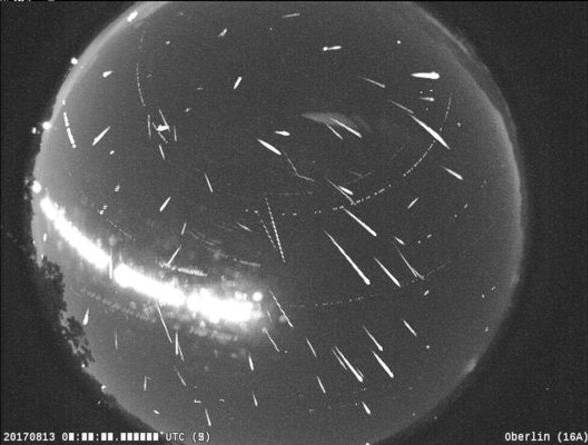
Over the past couple of weeks folks who are outdoors after the Moon sets in the morning might have been seeing some shooting stars or meteors appearing to zip through the sky. The ones I’m talking about seem to come from the northeast. These are the precursors of the Perseid meteor shower which will reach its peak on the mornings of August 12 and 13 this year with the interference of a bright Moon. Over the millennia the meteoroid stream that feeds the meteors to our skies has spread out to last over a month from the latter half of July to three-quarters of August. I try to use the proper terminology for all this. A meteoroid is the tiny body in space. In the Perseid’s case the size of a grain of sand to a pea. Meteor is the streak we see in the sky as it burns up. A meteorite is the body that makes it to the ground. To my knowledge no Perseid has made it that far.
The astronomical event times given in this blog are for the Traverse City/Interlochen area of Michigan (Lat 44.7° N, Long 85.7° W; EDT, UT – 4 hours) unless stated otherwise. Times will be different for other locations.
Addendum
Ephemeris: 07/30/2025 – Taking our weekly look at the Moon and the naked-eye planets
This is Ephemeris for Wednesday, July 30th. Today the Sun will be up for 14 hours and 43 minutes, setting at 9:10, and it will rise tomorrow at 6:28. The Moon, 2 days before first quarter, will set at 11:40 this evening.
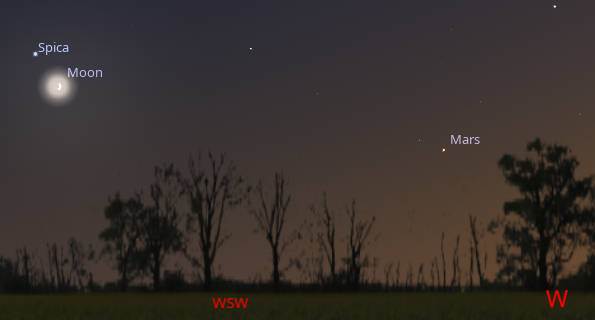
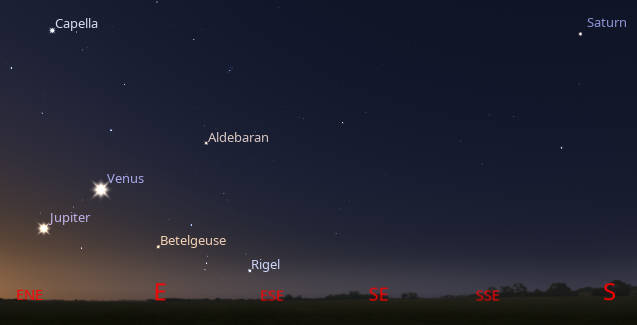
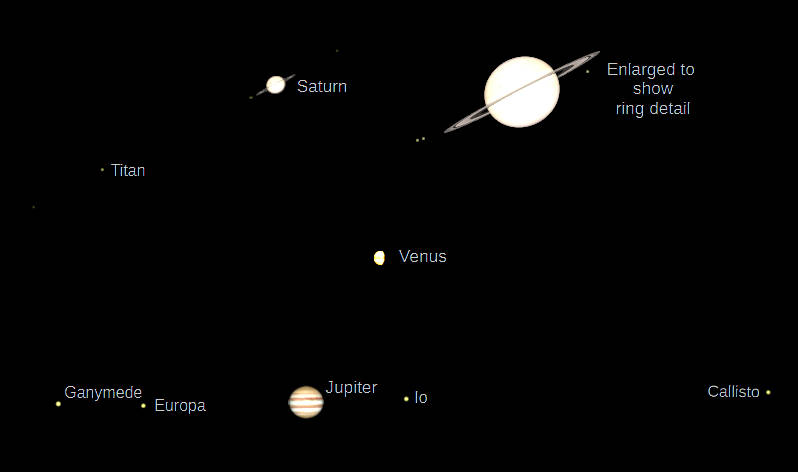
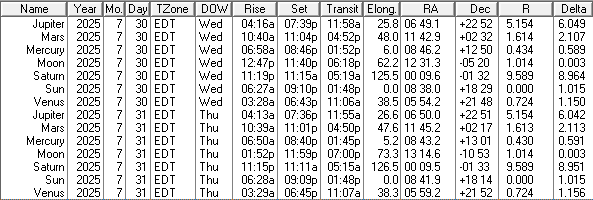
Let’s take our weekly look at the whereabouts of the naked-eye planets. The Red Planet Mars, will be seen low in the western sky at 10:15 PM. Mars is moving toward Spica, higher in the west-southwest, which will be above the Moon tonight. Mars will pass Spica on September 12th. By then they will be too low in the sky to be seen in twilight. Saturn now rises at 11:15 PM in the east. When I had my first telescope, eagerly waiting for Saturn to rise, I had to wait more than a half hour to get a sharp image of it. By 5:30 AM Saturn will be high in the south, when our winter pal Orion will be rising. Venus will rise at 3:29 AM in the east-northeast and will be higher in the east by 5:30. Jupiter will be below and left of Venus.
The astronomical event times given in this blog are for the Traverse City/Interlochen area of Michigan (Lat 44.7° N, Long 85.7° W; EDT, UT – 4 hours) unless stated otherwise. Times will be different for other locations.
Addendum
Ephemeris: 07/29/2025 – Altair, the nearest Summer Triangle star
This is Ephemeris for Tuesday, July 29th. Today the Sun will be up for 14 hours and 45 minutes, setting at 9:11, and it will rise tomorrow at 6:27. The Moon, 3 days before first quarter, will set at 11:23 this evening.
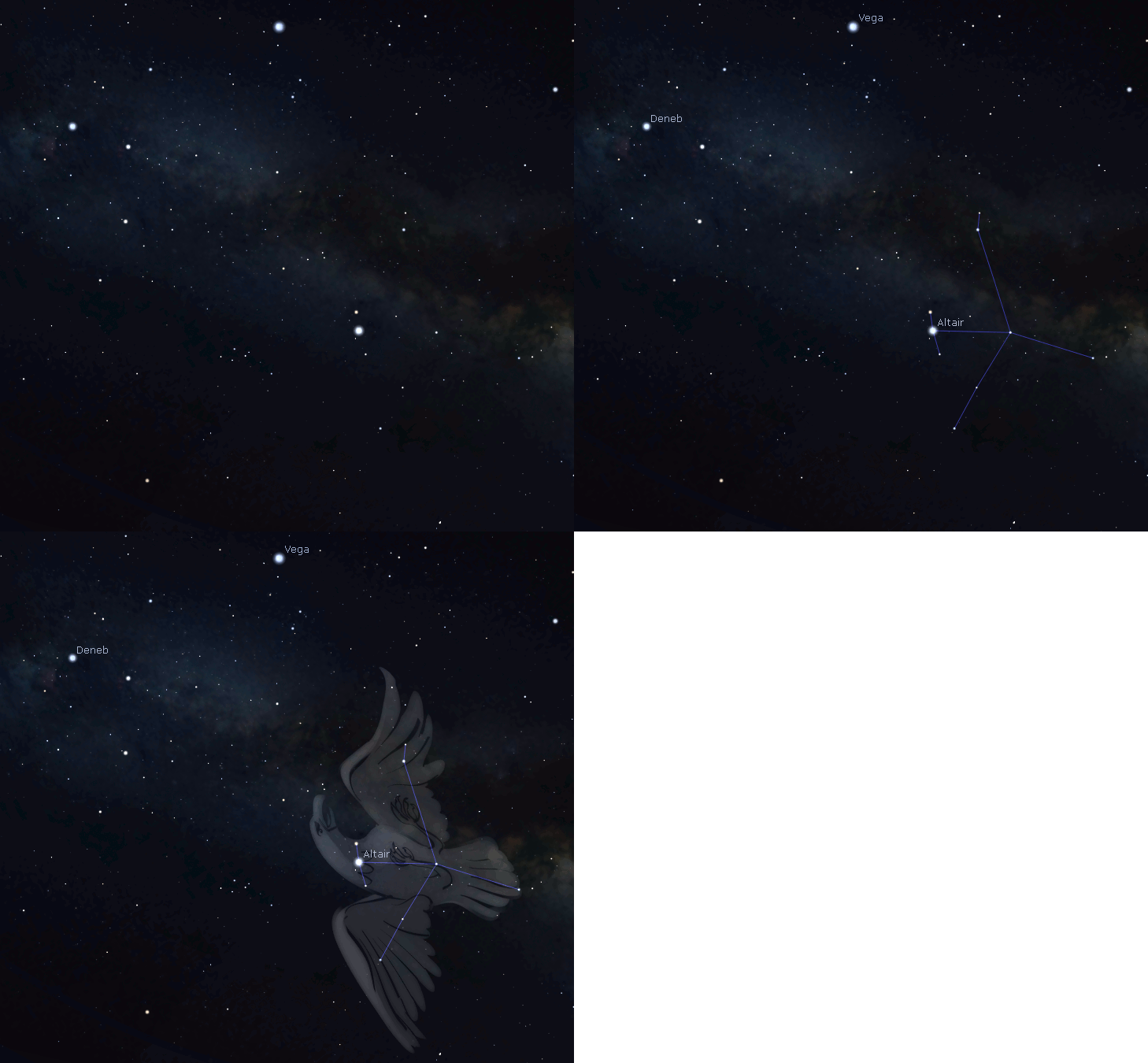
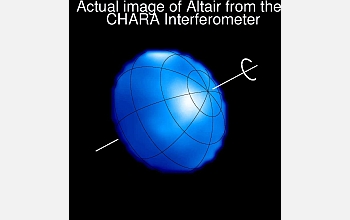
The southernmost star of the Summer Triangle is Altair, high in the east-southeast. The other two stars of the triangle are Vega nearly overhead in the east, and Deneb high in the east-northeast. Altair is the nearest of the three at a distance of 16.7 light years away. One light year is nearly 6 trillion miles. Altair is 10 times the brightness of the Sun. If seen at Altair’s distance, the Sun would only be as bright as one of the two stars that flank it. What is rather different about Altair is its rapid rotation. While it’s almost twice the sun’s diameter, it rotates once in about 9 hours, The CHARA Interferometer at Mt. Wilson has actually imaged its squashed disk in the infrared. Our Sun’s a slow poke, taking nearly a month to rotate once.
The astronomical event times given in this blog are for the Traverse City/Interlochen area of Michigan (Lat 44.7° N, Long 85.7° W; EDT, UT – 4 hours) unless stated otherwise. Times will be different for other locations.
Addendum
Ephemeris: 07/28/2025 – Deneb, a truly brilliant star
This is Ephemeris for Monday, July 28th. Today the Sun will be up for 14 hours and 48 minutes, setting at 9:12, and it will rise tomorrow at 6:26. The Moon, halfway from new to first quarter, will set at 11:06 this evening.
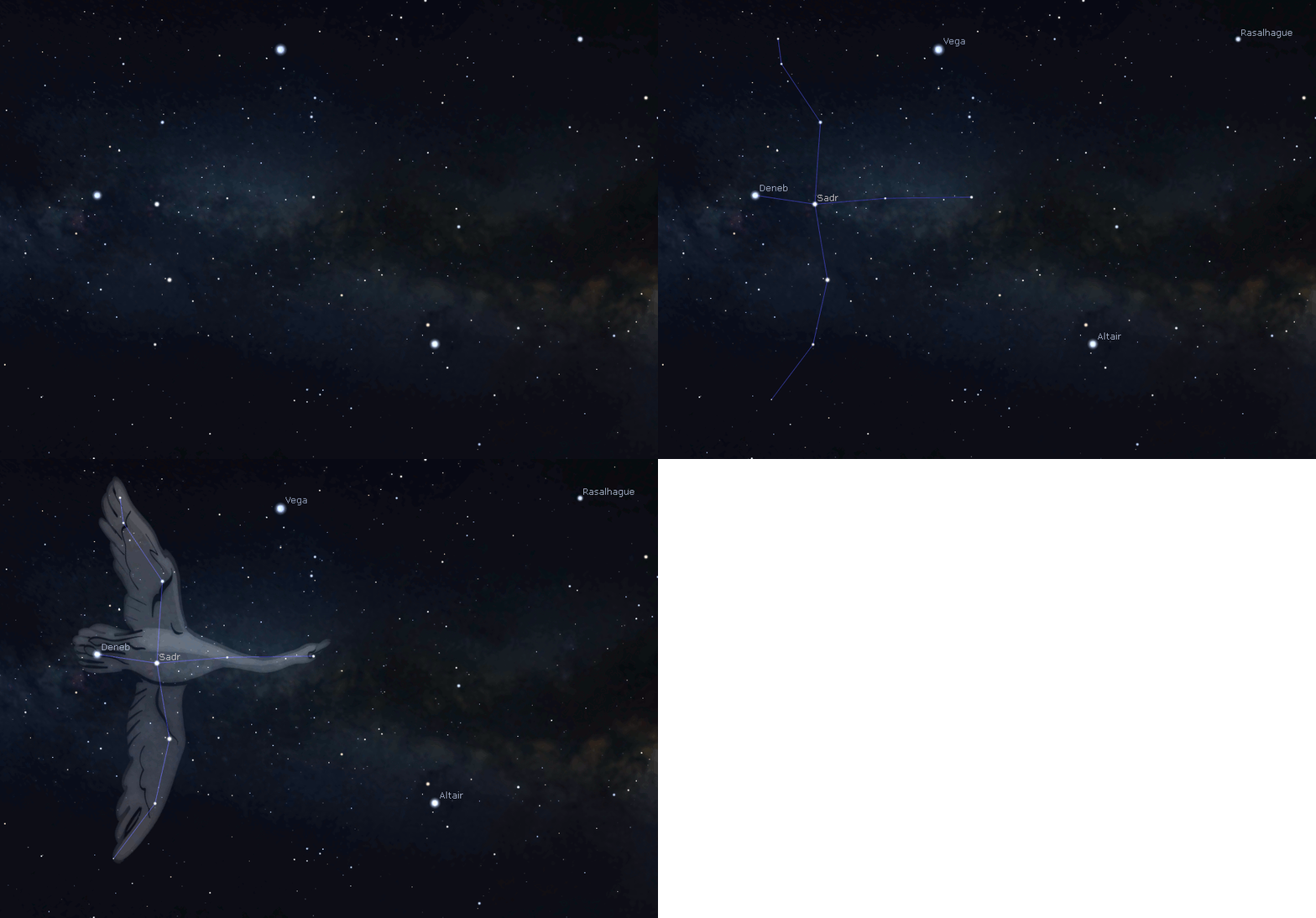
This evening when it gets dark enough the bright star Deneb in Cygnus the swan will be high in the east-northeast. Deneb is the dimmest star of the summer triangle. Of the other stars of the triangle, Vega is higher in the east, while Altair is lower in the southeast. Deneb’s apparent magnitude, or brightness as seen from Earth, is deceptive. Its vast distance of possibly 2,600 light years is over 100 times the distance of Vega. If brought as close as Vega, Deneb would be almost as bright as the quarter moon. It is possibly as bright as 200 thousand Suns; and a huge star, possibly as large as half the diameter of Earth’s orbit. For all this, it is only 19 to 25 times the mass of the Sun.
The astronomical event times given in this blog are for the Traverse City/Interlochen area of Michigan (Lat 44.7° N, Long 85.7° W; EDT, UT – 4 hours) unless stated otherwise. Times will be different for other locations.
Addendum
Ephemeris: 07/25/2025 – Star Party tomorrow night
This is Ephemeris for Friday, July 25th. Today the Sun will be up for 14 hours and 54 minutes, setting at 9:16, and it will rise tomorrow at 6:22. The Moon, 1 day past new, will set at 10:09 this evening.
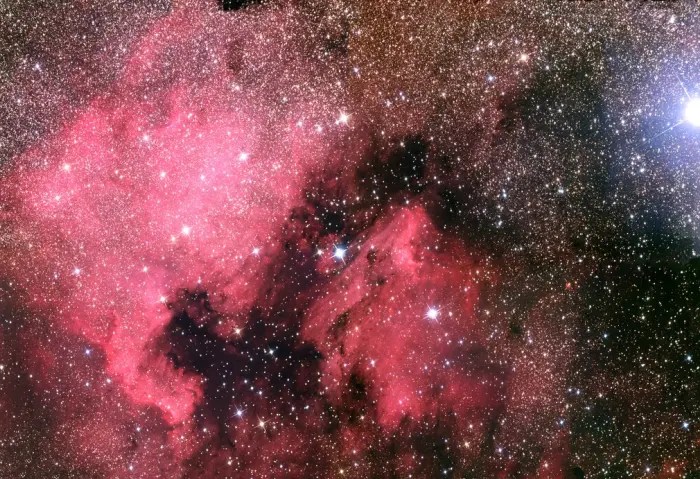
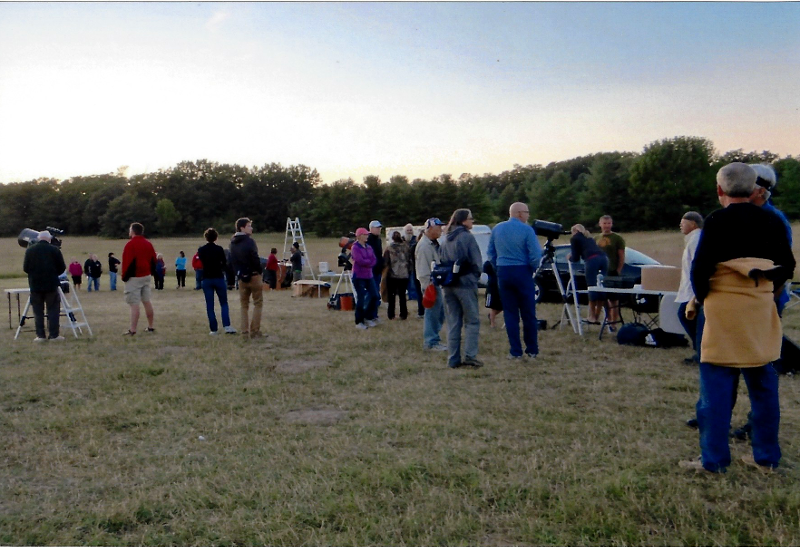
Weather permitting, the Grand Traverse Astronomical Society and the Park Rangers will host a star party at Sleeping Bear Dunes National Lakeshore, at the Dune Climb tomorrow night, starting around 9:00 PM. The parking lane closest to the dune will be blocked off for telescopes. Note… the start time is before actual sunset, however the brighter stars will be visible by 9:45. Also on tap will be binary stars, an interesting treat through the telescope. Then, as it gets darker some of the brighter interstellar wonders will appear. The Rangers leave around 11:00 PM however if it stays clear and there’s enough interest, society members with their telescopes will stay longer. Another star party is planned at the Dunes this summer, on August 23rd.
The astronomical event times given in this blog are for the Traverse City/Interlochen area of Michigan (Lat 44.7° N, Long 85.7° W; EDT, UT – 4 hours) unless stated otherwise. Times will be different for other locations.
Addendum
Ephemeris: 07/24/2025 – Vega, nearing the zenith in the evening now
This is Ephemeris for Thursday, July 24th. Today the Sun will be up for 14 hours and 56 minutes, setting at 9:17, and it will rise tomorrow at 6:21. The Moon is new today, and won’t be visible.
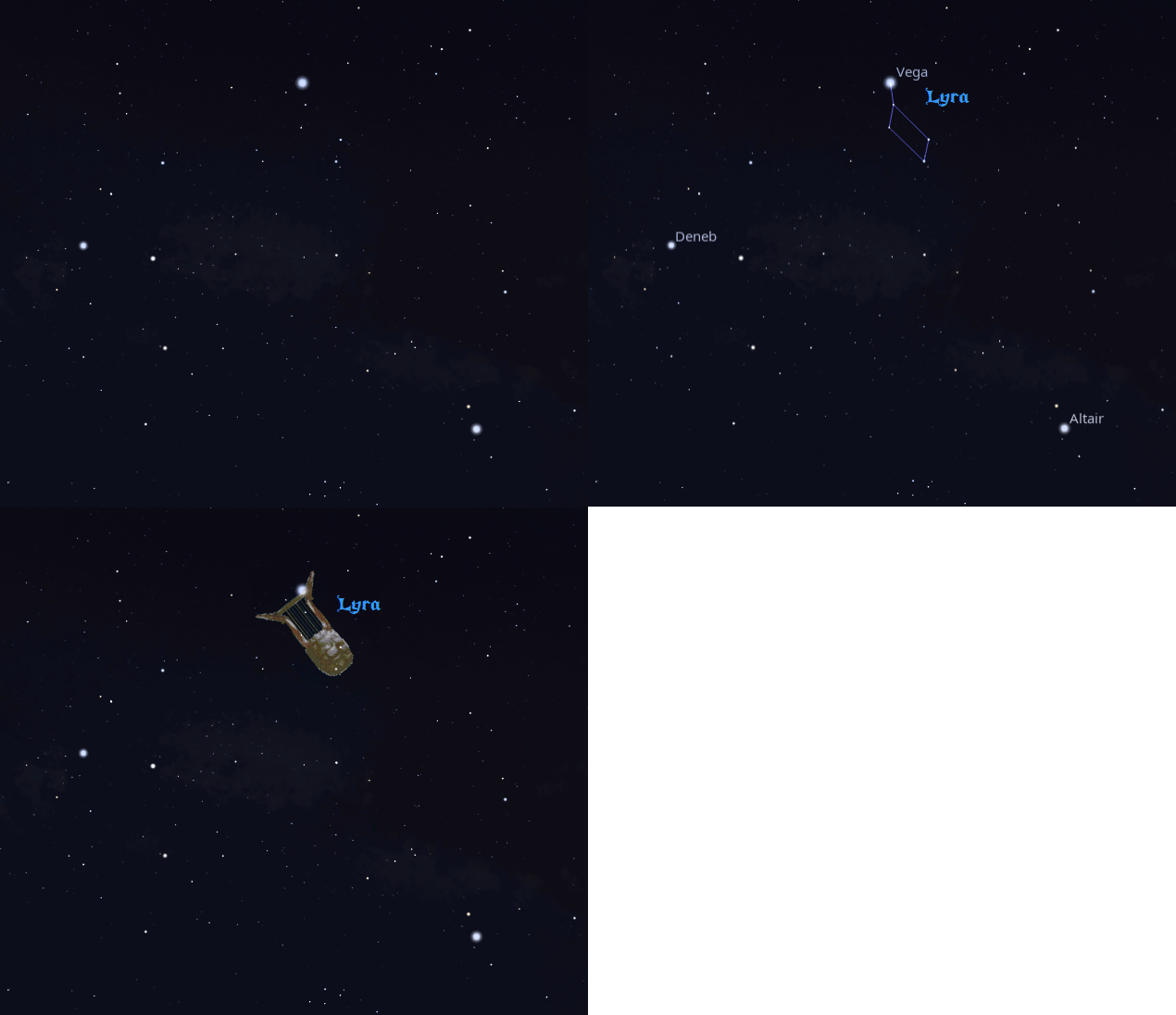
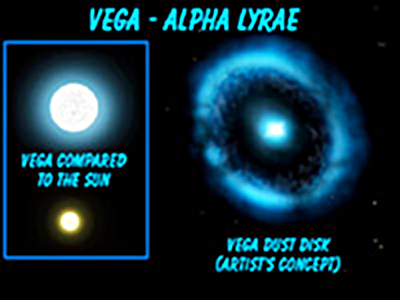
Vega, in the constellation Lyra the harp, is the highest bright star In the east and brightest star of the Summer Triangle also rising in that direction. It is an important and much studied star, first as a standard for brightness for the magnitude scale at almost exactly zero. In 1983 the Infrared Astronomy Satellite, IRAS, discovered an excess of infrared radiation coming from the star. It seems now that there are two orbiting rings around the star, an inner warm ring and an outer cold ring. This is somewhat like the two disks of material the Sun has: The asteroid belt between Mars and Jupiter and the Kuiper belt, beyond Neptune. No planets have yet been discovered around Vega, but I wouldn’t bet against it.
The astronomical event times given in this blog are for the Traverse City/Interlochen area of Michigan (Lat 44.7° N, Long 85.7° W; EDT, UT – 4 hours) unless stated otherwise. Times will be different for other locations.
Addendum
Ephemeris: 07/23/2025 – Our weekly look at the whereabouts of the naked-eye planets
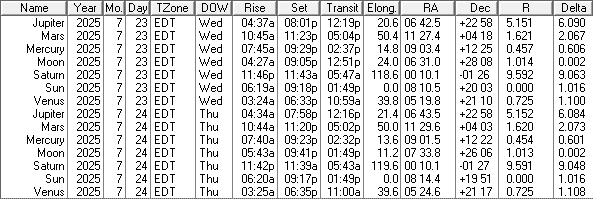
This is Ephemeris for Wednesday, July 23rd. Today the Sun will be up for 14 hours and 58 minutes, setting at 9:18, and it will rise tomorrow at 6:20. The Moon, 1 day before new, will rise at 5:43 tomorrow morning.
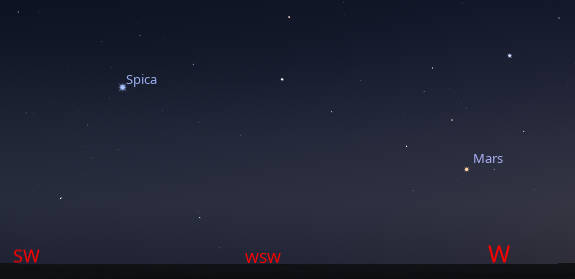
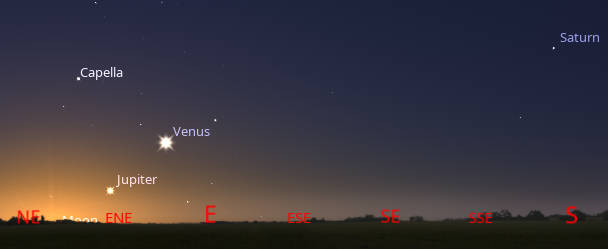
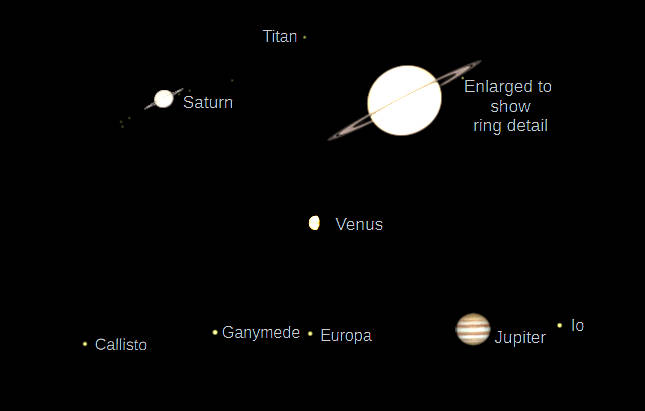
Let’s take our weekly look at the whereabouts of the naked-eye planets. The Red Planet Mars, will be seen low in the western sky at 10:30 PM. Mars is moving toward Spica, higher in the southwest. It will pass above Spica on September 12th. Mars moves much faster against the background stars than the more distant Jupiter and Saturn. Speaking of Saturn, it now rises just before midnight at just about due east, and by 5:30 AM will be high in the south. Venus will rise at 3:25 AM in the east-northeast and will be higher in that general direction by 5:30. Jupiter will be below and left of it then. That they will appear among the winter stars will become more apparent in the next few weeks.
The astronomical event times given in this blog are for the Traverse City/Interlochen area of Michigan (Lat 44.7° N, Long 85.7° W; EDT, UT – 4 hours) unless stated otherwise. Times will be different for other locations.
Addendum
Ephemeris: 07/22/2025 – It’s Pi Approximation Day!*
* I’d want to call it “Pi Fractured Fraction Day.”
This is Ephemeris for Pi Approximation Day, Tuesday, July 22nd. Today the Sun will be up for 15 hours exactly, setting at 9:19, and it will rise tomorrow at 6:19. The Moon, 2 days before new, will rise at 4:27 tomorrow morning.
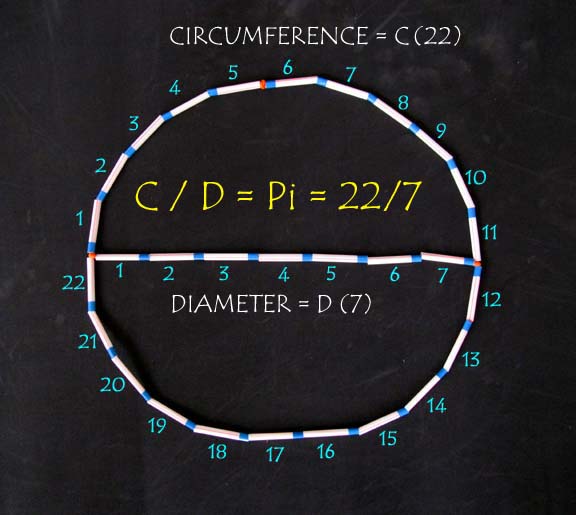
So why is July 22nd Pi Approximation Day? Pi being the Greek letter that represents, mathematically, the ratio of a circle’s diameter to its circumference. Well, we had Pi Day on March 14th or 3.14. Today represents the fractional way of getting to Pi, twenty-two sevenths for July 22nd. In Europe, it’s 22/7, rather how we in America write the date 7/22. I’ve never approximated pi that way. It’s one of those dreaded fractions I learned about in grade school, and to boot it’s an improper fraction. The Bible has a thing for the numbers 7, 40 and a thousand. Also, pi being equal to three. In First Kings, chapter 7, verse 23 it talks about a vessel with a diameter of 10 cubits and a circumference of 30 cubits. A very rough approximation.
The astronomical event times given in this blog are for the Traverse City/Interlochen area of Michigan (Lat 44.7° N, Long 85.7° W; EDT, UT – 4 hours) unless stated otherwise. Times will be different for other locations.
Addendum
Ephemeris: 07/21/2025 – When our knowledge of the size of the universe expanded
This is Ephemeris for Monday, July 21st. Today the Sun will be up for 15 hours and 2 minutes, setting at 9:20, and it will rise tomorrow at 6:18. The Moon, 3 days before new, will rise at 3:18 tomorrow morning.
A little over 100 years ago astronomers the Milky Way and the surrounding stars were thought to be the entire universe. A universe which was, apparently, disc shaped. Astronomers photographed examples of objects they called spiral nebulae, which they thought belonged to the Milky Way. Then Edwin Hubble photographed stars in the Andromeda spiral nebula. One star changed brightness in a way like some of the stars we know in our Milky Way. These stars are called Cepheid Variables and the rate of variation in brightness is related to their true brightness. This star that Hubble found was much too dim and much too far away to be in the confines of the Milky Way. Soon we found that we are in a spiral nebula or galaxy, like billions of others.
The astronomical event times given in this blog are for the Traverse City/Interlochen area of Michigan (Lat 44.7° N, Long 85.7° W; EDT, UT – 4 hours) unless stated otherwise. Times will be different for other locations.
Addendum
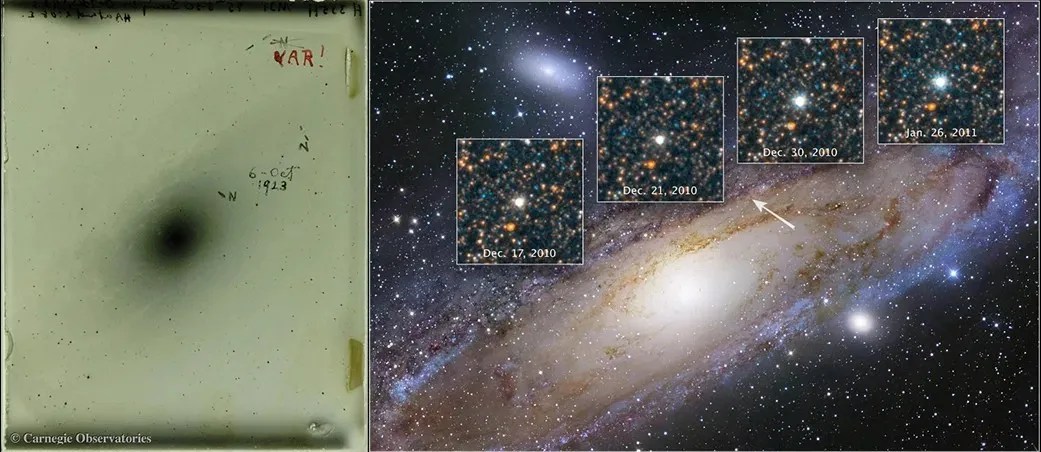
Left: Carnegie Observatories. Right: NASA, ESA, and the Hubble Heritage Team (STScI/AURA); Acknowledgment: R. Gendler
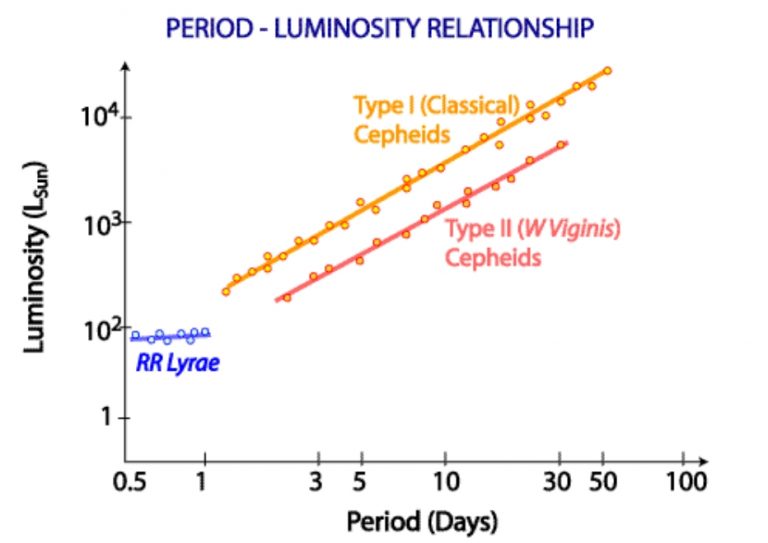
The universe “expanded” again, when astronomers found out there were two types of Cepheids, one 4 times brighter than the other. Using the brighter Type I Cepheids, the measurement doubled the estimated distance*. This was about the time in the early 1950s when I was getting interested in astronomy, so the quoted distance to Andromeda and all the other galaxies doubled from older astronomy books to the newer ones.
* Inverse square law: brightness drops with the square of the distance. Double the distance and the brightness drops by 22 or 4.
 Bob Moler's Ephemeris Blog