Archive
Ephemeris: 03/16/2026 – The Big Dipper as seen from other places
This is Ephemeris for Monday, March 16th. Today the Sun will be up for 11 hours and 57 minutes, setting at 7:50, and it will rise tomorrow at 7:51. The Moon, 2 days before new, will rise at 7:14 tomorrow morning.
The Big Dipper is ascending in the northeastern sky this evening when it gets dark, it’s seven stars shining brightly. The Big Dipper is not an actual constellation, recognized internationally. It’s part, the hind part, of Ursa Major, the great bear. The Big Dipper is an asterism or informal constellation. It is a distinctly North American constellation. For fugitive slaves, fleeing the southern states in the days before the Civil War, the Drinking Gourd, as they called it, showed the direction north to freedom. In England the dipper stars become the Plough (plow), or Charles’ Wain (Charlemagne’s Wagon). In France, known for culinary delights it is the saucepan, or the cleaver. Many cultures saw what was familiar to them in these seven bright stars.
The astronomical event times given in this blog are for the Traverse City/Interlochen area of Michigan (Lat 44.7° N, Long 85.7° W; EST, UT – 5 hours) unless stated otherwise. Times will be different for other locations.
Addendum
Ephemeris: 02/09/2026 – Orion’s amazing belt stars
This is Ephemeris for Monday, February 9th. Today the Sun will be up for 10 hours and 11 minutes, setting at 6:02, and it will rise tomorrow at 7:50. The Moon, at last quarter today, will rise at 3:01 tomorrow morning.
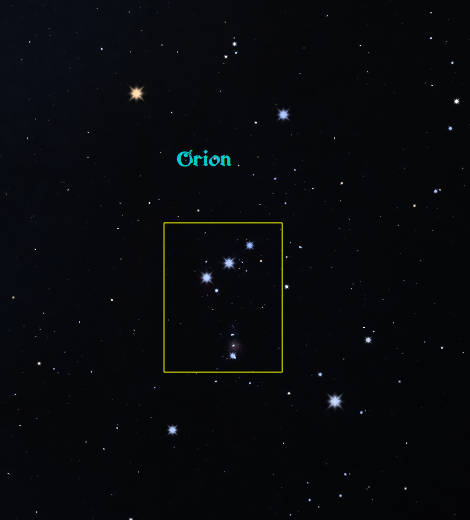
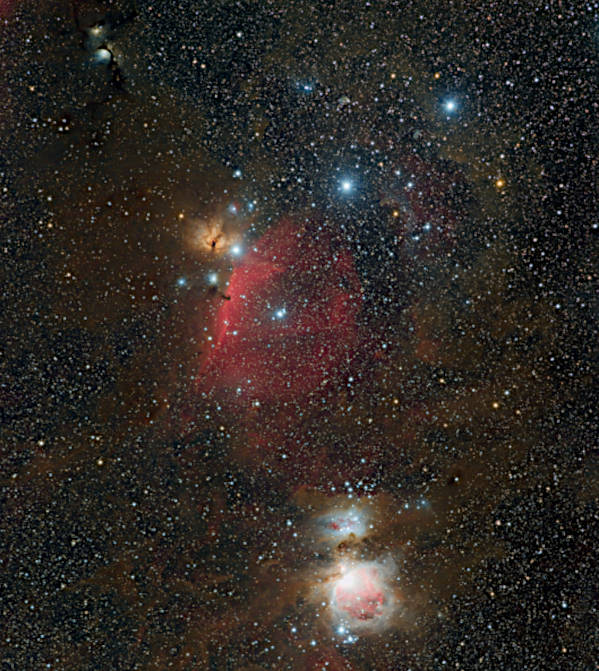
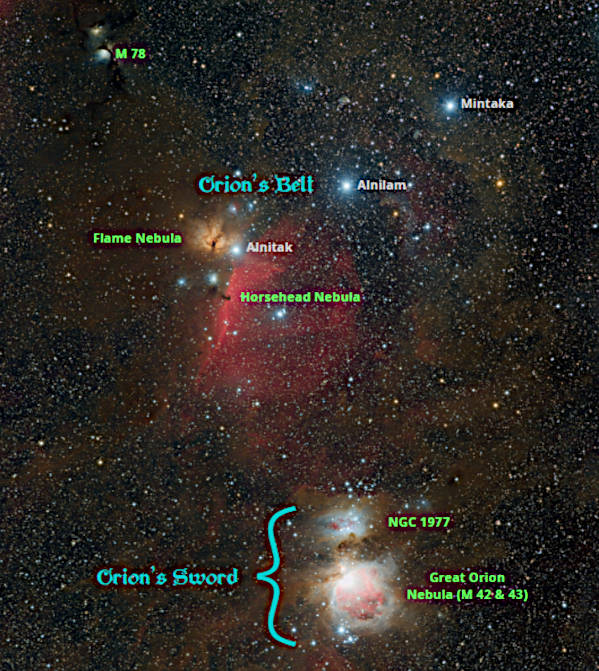
Orion’s belt of three stars is one of the most noticeable star groupings in the sky. There are no other groups of three bright stars in a straight line visible anywhere else in the sky. The star’s names from left to right are Alnitak, Alnilam and Mintaka. They are actually a bit farther away than the other bright stars of Orion. Alnilam, the center star, is over three times the distance of red giant Betelgeuse above them and over twice as far as blue white giant star Rigel below them. Alnilam is 375 thousand times brighter than the Sun. These three stars were also known as Frigga’s Spindle by the Norsemen. Frigga, also known as Freya, is the goddess from which we get the name of the day of the week we call Friday.
The astronomical event times given in this blog are for the Traverse City/Interlochen area of Michigan (Lat 44.7° N, Long 85.7° W; EST, UT – 5 hours) unless stated otherwise. Times will be different for other locations.
Addendum
Ephemeris: 12/15/2025 – Capella, the winter star that never quite leaves us*
This is Ephemeris for Monday, December 15th. Today the Sun will be up for 8 hours and 49 minutes, setting at 5:02, and it will rise tomorrow at 8:14. The Moon, halfway from last quarter to new, will rise at 5:13 tomorrow morning.
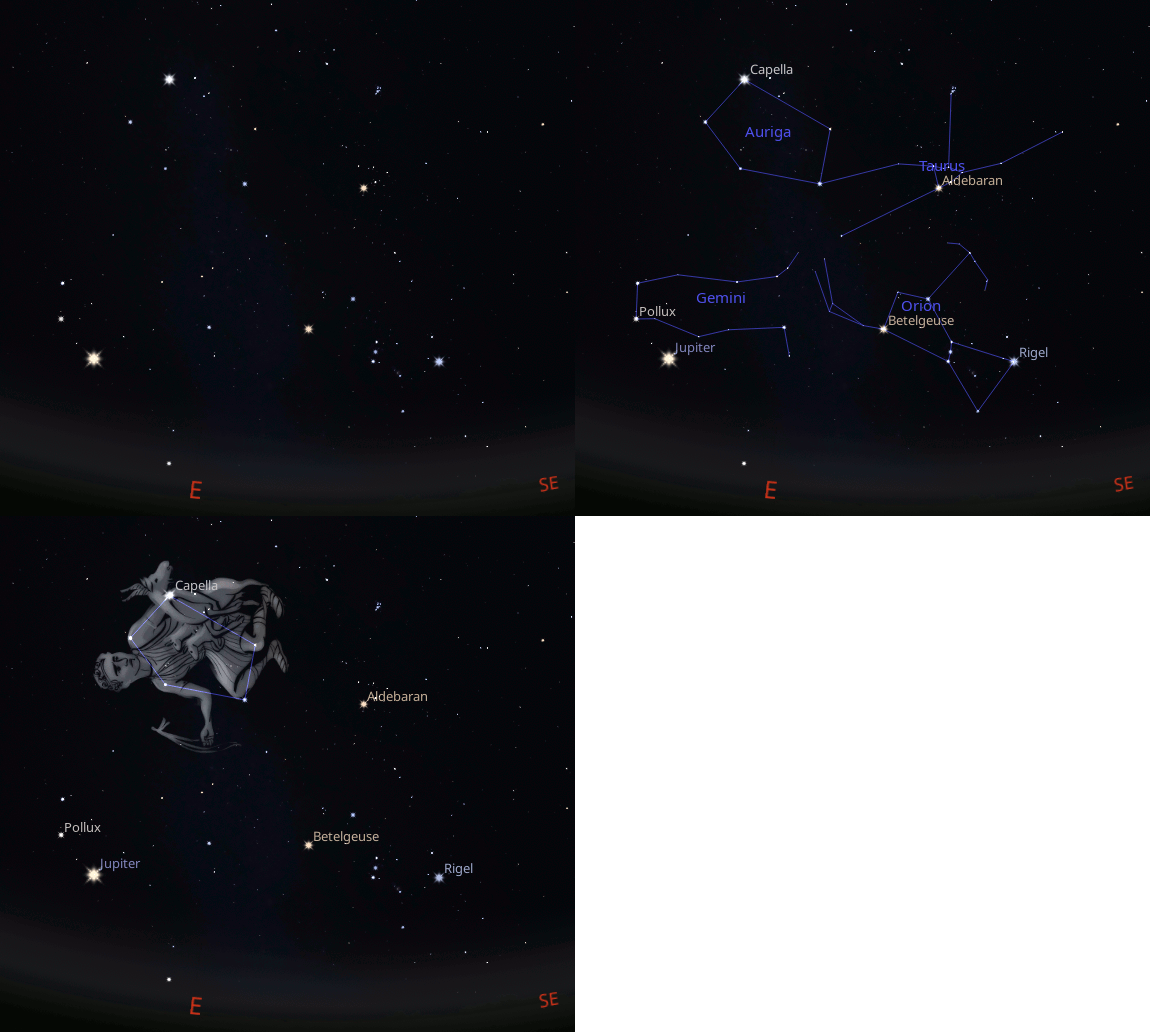
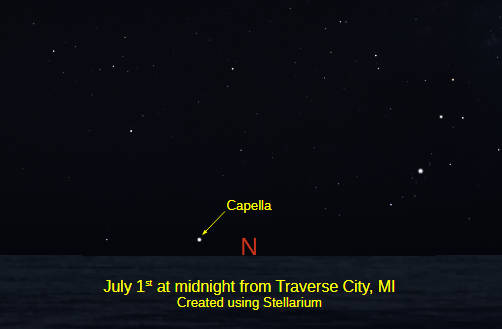
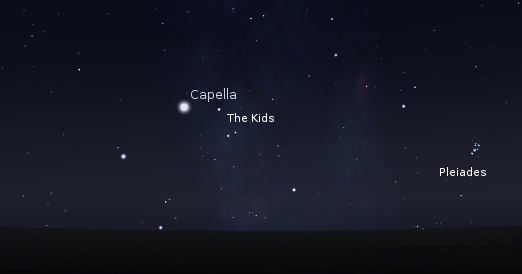
Capella is the northernmost first magnitude stars. Tonight it shines in the northeastern sky. First magnitude stars are the 21 brightest stars in the night sky. Capella is the 6th brightest. Although I’ve always known it as the little she-goat, Capella’s name literally translates to “little goat.” Her three Kids are represented by a narrow triangle of stars positioned to the right of her in tonight’s evening sky. Capella is in the topmost corner of the pentagonal constellation of Auriga the Charioteer. Capella is actually a system of four stars only 43 light years away. And never sets for listeners in the Interlochen Public Radio transmission area who have a low northern horizon.
The astronomical event times given in this blog are for the Traverse City/Interlochen area of Michigan (Lat 44.7° N, Long 85.7° W; EST, UT – 5 hours) unless stated otherwise. Times will be different for other locations.
* If you live north of 44° north latitude.
Addendum
Ephemeris: 07/15/2025 – Finding Cygnus the swan
This is Ephemeris for Tuesday, July 15th. Today the Sun will be up for 15 hours and 13 minutes, setting at 9:25, and it will rise tomorrow at 6:12. The Moon, 2 days before last quarter, will rise at 12:01 tomorrow morning.
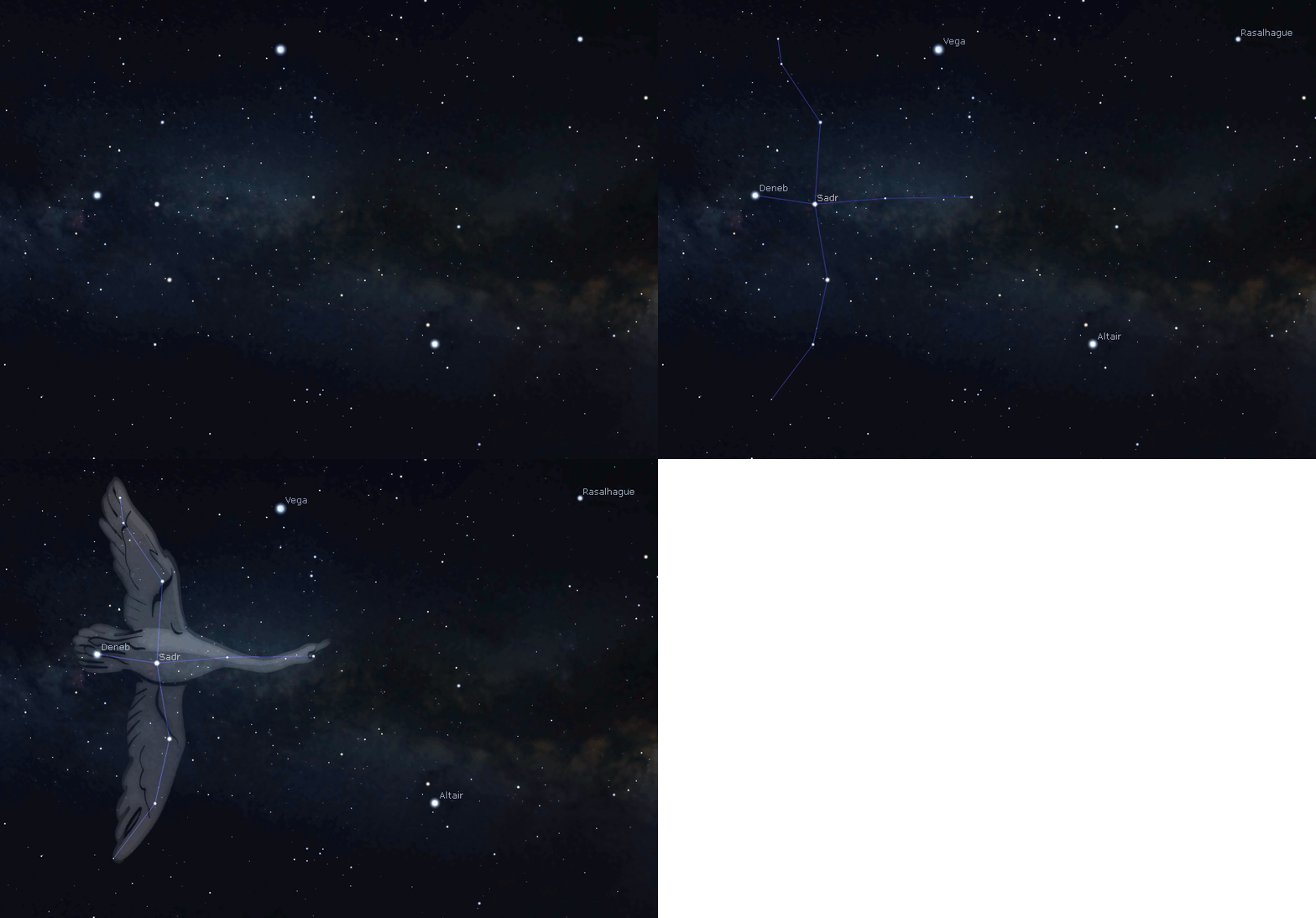
Located fairly high in the east at 11 p.m. is the constellation of Cygnus the swan, flying south through the Milky Way. It is also called the Northern Cross, an asterism or informal constellation. At the left, the tail of the swan or the head of the cross is the bright star Deneb, one of the stars of the Summer Triangle. The next star right is Sadr the intersection of the body and the wings of the swan seen in flight, or the intersection of the two pieces of the cross. There are two or three stars farther to the right that delineate the swan’s long neck or upright of the cross, that ends with the star Alberio in the beak of the swan or foot of the cross. The crosspiece of the cross extends to the stars on either side of the intersection star Sadr, while the swan’s wings extend to a couple more stars each.
The astronomical event times given in this blog are for the Traverse City/Interlochen area of Michigan (Lat 44.7° N, Long 85.7° W; EDT, UT – 4 hours) unless stated otherwise. Times will be different for other locations.
Addendum
Ephemeris: 06/23/2025 – The Big Dipper is tearing itself apart
This is Ephemeris for Monday, June 23rd. Today the Sun will be up for 15 hours and 34 minutes, setting at 9:32, and it will rise tomorrow at 5:58. The Moon, 2 days before new, will rise at 4:33 tomorrow morning.
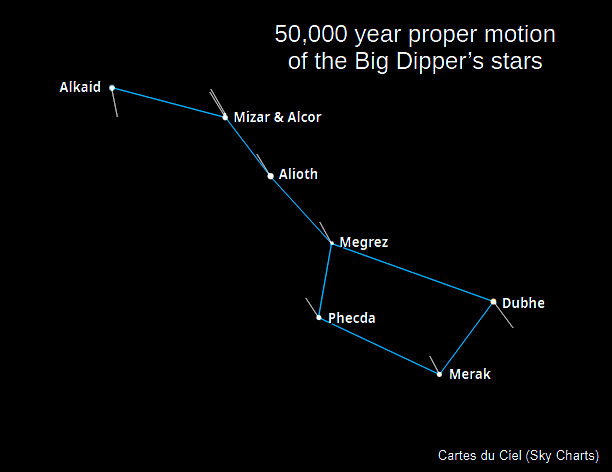
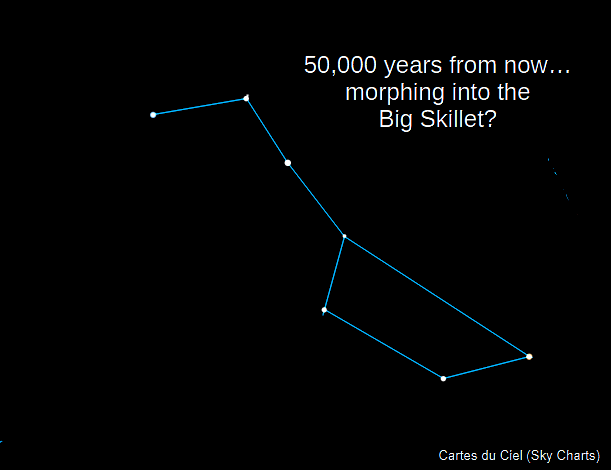
The usual impression is to think that the stars of a constellation are actually located close together. This is usually not true. The stars of a constellation can be at vastly different distances. The Big Dipper is different. The five stars, excepting the two end stars of the dipper and 12 other dimmer stars in the general area are of similar distance and have the same motion through space. The group is called the Ursa Major Moving Cluster or Ursa Major Association, and is moving about 9 miles per second relative to the solar system to the east. An association is a rather loose, sparse star cluster. This association lies about 80 light years away. If it were five and a half times farther away, it would be the same distance as the Pleiades.
The astronomical event times given in this blog are for the Traverse City/Interlochen area of Michigan (Lat 44.7° N, Long 85.7° W; EDT, UT – 4 hours) unless stated otherwise. Times will be different for other locations.
Addendum
Ephemeris: 06/13/2025 – Finding the Summer Triangle
This is Ephemeris for Friday, June 13th. Today the Sun will be up for 15 hours and 32 minutes, setting at 9:29, and it will rise tomorrow at 5:56. The Moon, 2 days past full, will rise at 11:59 this evening.
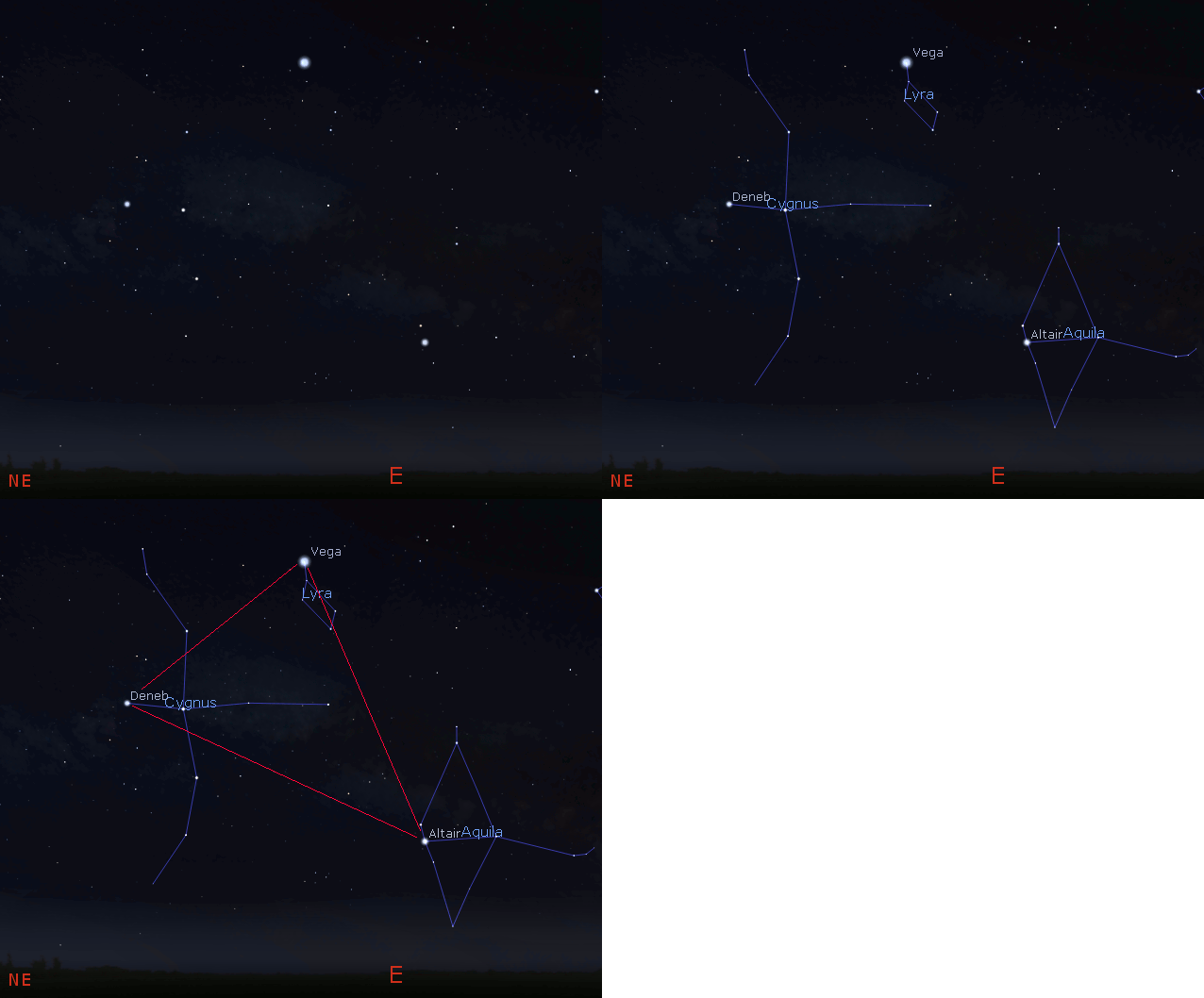
Summer skies are coming. It’s only 7 days until summer officially arrives. Looking to the eastern sky at 11 pm are three of the brightest stars in a large triangle. The top star Vega is about halfway up the sky to the zenith, and the brightest of the three. It’s in the small constellation of Lyra the harp. Lowest of the stars and just about due east is Altair in Aquila the eagle. Completing the triangle is Deneb in the northeast in the tail of Cygnus the swan or the head of the horizontal Northern Cross. These three stars make up the Summer Triangle, which isn’t an official constellation. It’s one of the many informal star patterns called asterisms. The Summer Triangle will be in our evening sky moving slowly westward until December.
The astronomical event times given in this blog are for the Traverse City/Interlochen area of Michigan (Lat 44.7° N, Long 85.7° W; EDT, UT – 4 hours) unless stated otherwise. Times will be different for other locations.
Addendum
Ephemeris: 05/27/2025 – The many faces of the Big Dipper
This is Ephemeris for Tuesday, May 27th. Today the Sun will be up for 15 hours and 13 minutes, setting at 9:17, and it will rise tomorrow at 6:02. The Moon, 1 day past new, will set at 10:44 this evening.
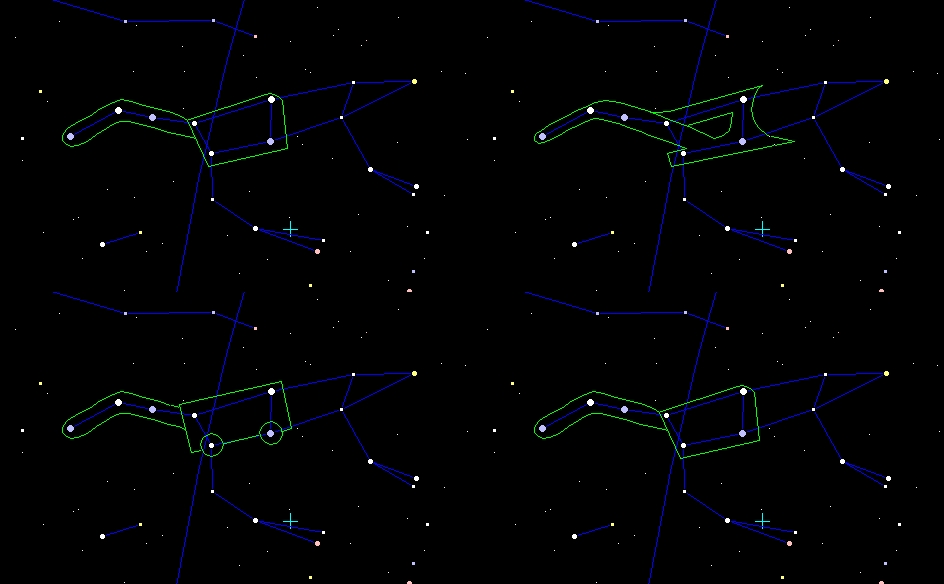
The Big Dipper is overhead, actually north of overhead this evening when it gets dark for us in Michigan, it’s seven stars shining brightly. The Big Dipper is not an actual constellation, recognized internationally. It’s part, the hind part, of Ursa Major, the great bear. The Big Dipper is an asterism or informal constellation. It is a distinctly North American constellation. For fugitive slaves, fleeing the southern states in the days before the Civil War, the Drinking Gourd, as they called it, showed the direction north to freedom. In England the dipper stars become the Plough (plow), or Charles’ Wain (Charlemagne’s Wagon). In France, known for culinary delights it is the saucepan, or the cleaver. Many cultures saw what was familiar to them in these seven bright stars.
The astronomical event times given in this blog are for the Traverse City/Interlochen area of Michigan (Lat 44.7° N, Long 85.7° W; EDT, UT – 4 hours) unless stated otherwise. Times will be different for other locations.
Addendum
Ephemeris: 02/27/2025 – The spring constellations are rising
This is Ephemeris for Thursday, February 27th. Today the Sun will be up for 11 hours and 5 minutes, setting at 6:28, and it will rise tomorrow at 7:21. The Moon is new today, and won’t be visible.
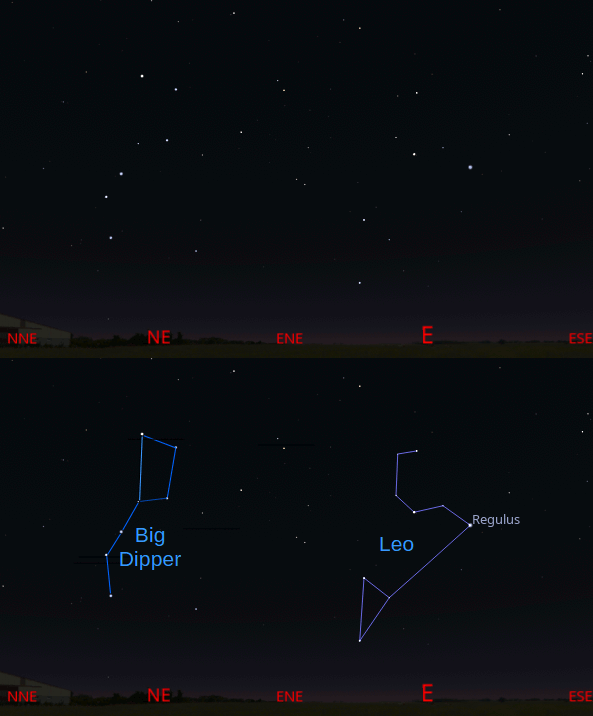
Today, we are exactly 3 weeks from the start of spring. The temperatures this week are rising. Even though at 8:00 PM Orion is high in the south, looking off to the east the spring constellation of Leo the lion has risen, and the Big Dipper is standing on its handle in the northeast. To the Anishinaabe native peoples of this area the Big Dipper is part of Ojiig, the Fisher, who brought summer to the Earth and when he’s in this position in the northeastern skies standing on his tail it is a sign of the spring to come and the start of the maple sugaring season. This next week or so is especially the best time, all year, to see the planet Mercury in the evening twilight due west, shortly after sunset. Its greatest separation from the Sun will come March 8th.
The astronomical event times given are for the Traverse City/Interlochen area of Michigan (EST, UT – 5 hours). Times will be different for other locations.
Addendum
Ephemeris: 02/17/2025 – Follow the Drinking Gourd
This is Ephemeris for President’s Day, Monday, February 17th. Today the Sun will be up for 10 hours and 35 minutes, setting at 6:14, and it will rise tomorrow at 7:38. The Moon, 3 days before last quarter, will rise at 11:47 this evening.
In the decades before the Civil War, runaway slaves would travel, often at night, northward from the slave states in the south to the northern free states and Canada over the metaphorical Underground Railroad following the Drinking Gourd, the Big Dipper as their compass. For millennia, the North Pole of the sky had been passing near the handle of the Big Dipper or Great Bear’s tail and now up to the star Polaris in the Little Dipper. As an amateur astronomer, who loves the dark, starlit skies, I’ve noticed that everyone is the same color in the dark! This year the Grand Traverse Astronomical Society will, once again, team with the Sleeping Bear Dunes for more Sun and star parties.
The astronomical event times given are for the Traverse City/Interlochen area of Michigan (EST, UT – 5 hours). Times will be different for other locations.
Addendum

Ephemeris: 01/20/2025 – The planets augment the Winter Hexagon
This is Ephemeris for Martin Luther King Jr. Day, Monday, January 20th. Today the Sun will be up for 9 hours and 22 minutes, setting at 5:35, and it will rise tomorrow at 8:12. The Moon, 1 day before last quarter, will rise at 12:56 tomorrow morning.
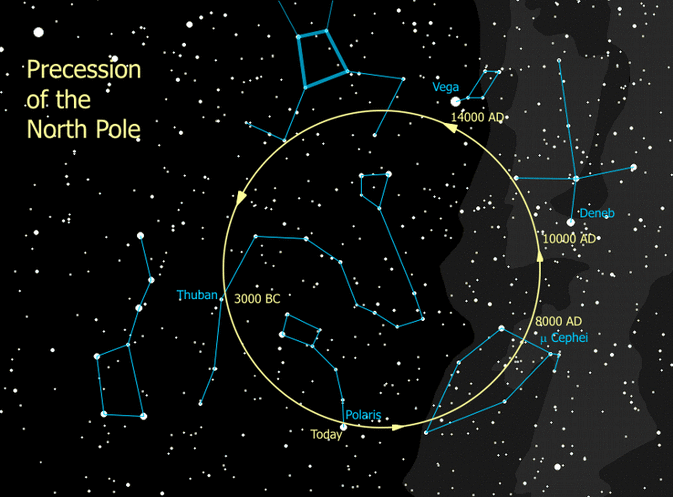
The winter circle or more properly hexagon, seen in the winter sky this evening, has the addition of two planets, and they’re in the proper location so that they don’t spoil the hexagon. We start at the top with the star Capella high in the east. We move clockwise downward to Jupiter and below it the star Aldebaran. We drop lower to Orion’s knee and the star Rigel, then down to Sirius, low in the southeast, the brightest nighttime star, but doesn’t hold a candle to Jupiter. Then we go above left to Procyon and upwards and left to Mars, which is near Pollux, and finally back up to Capella. That’s that is our winter hexagon right now, so take it in while you can, before Jupiter and Mars move off and mess it up.
The astronomical event times given are for the Traverse City/Interlochen area of Michigan (EST, UT – 5 hours). Times will be different for other locations.
Addendum
 Bob Moler's Ephemeris Blog