Archive
The Death of Herod the Great – Dating of the Star of Bethlehem
Note: This is from an article I wrote for the Grand Traverse Astronomical Society’s December 2012 newsletter The Stellar Sentinel.
I’m preparing for my biennial talk In Search of the Star of Bethlehem. In recent years I’ve been intrigued with the date of King Herod the Great’s death. Because it constrains the time of Christ’s birth since he was born near the end of King Herod’s reign according to the Gospel of Luke.
Late first century Jewish historian Flavius is the only source we have for the date of Herod’s death. Josephus was an interesting fellow. He was born Yosef ben Matityahu, a Jew. He fought against the Romans in A.D. 67, and was captured. He served as an interpreter for the Romans and was given Roman Citizenship.
In the 17th volume of his Antiquities of the Jews Josephus relates the events between a lunar eclipse and Passover the period in which Herod the Great died.
The favorite lunar eclipse over the years for this was a slight partial eclipse in March 13th of 4 B.C. The reason for this date is probably the possible discrepancy in the start of our current calendar numbering A.D. or C.E. This calendar numbering was promulgated by Dennis the Short in what would become the 6th century. There was a common thought that old Dennis was 8 years off, and that A.D. 1 was 8 years earlier than he thought. The hard thing about calculating the chronological eras was that there wasn’t just one. There were many. Trying to synchronize these is a daunting task.
The problem with the 4 B.C. eclipse is that there was only one lunar month between that eclipse and Passover which begins on the day of the full moon. And Josephus records many events between that eclipse and Passover.
If we believe many ancient sources writing close to the to the time of Christ’s birth, his date of birth would have been around 3 or 2 BC., which puts the 4 B.C. Death of Herod too soon. I was never wild about the 4 B.C. Eclipse for another reason, the eclipse was a slight partial eclipse occurring in the morning. Eclipse calculations were capable of predicting that eclipse, but it would have not have been very noticeable to the population.
The next lunar eclipse occurred on January 10 of 1 B.C. It was a total lunar eclipse that was seen most of the night. There were 3 lunar months between that eclipse and Passover that year. Plenty of time for all of Herod’s final activities.
According to Josephus the Eclipse was mentioned in connection with the burning alive of a fellow named Matthias and his companions for sedition.
Herod became very ill, as described in rather excessive detail by Josephus. His doctors suggested that he go to the baths at Callirrhoe. He took their advise and crossed the Jordan river. Note at this tome Herod resided in Jericho. As of this writing, I have not been able to find the location of Callirrhoe. It’s in present day Jordan near the Dead Sea. It could have been 20 or so miles from Jericho. There is a current day hot springs at Hammamat Ma’een which is a tourist attraction, but I so far haven’t found Callirrhoe whose waters run into the Dead Sea or Lake Asphaltites. The trips to and from Callirrhoe would have been slow carrying the sick King.
Knowing he was close to death he decreed a bonus of 50 Drachmas to his soldiers and another bonus to his commanders and friends. He then returned to Jericho. He had his minions draft and send letters to all the important Jewish men to come to Jericho under pain of death. He calculated, perhaps rightly that they would not mourn him when he died, so he would keep them at the hippodrome (racetrack) and when word of his passing be made known, have his archers slay all that were gathered there.
Herod then received a message from Caesar as to the verdict on son Antipater’s trial for plotting to kill Herod. It was left to Herod to decide what was to be done with him, until then Herod had him under arrest. Herod was feeling very ill and while paring an apple for himself, which he normally did, decided to commit suicide but was prevented at the last instant by his cousin who let out a loud scream. Those outside thought that Herod had died. Antipater heard and tried to convince his jailer to let him out to claim the throne. The jailer refused and told Herod. Upon the news Herod had Antipater executed immediately.
Herod then changed his will, giving his kingdom to his son Archclaus and died five days after having Antipater executed. Herod’s sister Salome and her husband Alexas allowed those kept at the Hippodrome to be released to return to their own lands before the news of Herod’s death became known. Herod was prepared for burial and a large funeral procession of soldiers, followed by 500 domestics carrying spices moved out two miles to Herodium, where he was buried.
Archclaus, though greeted with great acclaim at first angered the people. Archclaus then wanted to plead his case before Caesar and have himself made king. Sometime after this Josephus mentions the feast of Passover.
In my perusals of sources mentioning the people in the above recounting, 4 B.C. appears to be the generally accepted year of Herod and Antipater’s deaths. This gives only 29 days for the drama above to take place. The better eclipse of 1 B.C. Has nearly 90 days for it to take place.
This is why I have come to accept the January 10, 1 B.C. lunar eclipse mentioned by Josephus, and that the two conjunctions of Venus and Jupiter in 3 and 2 B.C. were the Star of Bethlehem that the Magi saw.
12/17/2012 – Ephemeris – The Star of Bethlehem: Who were the Magi?
Ephemeris for Monday, December 17th. The sun will rise at 8:14. It’ll be up for 8 hours and 49 minutes, setting at 5:03. The moon, 3 days before first quarter, will set at 10:36 this evening.
The Star of Bethlehem is one of the great mysteries of Christmas. The Chinese of that time were the only ones that recorded the happenings in the heavens. There were no bright stars that appeared near the time of Christ’s birth. That leads us to the Magi themselves, if that’s who they were. Magi were astrologer priests of the Zoroastrian religion in Persia. They saw signs in the positions of the planets that would go unnoticed to the Jews to which astrology was forbidden. Conjunctions where two or more planets gathered together were the most powerful of these configurations. There was a triple conjunction of Jupiter and Saturn in seven BC that’s the most famous, but I have another set of conjunctions in mind to tell you about tomorrow.
Times are for the Traverse City/Interlochen area of Michigan. They may be different for your location.
11/22/2012 – Ephemeris – Celestial navigation in the days of the Pilgrims
Ephemeris for Thanksgiving Day, Thursday, November 22nd. The sun will rise at 7:48. It’ll be up for 9 hours and 19 minutes, setting at 5:08. The moon, 2 days past first quarter, will set at 2:58 tomorrow morning.
Back in the days of the Pilgrims navigation was much less certain than it is today. At the mercy of the winds and weather, sailing took a lot of courage. Celestial navigation took the form of measuring the altitude of the pole star Polaris at night and the sun at noon. That and tossing a log overboard attached to a rope with knots at regular interval to gauge their speed and progress. That’s where we get the term knots as a measure of speed for nautical and aviation use. Today we have GPS to tell us where we are. However that is based on the position of not stars, but quasars, bright nuclei of distant galaxies, whose motions are currently too small to measure. Have a happy Thanksgiving.
Times are for the Traverse City/Interlochen area of Michigan. They may be different for your location.
Addendum
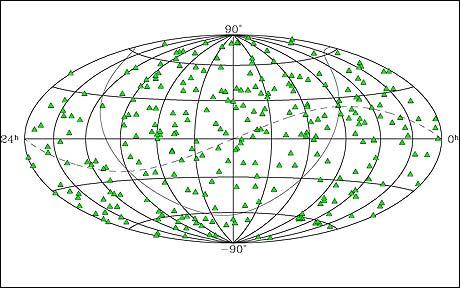
All sky map of quasar locations used as the celestial markers for the GPS system. Chart by David Bobolz, US Naval Observatory.
The chart above is from an article in the Telegraph.
02/27/2012 – Ephemeris – The Leap or Intercalary Day
Ephemeris for Monday, February 27th. The sun will rise at 7:24. It’ll be up for 11 hours and 2 minutes, setting at 6:26. The moon, 2 days before first quarter, will set at 12:37 tomorrow morning.
Wednesday we’re going to have one of those special days that only occur once every 4 years making this a leap year. It’s the intercalary day that compensates for that fact that the earth takes 365 and nearly a quarter day to orbit the sun. That orbit is a year, and those quarter days are accumulated and added as the last day of February on years divisible by 4. The Gregorian reform makes a slight adjustment on most century years, making century years not divisible by 400 ordinary years to keep the calendar in sync with the seasons. The Romans, from who we’ve gotten our calendar considered the month of February as unlucky, and so they shortened it. Enjoy your extra day Wednesday. * Times are for the Traverse City/Interlochen area of Michigan. They may be different for your location.
02/06/2012 – Ephemeris – It’s about Time
Ephemeris for Monday, February 6th. The sun will rise at 7:55. It’ll be up for 10 hours and 1 minute, setting at 5:57. The moon, 1 day before full, will set at 7:21 tomorrow morning.
What time is it? Don’t bother to check. This time It’s a rhetorical question. The basis of time keeping has always been astronomical. Astronomers almost lost it last month. There are now two time scales. Universal Time, that’s roughly in sync with the earth’s rotation and Atomic Time, which uses the vibrations of cesium atoms which are set to count seconds of the length they were in 1900. Thanks mostly to the moon and the drag of the tides the earth is slowing its rotation. The difference between the two time scales is over a minute, accumulated over that past 112 years. Universal Time has been tied to the earth’s rotation by the occasional addition of a leap second every year or two. The next leap second will be added on June 30th.
* Times are for the Traverse City/Interlochen area of Michigan. They may be different for your location.
11/24/11 – Ephemeris – The Pilgrim’s voyage
Thanksgiving Day, Thursday, November 24th. The sun will rise at 7:50. It’ll be up for 9 hours and 16 minutes, setting at 5:07. The moon, 1 day before new, will rise at 8:22 tomorrow morning.
We get the celebration of Thanksgiving from the Pilgrims who celebrated their first harvest, but at the wrong place. They were originally heading for the mouth of the Hudson River, which was considered North Virginia in back then. Navigation in those days was rather imprecise. Latitude was easy to determine at night or at noon but only if it was clear. Longitude was a guess. Generally in the age of sail sailors picked a latitude where the winds blew in the right direction to take them to the Americas, then would sail north or south to the latitude they wanted to go. Storms pushed the Mayflower off course and the Pilgrims ended up near Cape Cod several hundred miles north of their target, an easy mistake to make back then. Have a happy and safe Thanksgiving.
* Times, as always are for the Traverse City/Interlochen area of Michigan.
06/14/11 – Ephemeris – Fate of the Apollo lunar flags
Flag Day, Tuesday, June 14th. Today the sun will be up for 15 hours and 32 minutes, setting at 9:28. The moon, 1 day before full, will set at 5:35 tomorrow morning. Tomorrow the sun will rise at 5:56
Whatever happened to the flags left on the moon by the Apollo astronauts? Forty or so years after the landings the sun’s harsh unfiltered light, especially in the ultraviolet has bleached and degraded the nylon fabric of the flags. Also the lunar soil, called regolith contains small jagged particles that are very compact and hard to pound a flag pole in. Apparently the flags of all but Apollo 11 and 15 are still standing, while the rocket blast of the lunar module ascent stage blew down the other two. The flag of the United States is carried on two spacecraft that are about to leave the magnetic bubble around the sun that is the heliosphere. The farthest, Voyager 1 is 117 times the earth’s distance from the sun, nearly 11 billion miles away.
* Times are for the Traverse City/Interlochen area of Michigan. They may be different for your location.
06/02/11 – Ephemeris – The stars Mizar and Alcor
Thursday, June 2nd. Today the sun will be up for 15 hours and 21 minutes, setting at 9:21. The moon, 1 day past new, will set at 10:21 this evening. Tomorrow the sun will rise at 5:59.
The Big Dipper is high in the northwest at 11 p.m. now. It’s handle is also the tail of the Great Bear or Ursa Major. An Native American view of the bear was the the stars of the Big Dipper’s handle were not a tail, but hunters following the bear. The star Mizar, at the bend of the handle has a dim companion called Alcor. This was the cooking pot the hunters will cook the bear in. The ancient Arabs saw these two stars as the Horse and the Rider, and it was an eye test for warriors. If you could see Alcor, your eyesight was good enough. Even with my glasses I can rarely see this dim star, so I suppose I’d be the Arabic equivalent of a 4F. If you have a telescope, check out the Mizar-Alcor pair and you’ll find that Mizar has a close companion itself.
* Times are for the Traverse City/Interlochen area of Michigan. They may be different for your location.
Addendum
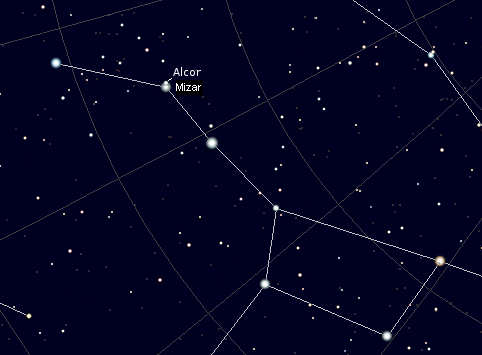
The Stars Mizar and Alcor in the Big Dipper. Cartes du Ciel
05/10/11 – Ephemeris – The Ancient Greeks and measuring the distance to the sun
Tuesday, May 10th. The sun rises at 6:20. It’ll be up for 14 hours and 36 minutes, setting at 8:57. The moon, at first quarter today, will set at 2:46 tomorrow morning.
The ancient Greek astronomers had great success in actually calculating the distance to the moon. They came up with 60 earth radii. Yes, they knew the earth was round and even measured its circumference to great accuracy. The distance they got for the moon lies within the range of the actual moon’s distance. They next tried to measure the distance from the sun. To do this, they tried to observe the moon and the sun at the exact time the moon was at first quarter. At this time the earth, sun and moon make a right triangle. Theoretically the actual angle between the sun and the moon would give the distance to the sun. The answer they got was that the sun was 20 times the moon’s distance. That’s way short, the sun is 400 times the moon’s distance away.
* Times are for the Traverse City/Interlochen area of Michigan. They may be different for your location.
Addendum
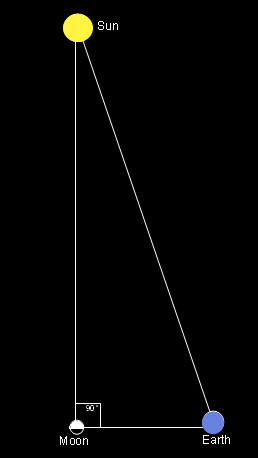
How the ancient Greeks tried to calculate the distance to the sun.
To the right is my take on the Greek sun measuring experiment. Using their guy Euclid and his geometry they knew that the sum of the angles of a triangle equal 180 degrees.
Having an exactly quarter moon, first or last, they knew the Sun-Moon-Earth angle was 90 degrees, so if they could measure the Sun-Earth-Moon angle from observation, they knew the other angle at the sun.
They had already calculated the moon’s distance, so they could calculate the other leg, the Sun-Moon distance using trigonometry. The first trig tables were invented by Greek astronomer Hipparchus.
Ah yes, Trig tables. I don’t suppose you kids use them anymore, with your electronic calculators. Back in my high school days my calculator was a slide rule. Sorry, old guy grousing.
What we used to know about Mercury
On Thursday evening, 8:45 p.m. March 17 EDT (12:45 a.m. March 18 UTC) the MESSENGER spacecraft will complete the second of NASA’s 2011 planetary trifecta when it will, if all goes well, fire its rocket engine to drop into orbit of the tiny planet Mercury. We’ve had six quick peeks at Mercury so far. Three by the Mariner 10 spacecraft in the 1970’s which looked at the same half of the planet due to Mercury’s unique rotational period. And three more by MESSENGER as it used Mercury to put on the breaks, so it would be going slow enough this time, so it’s rocket engine could drop it into polar orbit of the planet.
At first blush, Mercury looks like the moon. But it’s not. The moon is light, being made up, apparently, of mostly the crustal materials expelled by the earth and another Mars sized body. So it has a relatively small core. Mercury, on the other hand has a large core, and is the second densest planet at 5.43 grams per cubic centimeter. It’s only beaten out by the earth’s 5.52 g/cm3.
We’re going to learn a lot more about Mercury in the next year or so as MESSENGER maps Mercury and the complex interaction between it and the solar wind and magnetic field coming from the sun. Lets look back at the early history of our knowledge of Mercury.
It seems the that early Greeks noticed this elusive planet. They saw it in the morning sometimes, and then they saw it in the evening. At first they thought it was two separate planets that they gave the name Hermes in the evening and Apollo in the morning before they figured out that it was the same planet. The name Mercury we know the planet by today is the Roman equivalent of Hermes.
Another revelation came later. In my youth Mercury was thought to be in tidal lock with the sun, like our moon is to the earth. The rather poor markings found on the planet seen low in the sky at dusk and dawn seemed to bear that out an 88 day rotation to match its 88 day revolution of the sun. It wasn’t until 1965 that radar observations proved that the rotation was 2/3 of 88 days. Every 2 orbits of the sun Mercury rotates 3 times. It seems that the best times to spot Mercury are when it’s in the same part of its orbit, but basically every other return to that spot. Funny thing. The northern hemisphere’s best views of Mercury are for its eastern elongation on spring evenings and western elongations on autumn mornings. In effect we’re viewing Mercury at the same point in its orbit, when it is near its perihelion, when it is closest to the sun. The southern hemispheric observers get to see more favorable views of Mercury, when it’s farthest from the sun.
As we’ve found with all the planets that we’ve gotten a close look at, the generalities of our long-standing ignorance is brushed away. Each planet is its own unique place in the sun.
Taken from my March, 2011 article in the Stellar Sentinel,the newsletter of the Grand Traverse Astronomical Society.
Here is the MESSENGER web page. This mission is run for NASA by the Johns Hopkins Applied Physics Laboratory.

MESSENGER’s First Look at Mercury’s Previously Unseen Side
Credit: NASA/Johns Hopkins University Applied Physics Laboratory/Carnegie Institution of Washington
 Bob Moler's Ephemeris Blog