Archive
06/02/11 – Ephemeris – The stars Mizar and Alcor
Thursday, June 2nd. Today the sun will be up for 15 hours and 21 minutes, setting at 9:21. The moon, 1 day past new, will set at 10:21 this evening. Tomorrow the sun will rise at 5:59.
The Big Dipper is high in the northwest at 11 p.m. now. It’s handle is also the tail of the Great Bear or Ursa Major. An Native American view of the bear was the the stars of the Big Dipper’s handle were not a tail, but hunters following the bear. The star Mizar, at the bend of the handle has a dim companion called Alcor. This was the cooking pot the hunters will cook the bear in. The ancient Arabs saw these two stars as the Horse and the Rider, and it was an eye test for warriors. If you could see Alcor, your eyesight was good enough. Even with my glasses I can rarely see this dim star, so I suppose I’d be the Arabic equivalent of a 4F. If you have a telescope, check out the Mizar-Alcor pair and you’ll find that Mizar has a close companion itself.
* Times are for the Traverse City/Interlochen area of Michigan. They may be different for your location.
Addendum
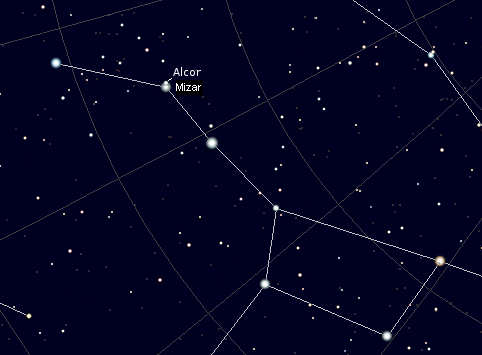
The Stars Mizar and Alcor in the Big Dipper. Cartes du Ciel
05/10/11 – Ephemeris – The Ancient Greeks and measuring the distance to the sun
Tuesday, May 10th. The sun rises at 6:20. It’ll be up for 14 hours and 36 minutes, setting at 8:57. The moon, at first quarter today, will set at 2:46 tomorrow morning.
The ancient Greek astronomers had great success in actually calculating the distance to the moon. They came up with 60 earth radii. Yes, they knew the earth was round and even measured its circumference to great accuracy. The distance they got for the moon lies within the range of the actual moon’s distance. They next tried to measure the distance from the sun. To do this, they tried to observe the moon and the sun at the exact time the moon was at first quarter. At this time the earth, sun and moon make a right triangle. Theoretically the actual angle between the sun and the moon would give the distance to the sun. The answer they got was that the sun was 20 times the moon’s distance. That’s way short, the sun is 400 times the moon’s distance away.
* Times are for the Traverse City/Interlochen area of Michigan. They may be different for your location.
Addendum
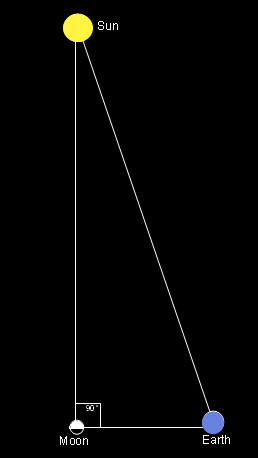
How the ancient Greeks tried to calculate the distance to the sun.
To the right is my take on the Greek sun measuring experiment. Using their guy Euclid and his geometry they knew that the sum of the angles of a triangle equal 180 degrees.
Having an exactly quarter moon, first or last, they knew the Sun-Moon-Earth angle was 90 degrees, so if they could measure the Sun-Earth-Moon angle from observation, they knew the other angle at the sun.
They had already calculated the moon’s distance, so they could calculate the other leg, the Sun-Moon distance using trigonometry. The first trig tables were invented by Greek astronomer Hipparchus.
Ah yes, Trig tables. I don’t suppose you kids use them anymore, with your electronic calculators. Back in my high school days my calculator was a slide rule. Sorry, old guy grousing.
What we used to know about Mercury
On Thursday evening, 8:45 p.m. March 17 EDT (12:45 a.m. March 18 UTC) the MESSENGER spacecraft will complete the second of NASA’s 2011 planetary trifecta when it will, if all goes well, fire its rocket engine to drop into orbit of the tiny planet Mercury. We’ve had six quick peeks at Mercury so far. Three by the Mariner 10 spacecraft in the 1970’s which looked at the same half of the planet due to Mercury’s unique rotational period. And three more by MESSENGER as it used Mercury to put on the breaks, so it would be going slow enough this time, so it’s rocket engine could drop it into polar orbit of the planet.
At first blush, Mercury looks like the moon. But it’s not. The moon is light, being made up, apparently, of mostly the crustal materials expelled by the earth and another Mars sized body. So it has a relatively small core. Mercury, on the other hand has a large core, and is the second densest planet at 5.43 grams per cubic centimeter. It’s only beaten out by the earth’s 5.52 g/cm3.
We’re going to learn a lot more about Mercury in the next year or so as MESSENGER maps Mercury and the complex interaction between it and the solar wind and magnetic field coming from the sun. Lets look back at the early history of our knowledge of Mercury.
It seems the that early Greeks noticed this elusive planet. They saw it in the morning sometimes, and then they saw it in the evening. At first they thought it was two separate planets that they gave the name Hermes in the evening and Apollo in the morning before they figured out that it was the same planet. The name Mercury we know the planet by today is the Roman equivalent of Hermes.
Another revelation came later. In my youth Mercury was thought to be in tidal lock with the sun, like our moon is to the earth. The rather poor markings found on the planet seen low in the sky at dusk and dawn seemed to bear that out an 88 day rotation to match its 88 day revolution of the sun. It wasn’t until 1965 that radar observations proved that the rotation was 2/3 of 88 days. Every 2 orbits of the sun Mercury rotates 3 times. It seems that the best times to spot Mercury are when it’s in the same part of its orbit, but basically every other return to that spot. Funny thing. The northern hemisphere’s best views of Mercury are for its eastern elongation on spring evenings and western elongations on autumn mornings. In effect we’re viewing Mercury at the same point in its orbit, when it is near its perihelion, when it is closest to the sun. The southern hemispheric observers get to see more favorable views of Mercury, when it’s farthest from the sun.
As we’ve found with all the planets that we’ve gotten a close look at, the generalities of our long-standing ignorance is brushed away. Each planet is its own unique place in the sun.
Taken from my March, 2011 article in the Stellar Sentinel,the newsletter of the Grand Traverse Astronomical Society.
Here is the MESSENGER web page. This mission is run for NASA by the Johns Hopkins Applied Physics Laboratory.

MESSENGER’s First Look at Mercury’s Previously Unseen Side
Credit: NASA/Johns Hopkins University Applied Physics Laboratory/Carnegie Institution of Washington
Cool local story about Carl Sagan’s Cosmos on its 30th anniversary
Local writer Pat Stinson wrote an article in the Grand Traverse Insider weekly newspaper called ‘Cosmos’ Shines Brightly. It’s about how Carl Sagan’s monumental 13 part documentary has affected some of us locals over the intervening 30 years. It’s a great read. Check it out here.
How the Search for the Star of Bethlehem Began
For this December’s meeting of the GTAS I will present my biennial program In Search of the Star of Bethlehem. I’ve been alternating this program with Biblical Cosmology, as a change of pace.
This posting will supplement and illuminate the presentation, not replace it. Here we’ll look at the origins of the search for what became known as the Star of Bethlehem and of the search for what the star was. We’ll start at the beginning with the only reference to the star found in the Bible, in the second chapter of Matthew. The translation here is from the New American Bible.
The story
After Jesus’ birth in Bethlehem of Judea during the reign of King Herod, astrologers from the east arrived one day in Jerusalem inquiring, “Where is the newborn King of the Jews? We observed his star at its rising and have come to pay him homage.” At the news King Herod became greatly disturbed, and with him all Jerusalem. Summoning all of the chief priests and scribes of the people, he inquired of them where the Messiah was to be born. “In Bethlehem of Judea”, they informed him. “Here is what the prophet has written: And you, Bethlehem, land of Judah, are by no means least among the princes of Judah, since from you shall come a ruler who is to shepherd my people Israel”. Herod called the astrologers aside and found out the exact time of the star’s appearance. Then he sent them to Bethlehem after having instructed: “Go and get detailed information about the child. When you have found him, report it to me so that I may go and offer him homage too.” After their audience with the king, they set out. The star, which they had observed at its rising went ahead of them until it came to a standstill over the place where the child was. They were overjoyed at seeing the star, and on entering the house, found the child with Mary his mother.
The story teller
The story is told in the Gospel of Matthew. Who was Matthew? We don’t know. Scholars are quite sure that he wasn’t the apostle Matthew. Much of the material of the Gospel of Matthew is taken from the Gospel of Mark, written by John Mark, a young associate of St. Paul. A source for Mark, and possibly Matthew and Luke was a now lost source, called by Biblical scholars called Q, from the German word Quelle, which means simply Source. It could have been written or even an oral tradition of the sayings of Jesus.
Mark’s Gospel is dated to about AD 70. While Matthew’s is somewhat later. He seemed cognizant of the destruction of Jerusalem in AD 70. Matthew’s audience for his Gospel seems to be Jewish Christians, and he emphasizes that Jesus is the fulfillment of Biblical prophesy.
The only other nativity narrative in the Gospels is that of Luke. Though not contradictory, the nativity stories of Matthew and Luke are completely different with few points in common. One wonders how Luke could omit the visit of the magi or the flight to Egypt, had he known. Maybe he didn’t. Luke’s audience was more non Jewish and not as interested in Jesus as fulfillment of biblical prophesy.
Most Biblical scholars agree that the Gospels are not biographies in the modern sense of the word, and may not be, I hate saying this, the Gospel truth. Where did the writer of Matthew get the goings on in King Herod’s court some 70 years after the fact? I suppose there were leaks, just like there’s leaks in our President George III’s recent administration. Even so there’s bound to be some alteration and embellishment over time. This tendency to embellish stories more with time is seen with the apocryphal or “hidden” gospels written later on which relate, rather fanciful accounts of Jesus’ childhood.
The search begins
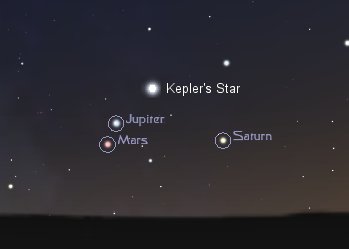
Kepler's Star and the planets
The search for the Star of Bethlehen began in 1604, with the appearance of a supernova in the constellation of Ophiuchus. At the bottom of this page is a representation of the sky near the end of twilight on the night Johannes Kepler discovered the supernova, October 9, 1604. It was near a close grouping of the three planets Jupiter Saturn and Mars. He calculated a similar grouping of the same three planets in 6 B.C. after Jupiter and Saturn pass three times in a triple conjunction the previous year.
He speculated that a nova appeared near that grouping too, and that the appearance of the planets and the “New” star prompted the magi to journey to Judea to pay homage to the newborn King of the Jews. The question is: was there a “new” star or a nova or supernova visible near the planets in 6 BC?
This is an excerpt of my December 2005 article in the GTAS publication the Stellar Sentinel
 Bob Moler's Ephemeris Blog