Archive
11/25/2018 – Ephemeris Extra – Comet 46P/Wirtanen may be naked eye in December
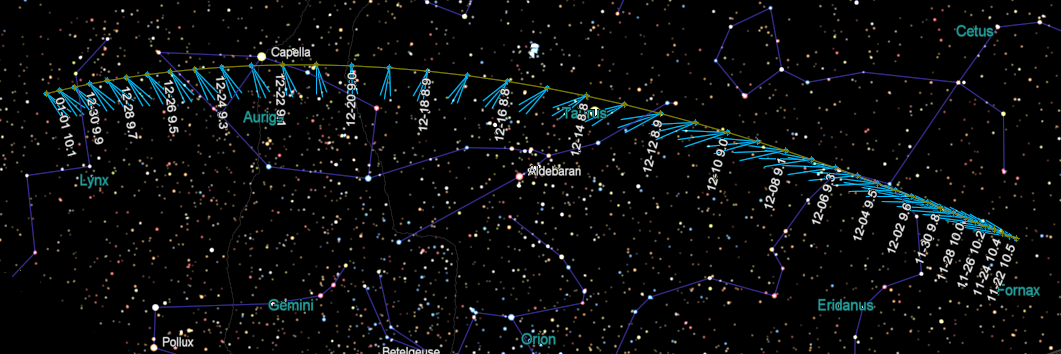
Comet 46P/Wirtanen will be well placed in the evening sky for observation. Though a small comet, it has a history of being active, which is not disappointing us now. It will be closest to the Earth on December16th at 7.1 million miles (11.4 million km).
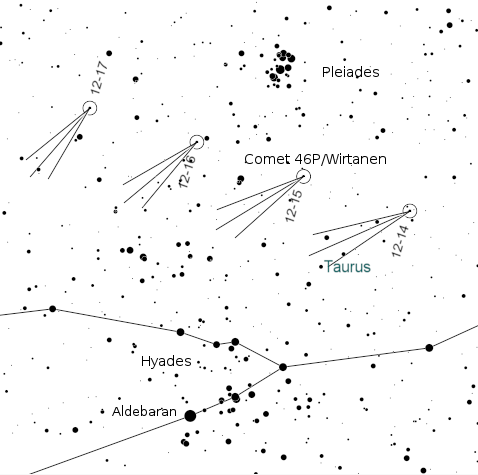
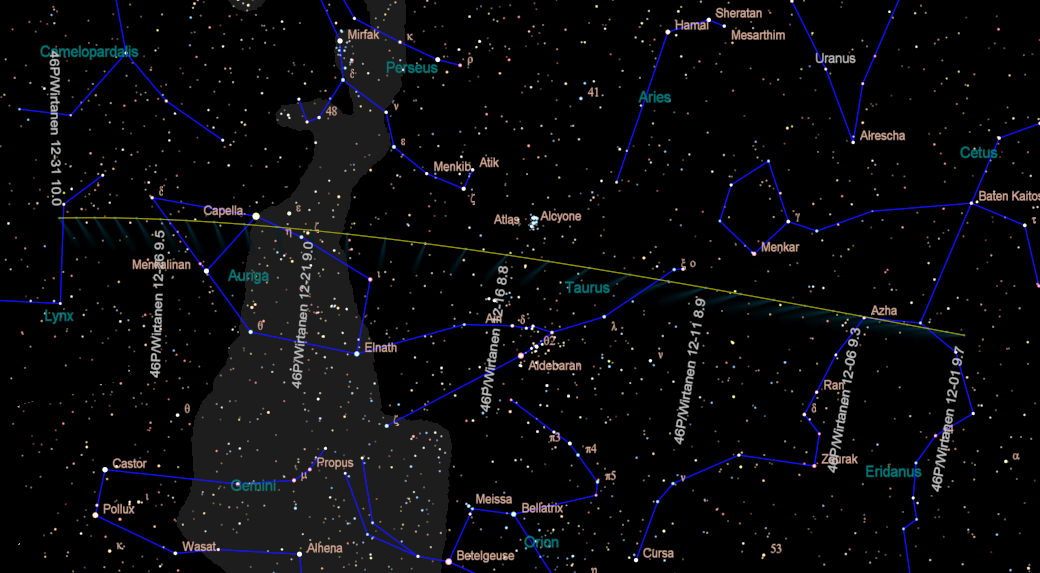
On December 16th the comet will be closest to the Pleiades. On the 23rd it will appear close to the bright star Capella. After that it will become circumpolar.
Comet Wirtanen is a small short period comet of 5.44 years. It’s orbit doesn’t come as close to the Sun as the Earth. It’s closest to the Sun, called perihelion it which it reaches December 12th is about 98 million miles (158 million km). The orbit extends out to nearly Jupiter’s orbit.
Checkout photos and animations of this and other comets in http://www.spaceweather.com/’s Realtime Comet Gallery.
Also check out Seiichi Yoshida’s website and his weekly information about Bright Comets: http://www.aerith.net/comet/weekly/current.html.
A note about comet magnitudes
Comet magnitudes are always devilishly hard to estimate. A comet always appears dimmer than its magnitude suggests because one is comparing the brightness of a diffuse object with the point source of a star. One either has to reduce the size of the comet to almost a point or defocus the star to the size of the comet to make the comparison if it doesn’t have a tail.
A point about magnitudes. They’re like golf scores. The lower the number, the brighter the object, and the better the golf score. Blame the ancient Greek astronomer Hipparchus, who ranked star brightness from first magnitude for the brightest stars to sixth magnitude for the dimmest stars visible to the naked eye. Modern astronomers put a mathematical basis for the system saying that a magnitude difference of 5 equals a brightness difference of 100. So each magnitude step equals the 5th root of 100 or 2.512. So a 5thmagnitude star is about two and a half times brighter than a 6thmagnitude star, and so on.
11/21/2018 – Ephemeris – The bright planets and two comets for this week
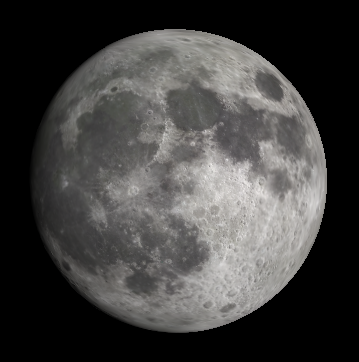
Ephemeris for Wednesday, November 21st. The Sun will rise at 7:47. It’ll be up for 9 hours and 21 minutes, setting at 5:09. The Moon, 2 days before full, will set at 6:47 tomorrow morning.
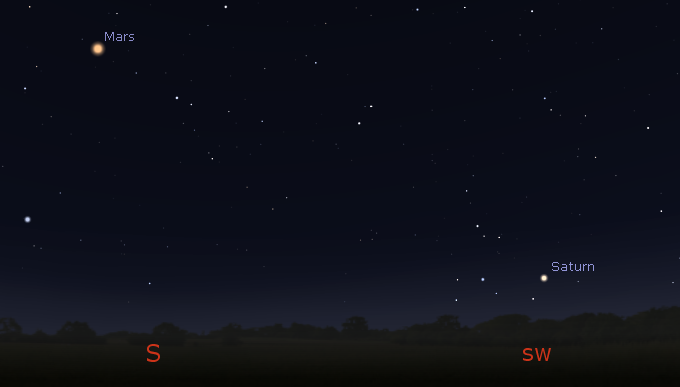
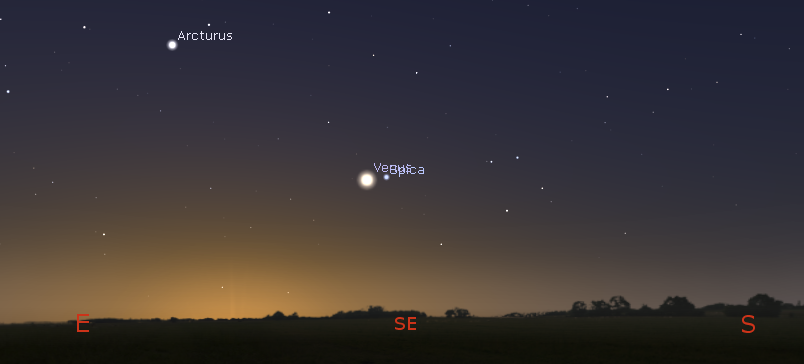
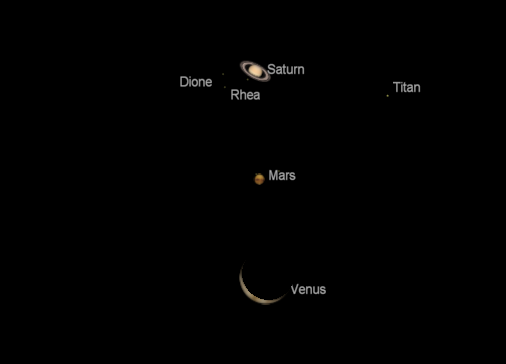
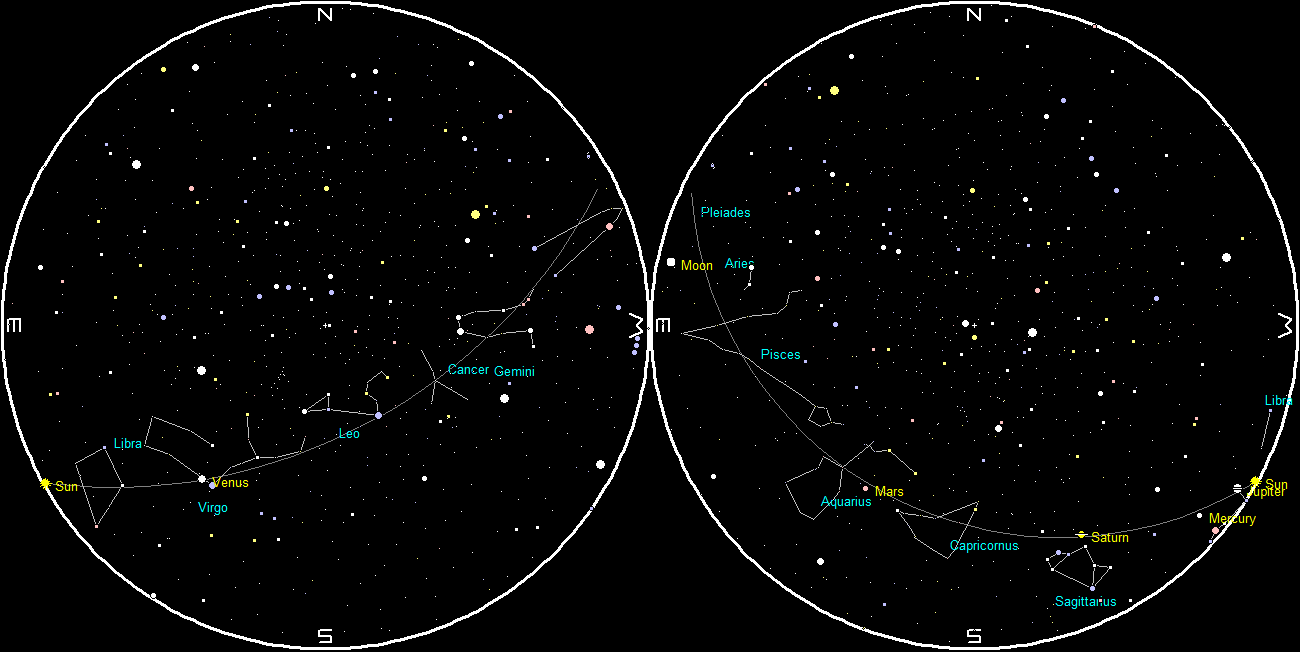
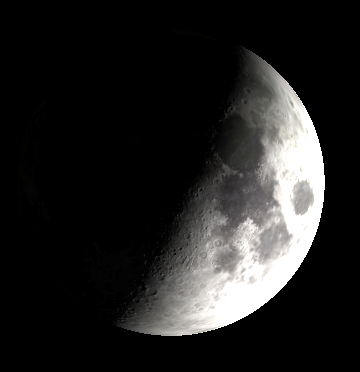
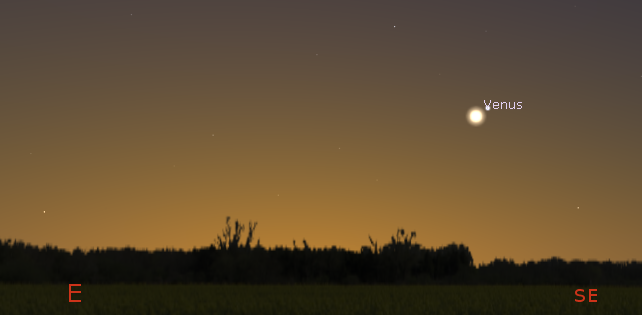
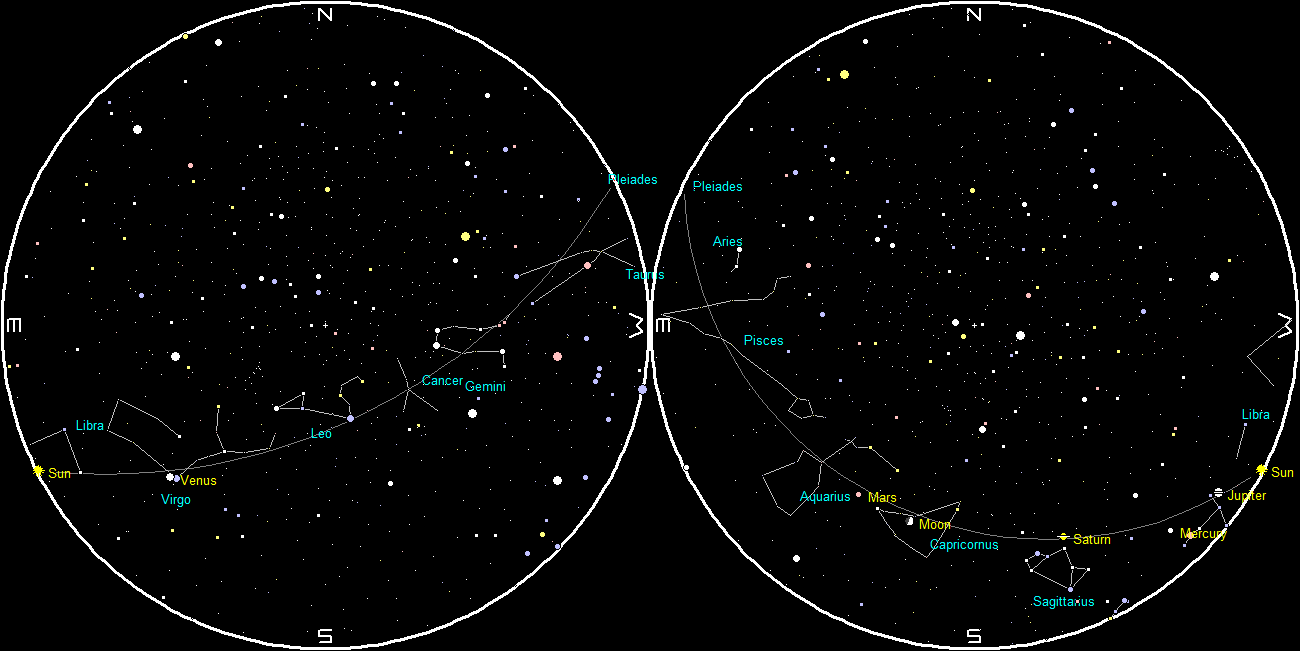
Let’s look at the bright planets for tonight. Two of them are visible in the evening sky. Jupiter is 5 days from passing behind the Sun, and will officially be a morning planet next Monday. Saturn, the ringed planet, will start the evening low in the southwestern sky and will set at 7:35 p.m. Mars will be in the south as the skies darken tonight. Mars will be due south at 7:03 p.m., and it will set at 12:20 a.m. Mars is moving eastward, crossing the constellation of Aquarius this month. It’s currently about midway through Aquarius, moving eastward and northward, so its setting time won’t change much over this month. Venus, our brilliant morning star, will rise at 4:50 a.m. in the east southeast. The blue-white star Spica is to the right and a bit above it.
The times given are for the Traverse City/Interlochen area of Michigan. They may be different for your location.
Addenda
Planets and the Moon
Click on images to enlarge
Current relatively bright comets
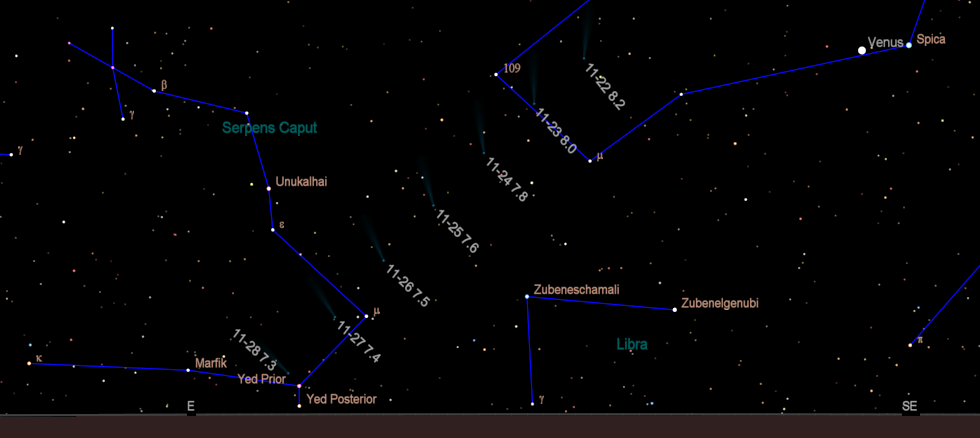
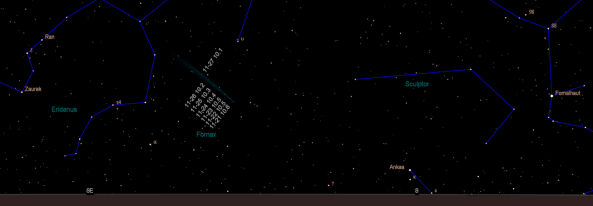
The new magnitude estimates are from Seiichi Yoshida’s website and his Weekly Information about Bright Comets: http://www.aerith.net/comet/weekly/current.html
11/19/2018 – Ephemeris – The Leonids’ comet 55P/Tempel-Tuttle
Ephemeris for Monday, November 19th. The Sun will rise at 7:45. It’ll be up for 9 hours and 25 minutes, setting at 5:10. The Moon, half way from first quarter to full, will set at 4:29 tomorrow morning.
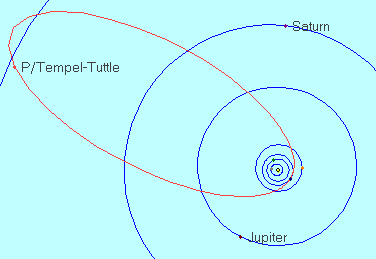
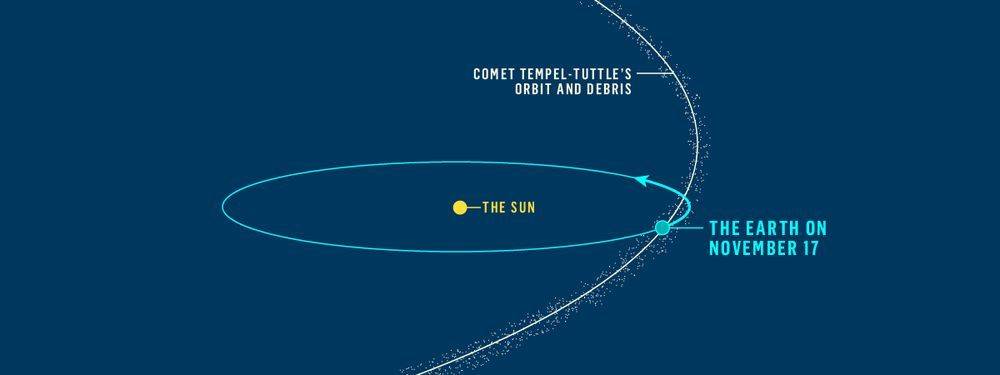
We have another day in this year’s extended Leonid meteor peak. In past years, usually every 33 years the Leonid meteors have a super peak, called a meteor storm, where thousands of meteors streak through the skies. These appear for a brief period over a rather small geographic area. In 1966 it occurred principally over the Rocky Mountains. The comet responsible is Comet Tempel Tuttle, independently discovered by two astronomers Tempel and Tuttle in 1865 & 1866. The comet had a 33 year orbit of the Sun, and its orbit crosses very close to the Earth’s orbit. Comets are notorious litter bugs, shedding gas, dust and pebble sized debris as they come close to the warming rays of the Sun.
The times given are for the Traverse City/Interlochen area of Michigan. They may be different for your location.
Addendum
11/14/2018 – Ephemeris – The bright planets this week
Ephemeris for Wednesday, November 14th. The Sun will rise at 7:38. It’ll be up for 9 hours and 37 minutes, setting at 5:15. The Moon, 1 day before first quarter, will set at 11:18 this evening.
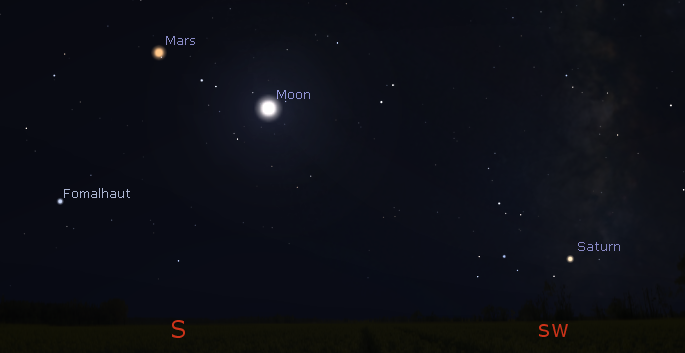
Let’s look at the bright planets for tonight. Two of them are visible in the evening sky. Jupiter will set too soon after sunset to be seen. It will set only 29 minutes after the Sun. Saturn, the ringed planet, will start the evening low in the southwestern sky and will set at 7:59 p.m. Mars will be low in the south as the skies darken tonight. Mars will be due south at 7:15 p.m., and it will set at 12:24 a.m. Mars is moving eastward, crossing the constellation of Aquarius this month. It’s currently at the western edge of Aquarius, moving eastward and northward, so its setting time won’t change much over this month. Venus, our brilliant morning star, will rise at 5:15 a.m. in the east southeast. The blue-white star Spica is just above and right of it now.
The times given are for the Traverse City/Interlochen area of Michigan. They may be different for your location.
Addenda
Comet Notes
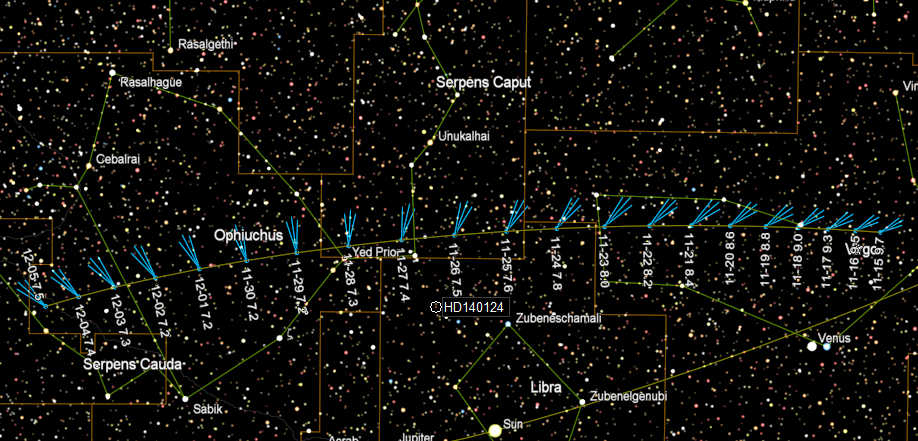
Two comets will be flirting with naked eye visibility later this month and next month. Newly discovered C/2018 V1 Machholz-Fujikawa-Iwamoto. It will be a morning object in mid-December and be its brightest at the end of this month or early December when it will be cruising through Ophiuchus.
Periodic comet 46P/Wirtanen is moving up from the south and is an evening object. It will pass close to the Pleiades in mid-December and will appear near the bright star Capella around Christmas time.
10/18/2018 – Ephemeris – Halley’s Comet returns as the Orionids
Ephemeris for Thursday, October 18th. The Sun will rise at 8:02. It’ll be up for 10 hours and 50 minutes, setting at 6:53. The Moon, 2 days past first quarter, will set at 2:32 tomorrow morning.
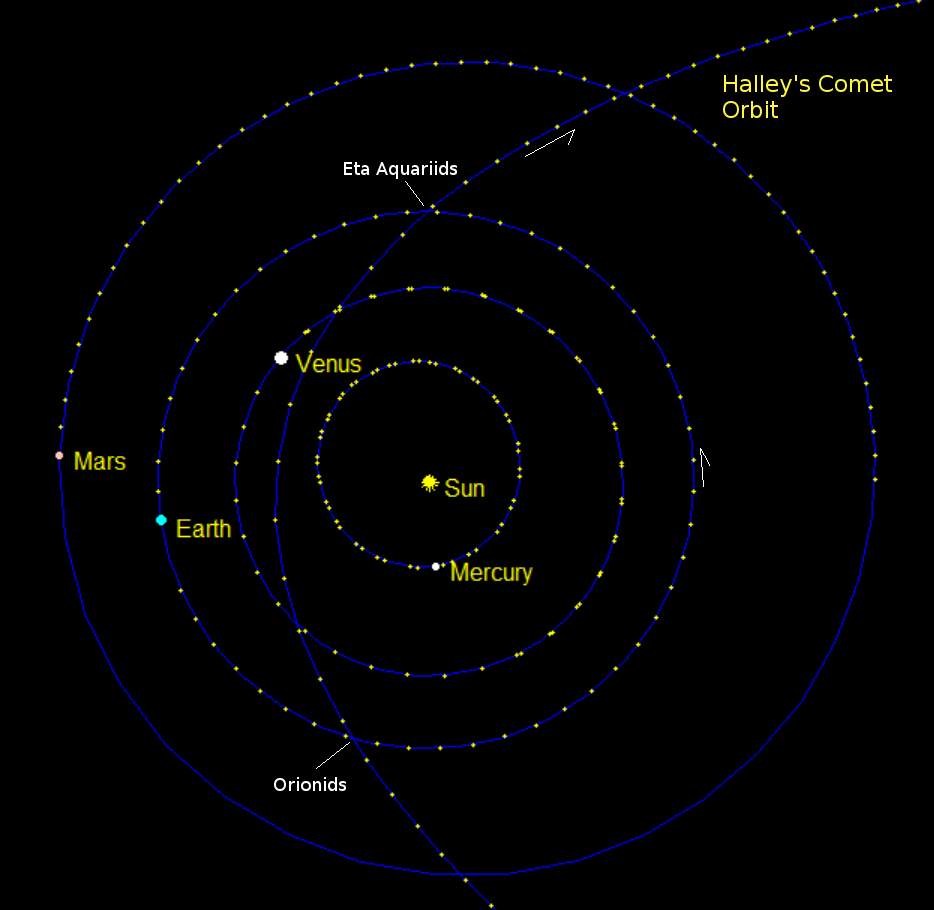
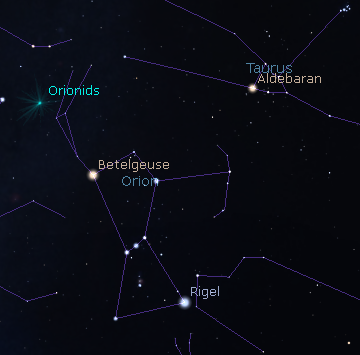
Halley’s Comet is back! (Pronounced Hall-ee’s) Well sorta. In the form of the Orionid meteor shower. Bits of Halley’s Comet from previous passes by the Earth’s orbit make their twice-yearly show in our skies as these bits collide with the Earth’s atmosphere. Halley’s orbit passes close to the earth’s orbit at points where the Earth is around May 6th and again near October 21st. Light dust and ionized gas get blown back into the tail of the comet. Heavier particles, still affected by the pressure of sunlight and the gravitational pull of the Sun and planets end up roughly following the comet’s orbit. In the morning after the Moon sets should be the best time to see them. They will seem to come from a spot above Orion and below Gemini.
The times given are for the Traverse City/Interlochen area of Michigan. They may be different for your location.
Addendum
08/07/2018 – Ephemeris – The source of the Perseids
Ephemeris for Tuesday, August 7th. The Sun rises at 6:35. It’ll be up for 14 hours and 24 minutes, setting at 9:00. The Moon, 3 days past last quarter, will rise at 3:18 tomorrow morning.
The Perseid meteor shower will reach its peak Sunday night and Monday morning, less than a week from now. The meteor shower is caused by tiny particles shed by the comet 109P/Swift-Tuttle on past trips through the inner solar system. The 109P means it was recognized as the 109th comet to have seen to return to the vicinity of the Sun to be rediscovered in 1992. Lewis Swift and Horace Tuttle first discovered the comet independently in 1862. The orbit of the comet fit the orbits of the meteoroids that produce the Perseid meteor shower each year. The comet will return in 2126 after retreating to 51 times the Earth’s distance from the Sun, deep in the Kuiper belt, leaving behind a trail of meteoroids.
The times given are for the Traverse City/Interlochen area of Michigan. They may be different for your location.
Addendum
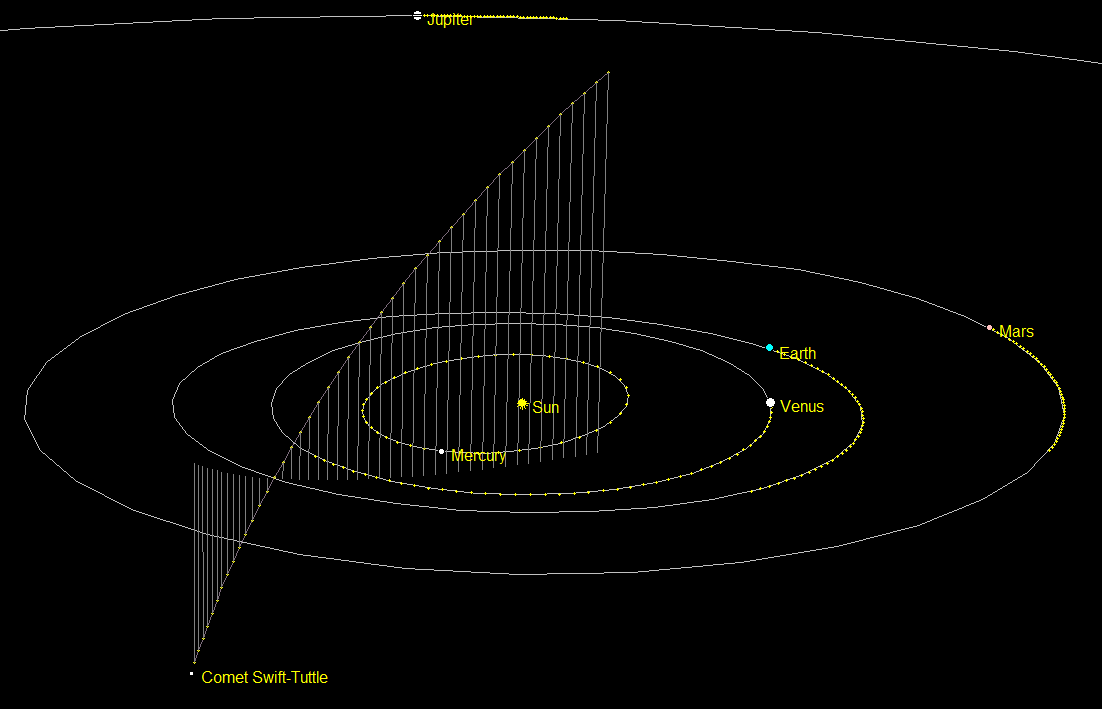
The passage of 109P/Comet Swift-Tuttle through the inner solar system November 1, 1992 to January 30, 1993. The meteoroids shed by the comet on its numerous trips close to the Sun lie close to that orbit. Note that its orbit intersects with the Earth’s orbit. That’s where the Earth will be around August 12-13 every year. Click on the image to enlarge. Created using my LookingUp program.
10/26/2017 – Ephemeris – Jupiter at perihelion and 96P/Comet Machholz 1 rounds the Sun
Ephemeris for Thursday, October 26th. The Sun will rise at 8:12. It’ll be up for 10 hours and 27 minutes, setting at 6:39. The Moon, 1 day before first quarter, will set at 11:48 this evening. | Today at 2:02 in the afternoon the planet Jupiter will be in conjunction with the Sun, moving from east to west with respect to the Sun. Leaving the evening sky to enter the morning sky. While invisible from the Earth’s surface. There are cameras recording the Sun at all times that will also pick up Jupiter. Two on the Solar and Heliospheric Observatory perched a million miles sunward of the Earth. are chronagraphs, and contain disks that block out the light of the Sun creating total eclipses. The planet will pass above or north of the Sun. The easiest way to find these images is to go to spaceweather.com, go down to the link section and select Solar and Heliospheric Observatory and click on The Sun Now. The images to check out at the two LASCO images.
The times given are for the Traverse City/Interlochen area of Michigan. They may be different for your location.
Addendum
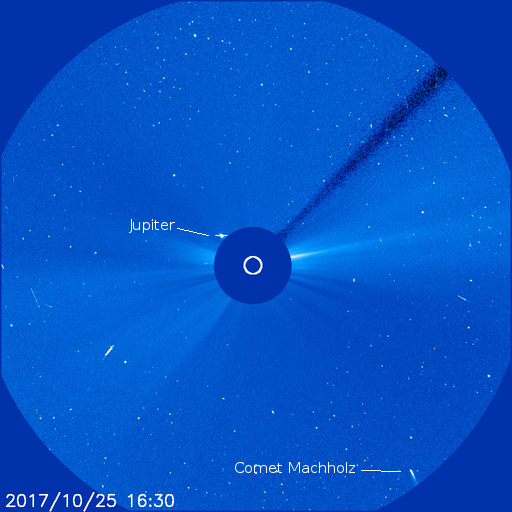
The current LASCO C3 image at this blog’s posting time Credit: ESA/NASA/SOHO.
Jupiter is about to be covered by the LASCO C3 coronagraph’s occulting disk. It will still be visible in the C2 field. As an extra bonus Comet 96P/Machholz entered the LASCO C3 field of view on the 25th and will exit on the 30th.
To follow Jupiter’s progress check out these animated GIFs: https://sohowww.nascom.nasa.gov/data/LATEST/current_c3.gif and https://sohowww.nascom.nasa.gov/data/LATEST/current_c2.gif.
Note that these animations will be current as of the date you click on them.
04/05/2017 – Ephemeris – It’s Wednesday, do you know where your bright planets are?
Ephemeris for Wednesday, April 5th. The Sun will rise at 7:15. It’ll be up for 12 hours and 59 minutes, setting at 8:15. The Moon, 2 days past first quarter, will set at 5:04 tomorrow morning.
In the evening twilit sky tonight will feature the elusive planet Mercury. This tiny planet might be seen to the upper right of the Sun’s setting point starting about 9 p.m. It will set at 9:55 p.m. Mercury is getting rapidly fainter because it’s now exhibiting a diminishing crescent to us. It takes a good telescope and very steady skies to spot Mercury’s phase. Mars is still hanging on, in the west above and left of Mercury, and will set at 11:09 p.m. Jupiter will rise about sunset a half hour before the star Spica, which it will be seen to hang out with this year. Jupiter will be still seen in the morning sky low in the southwest at 6 a.m. Saturn then is in the south above the Teapot figure of Sagittarius. It will rise at 2:06 a.m. in the east-southeast.
Times are for the Traverse City/Interlochen area of Michigan. They may be different for your location.
Addendum
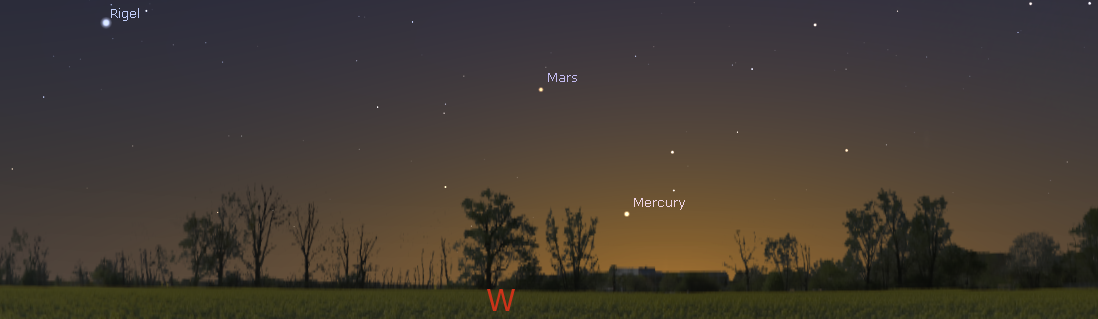
Mercury and Mars low in the west at 9 p.m. April 5, 2017. Created using Stellarium.
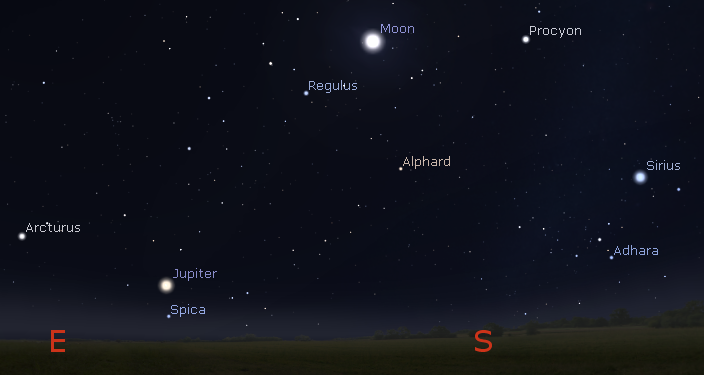
Jupiter and the Moon at 9:30 p.m. Created using Stellarium.
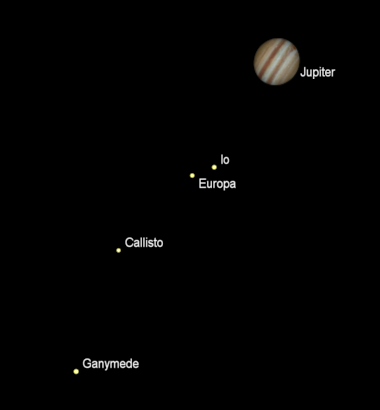
Jupiter and its moons as they might be seen in a telescope at 11 p.m. April 5, 2017. It is usually best to let planets rise a bit to minimize the atmospheric effects on the image. Created using Cartes du Ciel.
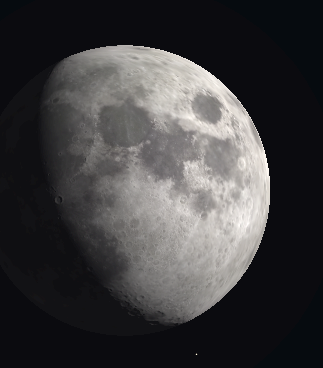
The Moon as it might be seen in binoculars at 9:30 p.m. April 5, 2016. Note the prominent crater Copernicus emerging into sunlight on the left of the Moon. Created using Stellarium.
If you’d like to check out the Moon in a telescope tonight, check out this posting : https://bobmoler.wordpress.com/2014/03/10/03102014-ephemeris-observibg-the-moon-tonight-and-the-crater-copernicus/
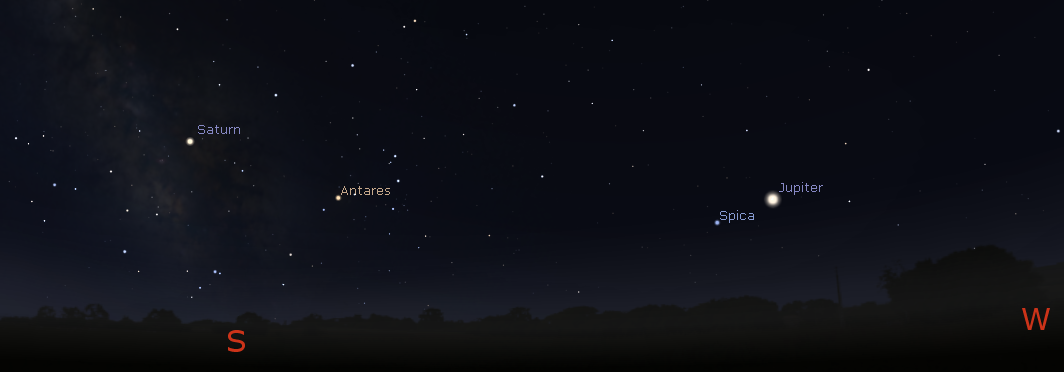
The planets visible at 6 a.m. April 6, 2017 Venus is just below the eastern horizon at this hour. Created using Stellarium.
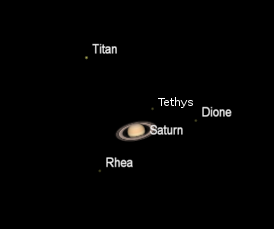
Saturn and its moons at 6 a.m. April 6th, 2017. Created using Cartes du Ciel (Sky Charts).
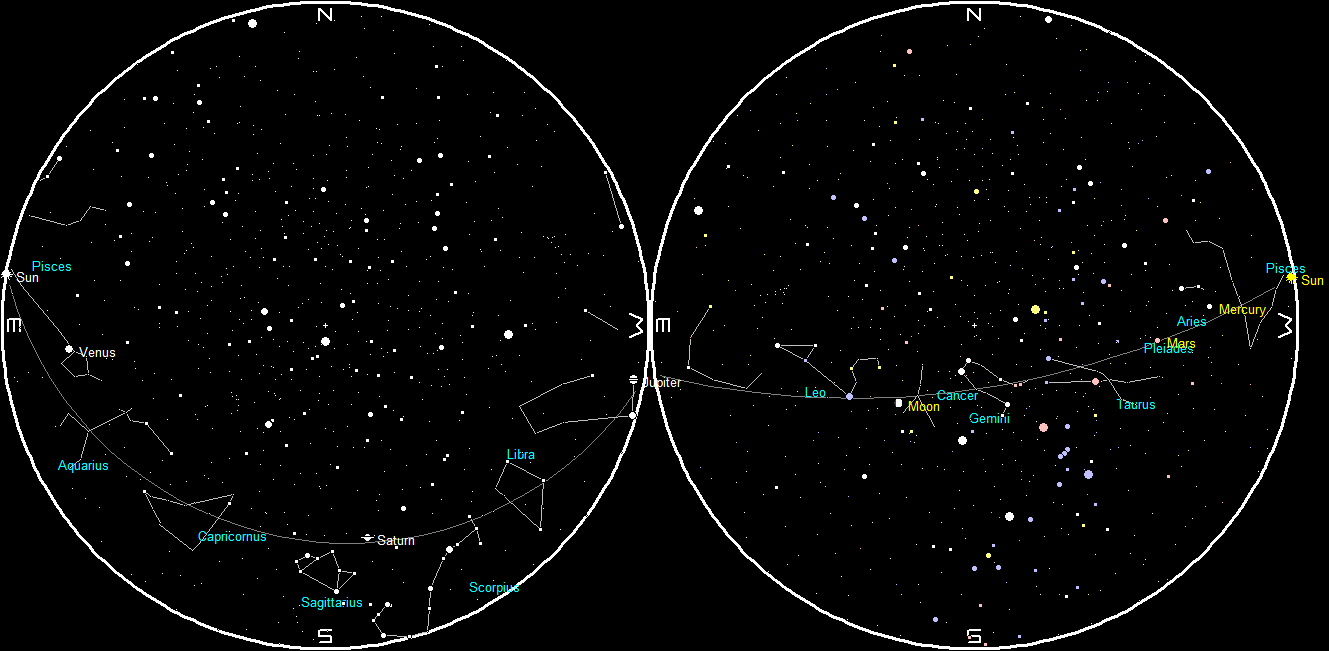
Planets and the Moon at sunset and sunrise of a single night starting with sunset on the right on April 5, 2017. The night ends on the left with sunrise on April 6. Click on the image to enlarge. Created using my LookingUp program.
A comet dramatically brightens
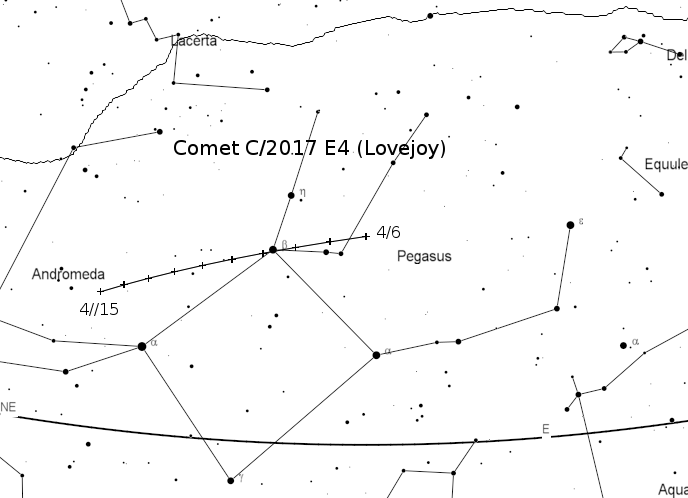
Here is the track for Comet 2017 E4 Lovejoy. This comet was expected to be 14th magnitude, but it’s brightness shot up to around 6.5, within range of binoculars. I’m only plotting 10 days. It should be brightest about mid-month, but is poorly placed for observation, plus we’re fighting a bright Moon. The curved horizontal line near the bottom is the Horizon on April 4, 2017. Created using Cartes du Ciel.
Universe today has lots more on the new Comet Lovejoy here: https://www.universetoday.com/134848/surprise-comet-e4-lovejoy-brightens/
03/19/2017 – Ephemeris Extra – Comet 41P/Tuttle-Giacobini-Kresak is within reach of binoculars and small telescopes
UT
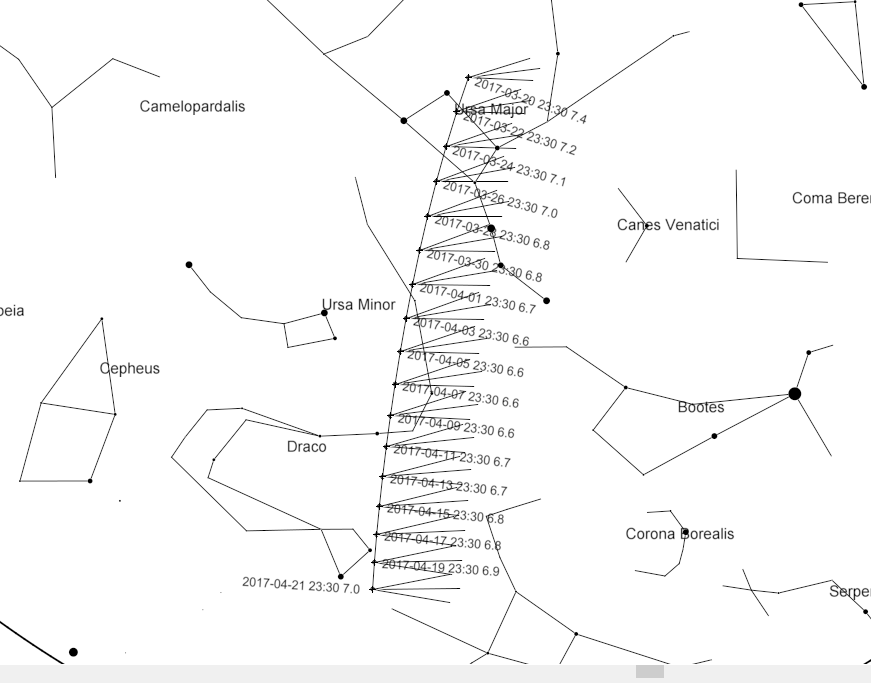
Comet 41P finder chart for the next month, March 20 to April 19. It is expected to be brightest at magnitude 6.6 in early April. Comet positions and orientation in the northeast are for 11:30 p.m. on the date specified or 3:30 UT on the next date. Created using Cartes du Ciel (Sky Charts). Click on the chart to enlarge.
Note above: The tail symbol points to the direction of a tail. However none of the photographs I’ve seen show a tail, so none will be visible visually.
This comet is known to have frequent outbursts where its brightness increases by many times. If an outburst occurs in early April, the comet could become visible to the naked eye. Original source material for this post comes from Seiichi Yoshida’s Weekly Information about Bright Comets web page. The comet will pass less than 14 million miles (22 million km) from Earth on April 5th, only 8 days before it’s closest approach to the Sun, called perihelion. From the finder chart one can see the comet will pass to the north of the Earth.
According to Gary Kronk’s Cometography.com web site the comet was discovered and lost three times. It was first discovered in 1858 by Horace Tuttle, whose name was attached to at two well known comets that produce meteor showers. It was unobserved for the next eight returns, which were expected every 5.42 years. Michel Giacobini rediscovered it again in 1907. Giacobini was the discoverer of Comet Giacobini-Zinner, another famous meteor shower producing comet. It was lost again until Lubos Kresák rediscovered it in 1951 after seven more missed returns.
01/31/2017 – Ephemeris – Looking ahead at February 2017
Ephemeris for Tuesday, January 31st. The Sun will rise at 8:02. It’ll be up for 9 hours and 48 minutes, setting at 5:50. The Moon, 3 days before first quarter, will set at 10:06 this evening.
February is the shortest month, even so the daylight hours throughout the month will be getting longer. Daylight hours will increase from 9 hours and 50 minutes tomorrow to 11 hours and 7 minutes on the 28th. The sunrise time will decrease from 8:01 tomorrow to 7:21 at months end. The sunset times will increase from 5:51 tomorrow to 6:29 on the 28th. Along with that the altitude of the sun at noon will increase from 28.4 degrees today to 38.6 degrees at month’s end. It will be a degree lower for folks in the Straits area because they are a degree of latitude farther north. Local noon, by the way for Interlochen and Traverse City is about 12:55 p.m. On the evening of the 10th the Moon will enter the Earth’s outer shadow with an penumbral lunar eclipse. I’ll have more information on that then. Moon will be near the planets Mars and Venus in the southwestern sky early tonight.
Times are for the Traverse City/Interlochen area of Michigan. They may be different for your location.
Addenda
February Star Charts
Evening
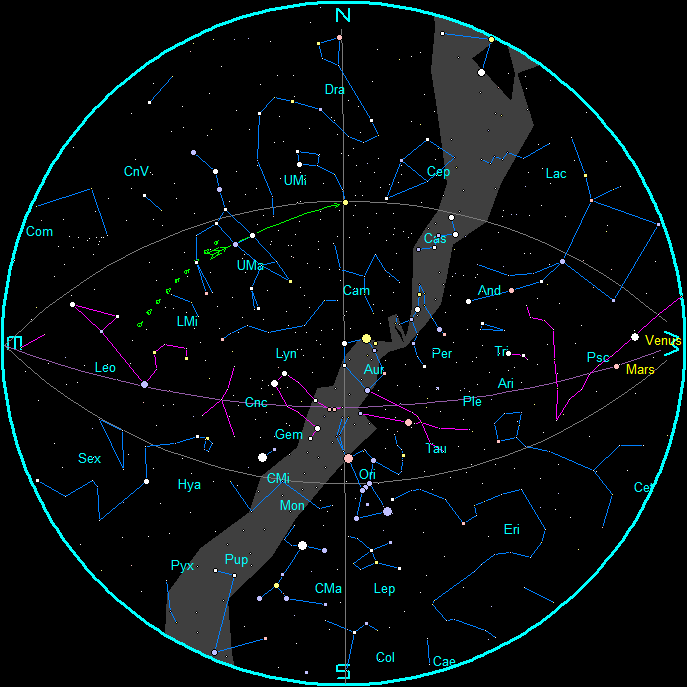
Star Chart for February 2017. Created using my LookingUp program. Click on image to enlarge.
Morning
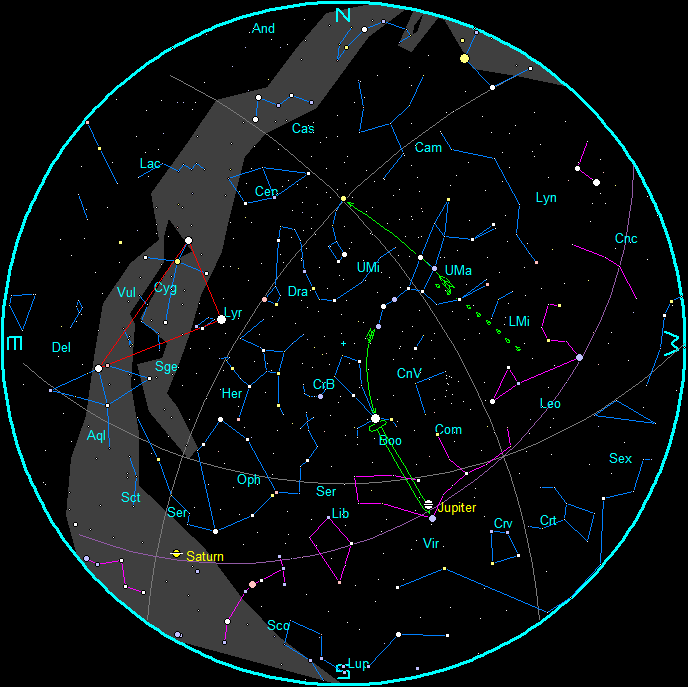
Star Chart for February 2017 mornings. Created using my LookingUp program. Click on image to enlarge.
The planets and stars are plotted for the 15th at 9 p.m. EST, and again at 6 a.m. Those are chart times. Note, Traverse City is located approximately 45 minutes behind our time meridian. (An hour 45 minutes behind our daylight saving time meridian. during EDT and 45 minutes behind our daylight standard time meridian. during EST). To duplicate the star positions on a planisphere you may have to set it to 1:45 or 0:45 earlier than the current time if you were near your time meridian.
Add a half hour to the chart time every week before the 15th and subtract a half hour for every week after the 15th.
For a list of constellation names to go with the abbreviations click here.
- Pointer stars at the front of the bowl of the Big Dipper point to Polaris the North Star
- Follow the arc of the handle of the Big Dipper to the star Arcturus, and
- Straighten to a spike to Spica
- The Summer Triangle is shown in red
Evening nautical twilight ends at 6:56 p.m. EST on the 1st, increasing to 7:31 p.m. EST on the 28th.
Evening astronomical twilight ends at 7:30 p.m. EST on the 1st, increasing to 8:05 p.m. EST on the 28th.
Morning astronomical twilight starts at 6:22 a.m. EST on the 1st, and increasing to 5:45 a.m. EST on the 28th.
Morning nautical twilight starts at 6:56 a.m. EST on the 1st, and Increasing to 6:19 a.m. EST on the 28th.
NASA Calendar of Planetary Events
Credit: Sky Events Calendar by Fred Espenak and Sumit Dutta (NASA’s GSFC)
To generate your own calendar go to http://eclipse.gsfc.nasa.gov/SKYCAL/SKYCAL.html
Times are Eastern Time and follow the time change dates.
Date        Time    Event
Feb 01  We          Venus: 45.5° E
    02  Th  5:11 am Venus-Mars: 5.4° N
    03  Fr 11:19 pm First Quarter
    05  Su  4:14 pm Moon-Aldebaran: 0.2° S
    06  Mo  8:59 am Moon Perigee: 368800 km
    07  Tu  1:34 pm Moon North Dec.: 18.9° N
    10  Fr  7:33 pm Full Moon
    10  Fr  7:45 pm Penumbral Lunar Eclipse
    11  Sa  9:04 am Moon-Regulus: 0.8° N
    11  Sa  2:49 pm Moon Ascending Node
    15  We  9:55 am Moon-Jupiter: 2.9° S
    18  Sa  2:33 pm Last Quarter
    18  Sa  4:14 pm Moon Apogee: 404400 km
    20  Mo  6:44 pm Moon-Saturn: 3.9° S
    21  Tu  3:50 pm Moon South Dec.: 18.8° S
    26  Su  1:28 pm Moon Descending Node
    26  Su  9:54 am Annular Solar Eclipse - South Atlantic
    26  Su  9:58 am New Moon
Mar 01  We          Venus: 32.5° E
February 2017 Calendar
LU             Ephemeris of Sky Events for Interlochen/TC
February, 2017    Local time zone: EST
+-----------------------------------------------------------------------+
| DATE |  SUN     SUN  DAYLIGHT|   TWILIGHT*    |MOON  RISE OR    ILLUM |
|      |  RISE    SET    HOURS |  END    START  |PHASE SET** TIME FRACTN|
+=======================================================================+
|Wed  1| 08:01a  05:51p  09:50 | 06:57p  06:55a |      Set  11:15p   26%|
|Thu  2| 08:00a  05:53p  09:52 | 06:59p  06:54a |      Set  12:25a   37%|
|Fri  3| 07:59a  05:54p  09:55 | 07:00p  06:53a |F Qtr Set  01:35a   48%|
|Sat  4| 07:57a  05:56p  09:58 | 07:01p  06:52a |      Set  02:45a   59%|
+------+-----------------------+----------------+-----------------------+
|Sun  5| 07:56a  05:57p  10:00 | 07:03p  06:51a |      Set  03:53a   70%|
|Mon  6| 07:55a  05:58p  10:03 | 07:04p  06:50a |      Set  04:56a   80%|
|Tue  7| 07:54a  06:00p  10:06 | 07:05p  06:48a |      Set  05:54a   89%|
|Wed  8| 07:52a  06:01p  10:09 | 07:06p  06:47a |      Set  06:45a   95%|
|Thu  9| 07:51a  06:03p  10:11 | 07:08p  06:46a |      Set  07:28a   99%|
|Fri 10| 07:50a  06:04p  10:14 | 07:09p  06:45a |Full  Rise 05:59p  100%|
|Sat 11| 07:48a  06:06p  10:17 | 07:10p  06:43a |      Rise 07:06p   99%|
+------+-----------------------+----------------+-----------------------+
|Sun 12| 07:47a  06:07p  10:20 | 07:12p  06:42a |      Rise 08:12p   96%|
|Mon 13| 07:45a  06:08p  10:23 | 07:13p  06:41a |      Rise 09:16p   90%|
|Tue 14| 07:44a  06:10p  10:26 | 07:14p  06:39a |      Rise 10:18p   84%|
|Wed 15| 07:42a  06:11p  10:28 | 07:15p  06:38a |      Rise 11:18p   76%|
|Thu 16| 07:41a  06:13p  10:31 | 07:17p  06:37a |      Rise 12:18a   67%|
|Fri 17| 07:39a  06:14p  10:34 | 07:18p  06:35a |      Rise 01:16a   58%|
|Sat 18| 07:38a  06:15p  10:37 | 07:19p  06:34a |L Qtr Rise 02:12a   48%|
+------+-----------------------+----------------+-----------------------+
|Sun 19| 07:36a  06:17p  10:40 | 07:21p  06:32a |      Rise 03:07a   39%|
|Mon 20| 07:34a  06:18p  10:43 | 07:22p  06:31a |      Rise 03:59a   30%|
|Tue 21| 07:33a  06:20p  10:46 | 07:23p  06:29a |      Rise 04:49a   21%|
|Wed 22| 07:31a  06:21p  10:49 | 07:25p  06:28a |      Rise 05:34a   14%|
|Thu 23| 07:30a  06:22p  10:52 | 07:26p  06:26a |      Rise 06:16a    8%|
|Fri 24| 07:28a  06:24p  10:55 | 07:27p  06:25a |      Rise 06:54a    3%|
|Sat 25| 07:26a  06:25p  10:58 | 07:28p  06:23a |      Rise 07:29a    0%|
+------+-----------------------+----------------+-----------------------+
|Sun 26| 07:25a  06:26p  11:01 | 07:30p  06:21a |New   Set  06:43p    0%|
|Mon 27| 07:23a  06:28p  11:04 | 07:31p  06:20a |      Set  07:53p    2%|
|Tue 28| 07:21a  06:29p  11:07 | 07:32p  06:18a |      Set  09:03p    7%|
+-----------------------------------------------------------------------+
* Nautical Twilight
** Moonrise or moonset, whichever occurs between sunset and sunrise
Penumbral Lunar Eclipse February 10/11, 2016
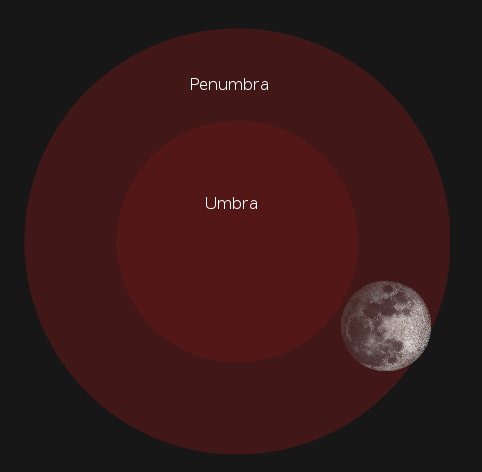
The moment of mid-eclipse at 7:45 p.m. February 10, 2016 EST (0:45 UT February 11). The Moon is traveling from upper right to lower left. Orientation is alt-az for northern Michigan. Created using Cartes du Ciel (Sky Charts).
In the early evening hours of February 10th the Moon will pass through the Earth’s outer or penumbral shadow. It will not get particularly dark since the Moon will still be somewhat illuminated by the Sun.
Anything shows two types of shadows in the sunlight. Your shadow appears fuzzy. That fuzziness is your penumbra, where the sunlight is only partially blocked. The dark inner part of your shadow is your umbra.
The eclipse starts at 5:34 p.m. (22:34 UT) at which time you will see nothing out of thee ordinary. Since the Moon is entering the shadow at a shallow angle it will take 2 hours and 11 minutes to reach the maximum eclipse. I’m guessing here, but one will probably not notice anything before 7 p.m. (0:00 UT) To help see the effect better, put on sunglasses. They will reduce the Moon’s glare to help see the darkening effect. Officially the eclipse will end at 9:53 p.m. (2:53 UT the 11th)
Binocular Comet 45P/Honda-Mrkos-Pajdusakova
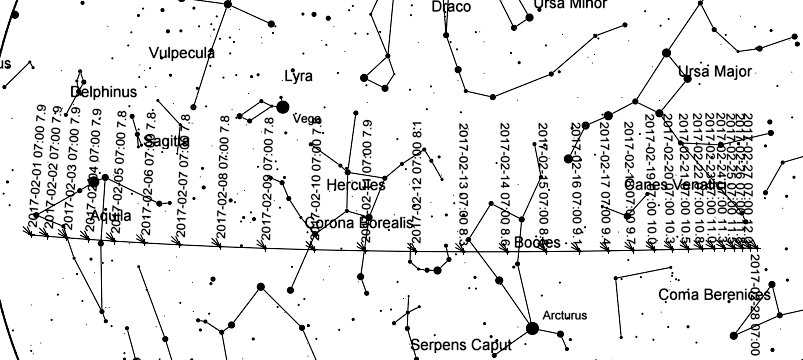
Comet 45P’s track for February. The comet is expected to be about a magnitude brighter than displayed (7th magnitude). Created using Cartes du Ciel (Sky Charts).
In the chart above the comet’s position is marked by a comet symbol. The comet’s tail, if visible at all, will actually point to the right along its track. The data for this chart is taken from Seiichi Yoshida’s Weekly Information about Bright Comets: http://www.aerith.net/comet/weekly/current.html
 Bob Moler's Ephemeris Blog