Archive
10/14/2016 – Ephemeris – Super Moon Sunday and a weird comet
Ephemeris for Friday, October 14th. The Sun will rise at 7:57. It’ll be up for 11 hours and 1 minute, setting at 6:59. The Moon, 2 days before full, will set at 7:03 tomorrow morning.
The full moon on Sunday will be the Hunter’s Moon it will also be a super moon, though not quite as super as November’s super moon. I tend to disparage the effect because of the optical illusion that makes the Moon appear larger when near the horizon than when higher up. Besides there’s nothing out there of comparable size to compare it to. Farther out in space, the comet 29P/Schwassmann-Wachmann 1, which is weird among comets in having a nearly circular orbit between Jupiter and Saturn. It can be observed over it’s entire orbit. Normally a comet out that far is pretty much inactive. However every once in a while it produces an outburst, brightening and expelling a cloud of gas and dust. This can occur up to 7 times a year.
Times are for the Traverse City/Interlochen area of Michigan. They may be different for your location.
Addendum
This month’s super Moon will appear to be 33.4 minutes of arc in diameter when it will rise Sunday night at 7:40 p.m. in the Traverse City/Interlochen area. It will be 222,393 miles (357,906 km) away. November’s super Moon will rise November 14 at 5:53 p.m. and appear to be 33.6 minutes of arc in diameter. Note that half a degree is 30 minutes of arc. Last April 2nd’s mini Moon was 29.4 seconds of arc in diameter when it rose. It was 252,262 miles (405,977 km) away. This full Moon will appear 13.6% larger than last April’s full Moon.
09/29/2016 – Ephemeris – The Rosetta spacecraft starts its fatal dive today
Ephemeris for Thursday, September 29th. The Sun will rise at 7:38. It’ll be up for 11 hours and 47 minutes, setting at 7:26. The Moon, 1 day before new, will rise at 7:09 tomorrow morning.
Tomorrow morning at 6:40 a.m. give or take 20 minutes the European Space Agency’s Rosetta spacecraft will slowly crash into Comet 67P/Churyumov-Gerasimenko after orbiting it for a bit over 2 years. The comet is carrying Rosette out toward Jupiter’s orbit where the spacecraft cannot receive enough sunlight to power it. Today the controllers will command the spacecraft to perform the collision maneuver to cancel Rosetta’s complete orbital velocity and let it fall straight down to hit the head of the rubber ducky shaped comet. It’s antenna will be facing Earth and it will be taking pictures all the way down for immediate transmission because Rosetta will turn off its transmitter forever when it impacts the comet.
Times are for the Traverse City/Interlochen area of Michigan. They may be different for your location.
Addendum
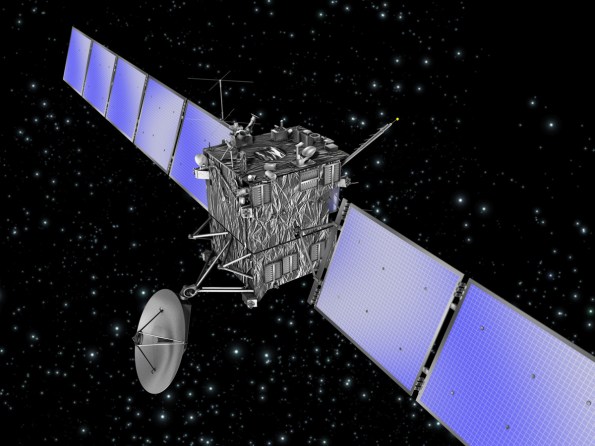
An artist’s illustration of the European Space Agency’s comet-chasing Rosetta spacecraft. Credit: ESA – C. Carreau
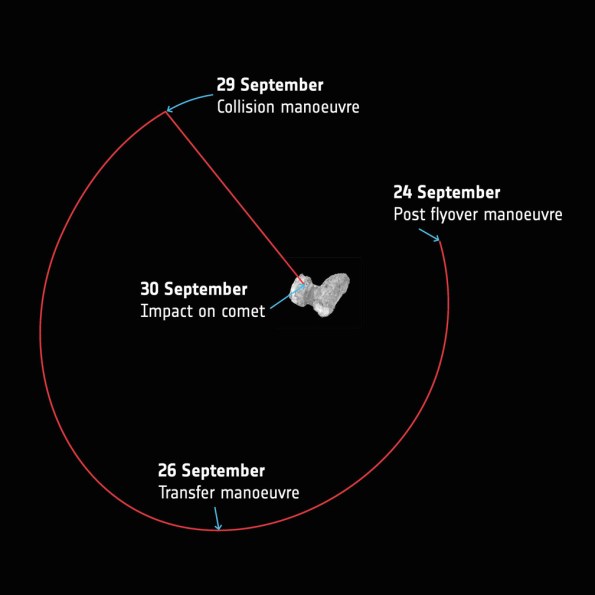
Rosetta, Final orbit. Credit & copyright European Space Agency (ESA)
07/15/2016 – Ephemeris – The end is near for ESA’s Rosetta spacecraft
Ephemeris for Monday, August 15th. The Sun rises at 6:45. It’ll be up for 14 hours and 1 minute, setting at 8:47. The Moon, 3 days before full, will set at 4:49 tomorrow morning.
In a month and a half the European Space Agency’s Rosetta spacecraft will end its mission to comet 67/P Churyumov-Gerasimenko or just 67/P for short. The end will come as the Rosetta spacecraft will make a slow crash onto the comet. A week ago the spacecraft shut down its link to the Philae lander, which itself didn’t stick its landing and bounced three times and found itself between ice and a hard place with no way for the Sun to reach it to recharge its batteries, and so had an abbreviated science mission before the batteries failed. The comet was closest to the Sun a year ago, and is heading back out to near the orbit of Jupiter. Last time it was out this far Rosetta had just been woken up out of a three-year slumber. This time though it will sleep forever after a job well done.
Times are for the Traverse City/Interlochen area of Michigan. They may be different for your location.
Addendum
An artist’s illustration of the European Space Agency’s comet-chasing Rosetta spacecraft. Credit: ESA – C. Carreau
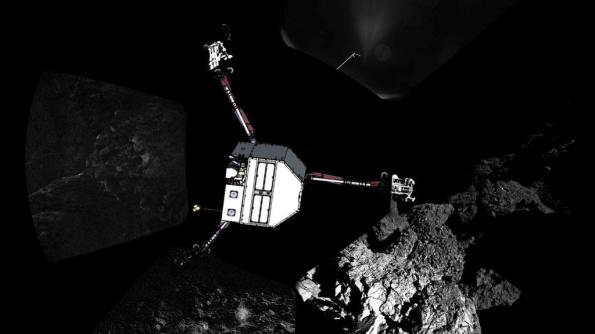
An image of the Philae lander superimposed on its panorama photographs where it was wedged between ice and a hard place in the shadows November 2014. Credit: ESA/Rosetta.
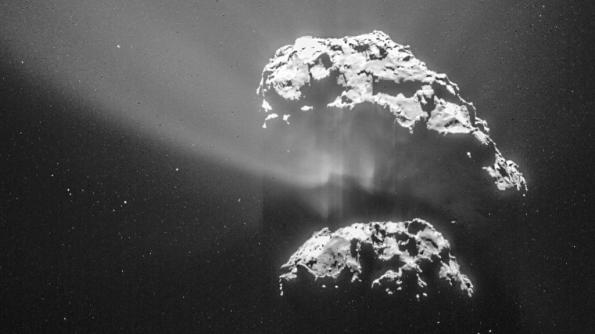
Comet 67P and jets of dust, carried by sublimating ices. Credit: ESA/Rosetta
08/09/2016 – Ephemeris – A look at the Perseids progenitor
Ephemeris for Tuesday, August 9th. The Sun rises at 6:38. It’ll be up for 14 hours and 18 minutes, setting at 8:56. The Moon, 1 day before first quarter, will set at 12:23 tomorrow morning.
Comet Swift-Tuttle is the comet responsible for the Perseid Meteor Shower which is now ramping up and will reach its peak Thursday night and Friday morning. The comet was independently discovered by Swift and Tuttle in the summer of 1862. Based on three months of observations it was predicted to return after 120 years in 1982. After it failed to appear more work was done to refine the orbit, and to check for past appearances of the comet. Sure enough comets appearing to fit the orbit were found in 188 CE and 69 BCE, so a new prediction for the comet to reappear was made for 1992 by the late Dr. Brian Marsden of the Smithsonian Astrophysical Observatory. His revised prediction was only off by 17 days.
Times are for the Traverse City/Interlochen area of Michigan. They may be different for your location.
Addendum
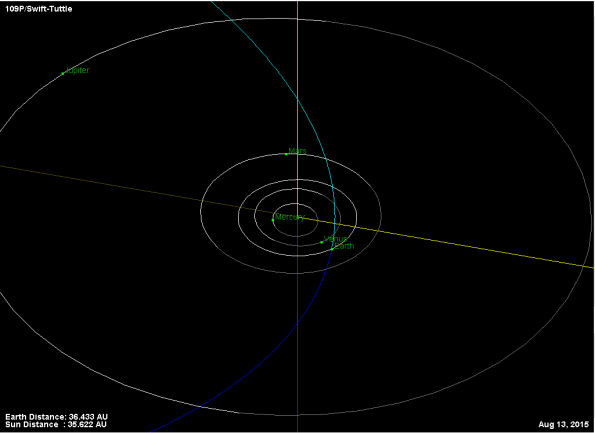
Orbit of Comet 109P/Swift-Tuttle. Blue line is the comet’s orbit, coming from above (North). Credit NASA / JPL / Applet by Osamu Ajiki (AstroArts), and further modified by Ron Baalke (JPL).
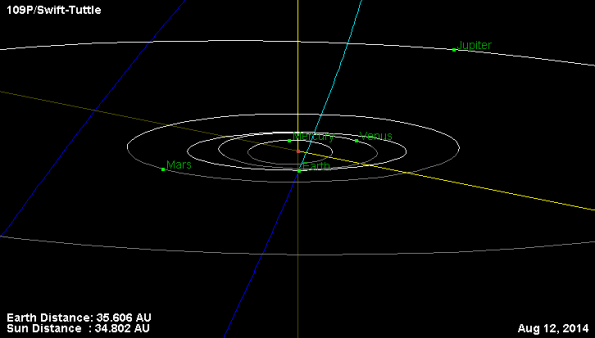
Orbit of Comet 109P/Swift-Tuttle. Blue line is the comet’s orbit, coming from above. That’s why the radiant is so far north. See yesterday’s post for the radiant point. Credit NASA / JPL / Applet by Osamu Ajiki (AstroArts), and further modified by Ron Baalke (JPL).
These were generated a couple of years ago. However the comet won’t be back until 2122 give or take.
03/21/2016 – Ephemeris – Two dim comets are making close passes of the Earth
Ephemeris for Monday, March 21st. The Sun will rise at 7:43. It’ll be up for 12 hours and 14 minutes, setting at 7:57. The Moon, 2 days before full, will set at 7:21 tomorrow morning.
Tomorrow Comet P/2016 BA14 (Pan-STARRS) will come it’s closest to the Earth at about 2.2 million miles (3.5 million km) or about 9 times the distance of the Moon away. It may not be a coincidence that another small comet 252P/LINEAR 12 in nearly the same orbit will be passing the Earth today at 3.3 million miles (5.3 million km). The Pan-STARRS comet will set a record as the third closest comet known to pass by the Earth. Many local folks saw the previous third closest comet, IRAS-Araki-Alcok from the Rogers Observatory back in 1983, when it passed 12.2 lunar distances from the Earth. Radio telescopes which use radar to probe both comets’ nuclei may give us a clue as to whether these two comets are chips off the same block so to speak.
Times are for the Traverse City/Interlochen area of Michigan. They may be different for your location.
Addendum
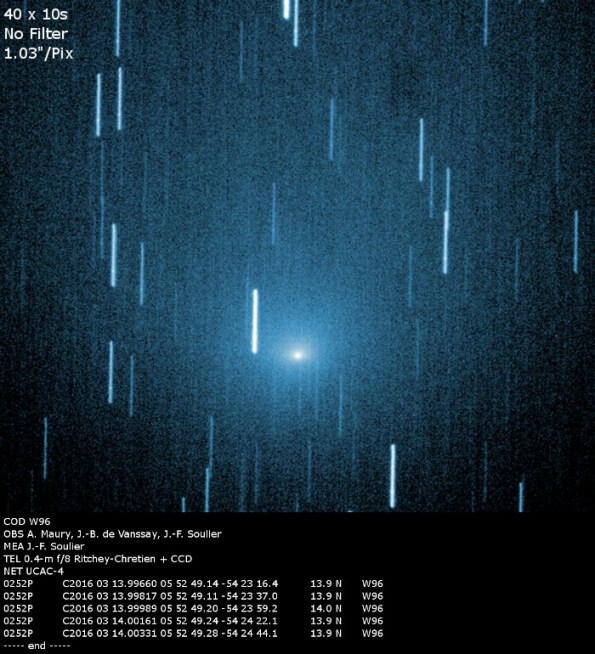
252P/LINEAR was expected to reach 8th magnitude, but has recently brightened to 5th magnitude, visible in binoculars. It’s currently too far south to be seen. On March 25th it will rises above our horizon as it passes the tail of Scorpius, heading north. Credit: Jean-Francois Soulier via Seiichi Yoshida’s web site.
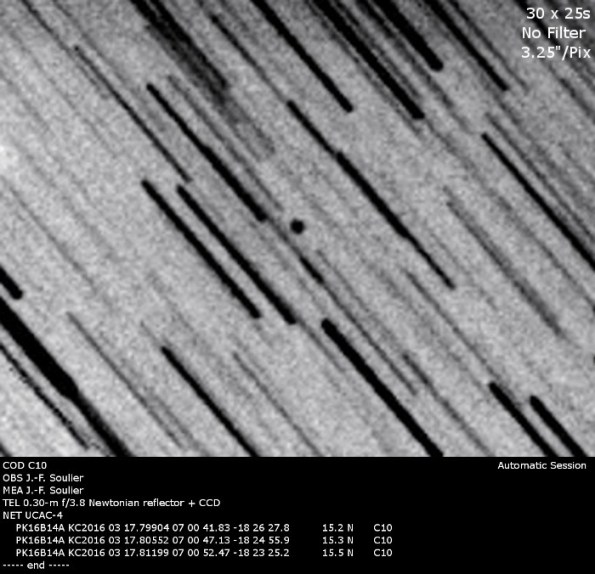
P/2016 BA14 ( PanSTARRS ) was discovered two moths ago it is too faint to be seen in all but the largest amateur telescopes. It’s currently passing the head of the constellation Hydra toward the head of Leo. This is a negative image. The dot is the comet. Credit: Jean-Francois Soulier via Seiichi Yoshida’s web site.
Seiichi Yoshida’s Weekly Information about Bright Comets link.
02/17/2016 – Ephemeris – All the bright planets are in the morning sky, but two of them are trying to sneak out
Ephemeris for Wednesday, February 17th. The Sun will rise at 7:40. It’ll be up for 10 hours and 32 minutes, setting at 6:13. The Moon, 2 days past first quarter, will set at 4:39 tomorrow morning.
Let’s check out the whereabouts of the bright naked eye planets. All the classical planets visible from antiquity are officially now in the morning sky. Though Mercury is too close to the Sun to be spotted. Jupiter will rise at 7:57 p.m., in the east. Jupiter is still a morning planet since it’s not up at sunset. Mars will rise next at 1:24 a.m. in the east-southeast. It’s brighter than the bright star Spica growing even farther to the right of it.. Saturn will rise at 3:40 a.m. in the east-southeast. Venus will rise at 6:27 a.m. again in the east-southeast. Mercury is too deep in the twilight glare to be seen. Comet Catalina is up all night and is a binocular object and fading fast. At 10 p.m. is above the constellation of Cassiopeia and right of Perseus.
Times are for the Traverse City/Interlochen area of Michigan. They may be different for your location.
Addendum
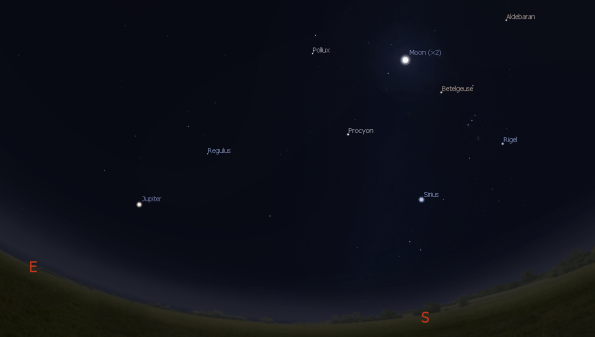
Jupiter, the Moon and the bright winter stars at 10 p.m. February 17, 2016. Created using Stellarium.
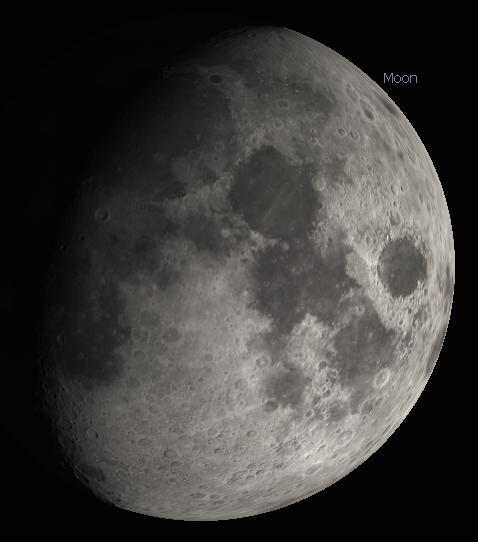
The Moon as it might be seen in binoculars at 10 p.m. February 17, 2016. Created using Stellarium.
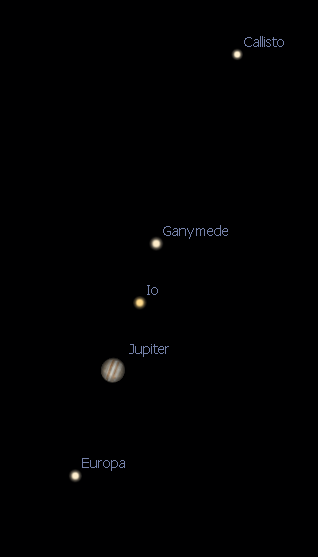
Jupiter and its moons as they would be seen in a telescope, at 10 p.m. February 17, 2016. Jupiter has an apparent diameter of 43.9″ Created using Stellarium.
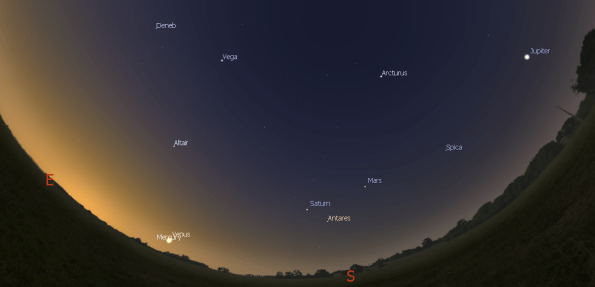
Morning planets and the bright s tar preview of summer. Mercury, though labeled can’t compete with the bright twilight. Observers south of here may have better luck. At 7 a.m. February 18, 2016. Created using Stellarium.
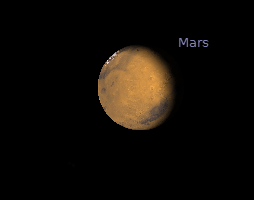
Mars in a telescope at high power. It’s apparent diameter is 7.9″. At 6 a.m. February 18, 2016. Created using Stellarium.
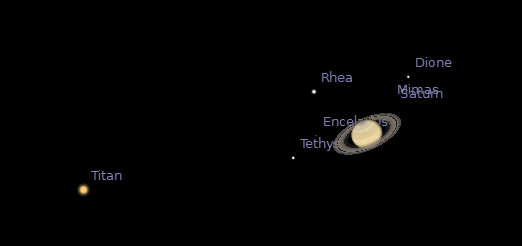
Saturn and its large satellite Titan and other moons as they should appear in a telescope at 6 a.m. February 18, 2016. The planet is 16.2″ in diameter while the rigs span 37.8″. Created using Stellarium.
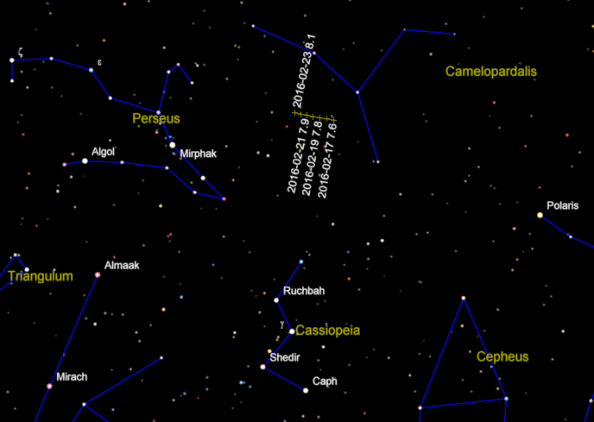
Comet Catalina’s path for the next week. Note that it is fading fast. It will take binoculars or a small telescope to spot the comet which will not show a tail visually. Created using Stellarium.
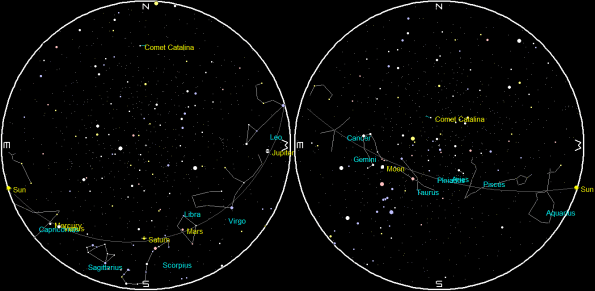
This is a chart showing the sunrise and sunset skies for February 17, 2016 showing the location of the planets, the Moon and Comet Catalina at that time. Created using my LookingUp program.
Some of these images above are shown smaller than actual size. Image expansion lately hasn’t worked. If you are using Firefox, right-click on the image, and then click on View Image.
02/10/2016 – Ephemeris – The morning planet gang will be around for 9 more days
Ephemeris for Ash Wednesday, Wednesday, February 10th. The Sun will rise at 7:51. It’ll be up for 10 hours and 12 minutes, setting at 6:03. The Moon, 2 days past new, will set at 8:53 this evening.
Let’s check out the whereabouts of the bright naked eye planets. All the classical planets visible from antiquity are officially now in the morning sky. However Jupiter actually will rise at 8:29 p.m., in the east. Jupiter is still a morning planet since it’s not up at sunset. Mars will rise next at 1:35 a.m. in the east-southeast. It’s brighter than the bright star Spica growing even farther to the right of it.. Saturn will rise at 3:40 a.m. in the east-southeast. Venus will rise at 6:25 a.m. again in the east-southeast. Mercury will rise behind Venus at 6:39. Comet Catalina is up all night and is a binocular object in the dark expanse of the constellation Camelopardalis between the bowl of the Big Dipper and the constellation of Perseus.
Times are for the Traverse City/Interlochen area of Michigan. They may be different for your location.
Addendum
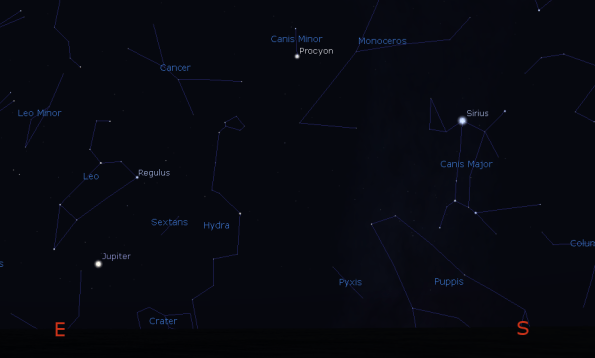
Jupiter low in the east-southeast at 10 p.m. on February 10th, 2016. Created using Stellarium.
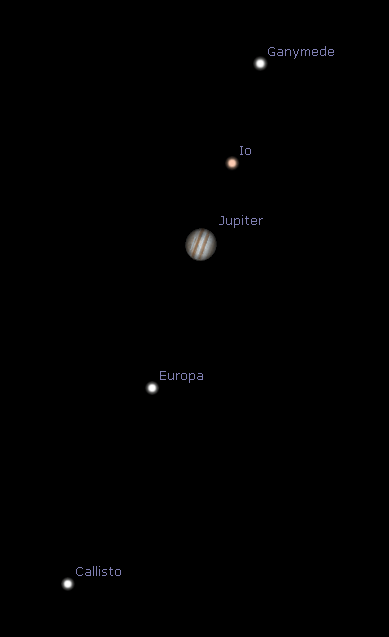
Jupiter and its moons as they would be seen in a telescope, at 10 p.m. February 10, 2016. Created using Stellarium.
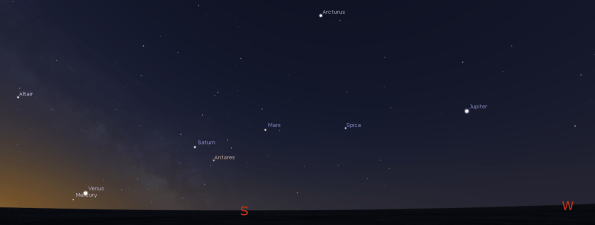
The planets in the morning sky at 7 a.m. on February 11, 2016. Jupiter is far to the west. Created using Stellarium.
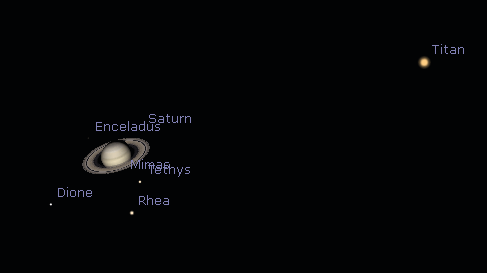
Saturn and its large satellite Titan and other moons as they should appear in a telescope at 7 a.m. February 11, 2016.
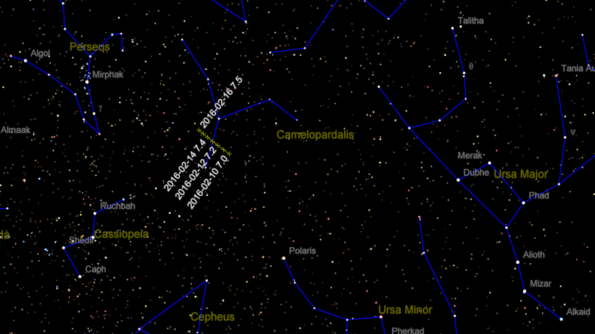
Comet Catalina’s path for the next week. Note that it is fading fast. It will take binoculars or a small telescope to spot the comet which will not show a tail visually. Created using Stellarium.
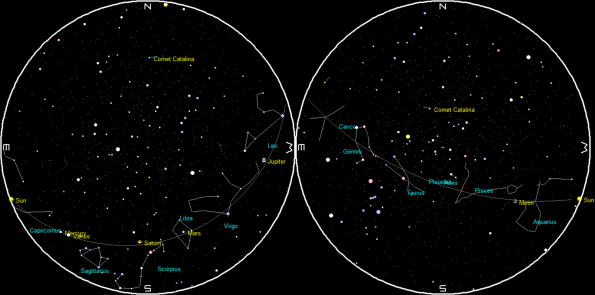
This is a chart showing the sunrise and sunset skies for February 10, 2016 showing the location of the planets, the Moon and Comet Catalina at that time. Created using my LookingUp program.
Some of these images above are shown smaller than actual size. Image expansion lately hasn’t worked. If you are using Firefox, right-click on the image, and then click on View Image.
02/03/2016 – Ephemeris – Though a morning planet, Jupiter can be seen in the late evening
Ephemeris for Wednesday, February 3rd. The Sun will rise at 8:00. It’ll be up for 9 hours and 53 minutes, setting at 5:53. The Moon, 3 days past last quarter, will rise at 4:27 tomorrow morning.
Let’s check out the whereabouts of the bright naked eye planets. All the classical planets visible from antiquity are officially now in the morning sky. However Jupiter actually will rise at 9 p.m., in the east. Jupiter is still a morning planet since it’s not up at sunset. Mars will rise next at 1:45 a.m. in the east-southeast. It’s left of the bright star Spica. Saturn will rise at 4:05 a.m. in the east-southeast. The Moon will be below, left of it tomorrow morning. Venus will rise at 6:19 a.m. again in the east-southeast. Mercury will rise behind Venus at 6:36. Comet Catalina is up all night and is a binocular object in the dark expanse of the constellation Camelopardalis between the bowl of the Big Dipper and the W shape of Cassiopeia.
Times are for the Traverse City/Interlochen area of Michigan. They may be different for your location.
Addenda
Planets
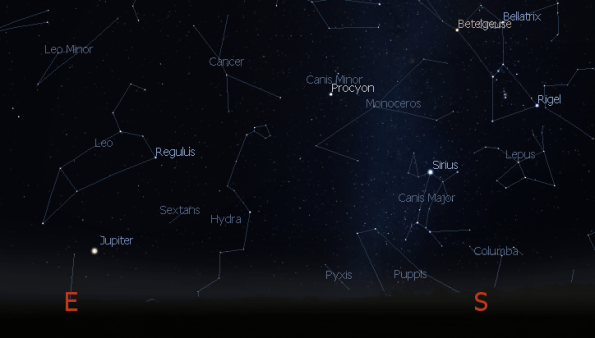
Jupiter low in the east at 10 p.m. on February 3rd, 2016. Created using Stellarium.
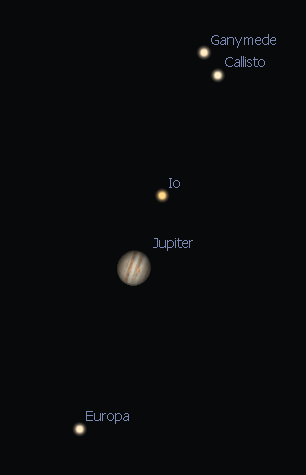
Jupiter and its moons as they would be seen in a telescope, at 10 p.m. February 3, 2016. I’d wait for an hour to let Jupiter rise above the thick atmosphere near the horizon for better clarity. Created using Stellarium.
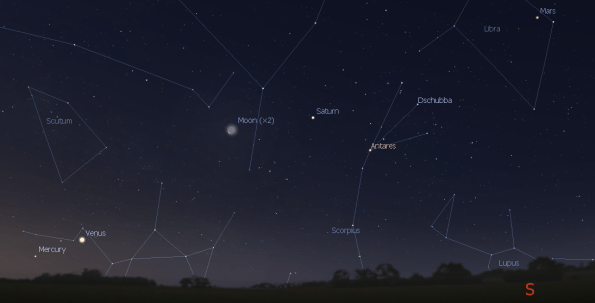
The planets in the morning sky at 7 a.m. on February 4, 2016. Jupiter is far to the west and out of this view. Created using Stellarium.
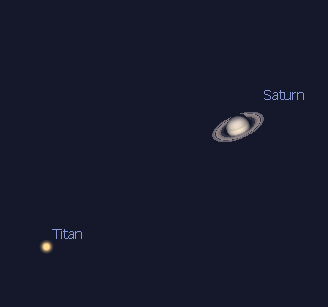
Saturn and its satellite Titan as they should appear in a telescope at 7 a.m. February 4, 2016
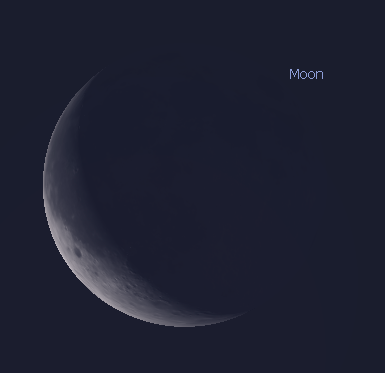
The Moon as it should appear in binoculars tomorrow morning at 7 a.m., February 4, 2016. Created using Stellarium.
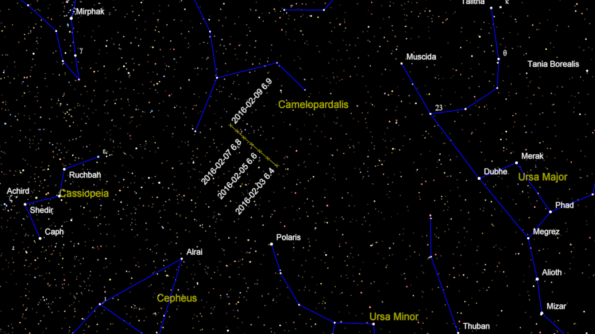
Comet Catalina’s path for the next week. Note that the magnitudes for the comet are about correct. It will take binoculars or a small telescope to spot the comet which will not show a tail visually. Created using Stellarium.
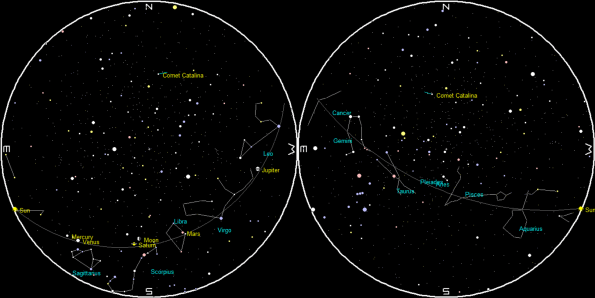
This is a chart showing the sunrise and sunset skies for February 3, 2016 showing the location of the planets, the Moon and Comet Catalina at that time. Created using my LookingUp program.
Off Topic
Stellarium
I’m now using Stellarium 0.14. It can detect older PCs and will not always crash, though I’m not thrilled with how it operates and some screen faults. The Portable Apps version has a patch that can be added to the application. The instructions for the patch are in the download page. Simply search “portable apps” to get started. The portable apps version worked better than the installed version, so I use the portable apps version. It turns out that my laptop can run 0.14, while my desktop cannot. The legacy version of Stellarium is 0.12.5.
It finally cleared up. For a while.
I bought myself a DSLR camera for my birthday/Christmas present a month and a half ago. I used to do a fair amount of astrophotography back before CCDs took over. I had some point and shoot digital cameras, which were not suitable for astrophotography. My last big spurge with film was for Comet Hale-Bopp in 1997.
But with the solar eclipse coming up next year the bug is biting again. I hate to brag but I’ve seen 4 total solar eclipses (1963, 1970, 1972, and 1979), plus 2 annular eclipses. I will recount my experiences with those eclipses in the year leading up to August 21, 2017.
In my film days I had developed a system for setting exposures for the Moon, planets, solar and lunar eclipses, and other possibly faint objects. It took a search to locate the data and used it when it finally cleared up on Ground Hog day. Below is one of the photos.
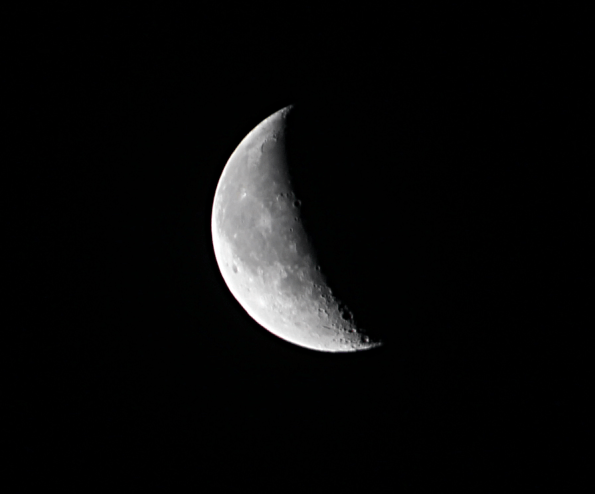
The fat crescent Moon at 7:02 a.m. February 2, 2016. ISO 100, 300mm focal length, f/11, 1/15 second.
02/01/2016 – Ephemeris – Previewing February
Ephemeris for Monday, February 1st. The Sun will rise at 8:02. It’ll be up for 9 hours and 48 minutes, setting at 5:50. The Moon, 1 day past last quarter, will rise at 2:34 tomorrow morning.
Let’s preview the month of February. It will be a day longer this year because it’s a leap year, the adjustment to keep the calendar in sync with the seasons. The daylight hours throughout February will be getting longer. Daylight hours will increase from 9 hours and 48 minutes today to 11 hours and 8 minutes on the 29th. The altitude of the sun at noon will increase from 28 degrees tomorrow to nearly 38 degrees at month’s end. The straits area will see the sun a degree lower. Local noon, by the way for Interlochen and Traverse City is about 12:56 p.m, which is mainly due to the fact that our standard time meridian happens to run through Philadelphia and the Sun is currently running 13 minutes slow.
Times are for the Traverse City/Interlochen area of Michigan. They may be different for your location.
Addenda
February Star Chart
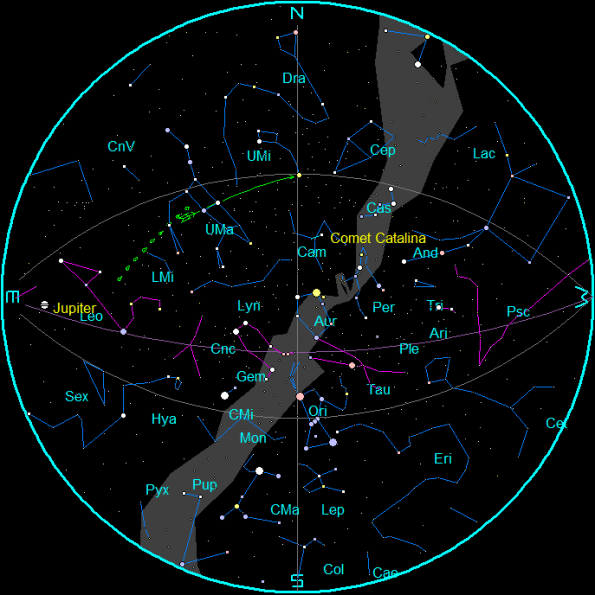
Star Chart for February 2016. Created using my LookingUp program. To enlarge in Firefox Right-click on image then click View image.
The planets and stars are plotted for the 15th at 9 p.m. EST. That is chart time. Note, Traverse City is located 45 minutes behind our time meridian. To duplicate the star positions on a planisphere you may have to set it to 45 minutes earlier than the current time.
Evening astronomical twilight ends at 6:56 p.m. EST on January 1st, increasing to 7:33 p.m. EST on the 29th.
Morning astronomical twilight starts at 6:56 a.m. EST on January 1st, and decreasing to 6:18 a.m. EST on the 29th.
Add a half hour to the chart time every week before the 15th and subtract and hour for every week after the 15th.
For a list of constellation names to go with the abbreviations click here.
- Pointer stars at the front of the bowl of the Big Dipper point to Polaris the North Star
- A leaky Big Dipper drips on Leo
Calendar of Planetary Events
Credit: Sky Events Calendar by Fred Espenak and Sumit Dutta (NASA’s GSFC)
To generate your own calendar go to http://eclipse.gsfc.nasa.gov/SKYCAL/SKYCAL.html
Times are Eastern Time. Some additions made to aid clarity.
     Date   Local    Event
            Time EST
Feb  01  Mo  3:48 am Moon-Mars: 3° S
     01  Mo          Venus: 31.4° W
     03  We  2:05 pm Moon-Saturn: 3.8° S
     04  Th 11:34 pm Moon South Dec.: 18.3° S
     06  Sa  2:32 am Moon-Venus: 4.5° S
     06  Sa 11:47 am Moon-Mercury: 3.9° S
     06  Sa  7:59 pm Mercury Greatest Elongation: 25.6° West
     08  Mo  9:39 am New Moon
     10  We  3:46 pm Moon Descending Node
     10  We  9:42 pm Moon Perigee: 364400 km
     12  Fr  9:32 pm Mercury-Venus: 4° N
     15  Mo  2:46 am First Quarter
     16  Tu  2:41 am Moon-Aldebaran: 0.4° S
     17  We  6:18 pm Moon North Dec.: 18.3° N
     22  Mo  7:48 am Moon-Regulus: 2.7° N
     22  Mo  1:20 pm Full Moon
     23  Tu 10:58 pm Moon-Jupiter: 1.9° N
     24  We  1:10 am Moon Ascending Node
     26  Fr 10:28 pm Moon Apogee: 405400 km
     28  Su 10:17 am Neptune Solar Conjunction
     29  Mo  1:16 pm Moon-Mars: 3.9° S
Mar  01  Tu          Venus: 24.9° W
Comet C/2013 US10 (Catalina)
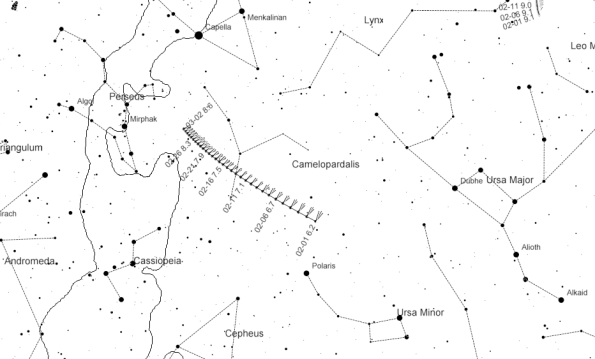
The track of Comet C/2013 US10 (Catalina) for February 2016. Created using Cartes du Ciel (Sky Charts).
The comet magnitudes, given after the date, are now pretty much on track. Comet is plotted every day at 10 p.m. EST (3 hr UT the next day). To monitor the brightness reports from observers go to http://www.aerith.net/comet/catalog/2013US10/2013US10.html.
01/20/2016 – Ephemeris – The planet action is in the morning sky
Update: This is the proper text for today
Ephemeris for Wednesday, January 20th. The Sun will rise at 8:13. It’ll be up for 9 hours and 20 minutes, setting at 5:34. The Moon, 3 days before full, will set at 5:51 tomorrow morning.
Let’s check out the whereabouts of the bright naked eye planets. All the classical planets visible from antiquity are now in the morning sky. However Mercury is too close to the Sun, and may remain too low in the sky to spot when it’s farther from the Sun. Jupiter will be the first to rise, actually at 10 p.m., in the east. It’s still a morning planet since it’s not up at sunset. Mars will rise next at 2:03 a.m. in the east-southeast. It’s below and left of the bright star Spica. Saturn will rise at 4:55 a.m. in the east-southeast. Venus will rise at 6 a.m. again in the east-southeast. Comet Catalina is a binocular object between the bowls of the Big and Little Dippers. It’s heading across the tail of Draco the dragon.
Times are for the Traverse City/Interlochen area of Michigan. They may be different for your location.
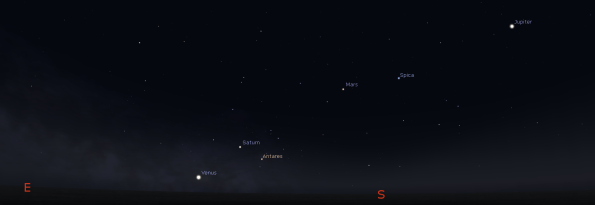
Here of the morning planets. From right to left, Jupiter, Mars, Saturn and Venus. Time: 6:30 a.m., January 21, 2016. Created using Stellarium.
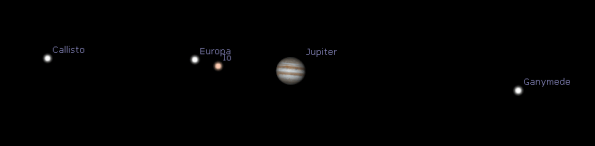
Jupiter and its 4 Galilean moons at 6:30 a.m., January 21, 2016. Created using Stellarium.
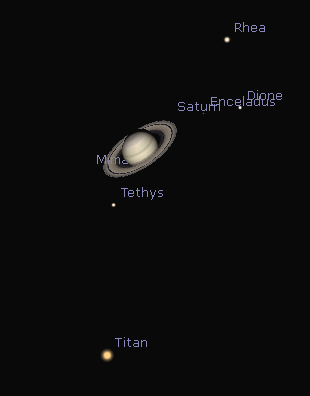
Saturn and its moons at a greater magnification as for Jupiter above at 6:30 a.m., January 21, 2016. Small telescopes will show only the moon Titan. Created using Stellarium.
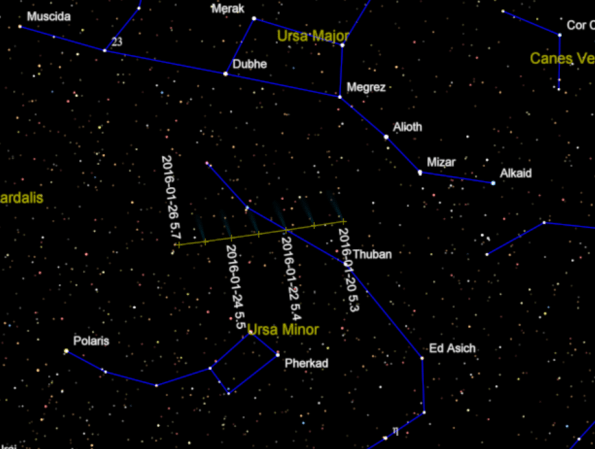
Comet Catalina’s path for the next week. Note the magnitudes for the comet are about correct. It will take binoculars or a small telescope to spot the comet which will not show a tail visually. Created using Stellarium.
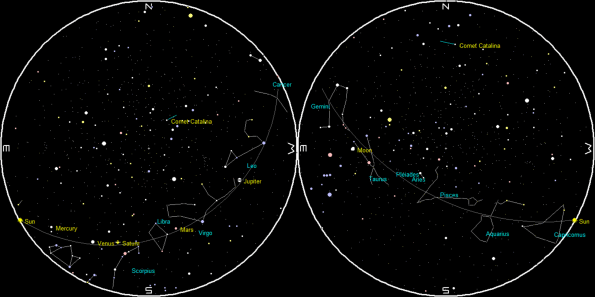
This is a chart showing the sunrise and sunset skies for January 20, 2016 showing the location of the planets, the Moon and Comet Catalina at that time. Created using my LookingUp program.
The top and bottom images above are shown smaller than actual size. Image expansion lately hasn’t worked. If you are using Firefox, right-click on the image, and then click on View Image.
 Bob Moler's Ephemeris Blog