Archive
Ephemeris: 05/26/2025 – About globular star clusters
This is Ephemeris for Memorial Day, Monday, May 26th. Today the Sun will be up for 15 hours and 12 minutes, setting at 9:16, and it will rise tomorrow at 6:03. The Moon is new today, and won’t be visible.
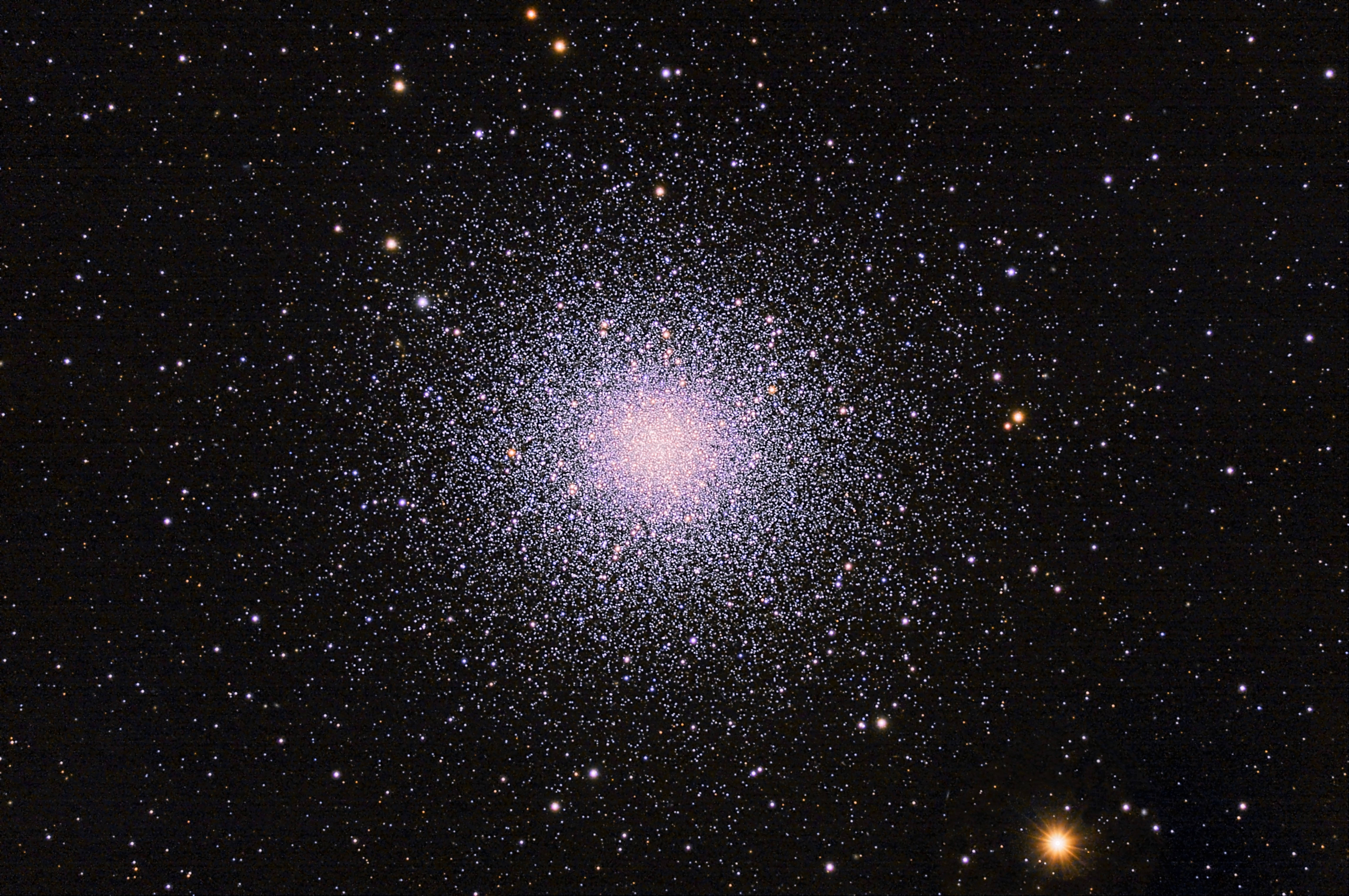
The constellation Hercules, out in the evening sky now, contains the brightest globular star cluster in the northern sky. A globular star cluster, about 25 thousand light years away. It’s an ancient assemblage of hundreds of thousands to millions of stars in a big ball. About 150 of these star clusters, that we know of, exist in the Milky Way. They form a spherical distribution around the Milky Way concentrated towards the center. The ages of these clusters runs to over 10 billion years. It is thought that they formed first out of the gas of the Milky Way and so did not participate in the collapse of the gas into the disk of the Milky Way we know today from which later stars were formed. We see them in other galaxies.
The astronomical event times given in this blog are for the Traverse City/Interlochen area of Michigan (Lat 44.7° N, Long 85.7° W; EDT, UT – 4 hours) unless stated otherwise. Times will be different for other locations.
Addendum
Ephemeris: 05/13/2025 – Arcturus, extragalactic visitor?
This is Ephemeris for Tuesday, May 13th. Today the Sun will be up for 14 hours and 45 minutes, setting at 9:02, and it will rise tomorrow at 6:15. The Moon, 1 day past full, will rise at 10:39 this evening.
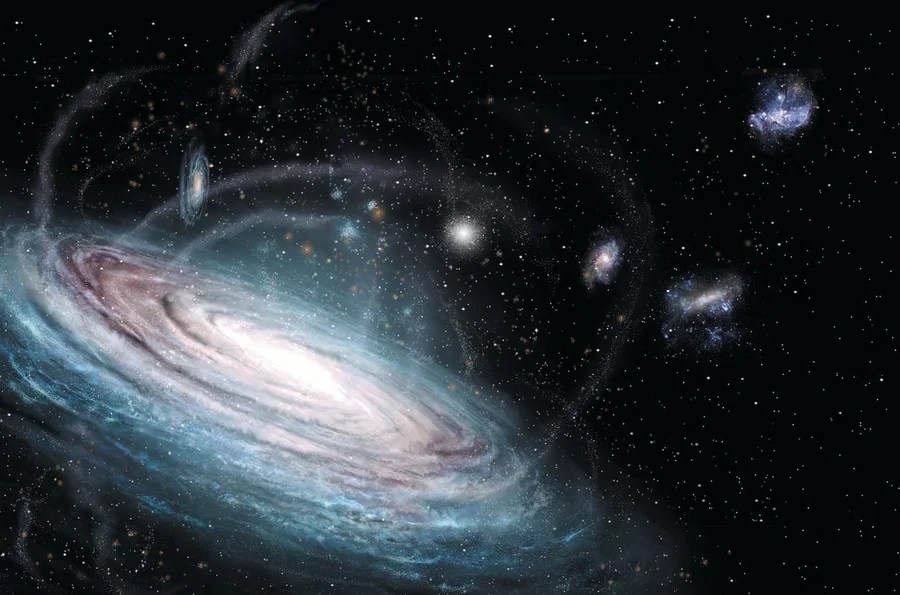
The bright orange star high in the southeast at 10 PM is Arcturus. Remember: Follow the arc of the handle of the Big Dipper to find Arcturus. It is an interesting star in many respects. Arcturus is somewhat more massive than the Sun and a bit older. It is starting its red giant phase having run out of hydrogen in its core and starting to use helium as its heat source, transmuting it into carbon and other elements. It has a very high velocity with respect to the Sun of about 100 kilometers per second. Arcturus is thought to be, by some astronomers, part of the remnants of a dwarf galaxy that collided with the Milky Way, and has now been assimilated. So Arcturus isn’t from around here.
-The astronomical event times given in this blog are for the Traverse City/Interlochen area of Michigan (Lat 44.7° N, Long 85.7° W; EDT, UT – 4 hours) unless stated otherwise. Times will be different for other locations.
Addendum
Ephemeris: 05/12/2025 – Artificial Intelligence, promise and caution

This is Ephemeris for Monday, May 12th. Today the Sun will be up for 14 hours and 43 minutes, setting at 9:01, and it will rise tomorrow at 6:16. The Moon, at full today, will rise at 9:34 this evening.
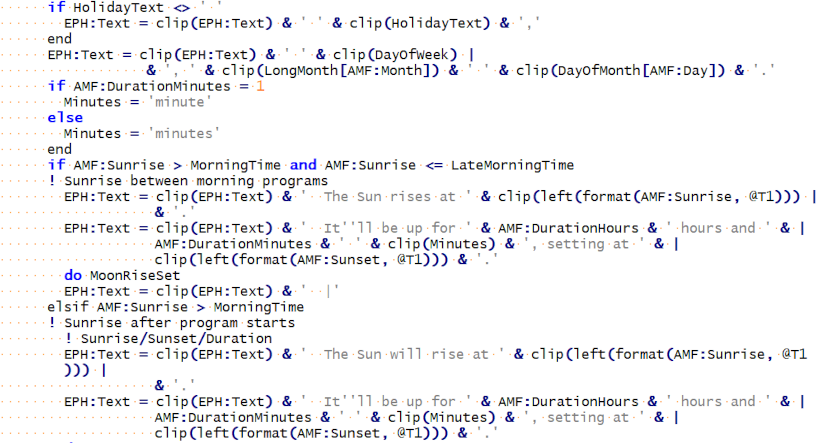
The text for the part of this program up to now was generated by a computer. It’s not AI. It’s generated by a program I wrote from data I created by another program that I also wrote, which is why it’s nearly the same every day. AI or artificial intelligence systems are trained rather than programmed. They learn their information more like how organic creatures learn, than computers do. And in talking to an AI one gets the feeling that there is almost a person there. It’s not like talking to the automated answering system of most businesses, where whatever the system is running, does not have a large vocabulary or under really understand anything. AI is powerful… and scary. AI can lie, they call it hallucinate, and can cheat. There’s great potential… and great danger.
The astronomical event times given in this blog are for the Traverse City/Interlochen area of Michigan (Lat 44.7° N, Long 85.7° W; EDT, UT – 4 hours) unless stated otherwise. Times will be different for other locations.
Addendum
Ephemeris: 05/09/2025 – AI and me
This is Ephemeris for Friday, May 9th. Today the Sun will be up for 14 hours and 36 minutes, setting at 8:57, and it will rise tomorrow at 6:20. The Moon, 3 days before full, will set at 5:08 tomorrow morning.
Continuing my look at Artificial Intelligence or AI. AI appears to be just about everywhere nowadays: on computers, software applications, and even on smartphones. The brains of AI are somewhere out on the Internet not on your phone or computer. I’ve gotten into it just recently. The first time was just this last February when I wanted a picture of a groundhog seeing its shadow for Groundhog’s day from my blog, which illustrated my day after Groundhog’s Day program here on Ephemeris. I use AI for research. Besides giving a synopsis of what it finds on the Internet. The one I use also gives a link to the original data, which has more information. I don’t rely on the synopsis it presents. And I would never have an AI write an Ephemeris episode. You could probably tell by its much better grammar.
The astronomical event times given in this blog are for the Traverse City/Interlochen area of Michigan (Lat 44.7° N, Long 85.7° W; EDT, UT – 4 hours) unless stated otherwise. Times will be different for other locations.
Addendum
Ephemeris: 05/08/2025 – AI, a different way to compute
This is Bob Moler with Ephemeris for Thursday, May 8th. Today the Sun will be up for 14 hours and 33 minutes, setting at 8:56, and it will rise tomorrow at 6:21. The Moon, halfway from first quarter to full, will set at 4:51 tomorrow morning.
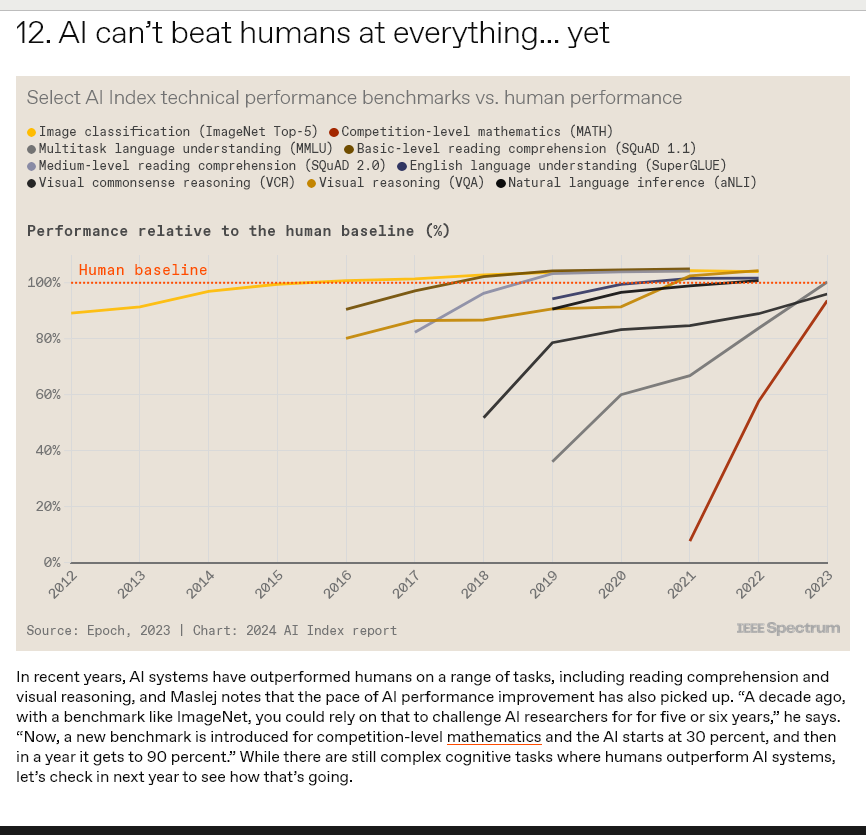
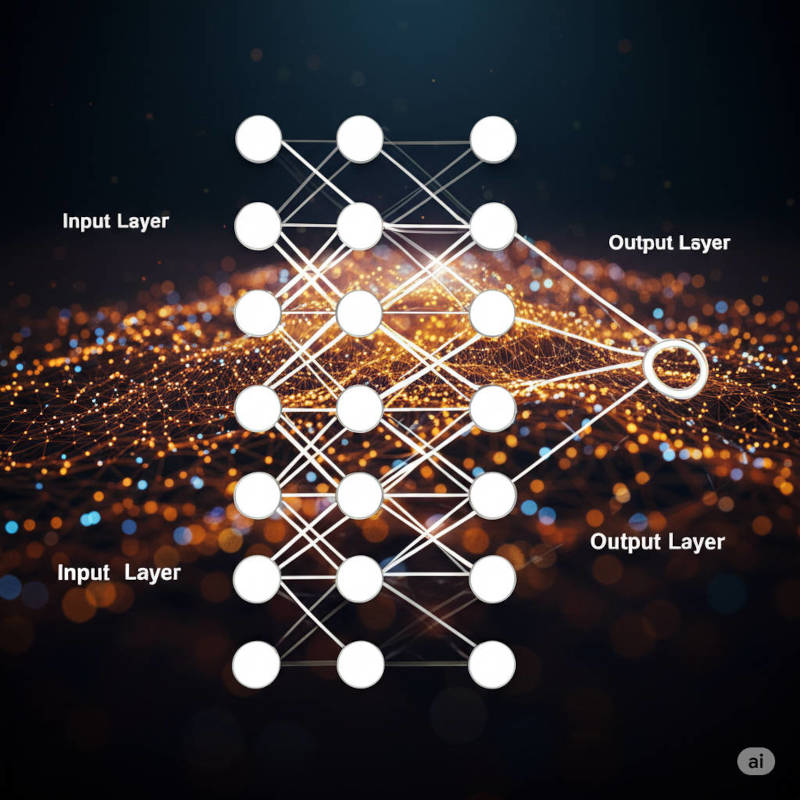
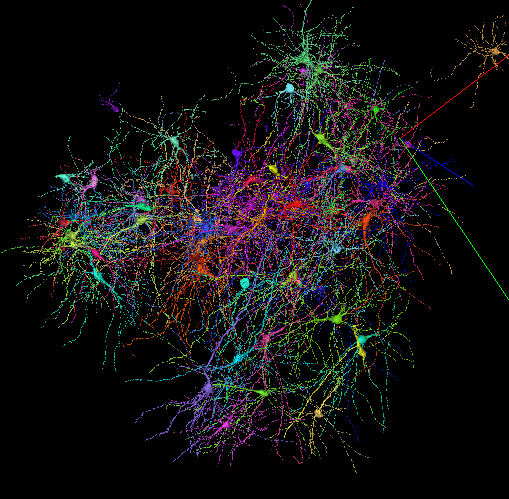
This week we’re investigating artificial intelligence or AI. My software experience in my career with computers is that of financial software for banks including ATMs and various other machines that have to do with banking, so AI or anything scientific was completely out of my realm. So I’m kind of looking at this like is an interested layman with some knowledge of computers. AI uses neural networks which is something that most computers don’t have. It can be simulated digitally, although I understand that they have chips that actually are neural network components. Neural networks are how the human brain functions with neurons and synapses. How they’ve gotten it to work, I have no idea.
The astronomical event times given in this blog are for the Traverse City/Interlochen area of Michigan (Lat 44.7° N, Long 85.7° W; EDT, UT – 4 hours) unless stated otherwise. Times will be different for other locations.
Addendum
Ephemeris: 05/05/2025 – Speculating about AI while the Moon is too bright
This is Ephemeris for Tuesday, May 6th. Today the Sun will be up for 14 hours and 28 minutes, setting at 8:54, and it will rise tomorrow at 6:23. The Moon, 2 days past first quarter, will set at 4:20 tomorrow morning.
With the Artemis moon program in doubt, NASA’s budget being cut, and scientific programs being eliminated, I’m going to wait until the dust settles a bit before I talk more about it. In the meantime I’d like to digress a bit with a little bit of expertise I’ve gotten from my working life as a systems engineer and computer programmer. I have no expertise in what’s hot now in computers, which is artificial intelligence or AI, but I do have some thoughts about it which I will talk about later on this week and next while the constellations are pretty much wiped out by the Moon’s bright light. AI came upon the scene rather suddenly*, after years of quiet development. All of a sudden just about every smartphone and computer app seems to have an AI component.
The astronomical event times given in this blog are for the Traverse City/Interlochen area of Michigan (Lat 44.7° N, Long 85.7° W; EDT, UT – 4 hours) unless stated otherwise. Times will be different for other locations.
*I’m a bit old, and moving slowly, but the clock seems to tick faster. Just about anything seems to happen faster.
Ephemeris: 04/29/2025 – Using the Sun as a telescope
This is Ephemeris for Tuesday, April 29th. Today the Sun will be up for 14 hours and 10 minutes, setting at 8:45, and it will rise tomorrow at 6:33. The Moon, 2 days past new, will set at 11:56 this evening.
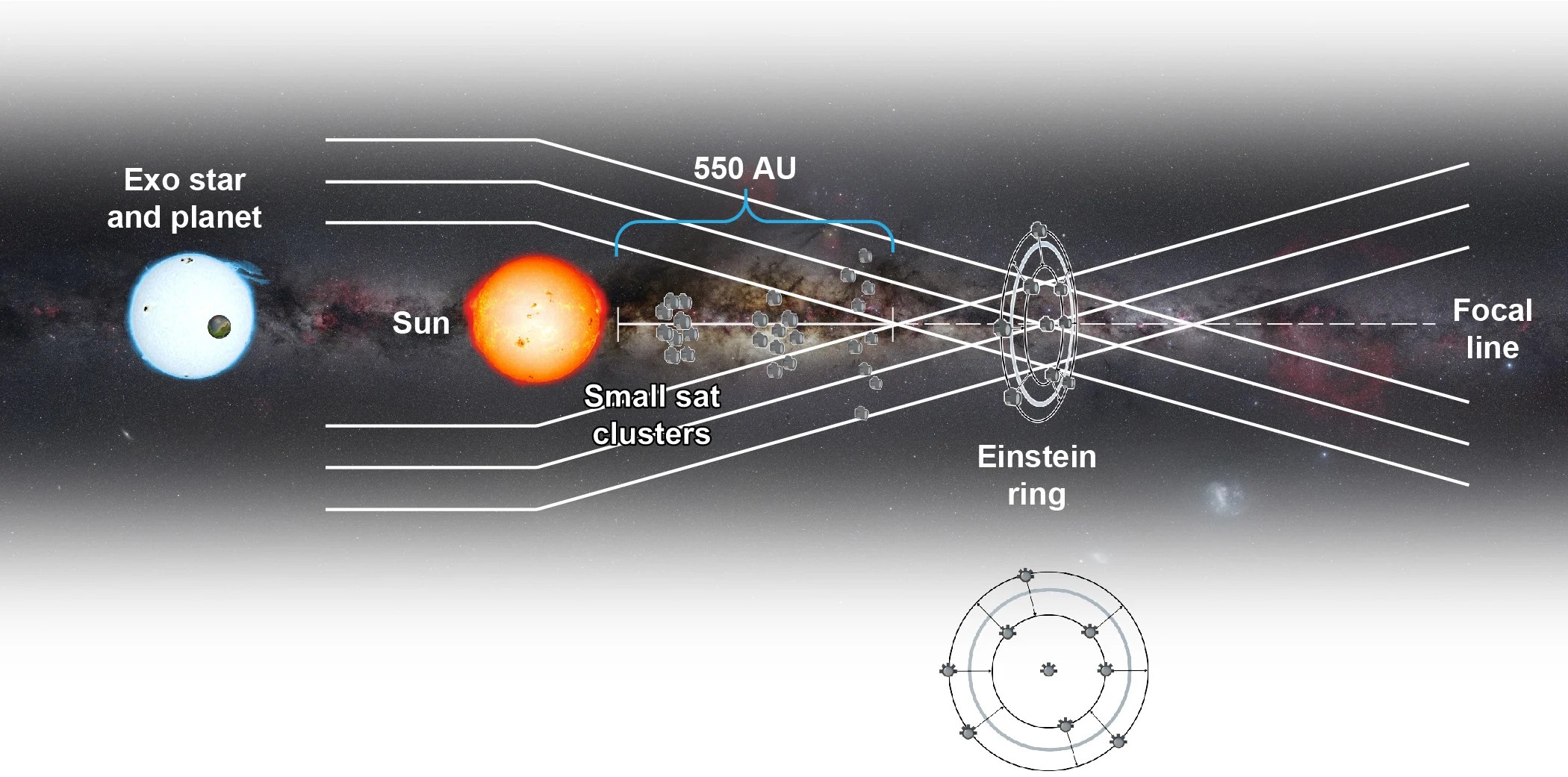
One idea of a telescope I find very fantastic. This is a telescope that uses the Sun and its mass curving spacetime to alter the path of light from a distant object to act like a lens in a telescope. This is called gravitational lensing. The length of this telescope would have to be about 542 times the earth’s distance from the Sun, 542 astronomical units. In the 48 years since Voyager 1 was launched it has achieved only about 1/3 of that distance. What would be the use of this telescope would be to image exoplanets. So far exoplanets, if they are visible at all, don’t even cover a single pixel in even our largest telescopes. The problems are huge, starting with gravitational lenses don’t bend light the same way as optical ones do.
The astronomical event times given in this blog are for the Traverse City/Interlochen area of Michigan (Lat 44.7° N, Long 85.7° W; EDT, UT – 4 hours) unless stated otherwise. Times will be different for other locations.
Addendum
Here are some sources of additional information on this topic:
https://www.universetoday.com/articles/how-can-the-sun-become-a-telescope
https://www.livescience.com/space/the-sun/could-we-turn-the-sun-into-a-gigantic-telescope
https://nasaspacenews.com/2025/04/see-alien-planets-in-4k-the-suns-gravitational-lens-explained/
https://news.stanford.edu/stories/2022/05/gravity-telescope-image-exoplanets
https://www.space.com/sun-gravity-could-help-observe-exoplanets-in-detail
Ephemeris: 02/24/2025 – Mars stopped in its tracks!
This is Ephemeris for Monday, February 24th. Today the Sun will be up for 10 hours and 55 minutes, setting at 6:24, and it will rise tomorrow at 7:26. The Moon, 3 days before new, will rise at 6:30 tomorrow morning.
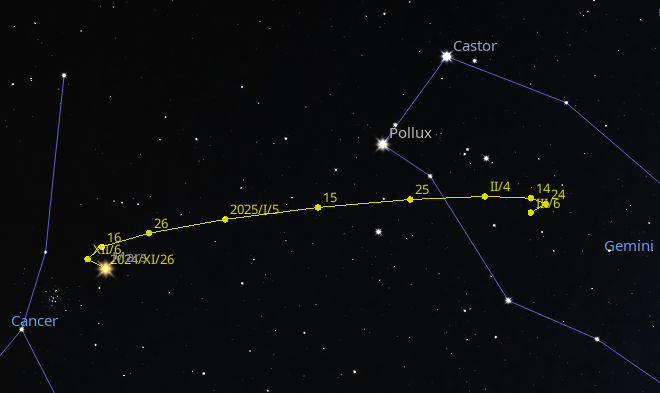
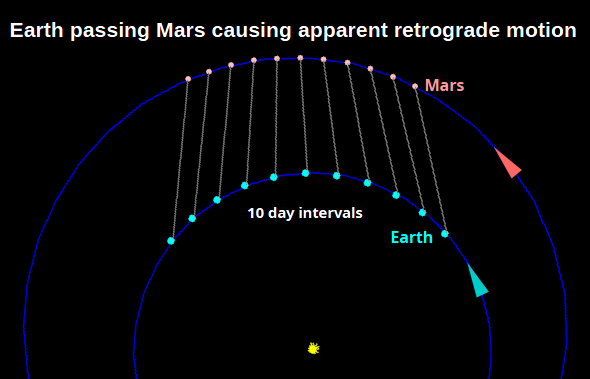
Today the planet Mars is said to be stationary. No, planets do not stop in their orbits of the Sun. It is because we are viewing them from the moving planet Earth. For the last few months Mars has been moving to the west, which is not its normal motion, so we call it retrograde motion. It does that because the Earth, moving faster on an inner orbit, is passing Mars moving slower on an outer orbit. This was a problem for the ancients of the western world because they thought all the moving objects, all seven of them, moved around a stationary Earth. Of those seven, two of them never went backwards, or westward against the stars. They were: the Moon which does orbit the Earth and the Sun which the Earth orbits.
The astronomical event times given are for the Traverse City/Interlochen area of Michigan (EST, UT – 5 hours). Times will be different for other locations.
Addendum
* For non astronomers: Inferior doesn’t refer to quality, but that the planet’s orbit is inside the Earth’s orbit. Superior planets orbit farther out from the Sun than the Earth.
Ephemeris: 01/14/2025 – Mars reaches opposition tomorrow – What that means
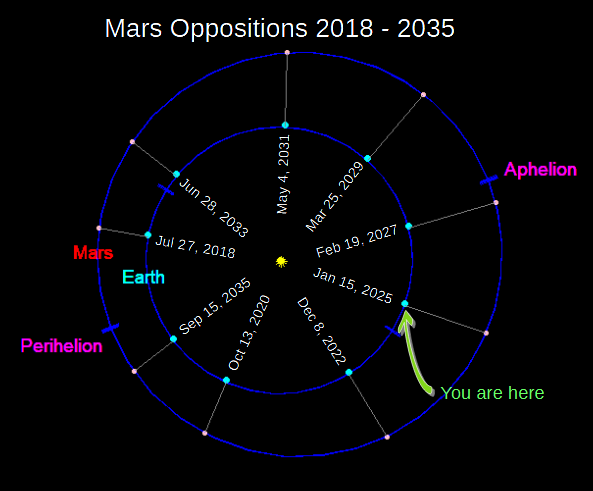
This is Ephemeris for Tuesday, January 14th. Today the Sun will be up for 9 hours and 10 minutes, setting at 5:27, and it will rise tomorrow at 8:16. The Moon, 1 day past full, will rise at 6:14 this evening. | Tomorrow the planet Mars will be in opposition to the Sun. That means it will rise at sunset and set at sunrise. This is the time we are closest to Mars or near closest to Mars of its current pass. Mars comes in opposition from the Sun about every 26 months on average. Currently, Mars is farther from the Sun than average. It has a large swing in distances from the Sun and so at this time moves slower than average. The time between oppositions is only 25 months currently. The various space agencies know that opposition time is the best time to launch spacecraft to Mars. However, they launch several months ahead of opposition for the spacecraft to arrive several months after opposition for the least amount of energy needed for the journey.
The astronomical event times given are for the Traverse City/Interlochen area of Michigan (EST, UT – 5 hours). Times will be different for other locations.
Addendum
Ephemeris: 01/09/2025 – Venus is at its greatest separation from the Sun today
This is Ephemeris for Thursday, January 9th. Today the Sun will be up for 9 hours and 2 minutes, setting at 5:21, and it will rise tomorrow at 8:18. The Moon, 3 days past first quarter, will set at 5:25 tomorrow morning.
Tonight, Venus will be at its greatest separation from the Sun in the sky at a little bit more than a 47° angle. Venus, being inside the Earth’s orbit, can ever stray far from the Sun. So today it is at its greatest eastern elongation from the Sun. For the rest of winter it will be moving closer to the Sun from our perspective. Crossing between the Earth and the Sun on March 22nd. During this period of time Venus will be a great object for the telescope, as it moves closer to the Earth and gets larger in telescopes and its phase, moving from being like a quarter moon to a very thin crescent near the end of winter. At inferior conjunction with the Sun, Venus will be only 26 million miles away from us, but quite invisible in the Sun’s glare.
The astronomical event times given are for the Traverse City/Interlochen area of Michigan (EST, UT – 5 hours). Times will be different for other locations.
Addendum
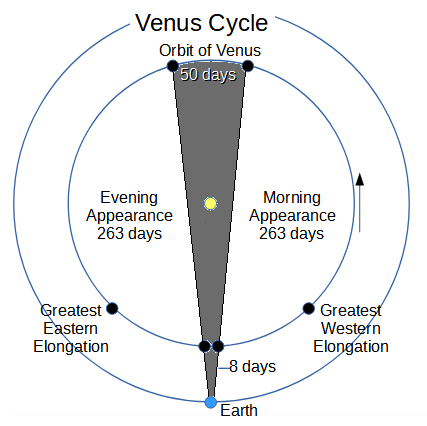
The Mayan civilization of Central America had several calendars. One of them was based on the planet Venus. They discovered that Venus repeated its positions in the sky with respect with the seasonal calendar over a period of eight years, which they called a Venus Sequence. They paid close attention to Venus and discovered it appeared to go around the Sun in the sky in 584 days, which they called a Venus Cycle. We call it Venus’ synodic period, which is the number of days between inferior conjunction, when Venus passes between the Earth and the Sun, then moves through the morning sky, and disappears behind the Sun at superior conjunction, then appears in the evening sky and back to inferior conjunction again. The gray area in the diagram is where Venus is not visible because it’s too close to the sun. However, at our latitude the number of days that Venus is invisible varies with the season. The Mayans, being in the tropics, didn’t have as much variation as we do. The Mayans discovered that Venus completed 5 cycles in almost exactly 8 years.
Today, Venus is at its greatest eastern elongation. On March 22nd Venus will pass inferior conjunction. That is 72 days from today. So it spends most of its time, 7 months, moving from around behind the Sun to the greatest elongation and only a short time, about 2 1/2 months moving from there to inferior conjunction. These 2 1/2 months are the best time to view Venus with a telescope, since Venus will grow in size and become an ever thinning crescent.
Check out my Wednesday posts showing the ever-growing and thinning Venus crescent until March 22nd. Or better yet, see it for yourself with a small telescope.
 Bob Moler's Ephemeris Blog