Archive
01/28/2022 – Ephemeris – Auriga the charioteer without a chariot
This is Ephemeris for Friday, January 28th. Today the Sun will be up for 9 hours and 39 minutes, setting at 5:45, and it will rise tomorrow at 8:05. The Moon, 3 days past last quarter, will rise at 6:10 tomorrow morning.
The constellation Auriga the charioteer is nearly overhead at 9 p.m. It is a pentagon of stars, with the brilliant star Capella at one of its upper corners. Capella represents a she-goat he’s carrying. A narrow triangle of stars nearby Capella represents her three kids. The chariot, or by some a wagon is not seen in the stars and is supposed to be pulled by four horses, abreast. Or four oxen, or two oxen, a horse, and a zebra. None of these are depicted in the stars. The only constellation art I’ve seen is a man holding a large goat and three baby goats. There’s no chariot, no wagon and definitely no horses, oxen or zebras. What I see is a distinctive pentagon of stars, with one, Capella, brighter than the rest, and a nearby small triangle of stars.
The astronomical event times given are for the Traverse City/Interlochen area of Michigan (EST, UT – 5 hours). They may be different for your location.
Addendum
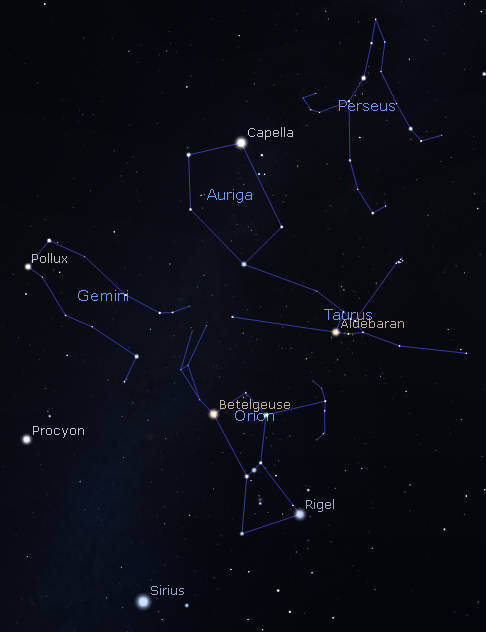
Auriga and surrounding constellations at 9 pm in late January. Created using Stellarium.
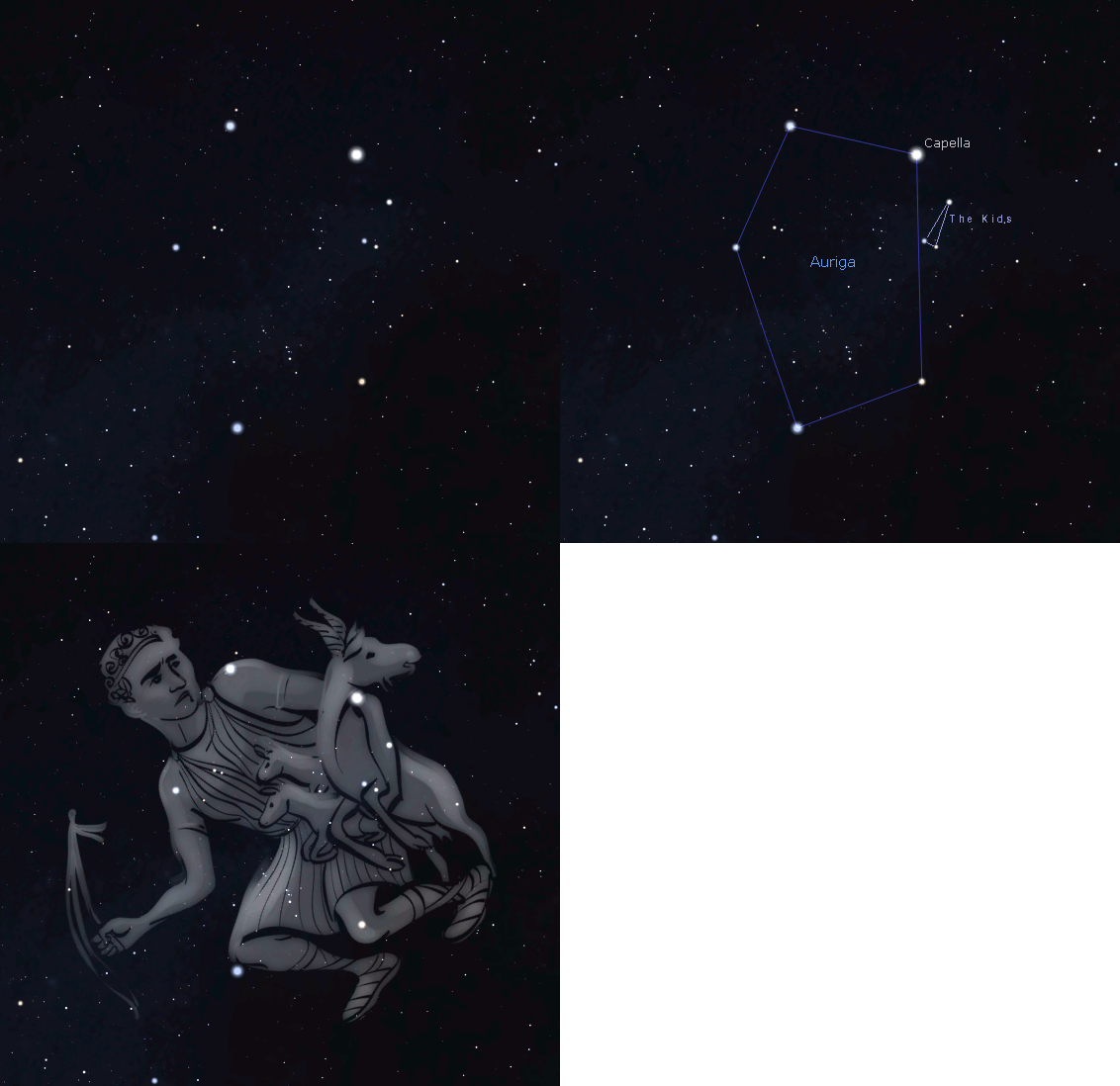
Auriga star field, constellation lines and art. Auriga seems to be missing a kid, he’s supposed to have three, I think. Created using Stellarium and GIMP.
I checked other constellation art, and it appears that there are only two kids. I may have been wrong all these years. Yet the asterism of The Kids has three stars.
01/27/2022 – Ephemeris – Looking at the constellation of Gemini the twins
This is Ephemeris for Thursday, January 27th. Today the Sun will be up for 9 hours and 37 minutes, setting at 5:44, and it will rise tomorrow at 8:06. The Moon, 2 days past last quarter, will rise at 4:56 tomorrow morning.
Another famous winter constellation is Gemini. The constellation of Gemini the Twins is visible high in the southeast, above and left of Orion the hunter, at 9 p.m. The namesake stars of the two lads, are the two bright stars at the left end of Gemini, and are high and nearly in the east. Castor is on top, while Pollux is below. From them come two lines of stars that outline the two, extending horizontally toward Orion. In Greek mythology the lads were half brothers, Castor was fathered by a mere mortal, while Pollux was fathered by Zeus, but were born together as twins. When Castor was killed during the quest for the Golden Fleece, Pollux pleaded with Zeus to let him die also, so Zeus placed them together in the sky.
The astronomical event times given are for the Traverse City/Interlochen area of Michigan (EST, UT – 5 hours). They may be different for your location.
Addendum
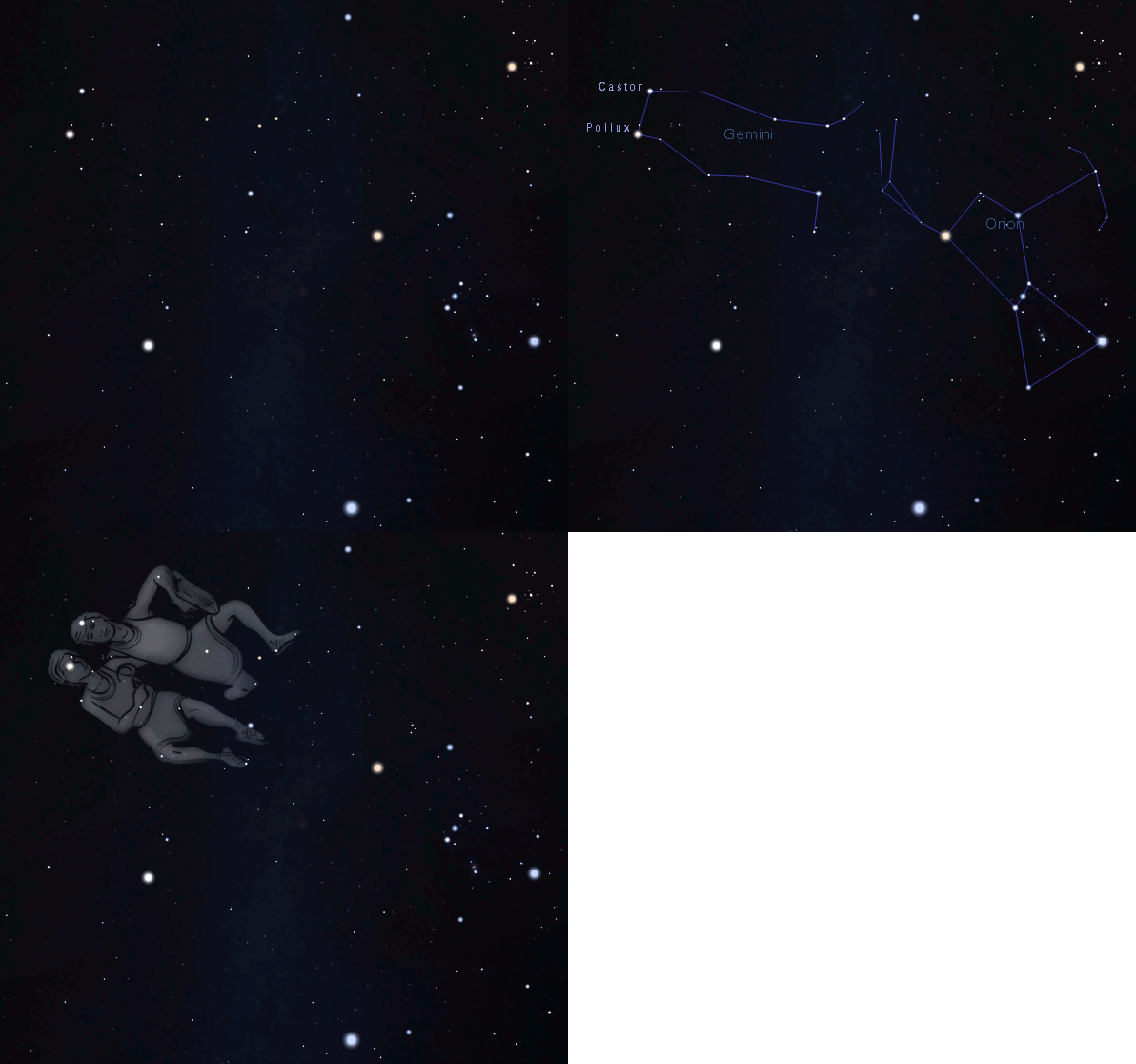
Gemini finder animation for 9 pm January 27th, showing just stars, constellation lines and star names, and figures of the lads. Click on the image to enlarge it. Created using Stellarium and GIMP.
01/21/22 – Ephemeris – A river in the sky, but not the Milky Way
This is Ephemeris for Friday, January 21st. Today the Sun will be up for 9 hours and 23 minutes, setting at 5:36, and it will rise tomorrow at 8:11. The Moon, halfway from full to last quarter, will rise at 9:31 this evening.
One of the more obscure constellations around is Eridanus, which depicts a river. The river starts near the lower right corner of Orion, near the bright star Rigel and flows to the right then down near the southwestern horizon, then it meanders along the horizon to the south before turning below the horizon. One has to travel to the far south to see the southern terminus of the river, the bright star Achernar. Writers over the ages have seen here the Nile and the Earth circling river Ocean of the flat earth days. Achernar is actually two stars. And the brightest was discovered to be the flattest star known, due to its rapid spin. The dimensions of Achernar A has been determined to be twice as wide across its equator than from pole to pole. It’s 139 light years away.
The astronomical event times given are for the Traverse City/Interlochen area of Michigan (EST, UT – 5 hours). They may be different for your location.
Addendum
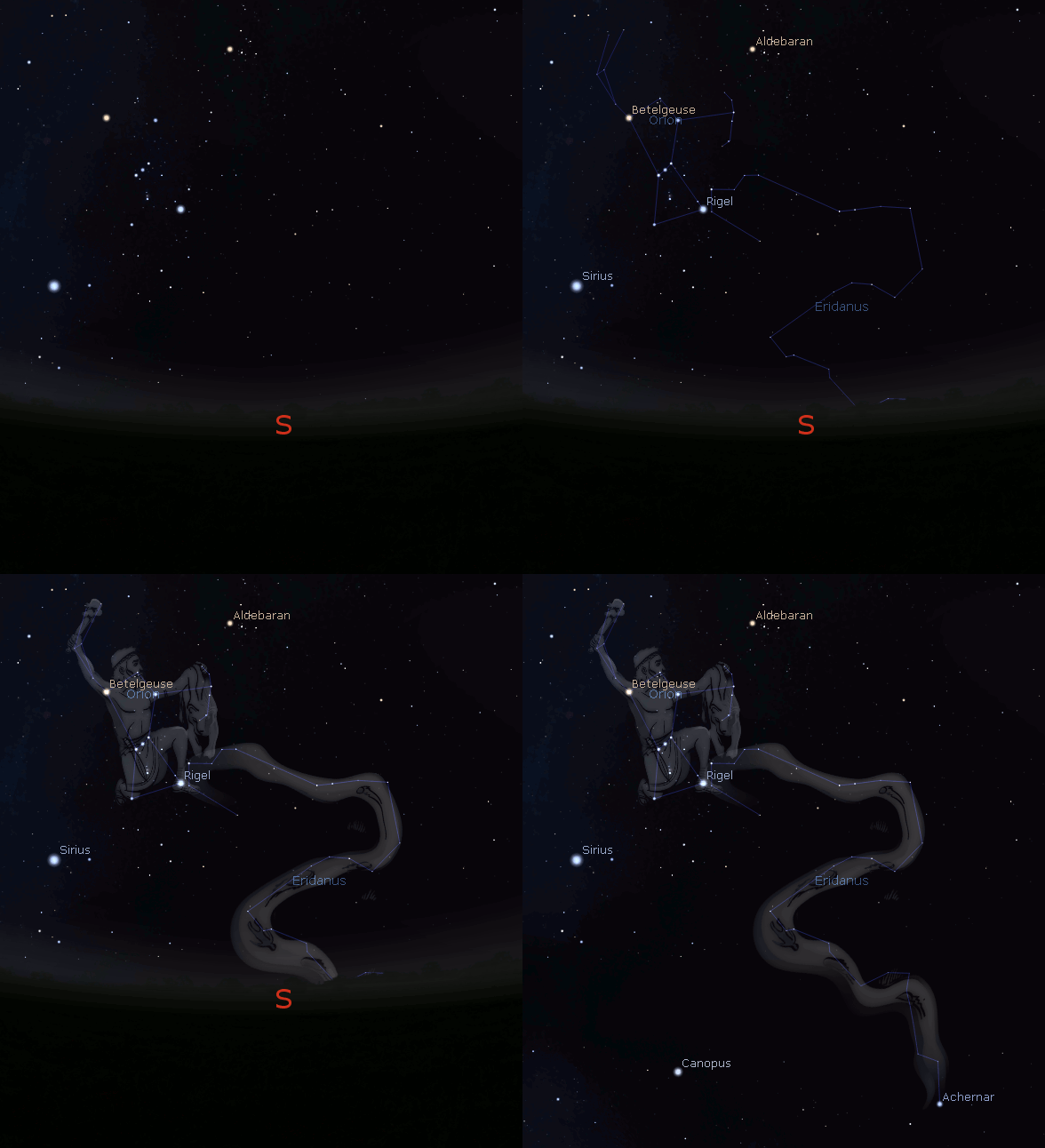
An animation of the constellation Eridanus, which is a river that flows from Rigel in Orion to the star Achernar below our southern horizon at latitude 45 degrees north. Create using Stellarium and GIMP.
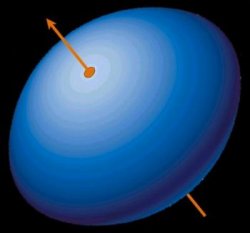
A model of Achernar by the European Southern Observatory (ESO).
01/20/2022 – Ephemeris – Taurus and the half sisters of the Pleiades
This is Bob Moler with Ephemeris for Thursday, January 20th. Today the Sun will be up for 9 hours and 21 minutes, setting at 5:34, and it will rise tomorrow at 8:12. The Moon, 3 days past full, will rise at 8:23 this evening.
High in the south-southeastern sky, and above-right of Orion, is the bright star Aldebaran. It’s at one tip of a letter V of fainter stars. The group of stars is the face of the constellation of Taurus the bull. Aldebaran is the angry bloodshot eye of the bull that’s charging Orion, whose defending himself with a lion skin shield and an upraised club. The stars in the V, and many more visible in binoculars, except for Aldebaran, belong to a star cluster called the Hyades. In Greek mythology, these are the half sisters of the Pleiades, visible as a tight group of stars above them. The V of stars is actually an upside down letter A, or Aleph, the first letter of the Hebrew and Mesopotamian alphabets. This was invented when Taurus, not Aries, was host to the Sun at the spring equinox.
The astronomical event times given are for the Traverse City/Interlochen area of Michigan (EST, UT – 5 hours). They may be different for your location.
Addendum
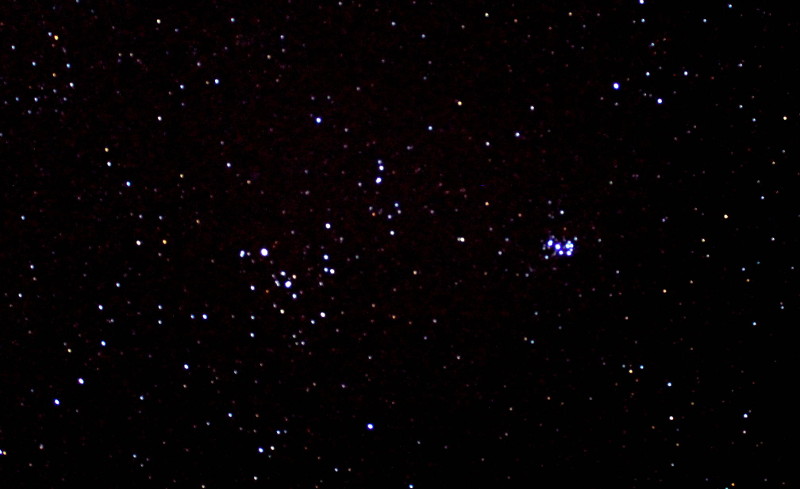
The Hyades (left) and the Pleiades (right) in this photograph I took January 4, 2016. Aldebaran is the bright star at the left tip of the Pleiades (right) of the Hyades.
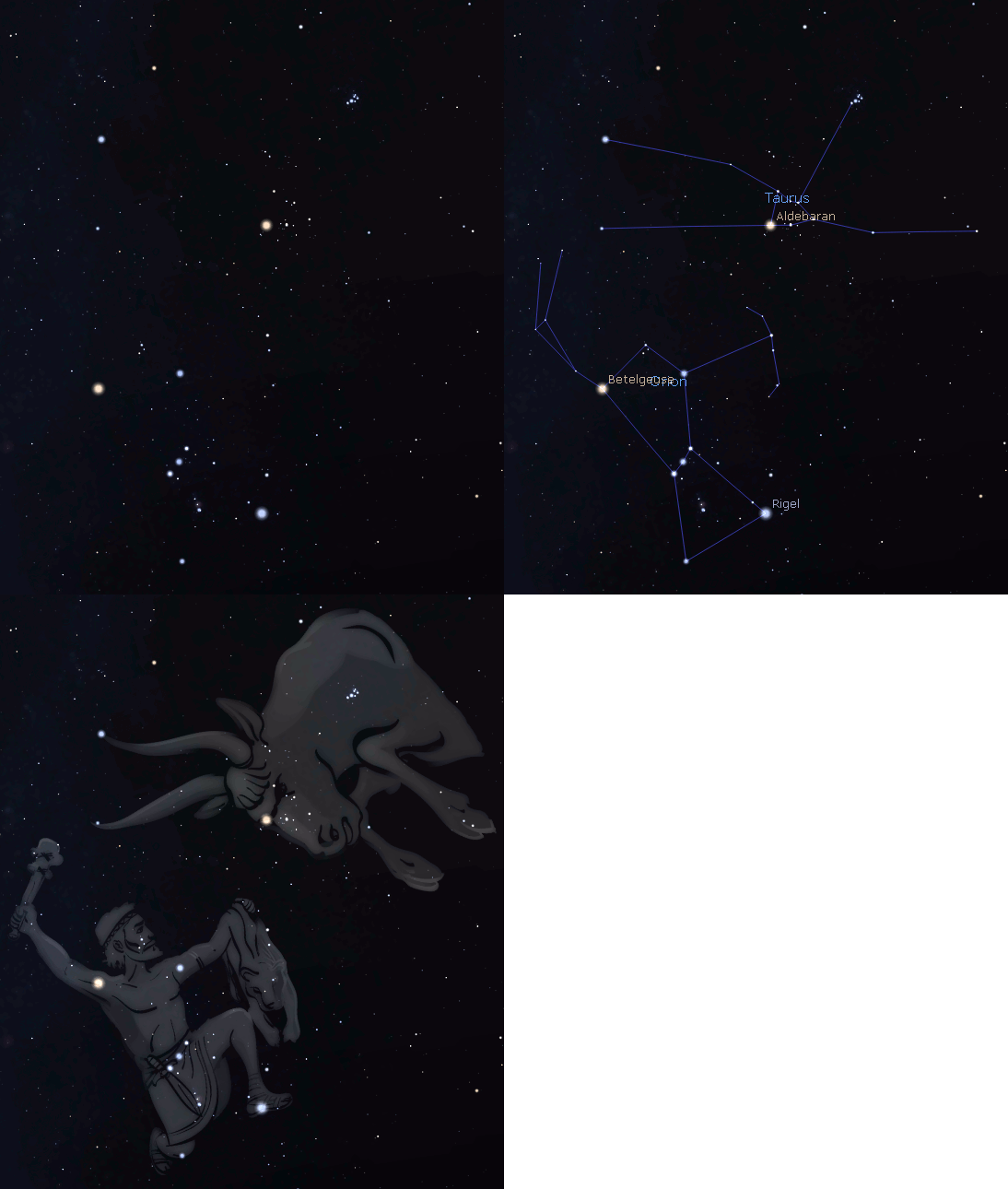
Orion and Taurus finder animation for mid-January. Created using Stellarium
11/26/2021 – Ephemeris – Native American Heritage Day
This is Ephemeris for Native American Heritage Day, Friday, November 26th. Today the Sun will be up for 9 hours and 11 minutes, setting at 5:05, and it will rise tomorrow at 7:55. The Moon, 1 day before last quarter, will rise at 11:33 this evening.
It’s also Black Friday, the day retail stores theoretically make it into the black, profit-wise. When looking at the sky and the few constellations of the native Anishinaabe people of our area, I am saddened there aren’t more of them. There were heroes, warriors, animals, fantastic and real, just like the Greek ones we learned of the European world. But they were lost in the attempted assimilation of these people into white society. It’s like the Borg of Star Trek: “You will be assimilated”. The atrocities of the Indian boarding schools are slowly coming to light, while certain powerful people want all the racial unpleasantness swept under the rug.
The astronomical event times given are for the Traverse City/Interlochen area of Michigan (EST, UT – 5 hours). They may be different for your location.
Addendum
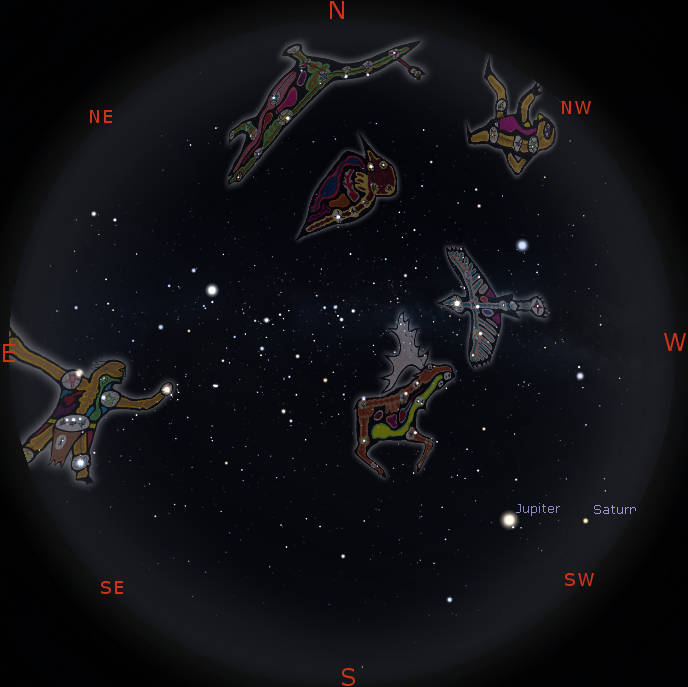
The Anishinaabe November Sky. Clockwise (sort of) from the top or North. The Fisher (Big Dipper); Loon (Little Dipper); Exhausted Bather (Hercules), in the northwest; high in the west, the Crane (Cygnus); nearly overhead, the Moose (Pegasus); and in the east the Wintermaker (Orion). Click on the image to enlarge it. Created using Stellarium. The Anishinaabe constellation drawings are from Ojibwe Sky Star Map Constellation Guide by Annette S. Lee, William Wilson, Jeffrey Tibbets and Carl Gawboy available locally and online. They are part of the latest editions of Stellarium, a free planetarium program. Links to it are on the right. Other information and links are available within Stellarium.
11/04/2021 – Ephemeris – Myths of the Pleiades from some other cultures
This is Ephemeris for Thursday, November 4th. The Sun will rise at 8:25. It’ll be up for 10 hours and 1 minute, setting at 6:26. The Moon is new today, and won’t be visible.
Let’s look at how some other cultures saw the Pleiades, the star cluster that is seen in the eastern sky these evenings. To the Anishinaabe native peoples around here, the Pleiades is the “Hole in the Sky” or the seven stones that are heated for the sweat lodge ceremony. To the Kiowa, these were sister stars that had been whisked into the sky from the top of Devil’s Tower in Wyoming, where they were threatened by a huge bear. In Norse mythology, these were the goddess Freya’s hens. The name we know them by has rather misty origins. Some think the Greek name is from the mother of the seven sisters, Pleione. The Greek word for sail is similar to Pleiades, and it seems the appearance of the Pleiades in the morning sky saw the best sailing weather in the Mediterranean.
The astronomical event times given are for the Traverse City/Interlochen area of Michigan (EDT, UT – 4 hours). They may be different for your location.
Addendum
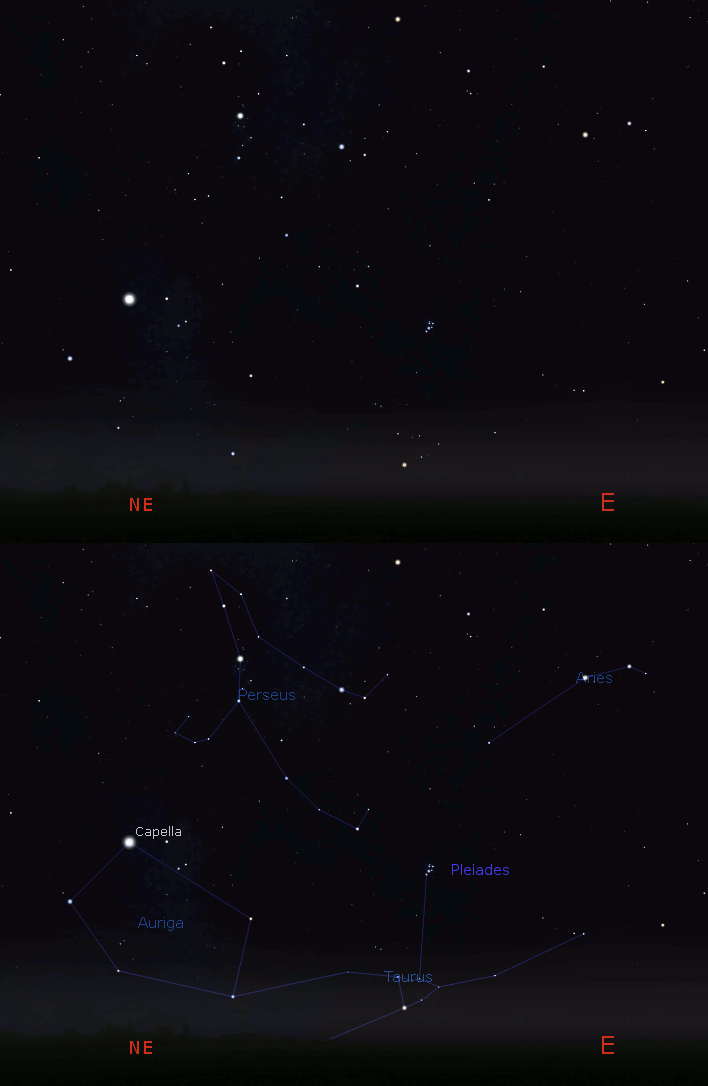
Finding the Pleiades animation for 9 p.m. October 29, 2019. Created using Stellarium and GIMP.
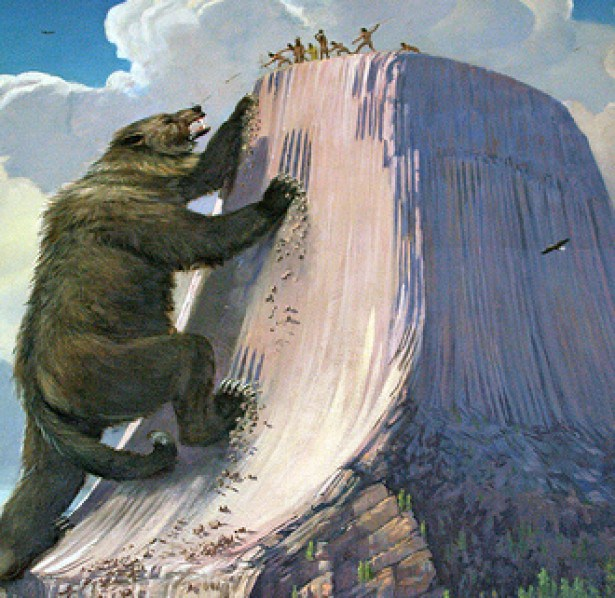
Seven maidens being attacked by a giant bear, having fled to the top of Devil’s Tower in Wyoming. Painting by Herbert Collins, http://www.nps.gov/deto.

They are also the Seven Daughters of the Moon and Sun. They loved to dance and play, and when their father, the Moon was low in the sky, would descend to the Earth in a basket to do their thing. On one of their trips to the earth, one of them was captured by a human, and she ended up falling in love with him, and married him. When father Moon found out he permanently dimmed her star, so now most people now only can spot 6 of the stars. This last bit seems to parallel the Greek story of the lost Pleiad.
10/28/2021 – Ephemeris – The spookiest star in the sky
This is Ephemeris for Thursday, October 28th. Today the Sun will be up for 10 hours and 21 minutes, setting at 6:36, and it will rise tomorrow at 8:17. The Moon, at last quarter today, will rise at 12:31 tomorrow morning.
We are getting down to the spookiest time of the year, with Halloween on Sunday, so it’s time to talk about the spookiest star in the sky, Algol the Ghoul or Demon Star. It’s in the constellation of Perseus the hero, now rising in the northeastern sky. The constellation itself looks like the Greek letter pi, or like the cartoon Roadrunner with its long legs. Algol is the second brightest star in the constellation, near the Roadrunner’s leading foot. That’s where the eye of the severed head of Medusa, that Perseus is carrying. It’s still winking, once every 2 days and 21 hours*. Tonight it will be in the deepest part of its wink at 8:43 pm. It will take about three hours to recover its usual brightness. I recall that the ancient Chinese weren’t fond of that star either.
The astronomical event times given are for the Traverse City/Interlochen area of Michigan (EDT, UT – 4 hours). They may be different for your location.
* More specifically, 2 days, 20 hours, 49 minutes on average and altered by Earth’s changing distance from the star due to its orbit of the Sun.
Addendum
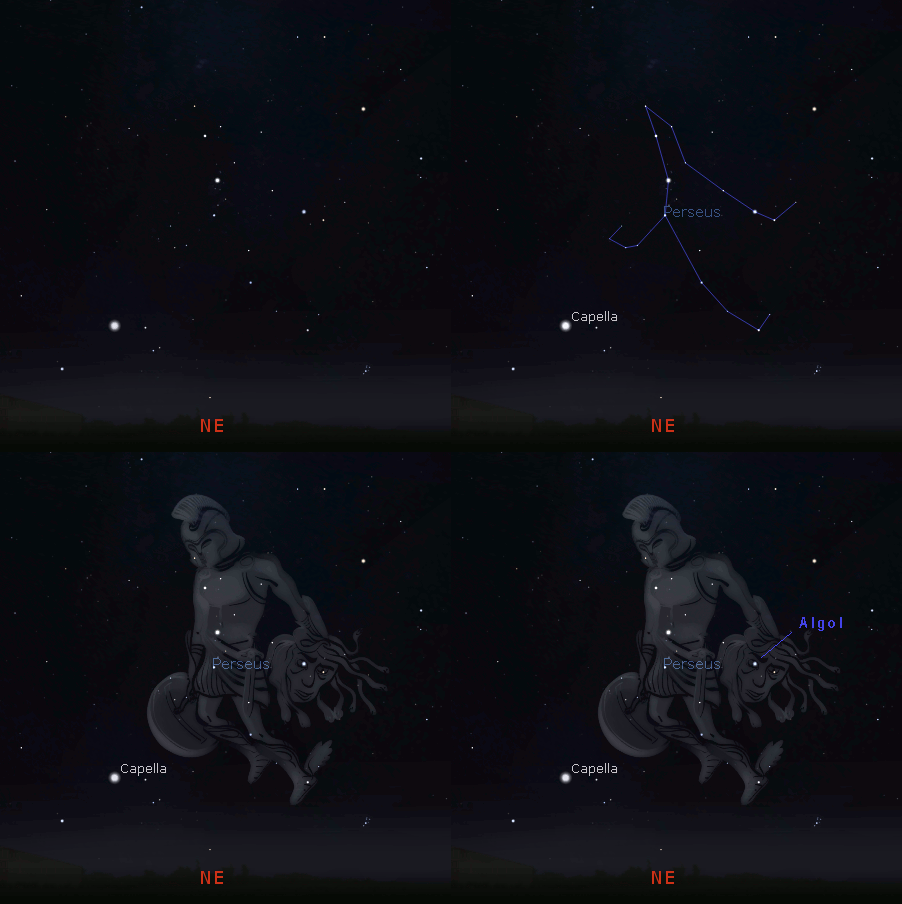
Algol Finder Animation for around 8 pm in the later part of October and early November (7 pm after the EST time change on the first Sunday in November). Created using Stellarium and GIMP.
Algol is an eclipsing binary star, where one star eclipses the other.
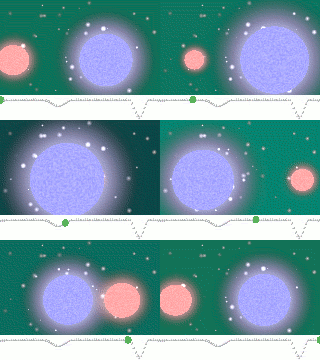
Animation of an eclipsing binary star like Algol. Credit: Wikimedia Commons h/t Earth and Sky
09/28/2021 – Ephemeris – Andromeda, a damsel in distress
This is Bob Moler with Ephemeris for Tuesday, September 28th. Today the Sun will be up for 11 hours and 50 minutes, setting at 7:28, and it will rise tomorrow at 7:38. The Moon, at last quarter today, will rise at 11:46 this evening.
In the east at 9 this evening can be found a large square of stars, the Great Square of Pegasus the flying horse. The square is standing on one corner. What looks like its hind legs stretching to the left from the left corner star is another constellation, Andromeda the chained princess. She is seen in the sky as two diverging curved strings of stars that curve upward. She was doomed due to her mother, Queen Cassiopeia’s boasting, which angered the god Poseidon. She was rescued by the hero Perseus, a nearby constellation, riding his steed Pegasus. Andromeda’s claim to astronomical fame is the large galaxy seen with the naked-eye just above the upper line of stars. The Great Andromeda Galaxy is two and a half million light years away.
The astronomical event times given are for the Traverse City/Interlochen area of Michigan (EDT, UT-4 hours). They may be different for your location.
Addendum
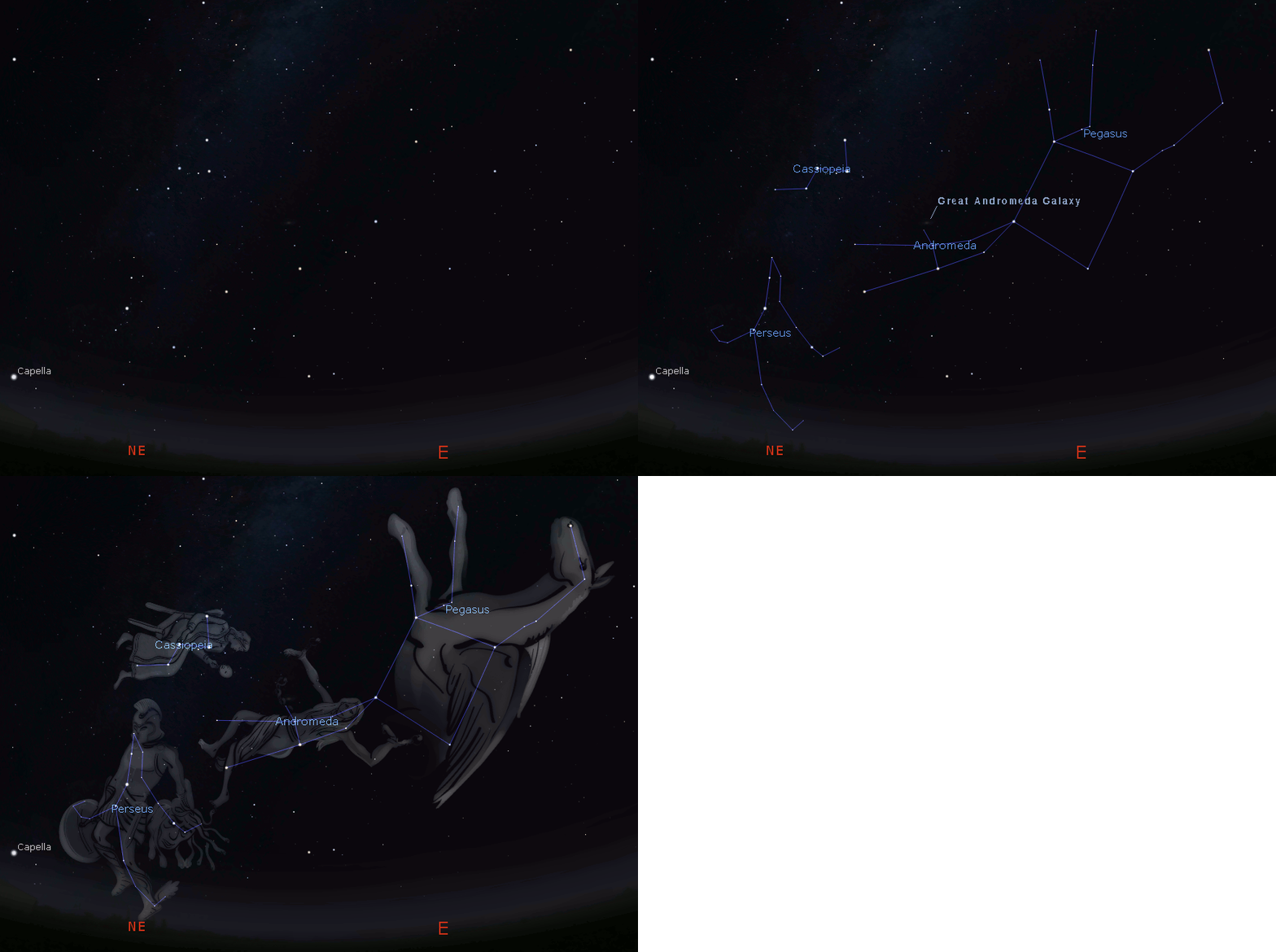
Andromeda finder animation surrounded by the other constellations in her story, except the monster, which will rise later. Click on the image to enlarge it. Created using Stellarium and GIMP.
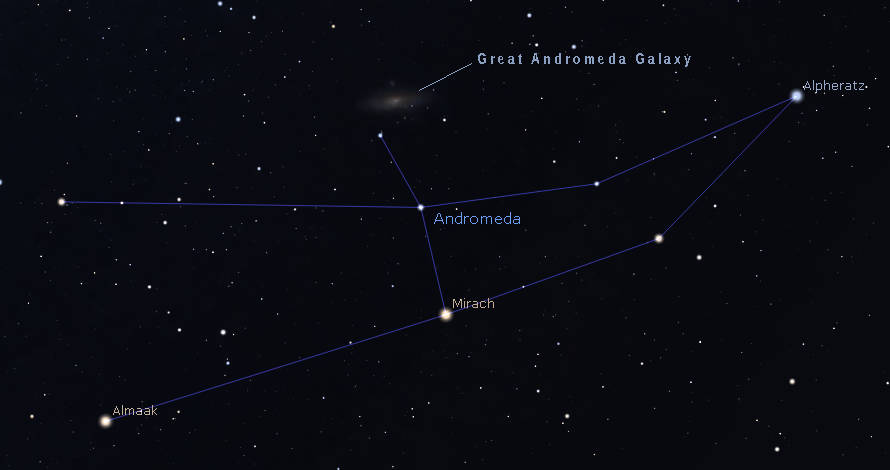
Great Andromeda Galaxy finder chart. This image shows the galaxy almost to its fullest extent. In the finder animation above, the galaxy looks pretty much as it would to the naked eye. Click on the image to enlarge it. Created using Stellarium.
Astronomers often refer to this galaxy as M 31 for short. It was the 31st entry in Charles Messier’s catalog of objects that could be confused as being comets by comet hunters like himself. It was added in 1764. He didn’t care what these fuzzy objects were, just that they didn’t move against the background stars. Actually, M 31 is in the background. The stars are in the foreground, in our Milky Way Galaxy.
09/09/2021 – Ephemeris – The constellation of Cassiopeia the Queen
This is Ephemeris for Thursday, September 9th. Today the Sun will be up for 12 hours and 49 minutes, setting at 8:04, and it will rise tomorrow at 7:16. The Moon, 3 days past new, will set at 9:40 this evening.
Tonight, check out the crescent Moon, with Venus below left of it. Cassiopeia is a constellation shaped like the letter W seen in the northeast these evenings. In Greek mythology, she was the queen of Ethiopia. She was very beautiful and very boastful of that fact. She even compared her beauty with that of the sea nymphs, daughters of the sea god Poseidon. Papa was not amused. So Cassiopeia’s daughter, the Princess Andromeda, was made to suffer for it. Poseidon sent a sea monster, Cetus, to ravage the coastal cities of the country. The only way to stop it was to sacrifice Andromeda to the monster. Andromeda and Cetus are constellations we’ll meet in the coming weeks. We’ve already met Pegasus, the flying horse, rising in the east. And we are yet to meet the hero, Perseus.
The astronomical event times given are for the Traverse City/Interlochen area of Michigan (EDT, UT – 4 hr). They may be different for your location.
Addendum
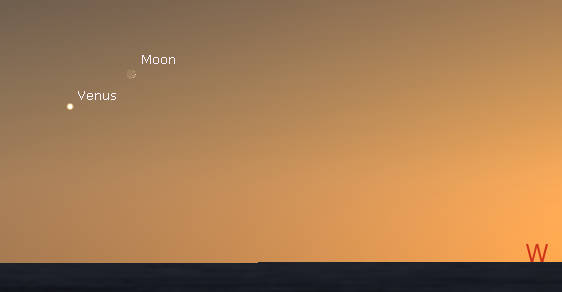
Venus and the Moon in evening twilight, about a half hour after sunset tonight, September 9, 2021. Created using Stellarium.
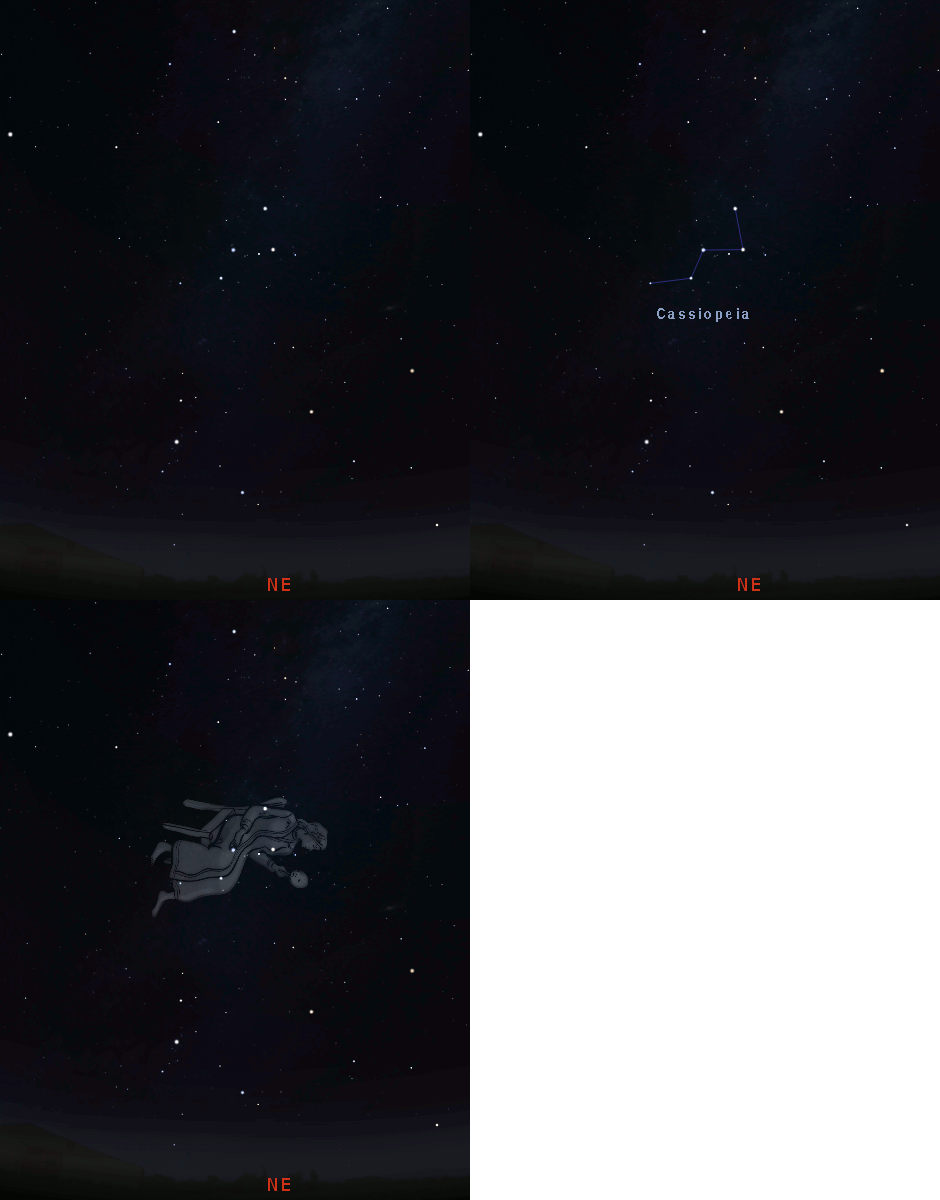
Cassiopeia finder animation looking northeast in mid-September, an hour and a half after sunset. Created using Stellarium.
09/07/2021 – Ephemeris – The constellation of Cepheus the king
This is Bob Moler with Ephemeris for Tuesday, September 7th. Today the Sun will be up for 12 hours and 55 minutes, setting at 8:07, and it will rise tomorrow at 7:13. The Moon, 1 day past new, will set at 8:53 this evening.
There’s a faint constellation in the northeast above the W shaped constellation of Cassiopeia. It’s a nearly upside down church steeple of a constellation called Cepheus the king, and husband of queen Cassiopeia. Cepheus’ claim to modern astronomical fame is that one of its stars, Delta (δ) Cephei, is the archetype for the important Cepheid variable stars. Delta is the bottom most of a trio of stars at the right corner of the constellation. In the early 20th century, Henrietta Leavitt discovered that Cepheids in the nearby galaxy the Large Magellanic Cloud varied in brightness with a period that was related to their average brightness. This meant that Cepheids could be used as standard candles to measure the great distances to other galaxies.
The astronomical event times given are for the Traverse City/Interlochen area of Michigan (EDT, UT – 4 hr). They may be different for your location.
Addendum
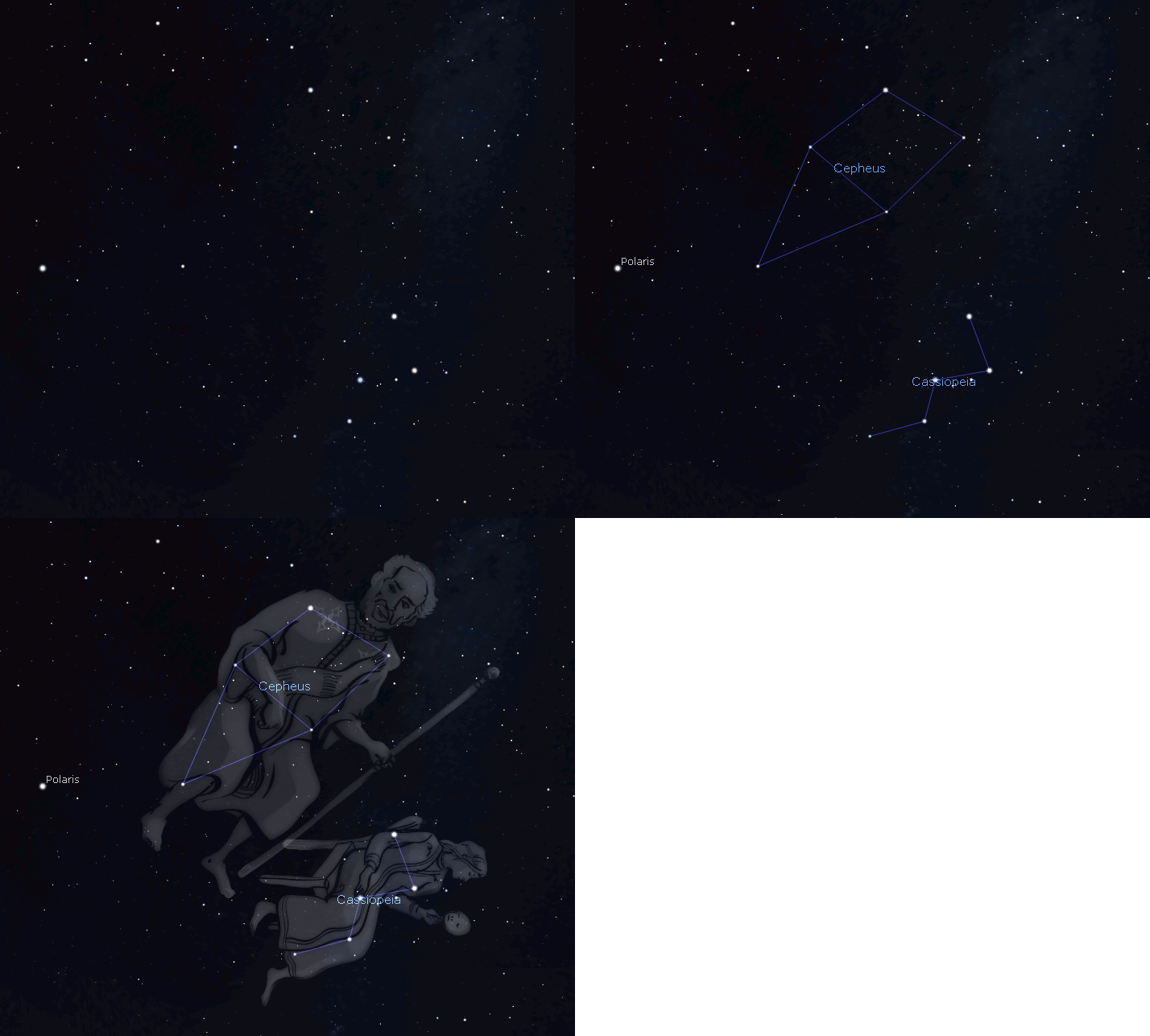
Cassiopeia and Cepheus finder animation looking in the northeast at 9-10 pm or about an hour after sunset. Created using Stellarium and GIMP.
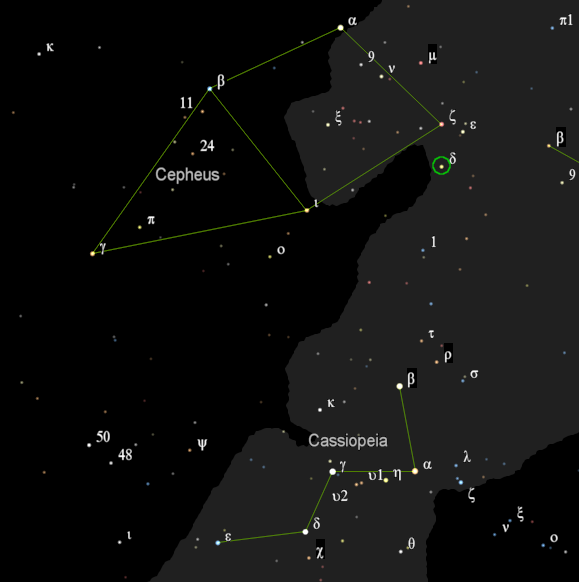
Delta Cephei finder for September at 9-10 pm, looking northeast. Created using Cartes du Ciel (Sky Chart).
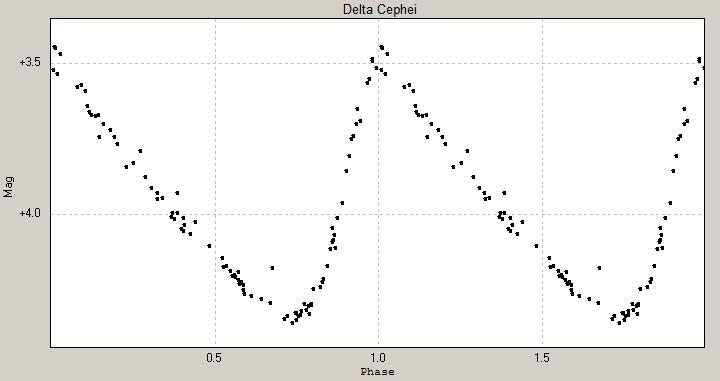
Light Curve of Delta Cephei. The pulsation period is 5.367 days. Note the Magnitude vertical axis, the lower the magnitude the brighter the star is. Blame that on the Greek astronomer Hipparchus, 2nd century BC. It’s like golf scores, the lower the score, the better the golfer. Credit: Thomas K Vbg – Own work, CC BY-SA 3.0, https://commons.wikimedia.org/w/index.php?curid=13887639.

