Archive
01/24/2019 – Ephemeris – Taurus the bull
Ephemeris for Thursday, January 24th. Today the Sun will be up for 9 hours and 29 minutes, setting at 5:40, and it will rise tomorrow at 8:09. The Moon, half way from full to last quarter, will rise at 10:14 this evening.
Midway up the sky in the southeast at 8 p.m. is the constellation of the giant hunter Orion. Above him, to the right is Taurus the bull. His face is a letter V shape of stars lying on its side, the star cluster Hyades, with the bright orange-red star Aldebaran at one tip of the V as its angry blood-shot eye, but actually about half way between us and the cluster. Orion is depicted in the sky facing, with club in one hand and a shield in the other, the charging Taurus. The Pleiades star cluster is in his shoulder. Taurus in Greek mythology was the form the god Zeus when he carried off the maiden Europa. Europa’s still with him as the intriguing satellite orbiting Zeus’ Roman equivalent the planet Jupiter.
The times given are for the Traverse City/Interlochen area of Michigan. They may be different for your location.
Addendum
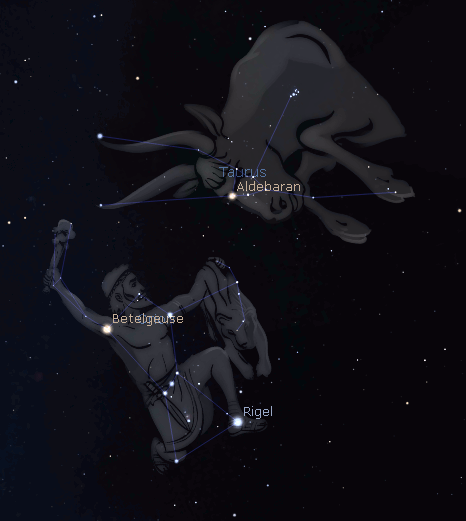
Taurus and Europa at 8 p.m. January 24, 2019. Created using Stellarium.
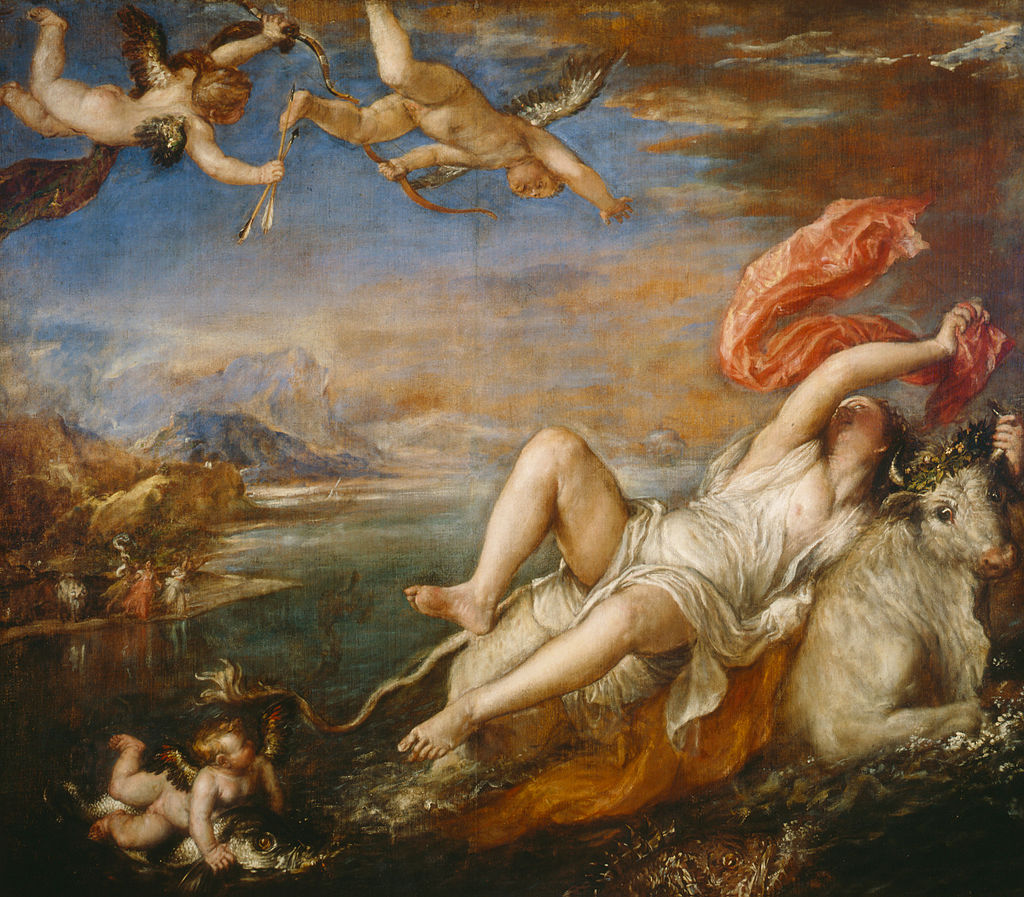
The Rape of Europa by Titian. According to the story Zeus as a bull abducted Europa and swam to Crete, where she became the first queen of that island, and bore him three sons. Other paintings of this subject are by Rembrandt and de Troy. This painting belongs to the Isabella Stewart Gardener Museum in Boston, MA. Click on the image to enlarge.
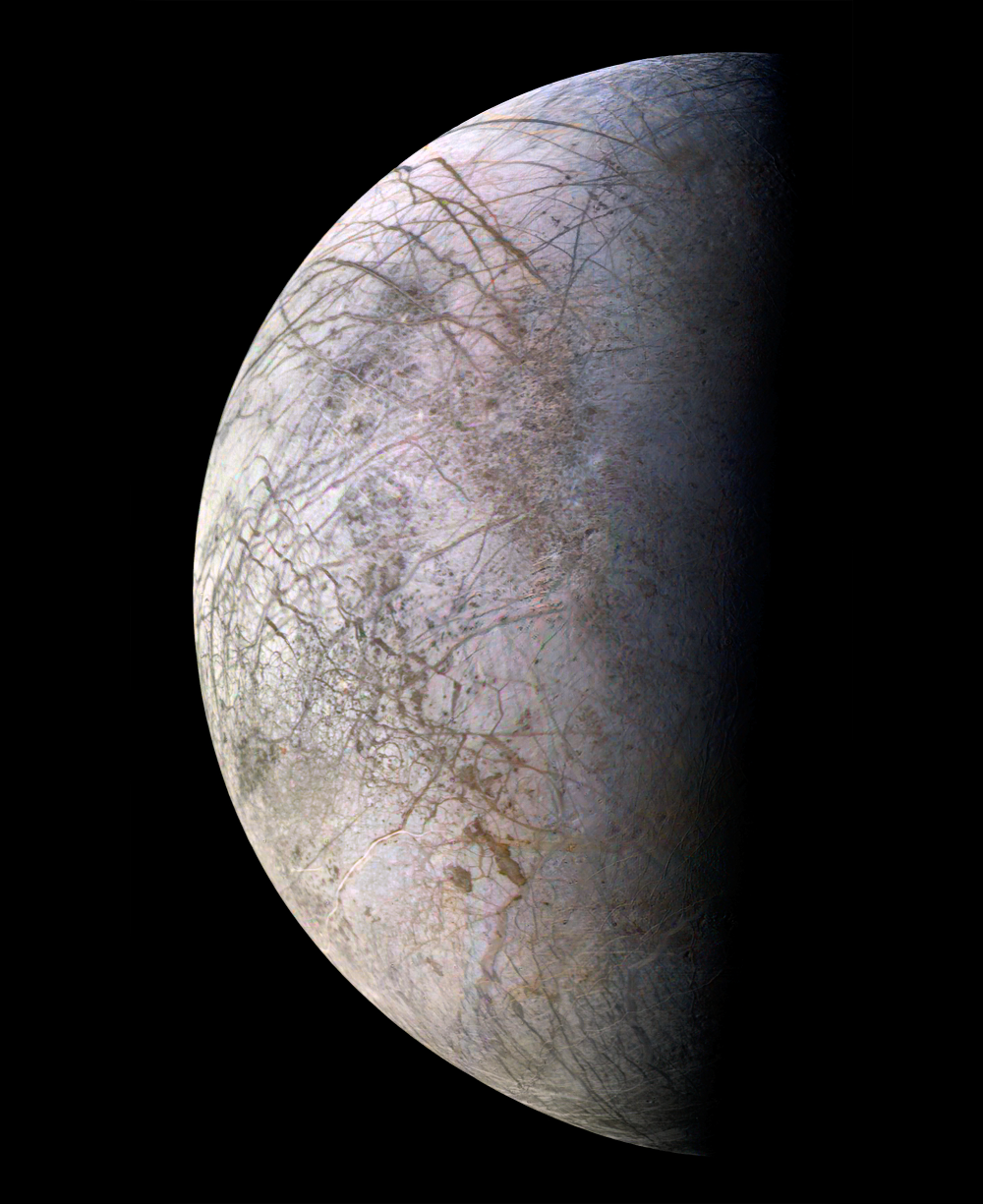
Jupiter’s satellite Europa, slightly smaller than the Earth’s moon, has a fresh ice surface with very little cratering. The ice floats on a deep water ocean supposedly containing more water than all the Earth’s oceans. Click on the image to enlarge. This is a place NASA will send a spacecraft to look for the chemistry of life. Credit NASA/JPL, Ted Stryk.
01/08/2019 – Ephemeris – The river at Orion’s feet
Ephemeris for Tuesday, January 8th. The Sun will rise at 8:19. It’ll be up for 9 hours exactly, setting at 5:19. The Moon, 3 days past new, will set at 7:55 this evening.
One of the more obscure constellations around is Eridanus, which depicts a river. The river starts near the lower right corner of Orion, near the bright star Rigel and flows to the right then down near the southwestern horizon, then it meanders along the horizon to the south before turning below the horizon. One has to travel to the far south to see the southern terminus of the river, the bright star Achernar. Writers over the ages have seen here the Nile and the earth circling river Ocean of the flat earth days. Achernar is actually two stars, the brightest was discovered to be the flattest star, due to its rapid spin. The dimensions of Achernar A has been determined to be twice as wide across its equator than from pole to pole. It’s 139 light years away.
The times given are for the Traverse City/Interlochen area of Michigan. They may be different for your location.
Addendum
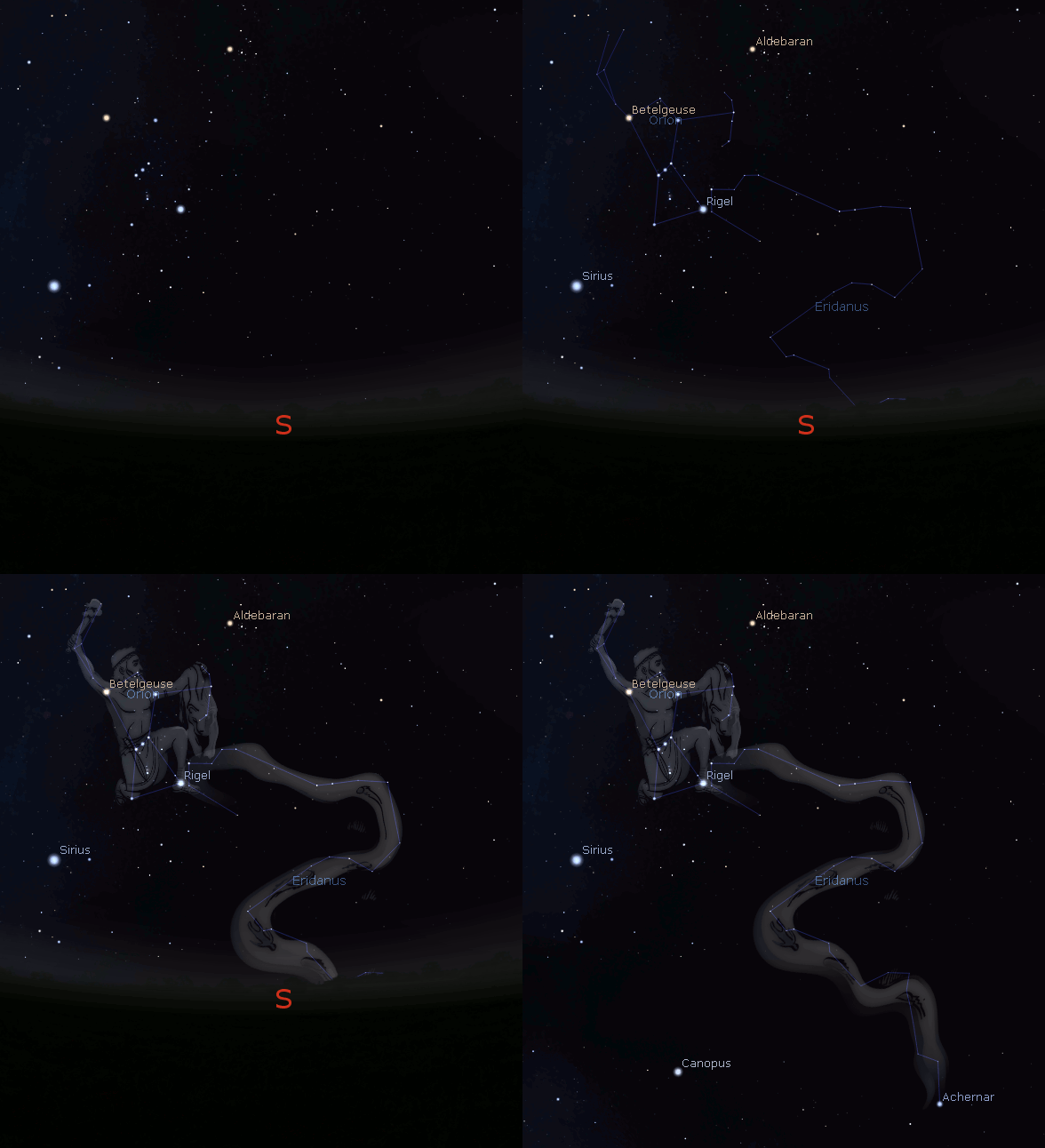
An animation of the constellation Eridanus which is a river that flows from Rigel in Orion to the star Achernar below our southern horizon at latitude 45 degrees north. Create using Stellarium and GIMP.
11/12/2018 – Ephemeris – Orion is rising
Ephemeris for Veterans Day Observed, Monday, November 12th. The Sun will rise at 7:35. It’ll be up for 9 hours and 41 minutes, setting at 5:17. The Moon, 3 days before first quarter, will set at 9:25 this evening.
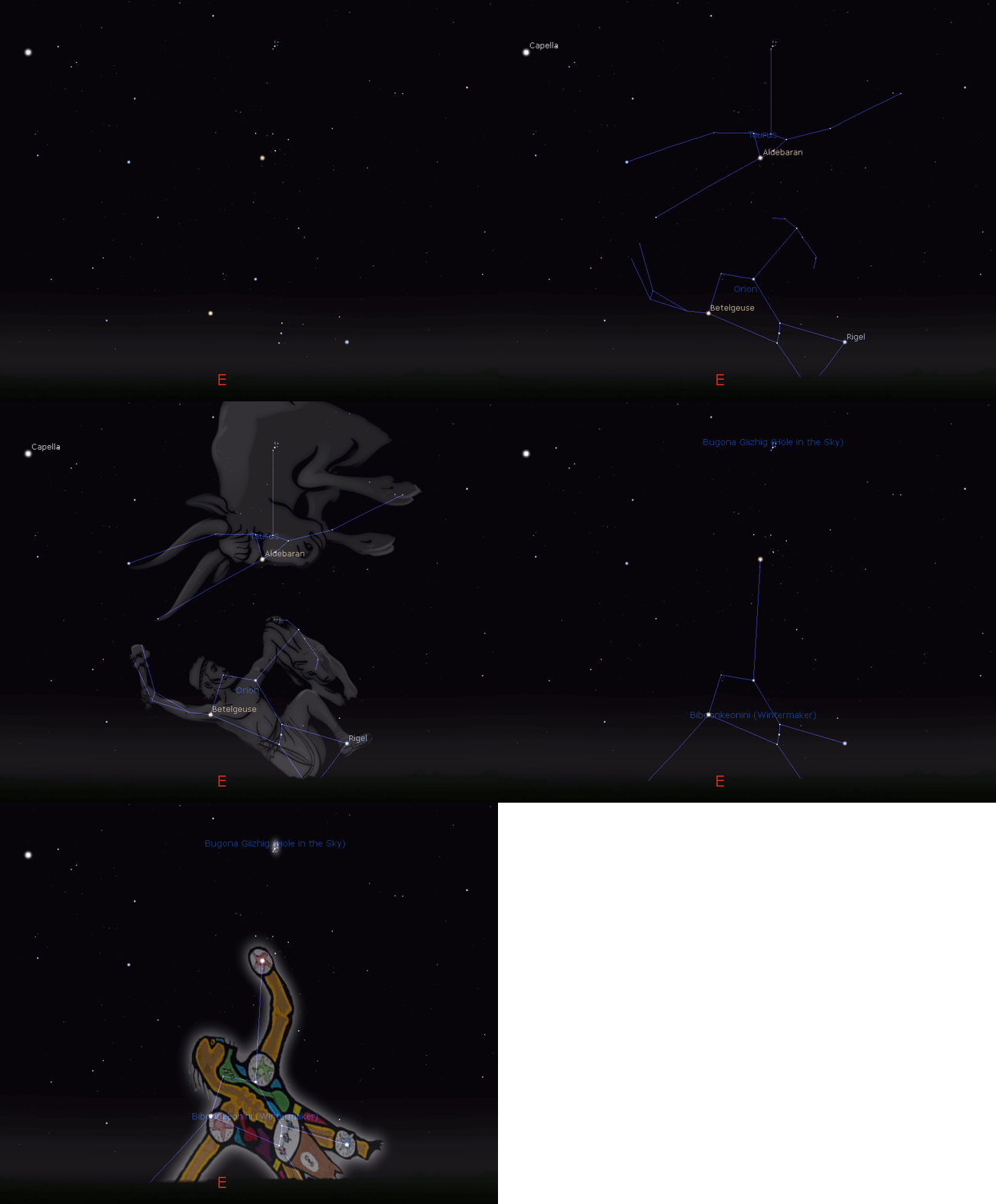
Just after the Moon sets tonight winter’s most dazzling constellation will be rising, Orion the hunter of Greek myth. The stars of his torso are in a rectangle leaning to the left. Orion’s belt of three stars in a straight line in the center of the rectangle is nearly vertical. The Anishinaabe peoples whose region we live in see the constellation of the Wintermaker rather than Orion. It uses Orion’s torso and belt stars, but his arms are spread wide from Aldebaran in the face of Taurus the bull to the west to Procyon in Canis Minor, which won’t rise until 11 p.m. to the east. The Wintermaker’s arms are wide enough to embrace the entire winter sky. Its name in Anishinaabemowin, which is Biboonikeonini, means “North Wind”.
The times given are for the Traverse City/Interlochen area of Michigan. They may be different for your location.
11/04/2018 – Ephemeris Extra – Wintermaker rising
A chill is in the air, The Fisher, Ojiig’s bloody tail has swooped low in the north at midnight to paint the trees with their fall colors, and the leaves have fallen to the ground. Haven’t heard of the Fisher? I mention it from time to time here on my Ephemeris program on Interlochen Public Radio. It’s a constellation of the Anishinaabe peoples indigenous to this area of Michigan, of which the Chippewa, Ottawa, and Ojibwe are a part.
The Fisher occupies the stars which we know as the Big Dipper and the Great Bear, Ursa Major. And unlike the bear, a fisher really does have a long tail. The fisher is a real weasel-like animal whose diet apparently does not include fish. It is found across southern Canada and in the American West. I’ve related the story of the Fisher, and how he brought summer to the Earth, in these pages in the August 2012 issue and on my blog bobmoler.wordpress.com. Search for fisher. Like most legends, there are different versions of that story and others about the Fisher.
Fisher or not, summer is gone and the world seems darker and colder. Over in the east these evenings great winter constellation of Orion is rising. It brings to mind the Robert Frost poem Star-Splitter, and our star chart this month from the November 1st post:
“You know Orion always comes up sideways.

Throwing a leg up over our fence of mountains,

And rising on his hands, he looks in on me

Busy outdoors by lantern-light with something

I should have done by daylight, and indeed,

After the ground is frozen, I should have done

Before it froze, and a gust flings a handful

Of waste leaves at my smoky lantern chimney

To make fun of my way of doing things,

Or else fun of Orion's having caught me.

Has a man, I should like to ask, no rights

These forces are obliged to pay respect to?"
The rest of the poem is available on the Poetry Foundation website: https://www.poetryfoundation.org/poems/44273/the-star-splitter. The poem is about one Brad McLaughlin and his telescope. While I don’t approve of how he financed his telescope, I do share his enthusiasm.
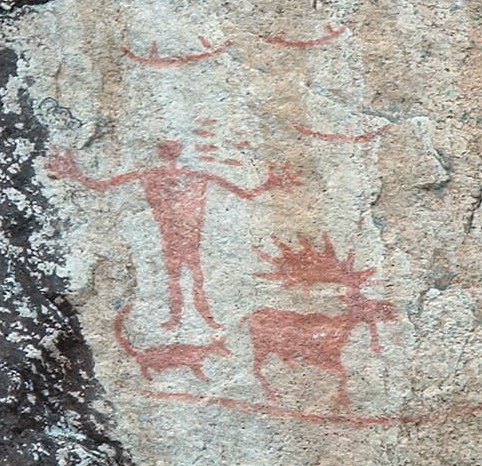
The Wintermaker, Biboonikeonini’s, name literally means North Wind. While his torso is the same as Orion’s his arms stretch from Aldebaran in Taurus to Procyon in Canis Minor, just about spanning the entire winter sky. The pictographs, seen above of the Wintermaker, Curly Tail and Moose can only be seen from a canoe in the cliff face on one side of the narrows between North Hegman and Trease lakes, 15 miles north of Ely, Minnesota
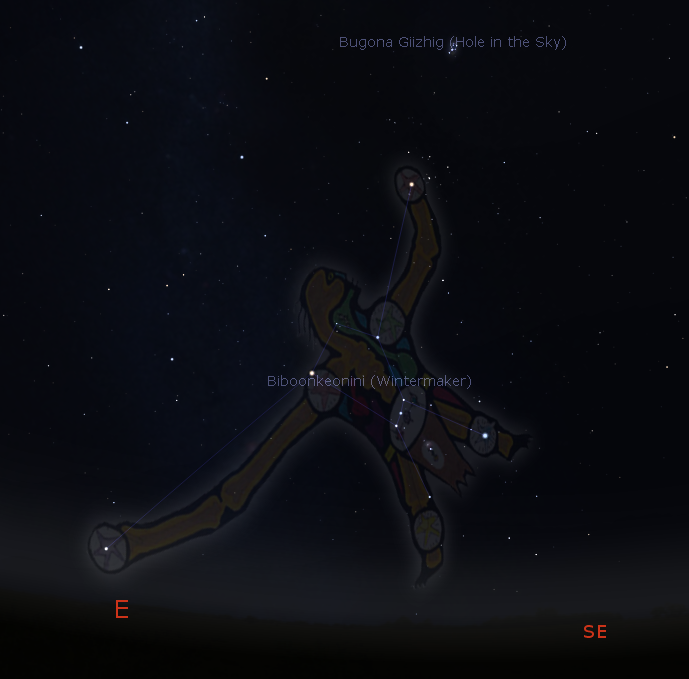
In late winter as Ojiig is rising in the northeast signaling the maple sugaring season, the Wintermaker is moving lower in the southwest. Some Ojibwe parents make bows for their children to shoot arrows at the Wintermaker to convince him to flee the skies so spring can begin as a way to teach them the old legends of their culture.
The Pleiades is an important group of stars for the Anishinaabe in several ways. It is the Hole-In-The-Sky, Bagone’giizhig, through which the Sky Woman fell and to give birth to the first humans on the Earth.
The Pleiades also represent the seven poles of the Shaking Tent Ceremony, and the seven sacred stones that are heated for the sweat lodge, which is also seen in the stars in the spring as Corona Borealis.

They are also the Seven Daughters of the Moon and Sun. They loved to dance and play, and when their father, the Moon was low in the sky, would descend to the Earth in a basket to do their thing. On one of their trips to the earth, one of them was captured by a human and she ended up falling in love with him, and married him. When father Moon found out he permanently dimmed her star, so now most people now only can spot 6 of the stars. This last bit seems to parallel the Greek story of the lost Pleiad.
Note: This is published as an article in the Grand Traverse Astronomical Society’s November 2018 newsletter Stellar Sentinel.
09/06/2018 – Ephemeris – The constellations of Delphinus and Sagitta
Ephemeris for Thursday, September 6th. The Sun will rise at 7:11. It’ll be up for 12 hours and 59 minutes, setting at 8:10. The Moon, 3 days before new, will rise at 4:19 tomorrow morning.
Located below the eastern edge of the Summer Triangle of three of the brightest stars in the sky, which is nearly overhead in our sky at 10 p.m., is the tiny constellation of Delphinus the dolphin. Delphinus’ 6 stars in a small parallelogram with a tail, really does look like a dolphin leaping out of the water. The parallelogram itself has the name Job’s Coffin. The origin of this asterism or informal constellation is unknown. Of the dolphin itself: the ancient Greeks appreciated this aquatic mammal as we do, and told stories of dolphins rescuing shipwrecked sailors. There’s another tiny constellation to the right of Delphinus, Sagitta the arrow a small thin group of 5 stars, which represents Cupid’s dart.
The times given are for the Traverse City/Interlochen area of Michigan. They may be different for your location.
Addendum
Delphinus and Sagitta finder animation. Click on image to enlarge. Created using Stellarium and GIMP.
09/03/2018 – Ephemeris – Looking for Sagittarius, Centaur or Teapot
Ephemeris for Labor Day, Monday, September 3rd. The Sun will rise at 7:07. It’ll be up for 13 hours and 8 minutes, setting at 8:15. The Moon, 1 day past last quarter, will rise at 1:08 tomorrow morning.
The Milky Way runs from northeast to south through the heavens at 10 p.m. The Milky Way is brighter and broader just above the horizon in the south. In that glow in the south is a star pattern that looks like a stout little teapot, with a bright stream of the Milky Way rising from the spout, which faces the west. This pattern of stars is the major part of the constellation called Sagittarius. This year the planet Saturn appears right above it. According to Greek mythology Sagittarius is a centaur with a bow and arrow poised to shoot Scorpius the scorpion setting in the southwest. This centaur is Chiron, the most learned of the breed, centaurs usually being a rowdy bunch. The center of the pin wheel of our Milky Way galaxy lies hidden beyond the stars above the spout of the teapot.
The times given are for the Traverse City/Interlochen area of Michigan. They may be different for your location.
Addendum
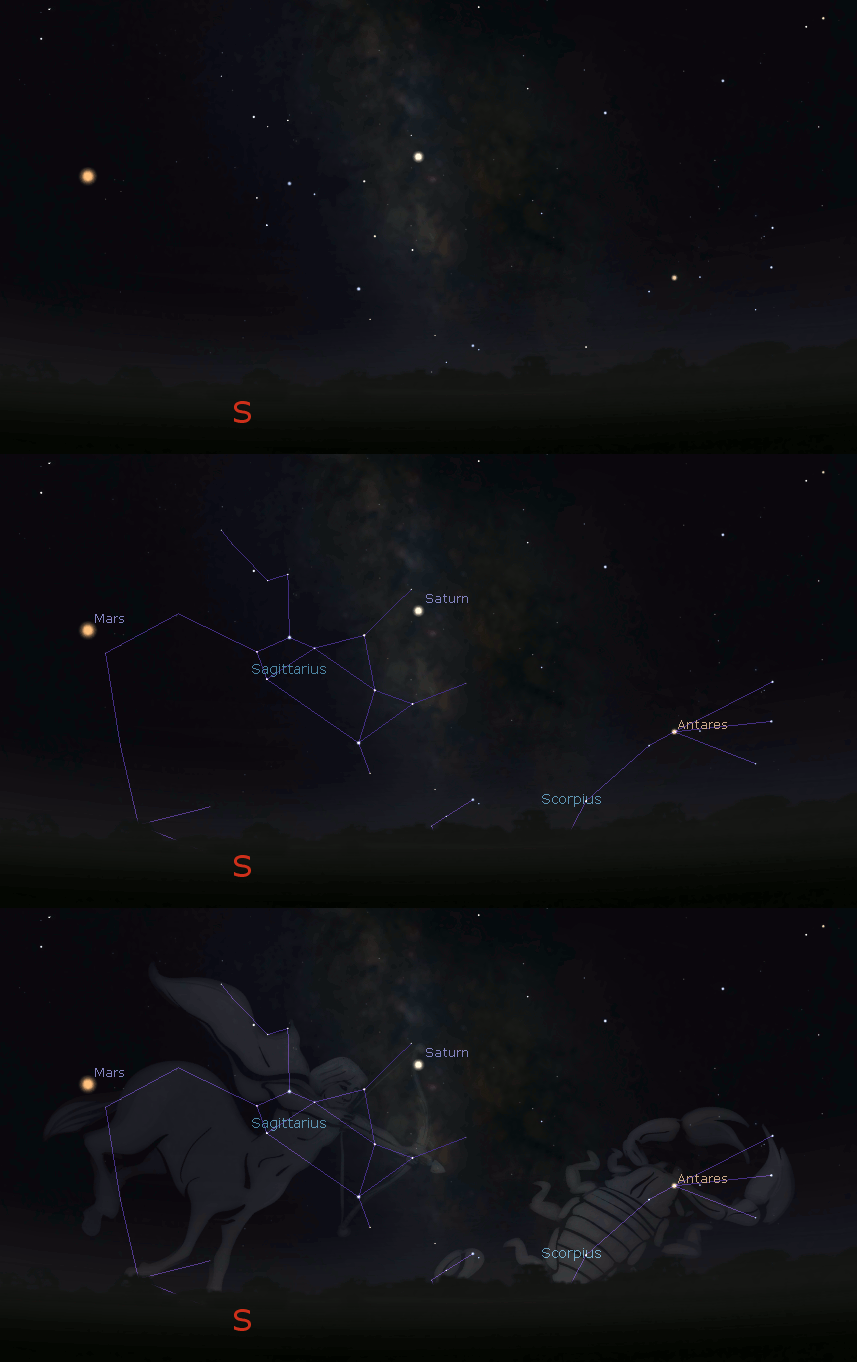
Sagittarius Finder animation for 10 p.m. September 3, 2018. Created using Stellarium and GIMP.
07/17/2018 – Ephemeris – Finding Cygnus the swan
Ephemeris for Tuesday, July 17th. Today the Sun will be up for 15 hours and 10 minutes, setting at 9:24, and it will rise tomorrow at 6:14. The Moon, 2 days before first quarter, will set at 12:32 tomorrow morning
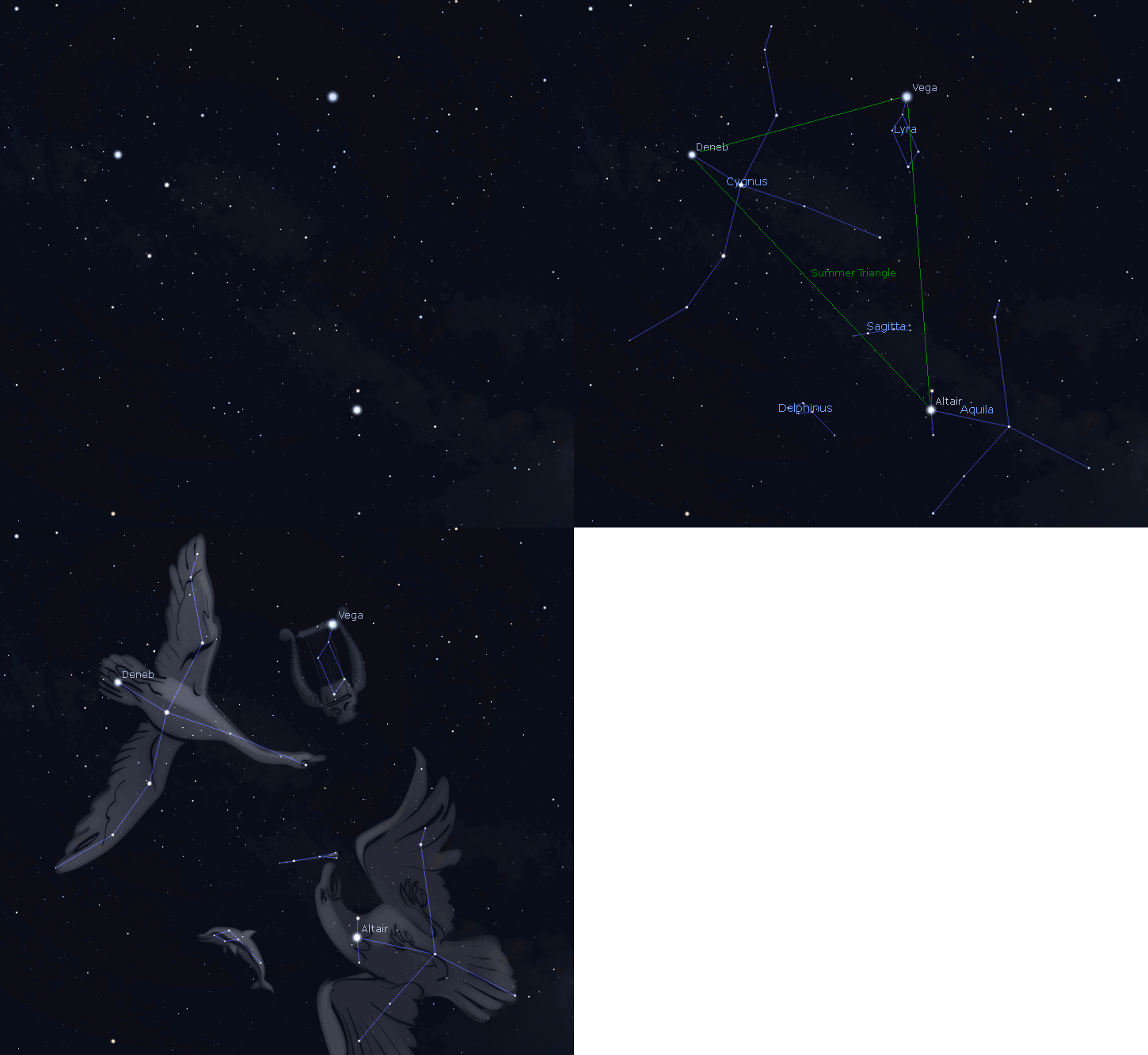
High in the east northeast as it gets dark flies the constellation of Cygnus the swan. This constellation is also known as the Northern Cross. The cross is seen lying on its side with the bright star Deneb at the head of the cross to the left. The rest of the cross is delineated in the stars to the right. As a swan, Deneb is the tail, the stars of the crosspiece of the cross are the leading edges of wings as Cygnus flies south through the Milky Way. There are faint stars that also define the tips and trailing edges of its wings. It is a very good portrayal of a flying swan, like the mute swans we see on the wing. In Cygnus we are looking in the direction that the Sun and the Earth are traveling as we orbit the center of the Milky Way.
The times given are for the Traverse City/Interlochen area of Michigan. They may be different for your location.
Addendum
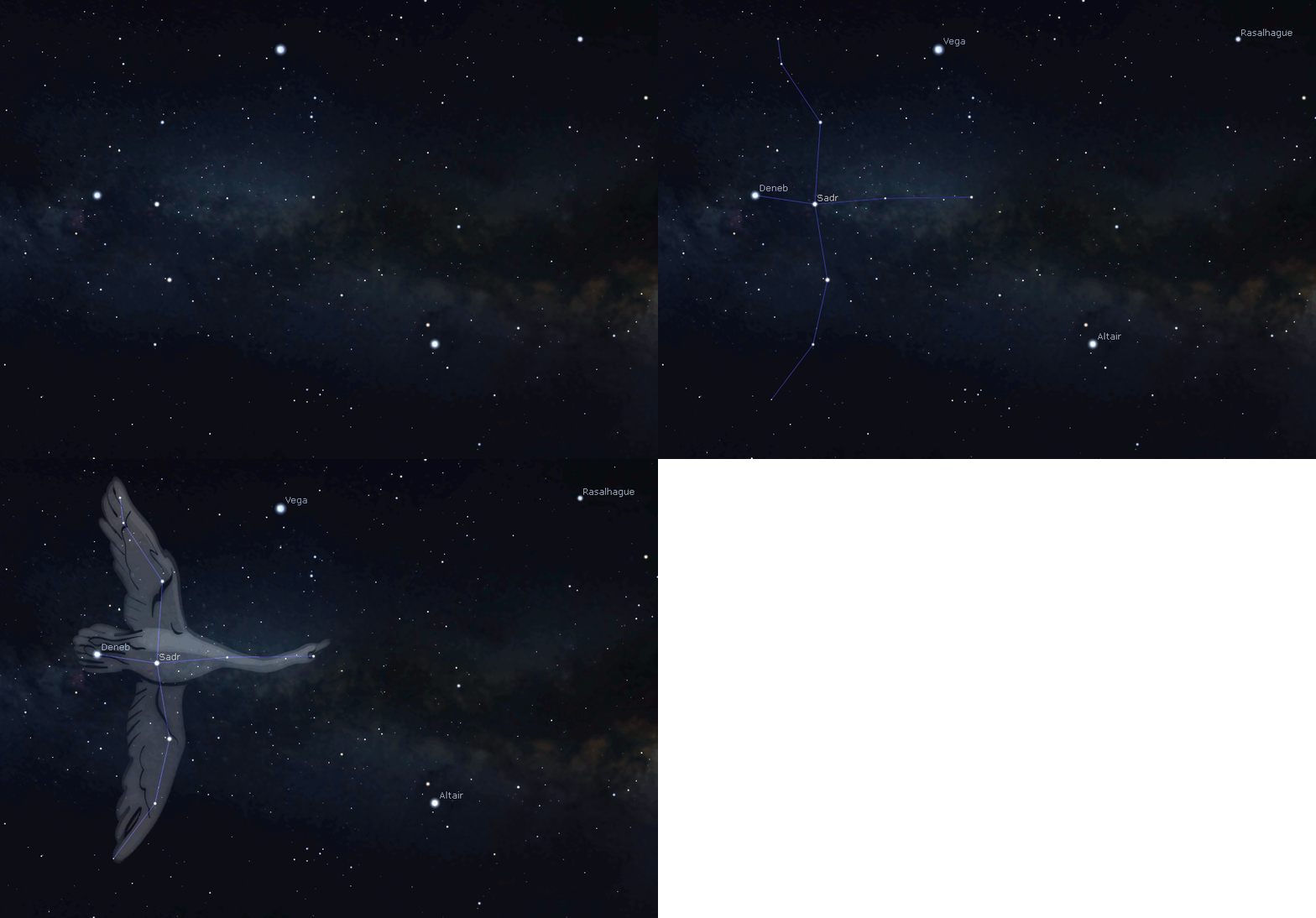
Animated Cygnus finder chart. Included also are, beside Deneb, the other stars of the Summer Triangle: Vega and Altair and their constellations Lyra the harp and Aquila. See if you can find them. Created using Stellarium.
07/16/2018 – Ephemeris – Lyra the harp, Hermes’ invention
Ephemeris for Monday, July 16th. Today the Sun will be up for 15 hours and 12 minutes, setting at 9:24, and it will rise tomorrow at 6:13. The Moon, 3 days before first quarter, will set at 12:02 tomorrow morning.
Very high up in the eastern sky at 11 p.m. can be found a bright star just north of a small, narrow, but very distinctive parallelogram of stars. They are the stars of the constellation Lyra the harp. The bright star is Vega, one of the twenty one brightest first magnitude stars. Vega is actually the 5th brightest night-time star. The harp, according to Greek mythology, was invented by the god Hermes. The form of the harp in the sky, is as he had invented it: by stretching strings across a tortoise shell. Hermes gave it to his half-brother Apollo, who in turn gave it to the great musician Orpheus. The Sun has a motion with respect to most stars around it. Its direction is towards the vicinity of Lyra.
The times given are for the Traverse City/Interlochen area of Michigan. They may be different for your location.
Addenda
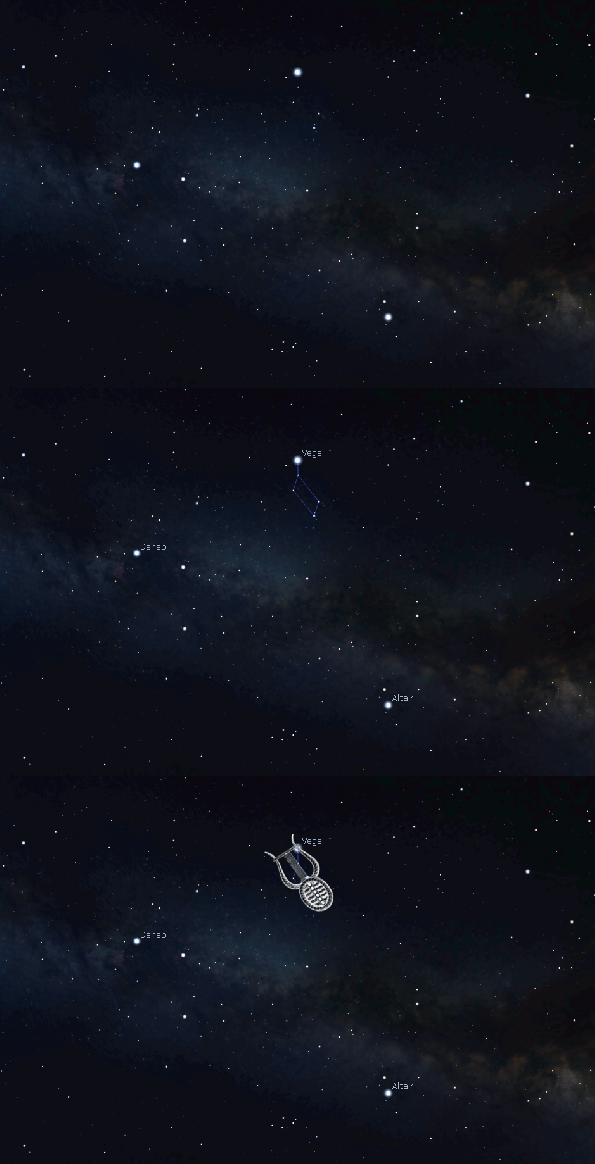
Animated Lyra finder chart. with Vega and the other named stars of the Summer Triangle. The lyre image not supplied by Stellarium but is from The World’s Earliest Music by Hermann Smith, Figure 60, A Project Gutenberg Ebook, and captioned “The Chelys or Greek Tortoiseshell Lyre”. Click on the image to enlarge Created using Stellarium and GIMP.
Last Saturday night’s wild Sun ‘n Star Party
Last Saturday night the Grand Traverse Astronomical Society, myself included, and the rangers and volunteers of the Sleeping Bear Dunes National Lakeshore held our Sun ‘n Star Party at the Dune Climb. I live 20 miles southeast of the Dune Climb, and about half way between Traverse City and Interlochen. It’s also the location for which the Ephemeris sunrise and sunset times are calculated for. We rely on the GOES East satellite imagery to show us the cloud patterns and movement. Saturday morning was pretty overcast and hot. GOES East showed that a big clearing was heading for us. At 1 p.m. I emailed our members that the event was a GO, and began to pack up the car with my two telescopes, and assorted items. Meanwhile some raindrops were showing up on the windshield. A check with weather radar on my phone confirmed that some rainstorms were popping up between my location and Lake Michigan. This is rather normal when it’s hot and humid in the afternoon, and wouldn’t affect the Dune area close to the lake. In driving to the Dune Climb I drove through some rain showers, but the skies cleared by the time I got within 5 miles from the lake.
The solar observing from 4 to 6 p.m.was great, except for no sunspots. We had 2 solar telescopes that did reveal some prominences. The sky was clear. The storm clouds were receding to the east. Of course we couldn’t see much to the west because the dune was in the way. Its angular altitude averaged 12 degrees. Some of us stayed there and ate our dinner. By 7:30 the wind came up from the southwest. A check of the GOES East satellite showed us a large, roughly square cloud the width of the lake slowly moving northward that was just south of us. Just after 8 p.m. we noticed clouds looming from the south, then fog was overtaking the tops of the dunes to the southwest. Shortly thereafter we were socked in. At a little after 9 p.m. Marie Scott the ranger in charge of this event gave introductions, and handed the microphone to me, who introduced our members and went over what we were supposed to see that night. We couldn’t track this cloud anymore by satellite because it was between the daytime color imagery and the nighttime infrared imagery. However around 10 p.m. someone spotted Vega, nearly overhead. And while I was swinging my 11″ Dobsonian towards it, someone else called out Jupiter. Looking around the fog was lifting. The night was salvaged. We stayed over an hour after the official 11 p.m. to watch Mars rise near the end of the star party, and finally view some of the wonders of the dark summer sky.
This was the fourth of seven monthly star parties scheduled at the Dunes this year. It was the first we didn’t cancel due to weather. We generally cancel one or two of then a year, but to start the year with three was depressing.
07/09/2018 – Ephemeris – Ophiuchus. the serpent bearer in the sky
Ephemeris for Monday, July 9th. Today the Sun will be up for 15 hours and 22 minutes, setting at 9:29, and it will rise tomorrow at 6:07. The Moon, half way from last quarter to new, will rise at 3:50 tomorrow morning.
The red star Antares shines in the south at 11 p.m. In the constellation of Scorpius. In the area of sky above and a little to the left lies a large constellation of faint stars called Ophiuchus, the serpent bearer. The constellation shape is like a large bell, which reminds me of the head, shoulders and arms of a fellow that’s holding the snake-like a weight lifter pulling up a heavy barbell. The serpent he’s holding is Serpens, the only two-part constellation in the heavens. The head rises to Ophiuchus’ right and the tail extends up to the left. In Greek legend Ophiuchus was a great physician, educated by the god Apollo, and the centaur Chiron, also found in the stars as Sagittarius, now rising below and left of him.
The times given are for the Traverse City/Interlochen area of Michigan. They may be different for your location.
Addendum
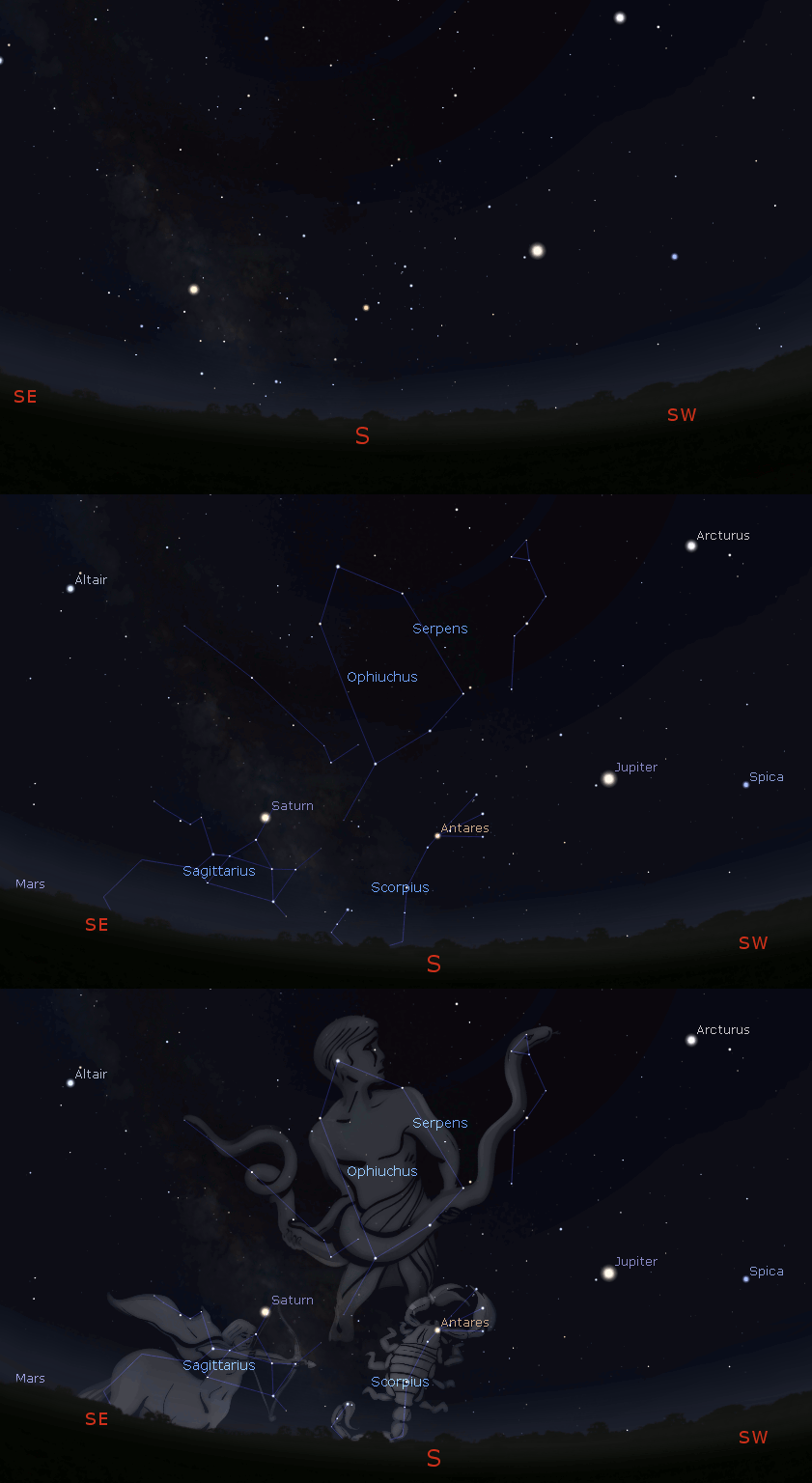
Ophiuchus finder animation plus constellations discussed. Created using Stellarium and GIMP.
06/14/2018 – Ephemeris – The mighty hero Hercules in the sky
Ephemeris for Flag Day, Thursday, June 14th. Today the Sun will be up for 15 hours and 33 minutes, setting at 9:29, and it will rise tomorrow at 5:56. The Moon, 1 day past new, will set at 10:27 this evening.
Orion, the hard luck Greek hunter gets a splashy constellation in the winter sky, but the greatest hero of all, Hercules, gets a dim group of stars on the border between the spring and summer stars. At 11 p.m. Hercules is high in the southeast. It is located above and right of the bright star, Vega in the east. Hercules’ central feature is a keystone shaped box of stars, called the Keystone, which represents the old boy’s shorts. From each top corner extend lines of stars that are his legs, from the bottom stars, the rest of his torso and arms extend. So in one final indignity he’s upside down in our sky. Some see him crouched down, club upraised holding the Hydra about to throttle it. For those with a telescope it contains the beautiful globular star cluster M13.
The times given are for the Traverse City/Interlochen area of Michigan. They may be different for your location.
Addendum
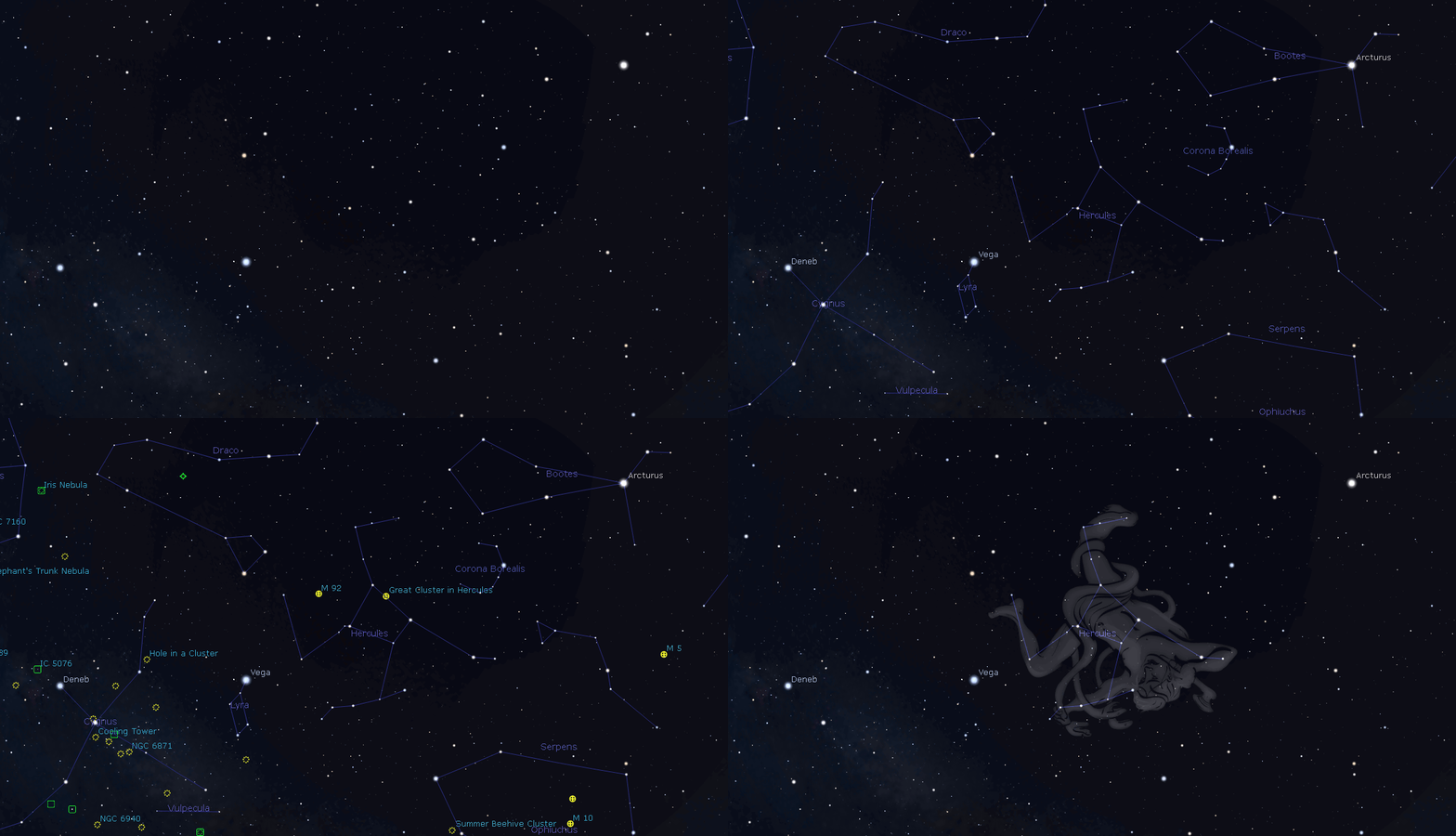
Hercules animation showing neighboring stars, constellation outlines, deep sky objects, and constellation art for Hercules. Created using Stellarium. Click on image to enlarge.
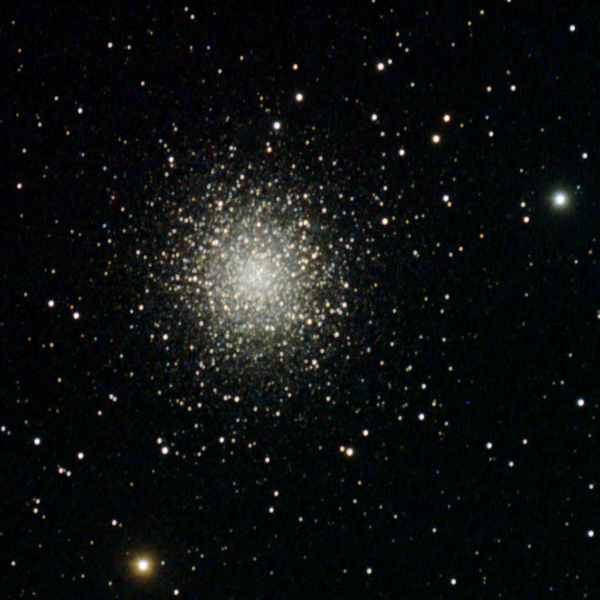
M13, the Great Globular Star Cluster in Hercules. Credit: Scott Anttila

