Archive
Ephemeris: 01/06/2026 – A river in the sky
This is Ephemeris for Tuesday, January 6th. Today the Sun will be up for 8 hours and 58 minutes, setting at 5:18, and it will rise tomorrow at 8:19. The Moon, 3 days past full, will rise at 9:25 this evening.
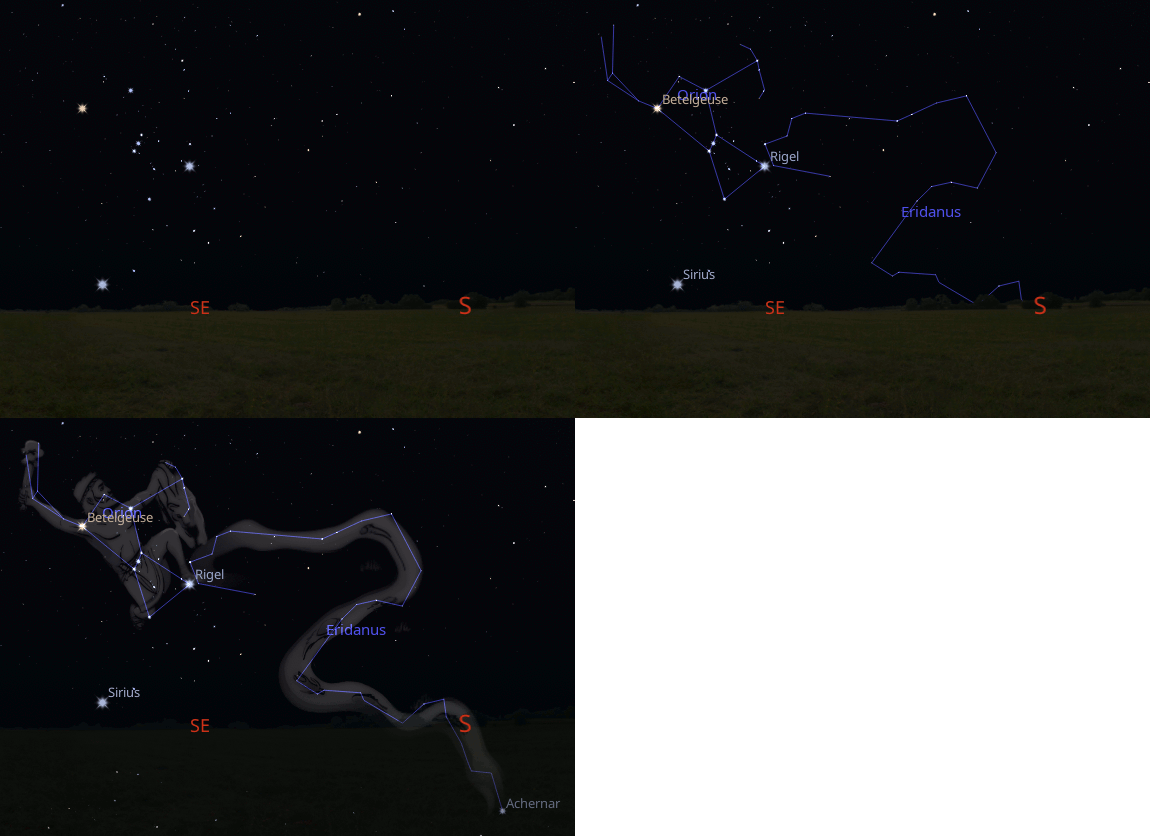
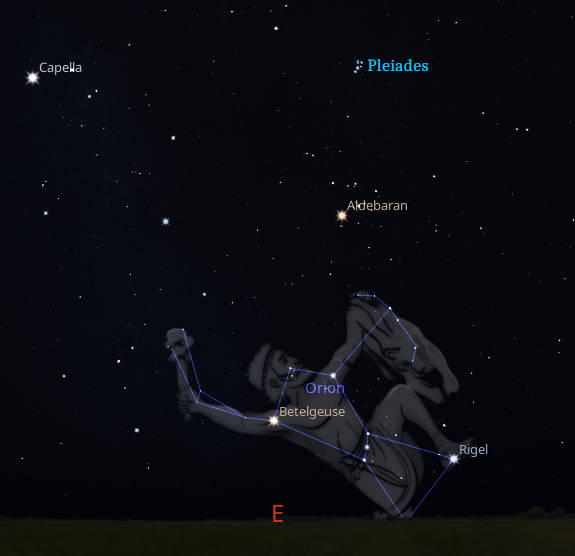
One of the more obscure constellations around is Eridanus, which depicts a river. At 8 PM the river, marked by dim stars, starts near the lower right corner of Orion, near the bright star Rigel and flows to the right then down a little way, then to the lower left, and again to the right, to the southern horizon. One has to travel to the far south to see the southern terminus of the river, the bright star Achernar. Writers over the ages have seen here the Nile, the Rhine and the Earth circling river Ocean of the flat earth days. To most Greeks, including Ptolemy it was simply the River. The earlier Greek astronomer Hipparchus called it the River of Orion, alluding to Orion’s star Rigel as its source. The southern part of the river was added when astronomers made it far enough south.
The astronomical event times given in this blog are for the Traverse City/Interlochen area of Michigan (Lat 44.7° N, Long 85.7° W; EST, UT – 5 hours) unless stated otherwise. Times will be different for other locations.
Addendum
Ephemeris: 12/18/2025 – Orion and Scorpius
This is Ephemeris for Thursday, December 18th. Today the Sun will be up for 8 hours and 48 minutes, setting at 5:03, and it will rise tomorrow at 8:16. The Moon, 1 day before new, will rise at 8:22 tomorrow morning.
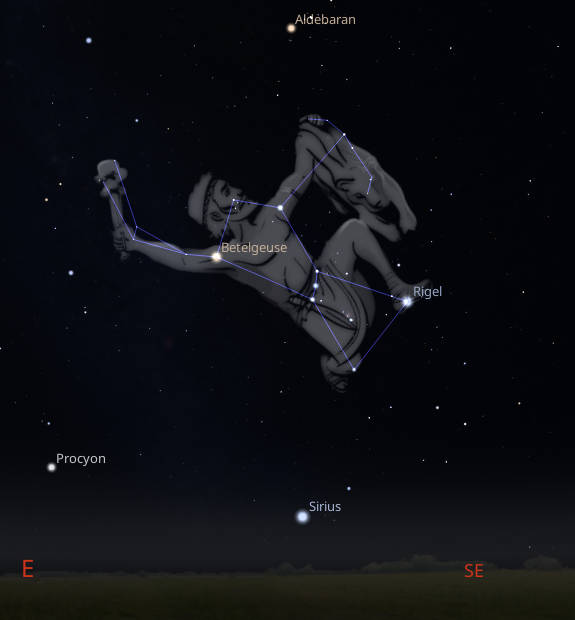
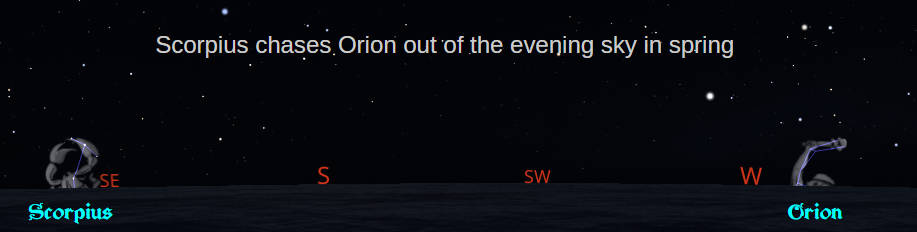
The wonderful constellation of Orion the hard luck hunter is seen rising in the east as twilight fades. According to one Greek myth he was killed by the sting of a giant scorpion, thus he can only rise after the summer constellation of Scorpius the scorpion sets in the southwest, and he must set as the scorpion rises on early spring evenings. By 9 pm, he is located in the southeast. His three belt stars are nearly vertically arranged in a line and equally spaced. They point down to the horizon, at the brightest nighttime star Sirius which rose 13 minutes before. The belt stars lie within a large rectangle of stars tilted to the left. His shoulders and knees. The top left star is the bright red Betelgeuse. The bottom right star is blue-white Rigel.
The astronomical event times given in this blog are for the Traverse City/Interlochen area of Michigan (Lat 44.7° N, Long 85.7° W; EST, UT – 5 hours) unless stated otherwise. Times will be different for other locations.
Addendum
Ephemeris: 12/16/2025 – Finding Orion and the Wintermaker
This is Ephemeris for Tuesday, December 16th. Today the Sun will be up for 8 hours and 49 minutes, setting at 5:03, and it will rise tomorrow at 8:14. The Moon, 3 days before new, will rise at 6:19 tomorrow morning.
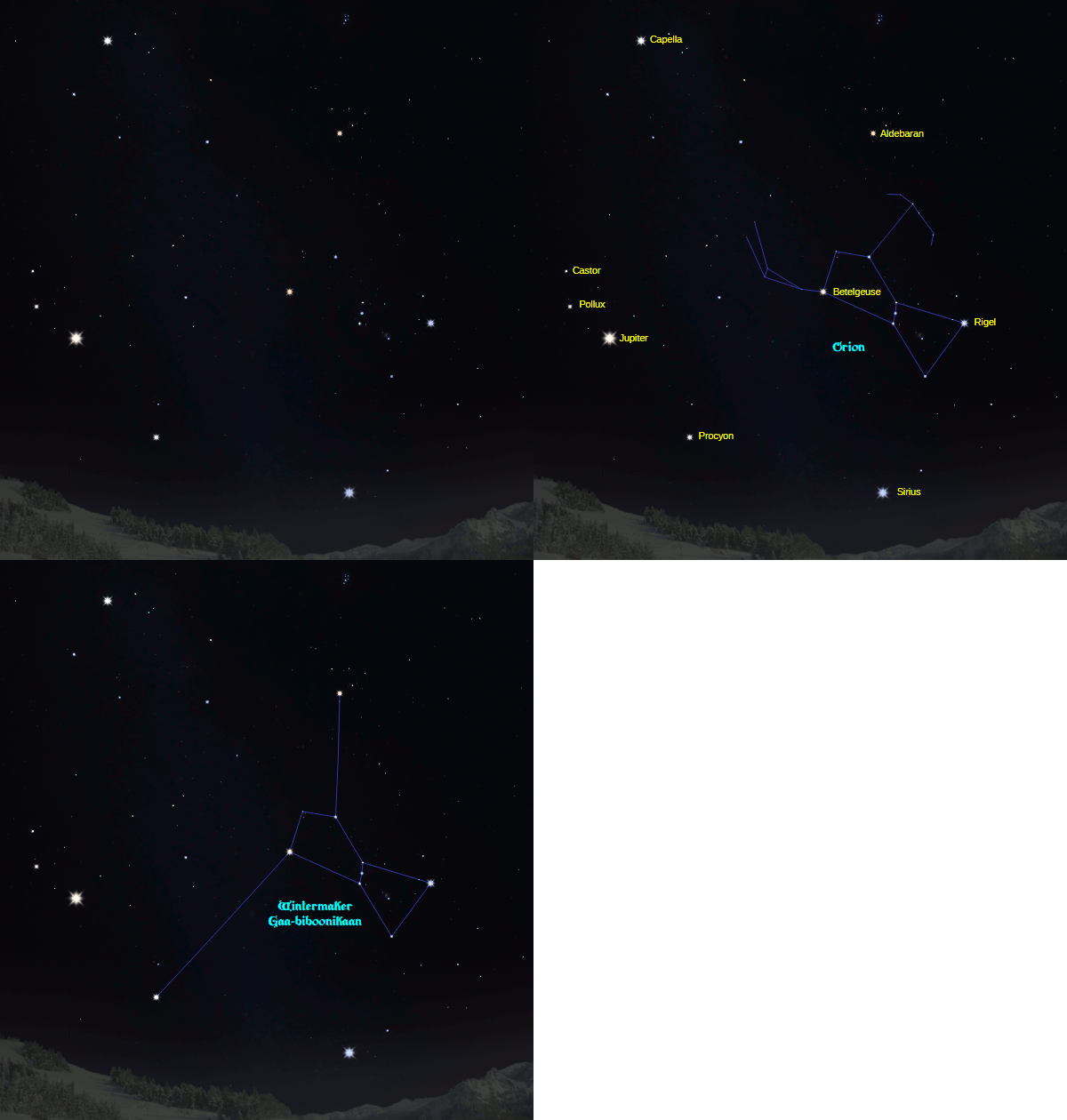
In the east, the central winter constellation Orion the hunter throws a leg over the horizon around 7 PM as Robert Frost told in his poem Star-Splitter. The upright rectangle that is his body is tilted to the left as he rises on December evenings. A bright red star, Betelgeuse, is at the top left of the rectangle, his shoulder. At the opposite corner is blue-white Rigel, a knee. In the center of the rectangle is a line of three stars nearly vertically aligned as he rises, which represents his belt. The stars of Orion’s belt are how many folks can find him. The Anishinaabe native peoples of this area call him the Wintermaker whose arms are held wide to encompass the winter stars. His rising in the evening heralds the coming of winter, five days from now.
The astronomical event times given in this blog are for the Traverse City/Interlochen area of Michigan (Lat 44.7° N, Long 85.7° W; EST, UT – 5 hours) unless stated otherwise. Times will be different for other locations.
Addendum
Ephemeris: 12/15/2025 – Capella, the winter star that never quite leaves us*
This is Ephemeris for Monday, December 15th. Today the Sun will be up for 8 hours and 49 minutes, setting at 5:02, and it will rise tomorrow at 8:14. The Moon, halfway from last quarter to new, will rise at 5:13 tomorrow morning.
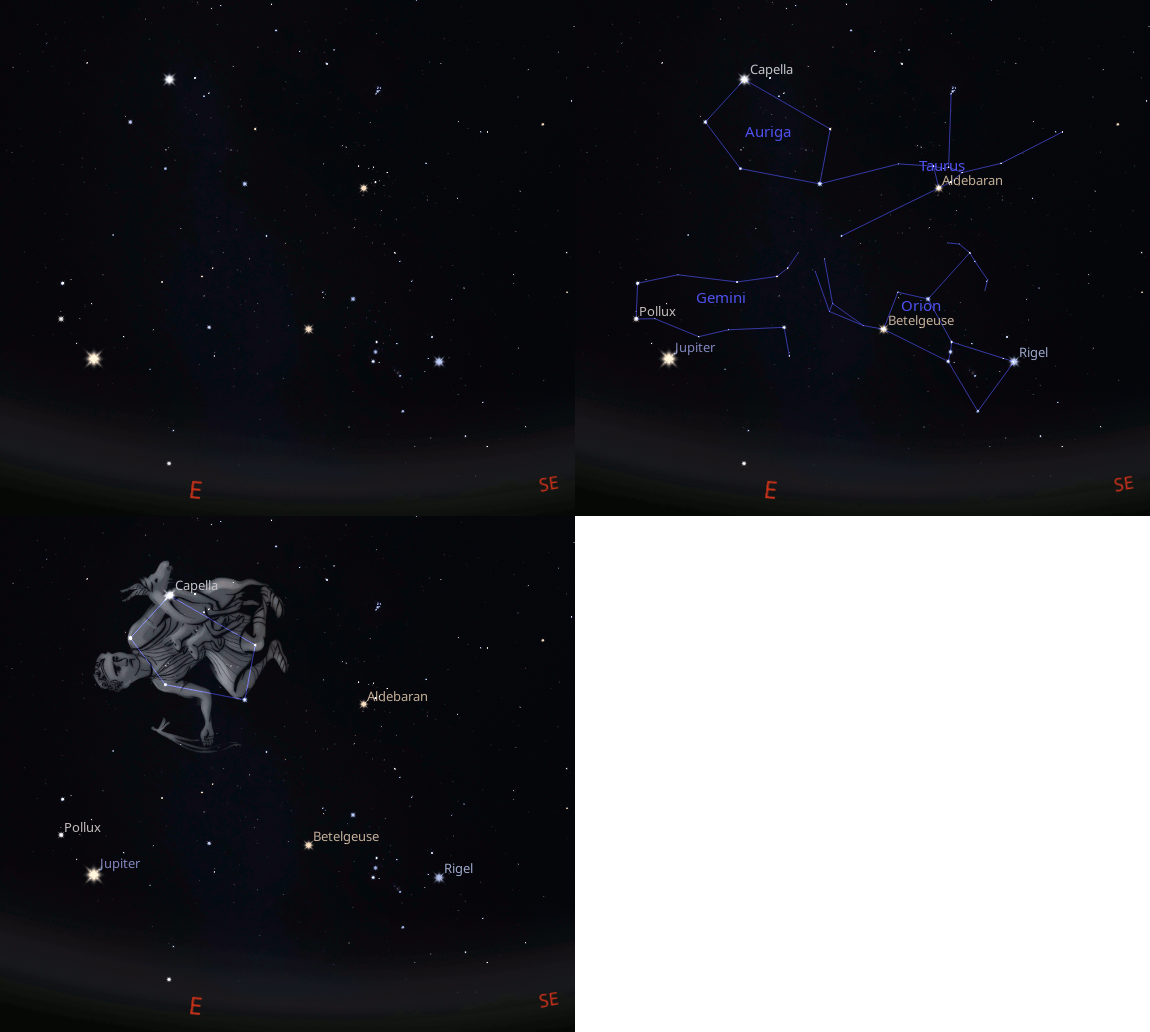
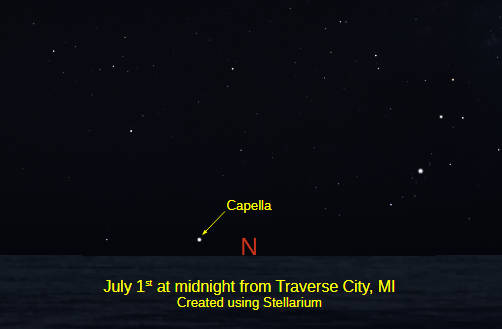
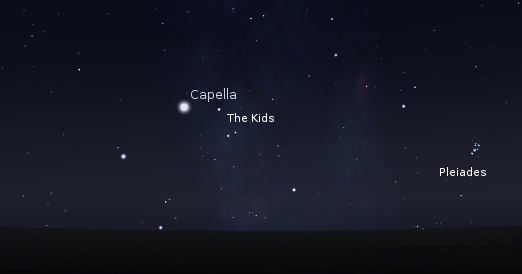
Capella is the northernmost first magnitude stars. Tonight it shines in the northeastern sky. First magnitude stars are the 21 brightest stars in the night sky. Capella is the 6th brightest. Although I’ve always known it as the little she-goat, Capella’s name literally translates to “little goat.” Her three Kids are represented by a narrow triangle of stars positioned to the right of her in tonight’s evening sky. Capella is in the topmost corner of the pentagonal constellation of Auriga the Charioteer. Capella is actually a system of four stars only 43 light years away. And never sets for listeners in the Interlochen Public Radio transmission area who have a low northern horizon.
The astronomical event times given in this blog are for the Traverse City/Interlochen area of Michigan (Lat 44.7° N, Long 85.7° W; EST, UT – 5 hours) unless stated otherwise. Times will be different for other locations.
* If you live north of 44° north latitude.
Addendum
Ephemeris: 12/11/25 – The constellation of the guy with the goats
This is Ephemeris for Thursday, December 11th. Today the Sun will be up for 8 hours and 51 minutes, setting at 5:02, and it will rise tomorrow at 8:11. The Moon, at last quarter today, will rise at 12:53 tomorrow morning.
The first constellation of winter is in the northeastern sky, called Auriga the charioteer. It’s to the upper left of Orion and directly left of Taurus. Auriga actually never really quite leaves us, because its brightest star, Capella is the star that never leaves us even in the heat of summer, Though for most of us it’s in the trees in the north. Auriga is a pentagon of stars with the Capella on top. Just right of Capella is a thin triangle of three faint stars, an asterism or informal constellation called the Kids, baby goats. Capella is their mother. For some reason they are all held by a charioteer, who is shown without his chariot. Ptolemy, last of the great Greek astronomers called Auriga the coachman. If so, he did have room for the goats.
The astronomical event times given in this blog are for the Traverse City/Interlochen area of Michigan (Lat 44.7° N, Long 85.7° W; EDT, UT – 4 hours) unless stated otherwise. Times will be different for other locations.
Addendum
Ephemeris: 12/08/2025 – Hyades, half sisters of the Pleiades
This is Ephemeris for Monday, December 8th. Today the Sun will be up for 8 hours and 54 minutes, setting at 5:02, and it will rise tomorrow at 8:08. The Moon, 3 days before last quarter, will rise at 9:19 this evening.
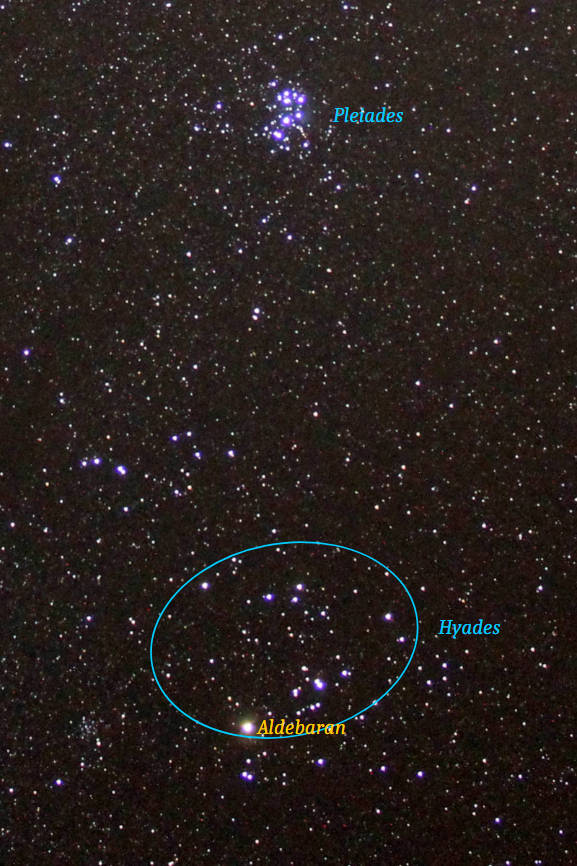
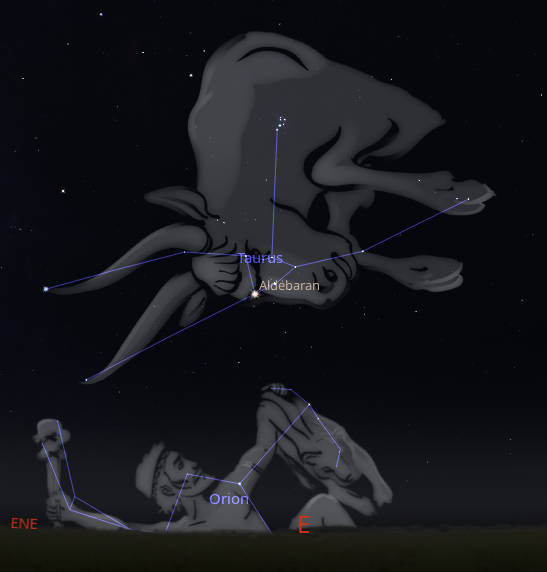
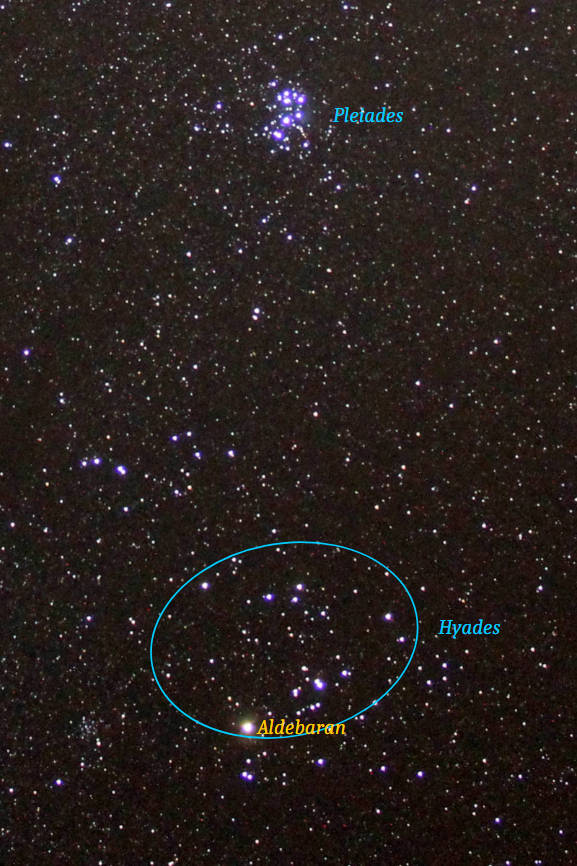
At 8 o’clock this evening the constellation of Orion the hunter is still in the act of rising with one leg still stuck in the snow. What is above him is the constellation of Taurus the bull. His face is a letter V of stars or as a letter A, is the star cluster called the Hyades. In Greek myth the stars are the half sisters of the Pleiades, which are right above them. The Hyades star cluster is very special. They don’t look as splashy as the Pleiades which are younger and still have their hot blue white stars. However, the Hyades are much closer, a third as far as the Pleiades. In fact they’re close enough to be measured by trigonometry using Earth’s orbit as the base of a triangle, before satellites. Which was critical in measuring distances beyond the solar system.
The astronomical event times given in this blog are for the Traverse City/Interlochen area of Michigan (Lat 44.7° N, Long 85.7° W; EDT, UT – 4 hours) unless stated otherwise. Times will be different for other locations.
Addendum
Ephemeris: 12/04/2025 – Orion survives a full moon
This is Ephemeris for Thursday, December 4th. Today the Sun will be up for 8 hours and 59 minutes, setting at 5:02, and it will rise tomorrow at 8:04. The Moon, at full today, will rise at 4:24 this evening.
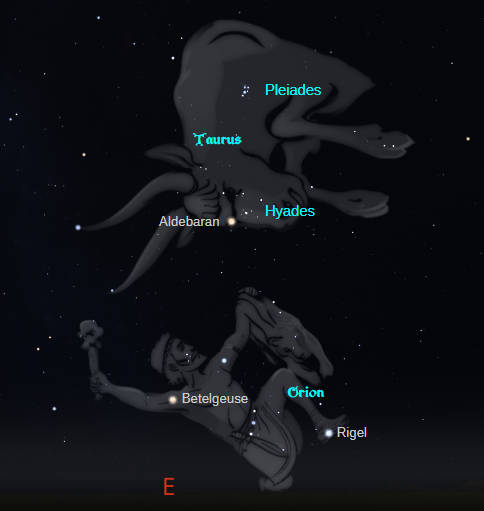
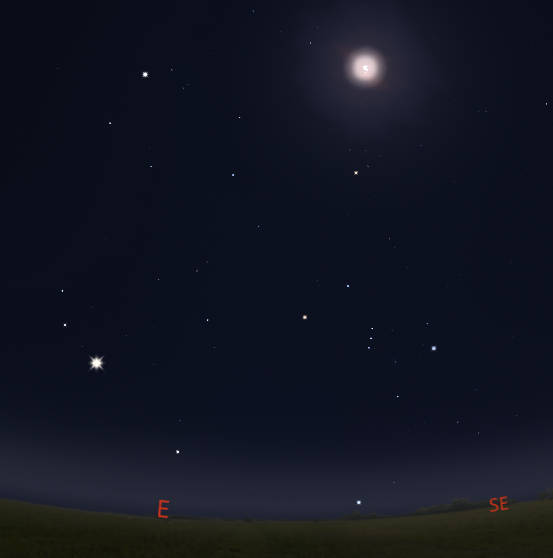
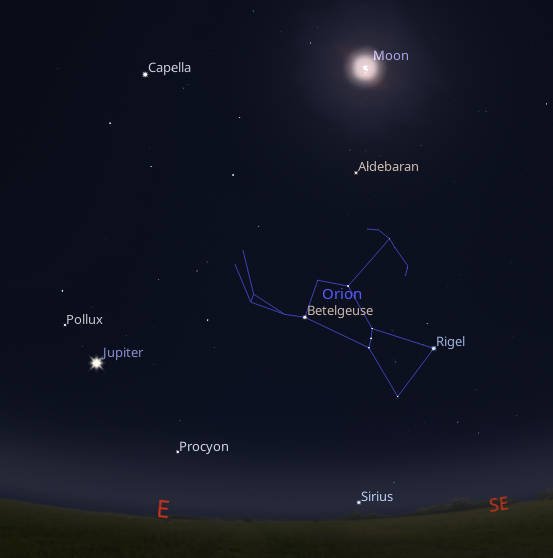
While the full moon overpowers most stars, the bright stars of winter persist. This is even true with tonight’s supermoon, a bit larger and brighter than average. Nowhere in the sky is there a concentration of bright stars as there is in the winter sky. I know it’s not winter yet, but if you stay up late enough, say 10 PM, all the winter stars will be in the sky. Last to rise is the brightest star of all, Sirius. And by 10 o’clock will be low in the southeast. Jupiter has joined the winter stars this year, outshining them all. As a constellation the mighty hunter Orion is easiest to spot on a full moon night, containing seven very bright stars, with three bright stars in a straight line as his belt, which most folks find as his most distinctive feature.
The astronomical event times given in this blog are for the Traverse City/Interlochen area of Michigan (Lat 44.7° N, Long 85.7° W; EDT, UT – 4 hours) unless stated otherwise. Times will be different for other locations.
Addendum
Ephemeris: 11/21/2025 – Finding Taurus the bull
This is Ephemeris for Friday, November 21st. Today the Sun will be up for 9 hours and 21 minutes, setting at 5:09, and it will rise tomorrow at 7:49. The Moon, 1 day past new, will set at 5:36 this evening.
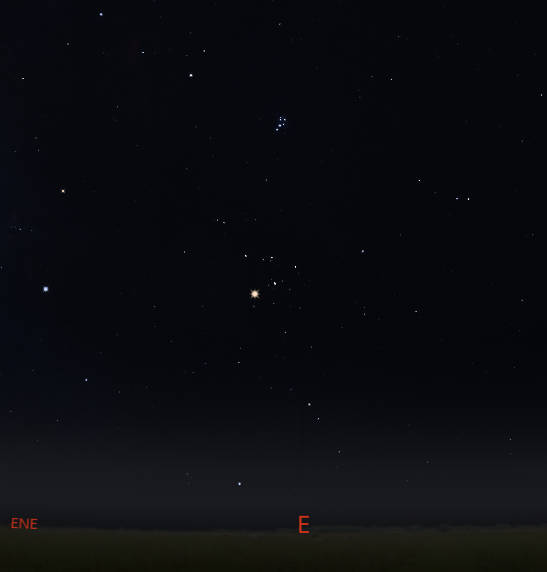
Low in the east at 8 this evening and below the beautiful Pleiades star cluster is Taurus the bull. His face is a letter V shape of stars lying on its side, the star cluster Hyades, which in Greek Mythology were the half-sisters of the Pleiades, with the bright orange-red star Aldebaran at one tip of the V as its angry bloodshot eye. Aldebaran is actually about halfway between us and the cluster. The Pleiades star cluster is in his shoulder. Taurus is seen charging downward at that hour, the rising constellation of Orion. Taurus in Greek mythology was the form the god Zeus assumed when he carried off the maiden Europa. Europa’s still with him as a moon orbiting Zeus’ Roman counterpart, the planet Jupiter.
The astronomical event times given in this blog are for the Traverse City/Interlochen area of Michigan (Lat 44.7° N, Long 85.7° W; EDT, UT – 4 hours) unless stated otherwise. Times will be different for other locations.
Addendum
Ephemeris: 11/18/2025 – What other cultures see in the Pleiades
This is Ephemeris for Tuesday, November 18th. Today the Sun will be up for 9 hours and 27 minutes, setting at 5:11, and it will rise tomorrow at 7:45. The Moon, 2 days before new, will rise at 7:22 tomorrow morning.
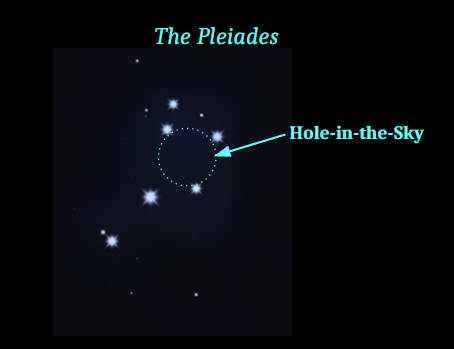
Let’s look at how some other cultures saw the Pleiades, the star cluster that is seen in the eastern sky these evenings. To the Anishinaabe native peoples around here, the Pleiades is the “Hole in the Sky” or the seven stones that are heated for the sweat lodge ceremony. To the Kiowa, these were sisters who were whisked up into the sky from the top of Devil’s Tower in Wyoming, where they were threatened by a huge bear. An Iroquoian legend has seven daughters who danced all day and were drawn into the sky, along with a black bear who danced with them. One daughter heard her mother’s call and fell back down to the Earth. In Norse mythology, these were the goddess Freya’s hens.
The astronomical event times given in this blog are for the Traverse City/Interlochen area of Michigan (Lat 44.7° N, Long 85.7° W; EDT, UT – 4 hours) unless stated otherwise. Times will be different for other locations.
Addendum
Ephemeris: 11/17/2025 – More about the Pleiades
This is Bob Moler with Ephemeris for Monday, November 17th. Today the Sun will be up for 9 hours and 29 minutes, setting at 5:12, and it will rise tomorrow at 7:44. The Moon, 3 days before new, will rise at 6:16 tomorrow morning.
Around 8 in the evening the marvelous small star group called the Pleiades, or Seven Sisters will be in the eastern sky. Most people can see six stars, but they’re called the Seven Sisters, so the story has come up about the Lost Pleiad. It was said that her star was dimmed because she married a mere mortal. In Greek mythology the Pleiades were the daughters of the god Atlas and Pleione. By 9 PM the hunter Orion is rising in the east to chase the Pleiades across the sky until dawn. The word Pleiades is related to the Greek word for sail, and in ancient times the sailing season in the Mediterranean Sea started with the heliacal * rising of the Pleiades at dawn in mid-spring.
The astronomical event times given in this blog are for the Traverse City/Interlochen area of Michigan (Lat 44.7° N, Long 85.7° W; EDT, UT – 4 hours) unless stated otherwise. Times will be different for other locations.
* Heliacal Rising – The first appearance in the morning of a celestial body after disappearing in evening twilight.
Addendum
 Bob Moler's Ephemeris Blog