Archive
11/18/2016 – Ephemeris – Aquarius the water spiller
Ephemeris for Friday, November 18th. The Sun will rise at 7:44. It’ll be up for 9 hours and 26 minutes, setting at 5:11. The Moon, 3 days before last quarter, will rise at 9:43 this evening.
One of the constellations of the zodiac is in the south-southwestern sky at 8 in the evening. It’s the constellation of Aquarius the water bearer. The image that is supposed to be depicted in the stars is that of a hapless fellow spilling a stone jar of water across the sky. Aquarius is fairly hard to spot because it is made of faint stars. One part of him, though, is easy to spot. That is the Water Jar, an asterism or informal constellation. It is a distinctive small nearly equilateral triangle of stars with another star in the center. Stars extending to the right from the water jar are he yoke he’s holding the water jar with. The Water jar is just below the top of the head of the upside down Pegasus the flying horse. The water is flowing down a vertical line of stars.
Times are for the Traverse City/Interlochen area of Michigan. They may be different for your location.
Addendum
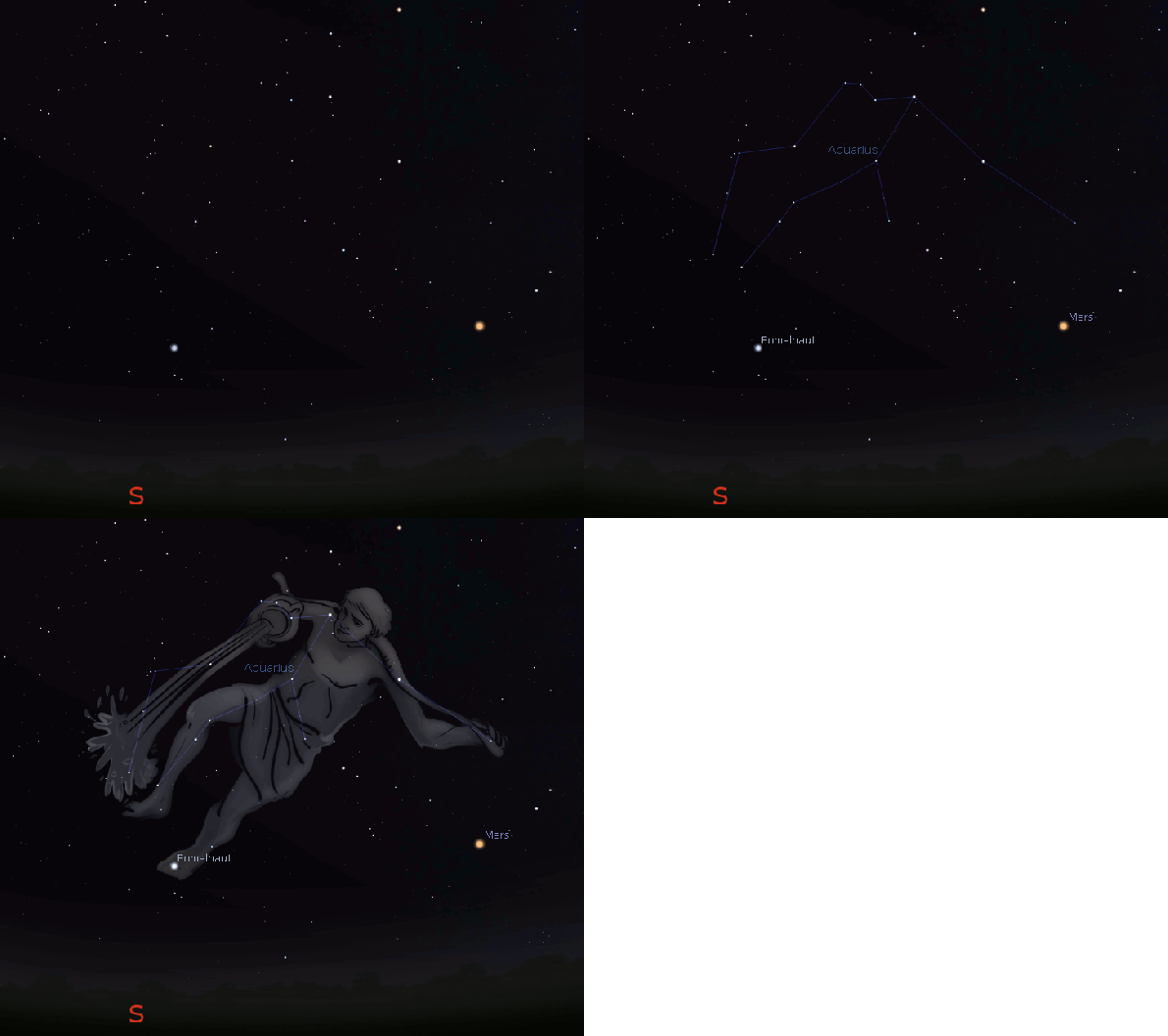
Aquarius the water bearer or rather spiller at 8 p.m. tonight, November 18. Note that Mars is in the next constellation west, Capricornus, and will enter Aquarius about mid-December. Created using Stellarium and GIMP. If you’re using the Firefox browser you can right-click on the image and display the enlarged version.
The triangle of stars with another star in the center is an asterism called the Water Jar, right where the artist drew it.
11/03/2016 – Ephemeris – Capricornus, a very strange goat
Ephemeris for Thursday, November 3rd. The Sun will rise at 8:24. It’ll be up for 10 hours and 3 minutes, setting at 6:28. The Moon, half way from new to first quarter, will set at 9:25 this evening.
The planet Mars is just to the right of the stars of Capricornus, one of the constellations of the zodiac. Astronomers and others who draw the constellations by drawing lines between stars like a dot to dot puzzle have a hard time getting a sea-goat emerge from its stars. The sea-goat has the front part of a goat and the back half like a fishes tail. Kind of like a mergoat, instead of a mermaid. To me, the constellation looks like a large sagging triangle, just above-left of Mars right now. It will take Mars only to mid December to cross Capricornus to enter Aquarius, just east of it. A couple of thousand years ago Capricornus was the location of the winter solstice point in the sky, for which the Tropic of Capricorn was named. That point is now on the Ophiuchus-Sagittarius border.
Times are for the Traverse City/Interlochen area of Michigan. They may be different for your location.
Addendum
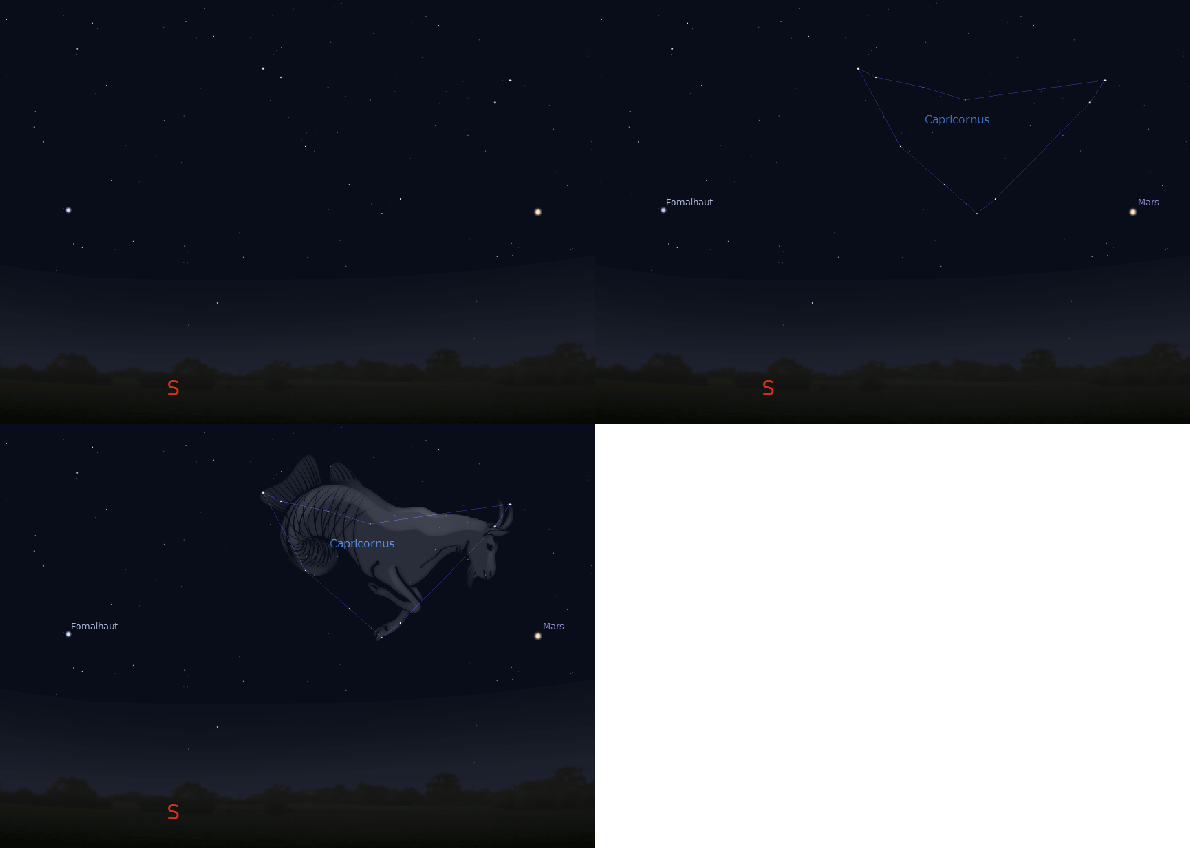
Animated GIF of Capricornus in the sky. Time 9 p.m. November 3, 2016. Created using Stellarium ans GIMP.
10/31/2016 – Ephemeris – What’s a Halloween sky without the Ghoul Star
Ephemeris for Halloween, Monday, October 31st. The Sun will rise at 8:20. It’ll be up for 10 hours and 12 minutes, setting at 6:32. The Moon, 1 day past new, will set at 7:28 this evening.
Not all the ghosts and goblins out tonight will be children. One is out every night, because it’s a star. Its name is Algol, from the Arabic for Ghoul Star or Demon Star. The Chinese had a name for it that meant ‘piled up corpses’. It’s the second brightest star in the constellation Perseus the hero, rising in the northeast this evening. The star is located where artists have drawn the severed head of Medusa, whom he had slain. Medusa was so ugly that she turned all who gazed upon her to stone. Algol is her still glittering eye. Astronomers finally found out what was wrong with Algol. It does a slow 6 hour wink every 2 days 21 hours because it is two very close stars that eclipse each other in that period. It did so this morning at 5:53 a.m.
Times are for the Traverse City/Interlochen area of Michigan. They may be different for your location.
Addendum
To run an app to calculate times for the minima of Algol click here: http://www.skyandtelescope.com/observing/celestial-objects-to-watch/the-minima-of-algol/ courtesy of Sky and Telescope Magazine.
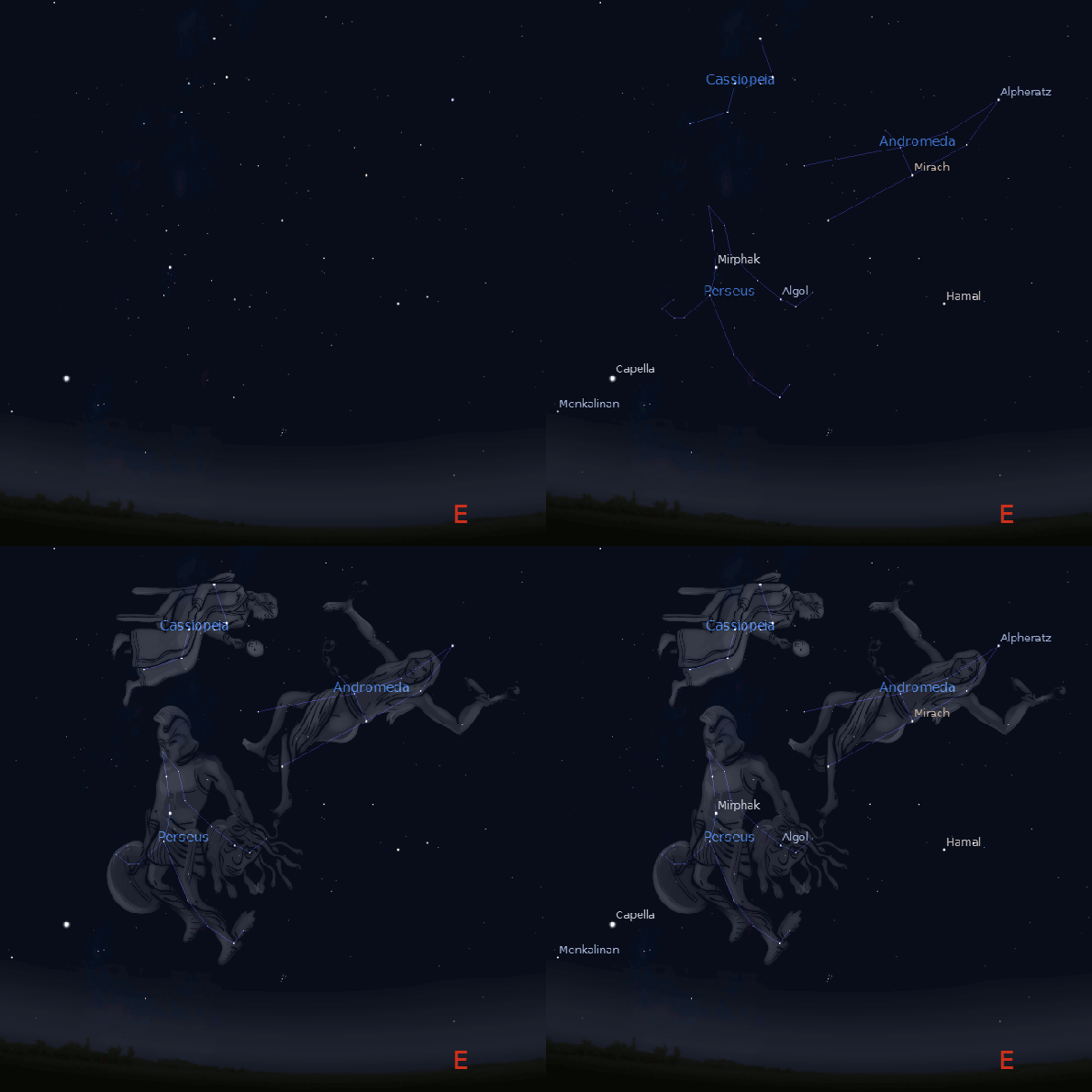
Perseus with Cassiopeia and Andromeda in the northeast at 8:30 p.m. on Halloween. Created using Stellarium and GIMP.
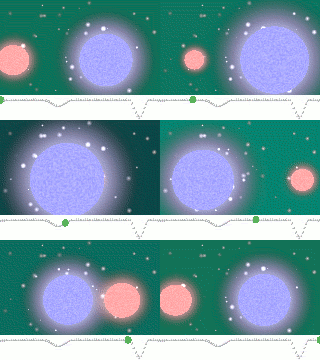
Animation of an eclipsing binary star like Algol. Credit: Wikimedia Commons h/t Earth and Sky
10/20/2016 – Ephemeris – Perseus: Is it a hero or a chicken?
Ephemeris for Thursday, October 20th. The Sun will rise at 8:05. It’ll be up for 10 hours and 43 minutes, setting at 6:48. The Moon, 2 days before last quarter, will rise at 10:54 this evening.
Positioned below the W shaped constellation of Cassiopeia half way up the sky in the northeast at 9 p.m. is the constellation of Perseus the hero of Greek myth who slew Medusa and rescued and married Andromeda represented in the constellation above and right of him. Rather than a hero the star pattern seems to look like a chicken or perhaps Big Bird. At least, that’s how I see it. In the back of the chicken is its brightest star Mirfak (Mirphak). Binoculars will show a beautiful group of stars near Mirfak just below unaided eye visibility called the Alpha Persei Association. Tomorrow morning will see the peak of the Orionid meteor shower, though all but the brightest meteors will be overwhelmed by waning gibbous Moon.
Times are for the Traverse City/Interlochen area of Michigan. They may be different for your location.
Addendum
Perseus with Cassiopeia and Andromeda in the northeast at 9 p.m. October 20, 2016. Created using Stellarium and GIMP.
10/14/2016 – Ephemeris – Super Moon Sunday and a weird comet
Ephemeris for Friday, October 14th. The Sun will rise at 7:57. It’ll be up for 11 hours and 1 minute, setting at 6:59. The Moon, 2 days before full, will set at 7:03 tomorrow morning.
The full moon on Sunday will be the Hunter’s Moon it will also be a super moon, though not quite as super as November’s super moon. I tend to disparage the effect because of the optical illusion that makes the Moon appear larger when near the horizon than when higher up. Besides there’s nothing out there of comparable size to compare it to. Farther out in space, the comet 29P/Schwassmann-Wachmann 1, which is weird among comets in having a nearly circular orbit between Jupiter and Saturn. It can be observed over it’s entire orbit. Normally a comet out that far is pretty much inactive. However every once in a while it produces an outburst, brightening and expelling a cloud of gas and dust. This can occur up to 7 times a year.
Times are for the Traverse City/Interlochen area of Michigan. They may be different for your location.
Addendum
This month’s super Moon will appear to be 33.4 minutes of arc in diameter when it will rise Sunday night at 7:40 p.m. in the Traverse City/Interlochen area. It will be 222,393 miles (357,906 km) away. November’s super Moon will rise November 14 at 5:53 p.m. and appear to be 33.6 minutes of arc in diameter. Note that half a degree is 30 minutes of arc. Last April 2nd’s mini Moon was 29.4 seconds of arc in diameter when it rose. It was 252,262 miles (405,977 km) away. This full Moon will appear 13.6% larger than last April’s full Moon.
10/04/2016 – Ephemeris – Celestial dolphin and Cupid’s arrow
Ephemeris for Tuesday, October 4th. The Sun will rise at 7:45. It’ll be up for 11 hours and 31 minutes, setting at 7:16. The Moon, 4 days past new, will set at 9:28 this evening.
There’s two small constellations I’ve overlooked in the heat of Summer. Located above the southernmost star of the Summer Triangle of three of the brightest stars in the sky, which is nearly overhead at 9 p.m., is the tiny constellation of Delphinus the dolphin, which is seen high in the south. Delphinus’ 6 stars in a small parallelogram with a tail, really does look like a dolphin leaping out of the water. The parallelogram itself has the name Job’s Coffin. The origin of this asterism or informal constellation is unknown. Of the dolphin itself: the ancient Greeks appreciated this aquatic mammal as we do. There’s another tiny constellation to the right of Delphinus, Sagitta the arrow, which represents Cupid’s dart.
Times are for the Traverse City/Interlochen area of Michigan. They may be different for your location.
Addendum
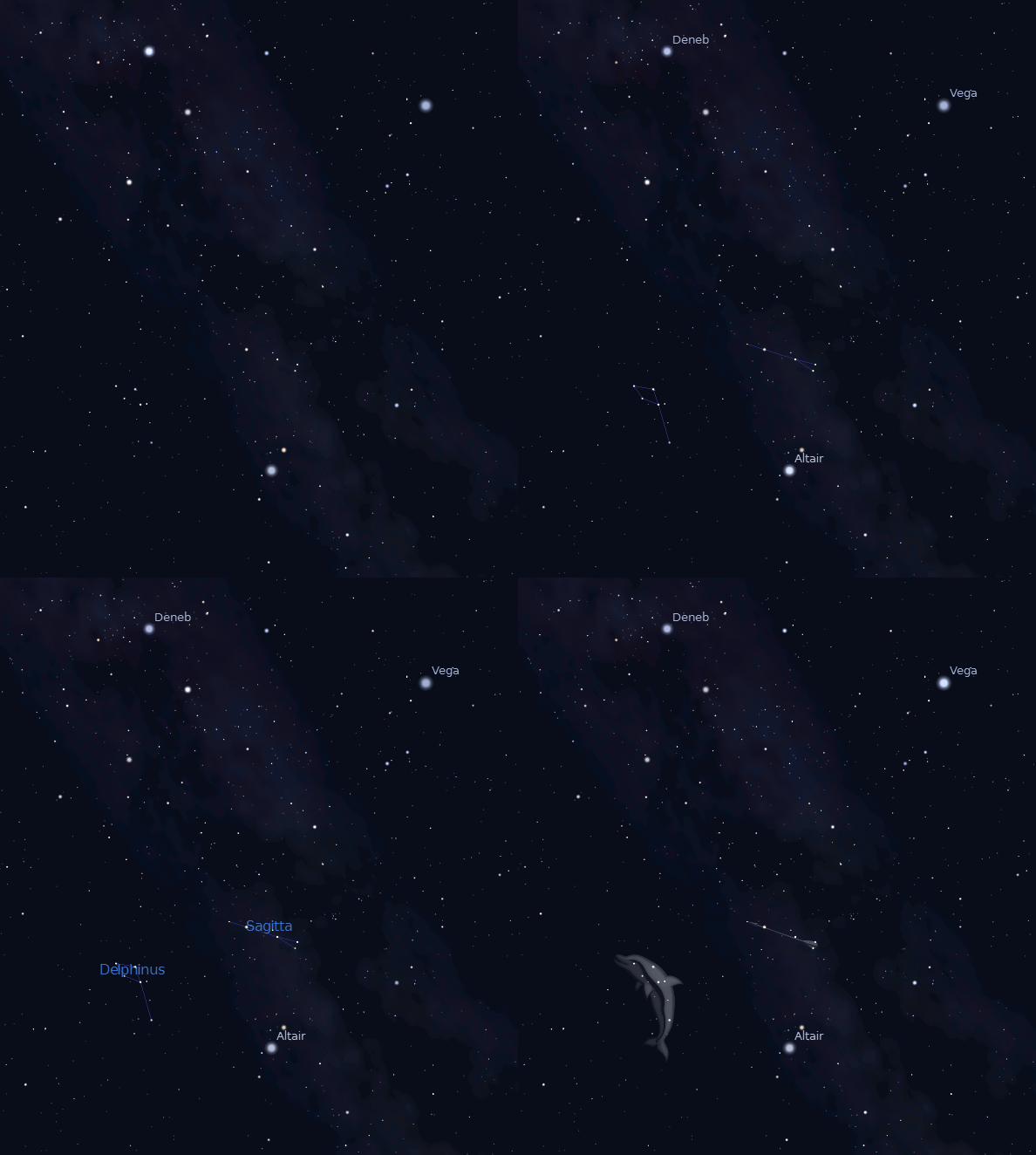
Delphinus and Sagitta seen in an animation showing them without captions, with stick constellations, labeled, and as an artist sees them. Created using Stellarium.
10/03/2016 – Ephemeris – Cassiopeia the celestial queen, and a look at Venus with the Moon
Ephemeris for Monday, October 3rd. The Sun will rise at 7:43. It’ll be up for 11 hours and 34 minutes, setting at 7:18. The Moon, 3 days past new, will set at 8:55 this evening.
The stars of autumn are in the northeastern to southeastern part of the evening sky. Look half way up the sky in the northeast at 9 p.m. and you can find the W shaped constellation of Cassiopeia the queen. Cassiopeia never sets for us in Michigan. It is opposite the pole star Polaris from the Big Dipper. Above Cassiopeia is a dim church steeple shaped constellation of Cepheus the king. The steeple is toppled to the left. The Milky Way flows through Cassiopeia and through a corner of Cepheus to the bright star Deneb in Cygnus the Swan, or Northern Cross, overhead. Below Cassiopeia it flows through the constellation of Perseus the hero, which kind of looks like a chicken, to the bright star Capella near the horizon.
Times are for the Traverse City/Interlochen area of Michigan. They may be different for your location.
Addendum
The crescent Moon will appear above Venus tonight.
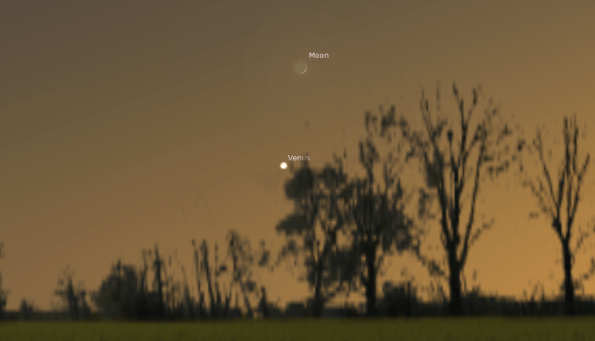
Looking very low in the west-southwest at 7:38 p.m., 20 minutes after sunset, October 3, 2016. The thin crescent Moon will appear about 4 degrees 15 minutes (8 1/2 moon diameters) above Venus. Created using Stellarium.
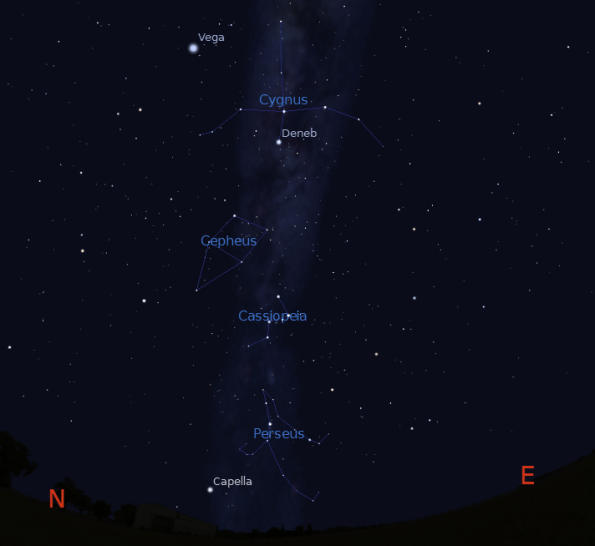
Cassiopeia with Cepheus, Cygnus and Perseus in the Milky Way in the northeastern sky. Created using Stellarium.
09/27/2016 – Ephemeris – The princess Pegasus helped save
Ephemeris for Tuesday, September 27th. The Sun will rise at 7:36. It’ll be up for 11 hours and 53 minutes, setting at 7:29. The Moon, 3 days before new, will rise at 5:08 tomorrow morning.
In the east at 9 this evening can be found a large square of stars standing on one corner, the Great Square of Pegasus the flying horse. What look like its hind legs stretching to the left from the left corner star is another constellation, Andromeda the chained princess. She is seen in the sky as two diverging upward curving strings of three stars each. She was rescued by the hero Perseus, a nearby constellation, riding Pegasus. Andromeda’s claim to astronomical fame is the large galaxy seen with the unaided eye just above the upper line of stars, the Great Andromeda Galaxy, 2.5 million light years away. To the unaided eye the galaxy appears as a small smudge of light. In binoculars the galaxy is a delicate spindle of light.
Times are for the Traverse City/Interlochen area of Michigan. They may be different for your location.
Addendum
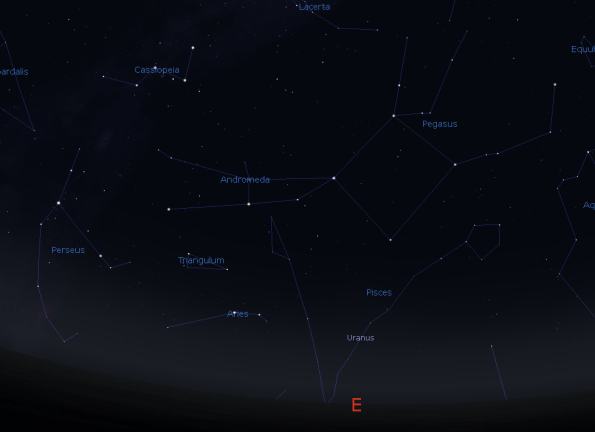
Andromeda, Pegasus and Perseus in the east. Created using Stellarium.
I added some constellation lines to Andromeda since yesterday to match the transcript and how I see her. Looks like I have some work to do with Perseus, before I talk about him later on. He doesn’t look like a chicken enough. I’m going for laughs here.
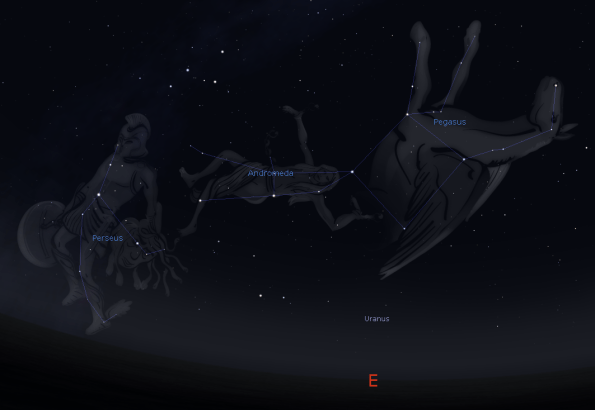
Andromeda. Pegasus and Perseus in the east. Created using Stellarium, art by Johan Meuris.
09/26/2016 – Ephemeris – Pegasus flies through autumn skies
Ephemeris for Monday, September 26th. The Sun will rise at 7:35. It’ll be up for 11 hours and 56 minutes, setting at 7:31. The Moon, 3 days past last quarter, will rise at 4:05 tomorrow morning.
Rising and almost half way up the sky in the east at as it gets dark around 9 p.m. can be found one of the great autumn constellations: Pegasus the flying horse of Greek myth. Its most visible feature is a large square of four stars, now standing on one corner. This feature, called the Great Square of Pegasus, represents the front part of the horse’s body. The horse is quite aerobatic, because it is seen flying upside down. Remembering that fact, the neck and head is a bent line of stars emanating from the right corner star of the square. Its front legs can be seen in a gallop extending to the upper right from the top star of the square. From the left star extend, not hind legs but the constellation of Andromeda, rescued with the help of Pegasus.
Times are for the Traverse City/Interlochen area of Michigan. They may be different for your location.
Addendum
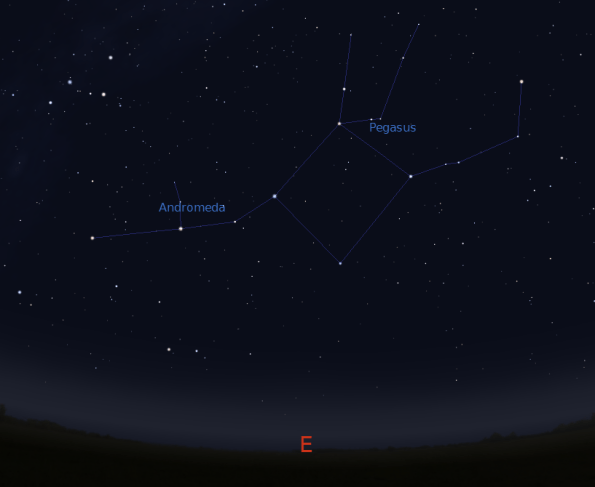
Pegasus and Andromeda in the east. Created using Stellarium.
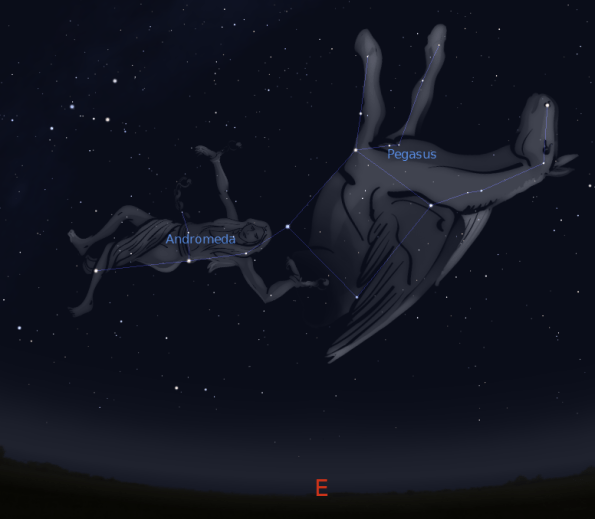
Pegasus and Andromeda in the east. Created using Stellarium, art by Johan Meuris.
08/30/2016 – Ephemeris – One of the many wonders in the steam from the Teapot
Ephemeris for Tuesday, August 30th. The Sun will rise at 7:03. It’ll be up for 13 hours and 18 minutes, setting at 8:22. The Moon, 2 days before new, will rise at 6:14 tomorrow morning.
Yesterday I talked about the Teapot pattern of stars low in the south these evenings that’s better represented in the stars for us moderns than a centaur with a bow and arrow called Sagittarius. The teapot, spout to the right is appearing to begin to pour its contents on the southern horizon, with steam appearing above the spout. That steam is the Milky Way. In that steam, above the spout is a small horizontal line of light. Binoculars or a telescope will reveal a star cluster there and more haze. That haze is the Lagoon Nebula, also known to astronomers as M8, that spawned that star cluster. This is the brightest nebula of the summer sky, and is 5 to 6 thousand light years away, in the next spiral arm inward in our Milky Way galaxy.
Times are for the Traverse City/Interlochen area of Michigan. They may be different for your location.
Addendum
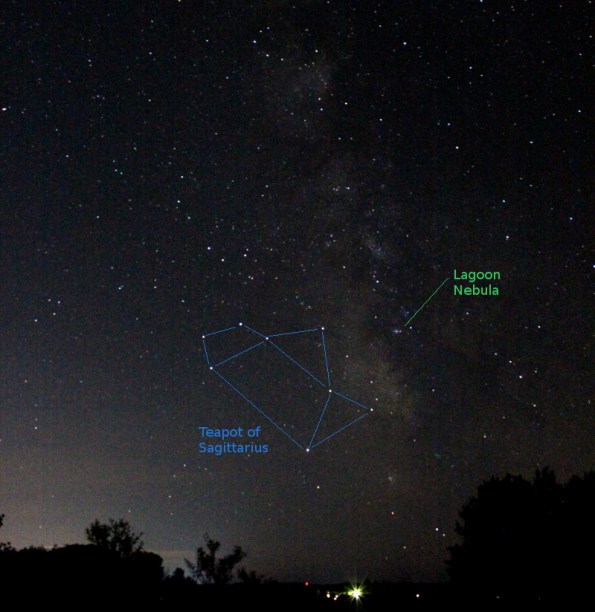
The Sagittarius Teapot showing the location of the Lagoon Nebula that is visible to the naked eye. Photo Credit Bob Moler.
Objects designated by the letter M are known as Messier objects, from a list made by Charles Messier who was an astronomer at the Paris Observatory at about the time of the American Revolution. Messier was interested in discovering comets, which when the first become visible are fuzzy blobs without tails. A comet makes itself known by moving against the stars. The objects on the list don’t move against the stars, being with the stars or beyond, which we call deep sky objects. So it’s a list of objects not to bother with, because they aren’t comets. Today we use his list or catalog of objects as some of the finest objects in the heavens.
 Bob Moler's Ephemeris Blog