Archive
02/27/2015 – Ephemeris – Previewing the month of March
Ephemeris for Friday, February 27th. The sun will rise at 7:24. It’ll be up for 11 hours and 3 minutes, setting at 6:27. The moon, 2 days past first quarter, will set at 4:08 tomorrow morning.
During March the increase in daylight hours are at its greatest, with Spring 3 weeks away. Daylight hours will increase from 11 hours and 9 minutes Sunday to 12 hours and 42 minutes on the 31st. Along with that the altitude of the sun at noon will increase from 38 degrees Sunday to 49 ½ degrees at month’s end. Local noon, by the way for Interlochen and Traverse City is about 12:50 p.m, which is mainly due to the fact that our standard time meridian happens to run through Philadelphia. That’s before daylight time starts in a bit more than a week. Then our time meridian will run by the eastern tip of Nova Scotia, so local noon, when the Sun is due south will occur at 1:50 p.m.
Times are for the Traverse City/Interlochen area of Michigan. They may be different for your location.
Addendum
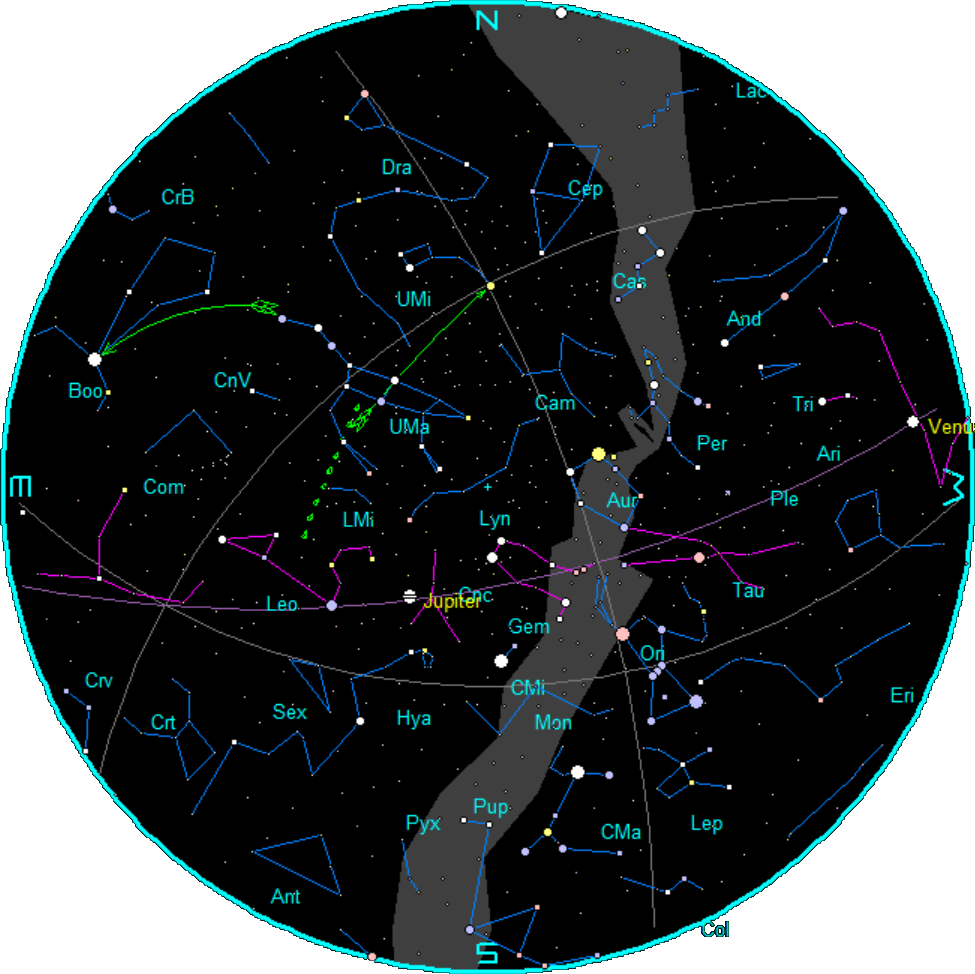
Star Chart for March 2015. Created using my LookingUp program.
The Moon is not plotted. The planets and stars are plotted for the 15th at 10 p.m. EDT. That is chart time.
Evening astronomical twilight ends at 8:07 p.m. EST on March 1st, increasing to 9:49 p.m. EDT on the 31st.
Morning astronomical twilight starts at 5:43 a.m. EST on March 1st, and decreasing to 5:45 a.m. EDT on the 31st. (Yes it is a decrease, thanks to the imposition of daylight time on March 8th)
Add a half hour to the chart time every week before the 15th and subtract and hour for every week after the 15th.
For a list of constellation names to go with the abbreviations click here.
The green pointer from the Big Dipper is:
- Pointer stars at the front of the bowl of the Big Dipper point to Polaris the North Star.
- Drill a hole in the bowl of the Big Dipper and the water will drip on the back of Leo the Lion.
- Follow the arc of the Big Dipper’s handle to Arcturus
Calendar of Planetary Events
Credit: Sky Events Calendar by Fred Espenak and Sumit Dutta (NASA’s GSFC)
To generate your own calendar go to http://eclipse.gsfc.nasa.gov/SKYCAL/SKYCAL.html
Times are Eastern Standard Time on a 24 hour clock. Some additions made to aid clarity.
Conjunctions like the Moon-Saturn: 2.4° S means Saturn will appear 2.4° south of the Moon.
| Mar | 01 | Su | Venus: 30.1° E | |
| 05 | Th | 02:35 | Moon Apogee: 406,400 km | |
| 05 | Th | 13:05 | Full Moon | |
| 07 | Sa | 16:04 | Moon Ascending Node | |
| 12 | Th | 04:25 | Moon-Saturn: 2.4° S | |
| 13 | Fr | 13:48 | Last Quarter | |
| 13 | Fr | 21:39 | Moon South Dec.: 18.3° S | |
| 19 | Th | 15:38 | Moon Perigee: 357,600 km | |
| 20 | Fr | 05:36 | New Moon | |
| 20 | Fr | 05:46 | Total Solar Eclipse | |
| 20 | Fr | 18:45 | Vernal Equinox | |
| 20 | Fr | 22:19 | Moon Descending Node | |
| 21 | Sa | 18:13 | Moon-Mars: 1° N | |
| 22 | Su | 15:51 | Moon-Venus: 2.9° N | |
| 25 | We | 02:55 | Moon-Aldebaran: 0.9° S | |
| 26 | Th | 10:29 | Moon North Dec.: 18.2° N | |
| 27 | Fr | 03:43 | First Quarter |
02/17/2015 – Ephemeris – There are no unicorns except in the heavens
Ephemeris for Fat Tuesday, Tuesday, February 17th. The sun will rise at 7:40. It’ll be up for 10 hours and 33 minutes, setting at 6:13. The moon, 1 day before new, will rise at 7:07 tomorrow morning.
Among all the constellations in the sky of animals real and mythical, there is also a unicorn. It’s called Monoceros, and inhabits the southeastern sky at 9 p.m. bounded by Orion on the right, Canis Major, the great dog below and Canis Minor, the little dog to the left. Unfortunately for observers without optical aid Monoceros, though large, is devoid of any but the faintest stars. Maybe that’s why no one sees unicorns anymore. It has many faint stars because the Milky Way runs through it. To the telescope it is a feast of faint nebulae or clouds of gas and dust, the birth place of stars, including the red rose of the Rosette Nebula, and the strange and tiny Hubble’s Variable Nebula. It contains no bright stars, but it has wonders for the telescope.
Times are for the Traverse City/Interlochen area of Michigan. They may be different for your location.
Addendum
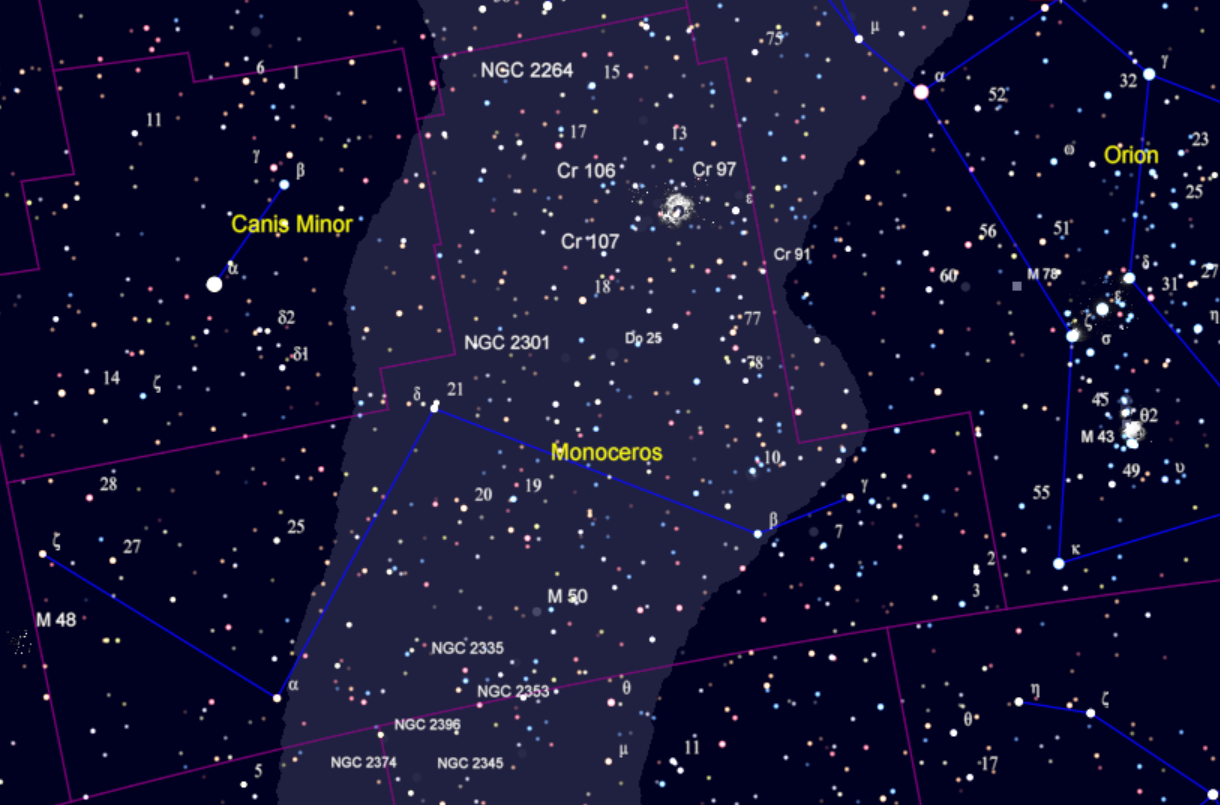
The constellation Monoceros the unicorn. Created using Cartes du Ciel (Sky Charts). Click to enlarge.
Can you see a unicorn here? Me neither.
One thing I didn’t mention in the program is the star labeled β. It is a triple star in telescopes.
Universe Today has a great post on Monoceros by Tammy Plotner, who by sad coincidence passed away a few days ago.
02/09/2015 – Ephemeris – How to find the constellation of Cancer the crab
Ephemeris for Monday, February 9th. The sun will rise at 7:52. It’ll be up for 10 hours and 10 minutes, setting at 6:02. The moon, 2 days before last quarter, will rise at 11:51 this evening.
A small, dim member of the zodiac is Cancer the crab. It’s dim stars make to my eyes and upside down letter Y. It lies between Gemini to the upper right and Leo to the lower left, especially as it is still rising in the southeastern sky at 9 p.m. Right now the bright planet Jupiter is about half way between it and Leo. It does have a relatively bright fuzzy object to the naked eye amongst it’s stars, positioned roughly in the center. It was discovered as a fuzzy spot before the invention of the telescope and called Praesepe, the manger. With the invention of the telescope it was discovered to be a loose group of stars in an open or galactic star cluster. This easy binocular object is best known now as the Beehive cluster or M44.
Times are for the Traverse City/Interlochen area of Michigan. They may be different for your location.
Addendum
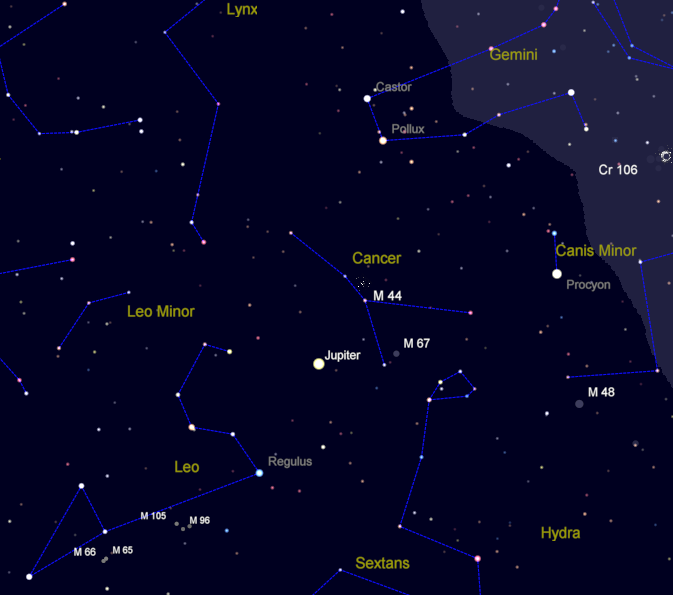
The zodiacal constellation Cancer with Jupiter nearby in the southeast at 9 p.m. February 9, 2015. Created using Cartes du Ceil (Sky Charts).
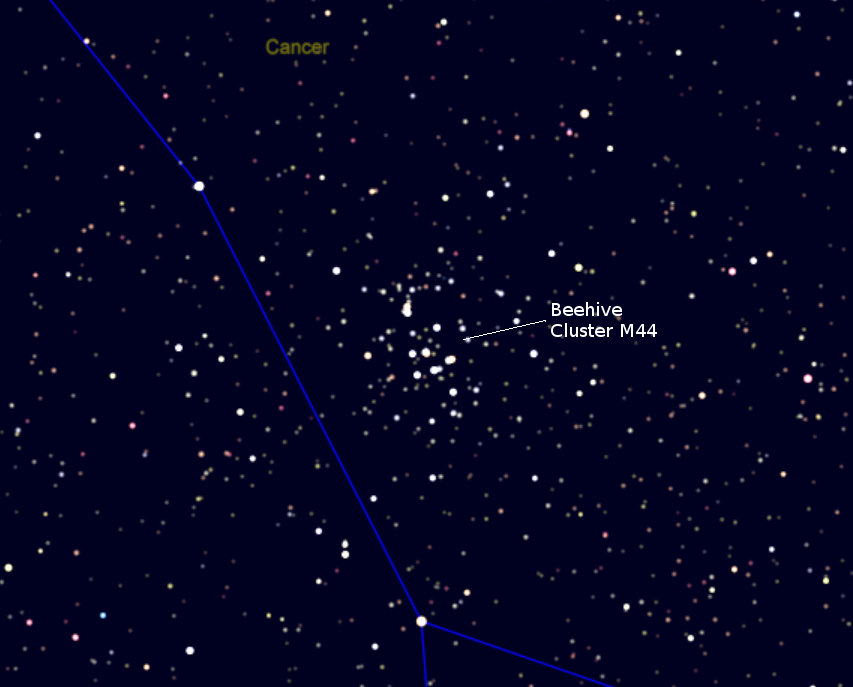
The Beehive star cluster, M44. Its ancient name was the Praesepe or manger when glimpsed by the naked eye. Created using Cartes du Ciel (Sky Charts).
M44 is a young star cluster, perhaps 600-700 million years old and only 577 light years away. It is an open or galactic star cluster. It only appears outside the band of the Milky Way because it’s close to us. The same cannot be said for M67.
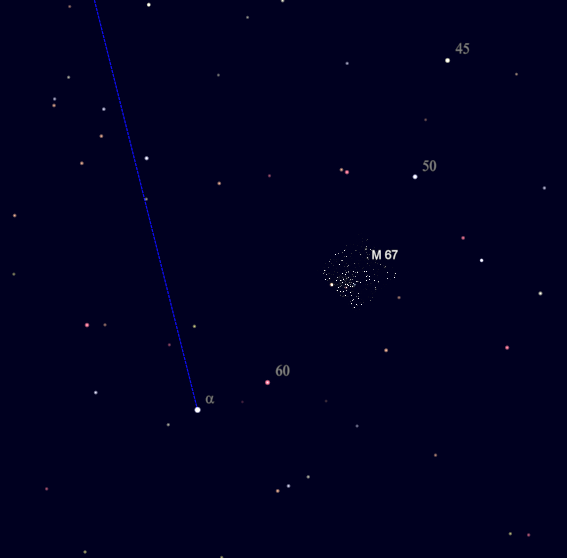
Finder Chart for open cluster M67, found just west of α Cancri, or Acubens. Created using Cartes du Ceil (Sky Charts).
M67 is a fuzzy spot in binoculars but really shows its beauty in telescopes. M67 is pretty old for an open star cluster, one of the oldest known, at about the age of the Sun or a bit younger. It’s nearly 3,000 light years away, so it really is out of the plane of the galaxy.
01/16/2015 – Ephemeris – Orion’s greater hunting dog: Canis Major
Ephemeris for Friday, January 16th. The sun will rise at 8:16. It’ll be up for 9 hours and 13 minutes, setting at 5:29. The moon, 3 days past last quarter, will rise at 5:09 tomorrow morning.
The great winter constellation or star group Orion the Hunter, is located in the south-southeastern sky at 9 p.m. His elongated rectangle of a torso is almost vertical. In the center of the rectangle are three stars in a line that make his belt. As a hunter, especially one of old, he has two hunting dogs. The larger, Canis Major can be found by following the three belt stars of Orion down and to the left. There lies the brilliant star called Sirius, also known as the Dog Star. It’s in the heart of a stick figure dog low in the southeast facing Orion that appears to be begging. I’ll have more to say about Sirius on Monday, but there’s a fine star cluster, caller M41, at the 5 o’clock position from Sirius easily visible in binoculars or a small telescope.
Times are for the Traverse City/Interlochen area of Michigan. They may be different for your location.
Addendum
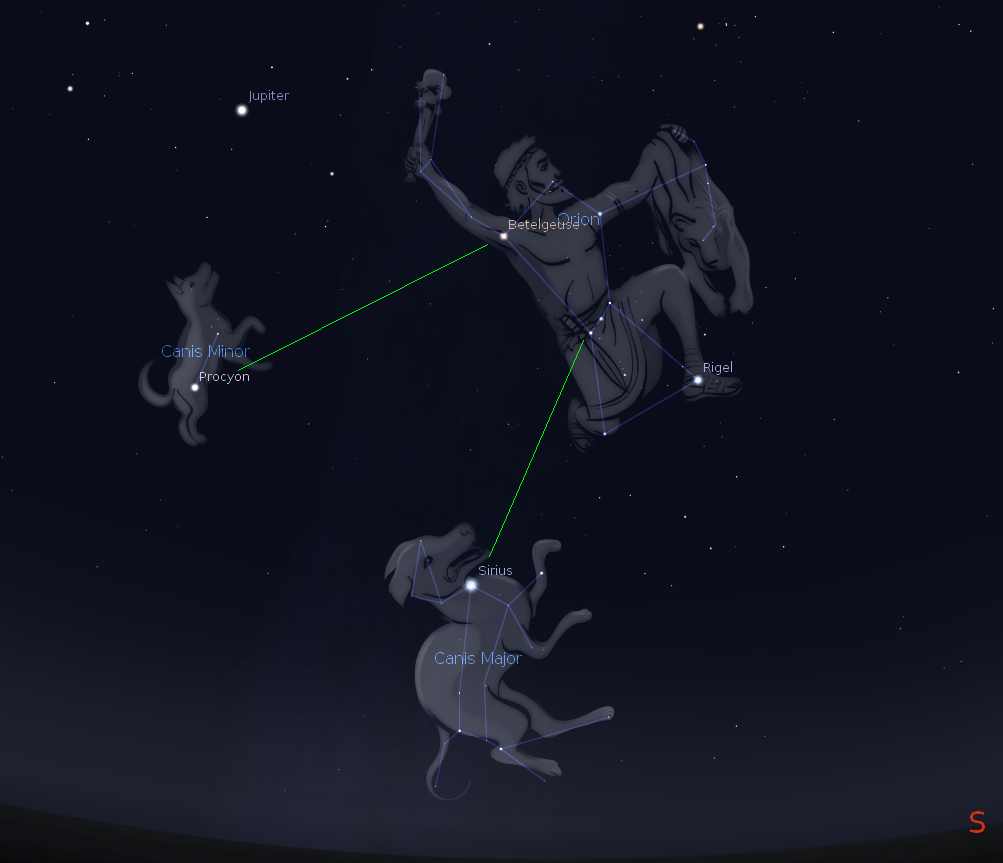
Orion and his hunting dogs with pointers as seen at 9 p.m. in the second half of January. Created using Stellarium.
01/12/2015 – Ephemeris – The world’s faorite constellation: Orion
Ephemeris for Monday, January 12th. The sun will rise at 8:18. It’ll be up for 9 hours and 6 minutes, setting at 5:24. The moon, 1 day before last quarter, will rise at 1:02 tomorrow morning.
For people the world over who look up and recognize the brighter constellations Orion is perhaps the odd on favorite. The Big Dipper, a favorite in the northern hemisphere, cannot be easily seen south of the equator. The Southern Cross cannot be easily be seen north of the equator. Orion, or parts of him can be seen from pole to pole because he straddles the equator of the sky. It has 7 bright stars like the Big Dipper, but those seven are brighter than those in the big Dipper. In the early evening Orion is seen is the southeast. The three stars of his belt now tipped diagonally from upper right to lower left. They are in the center of a left leaning rectangle of stars with bright red Betelgeuse to the upper left and bright blue-white Rigel to the lower right.
Times are for the Traverse City/Interlochen area of Michigan. They may be different for your location.
Addendum
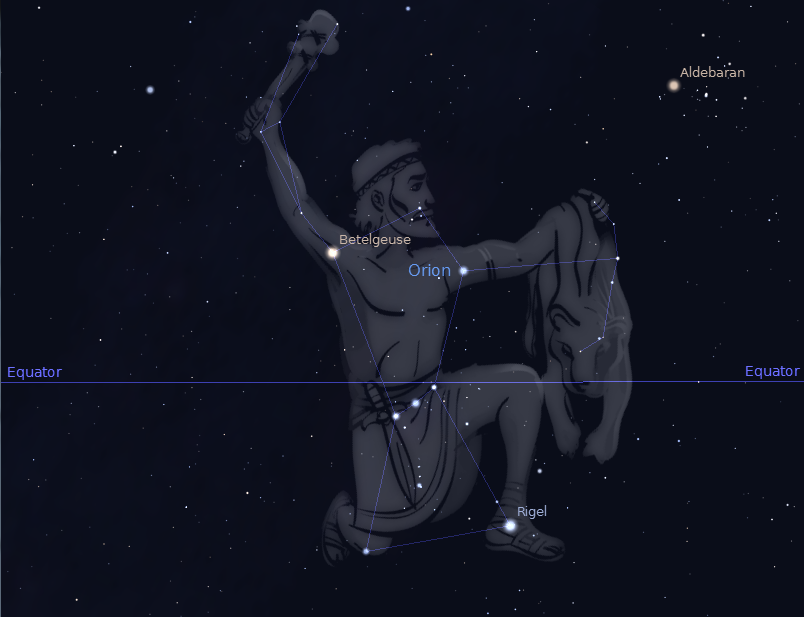
Orion from mid latitudes north of the equator. Orion would be upside down if viewed south of the equator. Created using Stellarium.
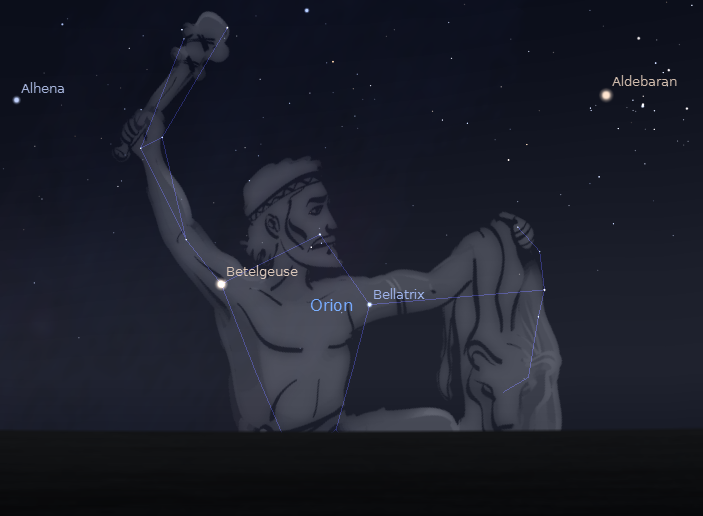
Orion from near the north pole. Created using Stellarium.
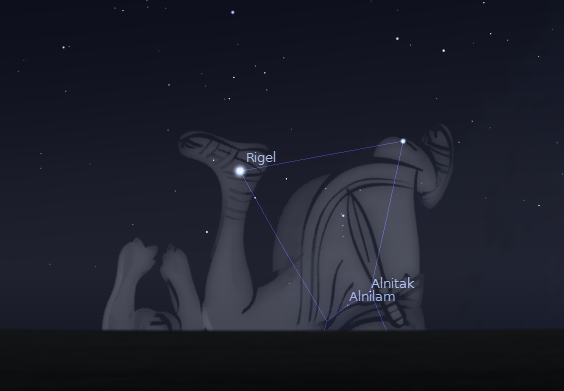
Orion from near the south pole. Created using Stellarium.
12/25/2014 – Ephemeris – My recollections of spotting the Southern Cross for the first time.
Merry Christmas. This is Ephemeris for Christmas Day, Thursday, December 25th. The sun will rise at 8:17. It’ll be up for 8 hours and 49 minutes, setting at 5:07. The moon, 3 days before first quarter, will set at 9:50 this evening.
My one and only sighting of the constellation the Southern Cross came two and a half years ago from a cruise ship traveling between the Hawaiian island of Maui and Hilo on the Big Island. I had plotted it out before the trip. Our ship would be traveling in a south-southeasterly direction and at 3 a.m., the Southern Cross would be low above the southern horizon from our latitude which I surmised would be about 20 degrees north. The southern cross would be visible from the bow of the ship. The only really dark location to view it was on Deck 14 with an unobstructed view with some subdued lights behind me. I easily found it, and verified it with the fifth star of the cross. Nearby was Alpha Centauri the closest star to the sun.
Times are for the Traverse City/Interlochen area of Michigan. They may be different for your location.
Addendum

The approximate sky that I saw from the bow of the ship at 3:15 a.m. HST February 14, 2012. The moon was a slight gibbous phase. Recreated using Stellarium.
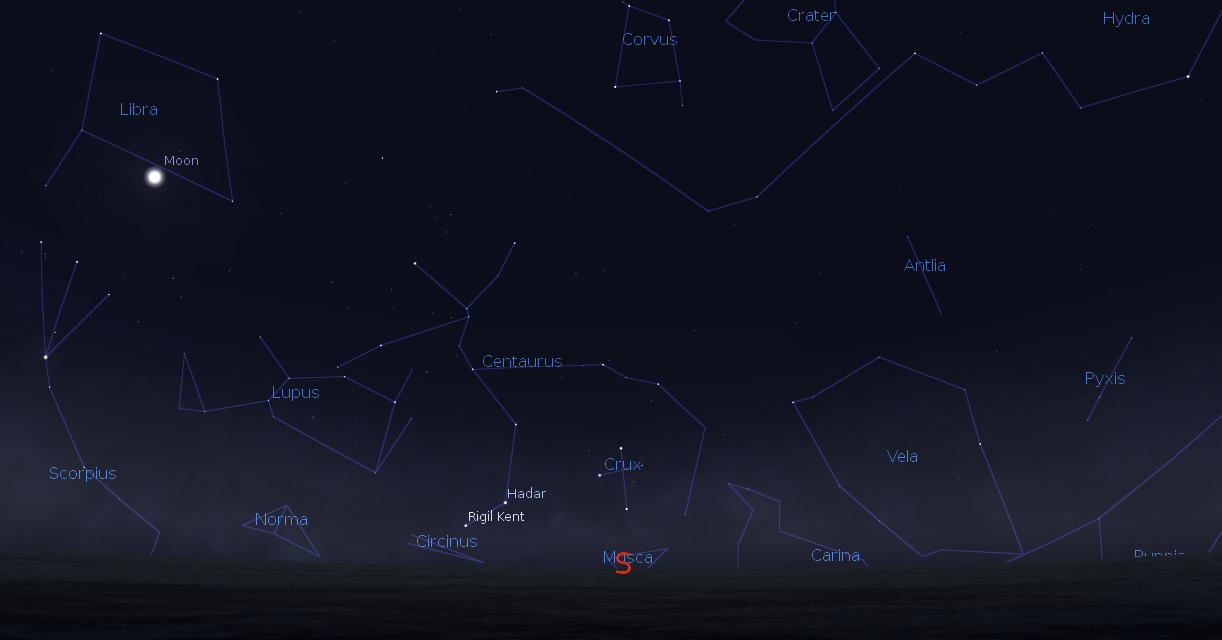
The approximate sky that I saw from the bow of the ship at 3:15 a.m. HST February 14, 2012, annotated. The moon was a slight gibbous phase. Recreated using Stellarium.
Note that the star named Rigil Kent is truncated. It’s Rigil Kentaurus, better known by its catalog name Alpha Centauri. The fifth star of the cross, my check star, is on the right side of the cross, just below the crosspiece. The Southern Cross’s real name is Crux, which simply means cross. The Northern Cross is not an official constellation. It’s part of Cygnus the swan.
I’ve heard folks say the Beta Centauri is Alpha Centauri’s companion star. That is not true. Beta Centauri is Hadar, seen near Alpha in the sky, but is much farther away. There are three stars in the Alpha Centauri system: Alpha Centauri A, Alpha Centauri B, and Proxima Centauri, a telescopic red dwarf, a bit away from the other two. Alpha Centauri A & B are a wide double, visible in a telescope. I saw and photographed them when on Key Largo in April 1986 for Halley’s Comet’s closest approach to the Earth. Note it wasn’t all that close, some 40 million miles, and it had a tail disconnection that week. Bummer.
12/23/2014 – Ephemeris – Is the constellation of Cetus a whale or a sea monster?
Ephemeris for Tuesday, December 23rd. The sun will rise at 8:17. It’ll be up for 8 hours and 49 minutes, setting at 5:06. The moon, 2 days past new, will set at 7:25 this evening.
The identity of the constellation Cetus is a bit mixed up. Officially it’s a whale, but in the story of the constellations above it, (Cassiopeia, Pegasus, Andromeda, Perseus and Cepheus) it is the monster sent to ravage the Ethiopian coast, and to whom the sacrifice of Andromeda was to stop. Either can be seen in the stars in the south at 8 p.m. It is a large constellation of dim stars below and left of the Great Square of Pegasus and Pisces. The whale can be seen diving, its tail of 5 stars in a squished pentagon, is seen to the upper left. If you see the stars differently and put the head of the sea monster where the tail of whale is the dreaded Cetus of the story appears. One of its stars is variable and will not be visible without a telescope, it’s Mira, the wonderful.
Times are for the Traverse City/Interlochen area of Michigan. They may be different for your location.
Addendum
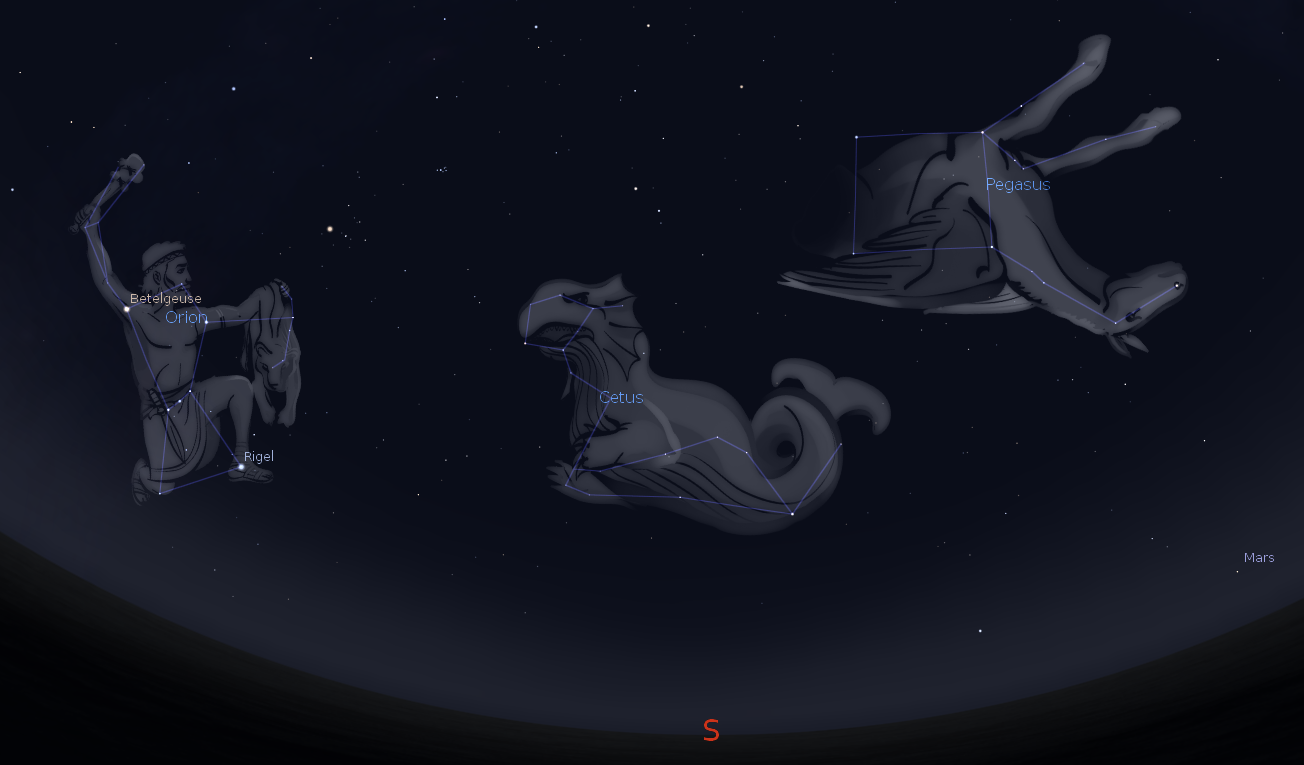
Cetus with Pegasus and Orion displaying mythological images at 8 p.m. on December 23, 2014. Created using Stellarium.
12/18/2014 – Ephemeris – Capella’s kids
Ephemeris for Thursday, December 18th. The sun will rise at 8:14. It’ll be up for 8 hours and 49 minutes, setting at 5:03. The moon, 3 days before new, will rise at 5:23 tomorrow morning.
Tuesday I talked about the bright star Capella in the constellation Auriga the charioteer, the brightest star in the eastern sky until Jupiter rises around 9:30. I mentioned a slim triangle of stars called the Kids, offspring of the mama goat Capella. The star at the tip of that slim triangle is designated by the Greek letter epsilon and so in known as Epsilon Aurigae. It was discovered to be variable in brightness in 1821. It turns out to be an eclipsing binary, where stars eclipse each other. Only the period between eclipses is 27 years, and the eclipses last about 2 years. Typical eclipsing binary stars have periods of days and the eclipses last hours. The eclipsing star has a large debris ring around it that’s also eclipsing the other star.
Times are for the Traverse City/Interlochen area of Michigan. They may be different for your location.
Addendum
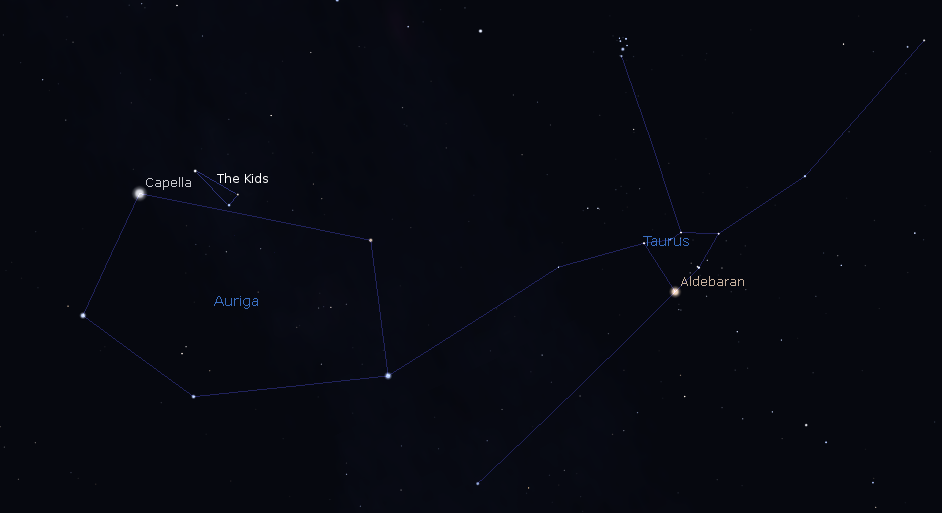
Capella and her kids. at 9 p.m. December 18, 2014. Created using Stellarium.
12/16/2014 – Ephemeris – Capella, the winter star that won’t set
Ephemeris for Tuesday, December 16th. The Sun will rise at 8:13. It’ll be up for 8 hours and 49 minutes, setting at 5:03. The moon, 2 days past last quarter, will rise at 3:17 tomorrow morning.
The bright star Capella is the only winter star I mention in the summer that still can be seen in the evening. That’s because it never sets for observers north of Ludington. It’s a constant reminder that winter is always just around the corner. Well this week it really is. It’s the brightest star in the eastern sky at 8 p.m. and for some time thereafter until Jupiter rises. Capella is in the constellation of Auriga the charioteer, a pentagonal constellation to my eyes. Capella means, essentially mama goat. Her three kids are the stars in a thin triangle to her right. Capella is actually a very close binary star, where the stars are too close to be optically separated. Breaking up the light with a spectroscope reveals its true nature.
Times are for the Traverse City/Interlochen area of Michigan. They may be different for your location.
Addendum
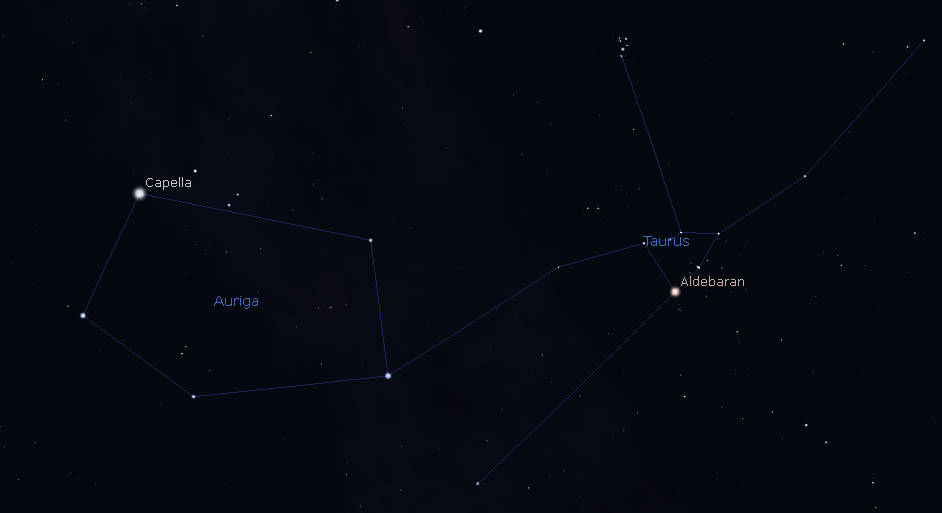
Capella in the constellation of Auriga at 9 p.m. on December 16, 2014. Created using Stellarium.
12/15/2014 – Ephemeris – How to find Orion through the evening
Ephemeris for Monday, December 15th. The sun will rise at 8:12. It’ll be up for 8 hours and 50 minutes, setting at 5:02. The moon, 1 day past last quarter, will rise at 2:15 tomorrow morning.
At 7 p.m. tonight the great central constellation of winter Orion is struggling to rise, with the top half of him in the eastern sky. By 9 p.m. he’s whole and low in the east-southeast. By midnight he has taken his rightful place as the central winter constellation. In the evening now his distinctive belt of three stars in a straight line, by which most folks can find him, is more or less vertical in the sky. His brightest stars are Betelgeuse a red star to the left of the belt and blue-white Rigel to the right. When Orion’s the highest in the south we’ll explore the wonders within this constellation, the most famous constellation world over. Parts of it can be seen at the north and south poles of the Earth. The Big Dipper, which isn’t a real constellation, doesn’t hold a candle to it.
Times are for the Traverse City/Interlochen area of Michigan. They may be different for your location.
Addendum
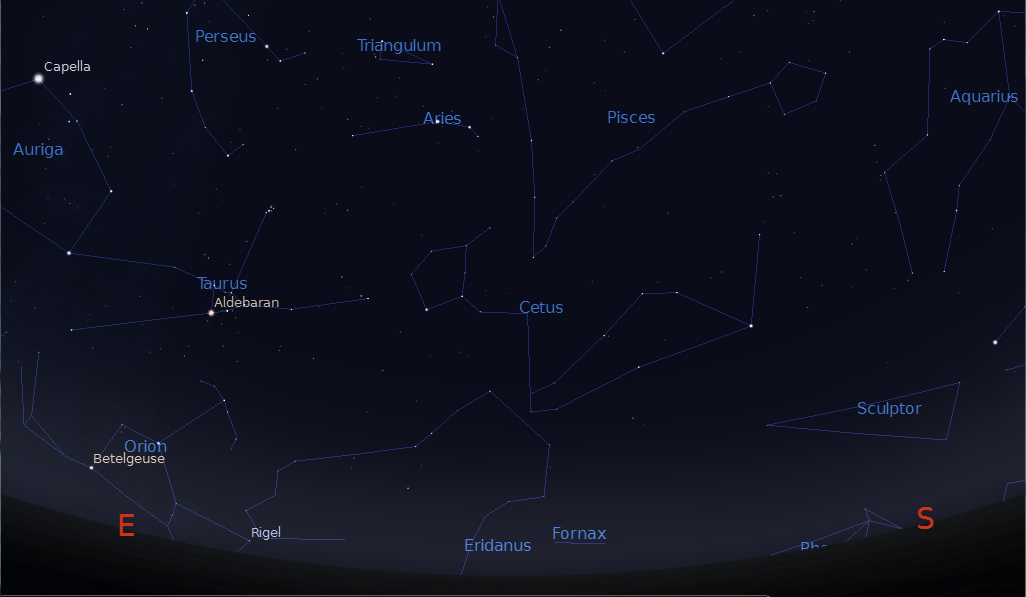
Orion rising at 7 p.m. December 15, 2014. Created using Stellarium.
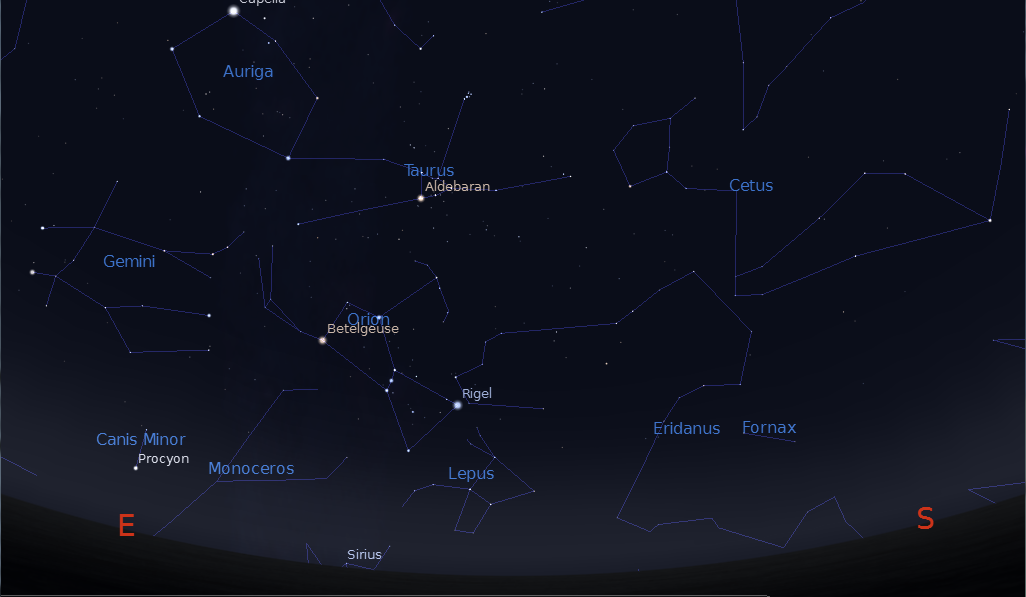
Orion rising higher at 9 p.m. December 15, 2014. Created using Stellarium.
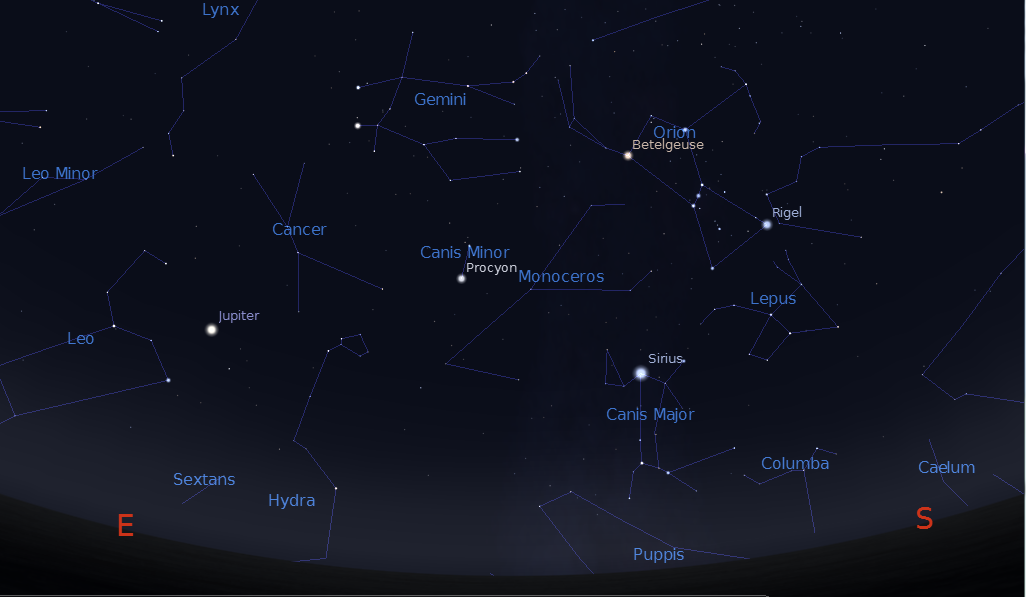
Orion close to the meridian at 12 midnight, December 16, 2014. There is distortion in this projection. Orion is standing straighter in the real sky than shown here. Created using Stellarium.
 Bob Moler's Ephemeris Blog