Archive
11/28/2014 – Ephemeris – Not quite a star cluster, but pretty cool nonetheless
Ephemeris for Friday, November 28th. The sun will rise at 7:55. It’ll be up for 9 hours and 9 minutes, setting at 5:04. The moon, 1 day before first quarter, will set at 12:01 tomorrow morning.
When is a star cluster not a star cluster? When it’s an association. That is when it has begun to dissipate because the gravitational force of the group cannot hold it together. The central stars of the Big Dipper belong to The Ursa Major Association. Below the W shaped constellation of Cassiopeia in the northeast at 9 or 10 p.m. Is the constellation of Perseus (Per-seus or Pers-e-us) as it is usually pronounced. Its brightest star is Mirfak with a designation of Alpha Persei. There are some stars there to the naked eye, but with binoculars there are a great many stars just below naked eye visibility. This is called the Alpha Persei association. It is perfect to spot with binoculars, but way too wide-spread for a telescope.
Times are for the Traverse City/Interlochen area of Michigan. They may be different for your location.
Addendum
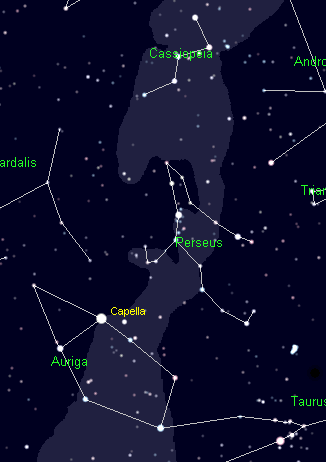
The Constellations Cassiopeia, Perseus and Auriga. Cartes du Ciel
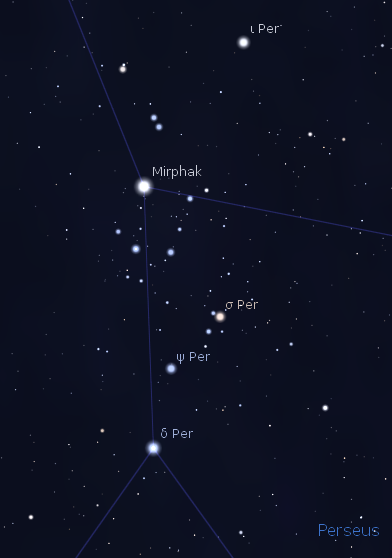
Alpha Persei Association. Created using Stellarium.
11/25/2014 – Ephemeris – Cassiopeia the constellation
Ephemeris for Tuesday, November 25th. The sun will rise at 7:52. It’ll be up for 9 hours and 14 minutes, setting at 5:06. The moon, 3 days past new, will set at 8:33 this evening.
Nearing the zenith at 8 p.m. is the W shaped constellation of Cassiopeia the queen. It’s actually just north of the zenith and since we’re half way from the equator and the north pole at near 45 degrees north, Cassiopeia will not set. Cassiopeia we say is circumpolar. Cassiopeia will rise is set if you’re in Florida. In Antarctica Cassiopeia is a just rumor, just as the Southern Cross is to us in Michigan since it never rises. Cassiopeia lies against the Milky Way, so there are a lot of star clusters in it. Unfortunately they can be seen only in telescopes. In 1572 the last of the pre-telescopic astronomers Tycho Brahe discovered a bright star that suddenly appeared. His discovery broke open the Aristotelian belief that the heavens were changeless.
Times and views are for the Traverse City/Interlochen area of Michigan. They may be different for your location.
Addendum
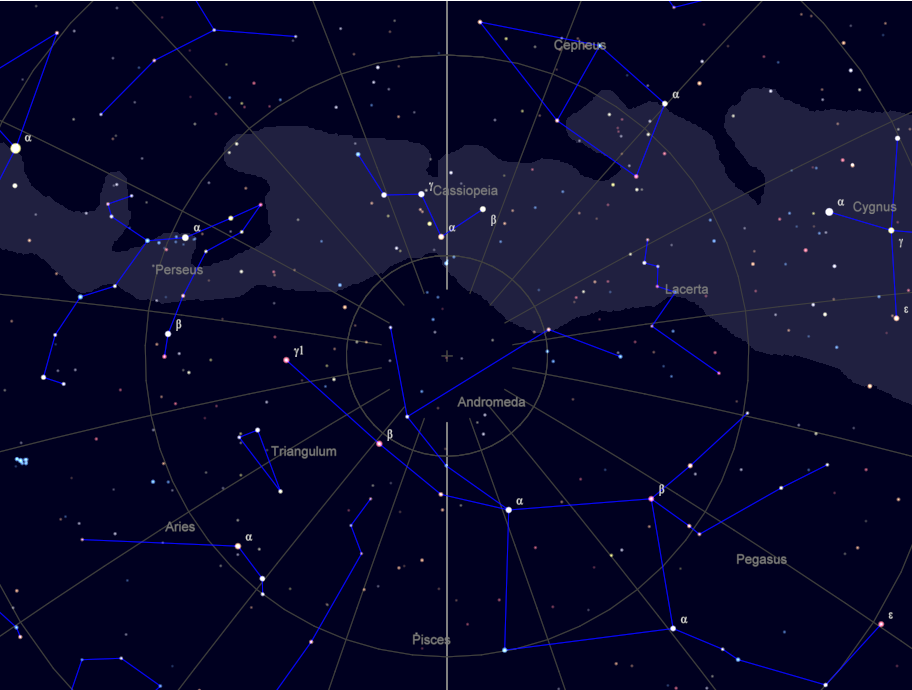
Looking straight up at the zenith, facing the south, Cassiopeia is just north of the zenith. The lines are radiating from the zenith. where the + sign is. Created using Cartes du Ciel.
My neck hurts just making this chart.
11/20/2014 – Ephemeris – Constellation rotation from rise to set
Ephemeris for Thursday, November 20th. The sun will rise at 7:45. It’ll be up for 9 hours and 24 minutes, setting at 5:10. The moon, 2 days before new, will rise at 6:38 tomorrow morning.
At 9 p.m., if it’s clear tonight look to the east to see the bright winter constellation Orion the hunter mostly risen over the eastern horizon as Robert Frost told in his poem Star-Splitter. Orion’s throwing a leg up over the horizon, climbing into the sky. The three stars of Orion’s belt are nearly vertical as the mighty hunter rises. When in the spring he sets those stars will be horizontal. The same is true on the two namesake stars of the twins of Gemini Castor and Pollux to Orion’s left rising in then east-northeast. They rise vertically aligned and set horizontally. It’s due to our latitude and the fact that these stars are near the equator of the sky. At the poles the stars don’t change attitude, and don’t rise or set. Here they flip about 90 degrees, and at the equator they do a 180. Interesting.
Times are for the Traverse City/Interlochen area of Michigan. They may be different for your location.
Addendum
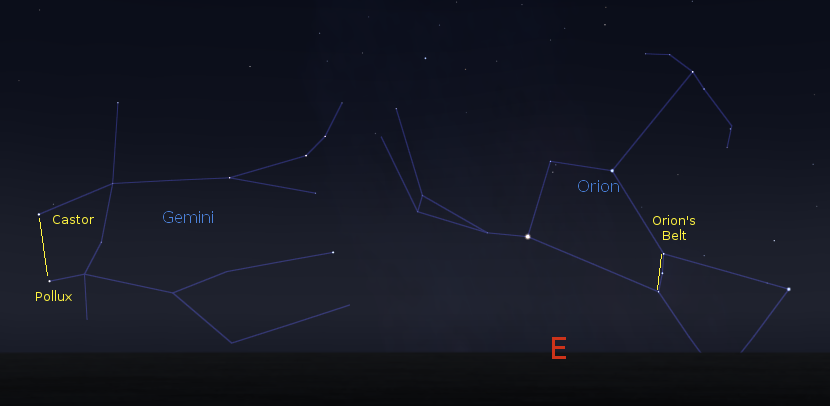
Orion rising at 9 p.m. on November 20, 2014. Note that Orion’s Belt stars and Gemini’s namesake stars are nearly vertically aligned. Created using Stellarium.
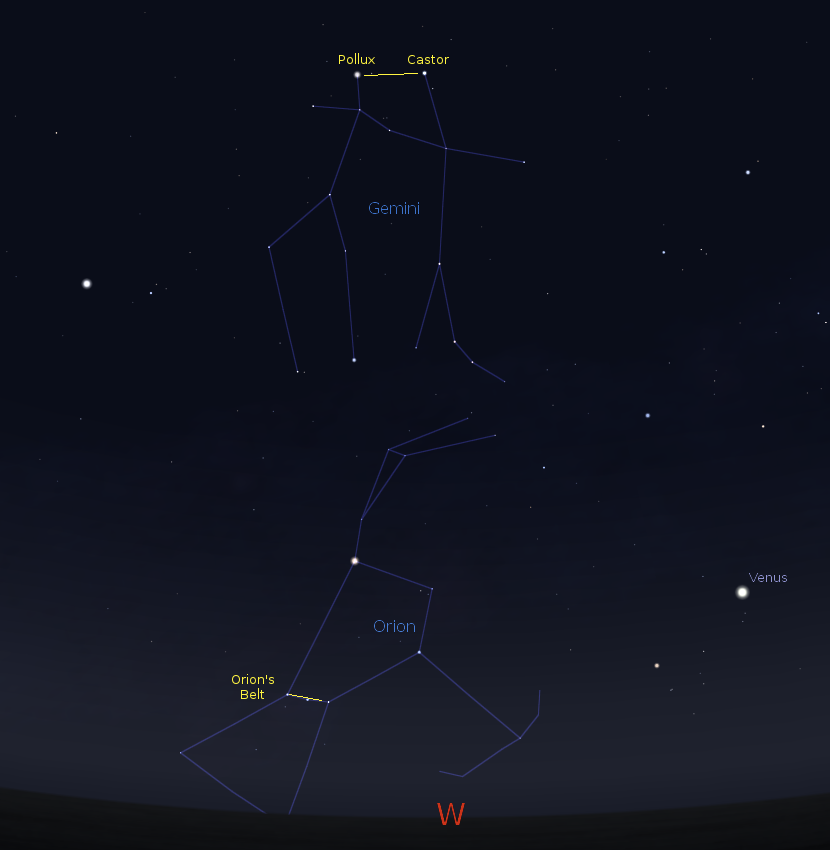
Orion setting near the end of twilight in April 2015. Note that Orion’s Belt stars and Gemini’s namesake stars are now nearly horizontally aligned. Created using Stellarium.
11/11/14 – Ephemeris – Something fishy in the stars
Ephemeris for Veteran’s Day, Tuesday, November 11th. The sun will rise at 7:33. It’ll be up for 9 hours and 45 minutes, setting at 5:18. The moon, 3 days before last quarter, will rise at 9:41 this evening.
High in the south at 9 p.m. are the four bright stars of the Great Square of Pegasus, the upside down flying horse. Lying along the left and bottom sides of the great square is the constellation of Pisces the fish, one of the 12 constellations of the Zodiac that lie along the path of the sun, moon and planets. Even though Pisces is called the fish, the fish themselves are not seen in the stars. What can be traced in the stars is the rope, that’s tied to their tails, anchored at the extreme southeastern part of the constellation far below and left of the lower left corner of the Great Square. The right end of Pisces is the asterism, or informal constellation, of the Circlet. It’s the loop of 5 stars, the rope around the tail of one of the two fish.
Times are for the Traverse City/Interlochen area of Michigan. They may be different for your location.
Addendum
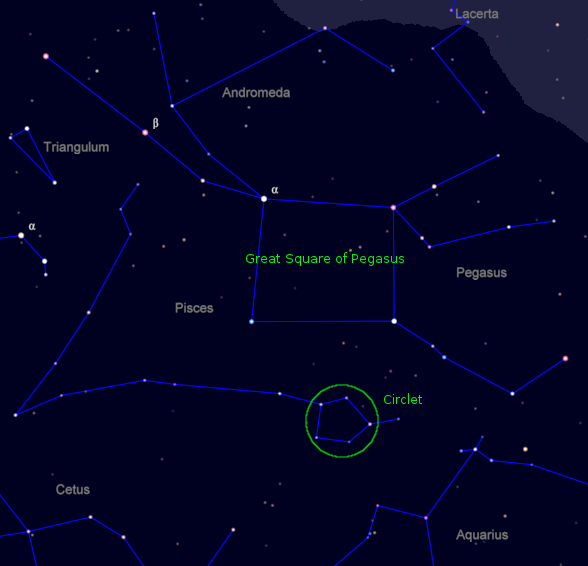
Pisces below the Great Square of Pegasus in the south at 9 p.m.
11/10/2014 – Ephemeris – Where is the constellation of Aquarius the water bearer
Ephemeris for Monday, November 10th. The sun will rise at 7:32. It’ll be up for 9 hours and 47 minutes, setting at 5:19. The moon, half way from full to last quarter, will rise at 8:45 this evening.
One of the constellations of the zodiac is in the southern sky at 8 in the evening. It’s the constellation of Aquarius the water bearer. The image that is supposed to be depicted in the stars is that of a hapless fellow spilling a stone jar of water across the sky. Aquarius is fairly hard to spot because it is made of faint stars. One part of Aquarius is easy to spot, the Water Jar, an asterism or informal constellation. It’s a distinctive small nearly equilateral triangle of stars with another star in the center. Stars extending to the right from the water jar are that stream of water in some depictions. The body of Aquarius is below, a misshapen balloon of stars that is seen above the bright star Fomalhaut, low in the south.
Times are for the Traverse City/Interlochen area of Michigan. They may be different for your location.
Addendum
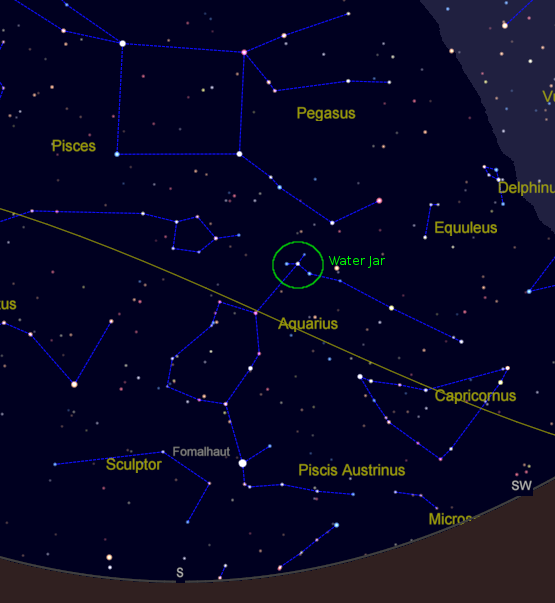
Aquarius highlighting the Water Jar. Created using Stellarium.
10/31/2014 – Ephemeris – The spookiest star
Ephemeris for Halloween, Friday, October 31st. The sun will rise at 8:18. It’ll be up for 10 hours and 13 minutes, setting at 6:32. The moon, 1 day past first quarter, will set at 1:59 tomorrow morning.
Not all the ghosts and goblins out Sunday will be children. One will be out every night, because it’s a star. Its name is Algol, from the Arabic for Ghoul Star or Demon Star. The Chinese had a name for it that meant “piled up corpses”. It’s the second brightest star in the constellation Perseus the hero, rising in the northeast this evening. The star is located where artists have drawn the severed head of Medusa, whom he had slain. Medusa was so ugly that she turned all who gazed upon her to stone. Algol is her still glittering eye. Astronomers finally found out what was wrong with Algol. It does a slow 6 hour wink every two days 21 hours, because it is two stars that eclipse each other. Her next wink will be 10 p.m. Sunday night.
Times are for the Traverse City/Interlochen area of Michigan. They may be different for your location.
Addendum
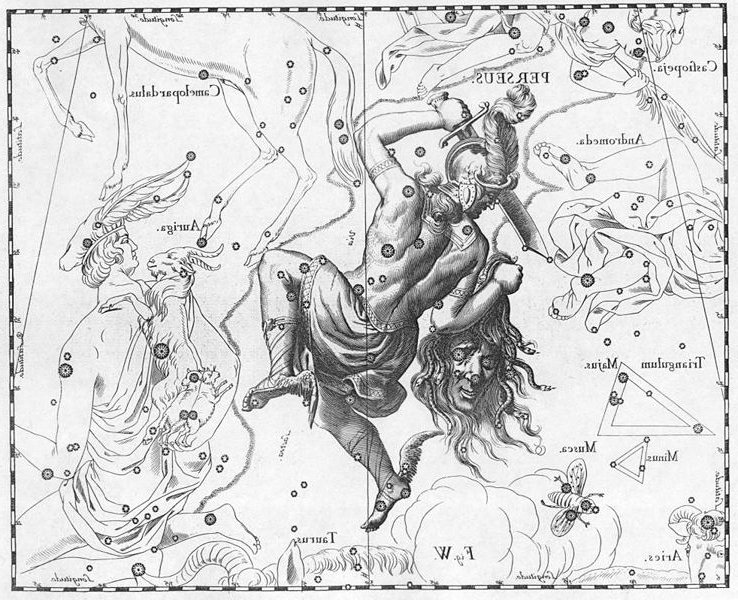
Perseus and the head of Medusa from the 1690 Uranographia by Johannes Hevelius. Image found with the article on Algol in Wikipedia.
Celestial globes of the day showed the celestial sphere from the outside, so the constellations appeared reversed. The star atlases of the day kept the trend. I reversed the image to correspond with the actual sky.
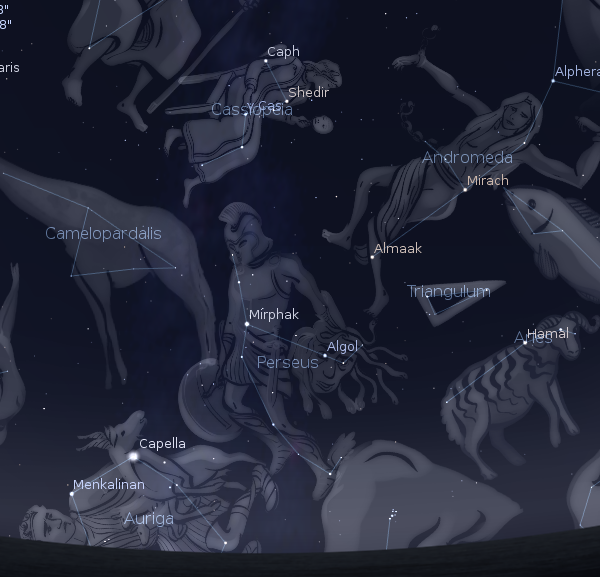
Algol at 7:30 p.m. on Halloween, in a modern portrayal. Created using Stellarium.
Update
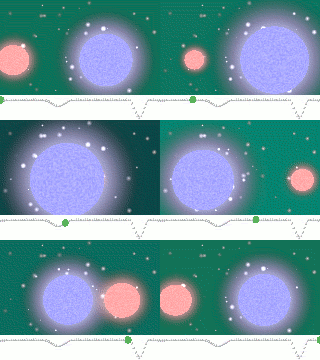
Animation of an eclipsing binary star like Algol. Credit: Wikimedia Commons. H/T EarthSky
Here’s a link to EarthSky’s post on Algol.
10/27/2014 – Ephemeris – The Pleiades in Greek and Native American mythology
Ephemeris for Monday, October 27th. The sun will rise at 8:13. It’ll be up for 10 hours and 25 minutes, setting at 6:38. The moon, 3 days before first quarter, will set at 9:38 this evening.
Visible low in the east at 10 in the evening sky can be spotted a small group of stars. It’s called the Pleiades or Seven Sisters. The Pleiades are really spectacular when seen in binoculars. It is remarkable that both the Greeks and the American Plains Indians saw this group as female stars fleeing from danger. In the former case they were fleeing the constellation Orion the giant hunter of the winter sky who will soon rise over the eastern horizon, and in the latter case a giant bear. Legend has it that the maidens fled to the top of Devils Tower in Wyoming. It’s said that the claw marks of this bear are seen in the walls of the tower. The maidens were then spirited from the top of the tower to the heavens, where we see them today. Whichever story you like the Pleiades is worth searching for.
Times are for the Traverse City/Interlochen area of Michigan. They may be different for your location.
Addendum
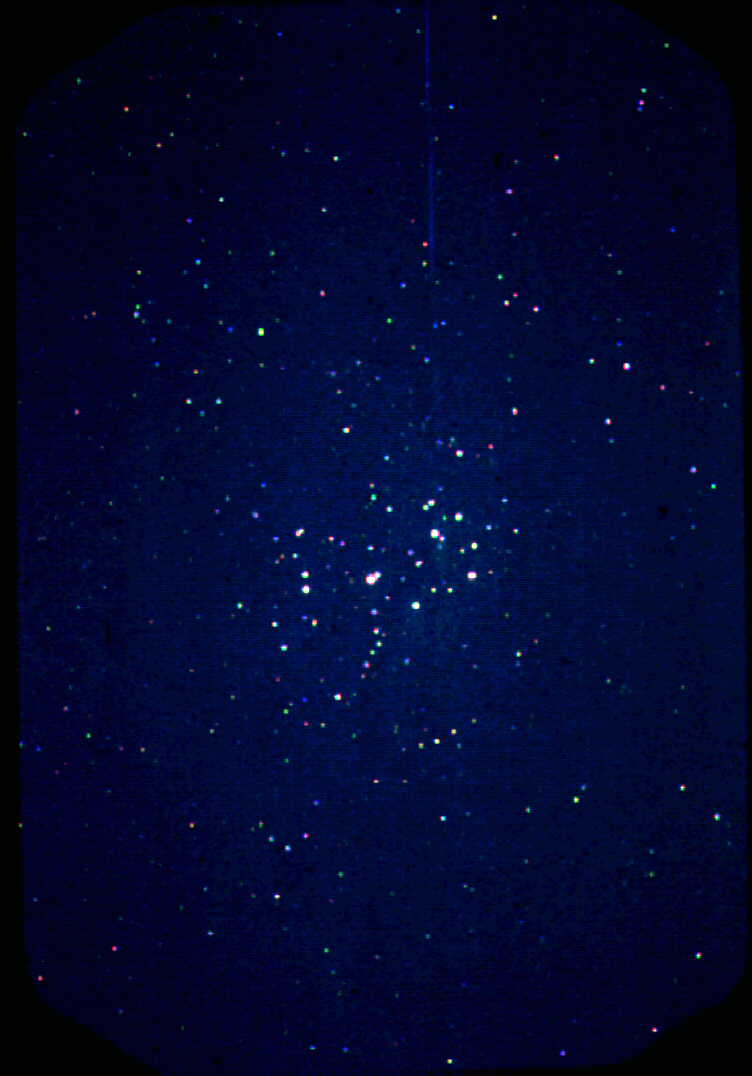
The Pleiades, about what you’d see in binoculars.
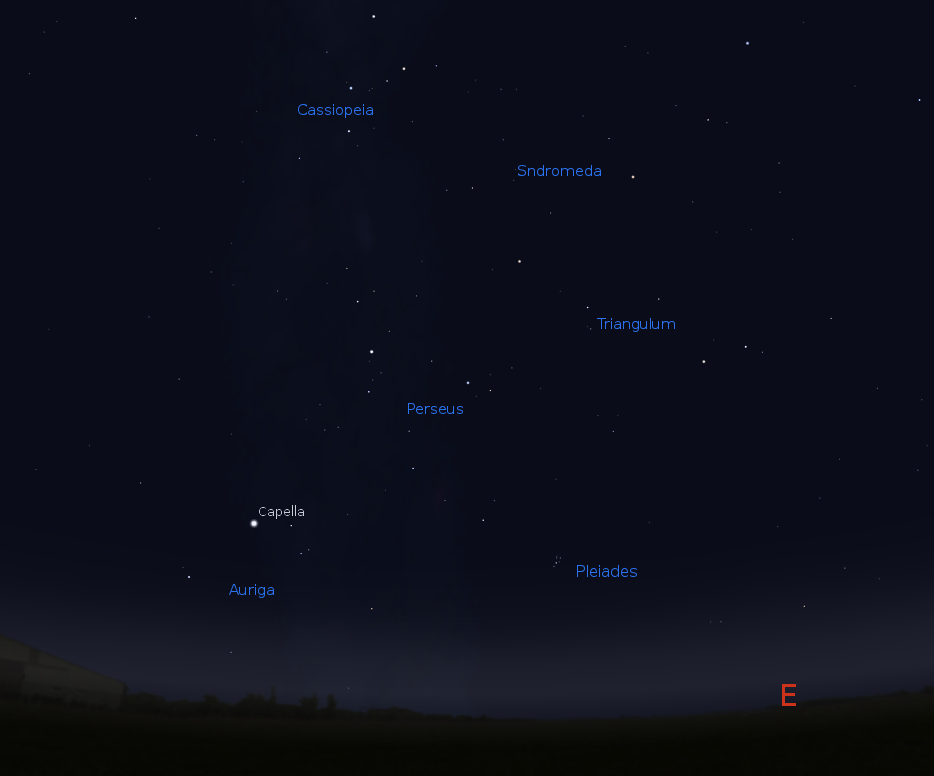
Looking to the east northeast at the Pleiades: 9 p.m. on October 27th. Created using Stellarium,
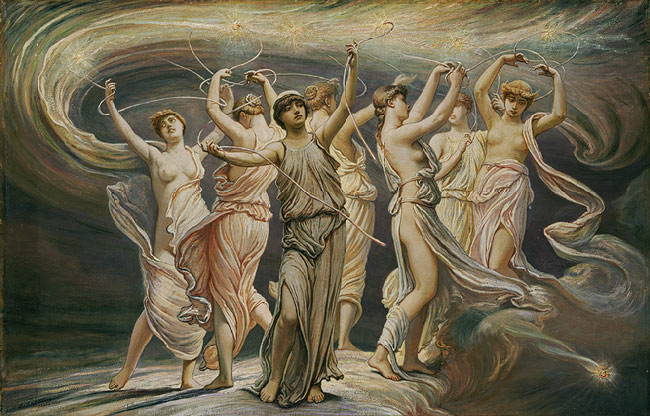
The Greek Pleiades a painting by Elihu Vedder in the Metropolitan Museum of Art, New York City. Public Domain.

Legend of Devils Tower Credit: Indian Country Today Media Network
This is the illustration from http://indiancountrytodaymedianetwork.com/article/the-legend-of-devils-tower-3273
09/30/2014 – Ephemeris – Previewing October skies and events
Ephemeris for Tuesday, September 30th. The sun will rise at 7:39. It’ll be up for 11 hours and 45 minutes, setting at 7:24. The moon, 1 day before first quarter, will set at 11:43 this evening.
Let’s look at the skies for the month of October. The sun will still be moving south rapidly. Daylight hours in the Interlochen/Traverse City area and will drop from 11 hours and 42 minutes tomorrow to 10 hours, 14 minutes at month’s end. The altitude of the sun above the southern horizon at local noon will be 42 degrees tomorrow in the Interlochen area, and will descend to 31 degrees on Halloween. This month will see two eclipses visible from our area plus a close encounter that a comet will have near Mars and our assets on and around Mars. We will be able to see, weather permitting a total lunar eclipse in the morning a week from today, the 8th and a partial solar eclipse on the 23rd, just before sunset.
Times are for the Traverse City/Interlochen area of Michigan. They may be different for your location.
Addendum
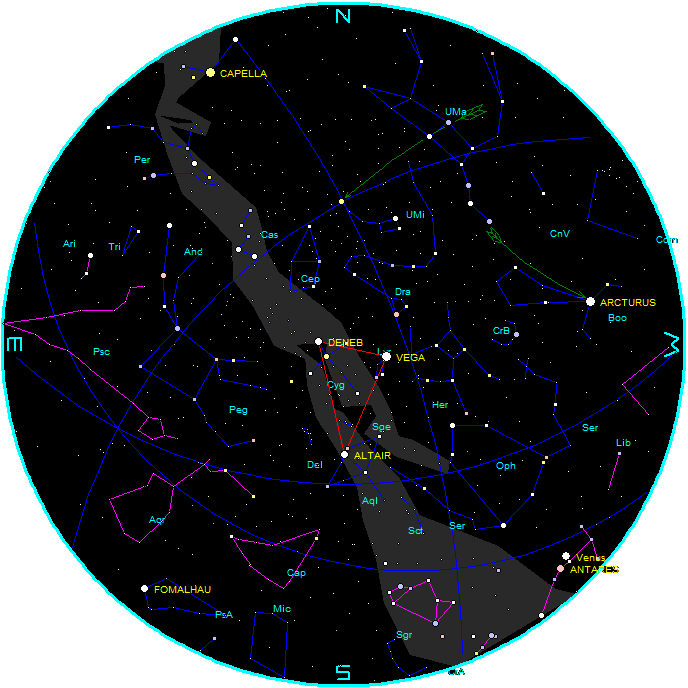
Star Chart for October 2014. Created using my LookingUp program.
The Moon is not plotted. The planets and stars are plotted for the 15th at 8 p.m. That is chart time.
Astronomical twilight ends at 9:00 p.m. on October 1st, decreasing to 8:11 on the 31st.
Add a half hour to the chart time every week before the 15th and subtract and hour for every week after the 15th.
For a list of constellation names to go with the abbreviations click here.
Also shown is the Summer Triangle in red. Clockwise from the top star is Deneb in Cygnus, Vega in Lyra and Altair in Aquila.
The green pointers from the Big Dipper are:
- Pointer stars at the front of the bowl of the Big Dipper point to Polaris the North Star.
- The arc of the dipper’s handle points to Arcturus.
Information on the total lunar eclipse on the 8th will be posted starting Monday October 6th.
09/25/2014 – Ephemeris – Capella rising
Ephemeris for Thursday, September 25th. The sun will rise at 7:33. It’ll be up for 12 hours and 1 minute, setting at 7:34. The moon, 1 day past new, will set at 8:13 this evening.
A bright star called Capella has slowly been rising in the northeastern sky in the evenings for the past few months. At 9 p.m. now it is low in the north-northeast far below the letter “W” shaped constellation of Cassiopeia. This winter Capella will be overhead the highest of winter’s seven brilliant first magnitude stars. Capella never quite sets for anyone north of Ludington. It is what is called a circumpolar star. Due to its brightness, and being the closest first magnitude star to the north pole, Capella appears to move slowly as the earth rotates, and spends summer and autumn evenings close to the horizon, and has in years past elicited a few phone calls and other queries about that ‘bright object in the northeast’. When it’s higher the rest of its constellation Auriga the Charioteer will be visible.
Times are for the Traverse City/Interlochen area of Michigan. They may be different for your location.
Addendum
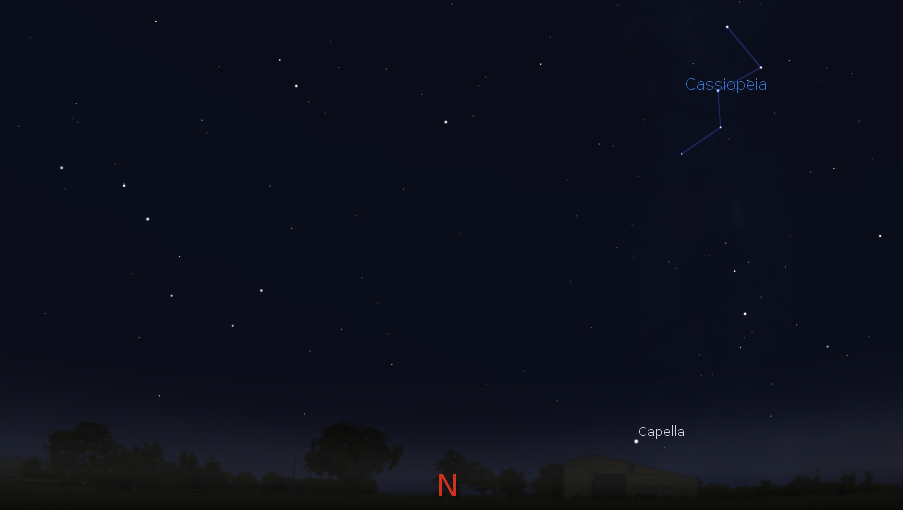
Capella cruising up from the north (thanks to the Earth’s rotation) on September 25 at 9 p.m. Created using Stellarium.
09/18/2014 – Ephemeris – The constellation Pegasus the aerobatic horse
Ephemeris for Thursday, September 18th. The sun will rise at 7:24. It’ll be up for 12 hours and 22 minutes, setting at 7:47. The moon, 3 days past last quarter, will rise at 3:02 tomorrow morning.
Rising in the east at as it gets dark around 9 p.m. can be found one of the great autumn constellations: Pegasus the flying horse of Greek myth. Its most visible feature is a large square of four stars, now standing on one corner. This feature, called the Great Square of Pegasus, represents the front part of the horse’s body. The horse is quite aerobatic, because it is seen flying upside down. Remembering that fact, the neck and head is a bent line of stars emanating from the right corner star of the square. Its front legs can be seen in a gallop extending to the upper right from the top star of the square. From the left star extend, not hind legs but the constellation of Andromeda, a fascinating constellation in its own right.
Times are for the Traverse City/Interlochen area of Michigan. They may be different for your location.
Addendum
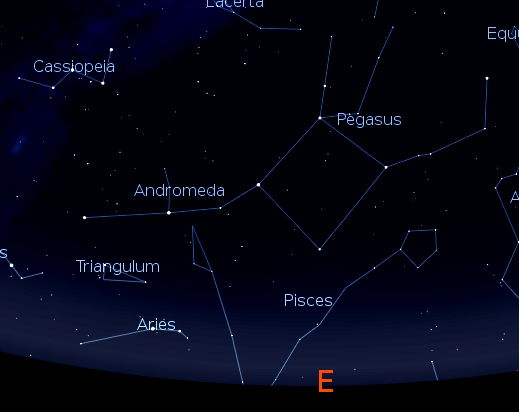
Pegasus at 9 p.m. Chart created using Stellarium.
 Bob Moler's Ephemeris Blog