Archive
09/15/2014 – Ephemeris – The mer-goat Capricornus
Ephemeris for Monday, September 15th. The sun will rise at 7:21. It’ll be up for 12 hours and 31 minutes, setting at 7:53. The moon, at last quarter today, will rise at 12:21 tomorrow morning.
Nearly 2000 years ago the southernmost of the constellations of the zodiac was Capricornus the water goat. That’s why the latitude on the earth where the sun is overhead on the winter solstice is called the Tropic of Capricorn. Not any more, Sagittarius, one constellation west and due south at 9 p.m., has that honor today. Actually Capricornus does need the press. It’s large, but made up of dim stars. To me it looks like a 45 degree isosceles triangle, long side up, but which all the sides are sagging. The constellation is found low in the south at 11 p.m. and tilted a bit from the upper right to the lower left. The image that is supposed to be represented by the stars is that of a goat whose hind quarters are replaced by a fish’s tail, not a mermaid but a mer-goat.
Times are for the Traverse City/Interlochen area of Michigan. They may be different for your location.
Addendum
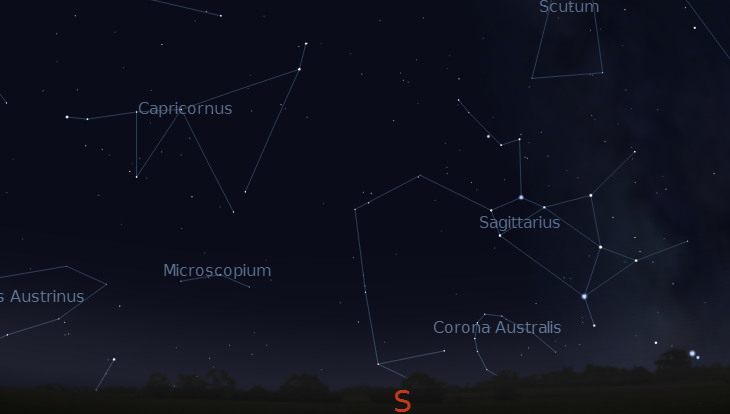
Capricornus as represented by Stellarium.
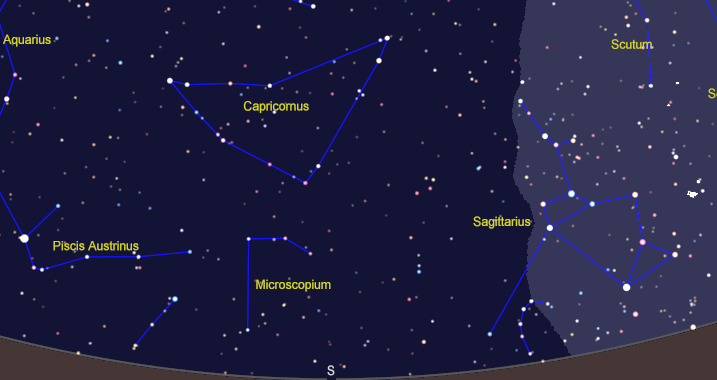
Capricornus the way I see it. Created using Cartes duCiel.
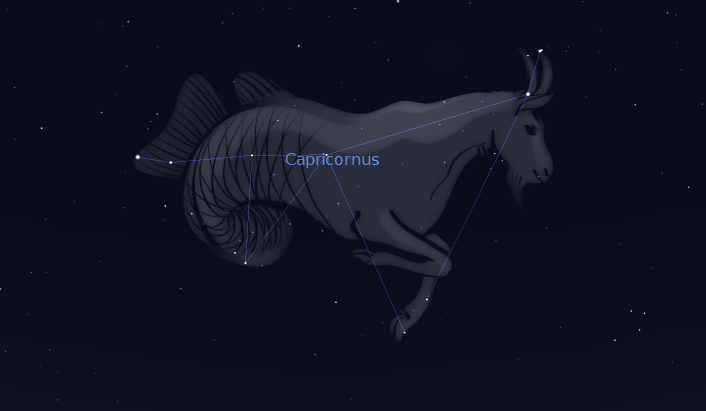
An artist’s rendering of Capricornus. A part of Stellarium’s functionality.
08/25/2014 – Ephemeris – Cool treasures in the constellation of Lyra
Ephemeris for Monday, August 25th. The sun rises at 6:56. It’ll be up for 13 hours and 34 minutes, setting at 8:31. The moon is new today, and won’t be visible.
The bright star Vega will be nearly overhead tonight at 10 p.m. It will be about 6 degrees south of the zenith. That’s quite a stretch of the neck to spot, with its accompanying stars in a small parallelogram that make up the constellation of Lyra the harp. Lyra has some interesting features for a serious observer with and without a telescope. The bottom right star of the parallelogram, if south is toward the bottom, is a star called Beta Lyrae that changes brightness by a factor of 3 in a period of 13 days. Another star near Vega looks like two close stars in binoculars, in telescopes each is again a double stars. That’s Epsilon Lyrae. The jewel of this constellation needs a telescope to find between the two bottom stars of the parallelogram, the famous Ring Nebula.
Times are for the Traverse City/Interlochen area of Michigan. They may be different for your location.
Addendum
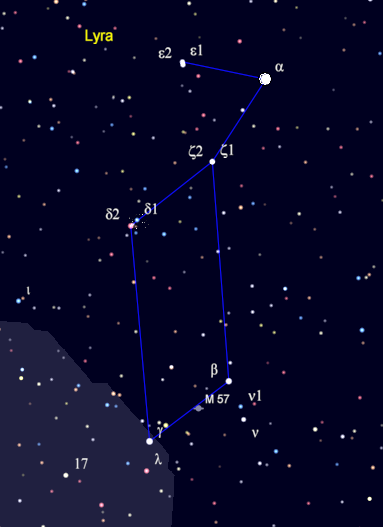
A bi more stars than what will be seen in binoculars of the constellation Lyra. Created using Cartes du Ciel (Sky Charts).
In the chart above:
The star designated α is Vega
The star designated β is Beta Lyrae
The stars designated ε1 and ε1 is Epsilon Lyrae
The object designated M57 is the Ring Nebula
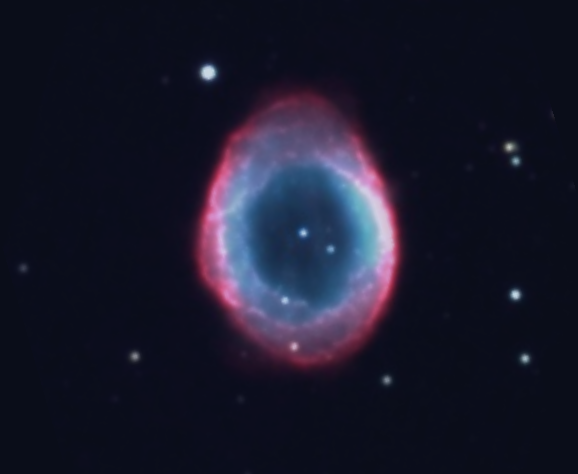
The Ring Nebula. Visually one cannot detect the color. It takes a large telescope to see the central star. Credit: Stellarium.
The Ring Nebula, AKA M57 by amateur astronomers, is a planetary nebula. The name planetary is a misnomer. Many of these objects look like the dim planets Uranus and Neptune. They are really stars like the sun, in their death throes puffing out their outer layers of gas at the end of their red giant stage. See below the latest image of the Ring Nebula I recently found on the Phil Plait’s Bad Astronomy Blog. It includes an explanation of what’s in the image.
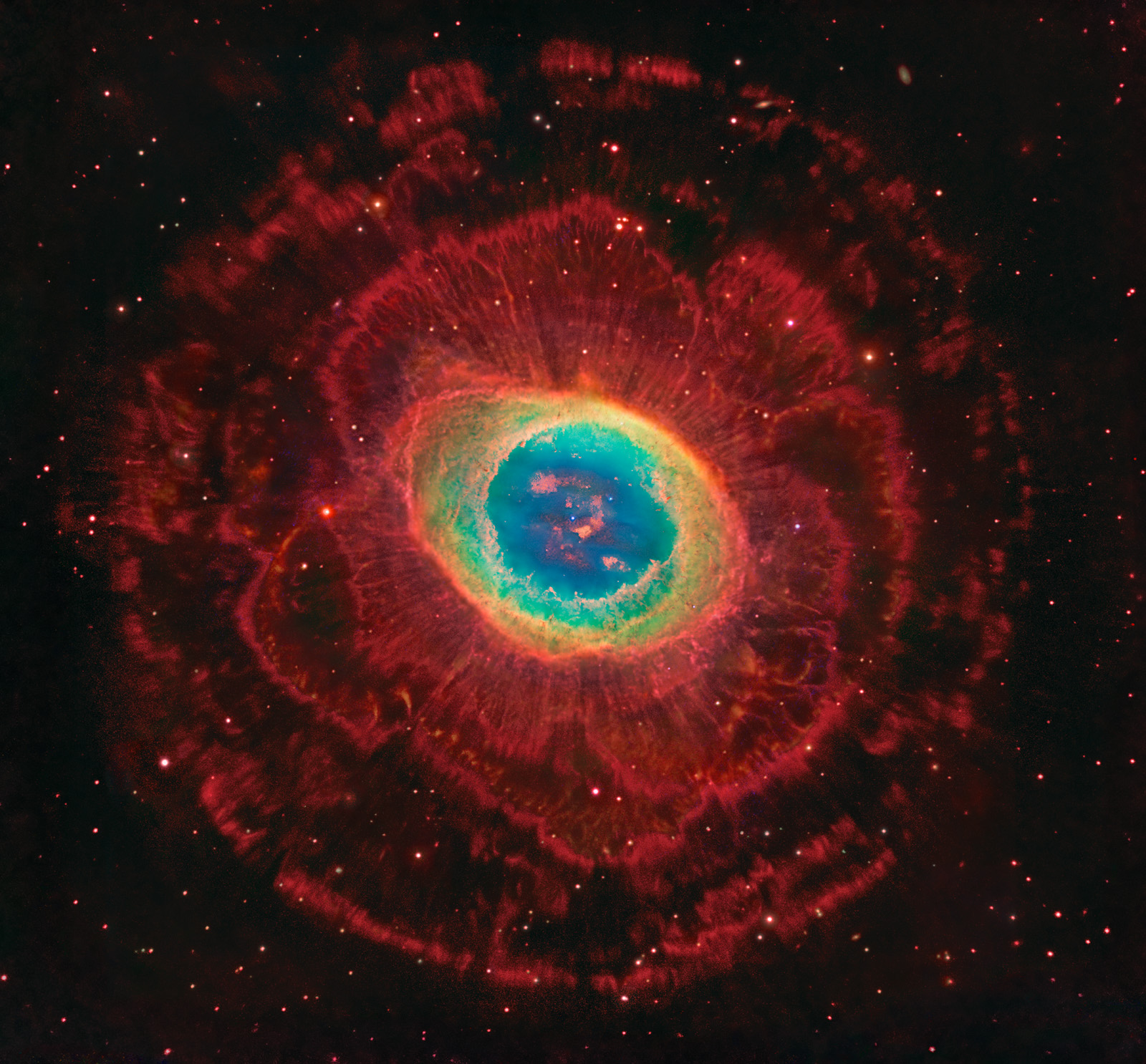
Photo by NASA, ESA, and C. R. O’Dell (Vanderbilt University) and Robert Gendler
Click on the image to get lost in the Ring Nebula!
08/22/2014 – Ephemeris – Cassiopeia Rising
Ephemeris for Friday, August 22nd. The sun rises at 6:53. It’ll be up for 13 hours and 43 minutes, setting at 8:36. The moon, 3 days before new, will rise at 5:08 tomorrow morning.
Now in the northeastern sky at 10 p.m. or later is the constellation of Cassiopeia the queen, which looks like, in its current orientation like the letter W. The Milky Way runs through it, if you trace the Milky Way from the zenith back to the northeast. The milky band isn’t as bright here as it is in the teapot shaped Sagittarius to the south. That’s because in looking to the south we are looking toward the star clouds of the dense spiral arm toward the center of the galaxy. In Cassiopeia, and in the winter sky, we are looking out to the less populated galactic arms farther out from the center of the Milky Way. Cassiopeia can be found using the Big Dipper. A line from the star Mizar at the bend of the handle of the dipper through Polaris points to Cassiopeia. Cassiopeia doesn’t set for us in northern Michigan.
Times are for the Traverse City/Interlochen area of Michigan. They may be different for your location.
Addendum
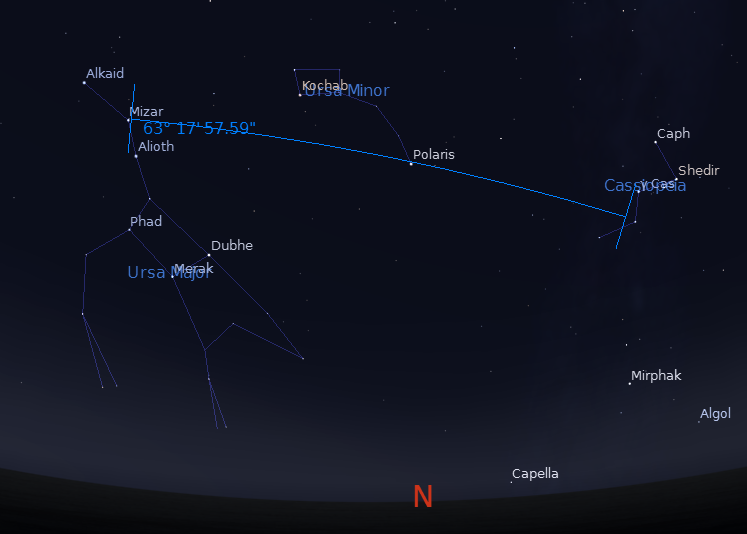
Finding Cassiopeia using the Big Dipper or Ursa Major at 10 p.m. August 22, 2014 using the angle measurement tool as a pointer. Created using Stellarium.
08/21/2014 – Ephemeris – What do a dolphin, an arrow and a coffin have in common?
Ephemeris for Thursday, August 21st. The sun rises at 6:52. It’ll be up for 13 hours and 46 minutes, setting at 8:38. The moon, half way from last quarter to new, will rise at 4:12 tomorrow morning.
Located below the eastern edge of the Summer Triangle of three of the brightest stars in the sky, which is high in the southeast in the sky at 10 p.m., is the tiny constellation of Delphinus the dolphin. Delphinus’ 6 stars in a small parallelogram with a tail, really does look like a dolphin leaping out of the water. The parallelogram itself has the name Job’s Coffin. The origin of this asterism or informal constellation is unknown. Of the dolphin itself: the ancient Greeks appreciated this aquatic mammal as we do, and told stories of dolphins rescuing shipwrecked sailors. There’s another tiny and slender constellation to the right of Delphinus called Sagitta the arrow, which is said to represent Cupid’s dart.
Times are for the Traverse City/Interlochen area of Michigan. They may be different for your location.
Addendum
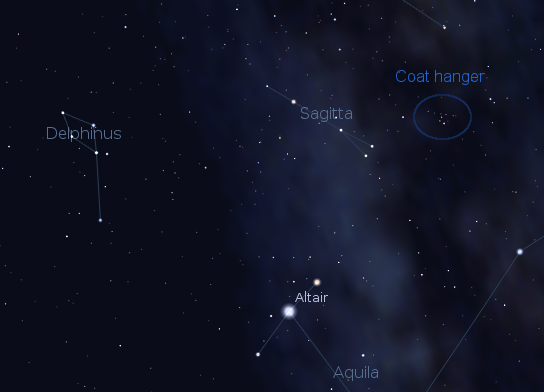
Delphinus, Sagitta and the Coat hanger. Diagram created using Stellarium.
The Coat hanger is strictly a binocular asterism. However it was discovered by the great Arabian astronomer Al Sufi inn the 10th century, and is currently designated Collinder 399. It is actually a random pattern of unrelated stars.
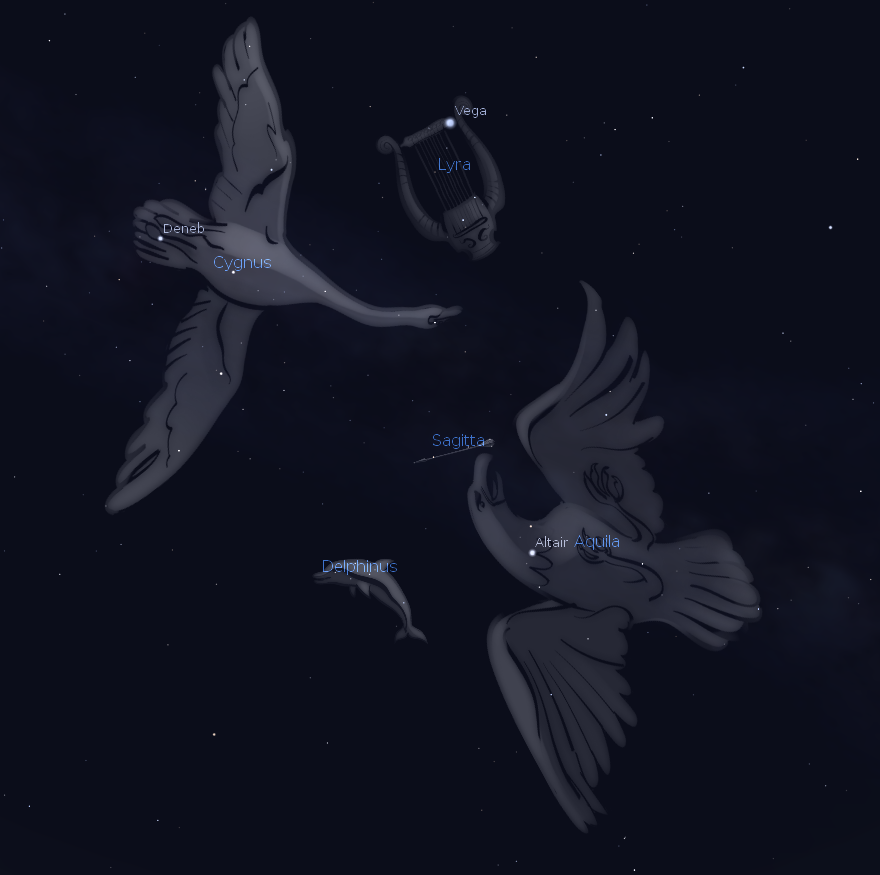
Delphinus and Sagitta images along with the stars and constellations of the Summer Triangle. Created using Stellarium.
08/19/2014 -Ephemeris – Scutum’s place in history
Ephemeris for Tuesday, August 19th. The sun rises at 6:49. It’ll be up for 13 hours and 51 minutes, setting at 8:41. The moon, 2 days past last quarter, will rise at 2:26 tomorrow morning.
Yesterday we took a look at the wonders in the constellation of Scutum the shield above the Teapot of Sagittarius and below Aquila the eagle. Scutum is the shield of John Sobieski the Polish king who stopped the advance of the Turks at Kalenberg in 1683. The Polish half of me is very proud. Scutum is one of two official constellations which are related to a real person. The other one is Coma Berenices, a hank of the Egyptian queen Berenice’s hair. However the stars here are so dim and embedded in the glow of the Milky Way as to be nearly impossible to discern. Scutum lies in one of the richest portions of the Milky Way, wonderful to scan with binoculars and telescopes for star clusters and nebulae or clouds of dust and gas.
Times are for the Traverse City/Interlochen area of Michigan. They may be different for your location.
Addendum
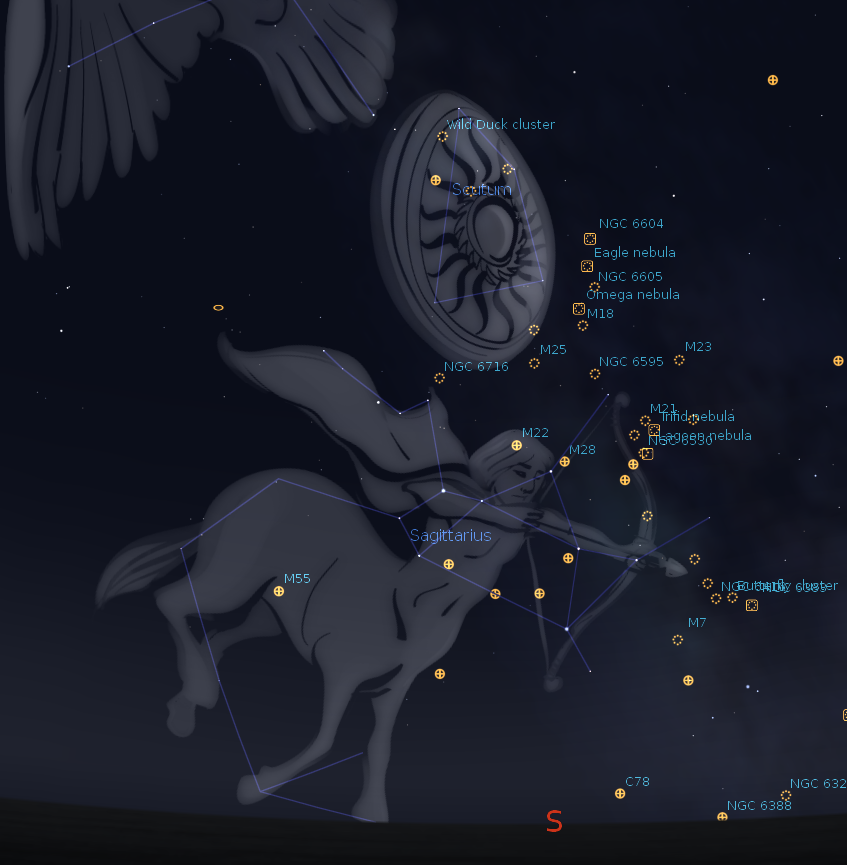
Binocular and telescope deep sky objects in Scutum and Sagittarius. Created using Stellarium.
08/18/2014 – Ephemeris – Scanning the Milky Way in Scutum
Ephemeris for Monday, August 18th. The sun rises at 6:48. It’ll be up for 13 hours and 54 minutes, setting at 8:43. The moon, 1 day past last quarter, will rise at 1:37 tomorrow morning.
The teapot pattern of stars that is the constellation of Sagittarius lies at the southern end of the Milky Way this evening. It appears that the Milky Way is steam rising from the spout. The area above Sagittarius in the brightest part of the Milky Way is the dim constellation of Scutum the shield. Don’t bother looking for the stars that make up the constellation; what’s important is the star clouds of the Milky Way. Scan this area with binoculars or small telescope for star clusters and nebulae or clouds of gas. In binoculars both clusters and nebulae will appear fuzzy, but a small telescope will tell most of them apart. Even if you’ve never been able to find anything in your telescope, use your lowest power and scan.
Times are for the Traverse City/Interlochen area of Michigan. They may be different for your location.
Addendum
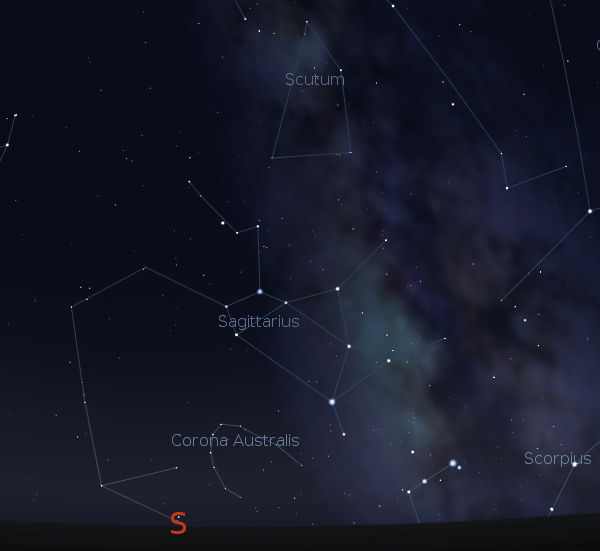
The constellations Sagittarius and Scutum. Created using Stellarium.
07/29/2014 – Ephemeris – The celestial Teapot
Ephemeris for Tuesday, July 29th. The sun rises at 6:25. It’ll be up for 14 hours and 45 minutes, setting at 9:11. The moon, 3 days past new, will set at 10:14 this evening.
The Milky Way runs from north to south through the heavens at 11 p.m. You’ll notice that the Milky Way is brighter and broader just above the horizon in the south. In that glow in the south is a star pattern that looks like a stout little teapot, with a bright stream of the Milky Way rising from the spout, which faces the west. This pattern of stars is the major part of the constellation called Sagittarius. According to Greek mythology Sagittarius is a centaur with a bow and arrow poised to shoot Scorpius the scorpion to the right. This centaur is called Chiron, the most learned of the breed, centaurs usually being a rowdy bunch. The center of the pin wheel of our Milky Way galaxy lies hidden beyond the stars and clouds above the spout of the teapot.
Times are for the Traverse City/Interlochen area of Michigan. They may be different for your location.
Addendum
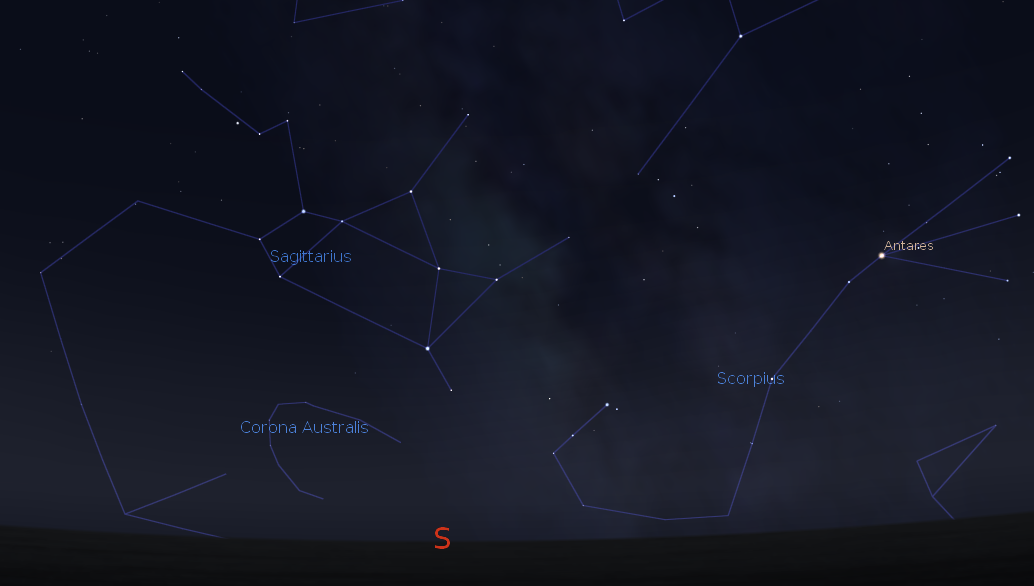
Sagittarius and Scorpius. Created using Stellarium.
Binocular and telescope deep sky objects in Scutum and Sagittarius. Created using Stellarium.
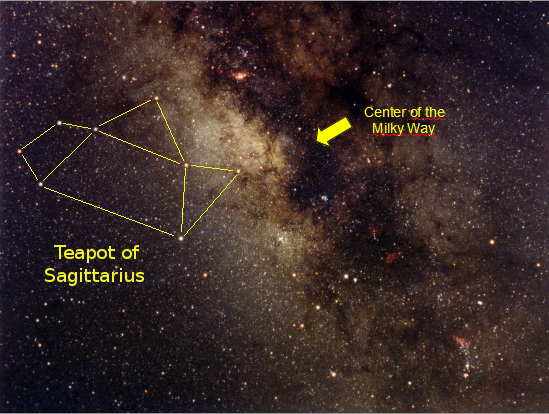
Location of the center of the Milky Way and the Teapot of Sagittarius.
07/21/2014 – Ephemeris – The celestial eagle: Aquila
Ephemeris for Monday, July 21st. Today the sun will be up for 15 hours and 2 minutes, setting at 9:19. The moon, 3 days past last quarter, will rise at 2:52 tomorrow morning. Tomorrow the sun will rise at 6:18.
Aquila the eagle is a constellation that lies in the Milky Way. It’s in the southeastern sky as it gets dark. Its brightest star, Altair is one of the stars of the Summer Triangle, a group of three bright stars dominating the eastern sky in the evening now. Altair, in the head of the eagle, is flanked by two slightly dimmer stars, the shoulders of the eagle. The eagle is flying northeastward through the Milky Way. Its wings are seen in the wing tip stars. A curved group of stars to the lower right of Altair is its tail. Within Aquila the Milky Way shows many dark clouds as part of the Great Rift that splits it here. The other summer bird is Cygnus the swan above and left of Aquila, flying in the opposite direction.
Times are for the Traverse City/Interlochen area of Michigan. They may be different for your location.
Addendum
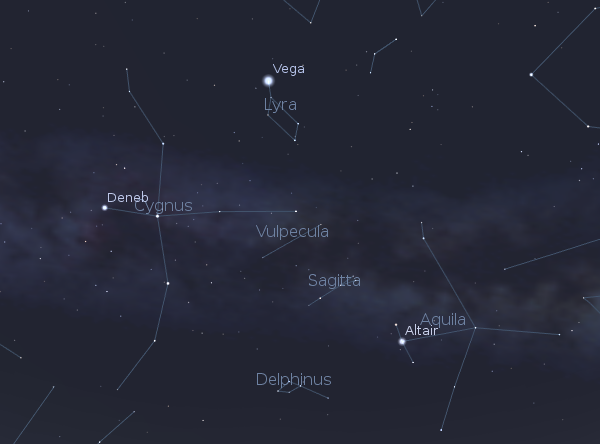
Deneb with the other stars and constellations in the Summer Triangle. Created using Stellarium.
07/18/2014 – Ephemeris – Deneb is the brightest star of the Summer Triangle… Really
Ephemeris for Friday, July 18th. Today the sun will be up for 15 hours and 8 minutes, setting at 9:22. The moon, at last quarter today, will rise at 12:58 tomorrow morning. Tomorrow the sun will rise at 6:15.
At 11 this evening the bright star Deneb in Cygnus the swan will be moderately high in the east northeast. Deneb is the dimmest star of the summer triangle. Of the other stars of the triangle, Vega is nearly overhead, and Altair to the southeast. While Deneb’s apparent magnitude, or brightness as seen from Earth, makes it the dimmest of the three bright stars, Deneb has a vast distance of possibly 1,550 light years. If brought as close as Vega, Deneb would be several times brighter than Venus. For all this it is only 13-20 times the mass of the sun. It will have an extremely short life and will explode, go supernova, in perhaps a few million years. Closer to home, check out the Sun at Kingsley Heritage Days This Saturday and Sunday.
Times are for the Traverse City/Interlochen area of Michigan. They may be different for your location.
Addendum
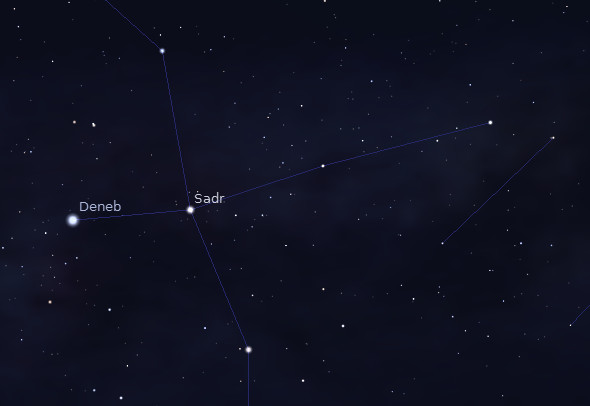
Deneb and the Northern Cross section of Cygnus the swan. Created using Stellarium.
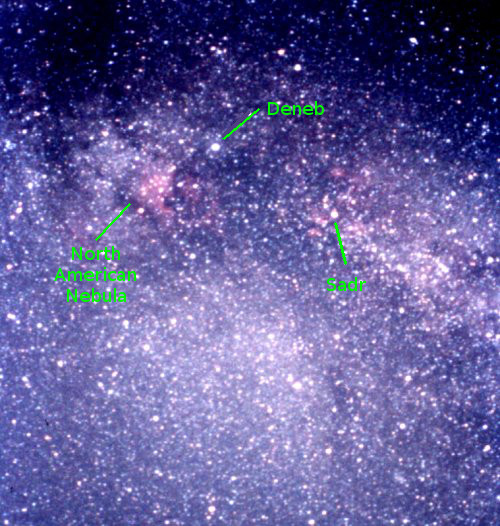
One of my old photographs of Deneb and the North American Nebula digitized from a slide.
The North American Nebula, visible as a faint smudge in binoculars or the naked eye may be ionized and illuminated by Deneb. It’s distance appears to be comparable to that of Deneb.
You may note that previous postings about Deneb over the years have given different distances of Deneb. That just denotes how difficult it is to pin down its distance.
07/17/2014 – Ephemeris – The constellation Cygnus the swan
Ephemeris for Thursday, July 17th. Today the sun will be up for 15 hours and 10 minutes, setting at 9:23. The moon, 1 day before last quarter, will rise at 12:25 tomorrow morning. Tomorrow the sun will rise at 6:14. | Fairly high in the east at 11 p.m. Is the constellation of Cygnus the swan, flying south through the Milky Way. It is also called the Northern Cross. At the left, the tail of the swan or the head of the cross is the bright star Deneb, one of the stars of the Summer Triangle. The next star right is Sadr the intersection of the body and the wings of the swan seen in flight, or the intersection of the two pieces of the cross. There are two or three stars farther to the right that delineate the swan’s long neck or upright of the cross, that ends with the star Alberio in the beak of the swan or foot of the cross. The crosspiece of the cross extends to the stars on either side of the intersection star Sadr, while the swan’s wings extend to a couple more stars each.
Times are for the Traverse City/Interlochen area of Michigan. They may be different for your location.
Addendum
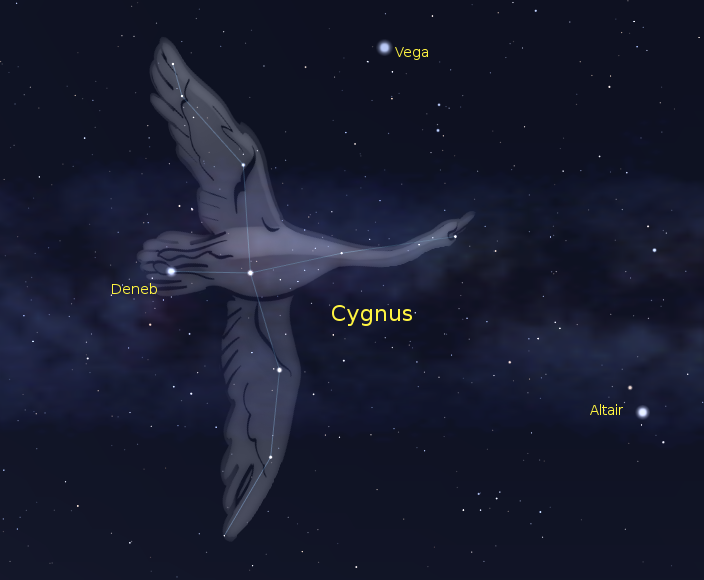
CygnusTheSwan Created using Stellarium.
 Bob Moler's Ephemeris Blog