Archive
01/21/2014 – Ephemeris – Orion’s hunting dogs
Ephemeris for Tuesday, January 21st. The sun will rise at 8:11. It’ll be up for 9 hours and 24 minutes, setting at 5:36. The moon, 3 days before last quarter, will rise at 11:23 this evening.
The great winter constellation or star group Orion the Hunter, is located in the south-southeastern sky at 9 p.m. His elongated rectangle of a torso is almost vertical. In the center of the rectangle are three stars in a line that make his belt. As a hunter, especially one of old, he has two hunting dogs. The larger, Canis Major can be found by following the three belt stars of Orion down and to the left. There lies the brilliant star called Sirius, also known as the Dog Star. It’s in the heart of a stick figure dog facing Orion that appears to be begging. The smaller dog can be found by extending a line through Orion’s shoulder stars to the left. We find a bright star called Procyon. It and one other star make up the hot-dog shaped constellation of Canis Minor, the little dog.
Times are for the Traverse City/Interlochen area of Michigan. They may be different for your location.
Addendum
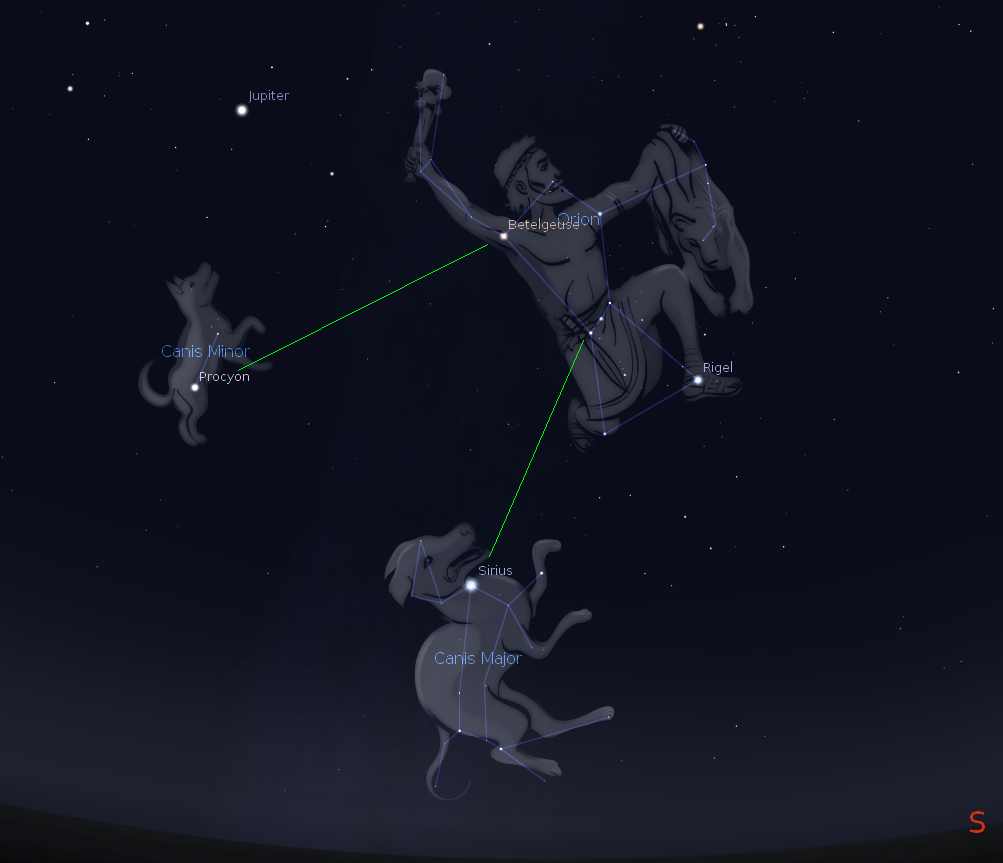
Orion and his hunting dogs with pointers as seen at 9 p.m. on January 21, 2014. Created using Stellarium.
12/30/2013 – Ephemeris – The tale of Gemini the twins
Ephemeris for Monday, December 30th. The sun will rise at 8:19. It’ll be up for 8 hours and 52 minutes, setting at 5:11. The moon, 2 days before new, will rise at 7:09 tomorrow morning.
The constellation Gemini, the Twins is visible in the east at 9 p.m. with the bright planet Jupiter interloping against its stars. The namesake stars of the two lads, will be on the left end of the constellation, nearly vertically aligned. Castor is on top, while Pollux, a slightly brighter star is on the bottom. Lines of stars from Castor and Pollux to the right delineate the lads. In Greek mythology Castor and Pollux were twins, and half brothers, Castor was fathered by a mere mortal, while Pollux was fathered by Zeus in the famous Leda and the swan affair. The brothers, however were inseparable, and when Castor was killed during the quest for the Golden Fleece, Pollux pleaded with Zeus to let him die also. Zeus placed them together in the sky forever.
Times are for the Traverse City/Interlochen area of Michigan. They may be different for your location.
Addendum
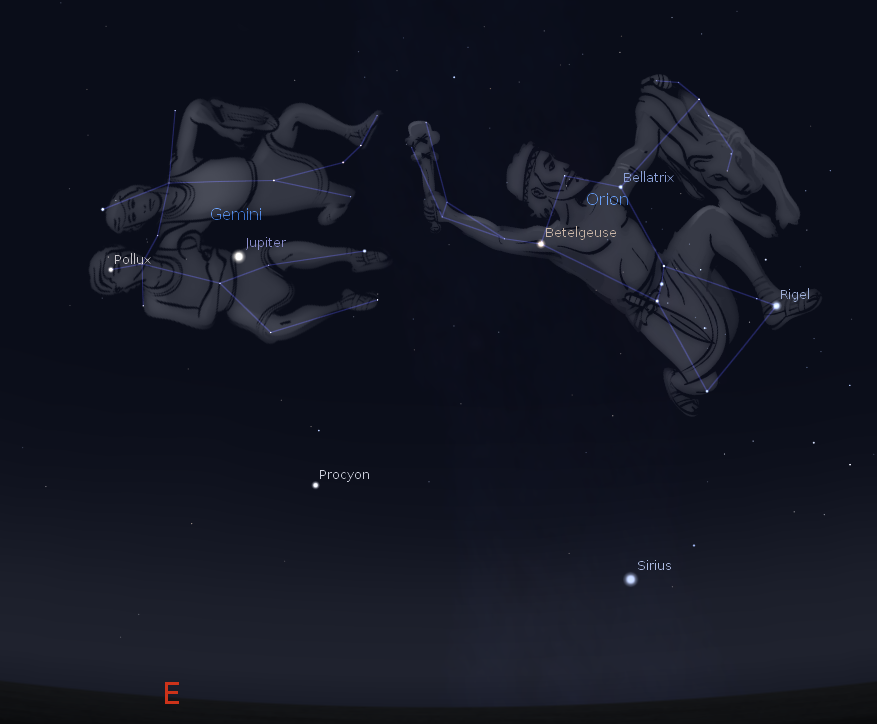
Gemini with Jupiter and Orion near by at 9 p.m. on December 30, 2013. Created using Stellarium.
12/27/2013 – Ephemeris – The star Procyon: “Before the Dog”
Ephemeris for Friday, December 27th. The sun will rise at 8:18. It’ll be up for 8 hours and 50 minutes, setting at 5:08. The moon, 2 days past last quarter, will rise at 3:48 tomorrow morning.
Yesterday I talked about the brilliant star Sirius, the dog star pointed to by the stars of the belt of Orion. Today we’ll look at another dog star. Procyon, the bright star in Canis Minor, the lesser dog. It is pointed to by the top two stars in the Orion rectangle Bellatrix and Betelgeuse. One of the translations of Procyon means “Before the Dog”. This seemingly odd title is explained that even though Procyon is east of Sirius and all things being equal, well at least latitude or declination the eastern star should rise after the western star. However Procyon is north of Sirius and if one is sufficiently north of the equator, the eastern most star can rise first. This is what happens. Procyon is a bit farther away than Sirius and isn’t quite as bright either.
Times are for the Traverse City/Interlochen area of Michigan. They may be different for your location.
Addendum
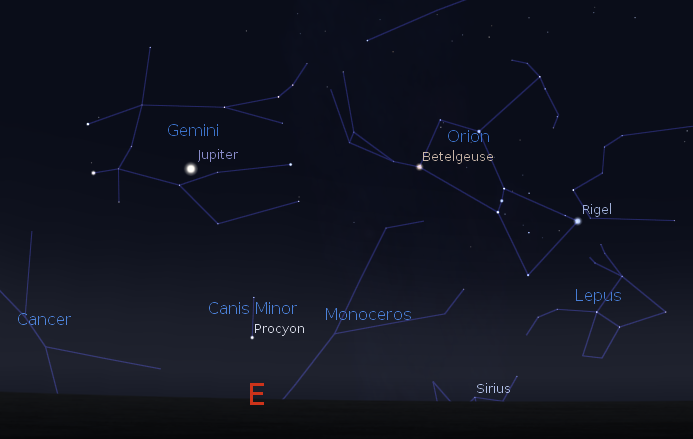
Procyon is already up as Sirius rises. Procyon also sets after Sirius. Created using Stellarium.
Note: Stellarium approximates atmospheric extinction, that is dims objects when they are near the horizon an effect due to looking through more of the Earth’s atmosphere when looking close to the horizon. That’s why Sirius looks rather fainter than in yesterday’s image.
12/26/2013 – Ephemeris – Sirius, the brightest night-time star
Ephemeris for Thursday, December 26th. The sun will rise at 8:18. It’ll be up for 8 hours and 49 minutes, setting at 5:08. The moon, 1 day past last quarter, will rise at 2:40 tomorrow morning.
At 9 in the evening the great constellation of Orion the hunter can be seen in the southeast. Its large rectangle of bright stars is tilting to the left, while in the center is a row of three stars, his belt. These stars tilt downward and a bit to the left to a very bright star merrily twinkling above the horizon in the southeast. This star is called Sirius, also known as the Dog Star because it’s in the heart of Orion larger hunting dog, Canis Major. It is an arc light white star as seen in binoculars or telescope. It’s a neighboring star, just twice the distance of the closest star to the sun at 8.6 light years. It’s name, Sirius, has nothing to do with a dog, but is from the Greek meaning scorching for its brightness or sparkling, due to its intense twinkling.
Times are for the Traverse City/Interlochen area of Michigan. They may be different for your location.
Addendum
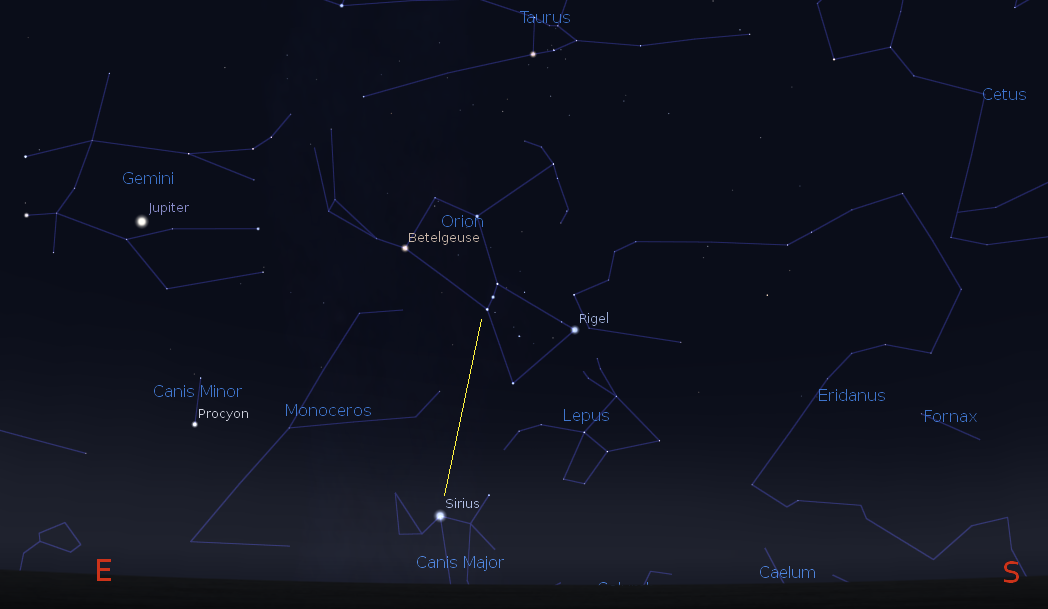
How to find Sirius from Orion. 9 p.m., December 26, 2013. Created using Stellarium.
12/23/2013 – Ephemeris – The constellation Orion: The hard luck hero
Ephemeris for Monday, December 23rd. The sun will rise at 8:17. It’ll be up for 8 hours and 49 minutes, setting at 5:06. The moon, 2 days before last quarter, will rise at 11:29 this evening.
The large and bright constellation of Orion is now in the southeast at 9 p.m. It is seen as an upright rectangle of bright stars tilting to the left, his shoulders and knees, with a belt of three stars in the center. Orion is a minor character in Greek mythology, much less celebrated than Hercules, which has a dim constellation named for him. Orion was a hunter. He had an ill-fated romance with Merope, whose father King Oenopion, had him blinded. After having his sight restored, Orion became a companion of Diana goddess of the hunt and they wanted to marry. Apollo, Diana’s brother disapproved of Orion also and was able to trick Diana into accidentally killing Orion with her bow. Another story had Orion dying of a scorpion sting.
Times are for the Traverse City/Interlochen area of Michigan. They may be different for your location.
Addendum
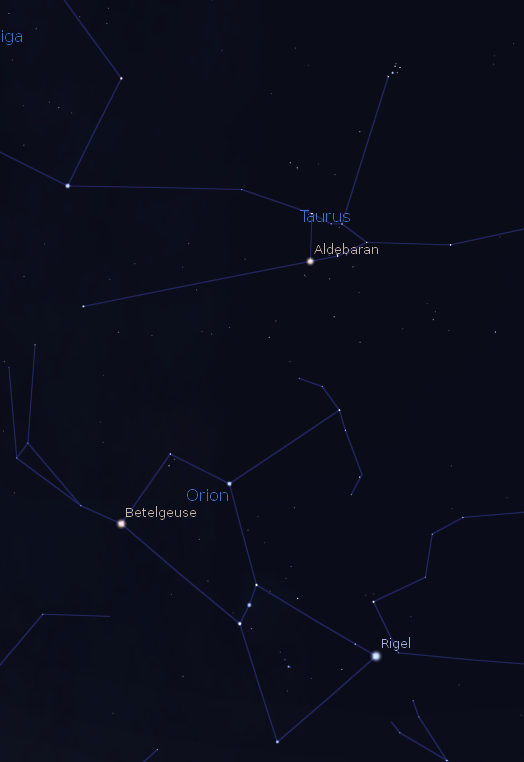
Taurus and Orion with Orion’s brightest stars named. Created using Stellarium.
12/16/2013 – Ephemeris – Orion’s bright blue-white star Rigel
Ephemeris for Monday, December 16th. The sun will rise at 8:13. It’ll be up for 8 hours and 49 minutes, setting at 5:03. The moon, 1 day before full, will set at 8:07 tomorrow morning.
Last week I talked about the star Betelgeuse the bright red star in the top left of Orion’s rectangle in the hunter’s shoulder. Orion is seen in the southeast at 9 in the evening. The blue-white star in Orion’s opposite corner is usually brighter. It is Rigel whose longer Arabic name of which Rigel is the first part means Left Leg of the Giant. Rigel is a giant itself, actually a super giant star, which is more a measure of its mass than its size, that of 17 solar masses. Its surface temperature is more than twice as hot as the sun. It is 130 thousand times as bright as the sun and 74 times its diameter. Its distance is around 860 light years. A telescope might reveal a close companion star to Rigel, off the edge of the bright arc light image of Rigel itself.
Times are for the Traverse City/Interlochen area of Michigan. They may be different for your location.
Addendum
Taurus and Orion with Orion’s brightest stars named. Created using Stellarium.
12/10/2013 – Ephemeris – The bright star Aldebaran, the Follower
Ephemeris for Tuesday, December 10th. The sun will rise at 8:08. It’ll be up for 8 hours and 53 minutes, setting at 5:02. The moon, 1 day past first quarter, will set at 2:18 tomorrow morning.
The central constellation of winter, Orion, is in the east southeast at 9 p.m. Above it is Taurus the bull. The bright orange star in Taurus is Aldebaran. Aldebaran appears at the lower left tip of a letter V group of stars lying on its side that is the face of the bull. Aldebaran isn’t actually part of the group, called the Hyades star cluster. The cluster is about 153 light years away, while Aldebaran is 65. The star has an orange hue because its surface is cooler than the sun’s. However Aldebaran is 44 times larger in diameter, and shines 465 times brighter than the sun. The name Aldebaran means “Follower” because it follows the Pleiades star cluster through the skies. The Pleiades is above right of Aldebaran.
Times are for the Traverse City/Interlochen area of Michigan. They may be different for your location.
Addendum
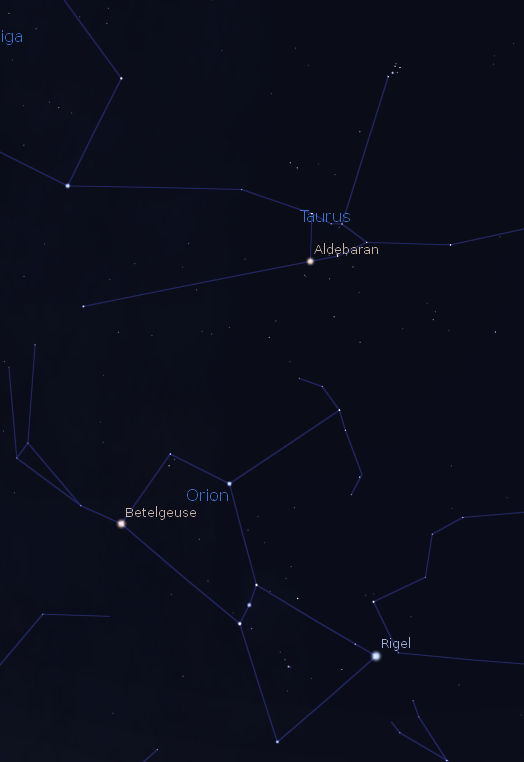
Aldebaran, the Hyades, of Taurus, Orion and the Pleiades at 10 p.m. December 10, 2013. Created using Stellarium.
12/09/2013 – Ephemeris – The bright star Capella, the she-goat
Ephemeris for Monday, December 9th. The sun will rise at 8:07. It’ll be up for 8 hours and 54 minutes, setting at 5:02, the earliest sunset of the year. The moon, at first quarter today, will set at 1:12 tomorrow morning.
A bright star called Capella is now high in the east. Capella is the farthest north of winter’s seven brilliant first magnitude stars. Capella never quite sets for anyone north of Ludington. Due to its brightness, and being the closest first magnitude star to the pole, Capella appears to move slowly as the earth rotates, and spends summer and autumn evenings close to the horizon and is a reminder that winter’s not far away. It has in years past elicited a few phone calls and other queries about that ‘bright object in the northeast’. Capella belongs to the pentagonal constellation of Auriga the Charioteer. Capella represents a mother goat he is holding. Three stars in a thin triangle nearby to the star’s right are her kids.
Times are for the Traverse City/Interlochen area of Michigan. They may be different for your location.
Addendum
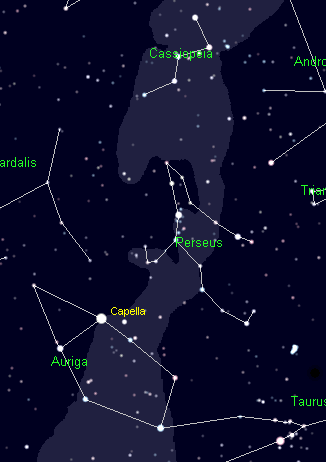
The Constellations Cassiopeia, Perseus and Auriga. Created using Cartes du Ciel
Note the small slender triangle of stars under the “p” in Capella. That’s the Kids, an asterism or informal constellation.
12/05/2013 – Ephemeris – The constellation Taurus the bull
Ephemeris for Thursday, December 5th. The sun will rise at 8:03. It’ll be up for 8 hours and 58 minutes, setting at 5:02. The moon, 3 days past new, will set at 8:27 this evening.
Early in the evening the moon will appear above the bright planet Venus in the southwest. Low in the east at 9 p.m. is the constellation of Orion the giant hunter. Above him is Taurus the bull. His face is a letter V shape of stars lying on its side with the bright orange-red star Aldebaran at the bottom tip of the V as its angry blood-shot eye. Orion is depicted in the sky facing with club in one hand and a shield in the other the approaching and in some depictions charging Taurus. The V of stars is a star cluster called the Hyades. The Pleiades are in his shoulder above. Taurus in Greek mythology was the guise the god Zeus when he carried off the maiden Europa. Europa’s still with him, sort of, as the intriguing satellite orbiting Zeus’ Roman equivalent Jupiter.
Times are for the Traverse City/Interlochen area of Michigan. They may be different for your location.
Addendum
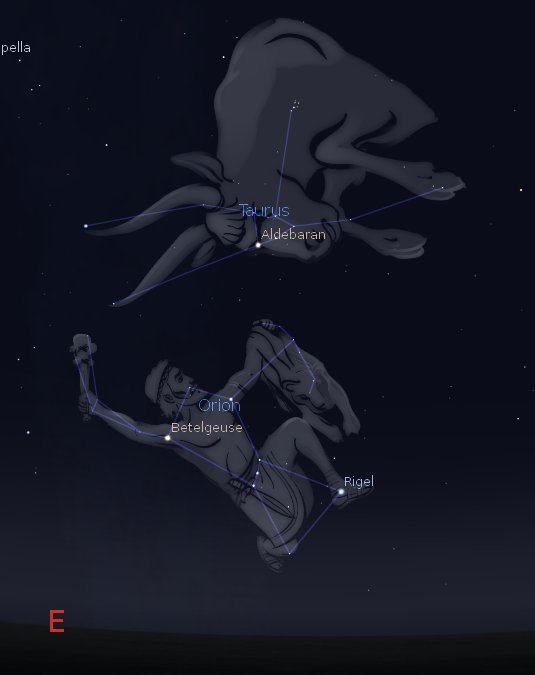
Taurus and Orion in the east at 9 p.m, December 5, 2013. Created using Stellarium.
12/03/2013 – Ephemeris – Orion rises
Ephemeris for Tuesday, December 3rd. The sun will rise at 8:01. It’ll be up for 9 hours and 1 minute, setting at 5:03. The moon, 1 day past new, will set at 6:07 this evening.
At 9 p.m. the constellation of Orion the giant hunter will be rising in the east southeast, with its belt stars nearly vertically aligned. The belt stars are contained within a tilted rectangle of four bright stars that’s leaning to the left. The brightest of the top stars is Betelgeuse a bright red star about the hue of the planet Mars. It’s a huge red giant star. Both top stars are Orion’s shoulders. The other shoulder star is Bellatrix. The bottom stars are Orion’s knees. The brightest, diagonally opposite from Betelgeuse is Rigel, a bright blue-white giant star. The other knee star is named Saiph. Orion is home to a beautiful nebula or cloud of gas, which we’ll explore later this winter. Jupiter is the bright stellar looking object to the left of Orion.
Times are for the Traverse City/Interlochen area of Michigan. They may be different for your location.
Addendum
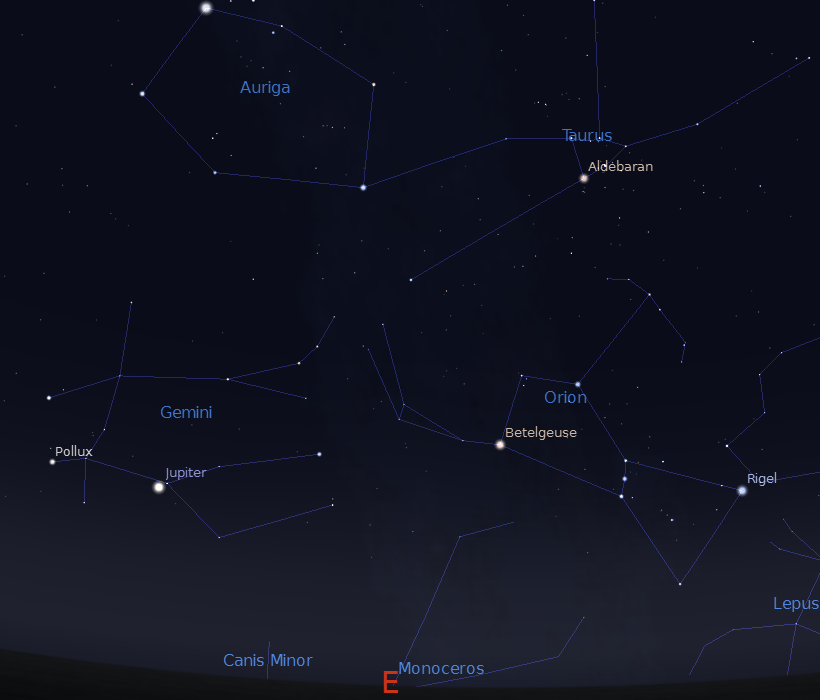
Orion Rising and other winter constellations at 9 p.m. December 3, 2013. Created using Stellarium
 Bob Moler's Ephemeris Blog